Categories
Living in Society

Community Volunteer

Trail walking on Nov. 22, 2025.

When I became an adult, married, and settled into steady work, it was assumed I would volunteer in the community. The volunteer impulse has its roots in the industrial period after the Civil War. People used less time to produce enough money with which to live our lives. In more modern terms, we could pay for things like our child’s college education without sacrificing a lot at home.

Perhaps the most prominent example was the robber baron Andrew Carnegie whose expansion of the steel industry made him one of the richest Americans and enabled his philanthropy to fund a number of public libraries, among other things. “The duty of the man of wealth,” Carnegie said, is “to consider all surplus revenues which come to him simply as trust funds, which he is called upon to administer . . . in the manner which, in his judgment, is best calculated to produce the most beneficial results for the community.”

I didn’t have “surplus revenues,” yet worked in jobs that created enough money to pay basic living expenses with a bit leftover. While there were limits on potential income, I was afforded regular free time and expected to use some of it to volunteer in the community. My volunteerism really took off when we moved to Big Grove Township.

I differentiate the types of volunteer work I have done since 1993. There is community work: membership on the home owners association board, election as a township trustee, and serving on the board of a senior citizen’s group. There is also what I call advocacy work: serving on the boards of peace-related organizations, politics, and two different county boards. Each had something to contribute to society. I talk about community volunteer work in the rest of this post.

Within the first year we were in our new home in Big Grove Township, I was asked to join the volunteer home owners association board and did. Any monetary considerations were insignificant. A regular person does not volunteer in the community for money. Part of living a sustainable life in rural areas is contributing to the general well-being, I believed. I felt blessed and had to give back to the community in which I lived.

Home owners’ associations get a bad rap. In our case, we managed the association like a small city. We provided a public water system, sanitary sewer district, road maintenance, refuse hauling, and real estate sales and purchases. Over time, we upgraded the roads from chip and seal to asphalt, dealt with changing government standards related to arsenic in drinking water, reduced the number of wells from three to one, complied with changing Iowa Department of Natural Resources standards for wastewater treatment plant effluent, handled a lawsuit, and coordinated activities like road use and maintenance with neighboring associations. If the board doesn’t do these things, they don’t get done. Everyone is the better for such volunteer boards. I served, off and on, for over 30 years. This was the beginning of a long period of volunteering in the community.

In 2012, when only one candidate was running for two township trustee positions, I ran a write-in campaign and won the election. Being a township trustee included managing emergency response and a volunteer fire department with other townships and the nearby city of Solon. Toward the end of my tenure, we formed a new entity to manage these functions. We maintained the local cemetery and supervised a pioneer cemetery where the first person to die in the township was buried. This work helped me understand how tax levies work and how they were used to support things the county did not, things like a small fire department or saving someone’s life in an emergency. There was only a single conflict during my time as a trustee, about the main cemetery. All the trustees showed up at the cemetery to resolve a dispute over a burial plot. No one wanted the job of township trustee and someone had to do it, so I stepped up.

When the local senior citizen’s group had an opening on their board, I volunteered and became its treasurer. This lasted about two years and provided insight into this segment of the community. Everything we did, from providing community meals, to giving home-bound people rides to medical appointments, to arranging outings around eastern Iowa, served an often-neglected segment of the population. It was a great opportunity to learn about the life of our senior citizens before I became one myself.

I am satisfied this activism did some good. I still believe it is important to stay engaged in the community.
Categories
Living in Society

Travel Day

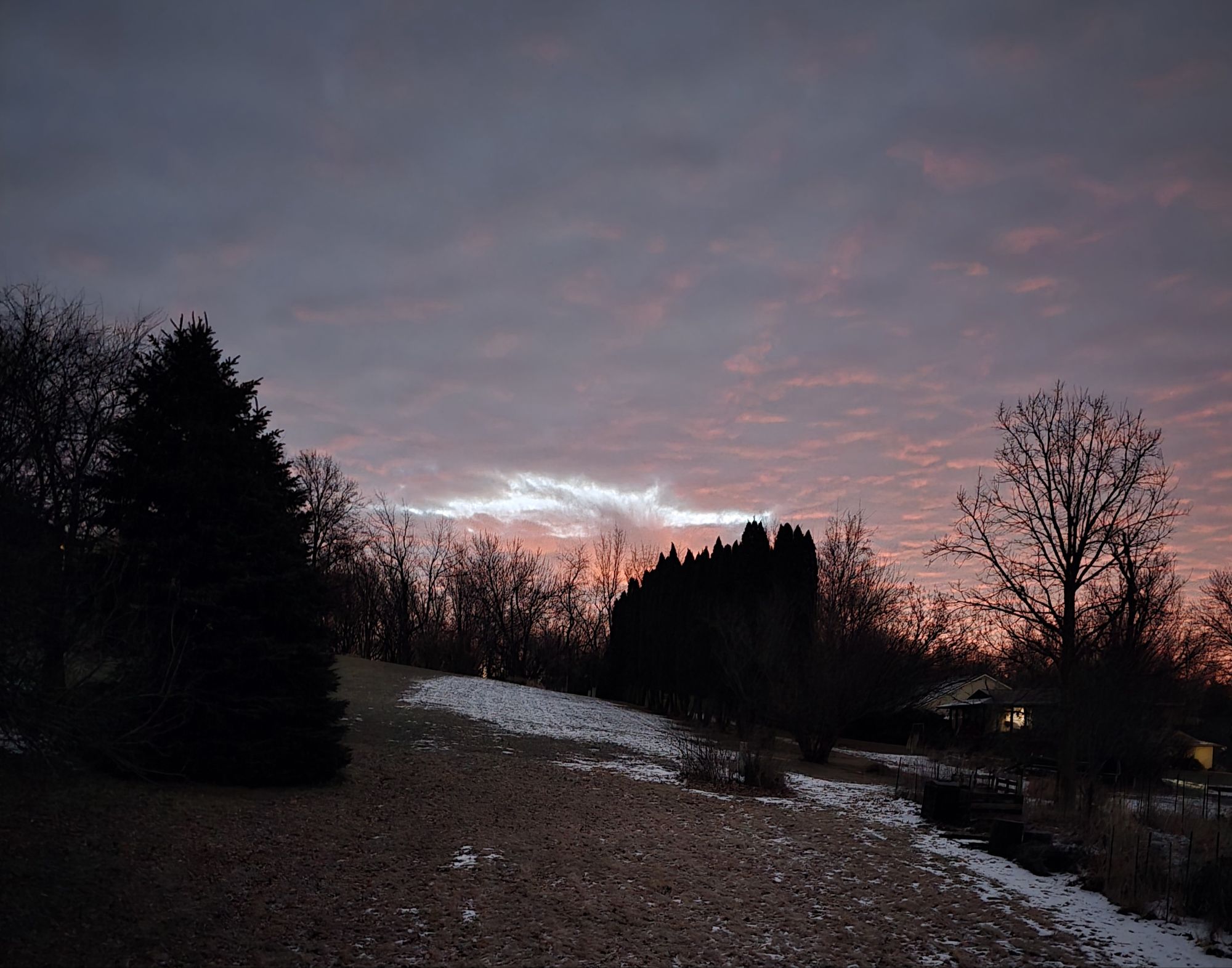
Morning light show.

Just posting this photo today while I use windshield time to wonder.

Categories
Living in Society

On the Trail to a Selfie

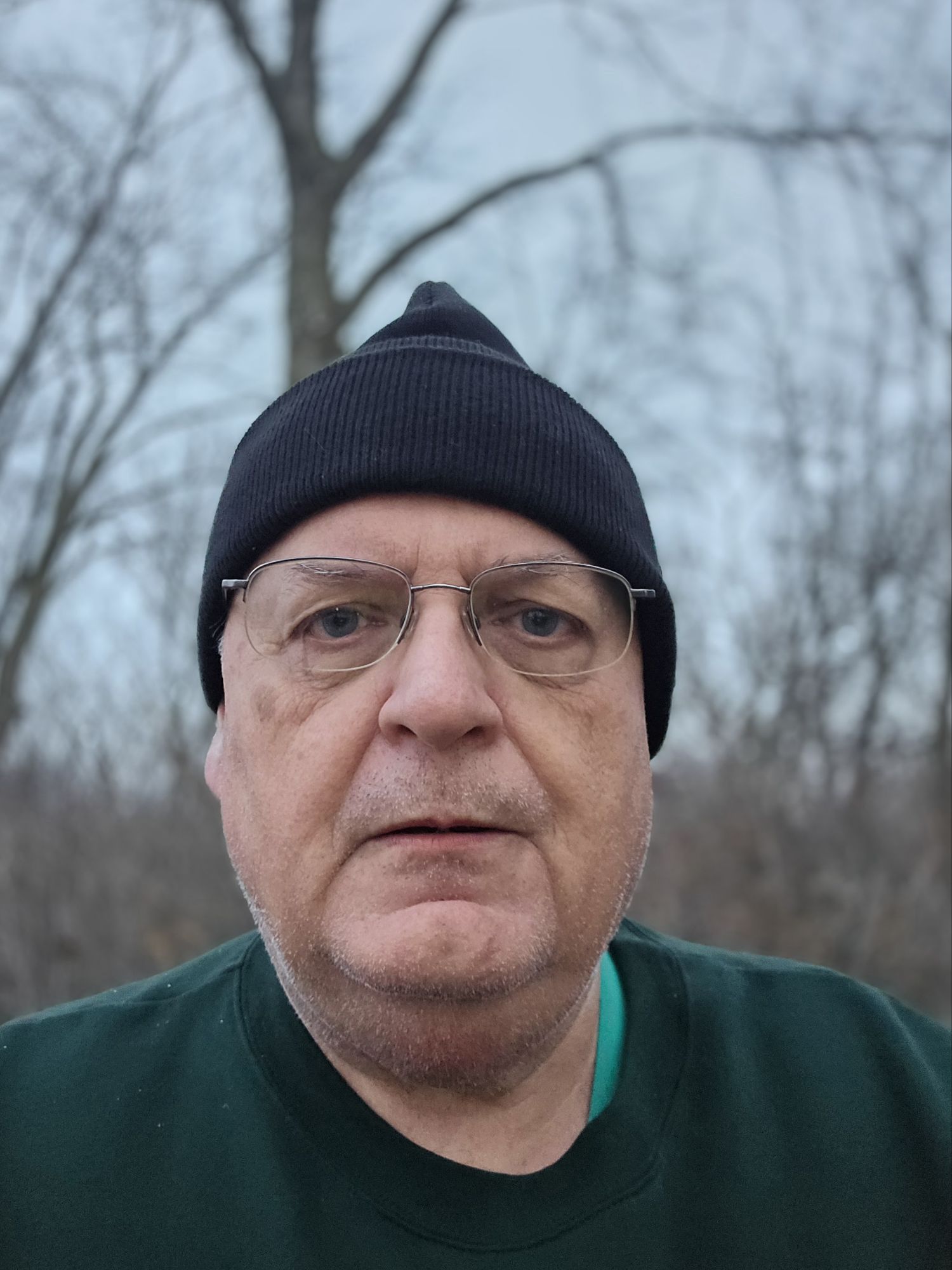
December 2024 selfie.

This is the face of a man trying to understand how his Android camera works. The background on the state park trail was planned. The green sweatshirt is my standard winter uniform, although I own sweatshirts in several colors. The watch cap was a gift from a farmer friend. My unshaven face is because I’m at the end of my once every three days shaving cycle. I’m looking at the lens because that’s what I think I should be doing. As selfies go, this is graded C-minus. It reinforces my belief I am not photogenic.

As if 2024 was not bad enough, today’s Cedar Rapids Gazette reported the University of Iowa is ending the American Studies Department in anticipation of anti-diversity legislation effective next year. I graduated from the progran in 1981 when it was a loose interdisciplinary group not even formalized into a department until 2000.

One of my valued possessions is a copy of Charles and Mary Beard’s The Rise of American Civilization with Alexander Kern’s signature inside the cover. I bought it for a buck at the library’s used book sale. I doubt Republicans behind anti-DEI knew of Kern’s early leadership in American Studies at Iowa, or of the Beards’ seminal work. I think that is the point of the anti diversity movement: public schools will only teach one version of American history, the one we legislators approve.

I’ve been around long enough to remember local folks questioning why we should build a big, fancy library in our town with population about 2,000. The money was donated, then the building was deeded to the city for one dollar. The expense of permanent staffing generated some griping. We live in a time when it is not a long distance from these attitudes rising to the surface again, and this time closing the library permanently. I hope not, but here we are.

On the positive side, this week a federal judge struck down key parts of an Arkansas law that would have allowed criminal charges against librarians and booksellers for providing “harmful” materials to minors. Nevertheless, Iowa leads the nation in the number of banned books.

Let’s face it. These discussions and repression of information in public helped make 2024 a difficult year all around.

I’ll likely continue to make selfies. Once I figure out the camera, I might work on posing. For now, I’ll deal with life as it presents itself. What else are we to do?

Categories
Living in Society

Question of a Frontier

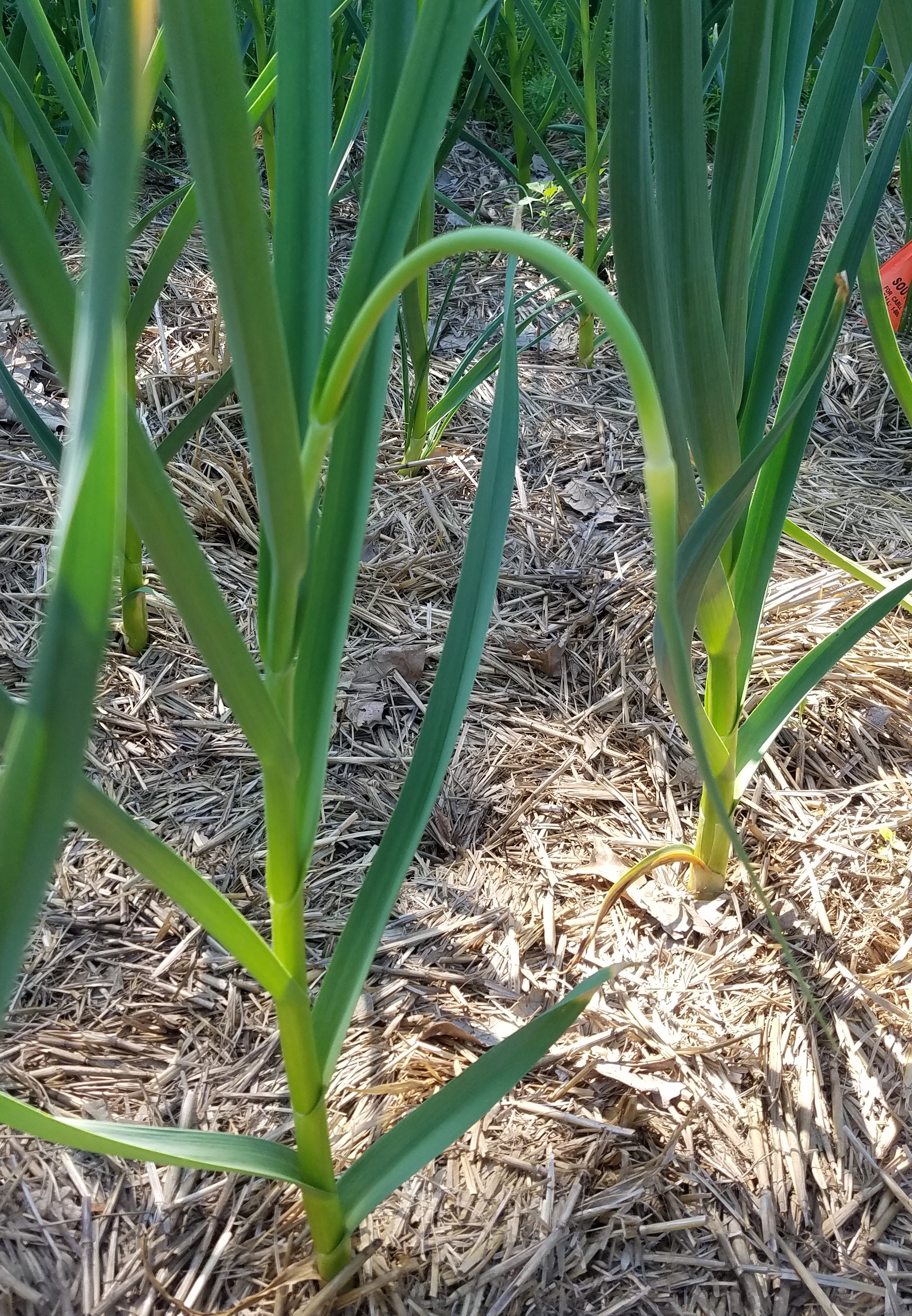
Garlic scapes have begun to emerge.

When Antoine LeClaire, George Davenport, and others brought the first steamboat full of land speculators from Saint Louis to sell them plots in what would become the city of Davenport, Iowa, they did not appear to have clear title to the land. Sales were lackluster. Right or wrong, I attribute this to the dominant unanswered question: Who truly owned the land?

When the Sac and Fox tribes crossed the Mississippi River into Illinois in 1831 and 1832, their dispute was with settlers who moved onto the land. Indigenous tribes did not recognize the previously signed 1804 treaty in which Sauk and Meskwawki individuals surrendered tribal lands. This dispute initiated the so-called Black Hawk War. The tribes were routed and a new treaty was signed in 1832. By 1837 all surrounding tribes had fled to the West, leaving the former Northwest Territory to white settlement, and expanding settlement into Iowa and the western parts of Minnesota.

In my autobiography I wrote about Lincoln County in southwestern Minnesota, “the presence and perceived threat of indigenous people had diminished.” In the white-written history of that place, there is scant mention of indigenous people. I included this sentence because the complete omission of indigenous people would be an error. If the tribes had truly fled to the west by 1883 when my great, great grandfather bought his land, they may have been a minor threat. Was southwestern Minnesota part of the frontier? One doesn’t see much to indicate it was. At the same time, how else would we describe it?

In 1893, Frederick Jackson Turner published The Significance of the Frontier in American History. I first read Turner in graduate school, and while his writing is familiar it was easier to disagree than agree with his thesis that once the frontier closed, so too did the defining aspect of American character. Yes, his work led to an expansionist foreign policy and forays by the United States into new territory during the Spanish-American War. At the same time, it is hard to stomach that the strength and the vitality of the America identity lay in its land and a once vast frontier.

I submit that land is land whether it be acres of tribal land ceded under a treaty, land granted or purchased for speculation by the founders of Davenport, or land bought in Minnesota from the railroad, the interaction of individuals and communities with the land and natural environment was more defining of American character. The better question is “What shall we make of this land where we find ourselves?” The perspective for an answer can be very narrow.

We Americans, like my Polish ancestors, often seem completely self-absorbed in ourselves and in our communities in locum. Our vision doesn’t go far beyond our noses. When we talk about character and culture, the native impulse is to tell a single, brief narrative of our lives. It is a combination of essential, defining moments, and multiple, broader narratives set in societal context. Depiction of a frontier may be part of it, yet once basic security and land rights are attained, the frontier fades into the background.

At the root of such stories, we must answer the question J. Hector de Crèvecoeur asked in Letters from an American Farmer, “What then, is the American, this new man?” The proper answer in 2024 is we are male and female, and not one singular thing. We have become Lyndon Baines Johnson’s vision of America, like it or not.

Once the question, “Who owns the land?” is settled, another important dynamic takes the foreground: the interaction of settlers with the natural environment. There is no question about a frontier, except to ask what took us so long to put it in its place?