Categories
Living in Society

O’Malley in Mount Vernon in Caucus Season

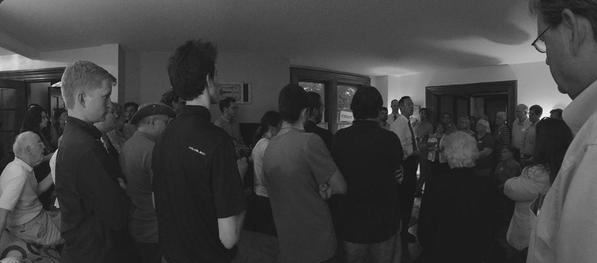
Listening to Martin O'Malley in Mount Vernon
Listening to Martin O’Malley in Mount Vernon Photo Credit O’Malley Campaign

MOUNT VERNON—In his family’s modest living room, Nate Willems introduced former governor Martin O’Malley to about 75 guests on Thursday.

O’Malley announced for president May 30 and was a regular presence in Iowa during the run up to the 2014 midterm elections. Because of that, Democratic activists are sympathetic to his message and polite. Not a lot signed support cards at the end of last night’s speech. It may be too early for that.

The message was about O’Malley’s 15 years of executive public service as mayor of Baltimore, Maryland from 1999 until 2007, then as governor until January 2015. Among his twitter hashtags is #newleadership, presumably differentiating himself from the Clinton/Bush dynasties. He was concise and repeated those points during the house party.

In my April 11 post I asserted, “O’Malley is a story teller. Will we like the narrative?” That observation was borne out last night.

O’Malley stumped on core Democratic issues, similar to the April speech. It’s hard to find fault with his broad positions. On climate change, I don’t like the narrative.

An audience member asked O’Malley what he would do as president about CO2 and methane emissions. The answer to this is easy. President Obama presented the U.S. plan for reduction of greenhouse gas emissions to the United Nations Climate Change Conference, or 21st Conference of the Parties in Paris this December. The U.S. plan relies upon the Clean Power Plan advanced by the Environmental Protection Agency for most of the proposed reductions. All O’Malley had to say was, “I support the Clean Power Plan” to satisfy climate voters. He didn’t.

Instead of a simple answer, he changed the question to one about “climate change.” He enumerated 15 things he did as governor to address climate change. It was an admirable punch list, but reducing CO2 and methane emissions is not the same thing. He missed the point of the question.

His brief statement on the campaign website did not provide much depth either:

Launch a Jobs Agenda for the Climate Challenge

Clean, renewable sources of energy represent one of the biggest economic opportunities in a century. And the threat of climate change is real and immediate. We must make better choices for a more secure and independent energy future—by limiting carbon emissions, setting renewable energy targets, driving innovation, seeding new industries, and creating good local jobs.

My take away from the event is that before I sign an O’Malley card for the February caucus, I need to get beyond the superficial narrative created for the campaign. Not just about climate change, but about each of his positions. This is Iowa, so that’s possible.

Some of my regular political companions were dismissive of O’Malley last night. I’m not ready to cast aside any of the five in the game at this point.

Political Miscellany

For the first time I interacted with a candidate’s D.C. staff via twitter. I posted this message:

A DC campaign staffer sent me this email after that post:

“You should go see O’Malley! Saw your tweet. You might like him.”

I gave the staffer a shout out on twitter:

Haley Morris, O’Malley’s national press secretary, liked my tweet.

While I was at the house party, first congressional district Democratic candidate Monica Vernon called. It was very noisy, so I explained I didn’t have money to donate, and when she was still interested in talking to me, asked her to call back in an hour after the O’Malley event.

I called her and we talked about ways I could help her campaign, even though I live in the second district. Of the three Democrats in that primary, she seems to be the only one really working.

I track how many views each post gets when I am live tweeting an event. It tells me whether or not there is an audience. Curiously, the following tweet had not been viewed by anyone. Could that mean someone is moderating the twitter without us knowing and behind the scenes?

Finally, I appear in the right side of the frame of the photo above. The women who took it almost knocked a lamp over getting into position with me behind the Willems’ couch. Note my ear seems very large compared to the image of the candidate. At least with that big ear I was listening.

Categories
Environment

Finn Harries Came to Iowa

Photo Credit: @FinnHarries

Last month Finnegan Harries came to Iowa to attend the Climate Reality Leadership Corps training in Cedar Rapids. If you don’t know Harries, you should.

With his identical twin brother Jackson Harries, he co-founded Jacks Gap, a YouTube channel, which is a story telling project inspired by travel.

Finn was assigned to my mentoring group by the organizers, but the idea he could learn more from me than I him borders the absurd. I am smart enough to step out of the way and let the next generation blaze a trail to more sustainable living when they can. Finn can.

Right after our training he wrote an article in The Guardian, titled “My generation must save the planet.” Because of his unique celebrity, the post garnered more than 36,000 shares to date. Finn Harries has something to say, and it’s important to listen.

Here’s the article. I recommend you click through and read the whole thing, including the videos linked from it. Follow @FinnHarries, @JackHarries and @JacksGap on twitter and check out JacksGap.com. Don’t forget the YouTube channel.

My generation must save the planet

YouTube star says his is the first generation to grow up with climate change and the last that will be able to do anything about it – unless we act now

As architecture design students we are taught to constantly question and reimagine the way things are. We’re taught that the world we live in is not a given. It’s the result of the best efforts our ancestors could muster at that time. If it has flaws, it is up to our generation to pick up where they left off and create the world we want to see for ourselves and our children.

I’ve grown to understand that the society and culture I was born into is damaging the planet we live on at a greater scale than ever before. We put profit above people, economy above environment, progress above purpose. As a result, climate change has become the most important issue of our generation.

But it’s such a meaty, complex problem that we’re not sure how to approach it. It doesn’t seem to pose an immediate threat to our everyday lives, and most of us assume that there are surely some very clever scientists somewhere who will solve the problem for us.

I became curious. If climate change is as big a threat as I’m being told, then my work as a designer and an architect should focus on helping address the issue. I wanted to really understand, in layman terms, what it is that’s causing our climate to warm. Why is a warmer climate dangerous? And how can I make a positive difference?

I started by attending classes on sustainable design at my university. I spent a weekend in Cedar Rapids, Iowa to watch former US vice president Al Gore present his famous slide show and explain it in-depth at one of his “climate reality” workshops; I picked up a copy of Naomi Klein’s book This Changes Everything and downloaded as many climate-change related documentaries as I could get my hands on.

To continue reading on the Guardian site, click here.

Categories
Environment

We Have a Water Problem

Iowa Row Crops
Iowa Row Crops

DES MOINES—”We have a water problem,” Mayor Frank Cownie said at the state convention of the League of Women Voters of Iowa on Saturday.

Like all municipalities, the Des Moines Water Works must comply with the Safe Drinking Water Act and the Environmental Protection Agency standards for maximum contaminant level in water processed and sent into its system. Peak nitrate levels in source waters have taxed the city’s ability to meet its obligations.

The problem is nitrates in the water, however, the bigger problem for Des Moines is nitrate discharge into drainage districts in Buena Vista, Calhoun and Sac Counties which feed its source.

“The current denitrification technology is outdated and cannot continue to operate with rising nitrate levels and increased customer demand.” according to the Des Moines Water Works. “Continued high nitrate concentrations will require future capital investments of $76-183 million to remove the pollutant and provide safe drinking water to a growing central Iowa.”

Nitrate runoff is an unrecognized environmental cost of farm operations. The lawsuit filed in the case asserts that the drainage districts named are point sources of nitrate runoff and should be regulated as such.

There is a lot of chatter about the lawsuit the Des Moines Water Works filed to establish a cost to people who use nitrogen fertilizer that contributes to water pollution. Here is their rationale from their website:

  • Des Moines Water Works filed a complaint in Federal District Court – Northern District of Iowa, Western Division, on March 16, 2015.
  • The complaint seeks to declare the named drainage districts are “point sources,” not exempt from regulation, and are required to have a permit under federal and Iowa law.
  • The complaint states that the drainage districts have violated and continue to be in violation of the Clean Water Act and Chapter 455B, Code of Iowa, and demands the drainage districts take all necessary actions, including ceasing all discharges of nitrate that are not authorized by an National Pollutant Discharge Elimination System (NPDES) permit.
  • In addition, damages are demanded to Des Moines Waters to compensate for the harm caused by the drainage districts unlawful discharge of nitrate, assess civil penalties, and award litigation costs and reasonable attorney fees to Des Moines Water Works as authorized by law.
  • Des Moines Water Works’ mission is to provide safe, abundant and affordable water to our customers. Des Moines Water Works is fighting for the protection of customers’ right to safe drinking water. Through this legal process, Des Moines Water Works hopes to reduce long-term health risks and unsustainable economic costs to provide safe drinking water to our customers, via permit and regulation of drainage districts as pollutant sources.
  • Continued insistence from state leaders that the voluntary approach of the Iowa Nutrient Reduction Strategy is working does not give solace to the 500,000 central Iowans who must now pay to remove pollution from their drinking water.

While this lawsuit is specific to Des Moines, there are a lot of unrecognized environmental costs in diverse business operations. Set all the partisan chatter about this issue aside and the fact remains there is a tangible cost, that someone should pay. It is a cost measured in risks to human health, environmental degradation and inadequate financial models in business.

Thanks to the Des Moines Water Works, we can begin to put a dollar figure to it.

Categories
Living in Society Social Commentary

Letter to the Solon Economist

Writing About Apples

A Bloomberg/Des Moines Register poll published last week contrasted how Democrats and Republicans weigh subjects in their approach to selecting a candidate running for the 2016 nomination for president in their respective parties.

Republican likely caucus goers surveyed were most interested in the budget deficit, national defense and taxes; Democratic likely caucus goers surveyed were most interested in energy, income inequality and the nation’s infrastructure.

One of the few places the two results were close was on job creation, favored by both Republicans and Democrats 86-14. The partisans have different approaches on how best to create jobs.

This framing of Republican versus Democratic by news organizations does us a disservice. It perpetuates the lie that people are divided.

For those of us who talk a lot to people from diverse backgrounds, we can see it is simply not the case. More people want to join together and work toward a common goal than get involved with political discussions.

That is especially true in our small community where we can join a non-profit, serve on committees, volunteer at the fire department, at church, or at the library, or if we are simply celebrating a special event like our sesquicentennial, or hanging out Wednesday night for music in the bandstand. Political party preference just doesn’t matter that much.

There is data to back this up.

According to the May report of the Iowa Secretary of State, the number of no party preference active voters in Iowa House District 73 exceeds either of the main parties by a distance (with 1,492 more no party registrants than Democrats and 1,817 more no party registrants than Republicans).

My point is this: we have more in common with each other than we disagree. What matters more than partisan debate is working toward common goals.

Large news organizations may not get this, but if we look around at the familiar faces near us, we should.

Categories
Living in Society Social Commentary

Favorite Places – Linn and Market

Linn and Market Streets

I have been spending time near Linn and Market Streets in Iowa City for most of my adult life. I lived on Market Street after getting my master’s degree—my last long stint of bachelorhood before marrying in 1982.

Within a small radius, so much happened that anytime I return, the trip is imbued with memories. But for the traffic, I would stand in the intersection for hours. I mostly settle for a window seat at the nearby coffee shop for my daydreaming.

Linn and MarketOur daughter was born here, and performed the role of a dog on Gilbert Street. It was also one of the few times I remember her performing the guitar in public. We had breakfast at the Hamburg Inn No. 2 after pulling all-night security at Riverside’s Festival Theatre in City Park. Hamburg Inn No. 1 was gone by then.

“Shady streets, very old white frame houses, porch swings, lilacs, one-pump gas stations, and good neighbors…” wrote W.P. Kinsella in Shoeless Joe. “We have a drugstore with a soda fountain… It’s dark and cool and you can smell malt in the air like—a musky perfume. And they have cold lemon-Cokes in sweating glasses, a lime drink called a Green River, and just the best chocolate malts in America. It’s called Pearson’s—right out of a Norman Rockwell painting.”

Pearson’s is now the bank in the photo.

We still favor Pagliai’s Pizza and I bring home a pie from time to time when I’m near around supper time. It is one of the places that hasn’t changed much through the years.

Down the street on Jefferson the university had a portable building where students could drop off punch cards to run on the computer in the early days of programming. Who knew what computing would become?

I was briefly enrolled in James A. Van Allen’s astronomy class—a chance to learn from the legendary physicist directly. I had to drop after registering for more classes than I could handle that semester. More than any teacher I remember, he stretched the limits of my ability to learn.

After so many years of wanting to hear him, when Saul Bellow read from Something to Remember Me By at Macbride Hall, I did.

I met James Hansen, Bill Fehrman, Beau Biden, Elizabeth Edwards, and heard countless speakers—too many to list. With each visit I recall one or another who made an impression. How could I forget Toni Morrison, introduced by Paul Engle, and the bat flying around her head at Old Brick?

I bought books at Murphy Brookfield, Prairie Lights, Iowa Book and Supply, the Salvation Army, the Haunted Bookshop and at the State Historical Society. I still have most of them.

Rich with 45 years of memories, I look forward to each return to Linn and Market—for a cup of coffee, a meeting with my nearby editor, and often, just to sit and remember before a meet up with a friend or two. For me, it will always be home.

Categories
Living in Society

Enraptured in Fandom

Iowa Caucus
Iowa Caucus

We’ve seen it so many times before progressives should be used to it.

The folks at Run Warren Run, financed partly by MoveOn.org, threw in the towel and are “suspending operations,” according to the MoveOn.org website. Hard to run a campaign when Senator Elizabeth Warren said repeatedly she’s not running for president in 2016. Fanboys and fangirls are nonplussed and will literally move on.

Non-Democrat Bernie Sanders announced his Democratic presidential ambition April 30, and pent up demand for a left-leaning presidential candidate burst the scene the way @POTUS and @Caitlyn_Jenner set records for ramping up Twitter followers.

Politicos are enraptured in fandom.

The allure of candidates who fit an intellectual ideal drew me in too. In 1980 it was Ted Kennedy; in 1984, George McGovern. After that, I was busy with a career and life, and moved to Indiana where the presidential elections seemed less important than they do in Iowa. No one else generated this type of excitement, especially when we’re in it for the long term.

Make no mistake, Sanders drew reasonable crowds at his Iowa and Minnesota events. They haven’t reached the bin-buster level yet, even if the room was too small at the Robert A. Lee Recreation Center in Iowa City last Saturday, and he drew several thousand people in Minnesota on Sunday. He’s had a good campaign launch, but as Slate points out, the front runner has little reason to worry.

While Sanders confidently told Katie Kouric, “My goal is to win this election,” his election is as likely as those of Presidents Ted Kennedy and George McGovern unless he begins to ramp it up among caucus-goers who are swing voters.

There’s no talking to most fan boys and girls about this. I’ll note one of the very few political questions I’ve heard on the street and at the convenience store has been “Did you see Bernie Sanders?” There is something there.

The art of politics is partly about excitement in a campaign. The problem is people don’t seem to be able to distinguish between events in the corporate news cycle and excitement, let alone momentum (whatever that is).

Note that no 2016 Democratic candidates for president are in Iowa this week.

Yesterday’s article by Paul Waldman of The American Prospect asks the right question, “Does the Iowa Caucus Still Matter?” He correctly points out that our star was diminished by the Republicans in recent cycles. While Jimmy Carter made the most of the caucuses, his style of personal campaigning will be, if it already hasn’t been, relegated to the dustbins of history.

Fandom is not for me, any more than cosplay or being a Trekkie has been. It is a form of enthusiasm, as described by the little known theologian Monsignor Ronald Knox. Not good for the long haul, even if Bernie Sanders has devilish eyes.

Categories
Kitchen Garden

Favorite Places – My Garden

Garden Spinach
Garden Spinach

Our garden is one of my favorite places.

A mature rabbit hangs out in the thicket next door. I see it in the garden often, usually minding its own business—being a rabbit—outside the fences. This year I’ve been pushing the limits of what can be unfenced and survive.

Today, the rabbit was sitting, next to the row of carrots chewing. Luckily, it was eating clover, not the unprotected carrot tops six inches away. My fear is it’s a she and undisciplined little rabbits will ravage the garden until getting picked off by the many predators who live nearby.

Later, the rabbit came back and was eating radish leaves planted between tomato cages. I picked a leaf and ate it—sweet and refreshing. No wonder rabbits eat them. I chased it away again. It ended up munching the clover in a neighbor’s yard, then disappeared in the midday heat.

New Garden Shoes
New Garden Shoes

This is the ecology of my life—living as best I can in the found environment. It’s not a natural place. The forests are long gone, and the weather is unpredictable. The ground is already parched, and nearer sundown I’ll water the young plants so they don’t perish before being mulched.

With a little management, the garden produces more food than we need, but not enough to make a business of it. The seasonality of spinach and inadequate freezer space makes gifts to friends and neighbors. The same will hold true when the kale matures, tomatoes come in, and the fall apple harvest arrives. All are parts of this ecology.

Radishes
Radishes

Here, I can forget about politics, society and culture—except maybe for agriculture. The symbiosis with this place is hard coded in me. Not coding like DNA or computer algorithms. More like a recipe made from scratch and varied with each iteration.

The truth is we all need something like this garden.

When we planned our move from Indiana we sought a place with enough of a lot to grow this large garden. We built everything on this piece of property to fit our lives. While it is not a perfect place, its lack of perfection is alluring. Suited respite from a society that does not appear to care much, if at all, about anything beyond circles of family and friends.

It is a place to gain strength for the next endeavor.

Categories
Environment

Mixed Greens Not Salad Days

Basket of Mixed Greens and Radishes

Street asphalt melted in Delhi, India as the country endures intense heat. In some cases, temperatures reached 122° Fahrenheit. The human death toll exceeded 1,100 as residents wait for the Monsoons to begin next week.

Closer to home in Hays County near Wimberley, Texas, the Blanco River rose from its banks to sweep a vacation home off its foundation and slam it into a downstream bridge. Family members remain missing.

“More than 11 inches of rain fell in some spots of Houston overnight into Tuesday—inundating byways and highways, slowing first responders, knocking out power and generally bringing the southeast Texas metropolis to a standstill,” according to CNN.

“You cannot candy coat it. It’s absolutely massive,” Texas Governor Greg Abbott said after touring the destruction.

Abbott’s views as a climate denier came to the surface during the 2014 gubernatorial election campaign against Wendy Davis, when he said, “Many scientists believe that certain human activities impact the climate. Others dispute the extent to which any activity has a particular level of influence on the climate, which is why this matter needs to continue to be investigated.”

Abbott’s skepticism about climate change didn’t stop him from requesting federal assistance from President Obama in the face of real-world impacts of global warming in Houston and Hays County.

These are not the salad days of extreme weather—it’s likely to get worse.

It bears repeating that global warming may not have caused these specific weather events—it made them worse. Because the greenhouse effect makes the atmosphere and oceans warmer, the hydrological cycle changed. Our heat waves are hotter, our storm systems are stronger, and our droughts are deeper. There are simply too many “record breaking” rainfalls, floods, heat waves, droughts, fires, and other disasters to deem them to be random exceptions. What Texas and India are experiencing may be the new normal.

It’s not just me saying this. The New York Times posted an article by Andrew Revkin yesterday that presented the consensus. “Among the clearest outcomes of global warming are hotter heat waves and having more of a season’s rain come in heavy downpours,” he wrote.

The problem isn’t as much that Texans like Abbott ignore the science of global warming, it’s what their repudiation of facts led them to do.

“What’s vividly clear is the extreme vulnerability created by the continuing development pulse in some of the state’s most hazardous places—including Hays County, in the heart of an area that weather and water agencies long ago dubbed “’Flash Flood Alley,’” said Revkin.

“The main challenge to rational planning for flood risk in the country is that private property rights trump even modest limitations on floodplain development,” said Nicholas Pinter, an expert on floods, people and politics at Southern Illinois University to Revkin. “And that sentiment runs deep in Texas. The result is unchecked construction on flood-prone land, up to the present day and in some places even accelerating.”

What to do?

“You can’t fix stupid,” said comedian and Texas native Ron White. “There’s not a pill you can take; there’s not a class you can go to. Stupid is forever.”

Iowa is connected to global weather systems. The spring rain we received as part of the storm system that soaked Houston was needed. Farmers now need a dry spell to get the first crop of hay out of the fields, and to plant soybeans before it gets too late. A radio commentator said soil moisture is good in most of Iowa.

Take the lessons from India into consideration. If we have a repeat of the 2012 drought, drink plenty of fluids, wear a hat, and maybe take an umbrella outside with you. If you are building something, pay attention to the flood zones re-drawn by our recent experience.

If you can do one thing about climate change, support the Clean Power Plan in your state. It is a real world solution to mitigate one of the leading causes of global warming. Contact your governor today—especially Governor Abbott.

Categories
Home Life

Memorial Day 2015

Wise County Civil War Group

Memorial Day is mostly about the Civil War. These shirt tail relatives and at least one direct ancestor pictured here (Thomas Jefferson Addington) made it back, but many did not. Men from this Virginia county fought both for the Union and the Confederacy. The photo was taken Memorial Day, 1912. I favored the Confederacy when I was young, but once understanding came, switched sides.

It’s a mixed bag as to whether people understand the meaning of Memorial Day. It’s not Veterans Day. We have another holiday for that. Many politicians get it wrong and talk about taking care of veterans. Today is about remembering soldiers who gave their life in the line of duty.

This is also the first of four days mostly off work and I was at it early. Reading in bed at 3 a.m., up around 5 a.m. to work in the kitchen, and then outside to mow at 2 p.m.

When I finished the mowing, I took a rake to the turned soil, working it for tomorrow’s planting if the dry holds. The vegetation in our yard is growing out of control. Four days may not be enough to get the yard in shape.

During the peasant’s revolt of 1381, 14 year-old King Richard II capitulated completely to the rebel demands at Mile End. He ended up reversing his decisions, but for a brief moment the peasants rose up, believed they had ended their servitude and changed the course of history in ways we can’t even fathom today. The pessimist in me says it was inevitable Richard’s promises would not be kept. The optimist in me looks to the possibility of common people joining together in a cause to overturn, even if only for a while, the status quo and embark on a new and more just path in society.

Have to hope the latter is possible and that it has some local application.

Categories
Sustainability

No Nukes? Not Now

Nuclear Spring in Sioux City

It is no surprise the 2015 Nuclear Non-proliferation Treaty (NPT) review conference failed to reach consensus about next steps.

On Nov. 7, 2014 the U.S. State Department made a statement about the role of the NPT in a press release, “The United States is committed to seeking the peace and security of a world without nuclear weapons. As we have said previously, the Nuclear Non-Proliferation Treaty (NPT) is the focus of our efforts on disarmament, as well as on nonproliferation and the peaceful uses of nuclear energy.”

The Arms Control Association highlighted the fact that the parties “could not overcome deep differences over the slow pace of action on nuclear disarmament.”

The U.S. and Russia have each embarked on a nuclear complex modernization process—the opposite direction from disarmament. Disarmament was talked about and around, but was never really on the table at the conference.

“The 2015 NPT Review Conference does not signal the end of the NPT, which remains vital to international security, but it reveals a lack of political will and creativity that undermines the treaty’s effectiveness. Without fresh thinking and renewed action on the 70-year old problem of nuclear weapons, the future of the NPT will be at risk and the possibility of nuclear weapons use will grow,” Daryl Kimball, executive director, Arms Control Association warned.

Some found hope in the humanitarian campaign for abolition of nuclear weapons.

“Regardless of what has happened here today, the humanitarian pledge must be the basis for the negotiations of a new treaty to prohibit nuclear weapons”, said Beatrice Fihn, executive director, International Campaign to Abolish Nuclear Weapons in an email. “It has been made clear that the nuclear weapon states are not interested in making any new commitments to disarmament, so now it is up to the rest of the world to start a process to prohibit nuclear weapons by the 70th anniversary of the atomic bombings of Hiroshima and Nagasaki.”

Fihn released a statement titled, “The Real Outcome,” that includes the following.

As the 2015 NPT Review Conference ended, over 100 states had endorsed the humanitarian pledge, committing to work for a new legally binding instrument for the prohibition and elimination of nuclear weapons.

The pledge reflects a fundamental shift in the international discourse on nuclear disarmament over the past five years. It is the latest indication that a majority of governments are preparing for diplomatic action after the Review Conference.

The wide and growing international support for this historic pledge sends a signal that governments are ready to move forward on the prohibition of nuclear weapons, even if the nuclear weapon states are not ready to join.

But for the nuclear-armed states, none of this seemed to matter.

The idea that world opinion could force nuclear states to abolish nuclear weapons is hopeful, but unlikely.

The U.S. made it clear in words and deeds it has no interest in moving forward under a new treaty. Unless the U.S. accelerates its progress toward compliance with Article VI of the NPT, progress in all of the nuclear states is stymied. At present the majority of countries has not been able to press their case for abolition in the U.S., where it is most needed.

While the NPT is legally binding, the lack of political will makes enforcement of its terms unlikely. That may be the most significant outcome of the conference.