LAKE MACBRIDE— The newspaper where I proofread offered me an opportunity to write a few articles on city council and school board meetings. I filed my first story yesterday morning and it was more work than I anticipated. By the end of a 5-hour writing session, my shoulder was sore, and I was reminded that journalism requires a different kind of energy and intensity. One down and four more to go during an initial, mutually agreed trail period.
I attended the Iowa City Community School District Board of Directors meeting on Jan. 28, and took notes while making a voice recording of the meeting. Getting to the meeting and attending took the better part of four hours. What surprised me was how little work actually got done at the formal board meeting. There was no substantial discussion, only ratification of work that occurred outside the meeting.
The operations committee meeting that occurred after the formal board meeting appealed to my inherent process orientation. It went on for more than two hours, and I felt engaged the entire time.
The budget assumption presentation was particularly enjoyable and I interviewed the district CFO afterward. Because of story length constraints, the budget information ended up on the virtual newsroom floor. What I noticed about the Iowa City school district is they are spending money like they have it. Because of the strong tax base they do have it.
We’ll see how this project goes, but I hope to become more efficient in producing stories, to reduce the investment of time, and to get better at writing news articles. The financial contribution will be, as my editor described it, “pocket change.” It will be another check predestined to go toward sustaining a life on the Iowa prairie.
LAKE MACBRIDE— Journal and blog writing is an open book filled with blank pages and freedom. There are few rules, and readership is limited, even when posting publicly on the Internet. Sometimes a writer wants to be read, and others, not so much. There is a formative urge that drives us to understand our world through language. Not everything we write is suitable for framing, in fact, most isn’t. We are driven to write, and occasionally to be read.
In the darkness of night, by the glow of the laptop, it is quiet. Mistake not this silence and solitude for separation from society. What we sense of the world is from constant acculturation beginning before our birth. If we write well at all, it is because of engagement in a world beyond the walls we see. There are no walls, there is no other, only the one of which we are all a part.
LAKE MACBRIDE— Almost every creative person could use more money. This has been true, not only for the vast majority of writers I have known, but for artists, musicians, potters, actors, dancers, painters, singers, theater technicians, and others who pursue creative endeavor. Very few people make a living in creative endeavor without working at something else for money that pays basic living expenses. It is tough to blend a personal economy with being creative without compromise. It is impossible to keep the two in separate isolation chambers, nor would we want to.
During my senior year at the university, a group of creative people shared expenses in an old house in Iowa City. We each had our own room, but shared the common space, holding periodic meetings when an issue arose. Residents came and went, poets, artists, musicians, a travel guide, a tropical fish breeder, and a mechanic. There was always something going on, most of it interesting, and some of it annoying. It was the creative life.
One day a poet arrived to set up shop. She found a job in town, and wrote every morning in the entryway. As an early riser, I encountered her often, and tried not to disturb the work in progress as I walked to the kitchen to make breakfast and get on with my day. After a while, and after giving a few readings in town, she left for California with another poet who was a frequent guest. She adjusted to a sparse life, focused on experience and her writing. Our shared moments seemed to be a way station on her longer journey. She swiped the cooking pans my grandmother had given me when she left, evidence she could have used more money.
That living arrangement and my undergraduate years were a way station for me as well. Early on, I was an admirer of people who worked a career and wrote, notably the pediatrician/poet William Carlos Williams. I thought I could do something similar. It takes a certain kind of career to avoid disrupting one’s creative outlook and I found my time in transportation and logistics wasn’t it. I’m thankful for the ability to earn a living, and led a full life. For 25 years, creativity wasn’t as much a part of my life as I would have liked. It took leaving the security of that work environment to enable writing. Now there is new hope.
Most days I get a chance to write here or off line. I continue to need monetary income to pay monthly bills, although I am no longer in search of a career, having left the one I had. That’s where gardening comes in.
The less than $200 in seeds and supplies will multiply tenfold in value during the growing season: home grown food reduces the need for money. I have a couple of paying jobs, and need one or two more to make ends meet. That’s life in the personal era of creativity. The good news is the garden seeds have been shipped.
I hopefully await arrival of the germinal package, and the chance to forget about money for a while and work directly with Earth’s bounty. Money may always be tight, but nature can help us survive if we are paying attention— and invest in the work.
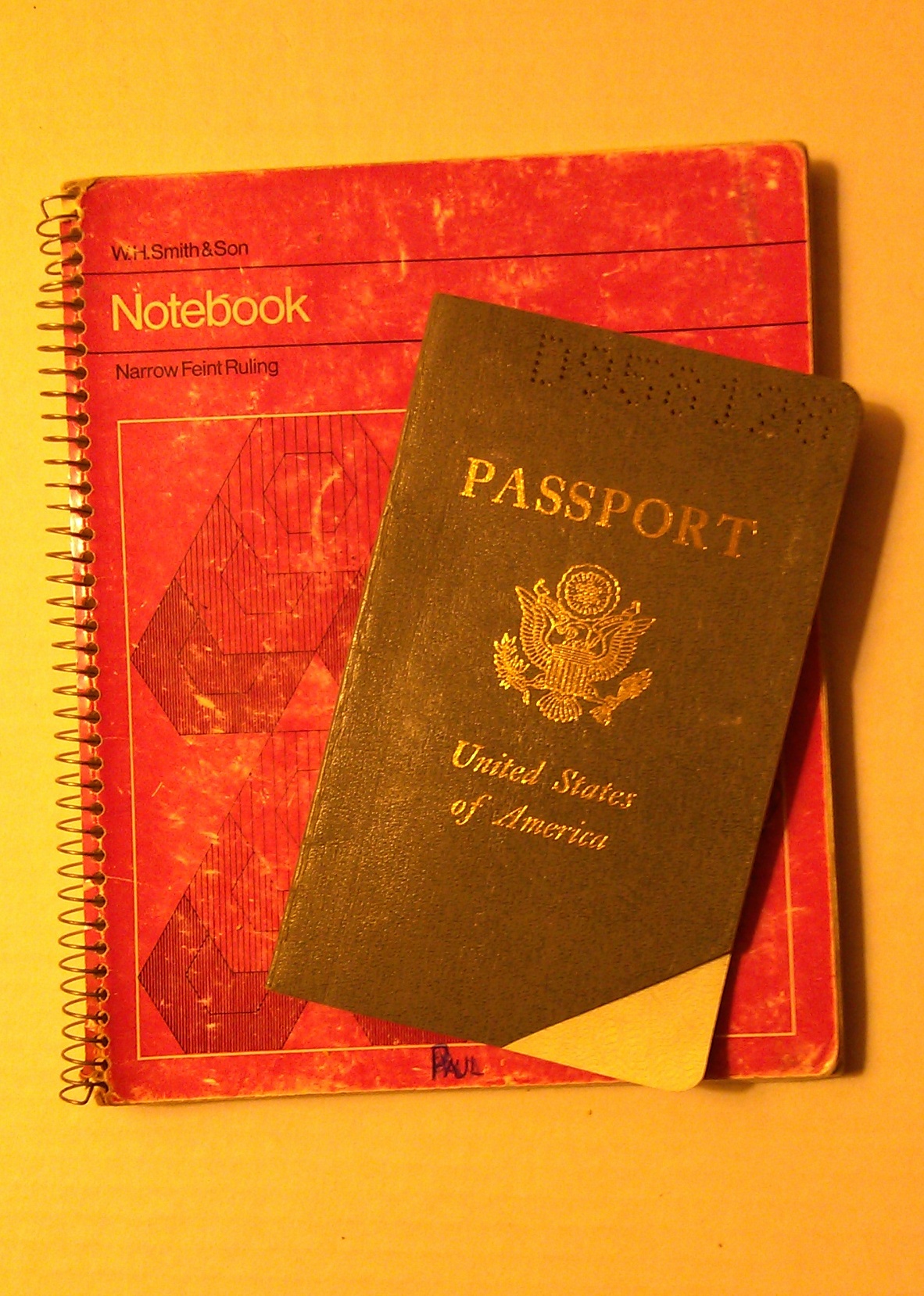
LAKE MACBRIDE— The U.S. Passport issued on April 26, 1973 is on my desk, waiting to be put away. During the 1972 to 1973 academic year at the University of Iowa, I lived with a friend in a mobile home his parents owned next to Interstate 80 in Iowa City.
We thought to travel to Europe together during the summer of 1973, to see the continent and visit his relatives in Bruges. I got my passport, and in the end, he went that summer and I didn’t, ending up playing in a band in Davenport until returning to finish my senior year in the fall. I traveled to Europe the following summer, after graduation, by myself.
It was what used to be described as “the Grand Tour.” Although my adventures were much less than grand, I did manage to visit Paris, Madrid, Venice, Rome, Vienna and other traditional destinations. Stamps in the passport provide five milestones for the trip. I arrived at London Heathrow on Aug. 15, 1974, departed England at Ramsgate on Sept. 2, left Madrid on Sept. 16, arrived in Arnhem, Holland on Oct. 25, and arrived back in Montreal on Oct. 31. There is more to the story than these stamps.
I kept a journal during my trip, although the first volume was stolen in Calais where someone pinched my backpack from the youth hostel my first night in France. I remember two women making café au lait in the kitchen the next morning and reporting the theft in my hopeless French at the nearby police station.
Last night I skimmed the remaining volume wondering what I was thinking when I kept track of the trip. Well, I know what it was— that the persistence of memory would be better than it is. My trip to Madrid explains the point.
Unlike today, I hardly kept track of day-to-day activities. For example, I wrote an entry on Sept. 10, 1974 at the Hotel Sabina in Madrid, with additional entries on Sept. 11, 13 and 15. In none of those entries was mention of the Sept. 13 Cafe Rolando bombing in Calle del Correo near the hotel. Conversations afterward at the hotel, and the bombing itself, were the reasons I left Spain when I did.
My passport was stamped by Spanish authorities on the train from Madrid to Irun as I left for France. Security had been tightened as I stopped in San Sebastián, in the Basque area that was home of the ETA, a separatist group said to be responsible for the bombing. There were military and police everywhere. When attempting to make it to the beach, an armed officer stopped me, waved his rifle at me and indicated the area was restricted. There is no mention of the police state Franco’s Spain seemed to be in my journal. However, I did write that the Prado seemed, “one of the richest museums of the ones I have seen.”
Memory does persist, although the story may have changed in the telling. It was a trip of language, art and experiences that moved me away from the intellectual world of art history classes, and study of the works of René Descartes and John Locke. What I found was a legion of people my age traveling the continent, and the experience changed me in ways that continue to seem astounding, although I hadn’t realized it at the time.
~ This is one of a series of posts based upon writing in my journal.
Departed Mainz June 3, 1977 at 2322 hours in a sleeping car for Vannes. The journey was quite nice. In such luxury I seldom indulge, but this trip I didn’t really think much about it. The little compartment had all the niceties of any fine hotel, and although I was concerned mostly with getting a good night’s sleep, the indulgence will be memorable. Especially the numerous buttons for summoning the waiter and turning the lights on and off. In an earlier time I would have experimented with all these buttons to discover their functions. But now I have changed.
As I exited the train at Gare de l’ Est, I struggled with my bags for 50 meters or so. An older man with a Polish-sounding name spoke with me and offered a ride for my cumbersome duffel bag and clothing sac. He asked the usual niceties— where are you from? Iowa, of course. It seems he is good friends with Mauricio Lasansky‘s son. Small world— so he said.
We shook hands and he guided me to a taxi where I stowed my bags, heading for the connection at Montparnasse.
The ride through Paris made me recall my last trip here.
~ This is the first of a series of posts based upon writing in my journal.
LAKE MACBRIDE— On the second to last day of 2013, it is nine degrees below zero with little reason to venture outside. The kitchen is well stocked with food, and there is plenty to occupy an active mind. The only thing lacking is time to accomplish everything that needs doing. For a change, I spent time getting focused soon after waking.
I plan to continue writing this blog in 2014. In case you missed it, there is a tag cloud in the right hand column where readers can pick topics of interest. Seldom have I worked any subject for very long, although local food, worklife and sustaining the human species (locally and more generally) continue to be topics that most engage me. I’ll probably write about those in 2014.
Sometimes my posts are pretty good and other times… If you made it this far, I hope you’ll read more, and either RSS, follow or twitter with me by clicking one of the links to the right.
My commitment is to continue to make it worth while for readers to stop by.
LAKE MACBRIDE— At 6:56 p.m. on Dec. 28, 1951, I was born at Mercy Hospital in Davenport, Iowa to Mr. and Mrs. Jack H. Deaton. Curiously, my mother’s full name is not on the birth certificate, although the attending physician, Howard A. Weis, M.D., is. We lived at 1730 Fillmore Street, a duplex shared with my maternal grandmother, down the street from where I was baptized, and three blocks from the hospital. A few photographs and memories of that time survive. I believe I had a normal city childhood among people who never had much money, but had a well defined culture centered on family, work and church.
Soon after, we moved to a house my parents bought at 919 Madison Street. While there, I was hospitalized for a head injury from a swing set in the basement, and still carry the scar. My sister was born in 1955, and my brother in 1956. In 1957 I entered Kindergarten at the Thomas Jefferson Elementary School on Marquette Street where my teacher, Ms. Frances Rettenmaier wrote about me, “he has good work habits and is willing and able to accept responsibility in the room.”
My parents sold the house on Madison on contract, and we moved to a rental behind the Wonder Bakery on River Drive. I attended first grade at Sacred Heart Cathedral where Sister Mary Edwardine, B.V.M. was the first of six nuns, along with two lay teachers, who taught me in parochial grade schools. I recall this because Mother kept all of my report cards. During the spring of 1959, my parents bought the house where I lived until leaving home to attend college in 1970. I transferred to Holy Family School in the parish of the same name, and spent some of the best years I recall as the Polish-American odd duck among children who were mostly the descendents of German and Irish immigrants. I met my best friend in the seventh grade and our friendship has endured. I entered Assumption High School during the Fall of 1966.
My father died in an industrial accident on Feb. 1, 1969, and the company he worked for gave me a four-year scholarship which I used at the University of Iowa beginning the Fall of 1970. My grades were lackluster in college, and I drifted, but graduated in four years with a bachelor’s degree in English, listening to the commencement exercises on the radio while I tie-dyed some shirts in the basement of our rented house on Gilbert Court in Iowa City.
When Richard Nixon resigned the presidency on Aug. 9, 1974 I felt a weight had been lifted. I had a little money and decided to tour Europe after college, visiting Canada, England, France, Spain, Italy, Austria, Germany and Holland. While in Rome, I had an audience with Pope Paul VI.
I worked a couple of low wage jobs in Davenport upon my return to Iowa. When the Vietnam War ended with the fall of Saigon on April 30, 1975, I decided to follow in my father’s footsteps and enlist in the U.S. Army that winter. I began basic training at Fort Jackson, S.C. in January 1976, took Officer Candidate Training at Fort Benning, Ga., and was assigned to a mechanized infantry battalion in the Eighth Infantry Division in Mainz-Gonsenheim, West Germany.
I served in the Fulda Gap, attended French Army Commando School, and was an exchange officer with a French Marine regiment in Vannes, France. On two occasions, some of my Iowa friends were able to visit and we made brief tours of Germany, France, Spain and other countries.
In 1979, after military service, I returned to Davenport and was accepted into the American Studies Program in the graduate college of the University of Iowa. I received my master of arts degree in May 1981, achieving a 4.0 grade average and feeling I had made up for my lackluster undergraduate years.
In order to stay in Iowa City after graduate school, I secured a job at the university, where I met my future wife, Jacque. We were married on Dec. 18, 1982. I began a career in transportation in March 1984 at CRST, Inc. in Cedar Rapids. Our daughter was born in 1985 in Iowa City and brought home to our house on the southeast side of Cedar Rapids. We relocated to Merrillville, Ind. in 1987, where I was a terminal manager for two years. I left the company to work for Amoco Oil Company in Chicago and eighteen months later, returned to CRST. I was transferred back to Cedar Rapids in 1993 and retired on July 3, 2009 as director of operations for CRST Logistics, Inc.
During the time after Nixon’s resignation until the 2000 Al Gore v. George W. Bush election, I remained mostly inactive in politics. The election and George W. Bush’s administration, especially after the Sept. 11, 2001 Al-Qaeda attacks, incensed me enough to get involved again. Beginning with the 2004 election I was very active in partisan politics and contributed in a small way to significant victories in 2006, 2008, 2010 and 2012. My political life culminated in getting elected as a Township Trustee during a write in campaign in 2012 while I managed an unsuccessful campaign for a statehouse candidate.
When our daughter left home to attend college in 2003, I began to get more involved in our community, and was appointed to the county board of health for two terms. This led to meeting friends around the state and country, and I became involved in a number of organizations, including Physicians for Social Responsibility.
I contributed to advocacy efforts to pass the Smoke-Free Iowa Act, to stop the coal fired power plants in Waterloo and Marshalltown from being built, to ratify the New START Treaty in the U.S. Senate, and to stop a nuclear power finance bill proposed in the Iowa legislature. In August 2013 I graduated from Al Gore’s training as a member of the Climate Reality Leadership Corps.
Having helped organize to protect our environment on the first Earth Day in 1970, I have come full circle, making environmental advocacy the center piece of my volunteer time today.
Importantly, I began blog writing in November 2007.
LAKE MACBRIDE— The last three times I’ve been to the grocery store, the person in front of me in the checkout line has commented that some baking must be planned in our household. What they don’t know is because of my work on farms this year, flour, sugar, butter, dried fruit, chocolate chips, and other shelf-stable and dried goods are all I need to pick up. Going into 2014, the pantry and freezer are still pretty full of the season’s goodness, with a couple of months food on hand should disaster strike.
There are usually some luxuries on the conveyor belt leading to the cash register: a small jar of hazelnut spread mixed with chocolate and skim milk, cured Spanish olives stuffed with pimiento, a bag of caramel corn on special, or a box of snack crackers. Those items not withstanding, the majority of food we buy at the grocery store is raw material to supplement our pantry while cooking our own meals. As people have noticed, what we buy at a grocery store is evidence that we use appliances beside a microwave oven in our home kitchen.
People snoop at my purchases, but I don’t mind. I do the same, but don’t usually comment, having been raised differently. When people comment, I respond politely, giving out as little additional information as possible, saying something like, “the sugar was on sale for $0.25 per pound, so I thought I would pick up a bag.” Like it or not, checkout is a sociable time.
I have gotten to know some of the cashiers at the mega-mart, and they call me by name after the transaction. They must read it on the display screen after my debit card goes through. It is not a personal relationship, but familiarity after long years of my repeat business and their continued employment. It is not a bad thing, and as people smarter than me have said, the sweetest sound is that of our own name. It’s good salesmanship to call customers by their name.
Neighborliness may have been reduced to these brief commercial interludes in the grocery store. Where I live, seldom do I see my neighbors outside, and even less frequent is an in depth conversation about anything other than the weather. I speak with my friends via email, and in person at events, but that is conversation through association rather than neighborliness. A little more neighborliness would be welcome in our increasingly contentious society. Even if it is only in the checkout aisle.
LAKE MACBRIDE— A friend forwarded a link to an article titled, “The 10 Awful Truths about Book Publishing,” that reported more than three million books were published in 2010 yet sales were down. Stephen Piersanti, president of Berrett-Koehler Publishers wrote, “there is no general audience for most nonfiction books, and chasing after such a mirage is usually far less effective than connecting with one’s communities.” In other words, unless you have kismet, keep writing, and building relationships to develop your own market for your writing. I came to a similar conclusion, and a number of area authors seem to be pursuing this approach as well. What gives?
Part of my writing efforts have been figuring out what role words on a page or screen would play in life. Where it ended was “as a self-employed writer, the challenges are to find venues for writing, and to improve one’s skills. For most of us, writing is seldom paid work in the era of social media. My current writing can be viewed on my website pauldeaton.com.” This statement, posted on my LinkedIn profile, has been a sanity keeper and set my expectations about publishing low, while maintaining a reason to write. Sure, I would like to make a living from writing, but the simple truth is not many people do, and the number who sell more than 250 copies of their book once published is miniscule. The endgame is if a viable book idea was forthcoming, the work will be self-published and marketed.
Discarded Books
There is a lesson to be learned from the prairie troubadour, Vachel Lindsay. Lindsay was one of the best known poets in the United States during his lifetime, but faded into obscurity after his death by suicide. He bartered poetry for food and lodging, and self-published works like, “Rhymes To Be Traded For Bread” toward that end. History has been unkind to Vachel Lindsay, and today his poetry is a difficult read.
Iowa History Books
The lesson to be learned is that we all live a life of struggle and desire. It is possible to self-publish a book, but the idea of written pieces as currency, or making a living solely from publishing and selling books is not realistic for most of us, and may never have been. It certainly didn’t work out for Vachel Lindsay, who had the fame that would presumably enable sales. Maybe he didn’t understand how to do it, struggling with in person sales negotiations to secure a bed and meal for the night, such bartering consuming a disproportionate amount of his time and energy. He worked hard, but maybe didn’t work smart enough.
The challenge isn’t the writing, it’s finding the reason to write and the opportunity to do so. For now that means sitting in front of a screen most mornings trying to figure out the meaning of a life. Hopefully readers will find some resonance with theirs. This may be as published as one person’s writing gets.
LAKE MACBRIDE— So begins the quiet time. Snow covers the ground, temperatures are well below freezing, and life turns inward toward family and friends, and reading, writing and cooking, as we approach the winter solstice. Somewhat spontaneous, and upon us all at once, there is practiced ritual to help us make it through the days.
Christmas at Home
Since making the last CSA delivery during Thanksgiving week, these days have also been a time of recuperation. The year’s physical labor was not without its toll. Tendons, ligaments and connective tissue are not as flexible as they once were, so despite a cautious approach to work, I have been a bit sore. Recovery is well under way, but I don’t recall that aspect of life from previous holiday seasons. Who knew naproxen sodium and skin moisturizer would become as prevalent as Christmas greetings and holiday lights?
All Roads Lead Home
Today, I’ll write and mail the fundraising letter for a social group. I’ll read a book, and plan for next year. There are a few errands in the hopper as we move toward the weekend. Then there will be the bustle of house cleaning, and decorating from the boxes of stored memories kept below the stairwell. One can get lost in the pattern and there is a yearning to do so because of its comfort and familiar warmth.
A time to let go of ambition and desire, and to return to being native.






 Journey Home
You must be logged in to post a comment.