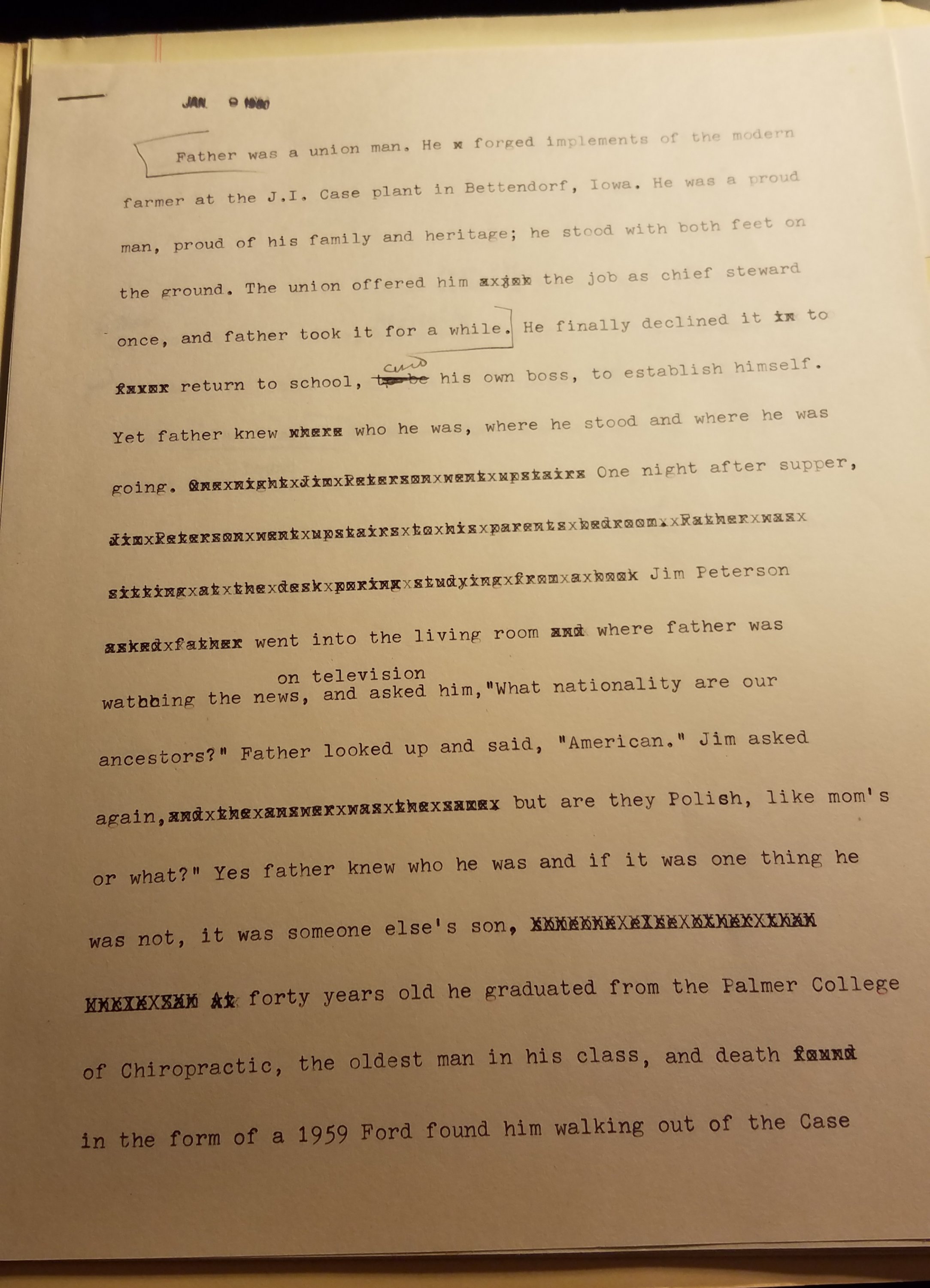
(Editor’s Note: Robert Caro instructs us to turn every page when writing biography. I don’t remember writing these fragments found in a folder with multiple typewritten drafts of each. Today they make me groan a bit. They are fiction with one foot in reality).
Fragment 1 – Jan. 9, 1980
Father was a union man. He forged implements of the modern farmer at the J.I. Case plant in Bettendorf, Iowa. He was a proud man, proud of his family and heritage; he stood with both feet on the ground.
The union offered him a job as chief steward once. He took it for a while, but ultimately declined it. He went back to school to get out of the plant and be his own boss, to establish himself.
He graduated in 1968, but death in the form of a 1959 Ford struck him as he walked out of the plant after his shift.
Those were hard years, but Jim Peterson was convinced his father knew who he was, and where he was going.
Fragment 2 – 1974
Danny Dziabas shut the door of his upstairs apartment and began walking to the sound of night creatures chirping near the house.Walking under the starlight of Orion rising. Walking from his apartment on Walling Court, near where Bix Beiderbecke had lived. Walking toward Locust Street where revving of car engines and laughter of young people muffled the night sounds. Where headlights and streetlights dimmed the rising hunter. Danny Dziabas walked to the Deep Rock Station and placed a call while a Corvette and a G.T.O. lined up at the intersection for a drag race.
As he finished his call, the traffic light changed to green and the two cars squealed away from the corner.In hot air, smelling of burnt rubber, Danny Dziabas began walking, away from the noise and light of Locust Street toward his nearly empty apartment on Walling Court near where Bix Beiderbecke had lived.
Fragment 3 – Dec. 25, 1974
When the time came Danny began looking up his friends. The first was Milton Murphy who was in possession of Danny’s books and record albums.
Danny and Milton had played together in a band called the Milton Murphy Moose Manglers. It lasted about nine months. Just as they were about to collect their pay from a party on a farm near the Wapsi River, a band mate carried the P.A. head 100 yards and threw it over the bluff into the river, ending both the evening and the band.
Remembering this and other episodes in the Manglers’ history, Danny questioned the sanity of leaving his possessions in Milton’s care in the first place. He knew it would be alright when he heard the dull beat of the base coming through the floor above the entrance hall.
Fragment 4 – Iowa City, 1973-4
In act of simultaneous co-creation Danny Dziabas skied the snow-covered slopes of Washington Street, mountainous mathematics to the left, his just crashed 1965 Volkswagen cavernous time away and in a ditch. Pirouetting on Madison Street, his toe reveals a greenery hidden by newly fallen snow.
I’ve been using the free, on line service FamilySearch to research parts of my family history. It is funded by the Church of Jesus Christ of Latter-Day Saints.
I call it, in a respectful way, the Book of Mormon.
My reference library has a copy of the actual Book of Mormon, replete with a photo of the prophet Joseph Smith from whose translations it was made in 1830. I’ve already opened FamilySearch many more times than the worn copy of the religious text.
Stories about early gatherings of my paternal ancestors include one about the funeral for “Aunt Stella.” I have a photograph of Stella in her coffin with someone identified as “Granny Reed” nearby. Stella was my grandfather’s sister. Oral history is no one knew anything about Granny Reed except that’s what they called her. According to FamilySearch, in the 1920 U.S. Census she is listed living in the household of my great grandfather as his mother-in-law, with an estimated birth year of 1864. Her complete name was Josephine Reed. It has bothered me we didn’t know more. Now thanks to the Mormons there is a better narrative of who she was.
When I write “better narrative” I mean the story is and continues to be a human creation. While there are “facts” to support it, there are vagaries in the U.S. Census data and oral tradition that went unrecorded. The temptation is to take a fact like a U.S. Census entry and make more of it than it actually is. As I wrote this post I found myself rewriting that paragraph time and again to refine my understanding of who was Granny Reed. I’m not sure how much more this discovery changes things.
I love the name Josephine and had we known about it when our daughter was born, it may have been entered into the pool of family names from which we selected hers. Granny Reed was our daughter’s great, great, great grandmother. It’s a fun fact yet not that relevant to our daily lives.
Somewhere in box-storage is a trove of genealogy documents collected from a man named Howard Deaton during a trip to Saint Louis. His focus was on our surname, Some of his work is relevant to our line and some isn’t. Robert Caro advises us to turn every page when researching biography. I don’t know I will have time to go through documents I have, let alone the entire Book of Mormon.
These are decisions one makes in compressing the story of a life into a hundred thousand words. If anything, the challenges of crafting a story come into high relief. What I’m writing will by its nature be a story built today with a perspective of right now. I don’t see how any biography or historical work can be anything else. There is a politics of history, a minefield of historian’s fallacies. There is also a poetry of history. What we hope to do is create a narrative grounded in something real that transcends the lived life upon which it was based.
At age 68 there is an urgency to get something down, edited and finished.
With Christmas and New Year’s on a Wednesday, from Dec. 20 until Jan. 7 I will have worked only two days at the home, farm and auto supply store. Yesterday I needed to get out of the house.
I found a box and filled it with discards for the public library book sale, the second such box this winter. As soon as it was filled, I drove it in, donated the contents, and socialized with friends. There will be more donations by the time I get organized for 2020 writing projects.
Afterward I stopped at a convenience store to buy a lottery ticket before finding my way home. Restlessness abated.
Who reads poetry? Why do we read it?
These are not a random questions. I have a few hundred books of poetry I’m either going to read, re-read, or get rid of. I’m interested in the 21st century case for reading poetry in a time of social media. I believe there is one.
I read poetry. When I do it’s mostly because of how I connect to the poet.
I’m thinking of Lucia Perillo who taught at Southern Illinois University during the time I was regularly visiting the Shawnee National Forest. I’m not sure I met her but the creative community there was small and tightly knit. Her poetry resonates of that time.
I’m thinking of Donald Justice who I encountered at the UPS terminal in Coralville. He was shipping books to himself in Chapel Hill, N.C., leaving Iowa.
I’m thinking of Robert Laughlin, William Carlos Williams’ editor at New Directions, who spoke about his last times with Williams at an event at the Lindquist Center in Iowa City.
I’m thinking of poets who visited and stayed at our rental on Gilbert Court in Iowa City: David Morice, Darrell Gray, Pat O’Donnell, Jim Mulac, Sheila Heldenbrand, Alan Kornblum, and the rest.
I’ve noticed there are many bad poets and plenty of good ones. If we can find ways to connect with poets, it makes time engaging and worthwhile. It smooths off the rough edges. Poetry can give us a different way of seeing our lives. We can get lost in the words, conjured images, and emotions. We need that from time to time.
As we begin a new year filled with tumult and uncertainty, I am reading again. I’m not ready to give up on the imagination. It’s there we may find relief and salvation.
Snow flurried outside the dining room window for a while. I thought we might return to normal winter weather. The thought passed and snow stopped without accumulation.
We need a good streak of very cold days to prune the fruit trees. Last year it was difficult to find such a streak yet I’m hopeful this year. I’m not going to wait for ideal conditions. I’ll take what we get in our evolving climate.
This year’s reckoning with the past and planning for the future is taking more time and effort. It’s not because I did more. The process has been more organized and thoughtful than in recent years. I’m conscious of my age and weighing carefully which projects and activities will get my attention. At the end of it I want a definite plan with time lines. It’s a better process.
While our personal lives went okay in 2019, our participation in broader society was like the wafting odors from nearby feedlots. It was hard to stay separate from the international shit storm.
As Julian Borger pointed out in The Guardian, 2019 was the year U.S. foreign policy fell apart. “Donald Trump’s approach to the world is little more than a tangle of personal interests, narcissism and Twitter outbursts,” he wrote. That’s no way to run a country, even if a majority seeks to isolate American interests from the rest of global society. We can do better than this.
Steven Piersanti wrote on DCReport.org, “Under the bankrupter-in-chief, the national debt is skyrocketing while economic growth is lagging.” Trump is running the country just like he ran his failed businesses, according to Piersanti. “The country’s economic resources are being wasted and our economic health is endangered.”
“The next 12 months will determine whether the world is capable of controlling nuclear proliferation, arresting runaway climate change, and restoring faith in the United Nations,” Stewart Patrick wrote at World Politics Review. Those things matter to everyone and positive outcomes on any of them are dubious without American leadership. President Trump, ditcher of nuclear arms control agreements, critic of the need to address climate change, and bad-mouther of the United Nations does not appear to have an appetite or the capacity to lead at home or abroad. The prospects are bleak on these fronts and more until government changes hands.
It comes back to personal planning for next year. What amount of time will I devote to addressing these problems? The overarching motivation is to remove our current federal elected representatives from office and replace them with people who understand the importance of foreign policy.
At the same time, I can’t let politics be a single thing that absorbs all my time. Regardless of the Republican shit storm, we each need balance in our lives.
It’s taking a little longer to plan this year but the premise of it comes back to my tag line. How shall we best sustain our lives in a turbulent world?
A toast to 2019, an aspirin and vitamin for 2020, and off we go into an uncertain future with the potential for great things.
Life without internet, Cedar Rapids, Iowa. 1986-1987
It’s been a quiet day in Big Grove where ambient temperatures were in the 50s and remaining snow melted.
I spent most of the day organizing material for a longer piece.
The idea is to organize documents and artifacts, dating from before I was born until the present, that are currently stored in a hodgepodge manner, using three-ring binders. Having lived a stable life, such documents survive. Once organized, I’ll write and pin a timeline to a bulletin board where I can hang stories, maybe twenty of them. It sounds straight forward, but the documents and artifacts are spread everywhere in the house. I relish the work.
A sense of place will help organize the stories once written. In presenting family history, I see a couple of narratives first.
The first place will be Lincoln County, Minnesota where my maternal great, great grandparents settled in the 19th Century. I visited there only once yet while there I collected a thick sheaf of documents, artifacts and experience.
I’ll write our history coming up in Southwestern Virginia. A published family history mentions the first presence of our ancestors in mid to late 17th century. I made three or four trips to the home place, including some as a child. I have a banker’s box of documents I collected from a man in Saint Louis who spent his retirement researching the Deaton lineage. I’m not sure how much of that is relevant but it needs review. If needed I’ll make a trip back to Virginia to research important missing pieces.
The culture of Northwest Davenport played an important role in my K-12 years. I will focus on the time immediately after my parents wed until I left grade school. It was a time when the Irish and German immigrant culture was in transition to something else, although we wouldn’t see what it would become until the time Mother moved to live with my sister toward the end of her life.
In addition to family history, I expect a brief remembrance of the late 1960s and early 1970s in Davenport and Iowa City.
There will be a story about the three years I lived in Mainz, Germany while in the U.S. Army. More than anything after schooling, military service helped me learn to live on my own and exposed me to a variety of people and experiences.
I’ll tackle my transportation career and our nascent family life in two places, in Iowa City after getting my masters degree and meeting Jacque, and in Merrillville, Indiana where we lived for six years.
Other places that seem important at this writing are Colorado Springs, Thomasville, Georgia, Orlando, Florida, Cedar Rapids, Iowa, Chicago, and our more than 25 years here in Big Grove.
There will be stories focusing less on a sense of place and on a broader, subject-specific narrative. It seems easiest to begin writing by understanding the collected artifacts and memories, by crafting a narrative about the place where they were significant.
I’m a long way from getting stuff organized. For now, it’s time to gather and finish making our traditional Christmas Eve dinner of chili and cornbread.
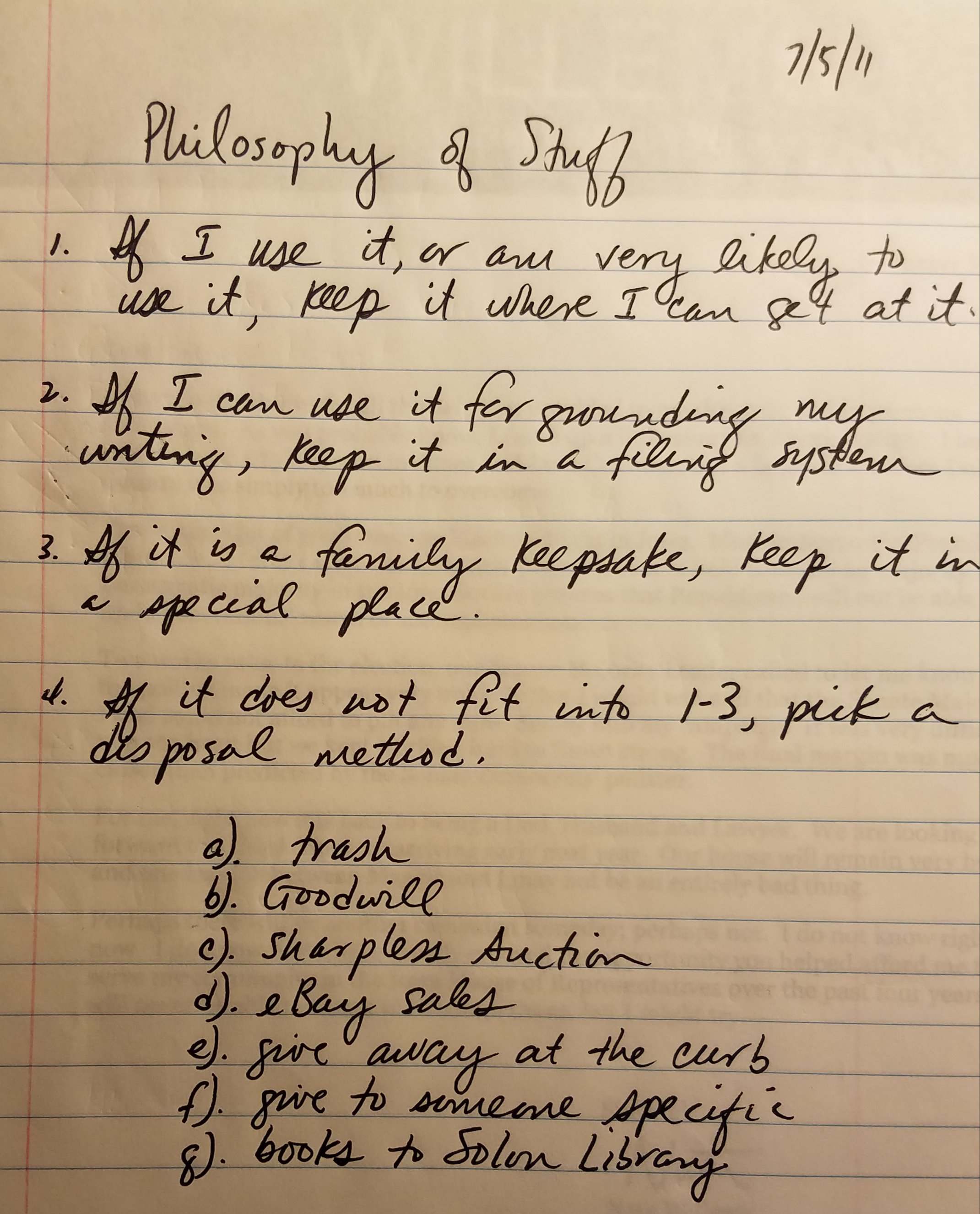
Turns out I developed an entire philosophy of stuff back in 2011, soon after the realization we had too much stuff.
New stuff continued to pile up but we’re over that now. Culling has begun. I took a load of books to donate to the Friends of the Library book sale last week.
The impetus has been recent awareness of mortality, highlighted by the death of Mother. She did things right and disposed of much of her stuff during the years before she moved in with my sister. Many of us would emulate the best qualities of our parents. We can’t take stuff with us when we die, and what reasonable person wants to leave the trouble of sorting it to others?
We have a duty to reduce, reuse and recycle all the stuff our consumer society has wrought. These days I’m working more on the reduce part of that.
I’ve long felt an urge to go shopping when my calendar is blank. When I lived in Mainz, Germany, if I had a free weekend, I felt I should cross the Rhine River to Wiesbaden and visit one of the big box stores. Living in that large community provided different options for food and clothing from what I could find at the Kaserne’s Post Exchange. Last Saturday, after a political event, I drove straight home, resisting the impulse to head to the home, farm and auto supply store or the warehouse club without a specific shopping list. It felt pretty good.
It’s time to put my philosophy of stuff into action.
1. If I use it, or am very likely to use it, keep it where I can get at it.
2. If I can use it for grounding my writing, keep it in a filing system.
3. If it is a family keepsake, keep it in a special place.
4. If it does not fit into 1-3, pick a disposal method.
Now begins the hard work: carving out time to reduce the amount of stuff before late winter gardening prep begins. Maybe easier said than done, but this year there is hope.
Mother sent this email on Aug. 13, 2000, after a family reunion in Davenport, Iowa.
The Nadolski family reunion was held on the 12th of August, 2000 at Fejervary Park in Davenport, Iowa. The reason that park was chosen is that in the old days we often had family picnics there and when they where alive, Catherine and Frank Nadolski held court, she in her dark flowered dress with a lacy collar and he in his dark pants, white shirt and suspenders. They sat in a prominent position, where they could see everything that was going on.
Grandpa would take his cane and hook a child around the waist, or sometimes the neck, and pull them toward him so that he could ask them questions and, I presume, when you gave the right answer to his question he sometimes gave you a nickel. Of course, a nickel meant much more then than it does now.
You could get an ice cream cone for a nickel or a candy bar. Grandma sat in her place and rarely smiled and didn’t ever have a conversation with me, or any other kid that I saw. Their daughters and their daughter’s families would provide the food and take the opportunity to have a good time together.
The kids all loved it. It was a fine park with swings and slides and Indian Rock to climb on and we had the best time. The food was always the best.
Traditional Polish foods as well as plenty of potato salad, deviled eggs, hot dogs and cakes and pies and my personal favorite, bologna with mustard on white bakery bread. I don’t think any of the families where rich, certainly we weren’t, but the pleasure of the moment and the memories of those simpler times in our lives is priceless beyond all wealth. When ‘family’ was not only a bunch of people with a genetic link, but a group of people with a palpable connection. Not only that, we could see our connection right there in Fej park; she in her long dress and he with his cane. They where and are our connection. The genes that live in all of us and show up in so many faces. The driving force that impacted on the way each of us have lived our lives.
It was with those memories and the warm heart they produced that I attended the first ever family reunion that I know of. I had looked forward to this occasion for the better part of this year and I will tell you that it did not disappoint. God gave us a glorious day. It was an unusual August day for Iowa. Usually it is very hot and humid in Iowa in August, very often with temperature in the 100s and humid as a swamp, but we really lucked out, or maybe it was a little Divine influence with so many Nadolskis up there.
I went to the park early so that I could really spend the whole day there and it was a lovely setting and so peaceful in the morning. Lots of trees around and plenty of room for the kids to run around and still be seen by their parents. I stayed and visited for a while with Marge and Bob and Sue Ellen and her daughters and then I had to run home and get the rest of my stuff and when I came back to the park, the people started to arrive. This was the best part. Seeing the people come. Many familiar faces and some that I had never seen before. There where people there from the families of Aunt Tillie, my mother Mae, Aunt Pauline, Aunt Barbara, Aunt Eleanor, Aunt Johnnie, Uncle Harry, and Aunt Marie.
It was lovely to see all the cousins come. Their families with them. I don’t think I ever saw so many smiling faces. Cousins who lived far apart getting to know each other again. Sisters and brothers talking, head to head about the old times. Cousins who never knew each other finding out that they had a common bond, like my kids talking to one of their cousins whom they had never met who told them ‘I loved Aunt Mae’ and my kids and Katie’s kids finding out that they weren’t the only ones who knew or loved their remarkable grandmother. The laughing about old times and the tears when the memories became so painful. One of the most prevalent common bonds among us was that we had all lost someone who was a Nadolski. Those moments when the memory of those members of our family who have gone forever brought a lump to the throat and took us back to when they where here. Oh how those sisters and Harry would have loved being there. Can’t you just see the wide smiles and joy in their eyes. Shirley said that they where sitting in the rafters of the shelter, looking down and smiling at us and I believe she was right.
I know that like all of you, I would give anything to have 5 more minutes with my mother. I know in my heart I can’t, but it is gatherings like these that help keep her and all of them alive.
Soon there where more people than I could count. 128 signed the book, but I know there where about 200 there. It was just great. Kids running around having a ball. Groups of grownups who just all looked like each other.
People laughing and crying; renewing friendships and just getting to know each other. The universal fun of watching children play; seeing a grandma and grandpa with fear in their eyes looking for a misplaced child; women talking about absent children and grandchildren; husband and wives just smiling with warm eyes at their spouses having such a happy time with their cousins; soon to be Grandma, patting the pregnant belly of a daughter-in-law; hugs and kisses from distant cousins; groups loading up a car and making a potty run; kids trying to toast marshmallows on a fire that wasn’t there; Dad’s watching the kids while Mom got caught up on the gossip; the food line with so much amazing food (one thing for sure, we all know how to cook); kids amazed that they can have as much ice cream as they want; everyone there because on Saturday, August 12, 2000 this was the place they wanted to be.
The most heart rendering moment was when a young man talked to my sister and said that he belong to the family, but he wasn’t sure how. He thought he was a descendant of Aunt Eleanor. That was so sad to me that someone wasn’t sure where they fit in the family and, paradoxically, so joyous because he had sought out his family and found them.
I also want to talk about a generation that is rapidly disappearing. It is my generation. When Uncle Floyd died recently, we lost the last one of that generation. We are now the older generation. We lost so many of our generation in the past few years and we are dwindling down to fewer than I can believe. So I want to talk about those of us who are first cousins who where there. Kenny and Marge who are the last two of Aunt Barbara’s children; LeRoy who is Aunt Johnnie’s son; Midge and Jimmy who are Aunt Eleanor’s children; Jan who is Uncle Harry’s daughter; Shirley and Winifred (Tiny) who are Aunt Pauline’s daughters; Larry who is Aunt Marie’s son; and Catherine and Lorraine who are your Aunt Mae’s daughters. When grandpa died in 1951, he had more than 80 direct descendants, most of whom where first cousins and there just aren’t enough of us left. It is good to know that many of us get together from time to time and we enjoy each other’s company but I sure would like to see more of my extended family. A lot of what keeps us from seeing family is just pure and simple geography. I have stayed in Davenport but it seems as though no one else did. Midge, Jimmy and I are the only ones left in Davenport. Hard to believe.
To those of you who couldn’t be there, we missed you. To those of you who were there, we where delighted to see you. To all of you, always remember that ‘we are family’ and the family is everything.
Thank you for reading, following, liking and commenting on my posts. You helped make 2019 a record year for this place in cyberspace.
The holiday season began in our house with yesterday’s thirty-seventh wedding anniversary. We’ll make a pot of chili with cornbread for Christmas eve, then settle into the rest of the seasonal slowdown: noting my birthday a few days later, then arrival of the new year.
Whatever end of year holidays have become they also are caesura in a life clinging to hope. There is a lot on the docket for next year. For now, it’s the in-between time and that’s good enough.
Best wishes for a peaceful season and a happy New Year from this writer in Iowa.
My history begins with today’s vantage: looking backward in time from an unfinished writing space in our Big Grove Township home. Such perspective helps our story makes more sense than it did while living it.
I understand all of my writing — countless emails, letters, social media posts, and blog posts — is derived from experience residing in memory. Sometimes it is unique, sometimes not.
I look, as if in a deer stand along a familiar pathway, hoping to encounter a subject, without its being aware. Armed with my senses, and hope I will find uniqueness in quotidian moments, I endeavor to capture such fleeting essence.
In that light I write this autobiography.
It is unthinkable that we are here only to consume, grow and die. There is a greater purpose, and in writing, I hope to reveal it to those close to me, to any reader who finds these words, and importantly, to myself. I find purpose in every piece I write, just as in more practical work like planting a seed, driving a lift truck, making the bed, or speaking in public.
There is a necessary organizational component to writing a longer piece. We shouldn’t be consumed with organization. Like an underground coal miner we need a framework of timbers, buckets, picks and shovels, water pumps, labor, and air circulation to do the work. We also need freedom to follow the seam where it leads.
Sometimes a remembrance stands alone as a solitary and specific instance of creation. Yet most memories are part of a social context. Understanding social context can make the narrative ours with broader applicability.
My autobiography is not as much about me, as it is about the people places and processes of which I have been a part. My task is not to chronicle events and ideas that were my experience. It is to tell a story of a life beginning in the present. It will include characters, locations, processes and events. Writing is a way to learn how to do that. Autobiography seeks ways we are unique grounded in shared experiences. If it is that, a finished work is more likely to have relevancy.
Writing autobiography is an American thing. I studied at university under Albert E. Stone who edited J. Hector St. John de Crèvecoeur’s Letters from an American Farmer. We Americans, especially in this century, often seem completely self-absorbed. There is a native impulse to write or tell a single, brief narrative of our life when more accurately it is a combination of essential, defining moments and multiple, broader narratives. At the root of autobiography, we must answer the question Crèvecoeur did, “What then, is the American, this new man?”
I will follow an outline. It is important to note the perspective of the present necessitates blending memory and experience into a life story. Likewise, the process of writing is an interrogatory, the answers to which must come through structured thought and research. I seek to gain understanding of which I am not now possessed.
I have a pile of subject cards on my writing table. I envision a story board, with segments centered around organizing principles, such as the locale, ideas, processes, and characters that have helped define me. Just as artists create self-portraits, this autobiography would also be one in a series of them.
There is something about the idea of artistic creation. While process is important, imagination is too. As I endeavor to capture fleeting moments of insight about our lives in society I eschew automatic writing and everything that means. From my perch near the lake I hope to take flight from time to time and bring back essential materials to make an engaging story. Whatever I write will be my story, crafted by two working hands and centered on a vision of understanding I discovered early on.
Fingers crossed the narratives have broader appeal.
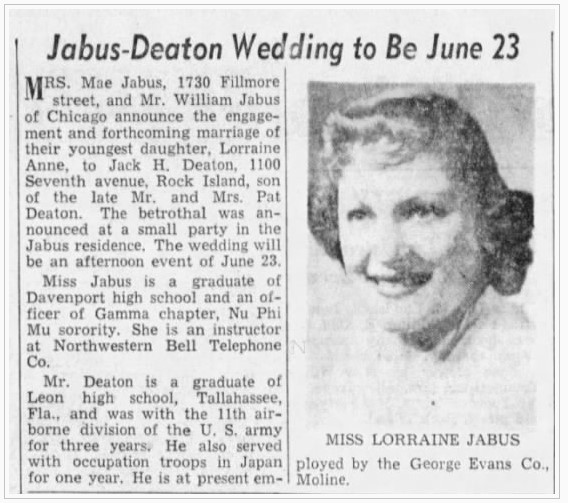
Wedding Announcement in the Daily Times, May 23, 1951.
When researching our lives, official publications like my parents’ wedding announcement in the May 23, 1951 Daily Times are never completely accurate.
William used the Polish spelling of his last name, Dziabas, rather than the anglicized version, Jabus, Grandmother did. Why was he in Chicago and Mae in Davenport? Despite Mother writing about it in a partial memoir, we’ll never fully know.
The article omits Father’s step mother, who lived in Rock Island well into my lifetime. I corresponded with her by mail but we never met. She said her marriage to Grandfather was a “business arrangement” in a letter. The business was named the Deaton Diner and she kept his name until she died, burying Grandfather and two subsequent husbands in a row near her eventual grave. She was known by the sexton at the cemetery but not a significant part of my life.
Despite the partial picture official announcements present, they detail biographical information that might otherwise be lost. Mother talked about graduating from Davenport High School and working for the phone company until her 90th birthday this year. The clipping is evidence. Our family visited Leon High School during a trip to Florida before Father died. I visited his alma mater while working in South Georgia for a logistics company. Father was a welder at George Evans Company according to the story. He seldom talked about his military service although an omitted fact — he was born in Virginia — was a primary influence when I was growing up.
As members of society we publish official notices to mark rites of passage. When I found this clipping by chance on the internet, it made my day. Official notices provide an opportunity to sand off the rough spots in our lives as we pass through milestones. As a biographer one has to ask whether to present the narrative as-is, or to embellish it with additional facts derived from experience outside its context. My answer is to present the artifact with sparing interpretation.
While presenting artifacts, I’m also weaving a narrative, something derived from both artifacts and experiences. The artifact never really stands alone. It becomes part of a narrative reduced to writing or told orally time and again until it becomes part of our world. Where such narratives will go remains uncertain. They have a basis in clippings like this wedding announcement.


 Journey Home
You must be logged in to post a comment.