Some of us aren’t doing any soul searching after the 2016 general election.
Democrats lost, and as a Democrat that means something to me personally. Yet I know what I stand for and so do my friends and family.
Nothing about our beliefs was changed by the election of Donald Trump. If anything, we plan to work harder to advocate for what we believe is just.
Last week the president-elect and his daughter met with former Vice President Al Gore. Gore’s statement after the meeting was important as it pertains to mitigating the negative impact of man-made global warming and climate change on humans. It also applies more generally.
“Despair is just another form of denial. There is no time to despair. We don’t have time to lick our wounds, to hope for a different election outcome,” Gore wrote. “We have to win this struggle and we will win it; the only question is how fast we win.”
I share Gore’s optimism and so should people who care about leaving a better world for our descendants.
Who knows what President Trump’s impact on the environment will be?
To hold ground environmental advocates have claimed since the Nixon administration, we can’t ignore the renewed challenges presented by the mogul’s rise to power.
We don’t know what Trump will do, however, environmental advocates have been stroking against the current all along. The stakes are too high to give up now, nor will we.
We are stronger together so I plan to join with my colleagues at The Climate Reality Project for mutual support and direction. A perfectly timed kickoff is the 24 Hours of Reality webcast scheduled Dec. 5 and 6. I will tune in for at least part of it and encourage readers to do likewise.
Here’s what our chairman had to say after the election:
In every great struggle humanity has undertaken, the march towards progress has included both successes and setbacks. And the struggle to protect and save the Earth’s ecological system is no exception.
Today, I am as optimistic and resolved as ever that we will solve the climate crisis. Our collective efforts are dependent not on politics or ideology — or elections — but on our commitment to each other, to the health of our planet and to a sustainable future for all.
We must — and will — continue to find hope and joy in our work that will define humanity for generations.
Last night President-elect Trump said he wanted to be a president for all Americans. In that spirit, I hope that he will work with the overwhelming majority of us who believe that the climate crisis is the greatest threat we face as a nation.
I wish him well in these efforts and intend to do everything I can to work with him and his administration to ensure that our nation remains a leader in the global effort to meet this challenge. Moreover, there is reason to believe that it is not naive or Pollyannaish to hope for more than what we fear.
We have already made great strides to solve the climate crisis all around the world. The work that has been done by civil society, businesses, investors, and governments at all levels will continue to be driven by the fact that solutions to the climate crisis are not just vital to our planet, but are vital to our economy. The market forces driving the transition to a sustainable economy simply will not be slowed.
Less than a year ago, when the historic Paris Agreement was reached, we knew that our journey was only beginning. We knew this work would not be easy – indeed, more would be required. Now we know that our work must be redoubled.
Today, without regard to last night’s outcome, we must turn our focus to making the promises of the Paris Agreement a reality by embracing the forces that are already working to grow our economy and transform our energy future.
A sustainable future is in sight – but we cannot take it for granted. We must fight for the future we all believe in. Now, more than ever, our planet needs us – and I’m inspired by the knowledge that we’ll take the path forward together.
Al Gore
Founder and Chairman
The Climate Reality Project
Closer to home, I’ve long followed State Senator Rob Hogg who is an advocate for protecting the environment and a member of The Climate Reality Project. Recently elected minority leader in the Iowa Senate, Hogg offered this advice:
Continue to speak up with elected officials. A Doubting Thomas today can be a leader for climate action tomorrow. Remind Republicans of their successes including the Clean Air Act, the Montreal Protocol, and solar energy investment tax credits. Do not let them off the hook by ignoring them.
Midway through my seventh decade of life it is time to get more active. I am ready for what lies ahead and the road forward.
The weekend began with a trip to the COSTCO bakery where I bought 2.2 pounds of cookies after my shift at the home, farm and auto supply store.
I am celebrating my first Saturday without a work shift since July 26 with, that’s right, cookies!
Saturday morning I made harvest soup from bits and pieces in the ice box, pantry and counter. With a sandwich it made a hearty lunch with three leftover quarts of soup for later in the week.
Hot peppers and kale
Gleaning the garden yielded sage, oregano, chives, kale, hot peppers, cucumbers and tomatoes.
After cleaning the vegetables there are bags of herbs and kale in the ice box, Bangkok peppers in the dehydrator, and a big bowl of Serrano and Jalapeno peppers in the ice box. More Bangkok peppers are ripening on the counter. Cucumber salad is in the works for Sunday as is an appetizer for the work dinner later in the evening. It is weird to be harvesting cucumbers and tomatoes in November.
I don’t fully understand the El Niño/La Niña cycle but the weather has been warm. Saturday’s harvest weeks after the normal first hard frost stands as evidence. Climate change is not about the weather per se but warming temperatures in the equatorial Pacific Ocean impact Iowa.
Assorted kale leaves
Photos of fresh produce compliment each day and help us forget about the impacts of changing climate. There is something to be said for a warm Iowa winter. It would be welcomed by most people I know.
The hard frost is coming and with it the end of the gardening season.
In the meanwhile we harvest what we can and make a life for ourselves on the Iowa prairie.
Heading into the general election, public life is converging into a melee with an uncertain outcome.
Worklife had me circling the wagons, inner focus broken only by work, social media, and news feeds on my hand-held computer. I engaged with thousands of people, yet remained focused on sustaining a life midst social turbulence.
The streams of politics, environmentalism, justice, and conflict seem heading for an apocalyptic finish line.
Where to begin?
Environmental activism is off track with opposition to the Keystone XL and Dakota Access pipelines. Mode of transportation will never be as important an issue as reducing global greenhouse gas emissions. Oil and natural gas production is predicated on economic models — models that can change dramatically as solar, wind and other forms of renewable power generation continue to be developed and deployed. The same economic, governmental, technology and health factors driving the decline in coal extraction and use can and should be at the forefront of environmental activism regarding oil and natural gas production, distribution and use.
Environmental advocates are distracted by development of the Dakota Access pipeline by Energy Transfer Partners. The pipeline is nearly complete in North Dakota, nearly complete in South Dakota, two-thirds complete in Iowa, and 75 percent complete overall as of earlier this month. The pipeline is not finished but clearly will be despite heartfelt protests.
The issue of land rights has taken prominence among advocates against the pipeline. That fight would more properly be fought in the United States Supreme Court by overturning the June 23, 2005 5-4 decision in Kelo v. City of New London which granted private developers the right to transfer ownership of property as a permissible public use under the Takings Clause of the Fifth Amendment to the U.S. Constitution. Use of eminent domain by Energy Transfer Partners to gain easements for their pipeline may be wrong, however, it is legal. Even if the U.S. Senate confirms a Democratic President’s appointment to the high court, there is no guarantee eminent domain would be taken up nor that Kelo would be overturned. Land rights issues activate people who would not normally be a part of environmental actions. The long-term value of such engagement to the environmental movement is an open question.
I support the Standing Rock Sioux Tribe’s resistance to land acquisition for the Dakota Access Pipeline. A web site No DAPL Solidarity calls for people to take action in support of tribal goals, including going to the site, organizing solidarity actions in our own communities, and sending money. I could do more to support the effort.
Election of anyone other than Hillary Clinton as president would be a setback for efforts to stop the Dakota Access Pipeline, and for environmental issues generally. Clinton may not be the champion for the environment we want, however, election of her main opponent would undo the environmental progress of the last 40 years. Melee may be too mild a word for what may happen after the Nov. 8 election.
Hay Feeder Ring Photo Credit – Tarter Farm and Ranch Equipment
Something is wrong when the garden produces tomatoes, cucumbers and peppers in Iowa the fourth week in October.
I’ll dice tomatoes for breakfast tacos later this week, Bangkok peppers are in the dehydrator, and cucumbers and jalapeno peppers in the icebox waiting to be used. There is chard and kale, oregano and chives. Those leafy green vegetables usually survive until November, but tomatoes and cucumbers?
Call it what you want but something is happening and we know exactly what it is.
I spent most of Friday working with hay feeder rings.
After re-resurfacing the outside lot where farm equipment is displayed at the home, farm and auto supply store, I assembled and re-merchandised the stock of feeder rings.
I don’t know if it was a day’s work, but spent a day doing it, working slowly and as safely as possible. I was tired after the shift with a hankering to leave everything and head west to work on a ranch — day dreams of a low-wage worker.
The garage was cluttered after a summer of intermittent work.
I checked off each item on the to-do list on my handheld device before heading to the orchard for a shift. I disassembled the grass catcher and stored it; re-mixed bird seed and filled the feeder; checked the air pressure on our auto tires; brought in salt and paper products from the car; stored 40 pounds of coarse salt in tubs for winter ice melting; cleared a work space on the bench; and swept the entire floor. It took about two hours. I wanted more, but time ran out.
Yesterday’s political events had me thinking of Gettysburg, Penn. My parents, brother and sister went there before Dad died. I remember reading President Lincoln’s Gettysburg Address on a placard near where he read it himself. With deep roots in rural Virginia, and ancestors fighting on both sides of the Civil War, it was a seminal experience for me. It began the process of turning me from being a descendant of southerners enamored of romantic notions about plantation life to being an American eschewing the peculiar institution and those who stood for it. To my mother’s probable dismay, I brought home a Confederate flag and hung it in my bedroom. Visiting Gettysburg helped me understand the reality of the Civil War and those who fought and lived through it. I was coming of age.
My parents pointed out the house and farm where Dwight and Mamie Eisenhower lived after his presidency. Eisenhower hosted world leaders there, including Nikita Khrushchev, Charles de Gaulle and Winston Churchill. He also raised Angus cattle. We thought favorably of Eisenhower even if he was a Republican. As Supreme Commander of the Allied Forces in Europe during World War II he was a well known part of our culture. Seeing his farm enabled us to touch reality in his celebrity.
My life is here in Big Grove. I’m not heading west to work on a ranch. I don’t display the Confederate battle flag or think about it much any more. I will re-read the Gettysburg Address as I did this morning and wonder how my ancestors got along with each other after fighting in the Civil War. Perhaps there are lessons for the United States in 2016. I’m certain there are.
(EDITOR’S NOTE: I send more letters to the Des Moines Register than get printed. This topic has been well covered in the news, so I doubt they will run it. Will post a link if they do).
There’s a bitter irony in the letter Iowa’s two U.S. Senators sent the U.S. Army Corps of Engineers Sept. 27 regarding $73 million in funding for a Cedar River project for flood risk management authorized but not funded by Congress in 2014.
The tough, clear message from Senators Grassley and Ernst to the Corps is find the money for the project in your budget. The irony is there will be no specific appropriation by the Congress to meet the needs of Iowa’s second largest city.
The Iowa Department of Natural Resources indicates on its website that eastern Iowa can expect increased frequency of precipitation extremes that lead to flooding. The need for the project is real.
While Iowa’s Senators have taken the Corps of Engineers to task for not prioritizing the Cedar River project, their effort to tie the Corps to the whipping post are transparent in this election year.
The letter is what austerity policy looks like. It’s not good for the people of Cedar Rapids or for other flood impacted areas in Iowa.
Instead of drafting terse letters, show us how Cedar Rapids gets funding for the Cedar River project.
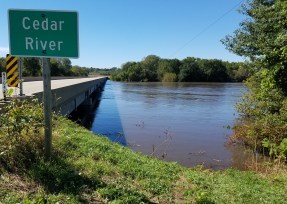
Cedar River at Iowa Highway One on Sept. 27, 2016 at 11:36 a.m.
The Cedar River crested in Cedar Rapids at 21.91 feet at 11 a.m. yesterday.
As the river recedes over the next few days the temporary flood wall and earthen berms built over the weekend will be monitored for breaches.
They held during the crest, protecting people and property from damage. Here’s a link to a news story about the flood.
State Senator Rob Hogg announced a “Flood Relief, Recovery and Resilience Tour” of Cedar Falls, Waverly, Clarksville, Shell Rock, Charles City, Vinton and Palo today and tomorrow. Hogg hopes to learn about the damage done, what kind of help people need, what worked and what didn’t work, and how we can do more together to reduce future flood damage, including better flood mitigation infrastructure and better watershed and floodplain management according to the event page on Facebook.
The City of Cedar Rapids knew what to do when flooding was predicted after heavy precipitation events upstream. Over the weekend officials executed a plan to build a temporary flood wall, evacuated low-lying areas and ramped up emergency services to prevent large-scale damage to homes, property and people living in Iowa’s second largest city. News media stories focused on the human drama of reaction to the impending flood. There has been little coverage of the causes of the heavy precipitation events that produced rain that caused the flooding in northeastern Iowa.
“Iowa is already experiencing the effects of climate change,” according to the Iowa Department of Natural Resources website. This includes “increased frequency of precipitation extremes that lead to flooding.”
Flooded Farm Near the Cedar River, Sept. 27, 2016
Because this is the second major flood in Cedar Rapids since 2008, solutions to protecting people and assets going forward have been discussed and are clear.
Senator Hogg outlined three essential strategies: get Congress to help fund permanent flood protection that has already received state and local funding; better upstream watershed and floodplain management to reduce peak flooding; and action on climate change to stop extreme precipitation events from getting worse.
U.S. Senators Chuck Grassley and Joni Ernst sent a letter to the Army Corps of Engineers “demanding answers on why they have neglected to complete flood mitigation projects in the Cedar Rapids region and have put the public’s safety at risk.”
They wrote:
With all due respect, it is no longer sufficient to say that your hands are tied and that nothing short of a congressional earmark can help communities like Cedar Rapids that have lower property values. You have some discretion to help and have simply made the decision to forego the assistance even though the community endured a 500-year flood event in 2008, worked with the Corps to develop a project to address that flood risk, and worked with Congress to get it authorized. Due to your refusal to budget for this project, Cedar Rapids is now facing another major flood event without the needed levee improvements.
Hidden in this tough language is a bitter irony. Congress won’t appropriate money for the project, yet the senators expect the Corps of Engineers to find it somewhere else in their budget. This is what austerity policies look like and they are not good for the people of Cedar Rapids and other flood impacted areas.
While Iowans impacted by flooding are concerned, in the upper atmosphere carbon dioxide levels maintained a level above 400 part per million according to monitors in Hawaii. Atmospheric carbon dioxide level is a key contributor to global warming which increases the intensity of precipitation events that have led to Iowa flooding.
“September is usually the month when carbon dioxide is at its lowest after a summer of plants growing and sucking it up in the northern hemisphere,” Brian Kahn wrote in an article on Climate Central. “As fall wears on, those plants lose their leaves, which in turn decompose, releasing the stored carbon dioxide back into the atmosphere. At Mauna Loa Observatory, the world’s marquee site for monitoring carbon dioxide, there are signs that the process has begun but levels have remained above 400 ppm.”
The United Nations Intergovernmental Panel on Climate Change’s fifth Assessment Report notes that, “continued emission of greenhouse gases will cause further warming and long-lasting changes in all components of the climate system, increasing the likelihood of severe, pervasive and irreversible impacts for people and ecosystems.”
That means more flooding in Iowa similar to this week’s event. While politicians like Senator Hogg are well-attuned to the urgency of this climate crisis, too many politicians and public officials are dismissive of climate change.
Governmental action to mitigate the effects of climate change is needed. If our current crop of politicians isn’t willing to take action, we should replace them with people who will.
Extreme One-Day Precipitation Events in the Contiguous 48 States. Bars = years; line = 9-year trend. Image Credit: U.S. EPA
The headline from this morning’s Des Moines Register was that residents of 5,000 Cedar Rapids homes were asked to evacuate in advance of the flood crest predicted to arrive Tuesday morning. The height of the crest has been revised downward to 23 feet, however, damage is expected to be severe.
Cedar Rapids fire officials plan to ask for the names of next of kin of residents who refuse to leave the flood zone.
City officials say government has been preparing for a major flood since the record-breaking 2008 event.
There is bravura in the execution of the local preparations indicating the city knows how to mobilize to prevent anticipated damage — better than it did in 2008. It is always good to see people coming together in times of natural disaster to help each other.
At the same time, almost everyone in government, in news media and in other accounts of the disaster fail to consider the root causes of the heavy precipitation events driving record flooding. The world continues to annually dump more than 38 billion tons of carbon dioxide into the atmosphere like it was an open sewer. That’s 2.4 million pounds per second.
News media and politicians may be enamored of the story of human resistance to the forces of nature, but failure to address the root cause of increased levels of carbon dioxide and other greenhouse gases in the atmosphere through proper governance should be unacceptable.
Government plays a significant role in mitigating the effects of climate change. Perhaps it’s time we changed the current crop of politicians who fill elected office seats from those who are cheer leaders for reaction to natural disasters to those who will take action to prevent them.
Without action, the chart above from the U.S. Environmental Protection Agency will continue to map a direction that puts people and assets in jeopardy.
We should know better and do something about global warming and climate change as a society.
Godspeed Cedar Rapids. May your elected officials who don’t already do so perceive tomorrow’s flooding as a wake-up call to action.
(Editor’s Note: When this guest column ran in the Cedar Rapids Gazette on Wednesday, Sept. 21, its abstract nature became real as heavy precipitation events pummeled Butler County and other parts of northeastern Iowa, disrupting lives there and downstream. Living in an environment where rain damages crops instead of nurturing them; where rivers jump their banks, close schools and displace people; and where Cedar Rapids must protect the city from record amounts of floodwater multiple times in eight years, something’s wrong. We must take action that includes electing a government that will address the causes of global warming and nuclear proliferation, not just deal with the actuality we have created).
Protect environment; stop nuclear weapons
By Paul Deaton Guest column for the Cedar Rapids Gazette Sept. 21, 2016. Reprinted with permission of the author
If we accept the premise articulated by Hillary Clinton’s presidential campaign, that we are stronger together, there is a lot in society requiring our collective attention.
There are no lone wolves in human society, although a number of people want to get away from the pack. Can we blame them? Being stronger together is a fundamental characteristic of Homo Sapiens. It’s what we do as a species.
What should we be working on?
It is hard to avoid the primacy of following the golden rule. We should be applying the golden rule, better than we have been, to everything we already do. This is basic.
Two other issues call for our attention, the threat of nuclear weapons, and mitigating the effects of climate change.
Today, on very short notice, nuclear powers can unleash a holocaust ending life as we know it. Nuclear war is not talked about much in the 21st Century; however the threat is as real today as it was when President Truman authorized the Hiroshima and Nagasaki nuclear bombings. The United States should take the lead in eliminating nuclear weapons. We need a transformational change in our nuclear policy that recognizes these weapons are the gravest threat to our security and must be banned and abolished.
We are wrecking our environment and should stop. Just 90 companies are to blame for most climate change, taking carbon out of the ground and putting it in the atmosphere, geographer Richard Heede said. If that’s the case, the move to eliminate fossil fuel use can’t come quick enough. These companies should be targeted for regulation by governments. Companies say they are not to blame for the demand from billions of consumers that drives fossil fuel use. Technologies exist to eliminate fossil fuels, and we should adopt them with haste. One purpose of government is to act as a voice for people who have no voice. Regulating business to protect our lives in the environment would serve that purpose.
After the 2016 election these issues will remain. The first can gain wide support easily. It is time the other two gain parity.
~ Paul Deaton retired from CRST Logistics in 2009.
There was a lot to make one cranky as summer ended yesterday, including the weather.
Extremely heavy rains are flooding parts of Iowa and the impact will soon be felt downstream.
The Cedar River is expected to crest at 24.1 feet next week in Cedar Rapids, Iowa, the highest level after the record 31.12 foot crest on June 13, 2008.
“We have four days to get ready, and now is the time to start,” Mayor Ron Corbett said Thursday.
We’ve had a lot more time than that to get ready.
During Al Gore’s Climate Reality Leadership Corps Training, conducted in Cedar Rapids in May 2015, Mayor Corbett made a presentation about the 2008 Cedar River flooding, how it impacted Cedar Rapids, and what actions were taken and being considered to mitigate damage from potential future floods. The next week will determine whether the plans and discussions were enough to prevent serious damage.
Senator Joni Ernst has been pushing the U.S. Army Corps of Engineers to expedite completion of the Cedar Rapids Flood Control Project, recently in the Water Resources Development Act.
“This legislation includes my work to direct the Army Corps of Engineers to expedite the completion of the Cedar Rapids flood control project,” Ernst wrote in a Sept. 15 press release. “The provision emphasizes to the Army Corps of Engineers that Congress wants this project to remain a priority. I will continue working to ensure the Army Corps of Engineers understands the great need for this long-standing project to be completed in a timely and efficient manner.”
These efforts seem well intentioned, but too little, too late.
The connection between this flood and global warming is clear. When the atmosphere is warmer, its capacity to store water vapor increases. When it does rain, it can do so in heavy precipitation events in which a large amount of rain falls in a brief amount of time. The frequency and intensity of heavy precipitation events has increased since World War II and that appears to be what happened in northeastern Iowa over the last few days.
Here’s an excerpt from a WHO-TV news article about flash flooding in Butler County. It tells the story:
BUTLER COUNTY, Iowa — Storms in northern and northeastern Iowa overnight caused some damage as they spawned tornadoes and dropped heavy rain – up to 10 inches – in some areas.
“We expect the crest this evening what we’re being told around 7 p.m. probably water levels similar to 2008 or more so,” said Jason Johnson, Butler County Sheriff.
Flooding from the Shell Rock River has cancelled classes in the North Butler School District for Thursday and many students gathered at the high school to help fill sandbags. Highway 14 on the way to Charles City is impassable because of water over the road.
Butler County Sheriff Johnson says there isn’t a widespread evacuation in Greene but some residents are moving to higher ground.
In Floyd County, 7.55” of rain was reported and Charles City saw 6.35”. The Little Cedar River is at moderate flood stage at Nashua and near Ionia. The rainfall total reported for Ionia is 6.24″.
Work will remedy the crankiness of summer’s end. One didn’t expect it to be sand bagging levies, homes and businesses to prevent damage from what is projected to be the second worst flood in Cedar Rapids history. It will get us through the weekend.
The newest flood begs the question of what’s next to mitigate the damage from future flooding? Government involvement in a solution is necessary but it must be implemented faster than it has been. We also have to connect the dots between our personal actions, global warming and climate change more than we have.
For now, we’ll just have to deal with the existential reality of the flood, something I recall doing since the 1960s. It’s a way of sustaining our lives in a turbulent world, but we can do better.
 Some of us aren’t doing any soul searching after the 2016 general election.






 Journey Home
You must be logged in to post a comment.