With Al Gore and Company at the Climate Reality Leadership Corps training in Chicago in 2013
2021 will be a pivotal year. We have a new American president, a new Congress, and abundant hope for progress in arms control and in mitigating the effects of warming atmosphere and oceans.
Each person can do something.
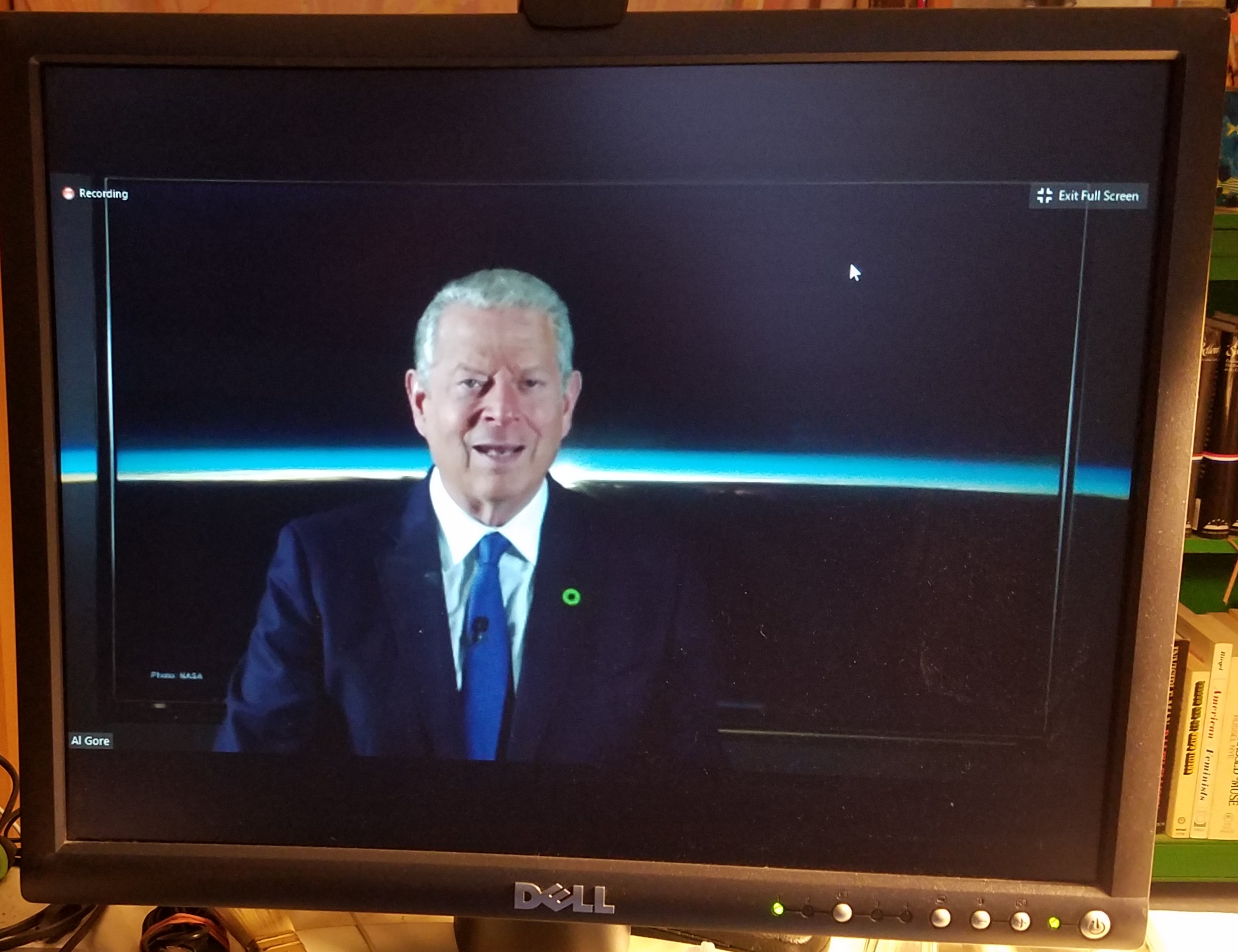
No matter your background, I encourage readers to consider participation in one of the Climate Reality Leadership Corps virtual trainings this year. The April 22 training is United States-focused to align with the opportunity our new government presents. There will be a virtual Latin America-focused training in July, and a virtual global training in October. Here is Al Gore’s announcement video and a link to the training page for more information.
This is a unique moment in history for climate action. Learn what it takes to engage in US-based climate advocacy at this vital hour at the @ClimateReality Leadership Corps Virtual US Training this April. Sign up today:https://t.co/AfbCyrWxB9pic.twitter.com/q1eROiOyXB
We received news on Tuesday afternoon the New START Treaty was extended.
“A week ago, the United States and Russia ‘exchanged diplomatic papers’ in order to extend the New START treaty for 5 years,” wrote Physicians for Social Responsibility in a Feb. 2 email. “Biden and Putin got this done in time — before New START was set to expire this Friday, Feb 5.”
Recent Republican administrations have not favored arms control treaties. In fact, the George W. Bush and Donald Trump administrations exited existing agreements. U.S. Admiral Charles Richard recently wrote in the U.S. Naval Institute journal Proceedings, the potential for nuclear war remains present.
“There is a real possibility that a regional crisis with Russia or China could escalate quickly to a conflict involving nuclear weapons, if they perceived a conventional loss would threaten the regime or state,” the four-star admiral wrote.
There’s nothing new in the Richard’s statement. While our relations with Russia and China require scrutiny, not only with regard to nuclear weapons, but with every facet of their complexity, a few things remain clear about the course the United States should be taking to prevent the detonation of nuclear weapons which may escalate into a full on war. In their new book, The Button: The New Nuclear Arms Race and Presidential Power From Truman to Trump, William J. Parry and Tom Z. Collina outline a framework that includes these items:
The president should not have sole authority to launch a nuclear weapons attack. The U.S. Constitution gives Congress sole authority to declare war. They should be engaged with any decision to launch nuclear weapons against another state or non-state actor. There is no need for the “nuclear football” that has been shadowing the president since the Kennedy administration.
We should never rush into nuclear war. Experience has shown us time is required to gather all the information needed to verify an attack is in progress. There is simply no need for the president to decide to retaliate based on sketchy or incomplete information in a matter of a few minutes. Launch on warning should be prohibited.
First use of nuclear weapons should be prohibited. Given U.S. conventional force superiority, there is little reason to use nuclear weapons.
Intercontinental Ballistic Missiles with nuclear warheads, positioned in silos to launch on warning are obsolete. If the U.S. were attacked with a large-scale nuclear missile launch, ICBMs in silos would be the among the first targets. They are part of the so-called nuclear triad which includes submarines and bombers ready to launch a nuclear attack or counter attack. If there were a nuclear attack on the U.S., submarines and bombers would comprise our primary retaliatory response. ICBMs are obsolete sitting ducks.
Strategic missile defense systems don’t work, despite billions of dollars spent developing them. Russia sees U.S. missile defense systems as a threat to their ability to retaliate in the event of a U.S. nuclear attack. U.S. missile defense systems, by their existence, block advancement of arms control negotiations between the world’s two owners of 90 percent of nuclear armaments.
The bigger picture is nuclear states should take seriously Article VI of the Non-Proliferation Treaty and work toward elimination of nuclear weapons. For those nuclear states which haven’t joined the treaty, they should. Countries should reduce and eliminate spending on weapons of mass destruction.
While I don’t agree with the Biden administration’s military spending priorities, I’m glad to receive the news they extended New START for five more years. Now build upon it.
This winter is shaping up to be a scary one. There has not been a substantial cold snap where the ambient temperature remains below zero for a week or more. We need that to suppress the insects living in the ground that feed on our plant life in the garden and yard when it gets warmer. Cold weather is also the best time to prune fruit trees.
It’s no surprise it’s getting warmer.
Atmospheric CO2 concentration hit 413.95 ppm at the Mauna Loa Observatory in Hawaii in December 2020. In my birth year of 1951 the global average was 311.80. There is a direct correlation between atmospheric CO2 and planetary warming. Our best hope is it’s not too late to mitigate rising CO2 levels.
According to NASA, 2020 tied 2016 as the warmest year on record in global average surface temperature. According to this chart, the rise in global surface temperature is in an accelerating upward trend since the baseline period of 1951-1980.
In the general election of 2020, Americans took a necessary step toward climate action by electing Joe Biden and Kamala Harris, the president and vice president willing to examine and understand the science of climate change and take action. Because Biden served as Barack Obama’s vice president, he knows what to do. It would have been better to elect a stronger majority in the legislative branch of the federal government, yet we didn’t. The majority we have will serve as we can’t wait two years to increase the majority of science believers in the midterms.
The United States rejoined the Paris Agreement within the United Nations Framework Convention on Climate Change. Like the election, it’s a beginning step. The Paris Agreement is flawed, yet it is difficult to see how the world makes progress toward reducing greenhouse gas emissions without the kind of cooperation it envisioned. Our country simply must be part of the discussion.
As a single citizen, or a small family, it is difficult to see how to help. We can and should reduce our personal carbon footprint, especially by doing things that don’t require a lot of capital: use less hot water, set the furnace thermostat lower, run the air conditioner at a higher temperature, use less gasoline and natural gas, eschew air travel and long automobile trips. The coronavirus pandemic kept many of us at home and that had a direct impact on greenhouse gas emissions. Eventually we will learn to live with the coronavirus and when we do, the need to control emissions will remain.
These are scary times. One view is there is nothing to be done about all this. The apocalypse is coming and the best we can do is mitigate its impact on us as individuals. It’s a vision of doomsday preppers, isolated and remote enclaves of the wealthy, and an attitude of preserving self as the catastrophe hits. I reject this view. We are stronger together and together we should remain in mitigating the impact of climate change.
It also seems important to focus on the big picture. Political leadership is required to make progress. For some of us, such leaders won’t be as bold as we want or feel is needed. We can’t relent on our politics.
Iowa has had its recent climate-related difficulties, floods in 1993 and 2008, tornadoes, straight line wind, a derecho, and drought. At the same time row crop yields were decreased due to climate change, as in the 2012 drought, a new, diverse agriculture remains possible because of our growing conditions. Gardeners like me contribute to resolving climate change by growing more of our own food. The process would be scalable if the importance of growing more local food were more generally accepted. We do what we can with local resources and conditions. We could do more.
Scary as it is, we can’t get depressed. It is human nature to be hopeful and hope is one of our most powerful attributes. It is important to be realistic about where we stand on mitigating the effects of greenhouse gases. For the next years, the picture isn’t going to be pretty. We can’t give up. We must persist in the effort to make our communal lives better. That’s what I plan to do.
It’s no secret there is an epistemological crisis undermining the authority of knowledge. It may be the most significant problem to grow out of the Reagan administration. That the discussion of creationism versus evolution returned during the 1980s was only the beginning.
There is a difference between justified belief (a.k.a. facts) and opinion and it is epistemological. That is, “relating to the theory of knowledge, especially with regard to its methods, validity, and scope, and the distinction between justified belief and opinion,” according to Dictionary.com. At issue is that solutions to other pressing problems rely on the ability of Americans to separate opinion from facts, something we as a society have become less able to do. Al Gore recently summarized our current situation as follows:
And though the pandemic fills our field of vision at the moment, it is only the most urgent of the multiple crises facing the country and planet, including 40 years of economic stagnation for middle-income families; hyper-inequality of incomes and wealth, with high levels of poverty; horrific structural racism; toxic partisanship; the impending collapse of nuclear arms control agreements; an epistemological crisis undermining the authority of knowledge; recklessly unprincipled behavior by social media companies; and, most dangerous of all, the climate crisis.
Al Gore, New York Times, Dec. 12, 2020
Unless we can agree there are facts, and how to distinguish them from opinions, we may have reached the end of the long, good run that was the American republic.
During the time since Reagan, moneyed interests gained hegemony in our government and society. Thom Hartmann put it this way in his forthcoming book The Hidden History of American Oligarchy: Reclaiming Our Democracy from the Ruling Class:
Billionaire oligarchs want to own our republic, and they’re nearly there thanks to legislation and Supreme Court decisions that they have essentially bought. They put Trump and his political allies into office and support a vast network of think tanks, publications, and social media that every day push our nation closer and closer to police-state tyranny.
Thom Hartmann, The Hidden History of American Oligarchy: Reclaiming Our Democracy from the Ruling Class, to be released February 2021.
It is particularly distressing American oligarchs used the cover of the coronavirus pandemic to increase their grip on the nation and extract taxpayer money intended to alleviate the fiscal crisis it caused. In normal times this would be unthinkable. These are not normal times.
In 1996, President Bill Clinton signed the Telecommunications Act which deregulated use of the public air waves. Regulations put in place in the 1920s through the 1940s were largely repealed. The result has been to consolidate most media under half a dozen corporations which now control the message. Perhaps Sinclair Broadcast Group is the worst in that they distribute editorial pieces from the corporation for inclusion during on-air broadcasts. All of the media corporations play a role in the deterioration of knowledge.
In 1987 President Ronald Reagan directed the FCC to cease enforcement of the Fairness Doctrine. In 2011 the Obama administration removed it from the FCC rules completely. Broadcasters no longer had an obligation to present balanced or fact-based information. The significance to the epistemological crisis these actions brought is hard to overstate.
What do we do about it? For those of us on small, private blogs it is easy: have a basis in fact if we run a story, focus on inquiry and understanding. As Tom Nichols pointed out in his book, The Death of Expertise: The Campaign Against Established Knowledge and Why it Matters, “None of us is a Da Vinci, painting the Mona Lisa in the morning and designing helicopters at night. That’s as it should be. No, the bigger problem is that we’re proud of not knowing things.”
With their 40-year head start, it will be challenging to overtake the oligarch puppet masters who bought much of our government. Hartmann has a dozen ideas to get us started. Gore and Nichols have more. The bottom line is the truth matters, scientific methods matter, and while religious belief plays a role in human culture there is a difference between things we take on faith and those that can be verified through scientific methods.
At the Oct. 22 presidential debate, Joe Biden said, “We’re going to choose science over fiction.” It’s a starting point on a long journey, one which we all should join.
After the Electoral College vote for president and vice president on Dec. 14, Senate Majority Leader Mitch McConnell publicly congratulated president-elect Joe Biden and vice president-elect Kamala Harris on their win. He noted Harris is the first female vice president-elect, a historic achievement.
In the kabuki dance that is our nation’s capitol, “(McConnell) urged Senate Republicans not to join a long-shot effort led by conservatives in the House to challenge the electoral college results when Congress formally tabulates the vote Jan. 6,” according to the Washington Post. Such an action is doomed to failure as on a straight line party vote it will fail in the U.S. House. Media outlets indicated McConnell wants to avoid such a vote in the Senate.
Former Vice President Al Gore was one of the first world renown environmental leaders to meet with president-elect Donald Trump at Trump Tower in New York after the November 2016 election. The conversation was kept private.
Yesterday, during a 45-minute webinar with members of the Climate Reality Leadership Corps, Gore said, “This is our moment.” The next four years represent an opportunity to address the climate crisis, beginning with the Biden administration’s intent to rejoin the United Nations Framework Convention on Climate Change, better known as the Paris Agreement. Gore had a long to-do list and there truly is a lot to get done to reduce global greenhouse gas emissions. We all must do our part.
McConnell’s announcement and Gore’s speech are the beginning points for a long, difficult journey. Not only does Washington need to recognize scientific truths, we must return to the Obama era practice of embedding climate action in every aspect of the U.S. government. Biden is willing to do so. With the appointment of John Kerry and Gina McCarthy to new roles devoted to addressing the climate crisis, the structural framework is being built.
The Climate Reality Leadership Corps has a number of members across Iowa. The May 2015 training event in Cedar Rapids helped increase our numbers. There are two Iowa chapters of Climate Reality leaders, one in Des Moines, and another in Ames. I joined the Des Moines chapter this morning. Having organized the state for other projects, I’m not sure of the efficacy of developing this chapter, or another in Eastern Iowa, when so many other environmental groups exist in the state. Efforts to pull them together have proven difficult because there is a lack of consensus on priorities. There is also plenty of diverse work to be done. In a society where internet connectivity plays an increasing role, efforts to organize people willing to take action on the climate crisis is energy that should be used to address the climate crisis directly. It is important to be a part of this and other groups. It is more important to focus on the work.
The Sierra Club has a strong presence in Iowa and I support and will work on some of their priorities, such as regulation of companies that seek to pump water from the Jordan Aquifer and ship it out of state. There are other groups as well. In Iowa there are issues that merit our attention. I described them to some long-time friends in an email:
I don’t know what people feel about carbon sequestration as a way to impact greenhouse gas emissions, but it’s all the rage in Iowa. Because it’s all the rage, it is possible, although unlikely, something can be done on it. The danger is it supplants other, more important action that could be taken to reduce GHG emissions.
Another concern is ethanol production. We need a resilient form of agriculture that relies less on making combustible fuel from corn and other biomass. We’ve been at loggerheads for a long time over ethanol yet if we could drive a wedge into this issue in 2021 it would be a positive development.
I don’t know where the University of Iowa is on their blending of biomass with coal, but after numerous attempts, I don’t see any headway in influencing what they do. They should retire the coal plant, and if we could figure out a method or argument to persuade them, that would be a balance between barking up the same tree and a major breakthrough.
Email to Iowa Physicians for Social Responsibility, Dec. 14, 2020.
The elephant in the room is the 2023 Farm Bill. Biden indicated addressing the climate crisis in it is an important priority. While Department of Agriculture secretary-designate Tom Vilsack is known for his alignment with large agricultural interests, and has been no friend to the environment, he is also a good Democratic soldier who will do what Biden asks and who deserves our support as the Farm Bill works its way through the process. Advocates for addressing the climate crisis in Iowa should monitor and devote some bandwidth to the emerging Farm Bill.
Gore waited to make his speech until after the Electoral College vote. We knew what was coming and are ready. There remains a lot to do to address the climate crisis and it will take all hands on deck. This is our moment.
The period after the general election and before the next U.S. Congress is proving to be desultory. About the only positive thing coming out of these weeks is the president is fading from view as each day brings us closer to a Biden-Harris administration. I don’t want time to pass quickly yet I seek outlets besides national politics for my human energy. I also take a daily afternoon nap.
Garden planning has begun and the first shipment from a seed supplier arrived yesterday. I hope to expand the garden, more closely correlate the garden and the kitchen/pantry, and grow more vegetables for the food rescue operation. In the meanwhile we’re still cooking food put up last summer and fall.
I read the first 400 pages of Obama’s presidential memoir. His first book, Dreams from my Father remains his best written with A Promised Land ahead of The Audacity of Hope. He’s a young man so I expect there will be more writing after he finishes the second volume of memoirs. I also doubt he will be as prolific a writer as Jimmy Carter became in his post-presidency period. A Trump memoir? Stand on your head if you think he will personally write one. No doubt he will cash in on the opportunity by hiring a ghost writer to tell his story, his way, and put his name on it.
I read my journal from late 1974 and 1975. In it I recorded reading many books, two or three a week and sometimes more. Today reading a book is a bigger deal. I will finish 50 or so this year, which is more than most people read, yet much less than I once did. According to the Social Security Administration life expectancy calculator I can expect to live 16 more years. At an average of two books per month that’s 384 more to read, which doesn’t seem like many given everything that is available.
I’m nowhere near assembling the planning threads for next year. There’s the garden, reading and writing. There is also our family’s wellness and home maintenance to consider. By the first of January I hope to weave something that is meaningful and fits well as we enter another year of the pandemic in 2021.
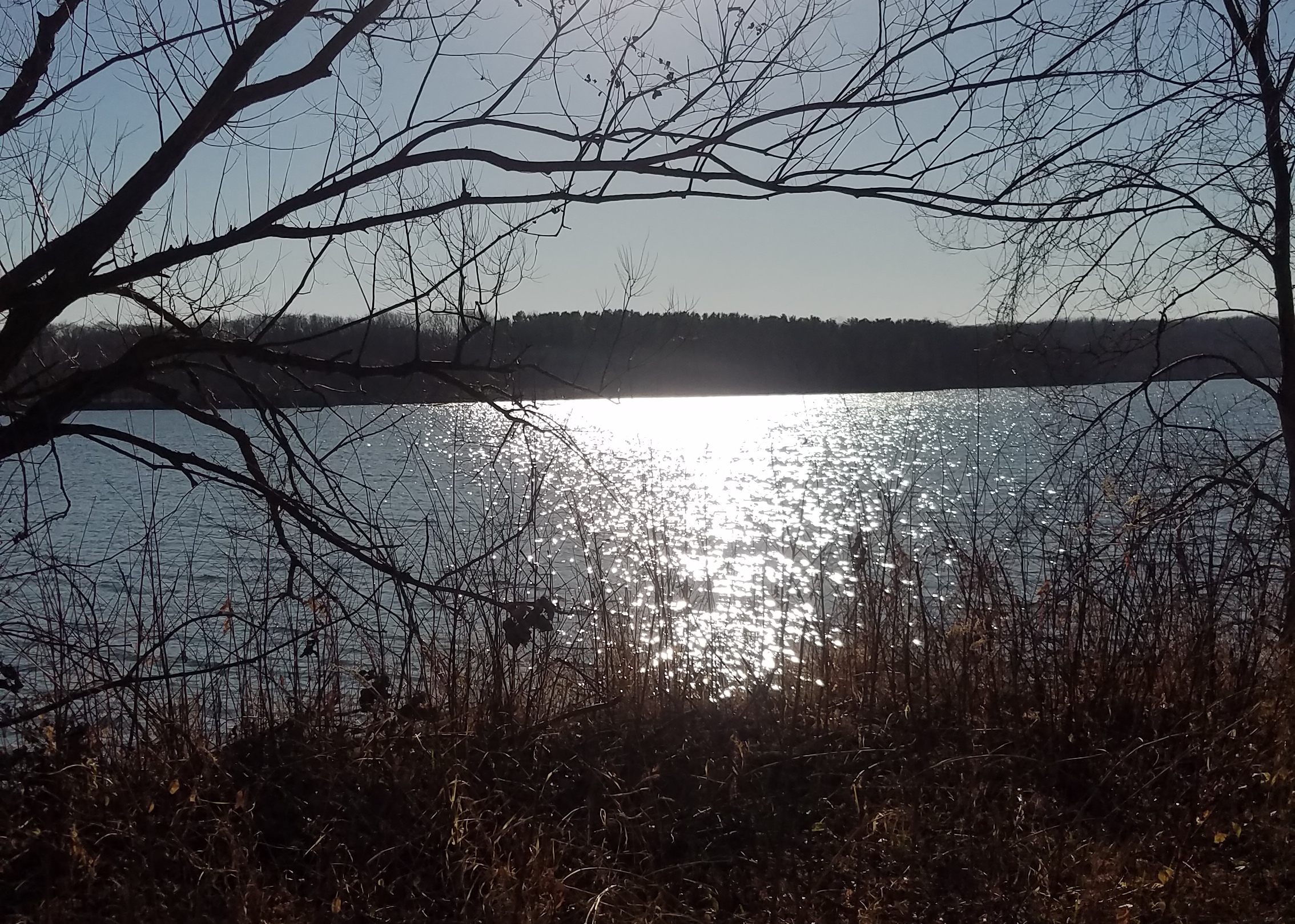
Yesterday the lake was frozen around the edges. There was plenty of open water where waterfowl — geese mostly — swam and fished. The weather was good for walking with not too much wind. Soon the ground will freeze and the cold will end work in farm fields.
As we bend toward winter there is much to consider… and plan… as we enter the second pandemic year. I’m on a brief hiatus from writing and will return with regular posts soon. Be well.
The 2020 general election produced a poor result for battling our biggest problems: income inequality, the climate crisis, environmental degradation, racial justice, nuclear weapons proliferation, and the coronavirus pandemic — even with election of a Democratic president. All of these issues are important yet the most significant is acting on the climate crisis.
Yesterday the United States formally exited the United Nations Framework Convention on Climate Change. While waiting for votes to be counted, Candidate Joe Biden said, “Today, the Trump Administration officially left the Paris Climate Agreement. And in exactly 77 days, a Biden Administration will rejoin it.”
German Budestag member Karl Lauterbach noted the results of the American election this morning, saying they set up gridlock in which “Biden hardly gets a law through, least of all in climate protection. Europe has to go alone.”
It’s not possible for any state to successfully go alone.
The failure of Democrats to secure a Senate majority makes the work more difficult. We know what Senate Majority Leader Mitch McConnell will do as we saw him obstruct the legislative goals of the last Democratic administration when Republicans were in both the minority and majority. While the work will be difficult, now that voting is finished, it must begin.
Wednesday morning, Jen O’Malley Dillon, Biden-Harris campaign manager, and Bob Bauer, campaign adviser for voter protection, laid out the path to 270 electoral college votes and Trump efforts to suppress vote counting. After waking up with not enough sleep and in a fog, the information was assuring. Biden won the election and once the votes are counted it should be revealed. Now what?
The clear message from this election is there is too little work being done to move toward consensus on important issues. Of my list above, there is denial that any of them are problems. As if people say, “I’ve got mine, and that’s enough.” While I can devote time to advocacy it means little if I don’t bring others along with me. By “others” I mean people who currently don’t agree with me.
The ambient temperature was 50 degrees so I donned my riding shorts, took the bicycle down from its ceiling hooks, and aired the tires to 90 psi. I rode 13.7-miles to Ely and back to get things going after missing daily exercise on Tuesday while at the polling place. The long, straight stretch of trail from the roundabout to Ely was a chance to get some thinking done. After descending the steep hill beginning at Highway 382, I entered the zone and miles passed quickly. Not sure how much thinking I did, yet the sun and wind felt good as I pedaled and rolled north. A new beginning.
While coalition building begins alone, that’s not how it will end. It’s hard to know who will join. I helped build diverse, successful coalitions before and believe we can do it again. That work begins today.
When Joe Biden said the 2020 election was about “the soul of the nation” he got it right. Who will we be as Americans? For too long our worst impulses have dominated our public life. As a nation, we are better than that.
Abraham Lincoln said in his first inaugural address, “I have no purpose, directly or indirectly, to interfere with the institution of slavery in the States where it exists. I believe I have no lawful right to do so, and I have no inclination to do so.” What we know now is Lincoln signed the Emancipation Proclamation a few years later. Was he being disingenuous? No, clearly not. He did what was needed to bring the Southern states, which had seceded, back into the imperfect union the United States represented since its founding. So it may be with addressing our most significant current challenges going forward.
We don’t want to upset the apple cart of public opinion as represented by the 2020 election results, but we must. It will be complicated and challenging, beginning with the idea going it alone solving society’s problems is no longer an option.
The weekend has been a stream of emails from friends leading to ratification of the United Nations Treaty on the Prohibition of Nuclear Weapons (TPNW).
On Oct. 24, Beatrice Fihn, executive director of the International Campaign to Abolish Nuclear Weapons (ICAN), reported Honduras became the 50th state to ratify the treaty. This started a 90-day clock for the treaty to enter into force and become international law on Jan. 22, 2021.
Congratulations to everyone who worked to achieve this significant milestone.
What we have known all along is the nine nuclear states have scant interest in eliminating nuclear weapons, even if most of them give lip service to Article VI of the Non-proliferation Treaty which calls for it.
During the Obama administration activists fully understood the United States would not lead on abolition of nuclear weapons. ICAN, International Physicians for the Prevention of Nuclear War (IPPNW), The Bulletin of the Atomic Scientists, and others took the cause to the international stage and yesterday set the world on a more definitive path by making nuclear weapons illegal. The hard work now begins.
There remains a growing danger of nuclear weapons proliferation. In an Oct. 24 statement, reacting to the 50th state ratification of the TPNW, IPPNW laid out the risks:
The treaty is especially needed in the face of the real and present danger of nuclear war climbing higher than ever. The hands of the Doomsday Clock stand further forward than they have ever been: 100 seconds to midnight. All nine nuclear-armed states are modernizing their arsenals with new, more accurate and “useable” weapons; their leaders making irresponsible explicit nuclear threats. The cold war is resurgent—hard won treaties reducing nuclear weapons numbers and types are being trashed, while nothing is being negotiated to replace them, let alone build on them. If the Trump administration allows the New START Treaty to expire, then from 5 February 2021, for the first time since 1972, there will be no treaty constraints on Russian and US nuclear weapons. Armed conflicts which could trigger nuclear escalation are increasing in a climate-stressed world. The rapidly evolving threat of cyberwarfare puts nuclear command and control in jeopardy from both nations and terrorist groups. Close to two thousand nuclear weapons remain on hair-trigger alert, ready to be launched within minutes of a leader’s fateful decision.
~ Tilman Ruff, Ira Helfand, Arun Mitra, and Daniel Bassey—Co-presidents of IPPNW
This milestone is a moment for celebration as the plan to eliminate nuclear weapons comes together as well as it has since the United Nations was established 75 years ago. Whatever uncertainties there are in our global civilization — the coronavirus pandemic, economic injustice, and armed conflict — today there is hope for a better world. That’s worth noting.






 Journey Home
You must be logged in to post a comment.