The sinusitis mentioned in recent posts has taken a toll. The yard work is set back, with seedlings standing tall, waiting transplant. I have a full basket of news stories to write and prospects of other work. There is a lot to do.
Yesterday I called off at the warehouse due to incessant coughing. I returned the coolers from Thursday’s CSA delivery and stopped at the pharmacy to find medicine used long ago to relieve sinusitis that proved incurable when we lived in Indiana.
I couldn’t recall how to spell it so I wrote what I knew on a piece of paper: chlor ________ maleate. The pharmacist recognized it, chlorpheniramine maleate, asked me a few questions about my health, and found a box of 24 tablets for $3.99. Within a few hours the medicine began relieving my symptoms, and in another day or so I’ll be as back to normal as it gets.
The morning after I’m sore and tired, but ready to mount the steed of a life built here in Big Grove and ride.
The meaning of songs like Stan Rogers’ “Northwest Passage” has changed with global warming and the ongoing re-discovery of the wreckage of Franklin’s vessels. Nonetheless, Stan Rogers didn’t live long enough to see these things, and occupies a unique place in music history. As I pick up my journey where I left it some three weeks ago, I recall these words from Rogers
For just one time I would take the Northwest passage
To find the hand of Franklin reaching for the Beaufort Sea.
Tracing one warm line through a land so wide and savage
And make a Northwest Passage to the sea.
The silence on the story of human trafficking connected with slavery in the seafood industry is deafening.
Margie Mason of the Associated Press reported Tuesday that Indonesian police arrested seven suspects in an ongoing case.
“Five Thai boat captains and two Indonesian employees at Pusaka Benjina Resources, one of the largest fishing firms in eastern Indonesia, were taken into custody,” wrote Mason. “The arrests come after the AP reported on slave-caught seafood shipped from Benjina to Thailand, where it can be exported and enter the supply chains of some of America’s biggest food retailers.”
But for the investigative reporting by the Associated Press, these instances of slavery and human trafficking would have gone unnoticed, especially in the Western Hemisphere at the end of the global food supply chain.
American consumers don’t want to hear what goes on at the far end of the food supply chain. Using slave labor to fish is particularly egregious, and most people I meet don’t want to hear any of it. The focus is on the box, can, bag or piece of fruit or vegetable in front of them. Few want to dig very deep into where it comes from. We are the less as a society because of this prevalent American value.
I’m not a person who sees cause for alarm everywhere I look. I’ve been inside enough manufacturing and production operations during the last 40 years to know it requires oftentimes difficult work to make things we use every day. In most cases, there is a human impact with the means of production.
In the slow walk away from union representation since the Reagan era, much of what we learned about worker treatment has been abandoned by companies whose business model is to outsource or use subcontractors. That’s the immediate defense of Pusaka Benjina Resources: their subcontractors were responsible for any human trafficking and slavery. It is really no defense.
One should appreciate that the Associated Press is still willing to invest substantial resources in breaking stories like the slavery on Indonesian fishing vessels. Few others seem willing to do so as news organizations struggle to carve out a viable business niche, and as news and information gets blended into a vast soup of engaging, but largely irrelevant bits and packets transmitted with the speed of breaking news.
What’s a blogger to do? We begin like a fisher, setting sail on the sea of posts, articles, books, emails and letters that exist on electronic media. Waiting for what is relevant, what is news, and importantly, what matters. Not what matters to me, but what matters to all of us on this blue-green sphere.
It’s been a tough couple of weeks complicated by a lingering and persistent impulse to void the rheum of excess mucus. I don’t feel ill for the most part, but the coughing has been terrible.
Missing work without sick pay means less income and a further exploration of the life of low wage workers. Well into the experiment in alternative lifestyle, I don’t see how people can make ends meet, even working three jobs as I have been doing this spring. That said, I won’t give up and expect to continue hacking through this rough patch—literally.
I picked lettuce, spinach and radishes from the garden the last two nights and made a frittata for dinner with greens from the CSA, spring garlic and onions. It was satisfying served with a salad, and there were leftovers. Already garden production is worth savoring. Between now and Memorial Day, the focus is on getting the spring planting done.
For the moment that’s all there is to say except change is coming. To make this life more sustainable, to improve our economic base. How change will look is an open question. I look forward to seeing how it comes together.
April has gotten very busy. There are dozens of tasks to do at home and farm work has kept me busier while my warehouse work and newspaper writing continue at the same level. It seems impossible that I had eight jobs at one point last year. Working three jobs fills the time if it doesn’t produce enough money to get ahead.
Farm work has been planting, planting and more planting—in the field, in seed trays, in the high tunnel. Yesterday was lettuce greens and broccoli. The day before onions and soil blocking. Today, I will seed some trays before cleaning up to head to the warehouse.
The challenge is to find time for our own garden. When I receive next week’s work schedule a priority will be setting aside a home work day.
A livestock farmer spent yesterday preparing his fields to plant corn. His planter is maintained and ready. Another spread fertilizer, complaining of a sore throat because he had the tractor window open.
Everyone’s busy with spring. That includes me. The garden needs planting before Memorial Day. It’s five weeks away, but it seems like tomorrow.
Two bits of news related to minimum wage emerged last week, and neither of them represents a solution for low wage workers.
The Iowa Legislature advanced Senate Study Bill 1151 from a subcommittee to increase the minimum wage to $8.75 per hour by July 2016, with a $0.75 increase July 1 and another $0.75 a year later. The bill is expected to be debated this week by the full Senate Labor and Business Relations Committee. Rod Boshart covered the story for the Cedar Rapids Gazette here. He indicated there is bipartisan support for increasing the minimum wage in both legislative chambers.
On Thursday, Doug McMillon, president and CEO, Walmart, announced a detailed plan to increase wages for its associates. Notably, current employees will receive at least $9 per hour beginning in April, with positions expected to pay at least $10 per hour beginning next year.
“Today, we’re announcing a package of changes in Walmart U.S. that will kick off a new approach to our jobs,” McMillon said in a letter to employees. “We’re pursuing comprehensive changes to our hiring, training, compensation, and scheduling programs, as well as to our store structure, and these changes will be sustainable over the long term.”
As Vauhini Vara pointed out in her Feb. 20 New Yorker article, “working at Walmart has long been a kind of proxy, in conversations about labor practices, for low-wage toil.”
“Such conversations have received more attention in the past couple of years, partly because they speak to a problem—stagnant wages—that has been acknowledged, even by conservative economists and policymakers, as a serious one,” Vara wrote. “When the recession ended, the unemployment rate began falling to pre-recession levels, and economists predicted that a tighter supply of workers would soon send wages up, too, as has historically happened. But, puzzlingly to some observers, that didn’t happen.”
Walmart, like any business, realizes the value of associates, and adjusted its pay and benefits when it had to.
While in Des Moines last week, I spotted Mike Owen and David Osterberg of the Iowa Policy Project at the capitol. They were working on the wage issue according to Owen.
The Iowa Policy Project is a nonprofit, nonpartisan organization founded in 2001 to produce research and analysis to engage Iowans in state policy decisions, according to their web site. One of their topics is minimum wage.
IPP noted the Iowa minimum wage increased to its current $7.25 level on Jan. 1, 2008 in a February position summary. They pointed out that while Iowa was once a leader in minimum wage, it is now a laggard.
$8.75 would be something, but it is not enough.
“Minimum wage doesn’t come close to supporting a family’s basic needs budget at Iowa’s current cost of living,” said the IPP report.
Walmart’s $10 per hour is better but doesn’t get families there either.
What’s missing from this discussion is that few minimum wage earners support a family alone. According to IPP, minimum wage earners contribute 46 percent of their family’s income on average. Which begs the question, how do low-wage earners get by?
We can’t be distracted by the two minimum wage rate developments.
Any low-wage earner today knows there are plenty of opportunities to earn $9 per hour or more if one can do the work. The minimum wage has not been the problem for a long time as companies pay more to attract a viable workforce. Walmart is a large employer and receives a lot of attention. My progressive friends and I debate whether Walmart is or isn’t the problem, and I land closer to Vara—they are a proxy for another argument.
That argument has to do with the changing nature of our society. We have become a place where fairness and equal treatment has given way to pursuit of financial success at any cost. It includes business models that drive out costs, human costs particularly. Our society, through our neglect, and perhaps intent, has led us to a very harsh place. I recall Thomas Merton:
“If I had a message to my contemporaries it is surely this: Be anything you like, be madmen, drunks and bastards of every shape and form, but at all costs avoid one thing: success… If you are too obsessed with success, you will forget to live.”
All this talk about minimum wage has made us forget something important. Work is not wasted whether it’s paid or not. We must go on living and wages have little to do with that.
Deeply invested in an economy of multiple income sources, part time work, no benefits and flexible hours, discussions in the national media about job growth, the 30-hour work week, and changing job descriptions fall upon deaf ears.
I’m happy to sustain a life in a turbulent world, avoiding big jobs like the one left in 2009, and take my chances with what work circulates at the bottom of the rain barrel during a long drought. Most wouldn’t call that making a living, but the easy-money jobs are all gone, if they existed once upon a time. People, including me, do what they must to sustain life.
Things didn’t change this year, or in the last five years. This experience is the result of an intentional movement, one that saw its best days during the Reagan administration.
The truth is we all have to make a life. Even if suicide is painless, it is no option at all.
What matters more, what helps us go on, is the drive ever forward in our lives. Not toward some dark and pearly other world destiny, but with the exercise of free will and intent, toward making the commons a better place. Taking care of ourselves, while important, is not the endgame.
Without good health and economic security, it would be hard to do anything. Some of us are lucky to have a stable, if somewhat precarious platform built on years of hard work, good health and a safe upbringing and neighborhood. If we are one of the lucky ones, it is important to remember John Donne, “no man is an island,” and recognize that unlike the bard, we are of an age.
In my worklife, dating to the 1960s, there have been only rare times when I worked a Monday through Friday day shift job, most notably while at the University of Iowa in the early 1980s. Nonetheless, there is a cultural resonance to “the weekend,” even if I haven’t really had one since those government employment days. Whether with a high paying job or what I’m doing now, work always beckons, regardless of the day of the week.
The saving grace is the brief respite when a workday is followed by one more open. A chance to open a bottle of wine purchased from the discard cart at the grocer, or enjoy a snack from newly bought food from the warehouse club—chez nous.
Tonight, after a shift at a job, grocery shopping and a meeting in the county seat, only then will I succumb to escape, then sleep soundly.
It seems upside down, but Monday really is my Friday and the work goes on with nary a day off. I’m not complaining, just trying to understand life in this turbulent world so it can be sustained.
On Saturdays I took the bus downtown to pay my newspaper bill. In the mid-1960s my home town had a downtown, and it wasn’t unusual.
Newspaper carriers collected subscription fees from customers, then remitted the cost of the papers at the building where they were printed. Whatever was left—a few dollars at most—was our margin.
I spent mine on the bus trip, on snacks at the automat inside Parker’s Department Store, and for an occasional book or magazine. Back then there were at least four department stores downtown and I shopped at them all from time to time.
I continue to have an urge to go downtown on my day off, but of course there is no downtown the way there was.
Sometimes I give in and go, but the impulse is less about the trip itself than feeding a connected and primal need. It’s not the same even though today’s mental awareness is connected to that long ago paperboy. Usually I end up buying things we need if I venture out, like food, light bulbs and hydrogen peroxide.
Days off are more complicated than they were. On every day there is some paid work to be done whether at a work site, or at my desk. I don’t mind. Modern life is about choices we make.
After re-purposing, there was no idea where the road would lead, and that was mostly a good thing. I knew there would be constant work to sustain a life outside of the old fashioned single big paycheck. I embraced the change. Some say over 40 percent of the U.S. workforce, or 60 million people, will derive their livelihood from this kind of “freelancing” also known as “working as needed.”
Dig a bit deeper, and what I am doing is a harbinger of the near-term future, which according to the Intuit 2020 Report, is where “2020 will see a new breed of senior citizens with ‘unretirement’ and active engagement best describing their lifestyle choices.” Translation: my cohort will be working for money until we croak.
So even if I feel the urge to venture downtown, a place that no longer exists, capitulating from time to time seems okay. I would argue it is necessary because so much depends on our connections to the past that if we don’t periodically revisit them, sustaining a life in the present would be nigh impossible.
The warehouse called me off this afternoon because of the weather. It created an opportunity to work my long to-do list and that’s positive, even if I’ll miss the income.
While driving home across Mehaffey Bridge Road on Sunday the front end of my automobile started vibrating at speeds above 35 miles per hour. Slowing down, I made it home safely.
The two brothers at the auto shop in town agreed to check it out Monday morning. I dropped the car off and walked the three miles home in an ambient temperature around seven degrees below zero. The walk was invigorating and needed.
They found one of the brake calipers had gotten stuck and was causing the vibration. It was a quick repair and I picked up the finished vehicle just as Monday’s snow started to fall.
I had to go to the county seat today, so I shoveled the driveway and ventured out. Between four and seven inches had fallen and the light, powdery snow made for quick removal.
After my meeting I picked up a few groceries, got a haircut, and headed home to weather the cold. The next warehouse shift is not until Friday, and as I mentioned, it’s an opportunity to get things done.
Between the warehouse, the car repair and the long walk home is another topic: consumer credit.
Because of the way we transitioned into a post-career life, we have credit. We have a line of credit against our home at a very low interest rate. We have credit cards to take the bumps out of monthly cash flow. Instead of creating immediate stress, the car repair went on the credit card and when income exceeds expenses, we’ll pay it down. These two financial tools make funding cash flow doable and to some extent, life easier.
Using credit is also a precarious thing to do.
There is the presumption of being able to pay it off, something not always possible. A lot depends upon getting the jobs and hours needed to generate income. Then there is the interest, an expense in its own right. Middle class people should get and use credit in a way that serves sustainability and nothing more. That’s what I try to do.
What else can working people do? What we always do. Keep working toward a life with a newer car, predictable income and less need for credit. However, if we get there, we will continue to take long walks on cold days.
This weekend is arguably the end of the holiday season. I previously suggested the holidays end Super Bowl Sunday, this year on Feb. 1, but who except people working for large corporations can write off the whole month of January?
So the work begins.
Part of the work is paid, and more paid work is needed in 2015. Partly to make up for one-time revenue streams that ended, and partly to ensure financial stability which ultimately will lead to financial sustainability. My preference is to find additional free lance writing jobs and some portion of research and development will be devoted toward that end.
The easy resolution to the income shortfall would be to take one of the many $9.25 per hour part time jobs that are available in the area. If it fit in my existing schedule, such a job would fill the cash flow gap short term. I may end up doing this, but am not ready to give up on other options yet.
2015 is planned to be a down-sizing year and some one-time income could be realized by selling some items. This may fill the February cash flow gap, buying me more R & D time, if January affords enough time to work on it. We’ll see if that happens.
At this point the road to a successful 2015 is open and full of opportunities. With an open mind and a ready attitude I have taken the next steps toward sustainability and a life worth living on the Iowa prairie. Here’s hoping for a happy new year.
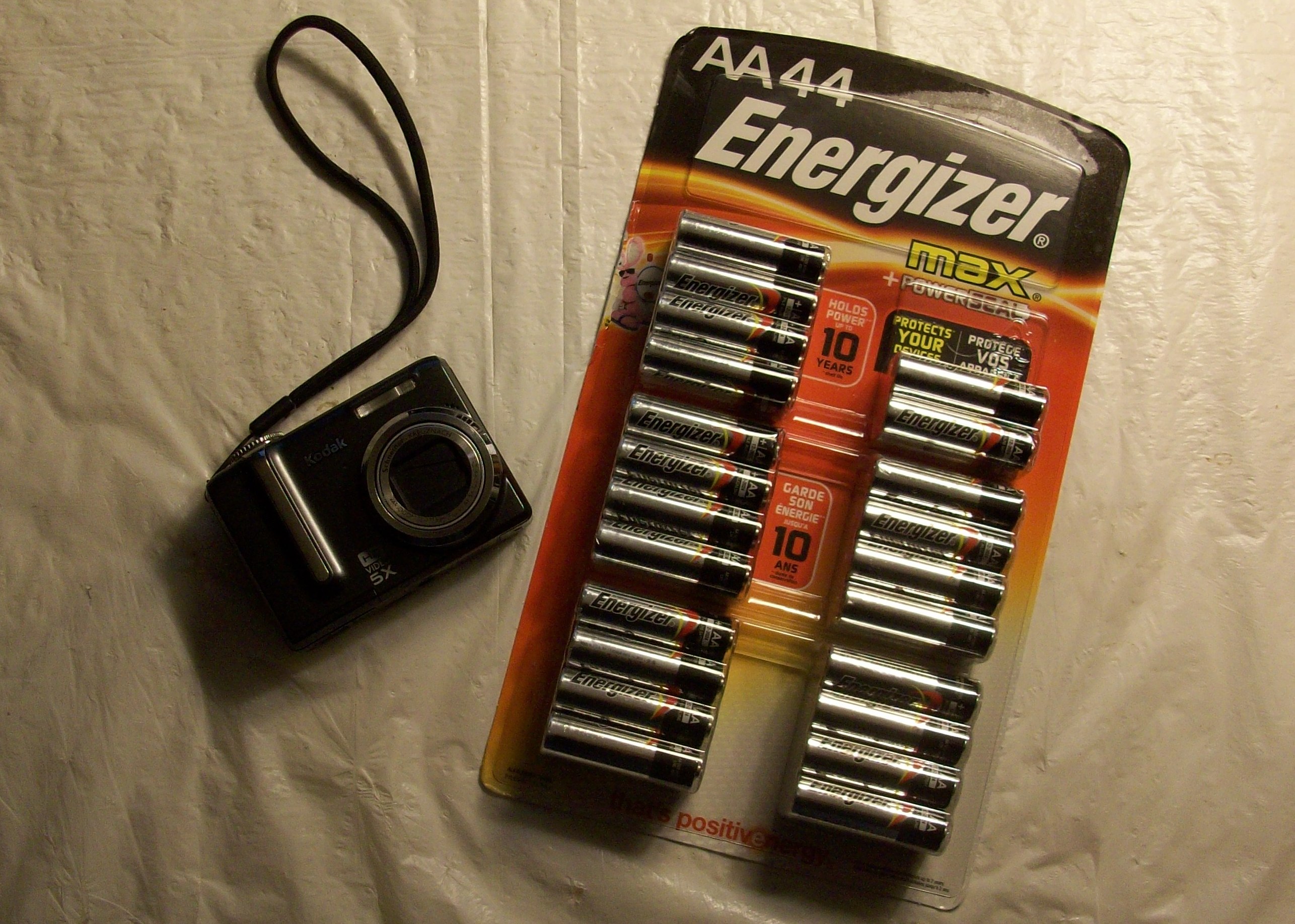
LAKE MACBRIDE— Is it better to use home electricity to power devices or batteries? As readers can see from the image, I opted for battery power and here’s why.
I already own a Kodak EasyShare Z1285 camera that takes two AA batteries.
While cameras come and go in the course of a person’s photo taking, extending the investment in currently owned equipment is more convenient and less expensive. Both of those things matter.
There is also the issue of coal and nuclear generated electricity coming into our house from the rural electric cooperative. While I don’t know how these alkaline batteries were initially charged, they are made of common metals—steel, zinc and manganese—and do not pose a significant health or environmental risk as burning coal and disposing of nuclear waste do. Heavy metals, mercury particularly, were eliminated in alkaline batteries in the 1990s.
The large pack of batteries also frames a project for the new year with the highest resolution digital camera in the house. When the batteries are gone, the project will end.







 Journey Home
You must be logged in to post a comment.