I attended the Solon City Council meeting regarding the minimum wage ordinance passed on Sept. 16.
This is a discussion worth having in the extended Solon community as we celebrate our dodransbicentennial.
A couple of things are worth mentioning.
It served no purpose for outside parties to participate in the discussion. Those from Davenport and Muscatine may as well have saved the gasoline. In the end the City of Solon must decide for itself where it stands regarding support of business at its intersection with social justice. If city residents don’t like what council is doing regarding minimum wage or anything else, then vote them out. Better yet, get involved and run for office.
None of the media coverage or statements at the meeting indicated the input of people who actually work for minimum wage in Solon was considered. The discussion was the less for that. The median household income of Solon is well above that of Iowa City and the rest of Iowa, so hourly wage is not a concern here as much as it is in larger urban areas. Nonetheless, the input of minimum wage workers would have added to the discussion.
During the recess following the minimum wage discussion someone said, “It’s just like the Scott Walker recall.” No, it’s not. I had expected the meeting to be more confrontational, but it wasn’t. Speakers and council achieved a level of decorum that stands as a model for other municipalities to emulate.
That Solon is having a discussion about minimum wage is an important step toward long-term economic vitality. We can thank the Johnson County supervisors for kicking things off. Their action served to prompt a discussion in which the city council members can be held accountable for their decision.
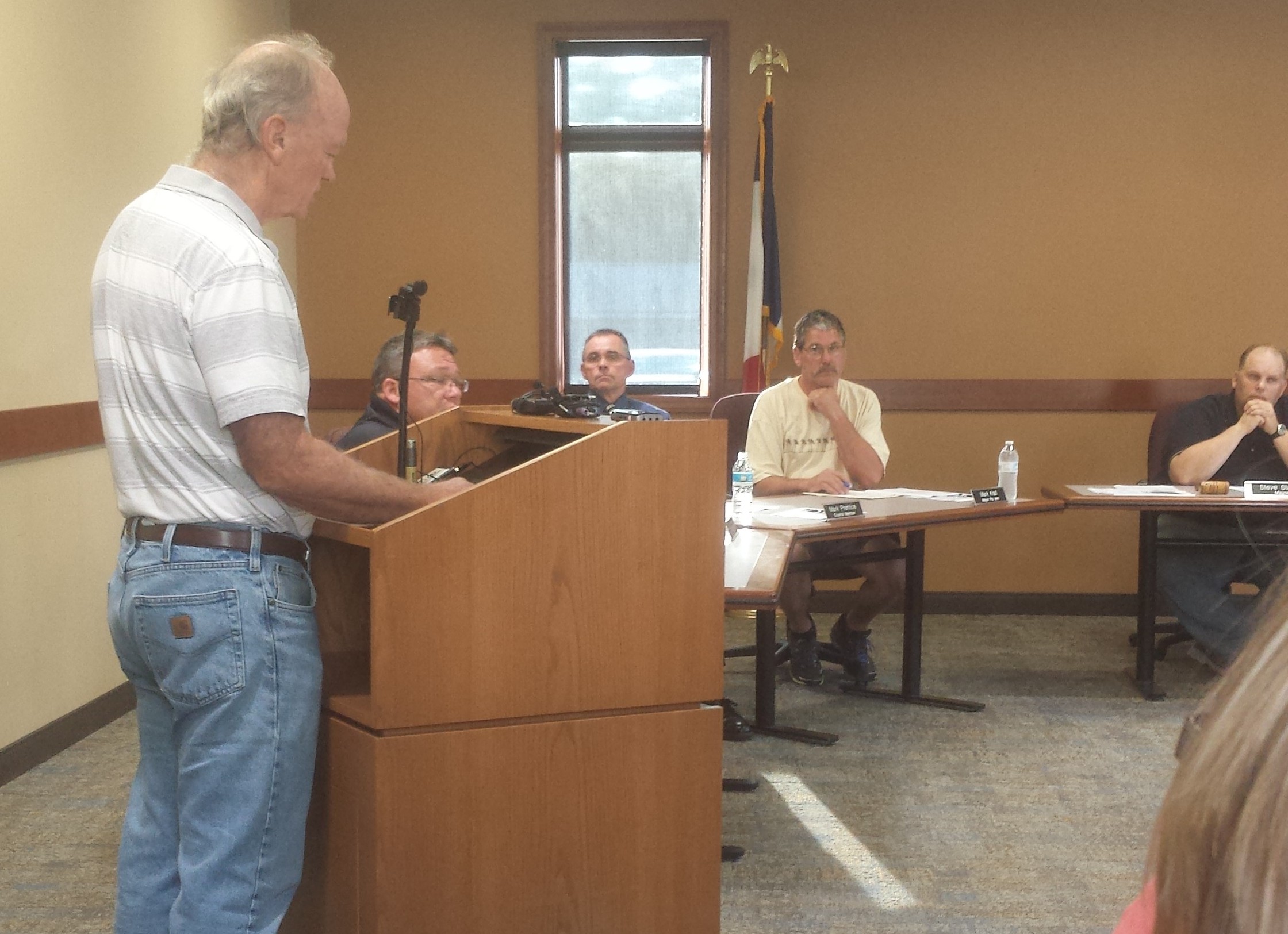
Peter Fisher of Cedar Township Addressing the Solon City Council
SOLON — The Solon City Council received more than 50 media and members of the public in its chambers this evening. In a unanimous vote, council rejected the Johnson County ordinance to raise the minimum wage in favor of state regulations. They collapsed three required readings into this one, so the decision is final.
Seventeen speakers on multiple sides of the issue made statements and appeals to council members. In the end, everything proceeded as it must have been foreseen by the mayor and council.
My last post about mau-mauing the city council got it wrong in that everyone who spoke, and the audience generally, were well behaved and non-confrontational. It didn’t make a difference.
Here are my takes:
The presence of people who lived outside the city made matters worse. Locals are well aware of what happened in Wisconsin during the unsuccessful recall of their governor. Kevin Samek of Solon mentioned Scott Walker by name during his remarks. Council supporters made clear outsiders weren’t welcome. One person said, “It’s just like the Scott Walker recall again.” Not in a good way regarding the coalition of organizations who were present.
Business owners don’t like the publicity. This is not a shocker, but word of a potential boycott got their attention. Jay Schworn of Salt Fork Kitchen said he hadn’t wanted to get involved until word of a potential boycott spread around on Facebook.
There were no minimum wage workers present. This voice should have been heard from and wasn’t. One speaker, whose name I couldn’t understand said she knew three Solon families working minimum wage jobs and couldn’t attend because they were working. One business owner said he employed a number of high school students at $7.25 per hour and they were a problem because of the limited hours they could work. He preferred hiring mature staff at a higher wage.
If people don’t like government, they should run for office. Solon voters made this council, except for one appointment. If it is perceived as broken, only they can fix it. The filing deadline in the Solon city races is tomorrow.
Public comments were a rich soup of heartfelt words deployed in a way that doesn’t work any more when persuading elected officials. For those of us who follow politics, there are lessons to be learned. I plan to listen to every minute of the audio recording — at least twice.
RURAL JOHNSON COUNTY — A group of advocates from the county seat is expected to arrive in nearby Solon for tonight’s city council meeting at 5:30 p.m.
On the agenda is an ordinance by which the City of Solon would opt out of the county mandate to raise the minimum wage from $7.25 per hour to $10.10 by Jan. 1, 2017.
The Center for Worker Justice is leading a direct action to confront the city council about their potential decision.
“Solon Council members need to hear the real facts about raising the minimum wage and how this change strengthens our communities,” Misty Rebik, executive director, Center for Worker Justice of Eastern Iowa said in an email last night. “Take action, protect what we’ve won.”
The center is organizing a car pool to the council meeting from their facility in Iowa City.
The story is gaining corporate media attention as Fox News/KGAN2 sent correspondent Matt Hammill to Solon yesterday. Hammill interviewed Sam Lensing, owner, Sam’s Main Street Market. It is noteworthy that Lensing points to the challenge others would have.
“It isn’t the idea of increasing wages for his employees that bothers Sam Lensing,” said the report. “In fact, most of his workers already make above minimum wage. He says the mandated increase would result in many businesses having to raise their prices to customers and pass along the increase in costs and in a small commuter town, where people have choices, that could kill businesses.”
The bright shiny object in Solon is the growing number of restaurant start-ups within city limits. By my count, there are nine places to get a bite to eat on Main Street and several more located in strip malls around town. Both city councilors and advocates are aware of this aspect of city life.
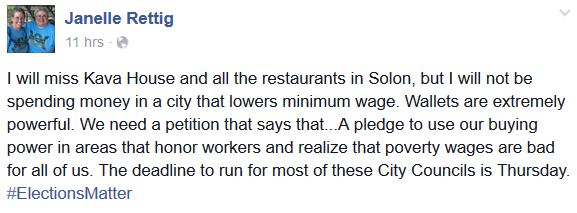
County supervisor Janelle Rettig and Iowa City resident David Goodner have suggested using the power of the pocketbook to influence the city council. Rettig made this post on Facebook:
Goodner echoes the pocketbook theme:
The approach taken by advocates for the county minimum wage ordinance is an adventure in mau-mauing the city council. Councilors are unlikely to be influenced by these tactics unless Solon residents step forward to advocate support for the county ordinance. To date, no one has done so.
The face of poverty is invisible in Solon.
Who are Solon’s minimum wage workers? We don’t really know. They may be clients of the food bank at the Methodist Church. They may be taking advantage of government programs like SNAP and Medicaid. They may be neighbors who just don’t want to talk about it.
Unless arguments for and against raising the minimum wage consider actual people who take minimum wage jobs in Solon, they are a useless political construct among people who already have had more than their share of politics. This applies equally to city councilors, business owners who have come forward, and to out of town advocates.
Leaves are beginning to fall from the Green Ash trees. Those on the two early apple trees have been down more than a week. The garden is producing and likely will until the hard frost comes in mid-October.
This time, more than any in the year, is for work at home.
Today’s to-do list includes harvesting tomatoes and peppers, canning, and cooking gumbo. I prepared a lunch of sliced tomato, salt, pepper and feta cheese using blemished fruit. It’s a simple and satisfying repast.
For so many years, work was elsewhere. While downsizing I found a three-ring binder with papers from expense reports dated 1992. I was managing trucking terminals in Schererville and Richmond, Indiana, and starting recruiting operations in West Virginia, Georgia, Pennsylvania and Missouri. I would wake up on an airplane unsure of where I was, or where I was going. It was a busy time and there was little left for family. They were days of intangible hope for a future that included success. I don’t know what that means any more.
President Obama stopped at the Iowa State Library in Des Moines yesterday. The stop wasn’t on his formal agenda, but while there he submitted to an interview by Marilynne Robinson, the Pulitzer prize-winning author who lives in Johnson County. Obama reads Robinson and listed Gilead as one of his favorite books. It is pretty neat that one of our own has this kind of relationship with the president. Obama quoted from the book in his eulogy for the Rev. Clementa C. Pinckney in Charleston last July.
I’ve been trying to read Gilead without success. Starting it three times over the last three weeks, I don’t get it. Maybe eventually I will. It’s one of the must read books produced by an author affiliated with the Iowa Writer’s Workshop, where many less acclaimed books than Robinson’s have been produced. Maybe the time is not right. Maybe the president’s visit will encourage me to give it another try.
It’s two months to the 21st Conference of the Parties, or COP 21, in a suburb of Paris. Iowa environmental groups are wrangling for a unifying Iowa event just prior to the first day of the conference, Nov. 30. It seems a bit late to be planning as leaves fall, the harvest comes in, and we turn our attention to the work necessary to sustain ourselves. It’s important the parties reach an enforceable agreement. It won’t be the end of the world if they don’t. Or maybe it will.
RURAL JOHNSON COUNTY — The nearby City of Solon is concerned about the impact of the recently passed county ordinance to raise the minimum wage. The city council doesn’t buy in, local businesses don’t buy in.
On Sept. 10, the Johnson County Board of Supervisors held the last of three readings of a new ordinance to raise the county minimum wage in $0.95 increments to $10.10 per hour by Jan. 1, 2017. The board passed the ordinance unanimously.
The Cedar Rapids Gazette reported the Solon city council is considering opting out of the new county minimum wage structure.
According to the Solon city administrator, the city council is considering just such an action.
An agenda of the council’s Sept. 2 meeting lists “discussion on minimum wage ordinance by Johnson County.” Draft minutes from the last council meeting, which have not been posted online, show council members unanimously voiced opposition to the county’s minimum wage ordinance. Local business owners also spoke out against it, saying they couldn’t afford raises for all of their employees while maintaining the same staff levels.
Doug Lindner of the Solon Economist recounted Mayor Steve Stange’s Sept. 2 survey of council members here. The council unanimously opposed raising the wage in Solon as laid out in the new ordinance.
City Attorney Jim Martinek was directed by Stange to review the proposed county law and research the city’s options and responsibilities, according to Lindner. Council is expected to take up the issue at its Sept. 16 meeting.
KCRG – TV9 interviewed local business owners Leo Eastwood and Sam Lensing in a news segment that aired Sept. 11.
Eastwood owns Eastwood’s Sports Bar and Grill. He is well known in the community and has placed political advertisements for favored Republican candidates at his place of business. His business recently moved from a strip mall at the edge of town to Main Street, where he joined a growing group of bars and restaurants in the city of 2,300 people.
“You’ve got to pass that along or you’re not going to be in business long,” Eastwood said to KCRG of a potential mandatory wage increase.
Lensing owns the most visible business on Main Street, Sam’s Main Street Market, a full service grocery store. Another of Lensing’s businesses, D & D Pizza, recently vacated its space across the street from the grocery store and Eastwood moved in.
Sam’s Main Street Market is and has been an important part of the community, sponsoring local events, collecting funds for the local food bank, and preventing the city from becoming a food desert for people with limited transportation.
“If this wage hike does increase that much where people have to raise their prices what’s it going to do for their business?” Lensing asked in the interview.
Sam’s Main Street Market competes with Fareway, Aldi, HyVee, Walmart and Costco. Because Solon is a bedroom community, people who commute to work have an easy option to buy groceries and sundries elsewhere. The convenience of his location brings customers willing to pay more rather than make a special trip to another town. KCRG didn’t report how many employees Lensing has at near minimum wage to validate his concern.
All of this seems like a tempest in a teapot, and here’s why.
The council’s concern, as reported by the news media, seems like a knee-jerk reaction to the minimum wage increase by a small number of business owners. The retail price increase a minimum wage increase may or may not require would have little impact in a community where the median household income is more than $62,000 per year — substantially higher than either the county-wide or state-wide figures. The argument about raising prices is a red herring.
How many low wage workers has the council heard from? I wasn’t at the meeting, but probably zero. In my experience covering council meetings for the Solon Economist I found councilors exercised a reasonable amount of diligence in matters like this. While the composition of the council has changed since I covered them, one hopes they will get feedback from Solon residents who work at or near the minimum wage in the city before opting out of the county ordinance. It is a voice not heard in this discussion to date.
There has been no public discussion of the impact on the Solon workforce of opting out. There are a lot of questions to be answered, including, how many near minimum wage jobs (earning below $10.10 per hour) would be affected? Where do Solon workers in near minimum wage jobs live? Would near minimum wage employees at Solon businesses seek employment at higher wages elsewhere as a result of the city opting out? How do near minimum wage workers in Solon get health insurance mandated by the Patient Protection and Affordable Care Act, and at what cost to taxpayers? Has the city council read the ordinance to understand which businesses are required to comply and which are not? At present, there are no public answers.
As I wrote on Friday, the new county ordinance does little to address the underlying causes of poverty here. It turns out getting cities like Solon to buy in will be yet another delay in pursuit of social and economic justice.
Friday’s Brandywine, Rose and Beefsteak Tomato Harvest
Each day for the last two weeks I picked an apple and tasted it. The crop of Red Delicious is abundant and I want to make sure when the majority is harvested they are at the peak of sweet crispness. We’re almost there.
The pear harvest was limited to what could be reached. The tree grew well above the house leaving some ripe pears beyond the reach of even my long picking pole. We have enough to eat fresh and some leftover for apple-pear sauce.
Tomatoes are coming in faster than they can be eaten fresh. The plan is to can smaller ones whole and the slicers diced. There should be plenty of jars to fill the pantry shelves. The by-products of juice and ground bits and pieces will make soup or chili, although there is a limit to how much can be canned and used over the next year.
The bell pepper plants are flowering again and celery continues to grow. The main job of deconstructing the garden in preparation for winter will soon begin.
But for now, it’s time to pick and preserve as much of the harvest as we can.
From my earliest awareness I believed in free will and in joining together with others to accomplish common good.
Self-reliance, natural freedom, and Jean-Jacques Rousseau’s idea that “the fruits of the earth belong to us all, and the earth itself to nobody,” have been a part of me for as long as I can remember.
A poor disciple of these ideas, I stumbled through college, wandered into military service, became distracted in a 25-year career, and have been working to sustain a life in a turbulent world after cutting the cord on financial security. Between youth’s vigor and the infirmities of age there is a lot to accomplish before the final curtain.
I had better choose wisely.
This summer I wrote about the Democratic presidential primary and the Iowa caucuses. My purpose was to say something meaningful in public, and to pick a candidate to support.
Even though Vice President Joe Biden may enter the race, and there are literally scores of lesser candidates, the choice reduces itself to one of three people: Hillary Clinton, Martin O’Malley or Bernie Sanders.
I support Hillary Clinton for these reasons:
As a society there is little value in aging white men asserting leadership. It is time for this woman to be president.
Of the entire field of Democrats and Republicans, Clinton is most qualified to faithfully execute the office of president. Her resume is well known and stands above what any other candidate offers. In terms of her experience, her engagement in international conflict, in weathering controversy, she has been in the arena for a very long time… she’s still there and thriving.
Her advocacy for women and children, around the globe over three decades, not only made a difference, it was the right thing to do and still is.
Lastly, I trust Hillary Clinton to appoint Supreme Court justices who reflect the values of common men and women like me. The four oldest justices are or will turn 80 before the end of the next presidential term. We need a president who’s watching out for us when it comes time to appoint a replacement.
This cycle is not about issues or about whatever paid punditry raises in clamor. It’s about picking a president who can stand above the noise and stake a claim to help the American people realize their potential. For me, that person is Hillary Clinton.
Yesterday brought a truckload of news on three important issues: nuclear non-proliferation, the Iowa caucuses and local worklife.
Democrats in the U.S. Senate blocked a vote on legislation intended to derail the process of bringing the Islamic Republic of Iran into compliance with its obligations under the Nuclear Non-proliferation Treaty. By signing and ratifying the NPT Iran is entitled to a peaceful nuclear program in the areas of medicine and electricity generation as long as they comply with treaty terms. They weren’t in compliance.
How did Iran get to the point where developing a nuclear weapon became imminent? Thank the George W. Bush administration and its laissez-faire attitude toward Iran’s uranium enrichment program. Bush wouldn’t talk to Iran, or do much to enforce its obligations under the NPT. The Obama administration changed all of that, talked to Iran, and together with the P5 +1 nations forged an agreement to bring Iran into compliance.
Republicans howled that the deal was struck. Now that the political process has run its course, they shouldn’t have much to complain about. However, they do despite the administration’s cooperation with the Congress. Or as Laura Rozen, reporter for Al-Monitor posted on twitter,
Hard to understand McConnell’s gripe. they got review, they got 60 over 30 days, they got two offers for up or down vote from Reid.
In a survey of 832 likely Iowa Democratic caucus participants, Bernie Sanders closed the gap with Hillary Clinton to within the margin of error in the new Quinnipiac University poll released yesterday. People feeling “the bern” were quick to state Sanders now leads Clinton, but it’s early and one poll doesn’t mean as much as they may hope on Sept. 10.
Nonetheless, it is good news for Sanders to poll leading Clinton, even if it is within the margin of error. Already his campaign is raising money from the poll although the long odds continue to favor Clinton as the Democratic nominee. Steve Rattner of the New York Times posted the following analysis:
In a unanimous vote, the Johnson County Board of Supervisors approved an ordinance to raise the county-wide minimum wage to $10.10 by 2017. It was cause for celebration for the Center for Worker Justice of Eastern Iowa which helped organize a demonstration supporting the ordinance prior to the vote. The first $0.95 per hour increase is effective Nov. 1, although cities within the county can nullify terms of the ordinance, which they have been waiting for the county to finalize.
In the end this ordinance does little to alleviate the issues driving poverty in our county. According to Pew Research Institute, increasing the minimum wage benefits what Pew calls “near minimum wage earners,” or people who earn less than $10.10 per hour. “The near-minimum-wage workers are young (just under half are 30 or younger), mostly white (76%), and more likely to be female (54%) than male (46%). A majority (56%) have no more than a high-school education,” according to Pew.
The Iowa Policy Project uses the Economic Policy Institute data on minimum wage. Pew says 20.6 million people nationwide would be impacted by an increase in minimum wage to $10.10 per hour. EPI puts the number at 27.8 million. It is prudent to look at both numbers, but as low wage workers understand, the primary impact of public policy is on individual lives, more than broad statistics.
I favor the analysis of local author Paul Street who used the EPI family budget calculator to break down the impact of a minimum wage increase in Johnson County. He said, “considering all this, I can be forgiven, perhaps, for not showering praise on the Johnson County Supervisors for moving forward on a proposal that would raise the county’s minimum wage from $7.25 to $10.10 an hour by 2017.”
Read Street’s guest opinion in the Sept. 7 Iowa City Press Citizen here.
Thursday was not a bad day for those paying attention. I drove to the county seat to pay my property taxes. Coming straight from the garden, I wore rolled up blue jeans, sandals and a T-shirt, funding the government for another six months.
There is a big difference between working at a Community Supported Agriculture project and at the end of a gigantic retail food supply chain. I’ve recently done both and found there are inevitable problems for the former in the latter. It has to do with the health halo.
“The health halo effect refers to the act of overestimating the healthfulness of an item based on a single claim, such as being low in calories or low in fat,” according to an article in The Guardian.
Humans want a shorthand to navigating recurring life decisions, and often, after recognizing a sign, head down the path to acceptance.
I’ve witnessed multiple instances – more than I can count – of when a feature of a type of food, such as “no sugar added,” is presented, people ask the confirming question, “that means it’s healthy, right?” Consumers seem driven, at least in what they say publicly about it, to search for and purchase “healthy food.”
“The purpose of Buy Fresh Buy Local Iowa is to create a statewide marketing campaign to encourage the connections among locally grown food, the farmers who raise it, and the consumers who eat it,” according to its web site. The campaign has been largely successful.
The campaign’s success, beginning in Iowa in 2003, resulted in checking marketing off the to-do list for small-scale local growers. Hard work in a bucolic setting shielded some from the fact that when consumers seek healthy food options marketing plays a more important role than any single campaign can produce.
Buy Fresh Buy Local has not been enough to compete with vigorous marketing of “USDA organic,” “GMO Free,” “gluten free,” “100% natural,” “fat free,” “sugar free,” “no added sugar” and other healthier option campaigns of large-scale food producers. Big operators have substantial financial resources and invest a lot in advertising, including messaging about features of their products.
While the local foods movement has a recognizable marketing campaign, mega-food companies have relentlessly pursued customers with national campaigns that dominate the consumer culture of our society. They benefit from the health halo as I’ve described it, and from market dominance.
We all want to be healthy because, well… being unhealthy or sick can suck.
Today, Alice Waters will receive the 2014 National Humanities Medal for championing a holistic approach to eating and health, celebrating her integration of gardening, cooking and education. Maybe some of us want to be Alice Waters and join the slow food movement. I know I might.
Most of us don’t feel we have time for the slow food Alice Waters promotes. We look for shorthand markers along the way and settle for what we find available in the market place and in our kitchens.
If we want to eat healthy we often look for the health halo and bask in its glow long enough to make a purchase and get on to the next thing in our lives. This consumer behavior is exactly what mega food companies target in their marketing campaigns.
To “Buy Fresh Buy Local” I would add “grow your own” and “know the face of the farmer.” A CSA can make a business with a couple hundred members because of Dunbar’s number. Gaining broader acceptance in our consumer society will take more than the good idea to buy fresh and local. It will also take more than an image of saintliness.
Voter turnout in yesterday’s Solon school board election dropped from 834 votes in 2013 (18.4 percent of registered voters) to 281 votes (8.18 percent).
What happened? The district is moving on after a 10-year cycle of electing politicized and mostly conservative board members to finding a less political, middle ground focused on doing what’s right for district school children.
2013 was arguably the high water mark for this change when the community rallied around former Solon mayor Rick Jedlicka to ensure his place on the school board.
It is telling that there were virtually no political yard signs for school board candidates on display this year. The change from previous years indicates an emerging lack of interest in political aspects of the school board.
Adam Haluska, a former University of Iowa basketball player, and Jim Hauer, a small business owner, got the most votes, with Hauer edging incumbent Dan Coons by three votes for the second seat on the board. From a talent perspective, the race between the two winners was a tossup. The community voted for the future by electing them both.
There are issues with the school board. They spend money like they have it, but that is a complaint I have about most governmental entities. The bigger problem is how to deal with growth in the district.
Will population continue to move to communities like Solon? For the time being, new families are attracted by the perceived quality of district schools and the proximity to amenities found in nearby Cedar Rapids and Iowa City. A significant amount of new, single family home construction has taken place over the last 25 years. The housing is a bit pricey, but comfortable for a family, and not over priced in the market.
The community is centrally located to enable working in Cedar Rapids or Iowa City. A significant number of people commute to work in the Quad-Cities. It is fair to say there will be incremental growth. Accurate projections—the kind needed to plan infrastructure—are harder to come by.
With the build-out of the new middle school and the performing arts center, the district should reach caesura as the community finds its way. The task of the new school board is to finish the current construction plan and work with the newly hired school superintendent, Davis Eidahl, to set a plan for the future.
Based on yesterday’s voter turnout, most people take the idea there will be progress for granted.






 Journey Home
You must be logged in to post a comment.