Categories
Creative Life

Toward New Reading

Chart of 2025 books read by month from Goodreads.

I decided to call 2025 finished with 71 books read. I set my goal at a book per week and exceeded it. Yay!

Goodreads is great for me because it provides satisfaction when I finish each book and rate it. Likewise, I refer to the historical information often. The above chart came via email last week and tells a story about which I hadn’t thought. June through August is the busiest time in the garden. Likewise September through November are taken up with kitchen work processing the harvest. Seems natural I would read fewer books during those six months. The seasonality just never occurred to me.

I post each book I finish on Goodreads and at the Read Recently page of this blog if interested. I also keep a spreadsheet.

Book reading appears to be a lost art in American society. I understand people are busy taking in information from the large number of sources that exploded after Tim Berners-Lee invented the World Wide Web in 1989. The web was popularized through the adaptation of web browsers in the mid-1990s. We bought our first home computer and logged in via dial-up on April 21, 1996. After that, it was Katie bar the gate with many more words than could be read by a single human. I think even artificial intelligence machines have trouble getting through all of it. All that said, I sort of understand it, yet believe individuals reading books is an important kind of experience that rewards us in tangible ways.

Online apps are not for everyone, yet if you are on Goodreads, I’d love to see what you are reading. Find me here and join my community!

Categories
Reviews

Book Review: Packinghouse Daughter

Packinghouse Daughter: A Memoir by Cheri Register is a book I wouldn’t have found except for patronizing an excellent local used bookstore. They have a deal where you set an amount of money to spend, tell them your interests, and they locate books that match. I have yet to be disappointed by their choices. One of the interests I presented was in memoirs written by female authors. They likely didn’t know the story of Wilson & Company was connected to me in multiple ways.

My father worked in a hog processing facility with a kill floor and everything else mentioned in this book through to the fertilizer processing tanks. He died in a plant accident in 1969. I worked there too, for two summers while at university. I even crawled into one of the large processing tanks to help a millwright fix it, learning about lockout/tagout for the first time. The first part of the book resonates completely with my experience, even though Register was older than I am. It is useful to know this history of Wilson & Company in Albert Lea, Minnesota exists.

Register claims hesitancy about writing the memoir about Albert Lea because it was her father who worked at Wilson’s and experienced many of the issues she mentions. I don’t know who can better tell this story than such a daughter whose father worked there and was invested in the job and packing plant employee community. She did the research and the narrative is better for it. She could have gone easier on herself. Register died March 7, 2018.

I was struck by the description of people moving from farms to the city to work in meat packing. This was true of my family where my maternal great grandparents left central Illinois to live in Davenport in retirement. Four or five of their daughters worked in a defense plant making coats during World War II. My maternal grandmother did, and also worked a stint at the Oscar Mayer hog processing plant where Father and I worked. That cohort is now buried in local cemeteries. This part of the book also resonates with my experience.

An exodus from farming and rural areas continues today as agriculture has grown larger and requires fewer workers because of computer automation and changes in operations. Those who relocate, for lack of a better term, are not choosing meatpacking as a profession — or even as a job. With consolidation in the meatpacking industry and increased automation, there are simply fewer positions available. It is hard, dirty work as well. As a result, the job-driven movement from rural areas to cities no longer exists in the same way it did in Albert Lea during the period covered by this book.

I found Register’s narrative deeply resonated with my experiences. It is must reading for anyone interested in the specific history of Wilson & Company or in meat packing culture. With changes in the industry happening post-WWII era, that culture would disappear without books like this.

Categories
Writing

End of Year Snow Melt

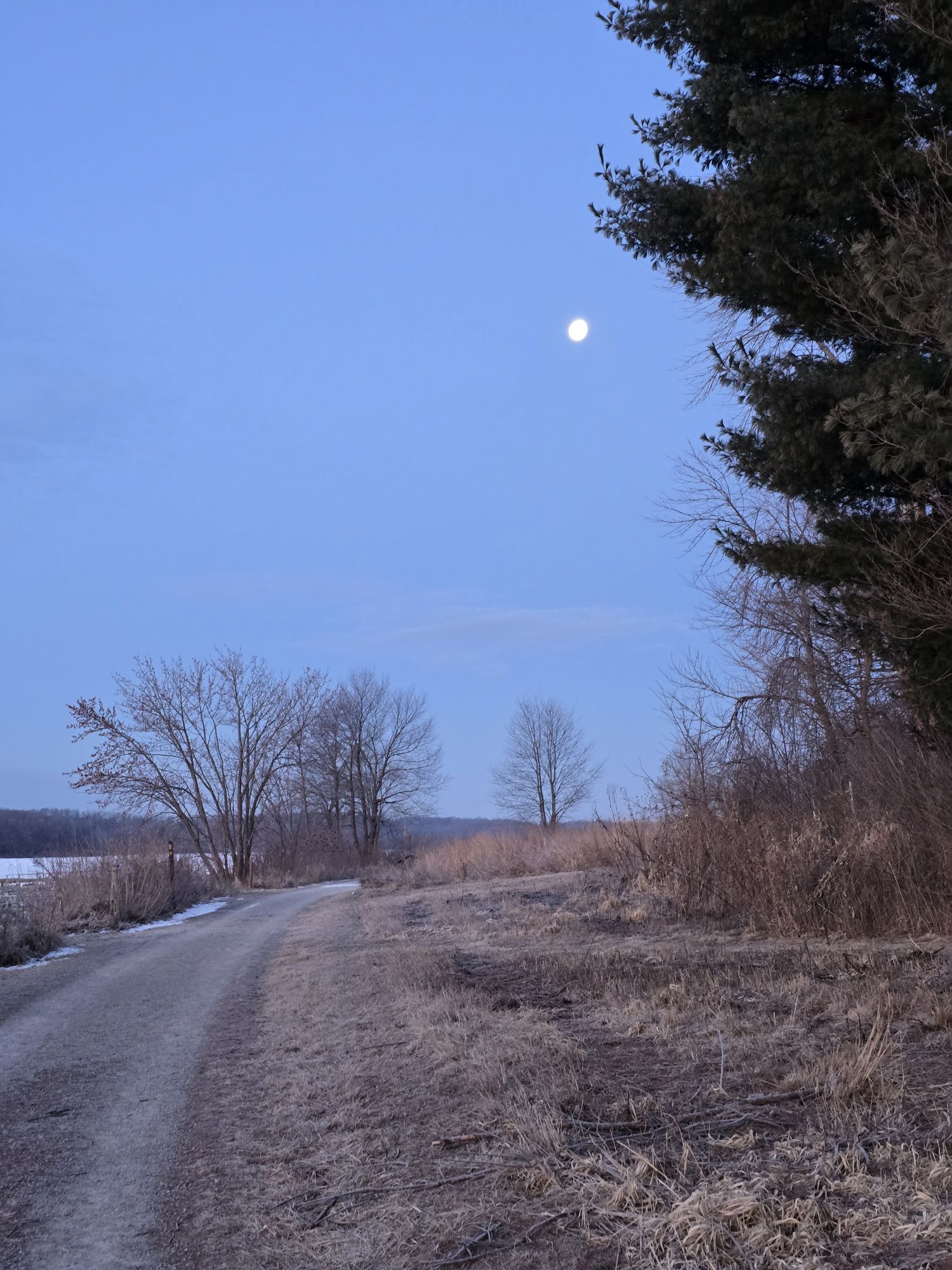
Lake Macbride on Dec. 26, 2025.

Ambient temperatures in the 40s have been melting snow and ice, leaving a dead landscape. No spring hope. No winter cover. Except for the lake, it’s just dead. It’s a good time to turn indoors to my writing.

I have three chapters remaining to draft in part two of my autobiography. In the story, I just concluded leaving paid work during the coronavirus pandemic. If the pandemic did one thing right, it made a clean break between the workplace and me, forcing me to live on a fixed income. The final chapters write quickly because they are so recent. Today I created three of them, and next I write about the coronavirus pandemic plus two other chapters with working titles of “Beginning of the end,” and “New beginnings.” It shouldn’t take long to finish the first draft. Then begins the process of going through the whole book for the first major rewrite. I expect there will be three or four of those before I’m ready to publish.

After the book is ready for publication, I don’t know. I’ve been focusing on this work so long, I hadn’t given much thought about what’s next. I want to revise the first book to clean up a few things identified by friends during the post-publication period. I also must see if there is continuity without repetition. Next year I should be able to declare everything finished.

The biggest predictable issue in our lives is Social Security doing nothing to avoid running out of money beginning as early as late 2032. Benefits will be cut automatically by 24 percent across the board if nothing is done to prevent going over this cliff. If anything, Republicans in charge of the federal government are going the wrong way. The One Big Beautiful Bill Act, and the Social Security Fairness Act, accelerated Social Security insolvency alongside well-known demographic challenges to its structure. An answer to the question “How do I make up for this loss in benefits?” needs finding. Counting on the Congress to do something is not an answer.

What that says is I have to return to paid work. I have no regrets about how my working life proceeded and ended.

Physiologically I am changing. I know this because I adopted a new morning exercise regimen and my conditioning schedule is outpacing the ability of my soft tissues to recover and adapt. After a good couple of weeks on the new regimen, my shoulders started to hurt. This is self-diagnosed as inflammation, not a chronic problem. I believe I’m right about that. I have to take it easy for a while to let my body catch up with my ambition. Apparently I am no longer young.

In the meanwhile, it’s nose to the grindstone with the book. If I can finish the first draft this year, that leaves me plenty of time to publish a final text in the first half of 2026. That would clear the deck for returning to the workforce, something I am loathe to do, yet may needs do.

Categories
Writing

The Great Sort – Part IV

North wall bookshelf after The Great Sort.

Calling this project done for now. I went through all remaining boxes in the two stacks and prepped two more boxes for the library used book sale. There are five empty boxes and a good amount of new stuff placed in old boxes. This was the first major sort of my books since they arrived in 1993 and I built the shelves. I’m satisfied I have a better idea of what is available, which was the point.

Notes:

I found the rest of my books related to slavery and African-American studies. The Autobiography of W.E.B. DuBois is important to the literary discussion of the United States. If a 21st Century canon was relevant or possible, he would be in it. I don’t expect to reread the book, yet it earned a place on the shelf. I studied Stanley Elkins’ book Slavery in graduate school. I would be curious to reread it, and also read the criticisms of it. Up from Slavery by Booker T. Washington moves from box to shelf as well. On my to-do list is rearranging my African-American studies books.

I had more than a hundred business books. It was a really complete set as my work at the transportation and logistics company ended in 2009. The only ones I am keeping are Dale Carnegie’s books, which include one owned by my father, and an autographed copy of Out of the Crisis by W. Edwards Deming. I picked Deming up for a buck at a used bookstore in Sweetwater, Texas during the rattlesnake roundup.

I intentionally left political books alone. I have all the presidential memoirs I know about, beginning with Truman. The next reading here is if Barack Obama ever finishes the second volume of his presidential memoir. I’m not a fan of Trump and to my knowledge, he hasn’t written a memoir from his first term. Like with Nixon, I’ll likely wait until he is dead before considering purchasing any memoir. I bought a copy of Mike Pence’s 2022 vice presidential memoir So Help Me God for a buck at the library used book sale. It is occupying the spot where Obama’s book will go when published. Pence seems to have tried to tell a normal story of that period. Will know more if I get around to reading it. Life is short. So many books with limited time.

As I approach a new year of writing, I feel refreshed by The Great Sort. I feel better aware of my stuff and know where to find things again. Highly recommend it if you have a wall of boxes hanging about your home.

Categories
Writing

The Great Sort – Part III

New light for these classics.

For years, my books about North American indigenous culture were tucked away in a box. I decided I was wrong about them and with newly opened space because of The Great Sort, I put them on a shelf. These are in addition to the works by and about Black Hawk which I always kept out, and those of Hyemeyohsts Storm which I kept out, yet now boxed away. I wrote about Chuck Storm as we called him here. The next step is to incorporate this literature into a reading plan.

Of these books, the author that might best fit into a canon of American Literature (if such a thing existed or was possible) is N. Scott Momaday, whose House Made of Dawn won the Pulitzer Prize in 1969. There are others here that remain quite good. I read what I read of these beginning in 1970 while at university. I don’t know where this is going, yet they are out and available in a prominent space. I won’t miss seeing them daily and expect to read some of them.

I mentioned the Time magazine purge. I came across a dozen copies of Harpers Magazine dated 1938 and 1942. I bought them at either an auction or a yard sale for a buck. They used to be property of the Mount Carroll, Illinois public library, yet now find themselves in The Big Sort. There are familiar authors inside: John Dos Passos, E.B. White, Peter Drucker, Margaret Bourke-White, Glenway Wescott, Eudora Welty, T.S. Eliot, Franz Werfel, and probably others I should recognize. At the stop on my desk, enroute to the recycling bin, I notice how many pages of book advertisements there are. The December 1938 issue has 44 pages by most of the major publishers. That says something about the role Harpers played in popular culture. If that didn’t give it away, the advertisement for New York department store Hammacher Schlemmer did.

There are four mover’s boxes of vinyl records which I will attempt to sell locally. I asked our child about them and there was only a single record of interest: Beethoven’s Fidelio. The ones I will keep are a small, undetermined number. I will keep the Red Gallagher album because he autographed it for me and grew up a block away from our home. I spent a good part of my life listening to these hundreds of records. While I still have a turntable, I need a new amplifier and don’t want to spend the money. Probably should sell the turntable as well.

I’m writing on Christmas Day and noticed how many empty boxes there are. The purge of books and magazines is having the desired effect. There are more boxes than things on the sorting tables. At this point, I will find something to fill most of the boxes, although I am weeding out different styles of boxes because I need them for book shipments to the public library. While I just began The Big Sort, it feels like it has been going on for a much longer time. In a way, it has.

Categories
Writing

Christmas 2025

Christmas Lights

This is the first blog post I made about Christmas on Dec. 25, 2007.

The meaning of Christmas is derived from my remembrance of the priests at Holy Family Catholic Church in Davenport genuflecting while reading John 1:14 “And the Word was made flesh and dwelt among us…” There are many translations of this verse and the idea that an omniscient God would take human form remains a compelling idea. In order for our lives to have meaning, we should live them as Jesus did, through acts in human society.

If Jesus was the incarnate God, we are something less.

If the meaning of Christmas can be found in John 1:14, how should that affect us with our imperfections?

My Christmas story is about the coffee cup that we keep in our bins of Christmas decorations. It was a gift from Jacque and printed in the glaze are five reindeer around a typewriter consulting on a message. The reindeer at the keyboard has a red nose, and must be Rudolf. On the other side of the mug are misspelled the words “Merry Christmas,” presumably typed by Rudolf. At some point I chipped the cup and each year we discuss whether we should get rid of it because of the chip. I have always said no, although I should probably let go. The chipped cup with the animals trying to put a message into human language using human technology has become part of our Christmas tradition. Because it is so similar to the meaning of Christmas, I have trouble letting go of it. We have always ended up keeping the cup and I am using it now to hold the coffee I made this morning.

We humans can use some coffee on Christmas morning, and we need to put it in something.

Merry Christmas reader!

Christmas Coffee
Categories
Writing

The Great Sort – Part II

Books re-discovered during the Great Sort.

When handling hundreds of books long packed away, a few will stand out. Not only do I want to keep those in this photo, I want to read or re-read them next year. It’s part of the process of the Great Sort.

While living in Mainz, Germany, I had a stamp made with my military address and Social Security number on it. Back then, we viewed the Social Security number as unique to us and if we got separated from any possession, the rightful owner could be found. It was embossed into our dog tags. We put it on clothing, imprinted it inside field boots, in books, on everything that would take ink. That was short-term thinking from a perspective of how many people today would like to get hold of that number and use it for theft and other evil purposes. Wasn’t the best idea.

A substantial part of the Great Sort has been spent searching for these stamped locators and either blacking them out or cutting them off.

It has been hard to persist more than a few hours without getting impatient and stuffing books back into another box and into the new stacks I am building. At that point I must resist the urge, turn off the lights, and find something else to do. I want this to be a final sort. I’m labeling and dating the outside of the boxes so I know what’s in them and when I last touched the books. I doubt I will return to many of the boxes.

In the display area of my writing space I have about 3,000 books. I pulled out and boxed all the books of music. The vinyl long playing records will get boxed, reunited with the others I have, and then finally disposed of. This creates more space for active books and some of it will fill with the three-ring binders I am making as I write my autobiography. It should be a more useful (to a writer) library.

I want the Great Sort to be finished by Spring. I think that is doable even as I enter seedling planting time next month, especially if I stick with it a couple hours per day. The purpose of the work is to improve how I store research materials and become a better writer. I’m hopeful at this point. all of that will be the Great Sort’s outcome.

Mailing label from the first apartment where I wrote after university.
Categories
Writing

The Great Sort – Part I

Evidence of the great sort.

I spent two hours rearranging poetry books in my stacks. I decided eight 23-inch shelves was enough poetry and some had to go. Now there is an eight-inch stack of poetry books awaiting disposition. Poetry measured in inches.

I rearranged the poetry so more in which I have interest rest at eye level. On top are the smaller-sized books and below that is the canon. You know, Chaucer, Shakespeare, Dante, Donne, Milton, Dryden, Pope, Wordsworth, Coleridge, Byron, Shelley, Keats, Swift, Browning, and Blake. The exception is Chaucer and Shakespeare’s plays are across the room because the poetry shelves weren’t tall enough.

The other exception, or rather objection to the canon, is where are the women? You know, Charlotte Smith, Felicia Hemens, Mary Robinson, Anna Laeticia Barbauld, and maybe others. They were largely erased by the male authors of the canon. I don’t own any of them or I’d fit them in.

Don’t get me started on an American canon. Somewhere in the 20th Century that broke down and can never be repaired.

This is my current life when I am not writing. Opening about 100 boxes of books and deciding which to keep and which to donate. Already I’ve taken a dozen boxes to the library’s used book sale. There will be more.

I used to stamp my name and address in every book I bought. My hands have been on books from every place I lived this month. Some of the fifty year old paper has changed. Books from the 19th century crumble in my hands. I took one old book to a used bookshop to consult about the damage. This is a practical task that should involve logic. It’s more emotional than expected.

There is material for multiple posts in this project. I have to wait and see what I get into before knowing what their subject will be. I hope you are along for the ride.

The all-male canon.
Categories
Living in Society

Closing the Historical Society in Iowa City

Exterior of the State Historical Society of Iowa Research Center in Iowa City, Iowa, on Saturday, July 26, 2025. The closure of the State Historical Society Research Center in Iowa City was announced earlier this month, and its doors are set to close at the end of June 2026. The building, also known as the Centennial Building, houses millions of national and state records and is set to transfer its records to the State Historical Building in Des Moines amid funding issues for the Iowa City location. At the time of its closure in June 2026, the building will have been in use for 70 years. (Mitchell Brinkmeyer/The Daily Iowan)

It appears the State Historical Society of Iowa and the Department of Administrative Services will proceed on their plan to close the State Historical Society building in Iowa City to the public on Dec. 31. An update from Mary Bennett can be found here.

Despite the Oct. 24 temporary injunction issued by Johnson County District Court Judge Keever, based on a lawsuit filed by historians, archivists, donors, and community members challenging the shutdown and relocation; and despite an agreement between the University of Iowa and the State of Iowa to provide access to some artifacts; little has happened to resolve the conflict. According to Bennett, the best solution would be to reverse the decision to close the facility. Except for the outcome of the lawsuit, that seems unlikely to happen.

I am interested in Iowa history. I infrequently used the Iowa City facility for research, despite its proximity. In fact, it’s been more than 40 years since I set foot inside. I have little idea what content exists there whether related to my writing or not. One of the potential consequences of the closure is some historical records could be transferred to other institutions or deaccessioned under State Historical Society policies. That means, a researcher would lose access to what is currently available and it would be difficult or impossible (if they were destroyed as part of deaccessioning) to locate artifacts once housed in the Centennial Building.

I take the closure of the Centennial Building as an assault on our history, something Republicans in the government appear to feel is okay.

Categories
Living in Society

Old Subscriptions

Covers of three Time magazine issues.

The mover’s box was quite heavy as I pulled it from the stack. Inside were mostly Time magazines from 1968 until 1972. At first they were addressed to Mother, and when I left for university, the mailing labels had my name. Teenager me thought the subscription would go on forever.

I divided them into two stacks: one in which I had some interest, and another in which I didn’t. I have interest in too many of them, so that stack will be divided again. The endgame is to pick a dozen issues to put in my trunk of souvenirs from that part of my life. I don’t want to repeat the two hours of sorting I invested on Friday by culling them again at some future date.

There were two distinct aspects of my K-12 and university education: what I learned from teachers in school and what I learned from the mass media, including television, radio, newspapers and magazines. Time had a peculiar view of national culture.

In the March 20, 1972 special issue on “The American Woman,” editors asked riveting questions such as, “What is it like to be Jacqueline Onassis?” and “How did Pat Nixon keep her cool while knocking back all those 120-proof mao-tai toasts in China?” It also provided updates on the failing marriage of Tiny Tim and Miss Vicki, Julia Child cooking at the Smithsonian Institution, and how French actress Catherine Deneuve expressed being liberated.

The issue reported, “As often as not, the New Woman was a masculine fantasy.” Leave it to Time to define women in terms of how men view them. There was the obligatory (for Time) image of Hugh Hefner with two women in short shorts.

One of the photographs in the cover story was of “Girls awaiting Miss Teen-age contest call in Houma, LA.” Beauty pageants have changed in recent times, yet they have not gone away. By Time’s depiction, the “new woman” was not so new, after all.

Somehow I survived having a subscription to Time. I’m certain I leafed through each issue as it arrived in the mailbox. I will likely get upset over the coverage of the other two issues in the photo: The story of The Band because Time reportage was part of the establishment and therefore suspect. The story of William Calley because they gave him the attention of two covers when he should have been in prison. I likely want those reactions. That’s why I kept the artifacts in the first place.

I knew I had these back issues of Time. I did not look for them even a single time in writing my memoir of the period. Like other media of the day, it was background noise shaping me in ways I did not understand. To the extent they reported on a “national culture,” Time failed. They were responsible for creating an environment where Ronald Reagan could thrive, and ultimately responsible for the election of Donald Trump as president. As Heather Cox Richardson wrote in her Dec. 12, newsletter, about the president’s recent speech, “It seemed to mark an end for the Reagan Revolution whose ideology Trump has pushed to its brutish conclusion.”

Most of my issues of Time are bound for recycling. In retrospect it was a subscription I should have canceled before I did.