Categories
Social Commentary Writing

Diving In

Garden
Summer Garden

LAKE MACBRIDE— The ambient outdoor temperature was 50 degrees at 3 a.m., creating a yearning to work in the yard and garden. Other work, however, kept me busy this weekend. So much so, that when each day was done, bedtime couldn’t come soon enough— outdoors had to wait.

I’m okay with that, but I’m not.

When first feeling the urge to be a writer, many years ago, I had no idea what that meant. Now there is a full slate of writing jobs, some paid and some not, and meeting deadlines has become more of an issue. Writing and proof reading our weekly newspaper can’t be described as a stressful job, but beginning on Fridays, it’s crunch time.

The supervisory work at the warehouse also occurs on weekends, so there is little time for extras in the arc from Friday through Monday. The result has been to hang with a new, and very different group of people from the academicians, political activists, public figures, and peace and justice crowd that had become staples of my social life.

American lives move from a fixed point in time toward insularity. Frederick Jackson Turner wrote in 1893,

As each generation of pioneers moved 50 to 100 miles west, they abandoned useless European practices, institutions and ideas, and instead found new solutions to new problems created by their new environment. Over multiple generations, the frontier produced characteristics of informality, violence, crudeness, democracy and initiative that the world recognized as “American.”

The degree to which one takes issue with the frontier thesis asserted by Turner in The Significance of the Frontier in American History, there is no denying the bent toward utopianism that exists in daily life. People don’t care about money as much as they want to be able to pay their bills and live their lives. In doing so, they create an island of utopianism carved out of a complicated society. Perhaps I am corrupting what it means to be utopian, but that too is an American idea.

I heard a woman say she wanted the man to make the decisions for her last week. I was stunned. Only an insular life can espouse such a world view. One that lacks a basic connection to a greater society, and exists in the rarefied air of a peculiar social network.

Ugggghhhhh. That’s depressing,” said one friend.

“Thank goodness she’s in the minority,” said another.

“A sample of one does not a movement make,” said an activist I know.

Whatever repulsion there is to a woman who wants her man to do the thinking, it is part of the diversity of life which has become a context for my writing.

A writer must necessarily become isolated while working. At the same time, there is a constant want and need for contact with humanity in all of its diversity. Writers must break from the swaddling of the familiar and dive in— it’s as close to utopia as American living gets.

Categories
Writing

Beyond the Driveway

Beyond the Driveway
Beyond the Driveway

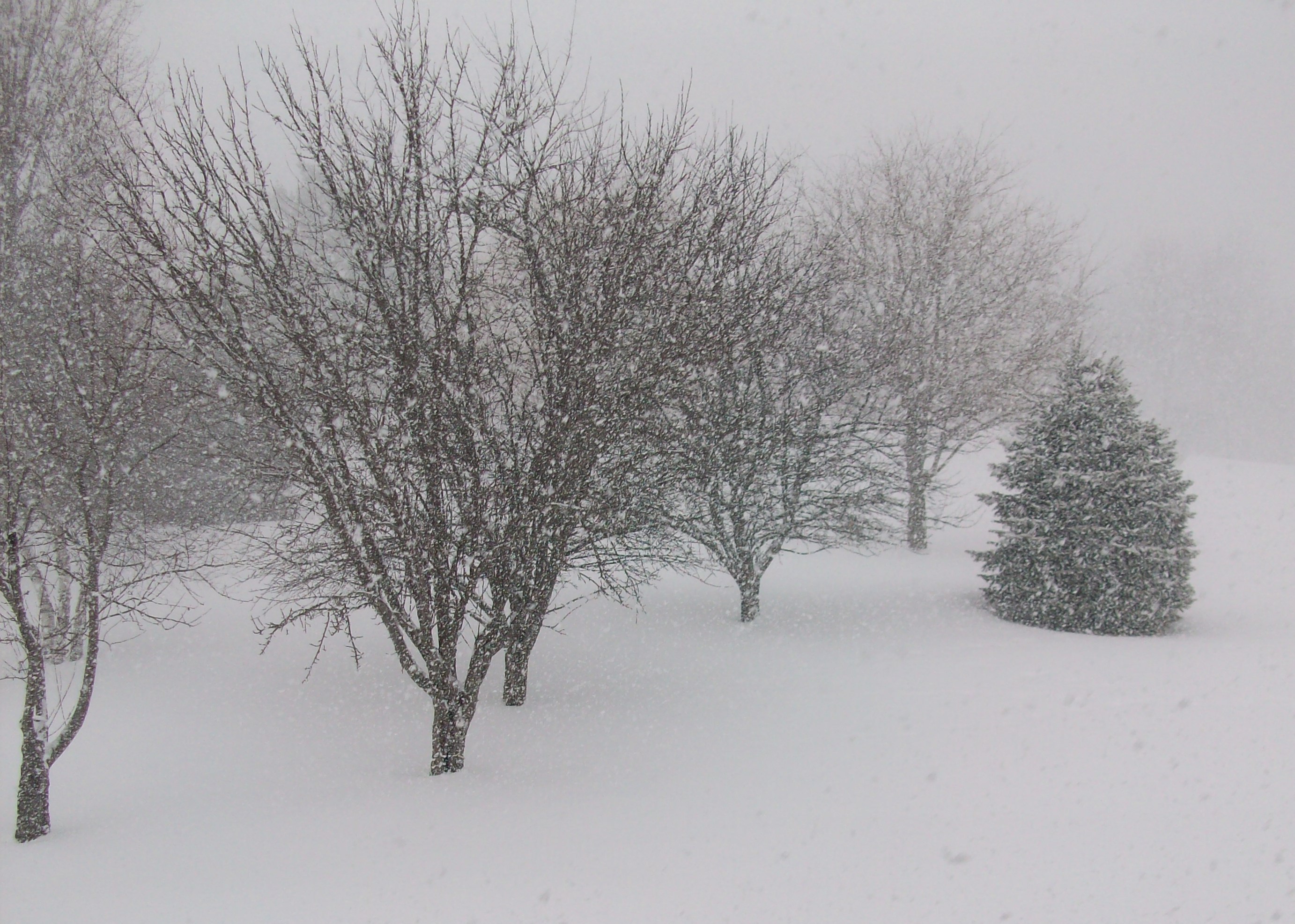
LAKE MACBRIDE— Falling snow whited out the world beyond our driveway. Isolated, it was hard to avoid wondering what was happening out there. The pipeline of data packets delivered to a screen beckoned us to leave our wonder, and engage with society beyond the driveway. At some point, I turned the computer off and set the mobile phone in another room.

Should a writer write what one knows, or what one wonders or imagines? And who is this writing to be about? If it is narcissistic preening, then why not take the whole endeavor off-line, get a paper journal, and write there— because who cares but the individual? Unless we write what we imagine society could be, and how we fit into the greater aspects of it, there is little reason to post on the Internet.

Apple Trees in a Winter Storm

I believe food is a connection to the rest of society and that’s why I write about it. At once it encompasses personal experience, labor, production, the environment, soil quality, botany, chemistry, biology, consumerism, preservation and packaging, distribution, cooking and eating— the whole enchilada of sustaining a life. Since everyone has to eat, food culture has been and remains a fertile field for the imagination, and a practical way to connect with people. That said, why care about what I cooked in the kitchen last night? One needn’t.

If we develop a sustainable culture where we live, we will be better able to survive in a turbulent world. We would be less distracted by media and outside factors, and empowered to act with authority on what we know. One needs a cultural platform to serve as a fulcrum for change. If we don’t make one, social progress becomes difficult.

As the snowfall slowed and stopped, the sun came out. The new fallen snow resembled a blanket over life’s previous markings— a chance to start again. Soon, I’ll grab a shovel and dig a path out to the street and a society with which I was always connected, but from which I took a retreat to work toward sustaining a life on the Iowa prairie.

Categories
Writing

A Byline

First Byline
First Byline

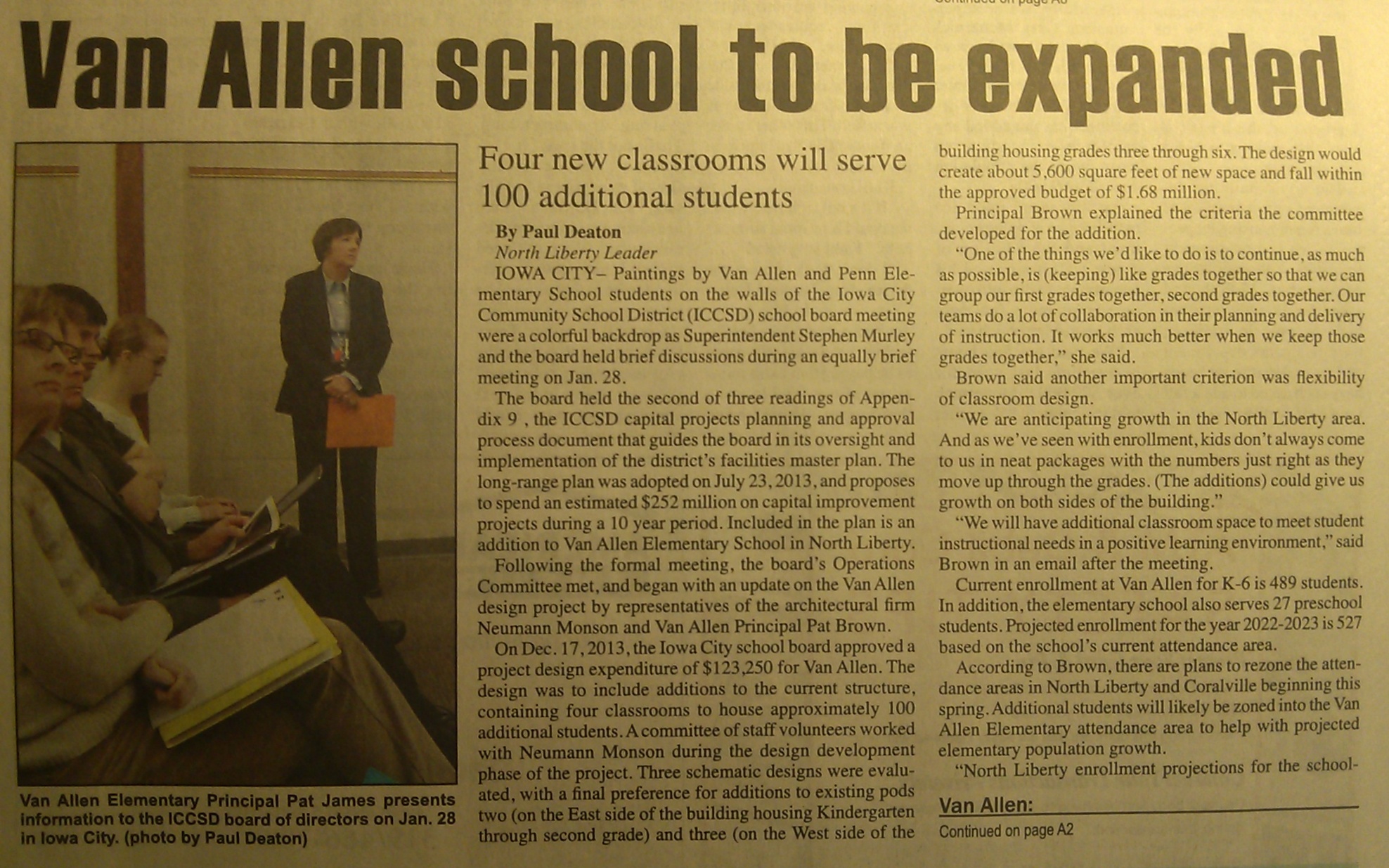
NORTH LIBERTY— On the front page, below the fold, is my first article written for a newspaper— The North Liberty Leader. I have two beats, the Iowa City Community School District Board of Directors, and the Solon City Council. We’ll see how it goes, but the work has been a plus.

Most importantly, I now have an editor who reads what I write and provides feedback. Every writer needs that, although in the era of social media and blogs, few have it. In my evolution as a writer— from high school work in the 1960s, to fledgling efforts in the 1970s, to graduate school, and through today, my writing has gotten better. Now there is a structure for improvement and I like it… a lot.

While life will continue to be busy as a low wage worker, at least part of my time is compensated for doing what I love. That is like Thanksgiving in February.

Categories
Home Life

Wintry Trip to Town

Snowfall in Big Grove

LAKE MACBRIDE— The sound of scraping entered the house and overpowered the muffling noise of the furnace fan. It will require work to get to town for a meeting. At least the snow plow did its part.

The driveway is snow-packed from the car tires, so whatever fell last night won’t be easy to remove. Work was planned for indoors this morning: to write a story for the newspaper. Snowfall is a happy coincidence that will break the quiet and be part of today’s process of fresh air, physical labor and writing. It’s as good as it gets.

Whatever funk descended upon me in December is gone. The new jobs, the promise of spring, and hope that a sound financial platform will enable better writing portend great things. Here’s hoping I’m equal to February’s promise.

Solon During a Snowstorm
Categories
Writing

First Story Filed

Newspaper Office
Newspaper Office

LAKE MACBRIDE— The newspaper where I proofread offered me an opportunity to write a few articles on city council and school board meetings. I filed my first story yesterday morning and it was more work than I anticipated. By the end of a 5-hour writing session, my shoulder was sore, and I was reminded that journalism requires a different kind of energy and intensity. One down and four more to go during an initial, mutually agreed trail period.

I attended the Iowa City Community School District Board of Directors meeting on Jan. 28, and took notes while making a voice recording of the meeting. Getting to the meeting and attending took the better part of four hours. What surprised me was how little work actually got done at the formal board meeting. There was no substantial discussion, only ratification of work that occurred outside the meeting.

The operations committee meeting that occurred after the formal board meeting appealed to my inherent process orientation. It went on for more than two hours, and I felt engaged the entire time.

The budget assumption presentation was particularly enjoyable and I interviewed the district CFO afterward. Because of story length constraints, the budget information ended up on the virtual newsroom floor. What I noticed about the Iowa City school district is they are spending money like they have it. Because of the strong tax base they do have it.

We’ll see how this project goes, but I hope to become more efficient in producing stories, to reduce the investment of time, and to get better at writing news articles. The financial contribution will be, as my editor described it, “pocket change.” It will be another check predestined to go toward sustaining a life on the Iowa prairie.

Categories
Writing

Meditation On Writing

Bison at Yellowstone

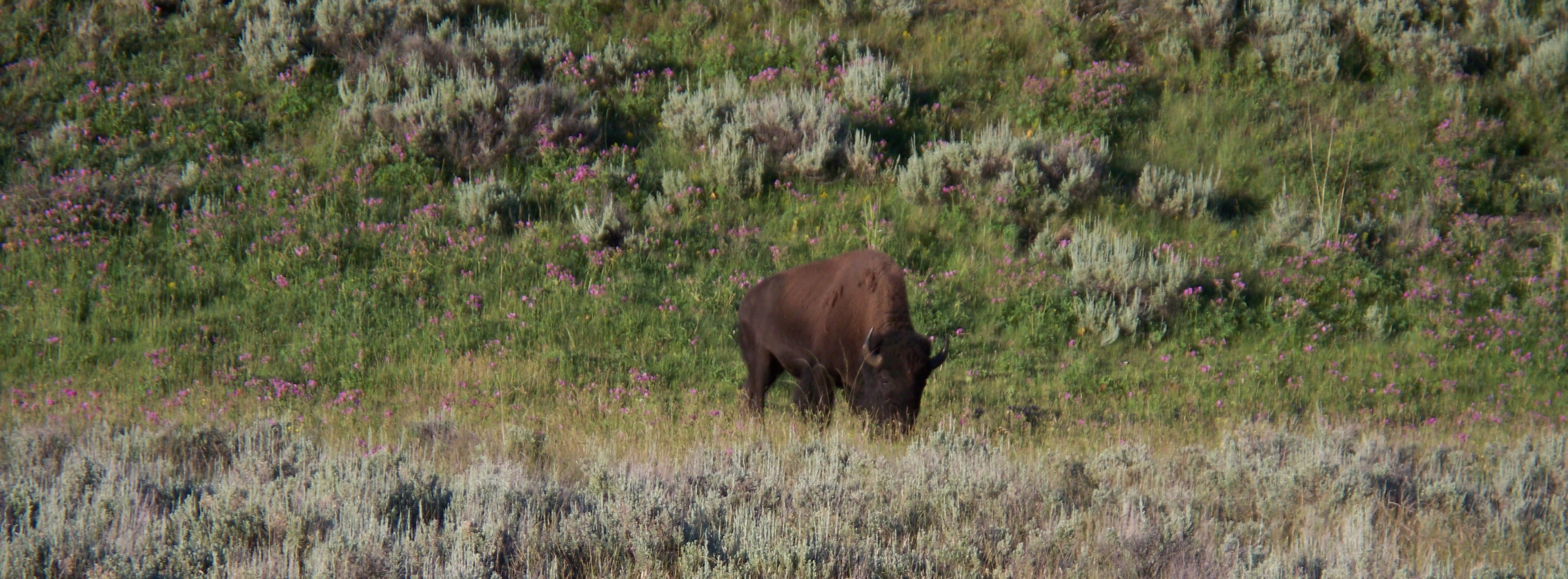
LAKE MACBRIDE— Journal and blog writing is an open book filled with blank pages and freedom. There are few rules, and readership is limited, even when posting publicly on the Internet. Sometimes a writer wants to be read, and others, not so much. There is a formative urge that drives us to understand our world through language. Not everything we write is suitable for framing, in fact, most isn’t. We are driven to write, and occasionally to be read.

In the darkness of night, by the glow of the laptop, it is quiet. Mistake not this silence and solitude for separation from society. What we sense of the world is from constant acculturation beginning before our birth. If we write well at all, it is because of engagement in a world beyond the walls we see. There are no walls, there is no other, only the one of which we are all a part.

Categories
Writing

The Garden Seeds Have Shipped

Garden Planning
Garden Planning

LAKE MACBRIDE— Almost every creative person could use more money. This has been true, not only for the vast majority of writers I have known, but for artists, musicians, potters, actors, dancers, painters, singers, theater technicians, and others who pursue creative endeavor. Very few people make a living in creative endeavor without working at something else for money that pays basic living expenses. It is tough to blend a personal economy with being creative without compromise. It is impossible to keep the two in separate isolation chambers, nor would we want to.

During my senior year at the university, a group of creative people shared expenses in an old house in Iowa City. We each had our own room, but shared the common space, holding periodic meetings when an issue arose. Residents came and went, poets, artists, musicians, a travel guide, a tropical fish breeder, and a mechanic. There was always something going on, most of it interesting, and some of it annoying. It was the creative life.

One day a poet arrived to set up shop. She found a job in town, and wrote every morning in the entryway. As an early riser, I encountered her often, and tried not to disturb the work in progress as I walked to the kitchen to make breakfast and get on with my day. After a while, and after giving a few readings in town, she left for California with another poet who was a frequent guest. She adjusted to a sparse life, focused on experience and her writing. Our shared moments seemed to be a way station on her longer journey. She swiped the cooking pans my grandmother had given me when she left, evidence she could have used more money.

That living arrangement and my undergraduate years were a way station for me as well. Early on, I was an admirer of people who worked a career and wrote, notably the pediatrician/poet William Carlos Williams. I thought I could do something similar. It takes a certain kind of career to avoid disrupting one’s creative outlook and I found my time in transportation and logistics wasn’t it. I’m thankful for the ability to earn a living, and led a full life. For 25 years, creativity wasn’t as much a part of my life as I would have liked. It took leaving the security of that work environment to enable writing. Now there is new hope.

Most days I get a chance to write here or off line. I continue to need monetary income to pay monthly bills, although I am no longer in search of a career, having left the one I had. That’s where gardening comes in.

The less than $200 in seeds and supplies will multiply tenfold in value during the growing season: home grown food reduces the need for money. I have a couple of paying jobs, and need one or two more to make ends meet. That’s life in the personal era of creativity. The good news is the garden seeds have been shipped.

I hopefully await arrival of the germinal package, and the chance to forget about money for a while and work directly with Earth’s bounty. Money may always be tight, but nature can help us survive if we are paying attention— and invest in the work.

Categories
Writing

Passports — Part I

Passport and Notebook

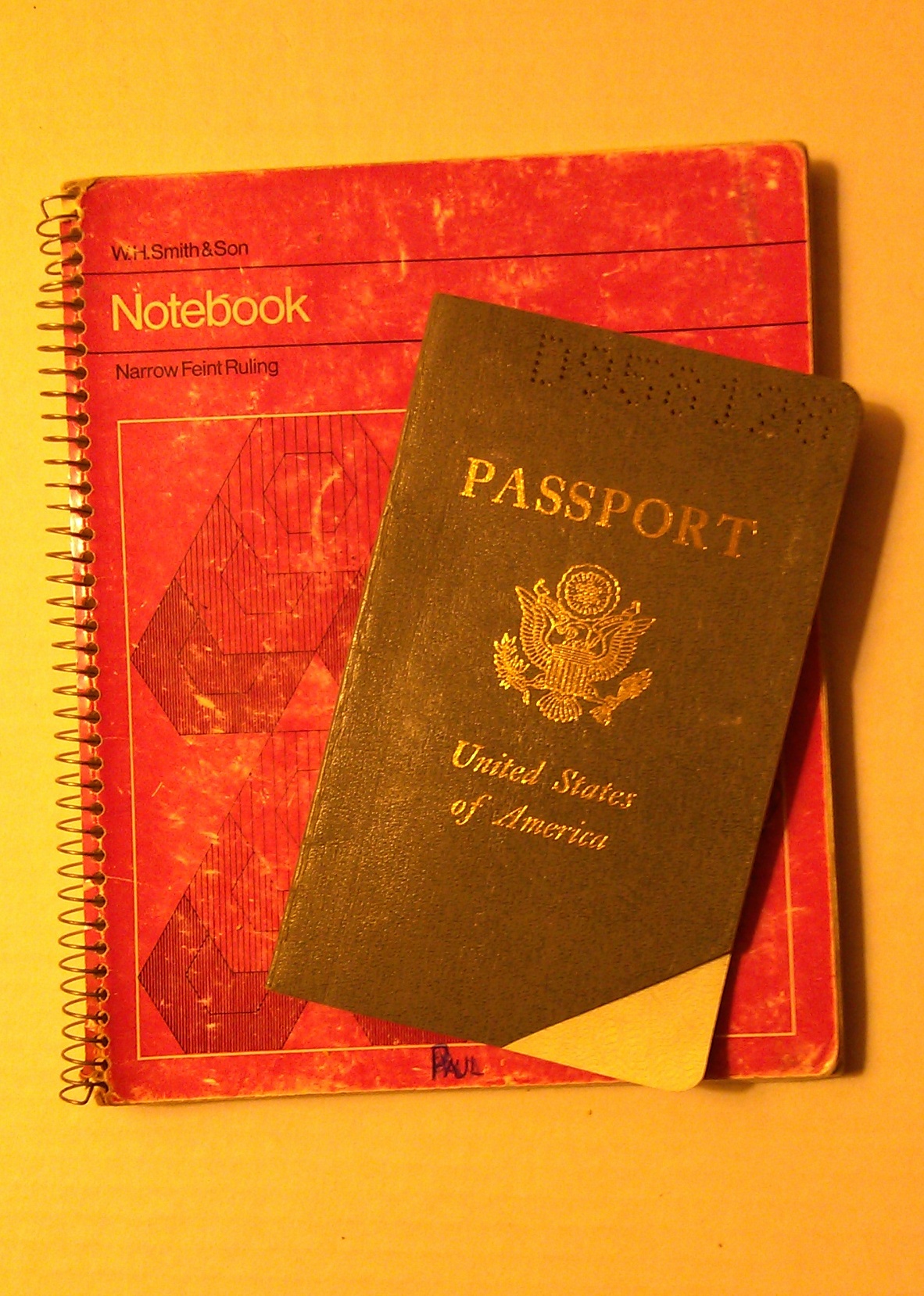
LAKE MACBRIDE— The U.S. Passport issued on April 26, 1973 is on my desk, waiting to be put away. During the 1972 to 1973 academic year at the University of Iowa, I lived with a friend in a mobile home his parents owned next to Interstate 80 in Iowa City.

We thought to travel to Europe together during the summer of 1973, to see the continent and visit his relatives in Bruges. I got my passport, and in the end, he went that summer and I didn’t, ending up playing in a band in Davenport until returning to finish my senior year in the fall. I traveled to Europe the following summer, after graduation, by myself.

It was what used to be described as “the Grand Tour.” Although my adventures were much less than grand, I did manage to visit Paris, Madrid, Venice, Rome, Vienna and other traditional destinations. Stamps in the passport provide five milestones for the trip. I arrived at London Heathrow on Aug. 15, 1974, departed England at Ramsgate on Sept. 2, left Madrid on Sept. 16, arrived in Arnhem, Holland on Oct. 25, and arrived back in Montreal on Oct. 31. There is more to the story than these stamps.

I kept a journal during my trip, although the first volume was stolen in Calais where someone pinched my backpack from the youth hostel my first night in France. I remember two women making café au lait in the kitchen the next morning and reporting the theft in my hopeless French at the nearby police station.

Last night I skimmed the remaining volume wondering what I was thinking when I kept track of the trip. Well, I know what it was— that the persistence of memory would be better than it is. My trip to Madrid explains the point.

Unlike today, I hardly kept track of day-to-day activities. For example, I wrote an entry on Sept. 10, 1974 at the Hotel Sabina in Madrid, with additional entries on Sept. 11, 13 and 15. In none of those entries was mention of the Sept. 13 Cafe Rolando bombing in Calle del Correo near the hotel. Conversations afterward at the hotel, and the bombing itself, were the reasons I left Spain when I did.

My passport was stamped by Spanish authorities on the train from Madrid to Irun as I left for France. Security had been tightened as I stopped in San Sebastián, in the Basque area that was home of the ETA, a separatist group said to be responsible for the bombing. There were military and police everywhere. When attempting to make it to the beach, an armed officer stopped me, waved his rifle at me and indicated the area was restricted. There is no mention of the police state Franco’s Spain seemed to be in my journal. However, I did write that the Prado seemed, “one of the richest museums of the ones I have seen.”

Memory does persist, although the story may have changed in the telling. It was a trip of language, art and experiences that moved me away from the intellectual world of art history classes, and study of the works of René Descartes and John Locke. What I found was a legion of people my age traveling the continent, and the experience changed me in ways that continue to seem astounding, although I hadn’t realized it at the time.

~ This is one of a series of posts based upon writing in my journal.

Categories
Writing

Changing Trains in Paris

June 4, 1977
Paris, France

Gare de l'Est
Gare de l’Est

Departed Mainz June 3, 1977 at 2322 hours in a sleeping car for Vannes. The journey was quite nice. In such luxury I seldom indulge, but this trip I didn’t really think much about it. The little compartment had all the niceties of any fine hotel, and although I was concerned mostly with getting a good night’s sleep, the indulgence will be memorable. Especially the numerous buttons for summoning the waiter and turning the lights on and off. In an earlier time I would have experimented with all these buttons to discover their functions. But now I have changed.

As I exited the train at Gare de l’ Est, I struggled with my bags for 50 meters or so. An older man with a Polish-sounding name spoke with me and offered a ride for my cumbersome duffel bag and clothing sac. He asked the usual niceties— where are you from? Iowa, of course. It seems he is good friends with Mauricio Lasansky‘s son. Small world— so he said.

We shook hands and he guided me to a taxi where I stowed my bags, heading for the connection at Montparnasse.

The ride through Paris made me recall my last trip here.

~ This is the first of a series of posts based upon writing in my journal.

Categories
Social Commentary

One Less Used Bookstore

Formerly Murphy-Brookfield Books

IOWA CITY— The number of used bookstores in the county is reduced by one. Murphy-Brookfield Books closed after 33 years in business, and its owners sold their historic stone building to the Haunted Bookshop. The deal is done and people and cats were in their new digs when I stopped by earlier this afternoon. Murphy-Brookfield Books went on-line.

I don’t like any of it… except maybe the cats.

I’ll start by saying that if I want to find something to read, there will be no problem. Our home library has enough reading material to last the rest of my life, and then some. Most of what I read is found here. Too, the public library provides on-line access to ebooks I can download to my phone for free if someone else doesn’t have them checked out. From time to time I browse the selection, and it is pretty good. If I can’t find what I want there, I go on-line and buy it from Amazon.com, eBay or one of the bookstores on the Internet. It isn’t for reading material that I frequent bookstores. I can get that at home.

Last year I stopped at the large chain bookseller at the mall. It had changed. It was as if they took everything I liked and removed or placed it out of sight. There was plenty of pulp fiction, and novels that looked like they all had been designed in the same advertising studio— similar titles, same sizes and an array of brilliant covers embossed with foil— lined up like so many treats in an old fashioned candy store. The caché of hanging out at a bookstore, reading and drinking coffee has faded. I’m no longer a fan of coffee bars and besides, who has time any more? I haven’t been back.

Browsing used books is like taking a vacation. I plan the trip for weeks, and upon arrival, one never knows what to expect. By chance, something catches the eye and comes off the table, down from the shelf, or out of a bin. If the price is right, the bound volume comes home.

Through Salvation Army stores, Goodwill and thrift stores, used book stores large and small, rummage and library sales, and estate auctions I have browsed since high school looking for something. In a box of discards I found a 19th Century edition of the collected works of James Fenimore Cooper— the pages turned yellow and brittle, too fragile to turn. At a thrift store in Sweetwater, Texas, for a dollar I bought an autographed copy of Iowan W. Edwards Deming’s “Out of the Crisis” while the rattlesnake roundup was going on. At the library used book sale I found Alexander Kern’s copy of Charles and Mary Beard’s “The Rise of American Civilization,” signed by Kern and dated Sept. 1932 inside the cover. That signature itself was a piece of local history. There is always something to connect to bits and pieces of my history or theirs.

So why don’t I like it? The people seem nice at the Haunted Bookshop. And after all, I was able to survive when the Epstein Brothers closed shop and their portable building was removed from Clinton Street. There is Prairie Lights on Dubuque Street. It was good enough for President Obama, so why not good enough for me?

I didn’t know Mark Brookfield at all… except that he was there most times I stopped by over three decades. I recognized him when I entered, and he was helpful without exception. Whether I was looking for something, or had a box of books to trade for store credit, each transaction went well. I was always happy when I left, and looked forward to the next visit. I doubt he knew me. Now he’s out of sight in the ether.

Maybe I just don’t like change— knowing another landmark off Market Street is gone. One less old haunt in a block where so much has happened in my life. Maybe it’s something else. The new place is packed with books, as if a massive shedding of the printed word was underway— more than just the university community ditching books before moving on. It may be something like that.

So one last time to consider the past, get used to the change, and then go on living with one less used bookstore in which to dig for memories. I won’t get over it. But maybe I will.