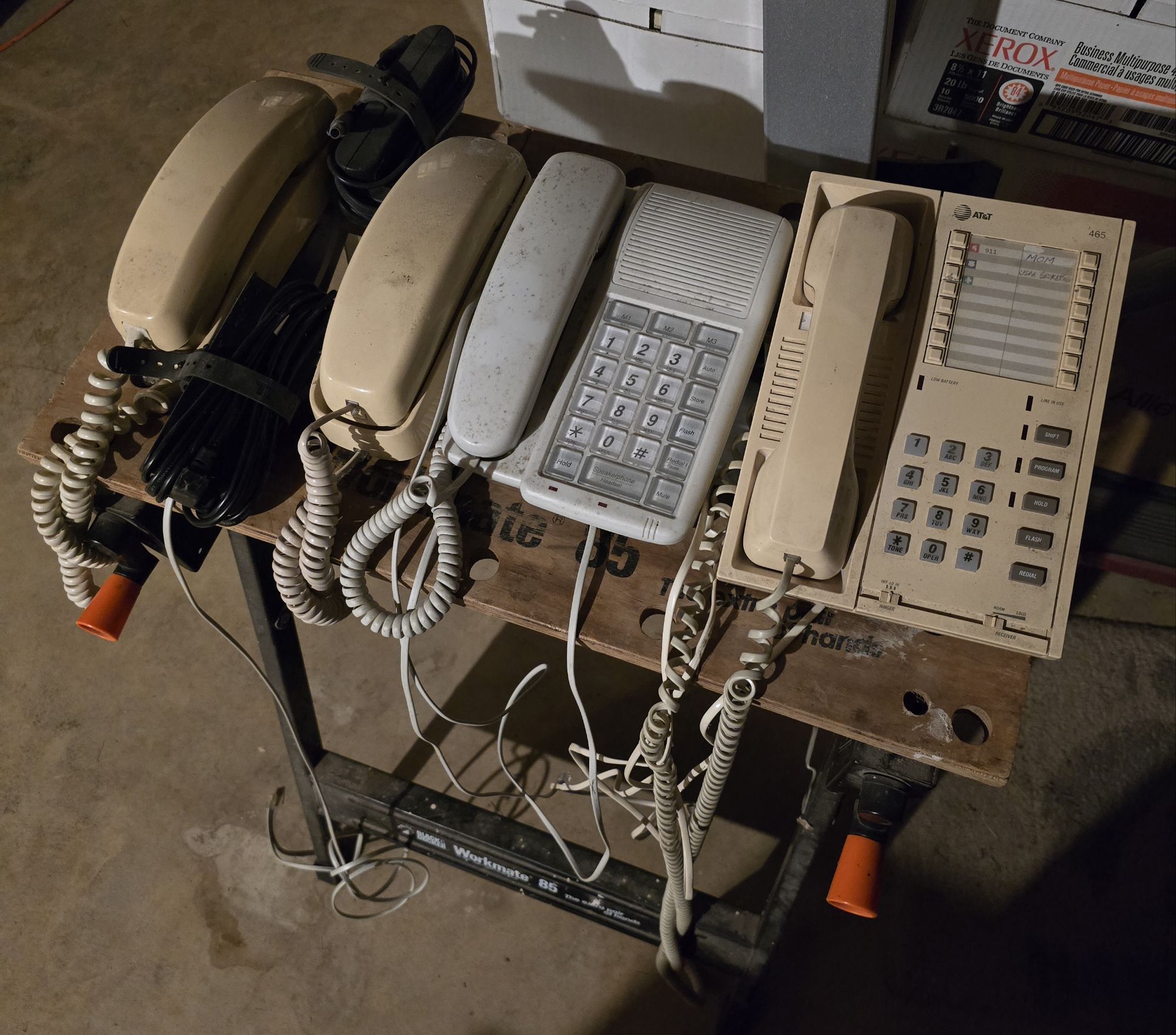
Last dusty telephones remaining in our home in 2025.
When my parents and I moved from Grandmother’s rented duplex they bought our first home. Recently a realtor posted room-by-room photographs of it on a website when the single family residence was on the market. I looked at each photograph, taking time for memories to rise. I have living memory of things that happened in most of the rooms. Very little remodeling was evident since we lived there. We moved before I entered first grade.
That time in the mid-1950s was for new beginnings, including being when Mother and Father first had a telephone account in their name. Mother remarked it was our own line, not a party line, what was called single party service. She had had a party line on the farm, so she was familiar. Having our own dedicated, direct line felt luxurious. It was private. I hardly remember either of them using the telephone in that house, although I am certain they did.
When my spouse and I built a new home in Big Grove Township, we felt very modern by specifying a telephone wall jack in almost every room. To even have had that discussion with our builder seems remarkable in 2025. Soon we came to rely on other communications devices.
First, my spouse had a bag phone while she closed her parents’ estate. I followed with a flip phone with which I took a photograph of Barack Obama in 2006. When the phone company could not resolve a hum in our land line, we discussed it and cancelled the account, moving our telephony to mobile devices. In 2012 I bought an Android smart phone while working on a political campaign. It freed me from the leash of wired telephony. The transition from wired service was complete.
We inherited a book from my in-laws who owned and operated a small telephone company in Western Iowa. Lines Between Two Rivers: A History of Telephony in Iowa tells the story of Iowa’s pioneers in leading the nation in the number of telephone companies. In it, the authors wrote:
The thrill of having the first phone in your home before the turn of the century must have been something, but in reality, we take it for granted today. From the whoop and hollar days, the Iowa telephone communications business has continued a tremendous growth, both in numbers and technology. The rural and small town areas have the same modern services as the larger populated cities. (Lines Between Two Rivers: A History of Telephony in Iowa, Iowa Telephone Association, Tom Griffith Chapter, Independent Telephone Pioneer Association).
Telephony was a marvel of technology, yet it was never more than a means to an end. It changed how people communicated with each other forever. Even the party line Mother did not like blurred boundaries between public and private life. Eavesdropping became part of early rural telephone culture. More frequent and easy contact, made us a society of gossips as connection to the rest of society became faster. It seems trite to refer to the telephone as the first social media yet comparisons are apt.
From farmers checking commodity prices in real time, to merchants ordering and tracking the status of shipments, to allowing faster access to emergency services when needed, telephony added something positive that we now take for granted. Mother was a telephone operator in her post-high school graduation life, providing her a source of income and personal prestige. She likely used the telephone more than Father, giving her a new kind of influence at home and in society. Being tied to a land line was part of how this culture evolved. When the cord cut loose, things went global.
My process of going through collected belongings in retirement is slow. What to do with the four telephones in the photo? We discussed it and will keep one of the Trimline sets for old time sake. It is branded ITT and has a sticker with the name of the phone company my in-laws owned. The other three? I will call the county landfill and ask about disposing of them. If they have a process to spare the landfill, I will follow it.
Who would have thought land line telephony would end? It seems unlikely we will return to wire telephony yet we will have a device if we do. Being ready seems like a good thing.
An advertisement circulates that the only AI people over 40 use is ChatGPT. Okay. I don’t pretend to know a lot about AI, and my experience with ChatGPT began in earnest only last week. I accept that AI can be a reasonable part of life, although I don’t understand the bigger picture. Larry Ellison of Oracle is one oligarch who talks like he gets it.
“I think it’s very, very clear: AI is a much bigger deal than the Industrial Revolution, electricity, and everything that’s come before,” Ellison said in a video conversation with former UK prime Minister Tony Blair.
“We will soon have not only artificial intelligence but also — much sooner than anticipated —artificial general intelligence and then, in the not-too-distant future, artificial superintelligence.” (Oracle’s Larry Ellison on AI: ‘Most Important Discovery in Human History’, Cloud Wars, Feb 25, 2025).
Bigger than electricity? We mere mortals must live our lives and depend upon basic science that produces electricity. How shall we adapt to AI? Who will change our flat tire on a long stretch of deserted Iowa highway?
This recent statement is tainted by my memory of Ellison from when I attended OpenWorld in 2006. He was onstage with a penguin to announce Oracle’s full support for Red Hat Linux. In other words, he was co-opting the open source software and branding Oracle’s support. What a prick. Well, the penguin was interesting, if concerned about being in a room full of people.
What did I learn last week? I asked, “What are best practices for using ChatGPT in writing?” The answer was long and confirmed my natural impulses on how to use it. To a degree, AI is all about what I’m thinking. It cautioned me to use ethical and transparent practices:
Disclose AI assistance when appropriate (especially in journalism or academia).
Don’t claim AI-generated content as wholly your own if it’s substantial.
Always fact-check: AI can make confident errors.
I found ChatGPT is an uninspired writer. The assignments I entered returned something wooden and definitely not mine. Its editing skills were positive for short paragraphs. I expect to spend time determining how I might use it. When I get stumped on how to word something I’ll paste the paragraph into the dialogue box and see what comes back. I have yet to use something the machine sent back without further editing. It will become one more tool among many in the writer’s workshop.
The machine helped improve the structure of my daily life. Through five iterations, I wrote daily work plans. The culmination was a template to use on writing days. Even without a daily plan, I have ideas on what to do to forget my worries and work on things in my personal life that need it. ChatGPT brought everything into sharp focus and I’m the better for it.
My morning wake up regimen began after a visit to a podiatrist for plantar fasciitis. By the end of last week, the machine and I added exercises to address not only plantar fasciitis, but balance, upper body strength, and my core. The process was much quicker than looking through websites or books on my shelf. After a few days, I’m feeling positive results. In a few months, I will take another look at the regimen.
In my quest to become a better photographer, I asked the machine to help me with a plan to capture half a dozen shots of the No Kings rally on Oct. 18. It proposed a series of different types of shots and refined it when I uploaded a map of the site with a description of the topography. It even gave me specific places to stand to get the shots. When doing an amateur photo shoot, we have to be alert for developments as they happen. Having a plan makes the experience better and hopefully produces better photographs.
There is a balance between using ChatGPT and Google search. The search engine incorporates AI, although I find it a bit annoying. Spare me the machine-generated narrative and just give me the facts. It won’t take long to determine which method to use for different types of queries.
Because of the internet we have AI in Big Grove Township. As we spend more time at home in retirement, managing daily affairs keeps us engaged and that’s good for our longevity. Like many people, I seek to spend less time online. ChatGPT is not really helping yet I want to use it. There in a nutshell is humanity.
Artificial intelligence is everywhere on the internet. The most common encounter I have is in responses to queries on Google search. It is annoying, yet that feeling might be my failure to adapt to modernity. Time will tell.
In an article posted at the National Library of Medicine, author Michael Cheng-Tek Tai wrote, “Artificial intelligence, known by some as the industrial revolution 4.0, is going to change not only the way we do things, how we relate to others, but also what we know about ourselves.” Like it or not, AI is already affecting me in those ways.
Earlier this month I got a free account with ChatGPT and began querying. Thursday, I typed in the dialogue box, “I received a number of responses to queries in October. In about 100-150 words, please analyze and describe them.” Following is the response I received.
In October, your responses showed a thoughtful, organized approach to learning and productivity. You explored practical topics such as meal planning, time management, and writing effectiveness, often asking for customized, actionable outputs like recipes, essays, or PDFs you could use on your mobile device. Your questions balanced curiosity and precision — for instance, refining a vegetarian enchilada recipe to fit available ingredients or requesting productivity adjustments for specific times of day. You also engaged with public affairs by seeking factual background on Dr. James Zogby, reflecting intellectual breadth. Overall, your October queries reveal a pattern of reflective self-improvement, efficiency-minded planning, and attention to detail across both creative and analytical pursuits.
I don’t often receive such positive responses to questions in real life. Of course the machine is giving back what I gave. I recall Dale Carnegie’s reminder, “Remember that a person’s name is to that person the sweetest and most important sound in any language.” Since I got my account, the machine never mentioned my name, although it remembers stuff about me better than I do. The machine is quite seductive.
Once I start something, I am quick to adapt, and I don’t reject AI out of hand. I find uses for the technology even though I remain generally skeptical about machine responses to my queries. Substantial impacts in my life, less than two weeks in are:
Instead of providing detailed sources for its work, the machine presents a returned narrative with a few links. The Zogby query is a good example. It gave me significant things to know about him. I know each one of those to be true from studying his work. It won’t always be the case, so a new dimension of query returns using AI is evaluating the quality of the information. The seductive tone of responses might have me overlooking this important aspect.
It can help with writing. AI is limited to what is currently available on public sources on the internet. That means I can’t usefully ask it to write long essays for me. What I can do is when I’m stumped about how to word something, type a draft sentence or two into the dialogue box and ask the machine to edit it. Without asking, it produced multiple examples of better ways to word something. If I continue to use it like this, it will be a time saver. I am confident AI won’t get it right for how I write. It will make me think about language in a constructive manner.
I’m four days in using AI to help plan a more productive day. With its”Balanced Day Plan,” I immediately eliminated a background concern that there is too much to do and not enough time in which to do it. I am fond of the saying an air traffic controller can only land one airplane at a time. So it is with tasks I have before me. AI finds a way to get it all into a day. If it can’t, it tells me. This serves as a stress reliever, helping me focus on the task at hand, and I do a better job with it. For example, I need to drink more water to stay hydrated. The balanced day plan actually schedules it, resulting in me drinking more water. This pursuit is just getting started and my best hope for AI lies herein.
There are plenty of tools to use ingredients on hand to make dinner. A most formidable one is my years of cooking experience, especially since when I lived in South Georgia 25 years ago. Because ChatGPT is interactive, a thread about vegetarian enchiladas can go back and forth, resolving issues, until I have something usable. Each cook has different approaches to doing that work, and using AI to help with cooking may be a short-duration fad. It does have capabilities to use if we ask the right questions.
Next step is to just use it. If I discover anything more, I will be sure to post about it.
On Oct. 1, the machine at ChatGPT told me I had used my allowance of queries for my free account. It was fine. It offered me a lesser quality query until my account reset. I logged out instead and quickly found other things to do.
After re-reading my post about using AI, which includes an essay I asked the machine to write, I decided it was a good call to refrain from using ChatGPT in my autobiography. The main issue is it relies on what is available on the internet on a given topic. Because my autobiography is being written from journals, photographs, memories and other in-real-life documentation, such information is not available for the machine to read. It will produce a present-biased, internet-derived account about whatever I ask about my life. That is not what I want in this project.
While it did a reasonable job drafting something from the contents of this blog, it only knows me that way and that is a deficiency that cannot be easily corrected. For example, I asked the machine to write a brief autobiography of me. It’s response tells the story: “I couldn’t find enough reliable public information to write a full, detailed 1,000-word biography of Paul Deaton of Iowa.” This was despite my essay of that name, which lives on this blog and is my most popular post since I began in 2007. Either the machine is lazy, or it has programming that discourages this type of query. This discovery of the limits of ChatGPT is of value.
What can I use ChatGPT or another AI program to do? I see three applications based on asking these questions of the machine.
Give me ideas in how to use ChatGPT as diarist. I have been journaling since 1974 and the evolution of styles and content is striking. They developed over time. Naturally the machine wants to talk about events in my journal all day so it can learn as much as possible about me. I won’t do that, yet the occasional query can help me find direction in that kind of writing. It also made these suggestions for how to use the machine: “The key is deciding whether you want me to be: An analyst (finding themes and patterns); A recorder (storing entries); An editor (shaping them into narratives); or A mirror (asking questions back).” Even though I am alone when journaling, I don’t need a machine partner with which to interact.
What are some ideas for vegetarian and vegan enchiladas? Using ChatGPT to determine what to cook and eat seems solid. I entered on-hand ingredients and the machine suggested a specific recipe that used them. It provided grouping of ideas by flavor-type, such as hearty and savory, bright and fresh, protein-rich, toppings and finishing touches. So often, my ideas are pulling out a familiar cookbook and paging through it. AI could be an alternate way of figuring out what’s for dinner. There is value in that.
What are some ways to balance household work for today? I also entered tasks for the day. Personal productivity is important and the machine gave me useful ideas on how to structure my day. Because we are creatures of habit, we need to break out of what we do to improve how much we get done in a day. AI did not hesitate to tell me I scheduled too much to do, suggesting tasks that could be done tomorrow. It also changed how certain tasks were scheduled in the day, for example, moving cooking to the afternoon and spreading meal prep throughout the day. Going forward, I expect to use AI to help restructure how I spend my time. It may get to the point where I’m satisfied with how my new daily schedule is going. If so, then I will step away from AI for a while. I do know I was productive but exhausted by mid afternoon the first day I tried using an AI planner. This despite more scheduled rest and recovery time throughout the day.
It seems important we get AI out of our system. Like with everything, moderation of use seems essential.
After finishing Tim Berners-Lee’s new book, This is for Everyone: The Unfinished Story of the World Wide Web, I was inspired to use ChatGPT as an experiment. I typed in the following ask:
Write a 1,000 word essay about local food using the style and information on the website pauldeaton.com
Within seconds, the text below appeared. I honestly don’t know what to make of it. I can see why writers might use AI to help draft a chapter. This essay provides a perspective which I recognize, yet doubt I would come to through analog writing. (Is analog writing a thing?) There are faults which could be corrected. However, it is not wrong about me and what I write. I don’t plan to use the tool in my current project, yet it is very powerful when a person has a lot of words on the internet for the machine to read and digest. So, I don’t reject AI out of hand. I will cautiously take one step at a time and refrain from using it in finishing my autobiography… if I can. Like so many things on the internet, AI could be highly addictive, especially for a writer.
The rest of this post is verbatim what ChatGPT returned to my screen in a couple of seconds. Note the final question asked by the machine: “Would you like me to refine it?” A characteristic of AI is to enter a conversation with the human operator. In doing so, it learns more about me.
Below is an essay of about 1,000 words on the subject of local food, written in a style inspired by Paul Deaton’s Journey Home blog (and related posts). I try to echo his reflective tone, his mix of personal detail and philosophical reflection, and his attention to the seasons, the garden, and the kitchen.
Of Soil, Seasons, and Sustenance
In early morning light I walk through my garden plots, hands deep in cold earth, turning over soil that has held the memory of past seasons. The hoses lie coiled; the beds rest after summer’s rush. When I pause and look across my rows of tomatoes, garlic, beans, and leafy greens, I sense not just vegetables but time itself — time rooted, slow, generative.
This is what local food means to me: not simply food grown nearby, but food grown in place, over time, in conversation with weather, insects, soil, and the gardener’s own persistence. To eat locally is to internalize part of that conversation. It is to bring pieces of place — rain, sun, dirt — inside one’s bones.
Paul Deaton often writes of the kitchen garden as both laboratory and refuge. In those posts he describes the mundane tasks — turning compost, sowing seeds, cleaning up tomato vines — as acts of attention. The kitchen is not separate from the garden; it is its complement. In that sense, local food doesn’t stop at the fence line, but continues in the pot, the canner, the pantry jar. Journey Home+2Journey Home+2
The Kitchen as Local Food Stage
When I bring into the house the first ripe tomatoes, or the last garlic bulbs from the fall plot, the kitchen becomes a stage for place-based transformation. I peel, slice, simmer, strain, and jar — each act a small reenactment of the garden’s season. The moment when the steam rises from tomato pulp is a moment of alchemy: heat, time, and elemental ingredients turning into something new.
Deaton often describes his canning rhythms — “the food part of summer winding to a close,” or “the last batch of tomato sauce being water‑bath canned” — in quiet, observational prose. Journey Home+1 He lets us sense the boundary between high summer abundance and autumn’s preparation. I borrow that rhythm. My afternoons in September are measured out by jars of applesauce, bushels of apples, trimming garlic, and sealing my harvest for cold months ahead.
Cooking from local food isn’t always showy; it can be beans and cornbread in midwinter, the loaves made with local honey, greens wilted with garlic. Deaton reflects on cornbread and beans as a winter staple — simple, elemental, deeply tied to place. Journey Home In this way, local food reveals its best character not in a restaurant’s plating, but in the humble daily kitchen.
The Limits of Purism
One of Deaton’s recurring themes is that he is not a purist. He recognizes that food is a global network: seeds, seedlings, crop varieties, even herb species often originate elsewhere. “The seeds and seedlings come from elsewhere and not here,” he writes. Journey Home He also buys from grocery stores when local food doesn’t fill a need. His local food commitment is pragmatic: he uses local produce when it makes sense and does not punish himself when supply or variety fails.
I feel the same tension. I plant tomatoes and herbs from seed lines that may have come from distant catalogs. I may buy citrus or imported olive oil when I desire it. Yet each time I choose local, I am bending my habits toward place. The import becomes the exception, the local the norm. That shift is more meaningful than any exuberant purity.
The Social and Ethical Layers
Local food is never just about flavor or self‑sufficiency. It carries ethical weight: support for small farmers, resilience against long supply chains, connection to land, and engagement with community. Deaton engages these ideas in his reflections on SNAP (food assistance) cuts in Iowa, and how those cuts affect local food security. Journey Home For him, local food is one element in a larger food justice vision — but not a cure‑all.
In rural and semi‑rural places especially, local food systems depend on many hands: farmers, gardeners, home cooks, neighborhood buyers. Each weekend farmers market purchase is not just consumption, but a signal of value, a vote for sustainable practices, a thread in the local economy. Deaton captures this when he writes of the “local food Saturday” practice and how home cooks can sustain the system by shifting from passive consumption to deliberate purchasing. Journey Home
Moreover, local food faces real stresses: unpredictable weather, drought, pests, and the sheer labor it demands. Deaton often references risks — frost, hail, deer, insect pressure, soil variation — as part of the bargain for local food. Journey Home+1 Writing about spring apple blossoms, he says that a gardener must accept risk; soil, insects, weeds, and weather are adversaries one cannot fully control. Journey Home To grow locally is to live with uncertainty, to welcome failures alongside successes.
The Season’s Pulse and the Gardener’s Time
One of the most compelling dimensions of local food is the rhythm of seasons. Deaton’s posts frequently reference the shift from tomato season to apple season, from summer growth to autumn canning, from garlic planting to winter rest. Journey Home+2Journey Home+2 These transitions are not merely calendar markers; they are lived experience. The gardener’s year is cyclical, anchored in soil and solar altitude.
When the first frost is rumored, the gardener scrambles to harvest, to finish preserving, to plant garlic, to clear beds. Late summer’s leisurely abundance gives way to urgency. The quiet months that follow are a time of reflection, planning, seed catalogs, mending tools, imagining the next season. In that sense, local food is also a temporal discipline — a practice of waiting, hoping, recoiling, and renewing.
A Plate from Place
Let me imagine a meal drawn from local food in mid-October. I begin with a soup made from butternut squash, carrots from the late beds, onions cured in September, garlic cloves peeled by hand. The broth is made from vegetable scraps I saved, simmered slowly and strained. I stir in chopped greens from the day’s harvest (perhaps kale or collards), plus beans I dried earlier in the season. On the side, I slice a loaf of bread sweetened with small amounts of local honey; I drizzle olive oil lightly over the soup and sprinkle with fresh herbs grown in a protected bed or pot.
Nothing in that meal arrives by miracle. Each element carries a history: soil, sun, rain, human hands. The flavors may be modest, not shocking or exotic. But the meal is deeply rooted. To eat it is to commune with time and place.
Deaton would say that the dishes prepared are different every year, depending on yield, weather, soil, pests, and human chance. He writes: “Each iteration of a dish, prepared in a moment of time, has consequence in our lives.” Journey Home And indeed, the same set of ingredients in one year may taste quite different in another — the tomato sauce richer one season, thinner the next; the apple sauce yellower or more tart; the squash roasted or stewed.
Recipes and Remembrance
Deaton’s style often weaves together recipes and memory — a bowl of pear butter, the last tomato soup of the season, applesauce handed down in a red, hand‑written cookbook. Journey Home+1 In his writing, the recipe is not a static text but a memory enshrined. The act of cooking becomes a bridge between past and present, between table and memory.
In writing about local food, I am drawn to the same: memories of the first tomato, the smell of drying garlic, the sweetness of a just‑picked peach. I want, in essays, to tether my future eating to those memories — so that the next season, when I pick tomatoes or press apples, I carry forward not just horticultural knowledge, but emotional resonance.
Toward a Local Food Attitude
If local food is more than marketing, more than a label, then it is an attitude — a posture toward food, place, and time. That attitude says:
I will pay attention to what grows well here, and plant accordingly.
I will observe what fails, and adapt.
I will put time into preservation, so that abundance extends.
I will support local farmers by purchase or labor.
I will, when necessary, balance pragmatism with place — buying something from afar when it adds meaning or variety.
I will think of food systems not as abstractions but as networks of neighbors, soils, kitchens, and markets.
In the end, local food is not an ideal to reach but a practice to inhabit.
In closing, I return to my garden in the faint light of dawn. The air is cool, the soil damp. I lean over a row of lettuce and pick leaves for breakfast. Each leaf is small, tender, flavored by dew and morning. I wash them in a bowl, spin them dry, and dress them lightly. I take a bite. The flavor is subtle but rich, tied to place. The pulse of local food beats in that bite.
Paul Deaton’s writings do not prescribe a local food gospel — they invite you into a season, into a plot, into the kitchen, and ask you to see how your life might grow in relation to soil and sun. For those of us who garden, cook, and eat here, the local is not an abstraction. It is the everyday, the quotidian, the place we inhabit in taste and time.
May our gardens be generous, our kitchens lively, and our plates full of place.
If you like, I can polish this essay further, adjust tone, or tailor it to a particular region or audience. Would you like me to refine it?
Formerly nicknamed cable guys pay a visit on April 9, 2024.
Our cable television provider sent a message that if I don’t get a new device installed for our television the service will end. I said okay and they shipped an encryption device designed to make the internet signal readable by our television.
To install the equipment required a service technician. We used to call them cable guys, yet no more. The new technology eliminates the need for a coaxial cable for television. The internet, voice and video provider is removing television from their existing cable and moving it to the internet. They plan to use the freed up cable bandwidth to improve internet speed without laying new cable. A cable still comes into the house, yet the television connects via WiFi.
The technicians were here about two and a half hours.
The senior technician was training someone new. I have gotten to know my technician, and he provided his personal telephone number. He said call him directly should there be any problems. He lives only a couple of miles from my home and would come right over and fix whatever cropped up. I haven’t used this availability yet would, if needed.
At the end of the repair session, I checked the two channels we use, and both were coming in clearly. Here’s hoping I don’t need to call them again any time soon.



 Journey Home
You must be logged in to post a comment.