LAKE MACBRIDE— The tomato seedlings weathered the afternoon sun and overnight rain, and each cage has at least one survivor from the transplanting. The next threat is bugs that chew on the young stems. I’m ready with extra seedlings should some be stricken.
The plot of spring vegetables looks nice after yesterday’s hoeing. Dark wet soil between bursts of green. The carrots did not germinate. It won’t be long before the radishes are ready to harvest. The ground is too wet to work in the garden this morning.
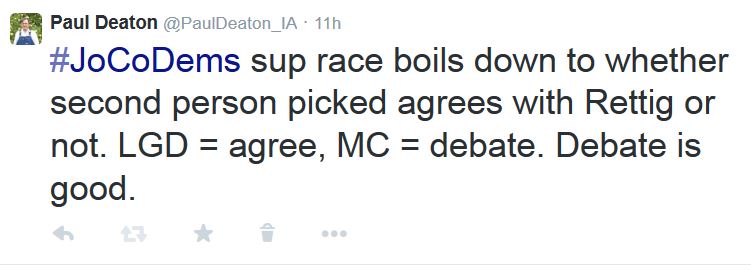
Mike Carberry, Diane Dunlap, Lisa Green-Douglass and Janelle Rettig
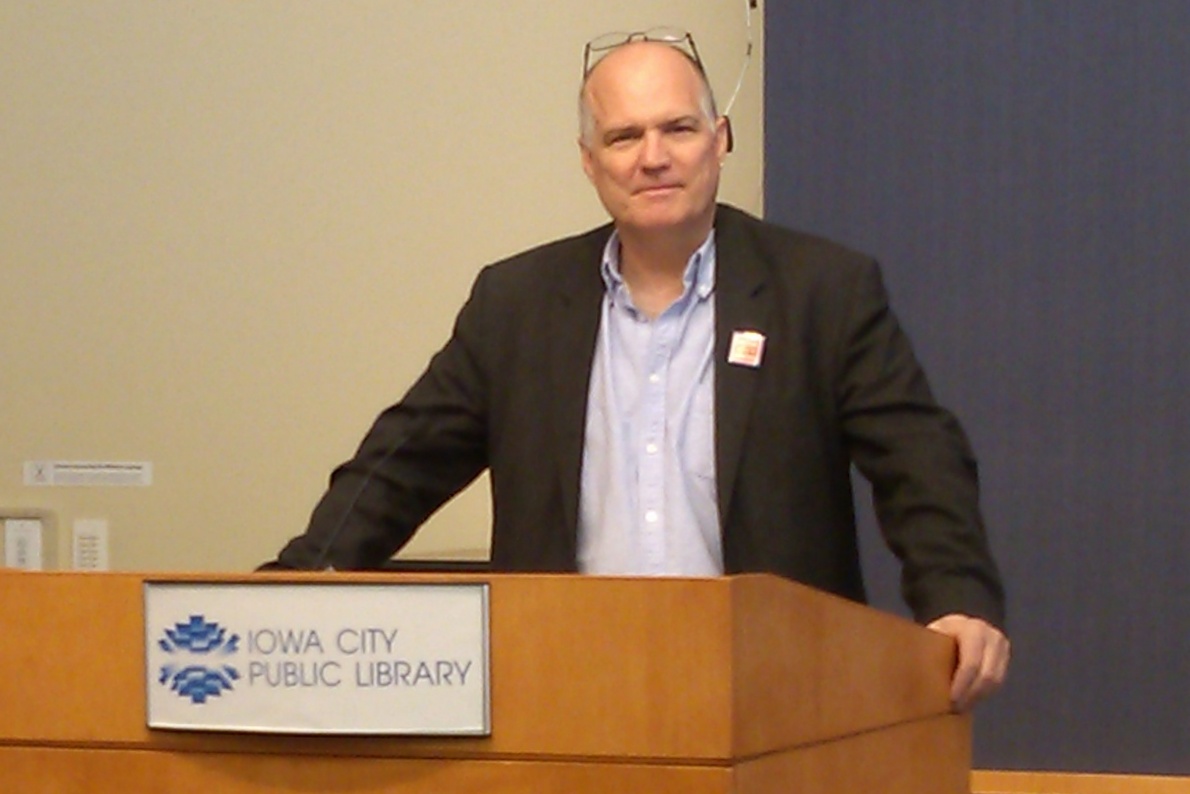
The local Sierra Club, Iowa City Climate Advocates, 100 Grannies for a Livable Future and my organization, Iowa Physicians for Social Responsibility, hosted a county supervisor forum at the Iowa City Public Library last night. Since we were a co-sponsor I felt obligated to attend.
Martha Norbeck moderated, and the way she crammed three or four questions into a single one gave the candidates license to answer how they would around the topics. I would have picked other questions, but was not in charge of that.
The forum went like this.
I’m supporting Carberry and Rettig because I know them best, their strengths and weaknesses, and believe they will work to do well as supervisors. The other two would likely work hard if elected, but I don’t know them at all, and picking a candidate is far from being a logical process on a level playing field.
Only two weeks until the Democratic primary, which in Johnson County has been the election for local races. The lone Republican supervisor, John Etheredge, is expected to be sanded off in the Democratic wood shop that is this county’s general election. For the time being, I’m planning to vote at the polls, but get back to gardening as soon as the ground dries, and there is a break in my outside work schedule.
LAKE MACBRIDE— Iowa’s first in the nation caucuses have resulted in a type of local media bias that favors Republicans. This became increasingly evident during the 2012 presidential election campaign, when President Obama was without serious opposition among Democrats, and a field of Republican hopefuls found ten candidates garnering votes at the caucuses with the three top vote-getters, Rick Santorum, Mitt Romney and Ron Paul, each receiving less than 25 percent. Corporate media reporting is about selling advertising and newspapers, so I don’t blame the reporters. Except that Republicans have increasingly begun to frame the media discussion in Iowa because media questions turn noticeably to Republican issues.
The framing around Republican issues was evident in the Des Moines Register endorsement of State Senator Joni Ernst for U.S. Senate in a primary field of five candidates.
“Ernst’s conservative credentials are impeccable,” wrote the editorial board. This is a Republican primary, but by choosing Obama 52 percent to Mitt Romney’s 46 percent in 2012, Iowans demonstrated that conservative credentials matter less than the Register’s framing suggests. The rejection of Romney in a state that picked George W. Bush in 2004 is meaningful. Romney received 20,000 less votes that Bush did, indicating the value of conservative credentials is in decline among voters in Iowa. For the 822,544 Obama voters in 2012, conservative credentials were even less relevant. But the Register continues to repeat the phrase.
The Register goes on to cite other issues in a Republican framework, including an absolutist position on Second Amendment rights, conceding that Medicare and Medicaid must be cut to address the federal budget deficit, and application of a Christian litmus test to federal judge nominees. All of these posit a Republican position and compare Ernst to it. Citing Iowa’s open primary process as a reason for weighing in on a Republican primary, what the Register has done is use the endorsement as a platform for confirming the conservative perspective of the editorial board.
The race to fill U.S. Senator Tom Harkin’s open seat looks to be a repeat of the 2012 election, and already we are seeing Republican media framing in the run up to the June 3 primary. Congressman Bruce Braley is running unopposed among Democrats. He has the endorsement of the current senator and is focusing on fund raising and grass roots organizing. If he has been working smart, he should have a substantial advantage over the eventual Republican nominee. He should also be heartened by the framing the Register and others have given the public dialogue about the 2014 midterms.
What Democrats learned in 2008 and 2012 is that media matters less and grassroots organizing will win elections. Let’s hope the Republicans continue to drink the Kool-Aid of a biased Iowa media, while Braley is busy quietly closing the deal.
LAKE MACBRIDE— A few people have asked how I am voting in the June 3 primary, but not many. Having framed the 2014 election process in January, and explained where I stand at the beginning of April, little has changed. It will be a case of playing through.
When the ground dries, I’ll make the first mowing, collect the grass clippings to mulch the garden, and put up my candidate yard signs. I see who is working and who isn’t. Everything leads to Memorial Day weekend and the unofficial beginning of summer. There is a lot of work to be done before then, and politics isn’t on the short list.
What is on the list is adjusting my work activities to generate sustainable economic value. That will be my breviary this morning.
LAKE MACBRIDE— It is time to shift gears from the environment to nuclear abolition— two aspects of the same thing. It’s a false choice to pick one over the other, as mismanaging either could have dire consequences for life as we know it. There are so many causes; and limited time.
What environmental and nuclear abolition advocacy have in common is they are global movements where the U.S. has taken a back seat.
Francesca Giovannini, the program director of the International Security and Energy Program of the American Academy of Arts and Sciences, summarized the as-is situation with nuclear weapons in an article for Rotary International.
Although we live in the Post-Cold War era, we remain trapped in a nuclear weapons-reliant world order in which the maintenance of active nuclear arsenals provides ultimate assurance of both survivability and destruction. Today, we talk much less about nuclear weapons than we did during the bi-polar era and the public globally is generally unaware of the continuous existence of thousands of nuclear warheads targeting cities and populated neighborhoods across the globe.
Rotarian at Work
The Rotary Action Group for Peace announced a collaboration between International Physicians for the Prevention of Nuclear War and Rotary International:
Nobel Peace Laureates International Physicians for the Prevention of Nuclear War and Physicians for Social Responsibility offer educational resources to Rotarian Action Group for Peace members interested in sharing information about nuclear weapons and peace with their Rotary clubs.
I am pleased to be part of the speaker’s bureau created to support the collaboration and look forward to reporting these new activities going forward.
DES MOINES— Governor Branstad’s office released an end of session message for the 85th Iowa General Assembly at 8:41 a.m. yesterday, saying, “despite the partisan tone of the session, we are pleased there was agreement on the majority of our legislative plan.” The House had been all high fives and out of there before 6 a.m., busy posting brilliant photos of the east side of the capital on Facebook as the sun rose.
Not so fast! The senate hadn’t adjourned.
House Majority Leader Linda Upmeyer cautioned members that the session was not over until it was over— after the Senate adjourned sine die. Switching my audio feed over to the Senate, instead of calling up HCR 109, the Sine Die Resolution, Majority Leader Mike Gronstal called for a rules committee meeting and recess. When the Senate re-convened at 7:34 a.m., a prayer was said, they pledged allegiance, approved the April 30 journal, and then adjourned at 7:48 a.m. until Friday morning.
What happened has been well reported by corporate media. Rod Boshart of the Cedar Rapids Gazette was one of the first to break the story.
“The shutdown of the split-control legislature’s 2014 session got messy Thursday morning when Senate Democrats attempted to pass a resolution giving a legislative panel broad investigative power to look into alleged mismanagement and secret dealings by Branstad administration officials,” he wrote.
Session may end today, but the politics is far from over.
Republicans provided comic relief in the wee hours of Thursday when it was announced State Senator and Republican U.S. Senate hopeful Joni Ernst called in around 4 a.m., asking the chair to be excused. The Republican level of participation in the Senate has been a joke, and Ernst has been campaigning with a clown car of candidates, running down the presumed Democratic nominee, Bruce Braley, and the president. Occupied by posting on Twitter about her footwear, she is likely to miss Friday as well.
The 2014 general election has begun in earnest. It is framing up nicely for Democrats.
Progressives should love it when the Republican U.S. Senate candidates, like Ernst, tie Bruce Braley to the Affordable Care Act. The law is working and its popularity will increase. If that is their campaign issue, please bring it on, because the law is already saving federal dollars on health care. In case you missed it, the escalating cost of health care was one of the drivers behind the law. It was designed to bring health care costs down and it is.
A reason to feel good about it is in light of 17.8 million sign-ups through Medicaid expansion and the healthcare.gov web site, the Republicans are trying to switch their narrative to Benghazi faster than the sinking of the Titanic.
Another reason Democrats should be hopeful is the mail from the TEA people indicates they don’t realize their group’s influence peaked in the rebellion of 2010. The TEA party is over, and that they don’t get it is good for progressives.
Iowa Democrats are also fielding excellent candidates in all four congressional districts. The tides are shifting. Signs are everywhere that this could be a great year for Democrats, and with all of the women running, Iowa seems more likely than ever to elect its first female U.S. House member.
There is no useful Republican campaign story for the corporate media to cover outside the weirdness of their debates and events. The more weirdness on display, the more swing voters will be alienated. It seems clear that Iowans don’t want a “true conservative” representing them in the U.S. Congress. Pragmatism would serve them better, but who am I to give advice?
Meanwhile, Braley continues to build support, Hatch is catching Branstad in the polls, and with all their Benghazi, Obamacare, gun, abortion, military hagiography, pro-Israel, free market talk, what reasonable person could take Republicans seriously?
I appreciate the work of our legislators this session, and when the Senate adjourns it will be over, but beginning again with the 2014 general election campaign. I’m in. Are you?
LAKE MACBRIDE— The Iowa legislature was still working when I awoke at 3:30 a.m. If they had pulled an all-nighter or two earlier in the session, they would likely have finished up last month. As it is, the house adjourned sine die at 5:54 a.m. this morning, and the senate adjourned until Friday. The 85th Iowa General Assembly is still in session, even if the lower chamber is all high fives and out of there.
When I expected the senate to adjourn sine die, Senate Majority Leader Gronstal called a rules committee meeting and recessed until today, then Friday.
“The shutdown of the split-control legislature’s 2014 session got messy Thursday morning when Senate Democrats attempted to pass a resolution giving a legislative panel broad investigative power to look into alleged mismanagement and secret dealings by Branstad administration officials,” wrote Rod Boshart of the Cedar Rapids Gazette.
Let the campaigns begin in earnest, (no, I’m not talking about State Senator Joni Ernst Republican U.S. Senate hopeful who called in about 4 a.m. this morning, asking the chair to be excused). I’m referring to the 2014 general election campaigns.
A couple of notes:
I love it when the Republican U.S. Senate candidates, like Ernst, tie Bruce Braley to the Affordable Care Act. The law is working and its popularity will increase. If that is their campaign issue, please bring it on, because the law is already saving federal dollars on health care. In case you missed it, the escalating cost of health care was one of the drivers behind the law. It was designed to bring health care costs down and it is.
The mail from the TEA people indicates they don’t realize their group’s influence peaked in the rebellion of 2010. The TEA party is over, and that they don’t get it is good for progressives.
Iowa Democrats are fielding excellent candidates in all four congressional districts. The tides are shifting. Signs are everywhere that this could be a great year for Democrats.
The reason I say this is there is no real story for the media to cover outside the weirdness of the Republican debates and events. The more weirdness on display, the more swing voters will be alienated. It seems clear that Iowans don’t want a “true conservative” representing them in the U.S. Congress. Pragmatism would serve them better, but who am I to give advice?
I appreciate the work of our legislators this session. Now let the campaigns begin.
LAKE MACBRIDE— The bills come quickly as the second session of the 85th Iowa General Assembly draws to a close. They are required to produce a budget, and legislators tend to follow this law. It is not every day they comply with the law. For example, they still owe the school districts a 2016 supplemental state aid number. Not likely that will happen before adjournment sine die.
It is not the scofflaw aspect of the group that makes me grumpy, although there is plenty about the legislature’s actions or lack thereof to grumpify a person. In many cases they are puppets for corporations and that isn’t a happy thought. I’d be happier if the members were required to wear lapel pins to show their corporate sponsorships— the way ARCA, NASCAR and other motorsports club drivers adorn their fireproof suits. Maybe then I wouldn’t be appalled by some of the bills they support. It wouldn’t be good, but it might make the citizen experience more tolerable and lower my blood pressure. After all, in the post-Reagan era it’s all about me, isn’t it?
Garrison Keillor’s appearance at the First United Methodist Church in Iowa City at 7 p.m. on May 4 is making me grumpy.
My favorite local bookstore is sponsoring Keillor at a reading from his newly released collection of writing, “The Keillor Reader.” Back in the day I would have been first in line to buy a copy and be inside the church to hear him from the pulpit. But you see, we had a falling out over his acceptance of a sponsorship from the investment firm Allianz which invests in the nuclear weapons complex.
Maybe be he read my blog and dropped them based on the strength of my position, I hoped. Anxiously googling their relationship, it was worse than I thought. Congresswoman Ileana Ros-Lehtinen of South Florida tried to get National Public Radio to pull the Allianz ads because the company collaborated with the National Socialist German Worker’s Party in their heyday. No Keillor for me, even though until last year, I listened to his program on Saturday nights, and had done so since our daughter was very young.
Which brings me to the connection. Why do I care about these corporate sponsorships anyway? Whether it is our legislators, or Garrison Keillor, or whoever? Why can’t I just live my life?
Someone has to be engaged in sustaining a life on the prairie, and it isn’t the ones sponsored by corporations.
IOWA CITY— We can thank Move to Amend for the sentences “corporations are not people,” and “money is not free speech.” Now what?
David Cobb, one of the founders of the organization, didn’t have an answer at the Iowa City Public Library on April 17. He did say if we filled out a sheet the national organization will plug us in. Plus us into what?
“Our essence was the realization that even people who engage in civic engagement on issues, and there has been just amazing work that’s done,” he said. “But we haven’t, in my lifetime and maybe in a generation, seen the kind of social movements that are the earmarks of this country. The social movement that culminated in the American Revolution, actually the creation of this country, was in fact a social movement. So too was the abolitionist movement, and the women’s suffrage movement, and the trade union movement, and the civil rights movement.”
“You see there is something different between movement and issue organizing or issue activism,” Cobb concluded.
The brochure Cobb distributed on Thursday had great organizing information, with solid ideas: form a study group; organize a workshop or street theater event and invite a speaker from their organization; pass out brochures at public events; write a letter to the editor or op-ed in your local newspaper; propose a local resolution or ordinance; contact elected officials and ask them to take a public stand; or sign a petition. Here’s the rub, organizing does not a movement make.
Blog for Iowa has been writing about Citizens United, which led to creation of Move to Amend, for years. Readers are familiar with the idea of amending the Constitution to say 1). Only natural persons have Constitutional rights and 2). Money is not free speech. After almost four years of being in Iowa, Move to Amend has picked some low hanging fruit: resolutions passed by a handful of governing bodies, some organizing, and a couple of Democratic sponsors for legislation. However, the bicameral Iowa legislature is no closer to acting on amending the Constitution than they were before the Citizens United decision was handed down.
What Move to Amend needs is to become a movement, something Cobb knew this afternoon. It is a long distance from that.
It is ironic that an organization born out of a think tank and turned into a 501 (c) 3 is what Cobb’s narrative implied is not needed. If Iowans want to amend the constitution regarding corporate personhood and money as free speech, then we better get moving. Move to Amend is looking at a 30 year process to amend the Constitution, according to Cobb. The truth is we can’t wait.
Blog for Iowa: Trish Nelson, Caroline Vernon, Dr. Alta Price, Paul Deaton, Dave Bradley. Photo by Dan DeShane
Happy Tenth Birthday Blog for Iowa
The 2000 election was supposed to have elected Al Gore as the first environmentalist president. He was a shoe-in after a popular Bill Clinton, or so some of us thought. What happened after the U.S. Supreme Court gave the election to Bush was people I know, from the whole political spectrum, launched into activism unlike any in my experience. Howard Dean was at the center of this. Who had even heard of the 79th governor of Vermont as votes were counted, and then the counting was stopped in the election of the hanging chad?
When the 2000 election wasn’t settled on Nov. 7, we were enthralled. I listened to the returns on the radio as I drove to Chicago for a meeting on the 8th. When I reached the motel, I stayed up late watching the early morning coverage on television. I followed the Supreme Court action at home and downloaded a ream of briefs to read. It was a unique time. It was a cursed time. I felt sitting on the sidelines was no longer an option.
The turning point came shortly after the Al-Qaeda attacks on Sept. 11, 2001, and not for reasons one might think. My flight was scheduled to depart Moline, Ill. that day for Philadelphia. After our staff meeting in Eldridge, the televisions in the operations room were turned on with live images of smoke emitting from the World Trade Center. Air travel would not be an option that afternoon.
When I did fly to Philadelphia several days later, the aircraft was almost empty. Enroute to the Eastern Iowa Airport, the car radio informed me that President Bush was also heading to Philadelphia to fulfill a campaign promise at a battered women’s shelter. It meant a possible delay getting to my work site at the former U.S. Steel facility in Bucks County. As we approached, Air Force One had already landed, so we circled for 20 minutes— the delay was minimal.
After getting a rental car and leaving the airport, there were law enforcement officers on every corner, thousands of them. As I headed to work, I passed the presidential motorcade on I-95, heading back to the airport. It was only 10:30 a.m. All that public money on the flight, and law enforcement for a political event? The seed was planted: Bush had to go.
The rest is the history of Bush 43. Things rubbed the wrong way. The television address on the invasion of Iraq seemed similar to Nixon’s explanation of the invasion of Cambodia— both presidents appeared to be deceiving us. There were Cheney’s secret energy meetings, Christine Todd Whitman’s brief tenure at the Environmental Protection Agency, and a thousands cuts against everything I held dear. We were ready for change in 2004.
From the beginning of the 2004 campaign, I didn’t care for Howard Dean. He had the endorsement of Democratic leaders, including Al Gore, and U.S. Senator Tom Harkin, but no one I knew was supporting him. Our small family caucused for John Kerry, who won the nomination, and we lost the November election.
Vindication of Dean’s new campaign style came in the form of Democracy for America (DFA), which I heard about from the current Blog for Iowa editor, Trish Nelson and her friend Ellen Ballas at a DFA training at Kirkwood Community College in Cedar Rapids.
At the training, I met Arshad Hasan, Dorie Clark, Dave Leshtz and others who provided training in the mechanics of winning elections. Things like estimating voter turnout, fund raising, and setting a timeline for the canvass, were all important lessons. Thing is, the DFA techniques worked.
We experienced some success in 2006, and the culmination was in the ultimate grass roots campaign of Barack Obama, with Howard Dean as the chair of the Democratic National Committee. To say Howard Dean wasn’t a part of the transformation of electoral politics would be a lie. Unlike certain politicians, I’m not willing to tell a lie.
My first mention on Blog for Iowa was by Ed Fallon on Nov. 17, 2007, in a post titled Action on Coal Plants. What cemented my Deaniac status and my relationship with the group at Democracy for Iowa, was when Trish Nelson asked me to start writing for Blog for Iowa. My first post was on Feb. 25, 2009 with an open letter to the Iowa Department of Natural resources on the then proposed Marshalltown coal-fired power plant. At some point along the way I got less formal, trading my suit for a T-shirt, but I have been writing ever since. And we can thank Philadelphia for that.
Congratulations Blog for Iowa! May you experience many new writers and another ten years.
LAKE MACBRIDE— I received the second of three press releases from candidates announcing campaigns for state representative in House District 73, so it’s time for an update.
I don’t intend to favor any house candidate going into the June 3 primary, and if my word counts about any one or the other aren’t equal, it means very little, if anything.
David Johnson held his kickoff event on July 2, 2013, so he has been well covered in the media. Des Moines Dem did a full writeup of Johnson on Bleeding Heartland.
Until yesterday, Johnson was the only candidate to formally announce. Dennis Boedeker’s press release came via the Iowa House Democrats listserv, and it is posted below. I didn’t know his resume when I recently met him, but he seemed a lot like me. Notably, we both served on the board of health in our respective counties.
Even though I am a Democrat, the closest political relationship I have with any of the three candidates who filed nominating papers is with the Republican incumbent, Bobby Kaufmann. I have been an active advocate in the legislature since we moved to Big Grove Township in 1993. Because of my social engagement, there are a number of things I follow and/or need help with in the legislature. Whoever is my representative, it is important to develop a relationship with him or her. I became comfortable emailing, texting or picking up the phone to call Rep. Kaufmann. He has been reasonably supportive of my efforts, and hasn’t formally announced for re-election.
I will vote in the Democratic primary on June 3, where there are two additional races of interest. I declared my support for incumbent County Attorney Janet Lyness over challenger John Zimmerman. I also declared my preference for incumbent County Supervisor Janelle Rettig, and long-time environmental activist Mike Carberry, over Lisa Green-Douglass and Diane Dunlap in the election to select two supervisor candidates. Neither Green-Douglass nor Dunlap have been active in the same circles as me.
Here is Boedeker’s press release:
Friday, April 4, 2014
Veteran, Farmer Dennis Boedeker announces bid for state representative
Cedar County– Farmer and veteran Dennis Boedeker of Cedar County officially announced his run for State Representative today. Boedeker, a former Cedar County Supervisor, is running in House District 73, which covers all of Cedar County, part of Johnson County, and the city of Wilton.
“I was born and raised in Cedar County and have lived here my entire life. I’m extremely proud of our communities and I’m excited about the opportunity to serve in the Iowa House,” said Boedeker, a Democrat. “As a farmer who still runs the small family farm where I grew up, I understand how important agriculture is to our economy. I’ll be a strong, experienced voice for rural Iowa and the middle class.”
In addition to farming, Boedeker served on the Cedar County Board of Supervisors for 12 years and before that worked for the Cedar County Roads Department. He also served in the US Air Force during Vietnam.
“There is no issue more important in the Legislature than education and there is more we must do to keep our rural schools strong,” said Boedeker, who serves on the Cedar/Jones Early Childhood Iowa Board. “We need to expand early childhood education so every child enters kindergarten ready to learn and make sure the state keeps its commitment to our schools and children.”
Boedeker is a lifelong member of Zion United Church of Christ and served four years on the church council, including one year as president. He and his wife, Cheryl, have been married 40 years and they have two grown sons and seven grandchildren.
Boedeker has been involved with a host of community organizations, including the Cedar County Board of Health, 7th Judicial District, Eastern Iowa Regional Utility Service Systems, and Cedar County Veteran’s Affairs.









 Journey Home
You must be logged in to post a comment.