First district Democratic congressional candidate Christina Bohannan
One of the worst kept secrets in Iowa’s First Congressional District is that Christina Bohannan intends to run against Mariannette Miller-Meeks again in the 2024 general election.
All Spring and Summer I’ve been pointing out at in-person political meetings there was no declared candidate for the Congress. Half a dozen different times I was rebuffed, with folks saying there was a candidate. Finally, at a July 6 event at a Mexican restaurant in Solon, someone named Bohannan as a candidate.
The soft launch of her campaign was confirmed Wednesday, Aug. 9, at 1:31 p.m., when they sent an email request to sign a petition with the following footer:
So Bohannan is in and one presumes there will be an official and more formal launch this month.
The response received from fellow Democrats when I asked, “Why Bohannan?” was, “Who else is going to run?” I point out that Miller-Meeks ran multiple times before being elected. and then won only when Dave Loebsack announced retirement.
Iowa is trending Republican right now, so whoever Democrats nominate to run against Miller-Meeks will be fighting a headwind. I make no judgement about whether Bohannan 2.0 can defeat her. Obviously Bohannan needs to do things differently to be successful this time. One hopes she will hire completely new staff members with new ideas for the second effort.
The subject of the email from the Bohannan campaign was abortion. Likewise, the Bohannan X account became active again recently, with a retweet about the Ohio special election on modifying their state constitution. The special election has been described as a referendum on abortion rights by news media and prominent Democrats. I talk to Iowa voters on a regular basis and from what I’m hearing, the abortion dog won’t hunt in Iowa. I could have a minority opinion, yet I don’t think so.
Now begins the primary campaign for a Democratic First District Congressperson. If there is a lack of interest among talented people to run, the nominee could well be Bohannan. Despite all the blabbermouths in the district, we’ll just have to wait until she makes it official.
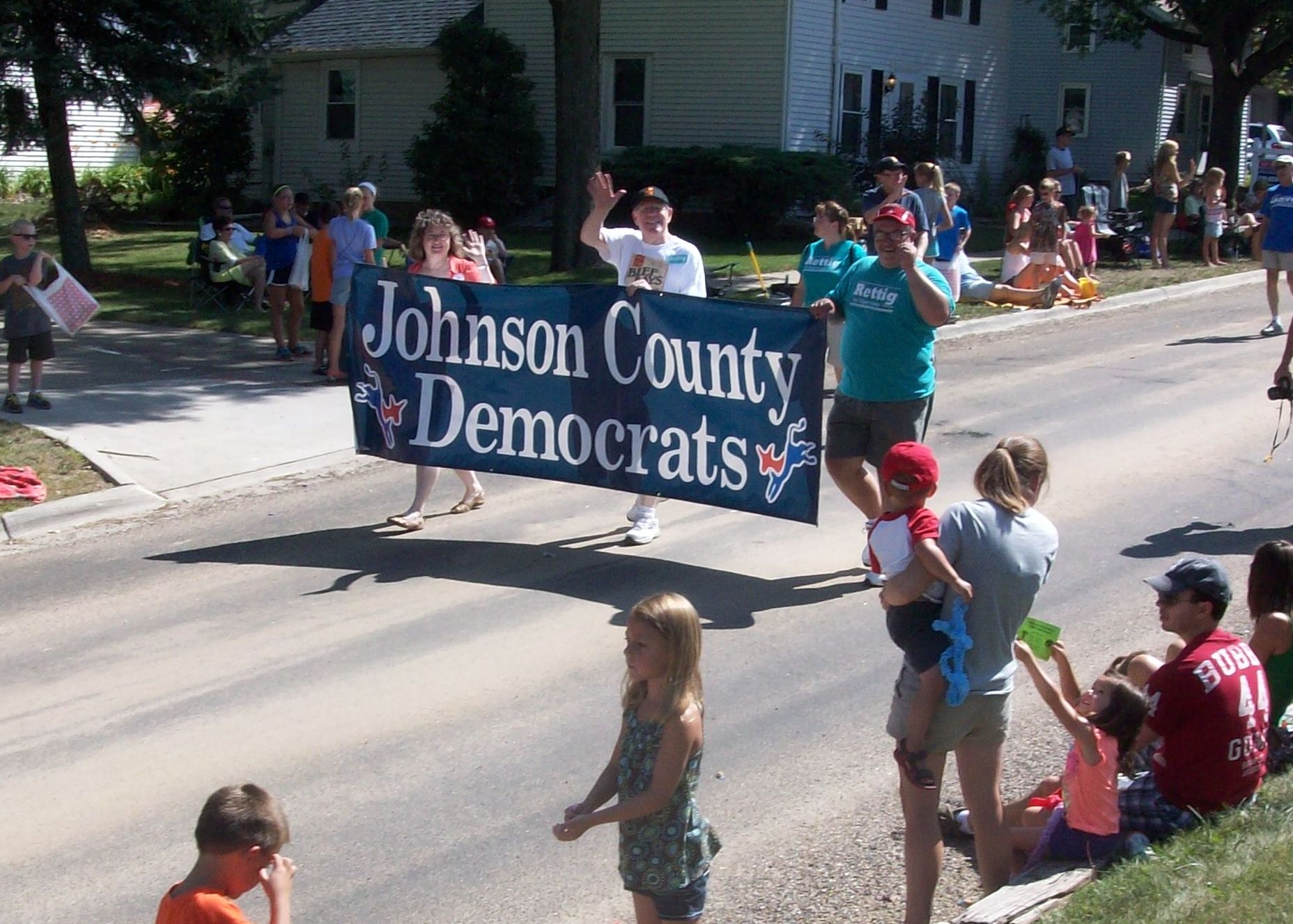
State Senator Bob Dvorsky waving at the cameraman in the Solon Beef Days parade, July 2013.
In 2006 I drove from work in Cedar Rapids to the Democratic campaign office in Iowa City once a week to make phone calls for Dave Loebsack. Staffer Tyler Wilson had a stack of papers with the names of people for me to call. That was a time when people would take a phone call from a political canvasser and have a discussion. I fondly recall the flip phone I used to make those campaign calls.
During the calls, I found Democrats had voted for Republican Jim Leach. They had had it after his support for the George W. Bush administration and would vote Democratic in 2006. By doing so, Dave Loebsack was elected to the U.S. Congress where he served from 2007 until 2021. It was a win: clean, pure and simple.
Chet Culver was elected governor that year but it was anything but a clean win. There was dissatisfaction among Democrats over the conservative selection he and lieutenant governor candidate Patty Judge represented. The vast geography, sparsely sprinkled with Democratic voters, had spoken in the primary. They didn’t want some lefty like Mike Blouin, Sal Mohammad, or Ed Fallon as chief executive officer of the state.
The run up to the 2006 election was a heady time for Iowa Democrats. The feeling culminated in 2008 with Barack Obama winning the nomination for president and carrying Iowa in the general election. The sparkle went off those years quickly. Loebsack won reelection. Culver did not when Terry Branstad re-emerged as the Republican gubernatorial candidate in 2010. Obama’s margin eroded by the time of his re-election in 2012. Since then, it has been all Republican in Iowa, culminating in the trifecta they won in the 2016 general election. Since then, they added to their majority.
What lesson does the ten-year period between 2006 and 2016 have to teach us? I’m sure many people have thought about this and have opinions. Here’s mine.
There is no returning to 2006 or 2008. With the rise in campaign technology beginning with the Howard Dean campaign in 2004, how campaigns were conducted changed. Obama brought the technology of campaigns together and we had an edge on Republicans. That didn’t last long.
In the 2012 campaign for Iowa House District 73, I used what I had learned from Obama about targeting voters. I soon discovered our opponent was targeting the exact same voters during canvasses. I noticed Jeff Kaufmann driving his canvassers around Mechanicsville and in other places on multiple occasions during the campaign. Sometimes I waited until the Kaufmann canvasser finished before making my pitch to the same voter. They seemed to get there first.
Technology is no longer an edge for Democrats. If one reads how the Trump campaign used data aggregation during their elections, and how they micro-targeted voters, they surpassed whatever Obama did in that regard. That may be because they viewed campaigns as a money-generating operation more than a traditional political campaign.
The effect of the pandemic is clear: it created isolation as we dodged COVID-19. Isolation served Republican interests. It unified them like never before and people I had known for years as inactive voters now activated as Republicans.
Working a campaign’s voter database is important. The luster of it faded into a drudgery of making calls and knocking doors. It seems like the wrong direction to perpetuate the idea of year-around calling and door knocking. I agree, there are no off years. I don’t agree using the same crooked sawhorse to build the same obsolete operation. Democrats must focus on winning the next election instead.
Leadership is important. Jennifer Konfrst, Zach Wahls, Sarah Trone Garriott, J.D. Scholten, and others represent the future of Iowa Democrats. Yeah, I know Wahls rubbed his fellow elected officials the wrong way while minority leader. That happened yet Wahls retains excellent prospects for leadership. If the future of the party is based on doing known things only, Democrats have no hope. Who else besides younger members of the elected cohort will lead? The correct answer is no one: we’ll get lost in the wilderness. For the Israelites, that was forty years. There is no promised land of politics today.
The electorate has changed and is changing. People are losing interest in politics. Young Iowans appear to be trending conservative. I see a lot of DeSantis support among Iowa Republicans. The open question is whether Iowa will be a decider in their primary contest. We’ll see what happens in 2024, but if it’s a rematch between Biden and Trump, I predict voters won’t turn out like they did in 2020.
The path forward for Democrats is engagement in society. I don’t mean in politics. Being seen on the library board, at K-12 functions, at the town festival planning committee, and other public spaces is exceedingly important. It is where people of differing political views meet and discuss our politics. For me, that is the path forward few are discussing in August 2023.
Would love to hear your thoughts about the path forward for Iowa Democrats. Leave a brief comment on this post if so inclined.
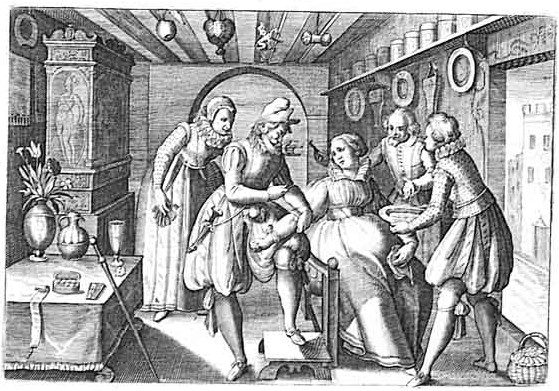
Pregnant woman attended by physicians. Image credit – Wikimedia Commons.
When the U.S. Supreme Court decided Roe vs. Wade in 1973, I was a junior at university. I reread the decision after retirement in 2009, along with dissenting opinions and some of the briefs. I know exactly one thing about House File 732 passed in a special session of the Iowa Legislature this summer: It restricted abortion in the state, yet did nothing, zero, to resolve controversy over abortion.
In 2022, a Republican-stacked Supreme Court overturned Roe which had enabled women with the right to seek an abortion. Discarding legal precedent, the justices ignored what’s best for the common good.
Along with this decision, male dominance over women is surging. Presently and throughout American history men have sought to dominate women at home, in the boardroom, and notably in legislation. A new generation of women, subservient to mostly male Republican legislators, are taking their marching orders. As Governor Kim Reynolds signed a near total ban on abortion in Iowa, women are faced with a familiar historic uphill struggle.
Along with the U.S. Supreme Court overturning Roe, abortion restrictions have led to a significant uptick in intimate partner violence, according to PBS Newshour.
Moreover, contraception is also coming under attack. If Republicans seek to take away abortion rights, effective contraception is the only method to reduce the number of unwanted pregnancies. If Republicans don’t agree, I suggest a remedial sexual education course. The United Nations Population Forum states that since 1994 modern contraception has more than doubled.
The takeaway? If half of humanity is not unfairly burdened everyone will benefit.
“Receiving an abortion does not harm the health and well-being of women,” according to The Turnaway Study by Diana Greene Foster. “Being denied an abortion results in worse financial, health and family outcomes.”
Failure to enable women with bodily autonomy and to make their own health decisions is a human rights violation.
A majority of Iowans can begin to take back rights denied us by House File 732 during the 2024 election.
With last night’s indictments of former President Donald J. Trump, handed down by a grand jury comprised of 23 ordinary citizens, a number of unnamed co-conspirators were mentioned yet not included in the indictment. The focus on the biggest fish is appropriate, the small fry having been pursued and jailed in significant numbers. What about Mark Meadows who sat in the middle of everything on Jan. 6, 2021 when he was chief of staff? What about the members of congress who were part of the plot? There remain many unanswered questions.
Former White House Chief of Staff Mark Meadows may be behind the scenes of the attempted coup against the United States. Thom Hartmann points out we can’t let go of investigations of him and 50 members of congress who joined the plot to overthrow the government. It’s an outrage they haven’t been investigated and appropriately charged already. The United States House Select Committee to Investigate the January 6th Attack on the United States Capitol focused on small fry under Democratic leadership. Apparently there was a deal with Republican committee member Liz Cheney.
For what it’s worth, Heather Cox Richardson reported the following earlier this morning:
Los Angeles Times senior legal affairs columnist Harry Litman concluded that the absence of Trump’s White House chief of staff, Mark Meadows, from the indictment indicates he’s cooperating with the Department of Justice.
Letters from an American, Heather Cox Richardson, Aug. 1, 2023.
Watch this 5:24 minute video for Hartmann’s important take.
RAGBRAI is finished, sweet corn is coming in, tomatoes are ripening, and home gardens and farmers markets are going full bore. Dinner may consist of a thick slice of tomato, steamed green beans, and boiled sweet corn. It’s life in Iowa, as good as it gets.
August is also the commemoration of the end of World War II with the atomic bombing of Hiroshima and Nagasaki. After the war, most nations agreed to eliminate nuclear weapons. More than 75 years after the atomic bombings, we are not close to giving up nuclear weapons. In the United States, the U.S. House passed the National Defense Authorization Act in a bipartisan vote that will spend more than ever on our nuclear weapons complex. The U.S. Senate passed a different version, equally spendy. The bill is heading to a reconciliation process when the Congress returns from summer break.
President Truman made the decision to drop the Hiroshima and Nagasaki bombs. The myth these two decisions ended Japanese aggression is just that: a myth. Truman’s decision to drop the bomb created a culture in which people were afraid for their very existence in a world with nuclear weapons. That culture persists, even if it has taken different forms. It is not too late for peace.
I wrote the following post three years ago:
75 Years After Hiroshima
President Harry Truman did not need to drop the atomic bomb to end World War II.
The first test explosion of an atomic bomb, called Trinity, was conducted by the U.S. Army July 16, 1945, as part of the Manhattan Project on what is now part of White Sands Missile Range.
The day after Trinity, U.S. Secretary of War Henry Stimson flew to Potsdam, Germany where President Truman was meeting with Winston Churchill, Clement Attlee and Joseph Stalin to determine the fate of Germany which had surrendered unconditionally on May 8.
Truman wrote about this meeting with Stimson in his memoir:
“We were not ready to make use of this weapon against the Japanese, although we did not know as yet what effect the new weapon might have, physically or psychologically, when used against the enemy. For that reason the military advised that we go ahead with the existing military plans for the invasion of the Japanese home islands.”
A committee had been established to evaluate use of the atomic bomb once testing was successful. On June 1, 1945 the committee of government officials and scientists made their recommendation, which Truman recounts:
“It was their recommendation that the bomb be used against the enemy as soon as it could be done. They recommended further that it should be used without specific warning and against a target that would clearly show its devastating strength.“
Ultimately Truman made the decision to drop the atomic bomb on Hiroshima and on Aug. 6 the U.S. Air Force delivered it. On Aug. 9 the Air Force bombed Nagasaki. The Japanese surrendered Aug. 10.
Historian Gar Alperovitz, in his book The Decision to Use the Atomic Bomb, asked two well-known questions about Truman’s decision.
“To what degree did (the president) understand that a clarification of the officially stated demand for ‘unconditional surrender’ specifying that Japan could keep its Emperor would be likely to end the war?”
“To what degree did (the president) understand that the force of a Russian declaration of war might itself bring about an early end to the fighting?”
The book based on his research is 847 pages.
The idea that dropping atomic bombs on Hiroshima and Nagasaki saved tens of thousands of allied forces lives by ending the war early is a myth perpetuated by those who would absolve our country from a decision to kill tens of thousands of Japanese children and as many or more other non-combatants. Historian Howard Zinn asked, “Would we have sacrificed as many U.S. children to end the war early?” Obviously we wouldn’t.
A friend, the late Samuel Becker, was in Guam in August 1945 preparing for the invasion of Japan. I recently asked him about the atomic bombings of Hiroshima and Nagasaki. The reaction in Guam was positive he said. U.S. military personnel were in favor of it because they felt it would bring a quick end to what could have been a prolonged, bloody conclusion to World War II. Before he died, Becker changed his mind. With time and reflection he found the notion that the atomic bombings saved many lives was a myth. The Japanese were already in a position to surrender.
Alperovitz said in a recent webinar that, to a person, contemporary military leaders went on the record to say there was no need to use the atomic bombs to end the war early. The war had already been won.
Truth matters and one truth is the atomic bombings of Hiroshima and Nagasaki were unnecessary. Their effects would fuel the Cold War and the idea of mutually assured destruction should they be used. This is crazy talk. Nuclear weapons must be eliminated and the only way to do that, to pierce the wall of our federal government, is citizen action demanding it.
On the 75th anniversary of Hiroshima it’s past time we took action.
~ Written for the Cedar Rapids Gazette and published Aug. 9, 2020.
More than 30 million people viewed a short video of Marjorie Taylor Green speaking about what the Biden administration is doing to the country. If you haven’t seen it, here it is:
Biden-Harris campaign ad on July 19, 2023.
It’s not about the words she spoke. Greene appears to be framing Biden in a certain way, assuming people will accept her framing and vote Biden out. In more popular jargon among right-wing politicians, she is attempting to “own the liberals.” You know, because that’s what the crazies do.
It didn’t quite work if that was her assumption. Biden received a lot of free, public media because of the way their campaign used words she spoke. It was a moment of brilliance on the part of team Biden in a campaign expected to have many advertisements. Biden got the better of Greene in this face-off.
It is early in the campaign to think much about a single advertisement. I enjoyed this one and as it runs its course, will forget it just as quickly as it was created. The lesson is not only do words matter, the context in which they are spoken does too. When words like Greene’s are spoken in the right-wing media echo chamber, the speaker should do a reality check, something she didn’t do before the Turning Point conference where she unwittingly made a Biden Harris ad.
Last night I led the last annual meeting of our home owners association as president. About a dozen members gathered at the shelter in town to share a potluck dinner, socialize, and hear news of what our board has been doing. I did my best to be thorough. It has taken me a while to shed volunteer activities undertaken since retiring in July 2009. This one dates back to 1994.
I’m almost there. The last will be to leave the county party central committee and become a regular voter. This one is tricky in that no one else in our precinct expressed interest in taking the responsibility for more than one term. I’ll figure a way to let go and it won’t be long.
I lost track of how many hours I volunteered in my life. After retirement it became a way of life for more than ten years. We’re at the end of the line. Going forward, I plan to concentrate on writing, gardening, and fixing up the house.
People should be helpers in society. I plan to continue to grow more food than we can use and donate extras to the food banks. Books, kitchenware and other excess possessions will be donated as well. Yet to lend time and experience to leadership of social groups is not in my future. If there was a catastrophe, I’d surely help out.
It’s not that I’ve earned time working on myself and our home, although I have multiple times over. It’s that the male drive that brought me this far needs to step back to let a new generation of people take the baton from here. I’m confident we’ll be fine, and so will my ego.
It is a brilliant day near the lake today. Wildflowers are blooming, and the ambient temperature hasn’t been too hot. For a while, I was able to walk the trail and just breathe.
When the U.S. Supreme Court decided Roe vs. Wade in 1973, I was a junior at university. I re-read the decision after retirement in 2009, along with dissenting opinions and some of the briefs. I know exactly one thing about House File 732 passed in a special session of the Iowa legislature this summer: It did nothing, zero, to resolve controversy over abortion.
In 2022, a Republican-stacked Supreme Court overturned Roe which had enabled women with the right to seek an abortion. Discarding legal precedent, the justices ignored what’s best for the common good. Along with this decision, male dominance over women is re-surging. Abortion restrictions have led to a significant uptick in intimate partner violence, according to PBS Newshour.
Presently and throughout American history men have sought to dominate women at home, in the boardroom, and notably in legislation. A new generation of women, subservient to mostly male Republican legislators, are taking their marching orders. As Governor Kim Reynolds signed a near total ban on abortion in Iowa, women are faced with a familiar historic uphill struggle.
“Receiving an abortion does not harm the health and well-being of women,” according to The Turnaway Study by Diana Greene Foster. “Being denied an abortion results in worse financial, health and family outcomes.”
Failure to enable women with bodily autonomy and to make their own health decisions is a human rights violation.
A majority of Iowans can begin to take back rights denied us by House File 732 during the 2024 election.
~ A version of this post appeared in the July 21, 2023 edition of the Cedar Rapids Gazette.
We are at the point of summer where if I see you in person, I’m likely to give you a cucumber. Two if you’ll take them. Last night at a meeting of mostly grey-haired friends, the box of cucumbers was empty when I left. Those who took one seemed to want and like the vegetable.
There is always something to do in the county where I live. In part, that was why I moved here in 1980. I attended three gatherings in the last 30 days. When I reflect upon them, I noticed there was little age difference between most participants. To the extent we can discuss new ideas and avoid worn out tropes, I am okay with being with members of my cohort. All of these meet ups were initiated because of politics.
In part, we get political news at these gatherings unavailable elsewhere. In part, people are working to organize for the 2024 general election campaign. The fallacy in this is while I enjoy being with people who work together on politics, unless we get some new ideas and new people involved, Democrats will remain the minority party in Iowa for years to come. The common denominator has been that we are all in the same U.S. Congressional District, Iowa-01.
Iowa Democrats have a long history of difficulty finding candidates for congressional elections, and winning races. The sawhorse I drag out when describing this is the Art Small U.S. Senate race against Chuck Grassley in 2004. Small and former Davenport mayor Bill Gluba were both elected to the Iowa legislature in 1970. I remember chatting with Art at the county central committee meeting where he announced his candidacy for the Senate. He showed me a letter from Gluba which said that somebody had to run against Grassley, and it was down to Gluba or Small. Art agreed to fill the ballot and lost.
When my congressional district paired us with Cedar Rapids, prominent Linn County Democrats “took turns” running against long-time incumbent Jim Leach. By the time the 2004 election came along, the party had pretty much given up on beating Leach, and ran Dave Franker who had no money, no following, and no chance against the popular Republican. Franker got only 38.7 percent of the vote.
No one has announced for U.S. Congress in Iowa-01. There was agreement at the meetings that the talent pool is shallow. It was also noted that each year our current congresswoman serves she becomes a stronger incumbent. We are at about the place Art Small and Bill Gluba were in 2004. I’m sure someone will run. In the current political environment I’m hoping the candidate is doing more than filling the ballot or taking their turn as we used to say.
If the coronavirus pandemic hadn’t happened, it seems likely Democrat Rita Hart would have won the 2020 congressional race when Dave Loebsack retired. The pandemic motivated Republicans like I’ve never seen before and they swept. 2020 was a precursor to 2022 when Republicans took all statewide offices except auditor and gained a super-majority in the Iowa legislature. Rebuilding from here won’t be possible without good candidates, starting with the Congress. We’ll see who steps forward. I don’t think it will be Rita Hart since she took a role as chair of the Iowa Democratic Party. Christina Bohannan is said to be kicking the tires on another run. She lost every county in the district except for Johnson, where she lives, with 46.6 percent of the vote. I doubt there will be enough Democratic interest for there to be a competitive primary.
Three gatherings in a month seems close to the right amount. I want to be with people more although I avoid the county seat and stick to events closer to home. For one event I drove across the lakes to North Liberty. It was a stretch of my distance requirements, yet truth be told, I had excess cucumbers needing distribution and a potential outlet. It worked out well.
Is democracy the default state of humanity? In The Hidden History of American Democracy: Rediscovering Humanity’s Ancient Way of Living, author Thom Hartmann presents the case that democracy is our default state, overcome only by the intrusion of dictators, popes, and kings using the power of great wealth, control of media, or the force of arms and technology. He explains where society has gone astray and what we can do to restore democracy.
The Hidden History of American Democracy is the ninth volume in Hartmann’s Hidden History series. Like its predecessors, it is accessible and easily readable, especially for readers immersed in the issues it covers. Hartmann creates a narrative grounded in historical documents yet seems fresh, and modern in its interpretation. The first two parts of the book dispel myths about democracy and the meaning of our constitution. The rest of the book frames the modern war on democracy and regulated capitalism; outlines a 21st Century democracy agenda; and presents a call to action.
The United States is not a Christian nation. Although Christianity was introduced in North America by European settlers in the 16th and 17th Centuries, and has experienced periodic revivals, it did not appear to take. The founders did not envision the newly formed country as Christian. They took precautions to avoid affiliation of the government with religion. Author of the Declaration of Independence and US Constitution Thomas Jefferson studied the Bible yet was decidedly not Christian. In fact, the US Constitution never explicitly mentions God or the divine. In this book, Hartmann creates a narrative about the founding using Jefferson’s own experiences with the Cherokee and other indigenous people, depicting American democracy’s indigenous and broadly based intellectual roots.
While the US Constitution isn’t strictly based on the Iroquois Confederacy, it does have some elements in common with it. The greater impact of Native Americans, however, was in helping to shape the thinking of Enlightenment thinkers from Spinoza to Locke to Montesquieu to Jefferson.
Thom Hartmann, The Hidden History of American Democracy.
Here in Iowa, people refer to the US Constitution as if they read it. What they say and appear to believe about it doesn’t match the text. Not only do citizens believe the United States was founded as a Christian nation, they superimpose misguided characteristics on the Constitution regarding gun ownership, the U.S. Supreme Court, the Electoral College, the branches of government and more. In part two of the book, Hartmann takes apart these cultural myths in an effort to return us to a basic democratic outlook from before some were led astray.
The high water mark for post World War II democracy may well have been the election of Ronald Reagan as president. 60 percent of middle class Americans lived “the American Dream” in 1980, according to Hartmann. So-called Reaganomics, or the rise of neoliberalism, brought de-regulation of capitalism, “which measurably set back the working and middle classes while also weakening our democracy,” Hartmann said. Both Republicans and Democrats espoused principles of neoliberalism, ending in an all-out war on democracy and regulated capitalism. It is hard to find fault with Hartmann’s analysis of this important issue.
The rest of the book outlines a 21st Century democracy agenda. In it, action steps such as making voting a right instead of a privilege, changing the relationship with the U.S. Supreme Court so there is a form of oversight or “regulation,” expand the U.S. Senate immediately by adding two new states (Washington, D.C. and Puerto Rico), providing health care for all, and more.
Thom Hartmann
Importantly, part of Hartmann’s agenda is for each of us to get involved in our democracy.
You may think your voice is but a faint whisper in the wilderness, but there are ways you can amplify it at no cost other than a bit of effort. Write letters to the editors of your local newspapers. Become active on social media. Volunteer with the dozens of great good-government groups and organizations devoted to saving our environment, our democracy, and our world.
Thom Hartmann, The Hidden History of American Democracy.
As we enter the 2024 general election cycle, many of us are seeking things we can do to make a difference. A good way to start is to read The Hidden History of American Democracy: Rediscovering Humanity’s Ancient Way of Living and share it with your friends.
The author interviewed Thom Hartmann about the book on July 10, 2023. Readers can hear the 31:25-minute interview by clicking here.
Thom Hartmann is a four-time winner of the Project Censored Award, a New York Times bestselling author, and America’s number one progressive talk show host. His show is syndicated on local for-profit and nonprofit stations and broadcasts nationwide and worldwide. It is also simulcast on television in nearly 60 million U.S. and Canadian homes.
To buy a copy of The Hidden History of American Democracy: Rediscovering Humanity’s Ancient Way of Living,click here. The book is available July 18, 2023.








 Journey Home
You must be logged in to post a comment.