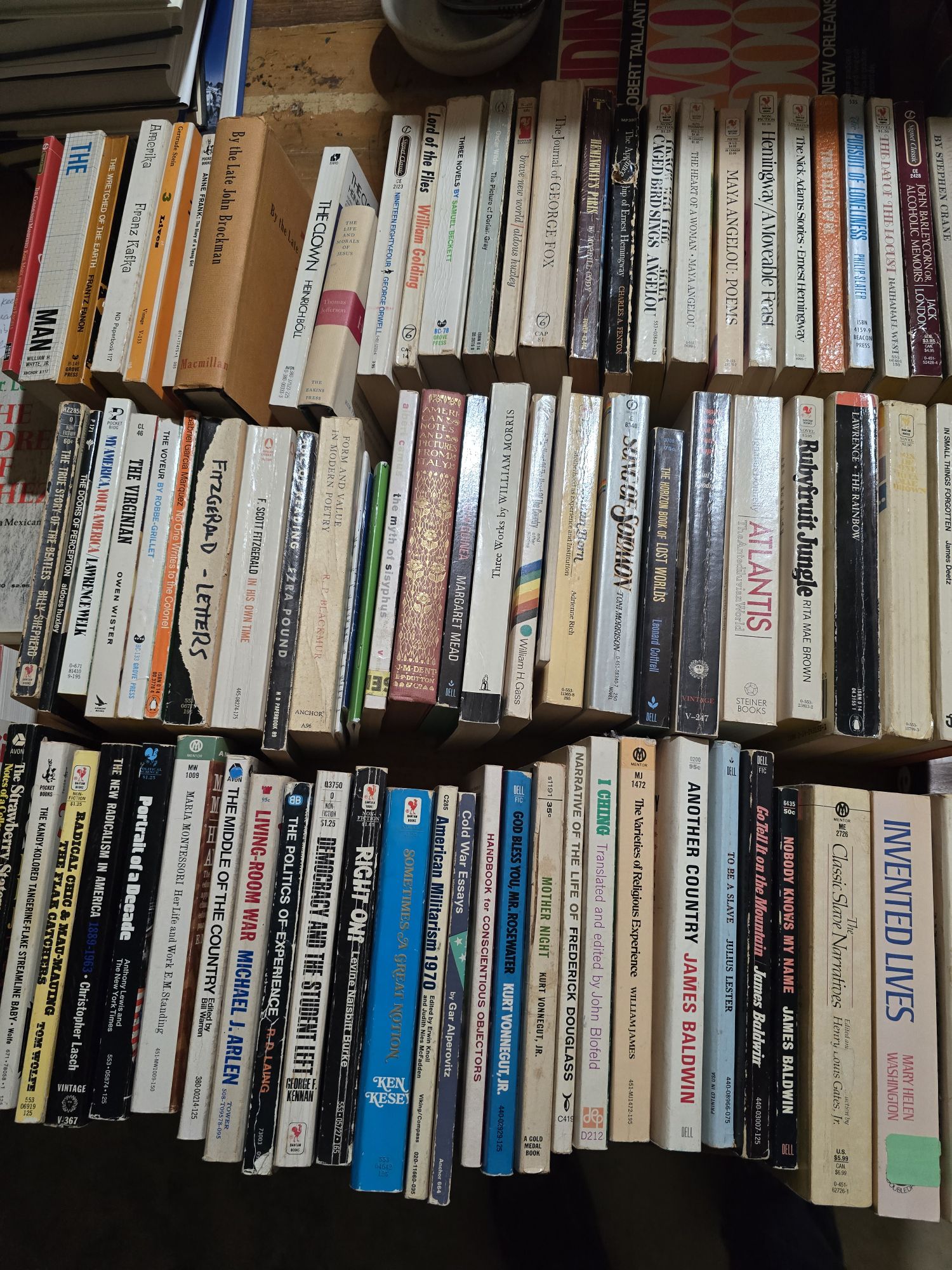
When I had a newspaper route, I stopped at the corner drugstore and occasionally bought mass-market paperback books. They are characterized by their small size (roughly 4.25 x 6.87 inches), lower price point, and widespread distribution in places like airports, grocery stores, and drugstores. I have so many of them that I built a special shelf to store them near the ceiling.
They were never archival quality, and a typical one from the 1960s has yellowing pages due to the cheaper paper from which it was made. The pages grow increasingly brittle with age. They are what they are: a record of what I was reading. They are subject to the same curation as any of my books.
One of the first I bought was The True Story of the Beatles by Billy Shepherd, illustrated by Bob Gibson. It was promoted as “The original book about the Beatles,” with photographs published in the U.S. “for the first time.” After seeing them on February 9, 1964, on The Ed Sullivan Show, I bought this book that summer and, in the fall, went with my mother to the King Korn stamp redemption center and got a new Kay guitar to play. Our family members were Beatles fans.
Another early purchase was The Great Escape by Paul Brickhill. Several World War II veterans lived in our neighborhood and spoke about their experiences. My cohort of grade schoolers descended on downtown Davenport to meet up for matinees at the several movie theaters operating there. World War II films, including this one, were de rigueur. The 50-cent Crest Book reported, “Now a spellbinding motion picture starring Steve McQueen, James Garner, Richard Attenborough. A United Artists release.” The printing of my copy was October 1965. I can’t say how many times I saw this film—yet many. That’s how grade schoolers rolled in the 1960s.
I went through a period when I collected mass-market paperbacks written and popular in the 1960s. Among them are On the Road by Jack Kerouac, One Flew Over the Cuckoo’s Nest by Ken Kesey, Beautiful Losers by Leonard Cohen, Bound for Glory by Woody Guthrie, Reminiscences of the Cuban Revolutionary War by Che Guevara, Prison Journals of a Priest Revolutionary by Philip Berrigan, Soledad Brother: The Prison Letters of George Jackson, How to Talk Dirty and Influence People by Lenny Bruce, Daybreak by Joan Baez, and Long Time Coming and a Long Time Gone by Richard Fariña. Just typing these titles is a trip down memory lane.
In part, that is the problem. I moved past the 1960s in my intellectual development, and these books are unlikely to be reread. I envision more culling of less useful mass-market paperbacks as I move through this project. The special shelf space sets the limit on how many I retain.

 Journey Home
You must be logged in to post a comment.