Joint Statement by Senator Rob Hogg and Representative Bobby Kaufmann on Keystone XL Pipeline:
BIPARTISAN OPPOSITION TO KEYSTONE PIPELINE IN IOWA BECAUSE OF EXPECTED USE OF EMINENT DOMAIN
DES MOINES– Two Iowa state legislators– Senator Rob Hogg (D-Cedar Rapids) and Representative Bobby Kaufmann (R-Wilton)– joined today to call on Congress to oppose the proposed Keystone XL pipeline because of the expected use of eminent domain in the development of the project.
“I urge you to stand with those land-owners who do not want this pipeline running through their property,” wrote Rep. Kaufmann in a letter to Congressman Dave Loebsack of Iowa’s Second Congressional District. “The interests in oil profits should not supersede the rights of property owners.”
“It is not in America’s national interests to allow a foreign oil company to condemn American farms and ranches to take foreign oil to the Gulf Coast for sale on the global market,” wrote Sen. Hogg in a letter to Congressman Bruce Braley of Iowa’s First Congressional District. “The Keystone pipeline threatens America’s land, water, and wildlife – Congress should say no, the State Department should say no, and President Obama should say no.”
Senator Hogg and Representative Kaufmann’s letters were also submitted to the U.S. State Department in advance of the March 7 deadline for public comments on the Environmental Impact Statement on the proposal. The public can submit comments at the following web address: http://www.keystonepipeline-xl.state.gov/
Download PDF of Senator Hogg’s letter to Rep. Bruce Braley here.
Download PDF of Rep. Kaufmann’s letter to Rep. Dave Loebsack here.
LAKE MACBRIDE— An article about James Lovelock was recently updated and is in the news again. “Enjoy life while you can,” said Lovelock in 2008. “Because if you’re lucky, it’s going to be 20 years before it hits the fan.” Whether enough people are listening to his admonition about the inevitability of catastrophic climate change is doubtful. Whether we should is another question.
While the U.S. has its share of doomsday preppers, by and large the potential for social unrest, like in Ukraine, Egypt, Syria and Venezuela, is discounted by most people I meet. If some are stocking up at COSTCO, it is the result of a mathematical calculation of price per serving, and how long that over-sized box of crackers will last. Preparing for Armageddon is the last thing on shopper minds. As Americans, we have a high level of tolerance for injustice… as long as we perceive that as individuals, we are being treated fairly.
Our public awareness is influenced by a media bought and sold by a few wealthy people. Corporations influence our lawmakers, agriculture, retail stores, our utilities, and anything we do that requires our participation. Seldom has there been a large scale outbreak of social unrest, nor is one likely without a wholesale breakdown of consumer society. The wealthy are smart enough to prevent that from happening unless it serves their purposes.
Perhaps the most recent American social movement was the political tide that swept Republicans out of power and inaugurated President Barack Obama. Discontent with our government increased once the abuses of presidential power became more widely known after Sept. 11, 2001. It was a peaceful movement, even if we had yet to end two wars, and continued our questionable use of drones to target people in countries with which we are not at war.
It would take a lot for wide-spread, violent protest to topple the U.S. government. For that matter, protests against drones, economic issues, taxation, the Keystone XL pipeline, nuclear weapons installations, mountaintop removal coal mining and other issues pass largely unnoticed by society. In the middle east, it took a widespread drought, a shortage of export crops from Russia and Ukraine and high food prices to activate citizens for social change. Of course now we are getting back to climate disruption caused by global warming.
Helping mitigate the causes of global warming is at the top of my to-do list. I wrote about it at this link, “climate change is real, it is happening now, it’s caused by humans, and is cause for immediate action before it is too late.” Of course, according to Lovelock, it is already too late. Climate change is not the only worry we have about survival of life on the planet.
The other threat is the lingering possibility of a nuclear weapons exchange. In our post-Cold War era, this borders on the absurd. The two countries with the largest number of nuclear weapons are the United States and Russia. The war is over, so disarm. We can’t afford the hundreds of billions of dollar we spend on the nuclear complex, so disarm.
The humanitarian consequences of a small-scale, regional nuclear war, like between nuclear states India and Pakistan, are unthinkable. Conservative organizations like the Red Cross/Red Crescent Society and Rotary International are signing on to abolish nuclear weapons for that reason. They are most active outside U.S. borders.
Americans are already looking to enjoy life more, oblivious to the tangible threats we face. It is possible to mitigate the causes of climate change, work toward nuclear abolition, and enjoy life more. Once one has read Sartre not much seems futile, and engaging in life becomes its own reason to live. Whether we can make a difference is a question the naysayers would answer for us, something we can’t let them do.
LAKE MACBRIDE— Between now and Tuesday, the Iowa Utilities Board (IUB) is accepting comments on distributed generation, or generating electricity closer to the point of use. This request for comments kicks off their first policy-making. It is common sense that if I can produce some of my own electricity at home, as a citizen, I should have the freedom to do so in compliance with regulations that may be promulgated by the IUB and our government. I made this comment:
NOI-2014-0001: Enable Distributed Generation to Advantage Citizens
Any rules regarding distributed electricity generation should enable individuals, property owners, and businesses to generate some or all of their own electricity and sell excess into the grid. Regulated utilities have made a substantial investment in infrastructure and contracts, and should receive reasonable consideration for them.
Why bother with taking action? Because it matters that we develop ways to reduce the amount of carbon dioxide being dumped into the atmosphere. Distributed generation is a way to take personal control of the decision of how we will generate electricity, and open possibilities to use solar collectors to take advantage of our most abundant energy resource. It’s time to put a price on carbon, and part of the price is taking personal action to mitigate the causes of global warming. Distributed generation is part of an approach to doing so.
Here is the full text of the IUB press release on distributed generation:
Iowa Utilities Board opens inquiry, seeks public comment on distributed generation in Iowa
DES MOINES– The Iowa Utilities Board has opened a notice of inquiry (NOI) proceeding to gather information related to policy and technical issues associated with distributed generation, which is an approach that employs various technologies for power generation closer to the point of consumption.
Information gathered by the inquiry will assist the Board in addressing the potential widespread use of distributed generation, related consumer protections, and interconnection and safety considerations. In its December 2, 2013, and December 16, 2013, Energy Efficiency Plan orders, the Board informed rate-regulated utilities and other relevant parties of its intent to conduct this NOI proceeding.
The Board is asking for comments or information relevant to this inquiry, is accepting responses to its questions related to distributed generation, and could seek additional responses to more specific questions and/or schedule a workshop(s) after all initial comments have been received. For more information, please see the Board’s Order Initiating Docket No. NOI-2014-0001.
The inquiry responses will provide information to the Board and other groups involved in energy, environmental, and economic policy for a more thorough understanding of the technical, financial, regulatory, safety, and policy aspects of distributed generation. In addition to Iowa utilities, the Board invites broad participation from other state agencies, local government and non-governmental organizations, environmental groups, renewable energy trade associations, industrials, and any others with an interest in these issues to contribute in this process.
Anyone may participate, and also respond to the questions posed in the Board’s written order, by submitting comments via its electronic filing system, https://efs.iowa.gov. Questions regarding this inquiry docket may be addressed to Brenda Biddle, Brenda.Biddle@iub.iowa.gov.
The Board is interested in hearing an extensive range of comments. Initial comments are sought by February 25, 2014. The Board has not previously conducted an inquiry related to distributed generation and has not taken any particular positions as it begins to gather information.
On Thursday, Jan. 16, the U.S. Senate Committee on Environment and Public Works will hold a hearing entitled, “Review of the President’s Climate Action Plan,” begging the question, if a tree falls in a forest and no one is around to hear it, does it make a sound?
A well credentialed panel is scheduled to appear, including administrator of the U.S. Environmental Protection Agency Gina McCarthy. The hearing is important mostly to generate interest in a conversation about climate change that is on life support on Capitol Hill. (For more information about the hearing, click here). Who will be listening?
There aren’t enough votes in the 113th U.S. Congress to put a price on carbon emissions, something that is essential to slowing them. Recently, U.S. Senators Barbara Boxer (D-Calif.) and Sheldon Whitehouse (D-R.I.) announced formation of a task force to revive talk about climate change in the Congress, and to defend President Obama’s Climate Action Plan.
The goals of the task force are modest— introducing some small-scale bills intended to “use the bully pulpit of our senate offices to achieve (a) wakeup call,” Boxer said. She added, “we believe that climate change is a catastrophe that’s unfolding before our eyes and we want Congress to take off the blindfolds.” What will come of this year’s task force is unclear, but anyone paying attention can see the disruptive effects of changing climate on our society. However, as a writer on Daily Kos pointed out, it is another task force in another year, and legislation mitigating the causes of climate change, or dealing with its effects, is expected to be dead on arrival because the votes aren’t there.
Boxer has it right that people on the hill, and in the public, are asleep about climate change. The reason is the money spent by climate deniers. In December, Drexel University released a study of 140 different foundations funding an effort to delay action on climate change. The so-called Climate Change Counter Movement (CCCM) spent more than $900 million from 2003 through 2010. Author Robert J. Brulle wrote that the study was, “an analysis of the funding dynamics of the organized effort to prevent the initiation of policies designed to limit the carbon emissions that are driving anthropogenic climate change. The efforts of the CCCM span a wide range of activities, including political lobbying, contributions to political candidates, and a large number of communication and media efforts that aim at undermining climate science.” The efforts of CCCM have been successful, insofar as “only 45 percent of the U.S. public accurately reported the near unanimity of the scientific community about anthropogenic climate change,” according to the study.
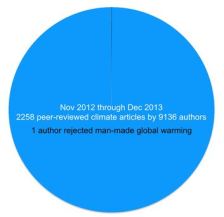
What does “near unanimity” mean? James Powell recently evaluated 2,258 peer-reviewed scientific articles about climate change written by 9,136 authors between November 2012 and December 2013. Only one article rejected anthropogenic global warming. This may not represent a consensus, but consensus is not the purpose of science. Science is to explain the world to us, and we don’t need to strike the word “near” to understand climate change is real, it’s happening now, human activity is causing it, and scientists believe that is the case.
I am not sure whether a group of rich politicians posturing in the Congress will make a difference. However, it’s the only game in town. They are willing to take positive action to support the president’s climate action plan, which doesn’t rely on new legislation that isn’t in the cards anyway. While not hopeful of meaningful action, fingers are crossed, and the game is on.
Following is this afternoon’s press release from the League of Conservation Voters:
WASHINGTON, D.C.– League of Conservation Voters (LCV) president Gene Karpinski released this statement on the creation of the Senate Climate Action Task Force, a group chaired by Senators Boxer and Whitehouse that includes more than a dozen senators committed to pushing for action on climate change:
“Big Oil and corporate polluters have worked with their allies in Congress to prevent action on climate change for far too long. This task force is the latest sign that environmental allies in Congress are fighting back, standing up for basic science and pushing for action on climate change. This is the type of strong leadership we need if Congress is finally going to get serious about addressing the climate crisis and meeting our moral obligation to future generations. We thank Senators Boxer, Whitehouse, Cardin, Sanders, Klobuchar, Merkley, Franken, Blumenthal, Schatz, Murphy, Heinrich, King, Markey, and Booker for speaking out on climate change today and look forward to continuing to work with them to address this vitally important issue.”
People seeking scientific proof of anthropogenic global climate change are barking up the wrong tree. The goal of science is not to prove, but to explain aspects of the natural world. Following is a brief explanation of climate change.
Around 1850, physicist John Tyndall discovered that carbon dioxide traps heat in our atmosphere, producing the greenhouse effect, which enables all of creation as we know it to live on Earth.
Carbon dioxide increased as a percentage of our atmosphere since Tyndall’s time at the beginning of the Industrial Revolution. As a result, Earth’s average temperature increased by 1.5 degrees Fahrenheit.
The disturbance of the global carbon cycle and related increase in carbon dioxide concentrations in the atmosphere is identifiably anthropogenic because of the isotope signature of atmospheric carbon dioxide.
We can also observe the effects of global warming in worldwide glacier retreat, declining Arctic ice sheets, sea level rise, warming oceans, ocean acidification, and increased intensity of weather events.
It is no wonder 97 percent of climate scientists and all of the national academies of science in the world agree climate change is real, it is happening now, it’s caused by humans, and is cause for immediate action before it is too late.
LAKE MACBRIDE— It’s no secret that when wind turbines began to be constructed, there was an unintended consequence of killing animals that collided with the large blades. Birds and bats made most of the news, endangered species particularly. On Friday, the U.S. Fish and Wildlife Service announced it will be extending the maximum length of the permits it’s granting wind energy facility operators for the ability to injure or kill bald and golden eagles. The move to increase the length of the permits from five to 30 years is intended to more closely match the life cycle of wind turbines and is said to be consistent with the department’s Eagle Conservation Plan Guidance. The so-called “eagle-take permits,” that accept the inevitable deaths of the national bird and other species, has begun to get conservationists in an uproar. It is only beginning.
First on deck to take action have been the National Audubon Society, the Environmental Working Group and the American Bird Conservancy. A friend who worked for the latter organization indicated that the U.S. Fish and Wildlife Service has put the cart before the horse in some cases. In Wyoming, a “record of decision” regarding an eagle-take permit on a wind farm was signed by the Department of the Interior before knowing where the turbines would be sited. It speaks of shoddy work by the department, even though the decision was more than a year in the works.
My experience in developing wind farms was a consulting engagement that was part of the Criterion Wind Project near Oakland, Maryland. At the time I was involved, we hadn’t hear of an incidental take permit for birds and bats, and it wasn’t until the project was completed that the subsequent owners of California based Clipper Windpower, United Technologies Corporation, were required to get one for Criterion, and that only after legal proceedings.
What I know for personal observations was that the developers were very much like the desperadoes of the 19th Century West in that they dealt with regulatory issues, only as they came up, not in a pro-active manner, and with an eye toward completing the project above all else. If corners could be cut, they were. There was a race to take advantage of expiring wind energy tax credits from the federal government, and that drove the implementation schedule, with its corner cutting. In the case of Criterion, public opposition grew, and the project was delayed because of it. Eventually, Criterion was scaled down and completed in December 2010. My understanding is that the take permit issue with regard to Indiana bats at this location is unresolved at this writing.
The U.S. Fish and Wildlife eagle take permitting re-emerged in the corporate media yesterday, and large environmental groups intend to fight the decision. Battle lines are being drawn between American Wind Energy Association (AWEA) and conservation groups, and somewhere Charles and David Koch are smiling as it serves their agenda for the nascent wind energy industry to experience challenges. For someone like me, it’s tough to pick sides between people I know and respect on all sides of the issue. What I do know is the issue of our time is the release of CO2 and other greenhouse gases into the atmosphere and the deleterious effects it is having on life as we know it. There is no time for side skirmishes like the eagle take permitting, and one hopes for a speedy resolution to the conflict.
LAKE MACBRIDE— The stack of holiday requests for money is growing, and this year there is not much extra to spread around, which makes the picking easy. In fact, besides paying annual dues to a couple of national organizations, no other organization will be getting anything. That’s the way it is going this year.
The last of the red delicious apples were used for a family dinner on Sunday, ending the Thanksgiving holiday season cooking with a few extra pounds of weight and a refrigerator full of leftovers. Or, as I posted on twitter, “baking apple crisp for family dinner across town. #localfood is great, but done with cooking in favor of leftovers for a long, long while.” While preparing a menu for our Thanksgiving meal, I realized how much food we have in the house, and it’s a lot, especially if one likes daikon radishes. We won’t have to buy many groceries except milk, lemons and limes between now and New Year’s Day. That frees up time for other things.
What are those other things? A short list includes finalizing a decision about our health and dental insurance during the annual open enrollment period (I’ll post about that when I do), cleaning house with my spouse, decorating for the holidays, and most importantly building a business plan for 2014. If 2013 was a hodgepodge of turbulent activities, I expect next year to be more orderly and sensible. The key aspect of the research and development of a business plan is networking with people to identify opportunities. In practical terms, that means becoming more social, and instead of turning down invitations, accepting them more. The agenda will rapidly become packed.
This also means keeping to my schedule of devoting a few hours each morning to writing. Not only here, but a larger project, the results of which I hope to self publish on Amazon.com. More on that as the plot thickens, literally.
Lastly, I attended an event with our U.S. Congressman Dave Loebsack yesterday. It is something to see the changes in him since he was a college professor challenging a 30-year incumbent, and he got excited and involved every time a person wrote a letter to the editor supporting his campaign, to someone who wants to get re-elected and has to deal with more than 750,000 constituents.
The League of Conservation Voters, that evaluates members of congress on environmental issues, gave Loebsack an 87 percent lifetime score, which means his views are similar to mine when it comes to his voting record. The only higher score in the Iowa delegation is Rep. Bruce Braley at 88 percent. U.S. Senator Tom Harkin is rated at 93 percent in 2012, with a lifetime score of 83 percent. The Republicans in the delegation are scored very low. Loebsack’s 2012 score is 69 percent, which reflects his growing movement to the center based upon having a much different district than he did when we first elected him in 2006.
What that means is on rare occasions like yesterday, when I get one-on-one time with him, I feel a need to briefly and succinctly talk about the need to put a price on carbon. I believe he shares my views, but has to suppress them in a move to the center to get re-elected. Among the many things he said during his remarks yesterday, was that he wanted to get re-elected, and the district has diverse views. I too would like to see him re-elected.
December will soon be gone, but there is a lot of living to do before it ends. Better get to some of that post haste.
LAKE MACBRIDE— At a holiday gathering, talk was about the billionaire who came to Iowa to meet with people about the possibility of spending some of his/her fortune on environmental advocacy, and not the climate denier type. There had been a successful campaign to identify environmental voters during the recent election in Virginia, so what about Iowa and it’s first in the nation caucuses? I was told about, but not invited to the meeting.
The trouble with this kind of money is non-profits and consultants will fight over it like there is no tomorrow, especially when the prospect is seven figures as this is reputed to be. That’s been the history: a dog-eat-dog contest to woo and sway donors to support one cause or organization over others. There is no time for the parochial concerns of a few non-profit environmental groups or consultants fighting over donations. In my opinion only one concern matters most: climate change is real, it’s happening now, it’s not too late to do something about it, and we should do something about it before it’s too late. We need to stay focused on what’s most important.
My agreement with The Climate Reality Project restricts me from accepting funds for my advocacy, so in any case, I would be out of the fray. It doesn’t make me impartial, just less able to be diverted by advocacy funding and its work-products. While funding an environmental advocacy effort is an important part of an overall effort to solve the climate crisis, there is hardly agreement among Iowa environmental groups about what is the most important legislative objective, let alone consensus. It’s safe to say there won’t ever be consensus.
Some group or groups may secure funds, along with their expectations, deliverables and arc of expenditure. They’ll develop a plan, engage paid and unpaid staff, and set objectives to meet the requirements of the funder. All well and good, but tying the project to the Iowa caucuses would not be as productive as other use of the funds could be. Case in point: what ever happened to the Sensible Priorities of Ben and Jerry, the Vermont ice cream purveyors? There are photographs and memories, but the government continues to spend more money on the military industrial complex than is needed, the Sensible Priorities project notwithstanding. My fear is adding a well funded environmental advocacy group to the Iowa caucus process would be akin to adding another clown car in the parade, and Iowa doesn’t need that.
What would be better is to channel the positive efforts that are emerging on a number of fronts into a concerted, non-partisan effort, something advocacy funding seems unlikely to do.
One should be thankful that groups are working on various aspects of the climate crisis, but in the end, the recent mold of political advocacy needs to be broken and re-invented to be more inclusive. Common ground must be found with the climate deniers, whether we like it or not, and the way to do that is not by matching the Koch brothers and others, dollar for dollar. We’ll see what happens, but the conversation was a lot more interesting than the game on the T.V. screens ever could be. It mattered more as well.
LAKE MACBRIDE— Spending the weekend with 25 or so environmental organizers and activists kept me busy, and engaged. Meeting new people and matching names with faces is important to any social justice effort, and the weekend did not disappoint in that regard.
Erin Pratt and Patty O’Keefe from Minnesota 350, and Erika Thorne of Training for Change arrived in Iowa Friday night, and led the workshop Saturday and Sunday. The focus of the workshop included planning strategic actions and campaigns, leadership skills, and tools for building a local team. The logistics were well organized, but the stars of the show were the Iowans who participated for part or all of the workshop. Old friendships were renewed, and new ones initiated. It was all good.
That said, it’s Monday, and the recurring, and ever present question, what’s next, needs answering… again.
Is there anyone on the planet that believes something positive will come from COP 19, the United Nations Framework Convention on Climate Change conference of the parties in Warsaw? The web page on decisions coming from the conference hopefully says, “decisions will be available shortly.” I doubt it.
In order for COP 19 to take substantial steps to mitigate the causes of global warming after Warsaw, the United States and other security council members have to lead. Ours is a country where a significant number of people are pro-life, anti-UN, anti-taxes, and tuned out to most of what the rest of the world does. Because of the influence of this small, but powerful minority view, the chances of the U.S. government leading this year are between slim and none.
A lot of the conversations at our workshop were around political influence to address climate change. Political change is important, but do we have time to implement a carbon tax and dividend, or to amend the U.S. Constitution to overturn Citizens United? Both seem to be good intentioned, but hopeless pursuits. Investing our time and resources in such endeavors occupies bandwidth that could be used for other needed activities, the most important of which is organizing and educating our communities about the existential threat to our way of life represented by greenhouse gas emissions. For me, some part of today will be working toward that end.
LAKE MACBRIDE— Taking down the fences and mowing the garden plots brought a sense of closure to this year’s growing season. It’s over, and it was time. The remaining fall task is to plant garlic, and while it is late for that calendar-wise, if the warmth continues, the roots may get a couple of week’s growth before frigid temperatures set in and produce normally. With the variability in our weather, all bets are off about predictability. Why not plant garlic? The worst that could happen is it fails to grow, and we have plenty for winter eating.
Yesterday, the U.S. Environmental Protection Agency (EPA) announced a proposal to reduce the renewable fuel standard for ethanol. This is a first, and within hours, Iowa governor Branstad reacted negatively toward the idea (statement here). The New York Times posted a valuable article on the issue here. The EPA’s proposed 2014 renewable fuel standard program is here. The Wikipedia article on ethanol is here. While widely expected, the EPA announcement kicks off what is expected to be resounding resistance here in corn country.
The world has changed since ethanol was first blended with gasoline, and it is appropriate to re-evaluate the percentage mixed with motor fuels. Following is my take on the matter from a Big Grove perspective.
It is hard to argue with governor Branstad’s statement, “the EPA has turned its back on rural America, and our economy and family farms will suffer as a result. Corn prices have already dropped to the cost of production, and this will likely further squeeze corn producers and negatively impact income growth in rural America. We have more than 50 ethanol and biodiesel plants in Iowa, and these EPA reductions would negatively impact thousands of Iowa jobs.” All of this is true, but what the governor didn’t say is that if anything, Iowa farmers are resilient. Re-directing growing patterns to deal with the over-abundance of corn is possible and should be done.
People seem to forget that the gasoline gallon equivalency of ethanol is 1.5:1. This means it takes one and a half gallons of ethanol to create the energy of one gallon of gasoline. The reason ethanol blended motor fuel costs less at the gasoline pump has little to do with the energy it produces, and everything to do with the current structure of federal government subsidies. Ethanol is not cheap by this standard, or by any reckoning.
This week, U.S. crude oil production exceeded imports for the first time in more than 20 years (USA Today story here). To the extent ethanol use increased in response to domestic oil production declines, that trend appears to have been reversed, precipitating a need to re-evaluate the renewable fuel standards. The bad news is the increase in domestic crude production is due to the environmentally questionable process of hydraulic fracturing. In any case, as a society, we should reduce the amount of fuel we burn to supply energy, so this is a red herring argument. We should divest ourselves of fossil fuels.
Ethanol has provided a market for corn growers, comprising as much as 40 percent of sales. Some argue corn for ethanol has less market share when the value of distillers grain and other by products are considered, but in any case, a lot of the corn crop goes to ethanol production. This market is at the core of governor Branstad’s argument against revising the fuel standards. The thing is, either Republicans want society to suck at the pap of big government, or they don’t. This is the core hypocrisy of a group that seeks favorable treatment on only those issues that effect their segment of society. The EPA rules, once finalized may impact corn markets, and in the end, the markets will set an appropriate price. Farmers, like everyone else, will have to deal with it.
Finally, there is a criticism that the corn crop should be going to food, not fuels. In a self-serving way, industrial farmers tout their ability to feed the world. Freeing up some of the corn crop to serve a growing global population should be a suitable market, right? Have you ever bitten into a kernel of No. 2 field corn? Without processing it’s hardly food for humans. The overall trend for food production will be to produce it locally and sustainably, something that sending vessels full of Iowa grain to Asia and Africa does not accomplish. While a short term market for grain exports may exist, in the end, large scale buyers, will produce the same crops much closer to home.
Anyone who has studied the matter can’t believe corn ethanol production is good for the environment. The EPA is on the right track, and the public comment period enables people who are impacted by the proposed rules to have their say. Not sure what ore we want from our democracy.







 Journey Home
You must be logged in to post a comment.