The ground is dry with eighth-inch cracks under the apple trees. There has been talk about a wet spring, yet the rasp on knees as I picked up wind-fallen apples before mowing was uncomfortable… and harrowing.
Relenting, I poured a gallon of water on the cucumber plants which were withered in the sun from lack of moisture. It helped—they recovered this time.
Ripening Apples
The garlic patch is also dry, in fact the whole garden could use rain. I had better see if the 50 percent chance of precipitation materializes later this morning and then water if it doesn’t.
The branches of the apple trees are burdened with fruit, making it difficult to get under them to mow. The walking mower wouldn’t start, so I spent half an hour cleaning and troubleshooting it. After replacing the spark plug and adding fuel, it fired up. I mowed under the fruit trees and in the ditch near the road pushing the small machine.
Taking a quart of canned whole tomatoes to the kitchen, I went back outside and gathered basil, Swiss chard and an Amish Paste tomato for pasta sauce. Along with a kale salad it made a satisfying dinner… sustenance against tough times.
Monday the Obama administration formally adopted the Clean Power Plan with targeted reductions of greenhouse gas emissions from coal-fired power plants of 32 percent by 2030 compared to 2005 levels.
If readers care about mitigating the causes of global warming and ceasing the practice of dumping more than 110 million tons of CO2 into the atmosphere each day as if it were an open sewer, this is it.
This is the majority of the United States plan to reduce emissions at the 21st United Nations Conference of the Parties in Paris (COP21) this December. It’s what we plan, as a nation, to do about climate change.
Adoption of the Clean Power Plan is expected to be greeted with derision, litigation, delay, obfuscation, contempt, denial and politically correct, but meaningless statements.
The Environmental Defense Fund, The Nature Conservancy and the World Wildlife Fund US queried 50 companies for their position on EPA’s Clean Power Plan. Their carefully worded responses are here.
They range from this:
“Starbucks signed the Ceres letter supporting the EPA Clean Power Plan.”
to this:
“We don’t have a position on the EPA’s proposed Clean Power Plan, and Target does not support the US Chamber’s position.”
to this:
“Cargill is part of Risky Business to lead a dialogue across the philosophical spectrum about the long-term impact that climate change could have on the ability to produce food and the ways that agriculture can adapt to ensure global food security. We believe progress can best be made by engaging with groups and discussing our point of view. In fact, Greg Page, former CEO of Cargill, briefed Tom Donahue, president and CEO of the US Chamber of Commerce, this summer about the Risky Business project and its findings. We also spoke with the Farm Bureau about the Risky Business report and asked their advice about how to effectively engage farmers on the climate change issue.”
to this:
“Caterpillar filed comments with EPA opposing the coal-plant rules. The company said: ‘Caterpillar strongly urges EPA to withdraw the Proposed Rule in order to (1) reevaluate the agency’s legal authority to establish requirements on both the entire electric sector and end-users of electricity; (2) conduct a more full and realistic estimate of the economic impacts of its proposed rule; (3) consider changes that avoid the adverse impacts outlined in these comments; and (4) provide guidance to states so that they have the tools necessary to minimize adverse impacts as they construct compliance plans.’ In its sustainability report, Caterpillar says: ‘We support intelligent, responsible public policies addressing climate and energy issues.’”
Gov. Terry Branstad has been critical of the proposed clean power rule, saying it will push energy costs higher and “hurt Iowa consumers and cost Iowans jobs,” according to the Des Moines Register.
If everyday Iowans don’t support the Clean Power Plan, then what? Doing nothing is not an option when it comes to mitigating the causes of climate change, and the Clean Power Plan is something.
There are few better options to take climate action than supporting the Clean Power Plan. Letting government officials know of your support is part of the picture, but what matters more is making the discussion part of everyday life. We may be accused of being “political” in our social circles, and that may be better than suffering the consequences of inaction, now and going forward. The Clean Power Plan is a solution worthy of our support. As the administration adopts it, so should we.
Image of Earth 7-6-15 from DSCOVR (Deep Space Climate Observatory)
This week NASA released new photographs from the DSCOVR satellite launched Feb.11 from Cape Canaveral. DSCOVR, or Deep Space Climate Observatory, is a NOAA Earth observation and space weather satellite. DSCOVR arrived at the L1 Lagrangian point, roughly 1 million miles from Earth, on June 5 and part of its mission is to photograph Earth and transmit images every two hours.
DSCOVR is the result of work initiated in 1998 by then vice president Al Gore. We take for granted the images of the fully illuminated Earth, but for most of the last 35 years, it has been the same set of images taken Dec. 7, 1972 by the crew of the Apollo 17 spacecraft.
Senator Ted Cruz, chair of the U.S. Senate subcommittee on space, science and competitiveness which funds NASA, has said NASA should spend less time studying the planet and more time finding ways to go out into space. Cruz views much of Earth study as “political distractions that are extraneous to NASA’s mandate.”
NASA Administrator Charles Bolden begs to differ.
“Our core mission from the very beginning has been to investigate, explore space and the Earth environment, and to help us make this place a better place,” Bolden said. “It is absolutely critical that we understand Earth’s environment because this is the only place that we have to live. Science helps exploration; exploration helps science.”
Whatever one thinks about the politics of NASA, the new images coming from DSCOVR remind us Earth is our only home, and there is no Planet B.
Iowa recreational lakes have become a nutrient-rich soup in which blue-green algae thrives. The Iowa Environmental Council won’t say what I will: nutrient runoff from agriculture, and to a much lesser extent from home lawn applications, is a key ingredient in this toxic soup.
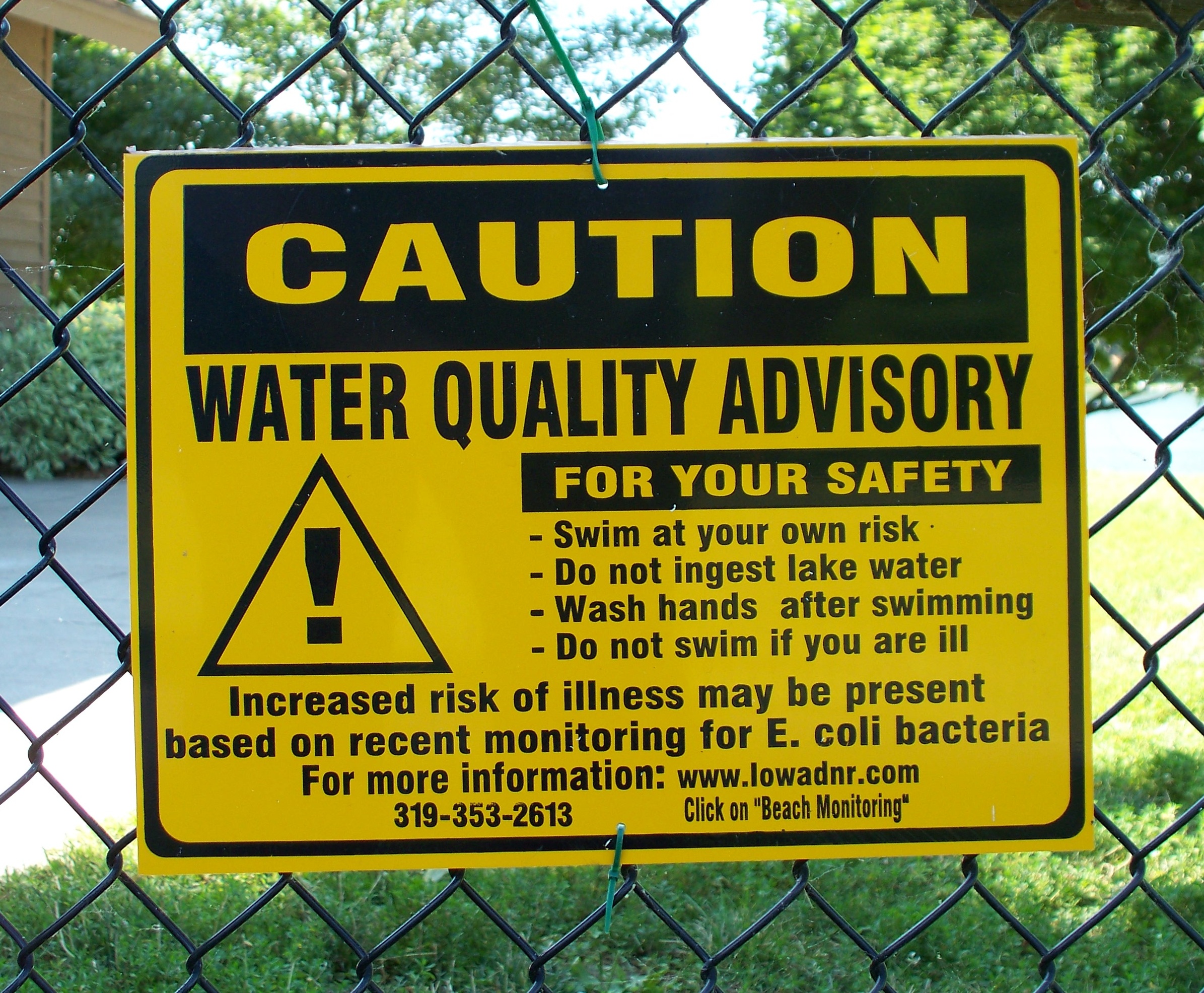
Algae can produce microcystin bacteria, which is toxic to humans and animals, and is only intermittently monitored outside Iowa DNR beaches. That means people who participate in low-impact water sports, like canoeing and kayaking may not get sufficient warning of the presence of microcystin bacteria.
While adventurers develop protective safety protocols for dealing with the unknown, the end result of recent warnings of elevated levels of bacteria was a scene where the homes of affluent locals looked on an abandoned beach on a brilliant summer day.
Cottage Reserve from Lake Macbride Beach July 14
The Iowa Environmental Council made this press release on Friday:
Toxic algae blooms pose threat to human, animal health
DES MOINES– Summer is in full swing, and many Iowans are heading to the state’s lakes to swim, paddle, relax and cool off with family and friends. However, many Iowans are being greeted by an unwelcome sight at their favorite swimming spots: toxic blue-green algae blooms.
This type of algae, caused by a combination of high levels of phosphorus pollution and increased temperatures can produce harmful microcystin toxins that can make people sick and be deadly for dogs, livestock and other animals.
The Iowa Department of Natural Resources (DNR) has posted 14 swimming advisories cautioning Iowans to stay out of the water at 11 different State Park beaches so far this summer due to high microcystin levels. Independence Day weekend, one of the busiest outdoor recreation weekends of the year, the DNR posted microcystin warnings at five Iowa beaches – the worst week yet. Included on this summer’s list are Lake Darling, Pine Lake, Red Haw Lake and Twin Lake West beaches – all first-time toxic blue-green algae offenders.
“The threats posed by toxic blue-green algae blooms are serious,” said Water Program Director Susan Heathcote. “Iowans need to be aware of this problem, the health risks, and know how to recognize and respond to toxic blue-green algae blooms.”
Toxic blue-green algae blooms create green, murky water, visible surface scum and a foul odor. The blooms can spread across the water but tend to accumulate in shoreline areas. Beach warnings are posted by the DNR when microcystin levels exceed 20 ug/liter, a guideline established by the World Health Organization. Contact with water at or above this level can result in breathing problems, upset stomach, skin reactions, and even liver damage. Inhaling water droplets containing toxic blue-green algae can cause runny eyes and nose, cough, sore throat, chest pain, asthma-like symptoms, or allergic reactions.
After tracking microcystin poisoning cases in Iowa as part of a national pilot project, Iowa’s public health leaders recently announced plans to add “microcystin-toxin poisoning” to the list of conditions doctors must report to the Iowa Department of Public Health.
“To rid Iowa of toxic blue-green algae blooms and ensure our lakes are safe and healthy for our families and pets, we must improve our water quality and reduce phosphorus pollution caused by agricultural and urban runoff and wastewater treatment systems,” Heathcote said. “This pollution not only puts our health at risk, but also has negative economic impacts on communities that depend on lake tourism, as well as our environment.”
The DNR monitors 39 State Park beaches for microcystin on a weekly basis between Memorial Day and Labor Day, issues advisories and posts warning signs when conditions are unsafe for swimming. The weekly beach advisories can be found on their website. Last summer, the DNR posted 22 beach warnings for high levels of microcystin during the recreational season.
At this time, DNR only monitors State Park Beaches, so if you swim at other public or private beaches you need to be aware of the potential for toxic blue-green algae this time of year. Not all blue-green algae is toxic, but when in doubt, stay out of the water and call the DNR Beach Monitoring Hotline at 515-725-3434. If you think you or your pets may have been exposed to toxic blue-green algae, thoroughly wash it off with fresh water. If you or your pet are experiencing symptoms associated with high microcystin levels after suspected exposure, seek medical or veterinary care immediately.
~ The Iowa Environmental Council actively works in public policy to provide a safe, healthy environment for all Iowans. The Council focuses on public education and coalition building to give Iowans a voice on issues that affect their quality of life and to protect Iowa’s natural resources for current and future generations. For more information, visit iaenvironment.org.
In 2015, France will be hosting and presiding over the 21st Session of the Conference of the Parties to the United Nations Framework Convention on Climate Change (COP21/CMP11), otherwise known as “Paris 2015.”
COP21 will be held from Nov. 30 to Dec. 11 on the Paris-Le Bourget site, bringing together around 40,000 participants in total – delegates representing each country, observers, and civil society members. It is the largest diplomatic event ever hosted by France and one of the largest climate conferences ever organized.
COP21 will be a crucial conference, as it needs to achieve a new international agreement on the climate, applicable to all countries, with the aim of keeping global warming below 2°C.
The stakes are high: the aim is to reach, for the first time, a universal, legally binding agreement that will enable us to combat climate change effectively and boost the transition towards resilient, low-carbon societies and economies.
To achieve this, the future agreement must focus equally on mitigation – that is, efforts to reduce greenhouse gas emissions in order to limit global warming to below 2°C – and societies’ adaptation to existing climate changes. These efforts must take into account the needs and capacities of each country. The agreement will enter into force in 2020 and will need to be sustainable to enable long-term change.
France will therefore be playing a leading international role to ensure points of view converge and to facilitate the search for consensus by the United Nations, as well as within the European Union, which has a major role in climate negotiations.
(Editor’s Note: This is a revised and updated post about solar power).
Climate Reality Leadership Corps founder and former vice president Al Gore gave his slide show, an updated version of the one used in the film An Inconvenient Truth, in Cedar Rapids on May 5.
It’s the third time I’ve seen him do so in person. There were differences in emphasis, but the big message of day one came from the panel on renewables and policy.
“Go solar,” said Warren McKenna, president of Farmers Electric Cooperative, Kalona.
In significant ways, these two words sum up what’s needed to meet world energy needs, replace fossil fuels, and move civilization toward sustainability.
In an hour, sunlight shining on Earth provides enough energy to meet our collective needs for a year. Whether we realize it or not, fossil fuels represent ancient sunlight stored for millennia in the ground. Which is more accessible?
According to multiple speakers at the conference, most of proven reserves of fossil fuels cannot be burned if we seek to retain Earth’s livability.
What makes solar an attractive solution to the climate crisis is the cost of installation is plummeting. At the point solar electricity generation reaches grid parity it will be an easy financial argument to make that fossil fuels should stay in the ground in favor of the less expensive alternative.
It’s not just me saying this.
The Way Humans Get Electricity is About To Change Forever is an article that appeared on Bloomberg Business last week. Author Tom Randall outlines shifts in electricity generation that will transform markets in the next 25 years. Randall predicts investments in solar will surge into the trillions of dollars, including distributed generation in the form of rooftop solar panels.
Companies such as Berkshire Hathaway Energy (BHE) already like solar, wind and other renewable energy generating capacity.
BHE accounts for six percent of U.S. wind electricity generating capacity and seven percent of solar according to Warren Buffet’s 2014 letter to shareholders.
“When BHE completes certain renewables projects that are underway, the company’s renewables portfolio will have cost $15 billion,” Buffet wrote. “In addition, we have conventional projects in the works that will also cost many billions. We relish making such commitments as long as they promise reasonable returns–and, on that front, we put a large amount of trust in future regulation.”
Solar is not without it’s problems. Natural resources must be exploited to make photo-voltaic panels, and the issue of conflict minerals continuously gets pushed aside. There are manufacturing, labor and transportation issues with solar. Problems notwithstanding, the argument for solar boils down to do we want a future, or not?
What we know is dumping 110 million tons of CO2 pollution into the atmosphere every day is not sustainable, and already we are seeing the impact of global warming and related climate change damage the lives of tens of millions of people.
There are no simple answers to solving the climate crisis. As industry demonstrates the viability of renewable energy, the only thing holding us back is a lack of political will to take unavoidable steps to mitigate the causes of global warming.
The economic argument provided by declining solar electricity generating costs will be a potent weapon in the political fight.
Before we knew it the year turned. Society’s distractions obscured it from time to time, yet the facts of days getting shorter, the planting season turning to harvest and second crops, and the humidity of summer are elemental, inescapable.
The construct of a year is artificial only from society’s view. Nature’s evolution in trips around the sun, with its changing angularity of light, formed deep expectations from which cultural patterns sprung. Patterns and culture are coming unhinged from human exploitation of the natural world. There have been unintended consequences for the biosphere just in living our lives.
Yet we go on living.
Today is the American holiday celebrating our independence from England. When I look at my life, the least benefited are descendents of the first people—who saw discovery, that loathsome word, genocide, and the great migrations from Europe, Africa and eventually from every habitable place on the planet.
At my workplace I hear the melodious, and sometimes harsh resonances of a dozen languages every day. We were never a melting pot, another loathsome phrase, but a garden of peoples who migrated and have taken to the land in its post settlement construct.
The name of our township is Big Grove, and what trees may have been here to warrant such appellation were mostly gone before the Civil War. It’s settled now, and to grow crops the soil must be augmented with chemical fertilizers. The rich topsoil, and that natural balance are mostly gone.
There is debate about whether to preserve, or recreate the oak-hickory forests that once dominated the landscape. What may have been here for thousands of years, has been relegated to parks and preserves, and not many of those. There’s no going back.
To say we understand nature is a lie, one I refuse to tell. Yet as the procession of days continues, I can’t help but notice things.
Like the wild blackberries I used to pick this holiday. The season is now finished, my favorite blackberry patches removed for development.
Like the cool damp days that have been good for garden lettuce, which by now had in previous years bolted.
Like the view of countless boats on the Coralville Lake as I crossed over the bridge under construction to North Liberty, despite warnings of underwater debris from the Iowa Department of Natural Resources. “Be careful out there” said one official, knowing little could prevent the overcrowded scene from developing on the high holiday of independence.
Like the nascent hope that despite these patterns, change is possible. Not hope against an inevitable reality, but something tangible, a path to preservation of culture that is eroding like the topsoil that was once so abundant.
One goes on living as best we can, making as light a footprint as possible in the dust of summer days. Our best hope is of crossing over into something more than a new bridge over old habits—to a better way of life clothed in fabric made of our past, over bodies naked and new like this place once was.
This is where I find myself this Independence Day.
The story we would like to be able to tell is of a world that “works for 100 percent of humanity.”
We’re not there. In fact, L. Hunter Lovins points out, “Humanity stands at the edge of a crumbling cliff.”
Whether one believes in climate change or not, it is time to walk back from the precipice and focus on what will sustain us. The doctrine of austerity, as reflected in today’s Iowa legislature, in Washington, and around the world is bankrupt. Lovins points out such policies were not an accident.
“Abraham Lincoln once said that the best way to predict your future is to invent it,” she wrote. “Indeed, 36 men created the economic mental model that has delivered the mess we’re in. Meeting in 1947 at the Mont Pelerin hotel outside Montreux, Switzerland they built the intellectual architecture of an economy of small government and individual decision-making in an unfettered free market.”
Sometimes we just want a livable world: clean air, a safe place, a sustained life. Thing is, walking back from the cliff we’ve made for ourselves will take economic engagement and Hunter Lovins tells a new story of what is possible. Here’s the article she posted Saturday on Unreasonable.
Economy at the Edge by L. Hunter Lovins
Humanity stands at the edge of a crumbling cliff. Half of the world’s wealth is owned by one percent of the population—the 80 richest individuals having as much wealth as the poorest 3.5 billion people.
At the same time, we are losing the biological integrity of the planet. Global Biodiversity Outlook Three states that we are losing life at a rate never before seen in history, and that the earth’s ecosystems are tipping into collapse. Three of them, are at particular risk: Business as usual, there may be no living coral reefs on planet earth, perhaps as early as 2035. The Amazon, the earth’s lungs, is drying up and burning. And the oceans are acidifying. This puts the whole of the oceanic food-chain at risk.
Scientists at the Stockholm Resilience Centre demonstrate that humanity has moved beyond the planetary boundaries in at least four of the nine critical categories: Loss of biodiversity, disruption of the nitrogen cycle, climate change, and forest loss. Despite this overuse of the world’s resources, we are still failing to supply all people with the basic necessities for life and human dignity. Dr. Kate Raworth of Oxford describes the doughnut: the safe and desirable operating space below the boundaries of the planet’s carrying capacity but above a minimum standard that fairly allocates resources to meet basic human needs for food, water, energy, equity and health care.
The great cultural historian Thomas Berry observed, “We are in trouble just now because we do not have a good story. We are in between stories. The Old Story–the account of how the world came to be and how we fit into it… sustained us for a long period of time. It shaped our emotional attitudes, provided us with a life purpose, energized action, It consecrated suffering, integrated knowledge, guided education… We need a [new] story that will educate man, heal him, guide him.”
The new story must, in the words of Buckminster Fuller, be about, “a world that works for 100 percent of humanity.”
Last month Finnegan Harries came to Iowa to attend the Climate Reality Leadership Corps training in Cedar Rapids. If you don’t know Harries, you should.
With his identical twin brother Jackson Harries, he co-founded Jacks Gap, a YouTube channel, which is a story telling project inspired by travel.
Finn was assigned to my mentoring group by the organizers, but the idea he could learn more from me than I him borders the absurd. I am smart enough to step out of the way and let the next generation blaze a trail to more sustainable living when they can. Finn can.
Right after our training he wrote an article in The Guardian, titled “My generation must save the planet.” Because of his unique celebrity, the post garnered more than 36,000 shares to date. Finn Harries has something to say, and it’s important to listen.
Here’s the article. I recommend you click through and read the whole thing, including the videos linked from it. Follow @FinnHarries, @JackHarries and @JacksGap on twitter and check out JacksGap.com. Don’t forget the YouTube channel.
My generation must save the planet
YouTube star says his is the first generation to grow up with climate change and the last that will be able to do anything about it – unless we act now
As architecture design students we are taught to constantly question and reimagine the way things are. We’re taught that the world we live in is not a given. It’s the result of the best efforts our ancestors could muster at that time. If it has flaws, it is up to our generation to pick up where they left off and create the world we want to see for ourselves and our children.
I’ve grown to understand that the society and culture I was born into is damaging the planet we live on at a greater scale than ever before. We put profit above people, economy above environment, progress above purpose. As a result, climate change has become the most important issue of our generation.
But it’s such a meaty, complex problem that we’re not sure how to approach it. It doesn’t seem to pose an immediate threat to our everyday lives, and most of us assume that there are surely some very clever scientists somewhere who will solve the problem for us.
I became curious. If climate change is as big a threat as I’m being told, then my work as a designer and an architect should focus on helping address the issue. I wanted to really understand, in layman terms, what it is that’s causing our climate to warm. Why is a warmer climate dangerous? And how can I make a positive difference?
I started by attending classes on sustainable design at my university. I spent a weekend in Cedar Rapids, Iowa to watch former US vice president Al Gore present his famous slide show and explain it in-depth at one of his “climate reality” workshops; I picked up a copy of Naomi Klein’s book This Changes Everything and downloaded as many climate-change related documentaries as I could get my hands on.
To continue reading on the Guardian site, click here.
DES MOINES—”We have a water problem,” Mayor Frank Cownie said at the state convention of the League of Women Voters of Iowa on Saturday.
Like all municipalities, the Des Moines Water Works must comply with the Safe Drinking Water Act and the Environmental Protection Agency standards for maximum contaminant level in water processed and sent into its system. Peak nitrate levels in source waters have taxed the city’s ability to meet its obligations.
The problem is nitrates in the water, however, the bigger problem for Des Moines is nitrate discharge into drainage districts in Buena Vista, Calhoun and Sac Counties which feed its source.
“The current denitrification technology is outdated and cannot continue to operate with rising nitrate levels and increased customer demand.” according to the Des Moines Water Works. “Continued high nitrate concentrations will require future capital investments of $76-183 million to remove the pollutant and provide safe drinking water to a growing central Iowa.”
Nitrate runoff is an unrecognized environmental cost of farm operations. The lawsuit filed in the case asserts that the drainage districts named are point sources of nitrate runoff and should be regulated as such.
There is a lot of chatter about the lawsuit the Des Moines Water Works filed to establish a cost to people who use nitrogen fertilizer that contributes to water pollution. Here is their rationale from their website:
Des Moines Water Works filed a complaint in Federal District Court – Northern District of Iowa, Western Division, on March 16, 2015.
The complaint seeks to declare the named drainage districts are “point sources,” not exempt from regulation, and are required to have a permit under federal and Iowa law.
The complaint states that the drainage districts have violated and continue to be in violation of the Clean Water Act and Chapter 455B, Code of Iowa, and demands the drainage districts take all necessary actions, including ceasing all discharges of nitrate that are not authorized by an National Pollutant Discharge Elimination System (NPDES) permit.
In addition, damages are demanded to Des Moines Waters to compensate for the harm caused by the drainage districts unlawful discharge of nitrate, assess civil penalties, and award litigation costs and reasonable attorney fees to Des Moines Water Works as authorized by law.
Des Moines Water Works’ mission is to provide safe, abundant and affordable water to our customers. Des Moines Water Works is fighting for the protection of customers’ right to safe drinking water. Through this legal process, Des Moines Water Works hopes to reduce long-term health risks and unsustainable economic costs to provide safe drinking water to our customers, via permit and regulation of drainage districts as pollutant sources.
Continued insistence from state leaders that the voluntary approach of the Iowa Nutrient Reduction Strategy is working does not give solace to the 500,000 central Iowans who must now pay to remove pollution from their drinking water.
While this lawsuit is specific to Des Moines, there are a lot of unrecognized environmental costs in diverse business operations. Set all the partisan chatter about this issue aside and the fact remains there is a tangible cost, that someone should pay. It is a cost measured in risks to human health, environmental degradation and inadequate financial models in business.
Thanks to the Des Moines Water Works, we can begin to put a dollar figure to it.
You must be logged in to post a comment.