Yesterday the U.S. Senate voted 98-1 that climate change is real. More specifically, “to express the sense of the Senate that climate change is real and not a hoax.” Senator Roger Wicker of Mississippi was the lone vote against the amendment to the Keystone XL Pipeline bill.
The Senate wouldn’t go so far as to say that climate change is influenced by human activity, thus providing wiggle room for the climate deniers who voted for this amendment.
Senator James Inhofe (R-OK) wrote the book on climate change as a hoax, co-sponsored and voted for the amendment. Once he took the gavel as chairman of the Senate Environment and Public Works Committee Inhofe proceeded to lay out his view of the matter on the Senate floor, including explaining what he meant by a climate change hoax. Emily Atkin took apart his presentation on Climate Progress, but here we are—a climate denier is now in charge on an important Senate committee.
This week, NASA released the largest photographic image of the Andromeda Galaxy ever, rendering the meaning of the Senate votes small by comparison. Comedian George Carlin said “the planet is fine, the people are fucked.” This too gets lost in the scope of the universe in which we live.
Nonetheless, life as we know it continues and where we’re bound is rarely certain. This week’s lesson is to be cautious about inflating our relevance as we endeavor to sustain our lives in a turbulent world.
LAKE MACBRIDE— People don’t connect the dots between lower gasoline prices and the shale oil boom.
Yesterday I filled my gas tank for $23.70, with the per gallon price in the mid-$2.40 range. That’s not low compared to when I commuted to Eldridge and fueled at Walcott for $1.02 per gallon for what seemed like months. Neither is it like when I was young and gas wars yielded prices below $0.30, enabling me to top off my tank for a buck or two. However, we are now below $3 per gallon with the prospect of going lower, so prices seems low in a short-term, relativistic way.
There is no doubt that the revolution in shale oil production through hydraulic fracturing is causing the lower oil and natural gas prices in the U.S. The shale boom is replicable world-wide (at least to some degree) because shale is a common and abundant form of sedimentary rock. In some ways, the game changing of shale is just getting started, even though it began in the 1940s.
When I was in my 20s, we thought shale oil was inaccessible. Hydraulic fracturing is a technology that revolutionized exploration, development and production of shale oil. In light of higher oil prices, it became profitable. Some credit goes to politicians, but most credit goes to the oil companies who persistently lobbied for a relaxed regulatory environment with anyone who could be influenced from the president on down.
What does this mean besides lower gasoline prices? Three things seem most important.
The arguments for and against hydraulic fracturing are reasonably accessible.
“Hydraulic fracturing is highly controversial, proponents advocating economic benefits of readily accessible hydrocarbons, and opponents concerned for the environmental impact of hydraulic fracturing including contamination of ground water, depletion of fresh water, degradation of the air quality, the triggering of earthquakes, noise pollution, surface pollution, and the consequential risks to health and the environment,” according to Wikipedia.
There is plenty of meaning in the existential fact of hydraulic fracturing and use of its products. What is less discussed is the impact on climate change, and the impact on renewable energy development.
While shale oil production is booming, 2014 will be the warmest year on earth since record-keeping began, and a clear departure from the climatic conditions in which the industrial revolution emerged. It’s hot and getting hotter world-wide. The climate has changed and is changing.
It is a scientific fact that man-made pollution is contributing to the warming planet. Natural gas is a fossil fuel that emits carbon dioxide when burned. While part of domestic carbon emission reductions during the last ten years have come by switching from coal to natural gas for electricity generation, there are problems.
Methane released as a byproduct of hydraulic fracturing operations is a more potent greenhouse gas than CO2. Methane leakage would reduce the value of the air pollution reduction realized by shifting electricity production from coal to natural gas. Some say methane leakage could negate any gains made in CO2 reductions from switching from coal to natural gas.
As a fossil fuel, natural gas should be viewed only as a so-called bridge fuel, although the clear and present danger is that it will be perceived as a destination fuel and become a permanent fixture in our energy mix.
That raises the third issue. There is a broader economic impact that the Bulletin of the Atomic Scientists (BAS) spelled out in a Dec. 10, 2014 article. Not only is gasoline cheap in a shale gas development scenario, it is impacting the U.S. energy mix, and nuclear power and renewables are taking the hit.
The basic argument about bridge fuels is that the shale boom and its products can act as “bridge” fuels, curbing emissions while non-fossil energy sources such as renewables and nuclear energy are ramped up.
As we have seen in Iowa, new nuclear power has become financially untenable unless its excessive costs can be passed along to rate payers.
Not only are new nuclear power plants imperiled because of the economics of the shale boom, existing nuclear plants have been as well. “While cheap gas is not the only culprit eroding the profitability of nuclear energy, it is the straw that is breaking the camel’s back,” wrote BAS.
What’s more important is the economics of shale gas are suppressing development of renewable energy. As we have seen in Iowa, without government subsidies of renewable energy, production of new renewable capacity languishes. In the current political climate, it is uncertain whether renewable energy subsidies will continue, and for how long.
While the economics of wind and solar may be reaching parity with fossil fuels in some markets, we are not there yet, and the subsidies are essential to continuing development of alternatives to fossil fuels.
It is important that we extend our reach beyond personal or family budgets and do what is right about the shale boom. That means developing the political will to finish a transition to a fossil fuel free world.
Easier said than done, but the price society will pay for failing to do so is much higher than what we see at the gas pump.
LAKE MACBRIDE— Yesterday the U.S. House of Representatives passed a bill directing the federal government to move forward on the Keystone XL pipeline on a 252-161 vote. It was less than the number of votes needed to override a presidential veto, but Barack Obama has been holding his cards close to the chest on Keystone. What he would do if a bill reached his desk is uncertain.
According to the New York Times, the U.S. Senate scheduled a vote on the bill for Tuesday, and Senator Mary Landrieu (D-LA) believes there are already 59 of 60 votes required to overcome a filibuster when the vote comes up. If the senate can get past a filibuster, the bill’s passage is assured, although getting 67 votes needed to override a presidential veto is less certain than it is in the the house. It’s all political theater.
Our Representative Dave Loebsack voted for the bill, reversing his last vote on Keystone XL. He sent social media atwitter with shock and disappointment framed in terms that appeared to help the authors vent frustration more than say anything coherent. I am disappointed with the vote, but what politician ever consistently voted my way?
I know a couple of things.
When people talk about “environmentalists” I no longer have a clue to whom they refer. Is a farmer who plants a buffer zone based on a government grant an environmentalist? Is a non-governmental organization’s local staff member—overly dependent upon funding sources—an environmentalist? Is a Washington lobbyist for a large NGO an environmentalist? What about members of the defense department working toward a lower carbon footprint for the military? What about my neighbors who protest building a subdivision near Lake Macbride? There aren’t real answers to these questions, and that’s the problem with vague references to “environmentalists.” There is no club to which they all belong, and fewer common denominators. The idea is actually a right wing talking point, and the frame “environmentalists” is used to demonize advocates for the U.S. Environmental Protection Agency, and against production of electricity using coal, natural gas and nuclear fuels. Keystone XL is not a common denominator among environmentalists.
The failure of environmentalists was targeting the pipeline at all, instead of the tar sands. The tar sands is a bigger problem because of humanity’s inexhaustible thirst for oil and natural gas. This is the same problem for the Bakken, West Texas and Eagle Ford formations. Because oil and gas are in demand, there is direct financial return, subsidized by our government, in exploiting these resources. The environmental communities have been unable to adequately articulate the unrecognized costs in terms of human health of these exploration, discovery and production operations—even if a small number of people are working on it. Successful efforts have taken a targeted, NIMBY approach, like the fight against frac sand mining in Allamakee County. By targeting Keystone XL, environmentalists set themselves up for failure. As a friend wrote me last night, “there are hundreds of pipelines in this country already—what’s one or two more?”
I also know unions favor building pipelines. Ken Sagar and Bill Gerhard laid out their position in a Dec. 11 opinion piece in the Des Moines Register. Only a cynic would say that Loebsack’s vote on Keystone XL was quid pro quo for union financial and canvassing support during the 2014 midterms. It is likely more complicated than that, but it had to have been a factor. Part of being Democratic is the fact that Democrats don’t always agree. Keystone XL and Iowa’s proposed Bakken Oil Pipeline are a prime examples of that. Loebsack’s framing of the explanation for his vote makes his sympathies for the union’s legislative priority clear.
“I was skeptical of side stepping the normal processes, but the jobs attached to building the Keystone Pipeline are too important and can no longer be tied to D.C. gridlock,” Loebsack said, according to Ed Tibbetts of the Quad-City Times.
What I also know is October 2014 was the hottest month recorded on the planet since record-keeping began, according to the Washington Post. Yes, you skeptics, the world’s temperatures may have been higher or much colder in some prehistoric era. But what matters more is our civilization, and the changes produced by the industrial revolution are at risk. The underpinnings of basic facts about our lives, when the first frost comes, the amount of rainfall in a region, how we produce electricity, how we sequester carbon in the land, water sourcing, and others are all being undone.
It will take more than one vote in one governmental body to address these broader challenges. What I know is that is unlikely to happen in my lifetime unless we stop focusing on bright and shiny objects like Keystone XL.
Partisan politics, and the manner in which the founders set up the federal government with its bicameral legislature, yielded an inability to deal with problems much beyond our noses. The founders planned it that way.
“A government of representatives, elected by the people at short periods, was our object; and our maxim at that day was, ‘where annual election ends, tyranny begins;’ nor have our departures from it been sanctioned by the happiness of their effects,” wrote Thomas Jefferson to Samuel Adams in February 1800.
With due respect to a fellow Virginian, the Congress seems unable to solve the most pressing issues of our time and that is becoming problematic. In a choice between Congressman Bruce Braley and State Senator Joni Ernst, Braley is the only choice to meet today’s needs. He isn’t perfect, but who is?
The constant reference to getting things done through bipartisanship by both candidates indicates a failure to understand the nature of what the founders intended in favor of politics of the day. That is not all bad, but it misses the point.
What has changed since the 18th century is humanity’s increasingly global perspective and interconnectedness. I’m not only talking about the Internet, although that is part of it. On any given day, I run into people from most inhabited continents, but from China especially. They are in Iowa to study at the university, but they have an opportunity to make connections that was unlike anything the 1700s. These travelers will take home what’s best about Iowa, and I don’t mean corn, soybeans and pork.
Additionally, business has gone global. When I worked for the oil company, we did business in 89 countries. With their merger with BP, the footprint grew even broader.But that is not all of what is different.
A global perspective on business was evident in the 18th century, and one might say the “discovery” of the Americas was part of business growth. At the same time, the need and desire to comprehend laws and culture throughout the globe and leverage that information for profit has grown to a scale unimaginable three hundred years ago. The U.S. is not isolated from the rest of the world, and it is unbecoming for politicians to assert that we can do what’s best for Iowa without examining a global context.
That said, there are three things I would like to hear from the Republican contender to be Iowa’s junior U.S. Senator, but likely won’t.
I would like to hear something other than that there is a problem with Social Security. Ernst is a parrot of the Congressman Paul Ryan plan for Social Security. In a cynical ploy to retain votes, she asserts keeping the sacred trust to seniors and those approaching retirement, but advocates doing something else, although she hasn’t decided what, for younger people. She indicated privatizing Social Security is on the table, but what she really means is that future retirees will have to fend for themselves.
She recently criticized Braley for not solving the problems with Social Security during his eight years in Washington, but the truth is that Republicans have never been fans of Social Security and have worked to chip away at its benefits since its inception. Ernst is no different and Braley has defended Social Security.
I would like to hear how Ernst would address our nuclear complex. The late Robin Williams pointed out, “remember the big weapons− huge weapons− the ones that really can do us in− are not in the hands of us. Something much bigger. Whether you believe in intelligent design or just a guy named Phil who’s pissed.” The threat of nuclear annihilation is not funny, even if Williams was. Would Ernst have the U.S. join the international humanitarian campaign to abolish nuclear weapons, or is she already under the spell of John Bolton and other conservative hawks that continue to assert U.S. hegemony through a weapon that could end or change permanently civilization as we know it without solving any of our most pressing problems?
Finally, I would like to hear what Ernst will do about the tangible impact on business and society of our changing climate. I heard and previously wrote about her lack of understanding about climate change as stated in the debate with Braley. Either she is incompetent to be a U.S. Senator, or she can learn. If she can learn about climate change, what is she willing to do to protect our common interests in air, water and the conditions that currently nurture life in Iowa and throughout the globe? Bet we don’t hear from her on that either.
The challenge this election cycle is the media and its corporate backers have created such a firestorm of disbelief among voters, that many are expected to skip this cycle. There are more than three things I’d like to hear from Ernst, but I am already confident of where Bruce Braley stands, so why should I insist. That would be time taken away from convincing people to vote for Bruce Braley.
LAKE MACBRIDE— It is hard not to engage in the news from outside Big Grove Township. U.S. and partner states are bombing Syria, the United Nations is taking up the expiration of the Kyoto accord, and more than 100 world leaders will address security issues at the U.N. It has already been a busy week.
Today, the U.N. Climate Summit 2014 convenes on an optimistic note:
Climate change is not a far-off problem. It is happening now and is having very real consequences on people’s lives. Climate change is disrupting national economies, costing us dearly today and even more tomorrow. But there is a growing recognition that affordable, scalable solutions are available now that will enable us all to leapfrog to cleaner, more resilient economies.
There is a sense that change is in the air. U.N. Secretary-General Ban Ki-moon has invited world leaders, from government, finance, business, and civil society to Climate Summit 2014 this 23 September to galvanize and catalyze climate action. He has asked these leaders to bring bold announcements and actions to the Summit that will reduce emissions, strengthen climate resilience, and mobilize political will for a meaningful legal agreement in 2015. Climate Summit 2014 provides a unique opportunity for leaders to champion an ambitious vision, anchored in action that will enable a meaningful global agreement in 2015.
While many states recognize the validity of what Ban Ki-moon has said, in the U.S., a positive outcome in the form of a binding and meaningful legal agreement seems unlikely. Even if some of us are pessimistic about U.S. participation, it will be worth our attention today and in coming days, to see what the Climate Summit produces. It is noteworthy that President Obama will be trying to get a resolution on counterterrorism passed by the U.N. Security Council rather than making any bold announcements on mitigating the causes of global warming.
In the universe of a single life, there can be hope. So that’s how I will spend this day on earth. Believing that we can sustain our lives in peace despite so much evidence to the contrary.
Many eyes will be fixed upon the discussion of climate change during the debate that begins Sept. 24 at the United Nations 69th General Assembly.
There is another topic of interest to the peace and justice movement.
President Obama is expected to preside over the U.N. Security Council meeting and a discussion of counterterrorism. He will have a draft resolution in hand for consideration and debate by the council. ThinkProgress covered the story:
Specifically the meeting will cover the phenomenon of foreign fighters traveling to conflict zones and joining terrorist organizations, as seen in the surge in foreigners joining ranks with such groups as Jahbat al-Nusra in Syria. “Certainly the problem of terrorists traveling to foreign conflicts is not new, but the threat posed by foreign terrorist fighters has become even more acute,” a U.S. Mission to the U.N. official told ThinkProgress when asked about the meeting. “The Internet and social media have given terrorist groups unprecedented new ways to promote their hateful ideology and inspire recruits. The conflicts in Syria and Iraq have highlighted this threat, with an estimated 12,000 foreign terrorist fighters joining that conflict.”
As part of its Campaign Nonviolence, Pace e Bene has organized a series of nonviolent actions to take place concurrent with the U.N. General Assembly and Security Council meeting, including one in Iowa City on Sept. 21.
“To launch this movement, over 100 nonviolent actions will take place Sept. 21-27 in cities and states across the U.S. and beyond, taking a stand against all violence and calling for concrete first steps toward peace, economic justice, healing the earth, and mainstreaming active nonviolence,” according to the campaign website. “These first steps include: an international treaty for swift, verifiable action to reverse climate change and taking nonviolent action for a culture of peace; ending the military drone program; establishing a $15 minimum wage for all; K-12 nonviolence education everywhere; and practicing nonviolence toward ourselves, toward all others, and toward the planet.”
Blog for Iowa contributor and local peace activist Ed Flaherty sent this invitation along:
Please join us on Sunday, Sept. 21, at 4 p.m. on the Pedestrian Mall in Iowa City for the first Campaign Nonviolence event. There will be many organizations involved, including Veterans for Peace, PEACE Iowa, Dancers for Universal Peace, Physicians for Social Responsibility, and several faith groups. Come help us celebrate the ways of non-harming towards self, others and our world.”
Campaign Nonviolence Order of Events:
Welcome (Dorothy Whiston)
Opening Song (Blowing in the Wind)
John Ivens (Veterans for Peace)
Rabbi Jeff Portman (Agudas Achim)
Barbara Schlacter (100 Grannies for a Livable Future)
Gospel Explosion Ministry
Paul Deaton (Physicians for Social Responsibility)
Yasur AbuDagga (Iowa City Mosque)
Ed Flaherty (PEACE Iowa)
Virginia Melroy (Dancers for Universal Peace)
Mary Kay Kusner (Ghandi prayer)
Kerry Batteau (Native American Blessing of the Four Directions)
“Peace, Salem, Shalom”
This week, the Great March for Climate Action headed east through Iowa and Blog for Iowa marched a small part of the route with them. About 150 people gathered in Coralville on Wednesday, Aug. 20, and marched leisurely to the Iowa City pedestrian mall. We marched down the Coralville Strip, past Carver-Hawkeye arena, the University of Iowa Colleges of Medicine and Nursing, the Veterans Administration Hospital, the university’s coal-fired power plant, Old Capitol, and ended in front of the Sheraton Hotel in the pedestrian mall where we were greeted with applause upon arrival. Speeches followed.
It was a chance to meet some of the marchers, and here are some of the people BFIA interviewed and heard:
Ed Fallon, “People need to be thinking of what changes they can make in their own life.”Berenice Tompkins and Andre Nunez. She’s walking barefoot (mostly) and he’s not speaking.Blair Frank “I’m here because of the shift that’s happening around the planet in climate change.Miriam Kashia, Mayor. “Imagine the audacity of a small group of ordinary citizens who believe they have to power to change the course of history.”Ed Fallon, Jeffrey Czerwiec, Miriam Kashia and John Abbe at the marshaling area in CoralvilleRosella Lala Palazzolo selling raffle tickets. Rosella is a veteran of the Great Peace March for Global Nuclear Disarmament in 1986Mike Carberry, “How we deal with climate change is the defining issue of our generation,” with Jimmy BettsJeffrey Czerwiec, “I’m walking every step of the way.”David Osterberg, “We need to make renewable energy 100 percent.”State Senators Rob Hogg and Joe Bolkcom
And finally, here’s the whole gang crossing Burlington Street on Iowa Avenue in Iowa City.
If one didn’t think the U.S. discussion of climate change was political, think again. U.S. Rep. David McKinley (R-West Virginia), added an amendment to a House appropriations bill to fund the Department of Energy and the U.S. Army Corps of Engineers that would prohibit the two agencies from using funds that would “design, implement, administer or carry out specified assessments regarding climate change.”
Another way to put it, from McKinley’s perspective, is if you don’t like science, ban it.
House Republicans took exception to the Department of Defense addressing the recommendations of the National Climate Assessment, and have added two agencies whose work is directly related to mitigating the effects of extreme weather to their list.
The floor debate captured the essence of the politics of climate change:
“Spending precious resources to pursue a dubious climate change agenda compromises our clean-energy research and America’s infrastructure,” McKinley said on the House floor. “Congress should not be spending money pursuing ideologically driven experiments.”
Speaking against the amendment, Rep. Marcy Kaptur (D-Ohio) said it disregards the research of the overwhelming majority of climate scientists.
“The Republicans, in general, don’t seem to trust the scientists,” Kaptur said. “This amendment requires the Department of Energy to assume that carbon pollution isn’t harmful and that climate change won’t cost a thing. That’s nothing but a fantasy.”
What next? Click here to read the rest of David Gutman’s coverage of this story in the Charleston, West Virginia Gazette.
And consider that June 2014 was the hottest month on record since records have been collected. Politicians like McKinley would deny the reality of human contributions toward global warming at the same time climate data released from the National Climatic Data Center of the National Oceanic and Atmospheric Administration, found that the worldwide average temperature over land and sea in June 2014 was 1.3 degrees Fahrenheit hotter than the 20th century average of 59.9 degrees. That is reality.
People seeking scientific proof of anthropogenic global climate change are barking up the wrong tree. The goal of science, if unlike McKinley, we accept science, is not to prove, but to explain aspects of the natural world.
Around 1850, physicist John Tyndall discovered that carbon dioxide traps heat in our atmosphere, producing the greenhouse effect, which enables all of creation as we know it to live on Earth.
Carbon dioxide increased as a percentage of our atmosphere since Tyndall’s time at the beginning of the Industrial Revolution. As a result, Earth’s average temperature increased by 1.5 degrees Fahrenheit.
The disturbance of the global carbon cycle and related increase in carbon dioxide concentrations in the atmosphere is identifiably anthropogenic because of the isotope signature of atmospheric carbon dioxide.
We can also observe the effects of global warming in worldwide glacier retreat, declining Arctic ice sheets, sea level rise, warming oceans, ocean acidification, and increased intensity of weather events.
It is no wonder almost all of climate scientists and all of the national academies of science in the world agree climate change is real, it is happening now, it’s caused by humans, and is cause for immediate action before it is too late.
Politicians like McKinley don’t get it, and advocate against reality. That’s nothing new for some members of the Republican Party.
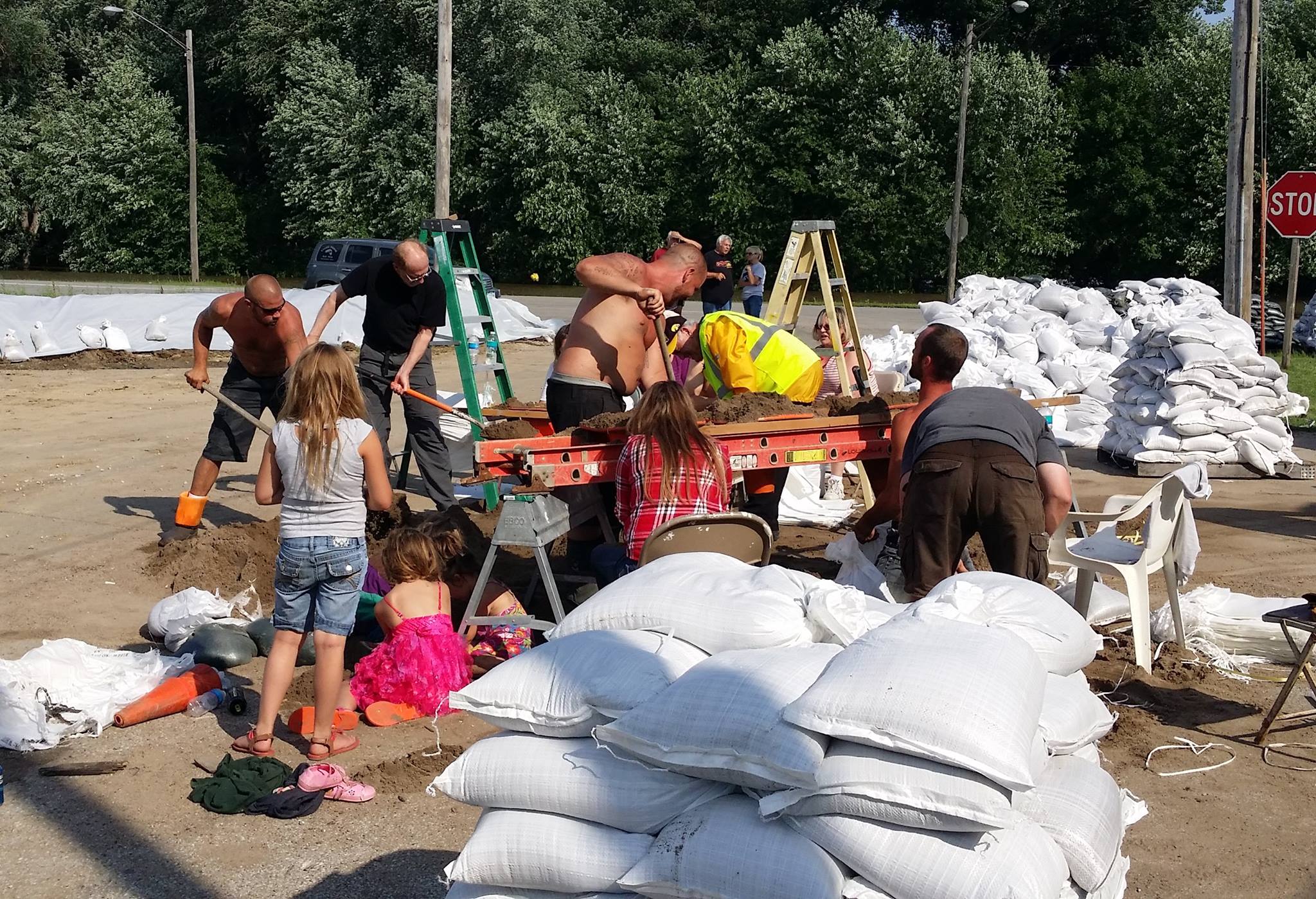
LAKE MACBRIDE— It’s June and Credit Island on the Mississippi River is expected to flood. Our U.S. Congressman was there yesterday to fill sandbags as part of an effort to prevent damage. Thing is, Credit Island has been flooding for as long as I can remember, and likely always will. People with businesses there should be used to it by now.
Part of the War of 1812 was fought on Credit Island, but I remember it more for the very flat golf course where my father, friends and I played from time to time. We would stop to hit a few balls into the river on the back nine.
Sandbagging on Credit Island
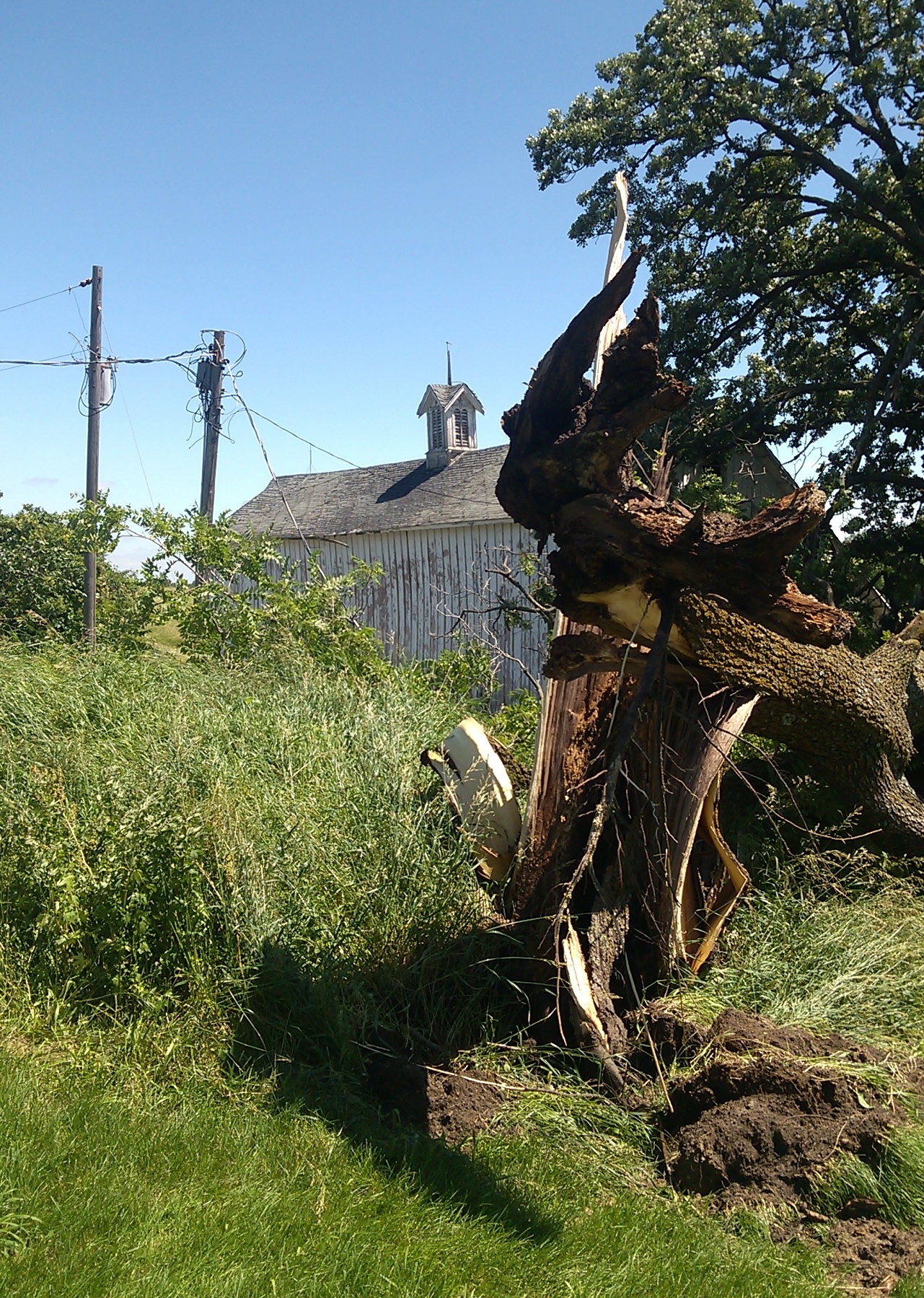
Our CSA had an old walnut tree knocked over by the storms. It rests on the electrical wire, waiting for the electric company to come turn off the juice so the tree can be chainsawed and removed from the main entryway.
The report isn’t published yet, but the state climatologist said yesterday that Iowa had its third highest June rainfall since record keeping began. What was bad about the recent storms was their intensity— made worse by our changing climate.
Locally there was not much damage. Last year’s extreme storms took out the weak trees and shrubs, so besides straightening a few tomato cages, there was little work to do in the yard. The rain is feeding a jungle that needs mowing soon.
Conditions look perfect for getting outside. Something one hopes to do soon.
LAKE MACBRIDE— Leadership on what matters most for our future will come from outside the United States. It’s not that Americans are bad people— for the most part, we aren’t. However, many of us have mistaken the advancement of bad ideas as the right ideas, and there is a difference.
The most recent example was last week’s vote on an amendment to the National Defense Authorization Act (NDAA). The NDAA is one of the few pieces of legislation that still works through the legislative process the way most of them did back when Congress did more legislative work. Rep. David McKinley (R-WV) offered an amendment which would “prevent the White House from sending funds to the U.S. Global Change Research Program National Climate Assessment, the Intergovernmental Panel on Climate Change’s Fifth Assessment Report, the United Nation’s Agenda 21 sustainable development plan, or the May 2013 Technical Update of the Social Cost of Carbon for Regulatory Impact Analysis Under Executive Order 12866.” McKinley questions the validity of climate science research generally, but, according to his website, also argued that reducing the use of coal wasn’t worth the harm it would do to the economy. The amendment passed the House, and is expected to advance to the Senate.
I understand coal country better than most mid-westerners. My family tree has long roots in Appalachia, predating the discovery of coal in Boone County, West Virginia by John Peter Salley in 1742. My career in transportation and logistics took me to Boone County and I learned about its dependence on coal. When the Coal Valley News announced our truck driving school, it was front page news, next to a story about United Mine Worker layoffs in the county seat.
Meeting with businesses, the governor’s office, the school board, local residents and others, I got to know the issues around coal. People didn’t like the mine owners and operators, but were dependent upon them. If life has changed from company-owned coal camps for most, coal camps still exist along with poverty and an extreme dependence on coal to extract a life. The question, “what are we supposed to do without coal?” resonates there if answers don’t.
There is no greater good in McKinley’s legislative work, and there is little point in arguing with climate deniers like him. The preponderance of evidence is that climate change is real, it is happening now, and its effects are causing harm. As the business community wakes up, we are increasingly able to place a dollar figure on the social and economic costs of global warming and related climate change. Economics will drive action to mitigate the causes of climate change, as making a profit remains paramount for businesses. Like it or not, West Virginia, part of mitigation of global warming means drastic reductions in the amount of coal used across the globe.
At the same time, bad ideas like McKinley’s have enough support to advance, making the U.S. Congress less relevant in addressing the most important issue of our time. That’s why I say leadership on climate change, as well as on nuclear abolition and other threats to life as we know it, will come from outside our country. For whatever reason, too many Americans embrace bad ideas to sustain the political will for positive change.
What I don’t get about West Virginia and coal country is that while there is a church in almost every neighborhood, another argument should resonate equally with self-serving economic interests, but doesn’t.
If God is the author of creation and wants humans to do anything, high on the list would be to care for creation. We have not upheld that responsibility even though it transcends politics. Instead, people like McKinley look to mammon for their inspiration, forsaking all of us in the process.
Belief in God is not the same usage as belief in climate change, because the efficacy of the harm done to humans by climate change will out regardless of what people believe or don’t believe. Like many concerned citizens I feel we must wake up to the threat to human health posed by climate change before it’s too late. If the U.S. won’t lead, then others will, because taking action won’t wait for U.S. politicians to get on board with the obvious.







 Journey Home
You must be logged in to post a comment.