Categories
Environment

A Climate Action for Every Iowan

Image of Earth 7-6-15 from DSCOVR (Deep Space Climate Observatory)

Iowa Public Television devoted its weekly Iowa Press program to climate change.

Dr. Gene Takle, Professor Emeritus at Iowa State University and Dr. David Courard-Hauri, Professor and Director of the Environmental Science and Policy Program at Drake University faced reporters David Pitt with Associated Press and Katarina Sostaric of Iowa Public Radio.

No new ground was broken in the 27-minute program because the nature of climate change as we experience it in Iowa is reasonably clear: it’s about moisture, too much in the spring, or too little during the growing season. World-wide warming atmosphere and oceans contribute significantly to extreme weather in Iowa.

Some don’t believe what goes on in Iowa falls into a broader trend or context. Courard-Hauri made an important point about this.

And one thing I’d add is that we focus a lot on this question and if you look at surveys it’s about 20 percent of the people who actively argue that climate change is not caused by people. And the majority of people either, well the majority of people believe the climate is changing, you can see it now, it’s at that level. And then the large majority are aware and concerned and so when we spend a lot of our time focusing on that really small minority, it’s a larger minority of lay people that (sic) it is scientists obviously, but if we spend a lot of time talking about that then I think we miss the fact that most people are wondering what can we be doing, what should we be doing?

What can we be doing about the climate crisis?

A few years ago State Senator Joe Bolkcom made the best case I’ve heard on what to do: join with like-minded people around a cause.

In a society where the myth of rugged individualism persists, and the expansion of media in the form of radio, television, smart phones and computers brought with it a new form of social isolation, that is hard to do. Do it we must and it’s not just me saying it. At some point the climate crisis becomes so obvious and threatening almost everyone wants to answer Courard-Hauri’s question.

An article by Cathy Brown at Yes! magazine last week pointed out there is a climate action for every type of activist.

“Susan Clayton, a professor of psychology and environmental studies at the College of Wooster, says getting involved with a group can help lift your climate-related anxiety and depression in three ways,” Brown wrote. “Working with like-minded folks can validate your concerns, give you needed social support, and help you move from feeling helpless to empowered.”

Bolkcom’s point was similar to Clayton: groups are more effective than individuals.

The reason I’m involved with environmental groups is to work on inter-generational issues. I won’t likely be around when the worst of the climate crisis hits but people I know and love will be. As I ease into retirement it is important to allocate some time to work on the issue.

When Iowa Public Television is doing a program on the climate crisis, the concerns are mainstream. While we expect a lot from our government, politicians need nudging from voters and that is where joining with others in our communities is important. As Brown’s article suggests, there is a way to get involved for every personality.

View Iowa Press episode on climate change here.

Read Cathy Brown’s article at Yes! magazine here.

Categories
Environment

COP24 and What’s Next

Image of Earth 7-6-15 from DSCOVR (Deep Space Climate Observatory)

Like others, I was skeptical the broad coalition to act on climate formed during and after the 21st Conference of the Parties to the United Nations Framework Convention on Climate Change in Paris would last. This week at COP24 in Poland, three top oil producing states, the United States, Russia and Saudi Arabia, along with number nine, Kuwait, blocked acceptance of the Intergovernmental Panel on Climate Change report the conference commissioned.

The four oil producers objected to “welcoming” the report and preferred the vague language of “noting” the report. Because the conference proceeds only after reaching consensus, and they couldn’t, the report was not adopted.

“Opposition to climate action is one of the issues motivating Trump’s cozy relationship with the corrupt leaders in Russia and Saudi Arabia,” State Senator Rob Hogg tweeted Dec. 9. “This is not who we are as Americans, and we need to put a stop to it.”

“Under Trump, instead of leading the world to act on climate change, the United States joined with Russia and Saudi Arabia to stop the recognition of a scientific report about the increasingly urgent need for climate action,” he tweeted.

Absent U.S. leadership on climate I expect further dissent within the coalition that reached consensus Dec. 12, 2015 with the Paris Agreement. Our politics, led by moneyed interests, hinders efforts to do what makes sense regarding climate change. We can’t even agree on the facts about climate change. Accepting the IPCC report, or “welcoming” it to use the vernacular of the conference, should be a non-issue.

Although President Trump announced his intent to withdraw from the Paris Agreement, the U.S. continues to be party to it. We live in a time when the truth has become unhinged from reality and it’s hard to see what path our country will take regarding our need to act on climate going forward.

What we see in Iowa is changing weather patterns enhanced and made worse by climate change. The 2012 drought was unimaginably oppressive and reduced corn and soybean yields. After local storms on Sept. 19, 2013 knocked trees down and damaged our home I wrote, “Everywhere in the farming community, people are concerned about extreme weather. Weather is always a concern for farmers, but this is different.” New research shows change in the atmosphere is reducing the nutritional content of foods we take for granted. None of this was expected. All of it hits home.

Whether people use the words climate change is less the issue. What matters more is our lives are changing, with tangible costs, and people are worried about it. Not only for the monetary damages of a storm, or for reduced crop yields, but for what it means for the future.

The aspiration of the Paris Agreement was noble, but likely unfeasible without leadership from the United States. Regretfully President Obama did not get buy-in from Republicans in government before he signed the Paris Agreement. Once he was gone, politics took over and his efforts to mitigate the effects of climate change are rapidly being rendered null.

There’s no easy solution to climate change. Was there ever? The truth before us is we must act on climate before it’s too late. Whether society is capable of doing so remains an open question. COP24 provided another setback to action.

Categories
Environment

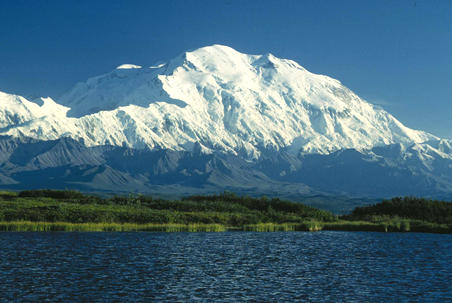
Denial and Denali

Denali Photo Credit - Wikimedia Commons
Denali Photo Credit – Wikimedia Commons

Environmentalists are having trouble wrapping their head around a president who visited Alaska above the Arctic Circle on Wednesday to speak on the need to mitigate the causes of climate change, while at the same time on Aug. 17 approved Royal Dutch Shell’s exploration and development of oil there.

It’s not that hard because the challenge of our time is the lack of political will to take action to reduce CO2 emissions in a culture dependent upon fossil fuels. The problem is politics, not physics.

Bill McKibben expressed the sentiment concisely:

It’s no use crying Bill McKibben’s tears.

In 2014, the U.S. used 6.95 billion barrels of crude oil with 27 percent being imported, according to the U.S. Energy Information Agency. That’s 19.05 million barrels per day, including biofuels. Most of it is for gasoline, diesel, jet fuel, heating oil and liquefied petroleum gas. (The EIA explains how the oil was used here).

During President Obama’s administration the U.S. took substantial action to reduce dependence on imported oil. During the eight years of President George W. Bush, the country imported 28.6 billion barrels of oil or 3.574 billion barrels per year on average. In 2014, the U.S. imported 2.68 billion barrels or 25 percent less than the Bush average.

The rub is that in order to reduce imports, the Obama administration encouraged domestic production through an all of the above strategy that included hydraulic fracturing and increased exploration and discovery like Royal Dutch Shell had been doing in the Arctic in 2012. The strategy worked, and has been revitalized, but at what cost?

Doing nothing about global warming is not an option. The Obama administration has been and is doing something significant. As much as some would like to shut down the coal trains, end hydraulic fracturing and stop drilling for oil – leaving fossil fuels in the ground – it is only beginning to happen under Obama. Whoever is president in 2017, an “all of the above” strategy would mean quite different things with a Democrat or Republican in office.

Scientists understand the basic physics of global warming, and mostly have since the mid-1800s. As long as there is demand for fossil fuels, there is no reason to think exploration and discovery by oil companies will end any time soon. The problem with denial is not so much with political climate deniers. The physics will out, hopefully not too late.

A bigger problem is denial of our addiction to fossil fuels. Most continue to use them like there is no tomorrow. A reckoning is coming and it will take more than renaming that mountain to climb it.

~ Written for Blog for Iowa

Categories
Environment Living in Society

Walking the Walk

Ed Fallon, Sen. Joni Ernst, Miriam Kashia

Twelve participants in the Great March for Climate Action made a reprise visit to Washington, D.C. last Wednesday.

Ed Fallon, march founder, tried to get meetings with the White House and the Environmental Protection Agency to coincide with the end of the march last September, however, key people were unavailable at the time.

The White House meeting did happen, with Dan Utech, special assistant to the president for energy and climate change; Rohan Patel, special assistant to the president and deputy director of intergovernmental affairs, and Angela Barranco, associate director for public engagement at the White House Council on Environmental Quality. My story about the meeting in the Iowa City Press Citizen is here.

Fallon was unable to attend the meeting with EPA later that day. Marchers met with Joseph Goffman,  senior counsel, assistant administrator for air and radiation and Mark Rupp, deputy associate administrator for intergovernmental relations. After the EPA meeting, marchers fanned out and met with their congressional representatives.

The Great March for Climate Action was not a stroll in the park for the core group of 35 marchers who made some or all of the way from Los Angeles to Washington. There were physical challenges including weight loss, foot and leg problems, fatigue and stress. They dealt with extreme weather events physically, notably in Nebraska where they encountered a giant hailstorm unlike any they had previously experienced. More than anyone I know, Fallon and company walked the walk, experiencing personal hardship to do so. The meetings in Washington were both a culmination and a new beginning for participants in advocating for climate action.

“Officials recognize that climate change is difficult for many people to grasp,” Fallon said. “The eight months along the march route allowed us to experience the situation directly, and this places us in a unique position of credibility.”

In addition to the White House meeting, Fallon called on Senators Chuck Grassley and Joni Ernst, and Representatives Dave Loebsack (IA-02) and David Young (IA-03) to advocate for climate action. While the results of the meetings were mixed, marchers had the ear of their elected representatives. All four politicians voted for a bill to build the Keystone XL pipeline, something the marchers adamantly oppose.

Last night, Fallon posted a photo of himself and Miriam Kashia of North Liberty with Senator Joni Ernst on his Facebook page.

“Between driving, meetings and presentations, I’m behind on getting these posted,” Fallon wrote. “Our meeting with White House staff on climate change: very encouraging! Our meeting with Senator Joni Ernst: not so much.”

Having gained standing by walking the walk on climate change, it opened doors. What marchers found on the other side wasn’t all they had hoped. While they were away from Iowa, the electorate brought to power our most conservative congressional delegation in a while, notably absent Senator Tom Harkin.

In effecting progressive change there are two important parts. Electing people who represent our views and advocating for our causes with them. In 2014, progressives did not fare so well on the former, which makes the latter more difficult.

While some may not like looking at photos of Fallon and company posing with these politicians, they are doing their part for progressive change. If we don’t like the current crop of politicians, we can’t give up.

“Obviously we were all disappointed with the outcome of the last election, and there are a lot of reasons for it and I’m happy to take on some of the blame,” said President Barack Obama at the House Democratic Issue Conference on Thursday. “But one thing I’m positive about is, when we’re shy about what we care about, when we’re defensive about what we’ve accomplished, when we don’t stand up straight and proud… we need to stand up and go on offense, and not be defensive about what we believe in.”

It’s an open question whether progressives will get organized for the next election. It’s clear we won’t unless we emulate the Great March for Climate Action and walk the walk—beginning now.