Categories
Social Commentary

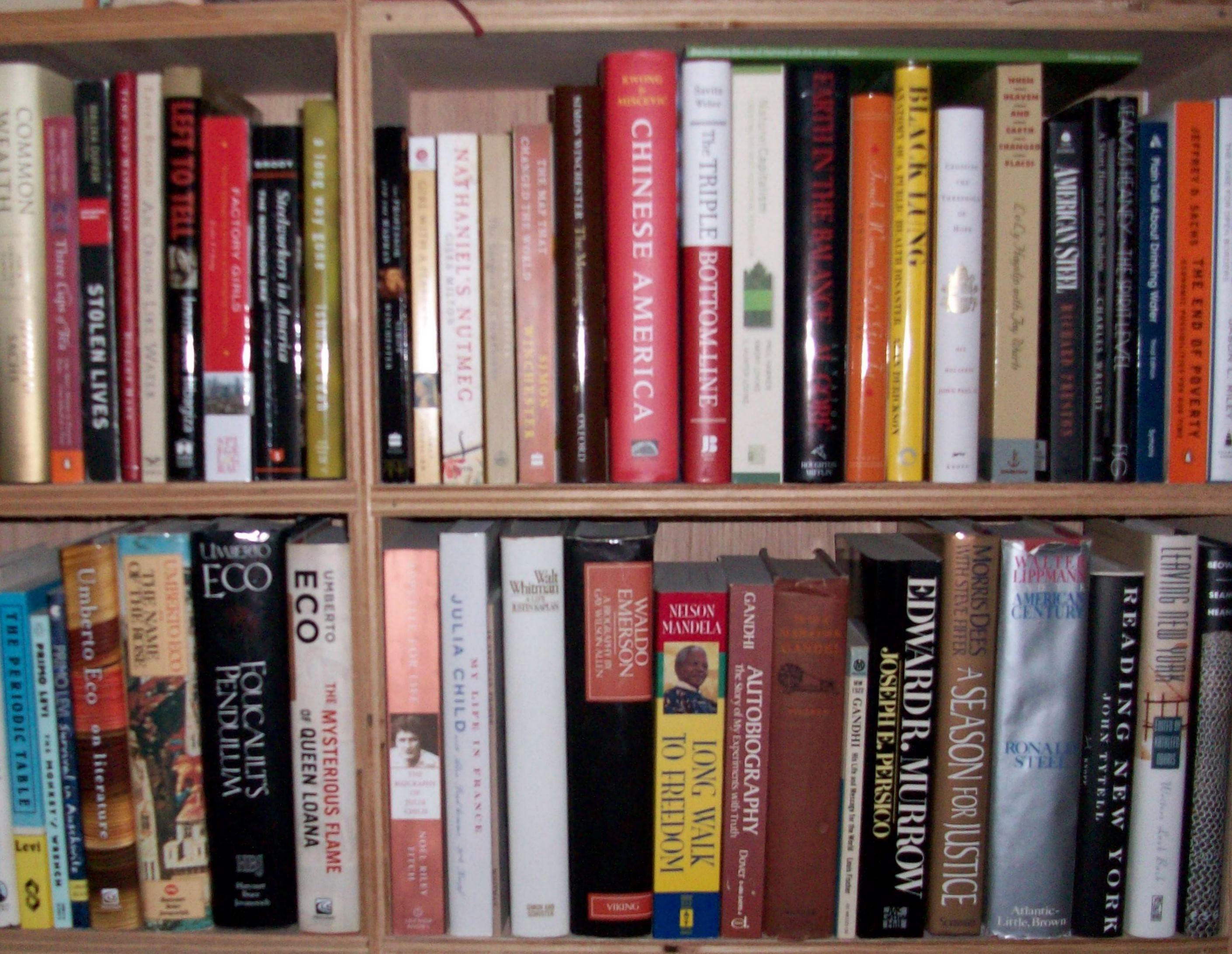
One Less Used Bookstore

Formerly Murphy-Brookfield Books

IOWA CITY— The number of used bookstores in the county is reduced by one. Murphy-Brookfield Books closed after 33 years in business, and its owners sold their historic stone building to the Haunted Bookshop. The deal is done and people and cats were in their new digs when I stopped by earlier this afternoon. Murphy-Brookfield Books went on-line.

I don’t like any of it… except maybe the cats.

I’ll start by saying that if I want to find something to read, there will be no problem. Our home library has enough reading material to last the rest of my life, and then some. Most of what I read is found here. Too, the public library provides on-line access to ebooks I can download to my phone for free if someone else doesn’t have them checked out. From time to time I browse the selection, and it is pretty good. If I can’t find what I want there, I go on-line and buy it from Amazon.com, eBay or one of the bookstores on the Internet. It isn’t for reading material that I frequent bookstores. I can get that at home.

Last year I stopped at the large chain bookseller at the mall. It had changed. It was as if they took everything I liked and removed or placed it out of sight. There was plenty of pulp fiction, and novels that looked like they all had been designed in the same advertising studio— similar titles, same sizes and an array of brilliant covers embossed with foil— lined up like so many treats in an old fashioned candy store. The caché of hanging out at a bookstore, reading and drinking coffee has faded. I’m no longer a fan of coffee bars and besides, who has time any more? I haven’t been back.

Browsing used books is like taking a vacation. I plan the trip for weeks, and upon arrival, one never knows what to expect. By chance, something catches the eye and comes off the table, down from the shelf, or out of a bin. If the price is right, the bound volume comes home.

Through Salvation Army stores, Goodwill and thrift stores, used book stores large and small, rummage and library sales, and estate auctions I have browsed since high school looking for something. In a box of discards I found a 19th Century edition of the collected works of James Fenimore Cooper— the pages turned yellow and brittle, too fragile to turn. At a thrift store in Sweetwater, Texas, for a dollar I bought an autographed copy of Iowan W. Edwards Deming’s “Out of the Crisis” while the rattlesnake roundup was going on. At the library used book sale I found Alexander Kern’s copy of Charles and Mary Beard’s “The Rise of American Civilization,” signed by Kern and dated Sept. 1932 inside the cover. That signature itself was a piece of local history. There is always something to connect to bits and pieces of my history or theirs.

So why don’t I like it? The people seem nice at the Haunted Bookshop. And after all, I was able to survive when the Epstein Brothers closed shop and their portable building was removed from Clinton Street. There is Prairie Lights on Dubuque Street. It was good enough for President Obama, so why not good enough for me?

I didn’t know Mark Brookfield at all… except that he was there most times I stopped by over three decades. I recognized him when I entered, and he was helpful without exception. Whether I was looking for something, or had a box of books to trade for store credit, each transaction went well. I was always happy when I left, and looked forward to the next visit. I doubt he knew me. Now he’s out of sight in the ether.

Maybe I just don’t like change— knowing another landmark off Market Street is gone. One less old haunt in a block where so much has happened in my life. Maybe it’s something else. The new place is packed with books, as if a massive shedding of the printed word was underway— more than just the university community ditching books before moving on. It may be something like that.

So one last time to consider the past, get used to the change, and then go on living with one less used bookstore in which to dig for memories. I won’t get over it. But maybe I will.

Categories
Writing

Into the City

Book Shelf
Book Shelf

LAKE MACBRIDE— Having never been a fan of the UNESCO City of Literature designation for Iowa City, I can see why people like it. It gives the social mavens something to preen over. In telling the story of Iowa’s development into a cultural oasis among fields of row crops, mine is somewhat different than what I read and hear about from the source of brightly lit night skies to the south. The main benefit of what the late Darrell Gray described as the U.S.S. Prairie Schooner has been an increased ability to hear writers, authors and lecturers invited by the local literati to speak or read from their work. Last night it was Margaret Atwood.

I don’t know Atwood or her work at all, so it was easy to listen to her talk without prejudice.  Somewhere in a box, I have a copy of “The Handmaid’s Tale,” which someone posted on social media is “canonical.” First to admit my deficiencies, I looked up canonical and it means, “included in the list of sacred books officially accepted as genuine.” Genuine is good, and when I find my copy, I’ll give it a try.

What most engaged me was Atwood’s question and answer period. Between you, me and the Internet, I didn’t care much for some of the questions, especially if they revealed too much about the questioner. One teacher went on about a group of women students and their class. She had one of Atwood’s works on the syllabus, but it appeared she wasn’t very knowledgeable about it. An awkward moment that soon passed. While I’m complaining, in the row in front of me was a couple behaving like they were in Juliet’s boudoir, and one or both of them needed a shower to wash away an offensive body odor that reminded me of stints in the oil patch of West Texas. Get a room people and take a shower before coming out in public. My neighbor to the right made a comment about reading the Guardian on my handheld device while waiting for the event to start. Nonetheless, we live life’s diversity, and these things were not a real distraction, even if recalled here.

I perked up at the question about the e-book – paper book divide. Atwood said the market share of e-books had declined from 30 to 20 percent, and that e-readers were better suited for short works. That resonates. She also mentioned her “Three Reasons to Keep Paper Books,” which can be found here, and is worth a read.

Margaret Atwood was smart, witty and attentive to the audience. I was happy to immerse myself in the weird, smelly, nosy and boisterous literary scene in the city just to hear her speak.

Categories
Reviews

America’s Climate Century by Rob Hogg

America's Climate CenturyIn America’s Climate Century, Iowa State Senator Rob Hogg asserts, “climate change is the defining historical issue of the 21st century.” If it is, one wouldn’t know it from listening to people, and that seems the point of the book: to educate citizens of the potential negative effects of human-caused global warming, to persuade about the immediacy of the problem, and to outline ways for citizens to engage in solutions.

As Hogg points out, there is broad consensus in the scientific community that the planet is warming and the cause is related to human activity. As a member of the Iowa Senate, Rob Hogg is one of a very small number of the 150 members in both chambers willing to work on addressing climate change. This book is a plea for like minded citizens to join him. We should.

The book is written by an Iowan to encourage advocacy and this perspective informs the narrative. If you live in Iowa and are concerned about the consequences of climate change, you should consider reading America’s Climate Century. It is a primer of key issues, with step-by step suggestions on how to advocate for political change that will address them.

America’s Climate Century was a quick and engaging read, with personal anecdotes and bullet pointed to-do lists. Whether one knows a lot or a little about greenhouse gas emissions and their consequences in the form of global warming and more frequent and intense weather events, the book was informative and easy to understand.

I found value in reading the book and recommend it to others whether you live in Iowa or elsewhere.

Categories
Reviews

Reinventing You by Dorie Clark

Reinventing YouReinventing You: Define Your Brand, Imagine Your Future” by Dorie Clark is worth a read for its useful nuggets of advice and for the perspective she spent years developing and refining. Many of us in the baby boom generation need to be reinventing ourselves to deal with a changing retirement picture and the related need to work long into retirement, both for our economic viability and for social enrichment. Read her book for an insightful perspective that can be useful not only to boomers.

I met Clark at a political workshop in Cedar Rapids, Iowa a few years ago, and found her personal anecdotes about fundraising to be useful and spot on. She was not afraid to tell us to do the hard work, and if one followed her advice, superior results could be attained. I felt similarly when she wrote in “Reinventing You” about the 360 interview, something that in some businesses has become a stale and mechanical process driven by professional human resource managers. She breathed new life into this long-standing process. While what Clark proposes is often hard work, based on my past experience with her advice, I would be willing to try it and hopeful for positive results after reading “Reinventing You.”

Some of what Clark writes is time-tested advice on things like highlighting our differences for competitive advantage and the role of volunteerism during transition. She adds a layer regarding social media which is important to consider. There was plenty of sound new advice in the book on topics that were already familiar.

I found the book engaging and a quick read, offering pragmatic advice as I transition into what’s next. You might too.