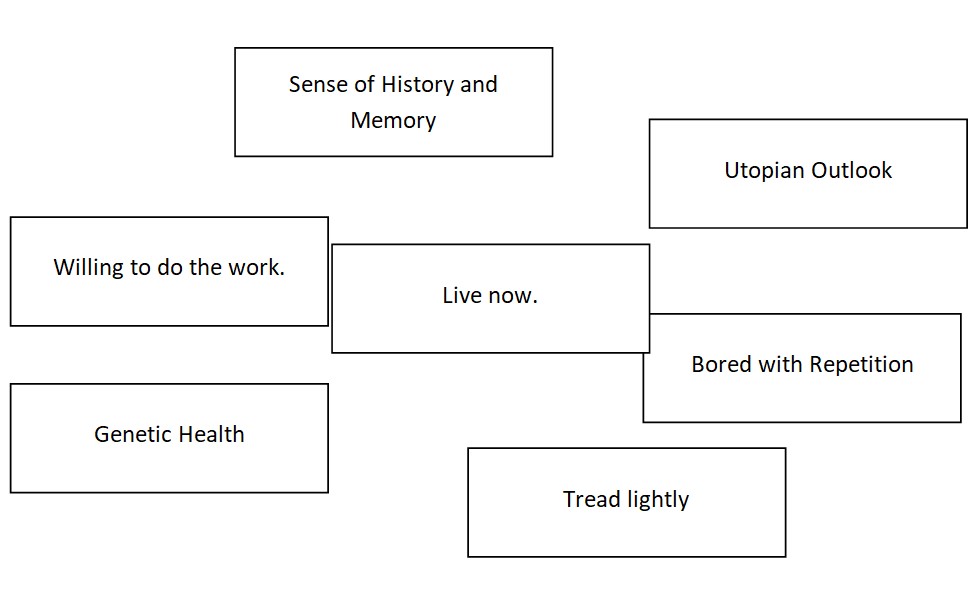
I’m not sure how I felt about Ram Dass’ book Be Here Now by 2013 when I made this diagram. “Live now” in the center weaves a thread back to my first reading of Ram Dass shortly after the book came out in 1971.
There was a shortage of mass media and consumer goods to support the new life we believed was possible after the tumultuous 1960s. Be Here Now fed that appetite.
A writer has to have more going on than living in the moment. That’s what the diagram is meant to represent… I think. If these are some of my qualities as a writer, the one that stands out today is “utopian outlook.”
There is a utopian outlook in American society that shows itself in the manifest destiny myth, in our outlook toward business startups, in things as simple as setting up a home. We have a fundamental belief in systems and our role as chief actors in them. The example of Iowa’s remade landscape and the farms and businesses that now populate it offers no more perfect example of utopian outlooks.
Endemic to my writing process is an attempt to figure things out then build a platform of experience from which I can observe the world. I then hope to write pieces that add positively to society: letters, blog posts and opinion pieces. The success of such writing depends on a developed understanding of society combined with a utopian outlook which presumes its perfectibility. Well, if not perfect, then continuously improving.
In 2013 one part of my life had run out of fuel and money, and another was being formed from a series of low-wage jobs. As important as establishing a source of income was, there is no related box on the diagram. Money has never been that important to me, especially once I established a system to pay the bills.
I don’t think there is a western version of Ram Dass unless it was himself. Our survival depends on being here now. What may matter more is how we see the now. That’s what I’m working on as I write my autobiography.
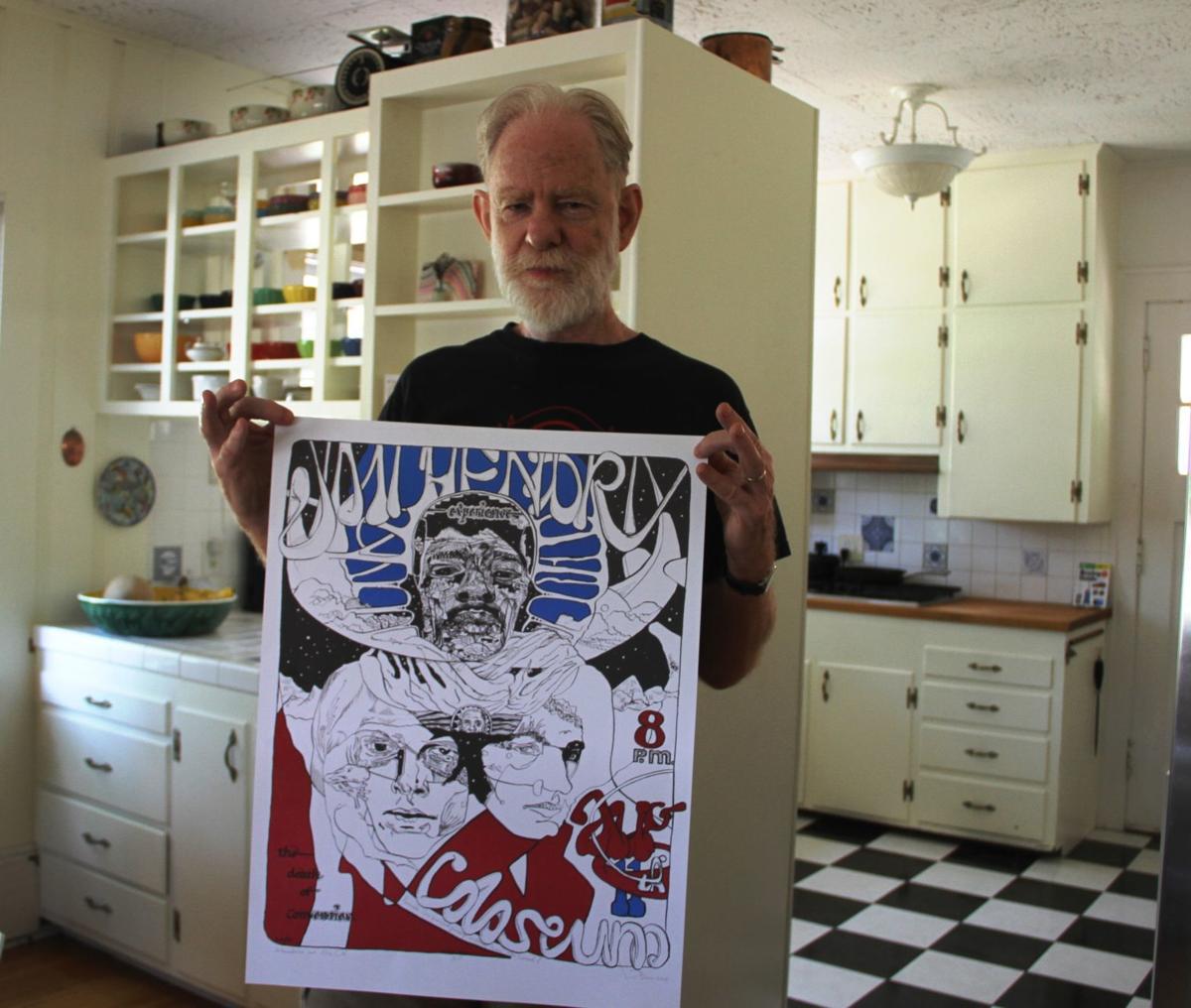
Leslie Bell on 50th Anniversary of the Jimi Hendrix Performance at the Col Ballroom in Davenport, Iowa with a reprint of the poster he made for the concert. Photo Credit – Quad City Times
How do we create?
Is creating work — writing, art, music, photography, film and television, radio, oral stories, events — magic? Sometimes it seems so because we can’t recognize how an end product came into being… it must be magic. Is creation the result of hard work, discipline and practice? Some of what I’ve written could have used more and smarter work.
“If you want to be a writer, you must do two things above all others: read a lot and write a lot,” Stephen King famously wrote. “There’s no way around these two things that I’m aware of, no shortcut.”
Over time I came to agree. Looking back at my extemporaneous writing — similar in technique to what Jack Kerouac did in stream of consciousness — it seems pretty lame. Creativity requires practicing the craft. Gaining awareness of other aspects of society is equally important to creativity. What King wrote about writing applies to other art forms.
In the 1960s and 1970s, I looked to Bob Dylan as a creative model, particularly during the time leading up to release of the album Bringing It All Back Home in 1965 through his work after the motorcycle accident with what would later become The Band. The stories of him living in Woodstock, New York, sitting at a typewriter for hours on end, and consuming the work of other musicians was how I envisioned myself.
The collaboration with Rick Danko, Garth Hudson and Richard Manuel, who lived at Big Pink in West Saugerties, New York, and with Robbie Robertson and Levon Helm, resulted in the bootleg tapes. A friend in high school secured a copy and we thought it was something. How my Dylan modeling played out over time is worth considering, but that will be later. Suffice it I knew I would be no Dylan but his work influences mine, even today. The process of his creative endeavor remains something to model.
I knew Leslie Bell mostly through my neighbor and friend John Kiley. I can remember only two personal interactions with Bell. I picked him up hitchhiking to visit a friend when he studied with Father Edward Catich at Saint Ambrose College. I also engaged his band to play at a high school class reunion. Everything else I knew about him was through someone else.
When I returned to Davenport from Germany, Bell and others had founded the Open Cities Film Society. While the films screened were less diverse that what I experienced in Iowa City where I attended graduate school, it was something available in a river city where a shoppie mentality continued to prevail among the populace. I don’t know how, if at all, Bell’s creative process influenced mine but this segment from a 2013 interview by Painter’s Bread is close to my creative process.
PB: How do you go about making your work and what kinds of challenges have you experienced? LB: Since my work is improvised and doesn’t rely on models or observation, my working method requires a lot of front-loading. Film, novels, music, and life played out in real time all help me build an archive of possibilities. I certainly keep my eyes peeled when I’m out and about. The years I spent as a street photographer have helped me scoop useful experience from the broader kettle of stimuli in the form of interactions, gestures and changes in the social fabric. In the studio, I begin with a blank canvas and no ideas. The canvas serves as a screen on which I can imagine random images, stories and compositions. I’m looking for a place to start—a strong-but-vague impulse. From that point on, it’s a process of call-and-response. I react to what’s on the canvas with a move that seems an appropriate extrapolation of the narrative, the color etc. I may not know what the painting is about until it’s almost done if at all.
Like many writers, I start with a blank page. I take a snippet from life, or a point from an outline, and type a couple of sentences on the screen. How and what I end up with is based on the “front loading” process to which Bell referred. The content seems better for diverse experience brought to the work. When adequately front loaded, the work product is better.
At the same time, there is magic to writing. When I hit on a sentence that stands out as universal, I can’t say where it came from. Such moments make the work worth while.
One has to let go of quotidian affairs while creating. Being grounded is important. It’s not always the point of a creative piece. Blending everything together takes practice… with a bit of magic to pull a good story together.
Father’s death on Feb. 2, 1969 dominated my life for a long while afterward. For years I thought it would be the central theme of my writing. I now realize it was a reality through which I had to work. It wasn’t until military service that I began to get through it.
I started several short sketches like this one using different names for the characters. While I pretended they were fiction, clearly they represented our lives, thinly veiled. This fragment captures my discussion with Father about nationality. It took place in the dining room of the American Foursquare on Marquette.
At our grade school we were divided into groups: about half were descendants of German immigrants and half Irish. A small number of us who were neither were assigned with the Irish because there were less of them. Our conversation was soon after this division. At our 40th high school class reunion I asked a classmate about division into Irish and German groups. She had no memory of it.
Being an “American” rather than a son of immigrants came to define part of my character.
The fragment below was written at my apartment near Five Points in Davenport less than two months after leaving active duty. It is edited to pull different parts of it together. I didn’t change much.
Father was a union man. He forged implements of the modern farmer at the J.I. Case plant in Bettendorf, Iowa. He was a proud man, proud of his family and heritage. He stood with both feet on the ground.
The union offered him a job as chief steward once, and he took it for a while. He asked to be put back on the second shift so he could return to school, and be his own boss, to establish himself. Father knew who he was, where he stood, and where he was going.
One night after supper, Jim Peterson went into the living room, where Father was watching the news on television, and asked, “What nationality are our ancestors?”
Father looked up and without hesitation said, “American.”
Jim asked again, “But are they Polish, like Mom’s or what?”
Yes father knew who he was and if it was one thing he was not, it was someone else’s son.
At age forty he graduated from the Palmer College of Chiropractic, the oldest man in his class. In September, death in the form of a 1959 Ford found him walking from the Case plant after second shift and brought his efforts to a different culmination.
On Dec. 7 I remember our neighbor Bill who continued to witness about the bombing of Pearl Harbor until his death in 1994. Those were days before we recognized something called Post-Traumatic Stress Disorder. Rest in Peace, Bill.
A neighbor died of COVID-19 over the weekend. The neighborhood’s rate of infection by the coronavirus has me questioning the wisdom of exercising on the state park trail. On one hand, I understand how the virus is transmitted and have taken to wearing a face mask on the trail. On the other, it’s an exposure I simply don’t need as the pandemic peaks in Iowa. What I know for certain is I will go crazy if I don’t get outside over the remainder of fall and through winter.
I made a couple of work shifts of discovery while I was indoors. While I plan to write my autobiography in 2021, I’m also not in a hurry to proceed because there is so much material. Going through it takes time and if I seek to capture a life accurately, it is time well spent.
I’ll be spending this week getting a grip on the scope of the project. I’m not comfortable I understand what’s available to me yet. I’ll be doing that and determining how to exercise as the coronavirus pandemic yields a record number of cases, hospitalizations and deaths. Be well.
It’s never a problem to fill days with activity. Setting and working toward a broader goal is proving elusive during the coronavirus pandemic.
Activities once taken for granted are now impossible. So many people are on the lookout to prevent contracting COVID-19, causing massive deterioration of our shared social life. My reaction to the extended pandemic was reasonable: a decision to focus on my autobiography. Increasing parts of each day include such work.
In the Jan. 28, 2019 issue of The New Yorker, historian Robert Caro recounted a meeting with his managing editor, Alan Hathway at Newsday in 1959.
“Just remember,” Hathway said. “Turn every page. Never assume anything. Turn every goddam page.”
Caro took the advice to heart. My book won’t be as detailed as his books on Robert Moses and Lyndon Johnson. However, it is important to read what I’ve previously written and saved. It’s important to go through the souvenirs, books, boxes and trunks that clutter our household. When the pandemic recedes it will be important to visit places and again speak in person with friends and acquaintances. It is important to give things consideration as I distill them into a couple hundred thousand word memoir.
I started keeping a journal after graduation from the university. The first volume was stolen with my back pack in 1974 at a youth hostel in Calais, France. The rest of them sit on a shelf within arms reach of my writing table. There are more than 35 bound volumes and more in photo albums, media, three-ring binders and file folders in the next room. That’s not to mention photographs, the trove of letters I wrote Mother and got back after her death, or the thousands of blog posts and hundreds of newspaper publications. It’s a lot to read, examine and consider.
I don’t know what to do except begin and let the thread go where it will. With that in mind, below is the first journal entry that remains with me.
Very sunny here today near Stonehenge, and other ancient ruins. Stonehenge yesterday brought to attention the very tourist like notions of seeing something only to tell your friends about it when you get back. It may be that these days this is the notion you should have or at least most common, but it is also a notion of which I refuse to partake. It is only a very insensitive person who will go look and come back in one hour as the tour bus takes, but then there’s hours and barb wire fence to keep you from doing it any other way. Yet here too comes the notion that since there are so many books and pictures and articles about Stonehenge why even bother the few minutes to even see the thing.
On the way from the rocks to the return bus, the drivers were talking and one said to another, “It’s too bad it started to rain. It spoiled their trip.”
Here it seems that there is such a “holiday” preconception among these drivers (and all Britons as well) that it prevents them from seeing what is really, actually there: some rocks with barb wire about them with people crowded within these premises. At any rate, I was no different from the others when I paid my 65p and walked, took some photographs, and bought some postcards which I today mailed to the states.
My experience of the 1970s is book ended on one end by graduation from high school and attending the Kickapoo Creek Rock Festival in Heyworth, Illinois on May 30, 1970. On the other is cutting up my military service identification card on Nov. 25, 1979 at a party in my apartment near Five Points in Davenport.
Life was not what I expected.
Some of my high school classmates married immediately after graduation. I expected to marry a woman, yet that would not be until later in life. Like many in my cohort I left home to attend college rather than settle down. The following ten years were a time of adventure and learning about the world beyond my home place. I sensed life would not follow a standard path.
There was an unseen momentum that led me to attend and graduate from university. Father’s death in 1969 resulted in questioning the efficacy of the life I’d been planning with him. Had I not been awarded the full scholarship through the efforts of the meat packers union, I doubt I would have attended or finished at university. My last discussion with him was about studying engineering, although he did not affirm that I should. He was busy with his own struggles attempting to turn the page from working at a slaughterhouse to passing the state medical board examination required to become a chiropractor.
Before I left home I had a conversation in the living room with Mother about whether I should stay in Davenport to help her get through the loss of Father and help with my younger siblings. She wouldn’t hear of me staying and encouraged me to leave Davenport to attend university. After working the summer at the Turn Style discount department store I left for the University of Iowa. More than any other parental guidance, this conversation set the course for who I would become.
A person does not experience life by becoming set in patterns of existence. The whole idea behind automation was the elimination of routines. By allowing standardization of products to dominate the ambitions of men, we can reach the point where society is nothing more than a group of zombie-like creatures who are willing to conform to what everybody else does. This is why European thinkers criticized the machine as a cancerous growth on humanity.
School papers, University of Iowa, Iowa City, Iowa. Fall 1970.
It seems appropriate my university coursework brought me to this conclusion about standardization. Few of us realized in 1970 what the impact of automation, branding, technology, communications, and dominance by corporate interests and other institutions would have on our lives half a century later. Part of my life has been standing up to such standardization. Even so, my 1970s were not that different from others.
I attended university, made a three-month tour of Europe, came back to Davenport for a year, then enlisted in the U.S. Army. By the time I returned to Iowa in 1979 — and collected all of my belongings from storage, shipped from Germany, and from Mother’s house — I knew I wouldn’t be long for my home town. This letter to the editor summarizes how I felt.
As a college graduate, I would like to believe that a rewarding lifestyle consists of more than a hefty paycheck with plenty of taverns in which to spend it. I would like to believe that my future in Davenport holds more than a secure family life.
Letters to the Editor, Quad-City Times, Dec. 30, 1974.
Looking back on the 1970s I see the beginnings of the same path I’m on today. While it was not a standard path it has been pretty consistent all along. I expect to continue, at least for a while.
Editor’s Note: There is a photo of my maternal grandmother sitting at the kitchen table in our house on Madison Street at my first Thanksgiving dinner. She looks on while Father carved the turkey and Mother captured the photograph. I sat against the wall between them. This post is about my return to Iowa from Fort Benning, Georgia for a brief Thanksgiving visit before departing for Europe in 1976.
Grandmother lived near or with us from my earliest memories until we moved to the Marquette Street house in 1959. After that we visited her occasionally. More commonly, Father picked her up at her apartment and brought her to our house for a special meal, holiday or event. Eventually she located at the Lend-A-Hand Club at the foot of Main Street on the riverfront.
The Lend-A-Hand was established in Davenport in 1886, part of a national network of Lend-A-Hand Clubs — a place for young women who lived and worked away from home to associate in a safe environment. After Grandmother left the farm in Lincoln County, Minnesota, she found such living arrangements, either with the people for whom she worked as a servant or cook, or in small apartments in a subdivided single family structure. In 1973 the Lend-A-Hand Club was rented to the City of Davenport and converted to elderly housing. Grandmother was one of the first residents after that. The building was listed in the U.S. National Register of Historic Places in 1983.
I visited her often after leaving Davenport in 1970. I can remember her room as if I were there today. She took a couple of photographs during those visits and I use them from time to time to aid my memory.
When senior dining began at the Lend-A-Hand she volunteered as a hostess. She also used an electric skillet to cook some of her own meals in her room. I often shared meals she cooked during my visits. She worked as a cook, seamstress and housekeeper most of her life and was good at it. I keep a couple of recipes she wrote down for me in my cook book in the kitchen.
The 1970s hold fond memories of our time together. On Nov. 26, 1976 I visited and wrote this journal entry. It became important later in my life as I became involved in the local food movement. It is lightly edited because I couldn’t stand some of the usage.
Today I visited Grandmother at the Lend-A-Hand and we ate ravioli from LaSalle, Illinois. They hand pack it there. It is a treat whenever we get a chance to make some.
I wonder about the brand names which grace our pantry — Kraft, Nabisco, Campbell’s, Carnation, Betty Crocker, Aunt Jemima, Libby’s, Quaker Oats, Folgers, Post, Hershey’s — and marvel at the simplicity of the containers in Grandmother’s shared kitchen.
There are milk cartons with all the ladies’ names on them; bulky, shapeless packages with owners’ names written on them; old butter dishes covered and taped shut; white and tan boxes each with a name on them. It seems fitting that the name of the consumer rather than the producer or canner appear on foods awaiting the pot.
Perhaps these women are not swayed by the numerous labels enticing them from supermarket shelves. Maybe they learned that a carrot is only a carrot, no matter who laid hands on it. But food is food and when one has it, one is grateful.
Mother took me downtown to a federal office building to register for the draft. I was 18. I have my draft card with the Selective Service number on it in a trunk with other memorabilia from the time.
Dad served as an army paratrooper during the occupation of Japan. There is a photograph of him and Uncle Don, fresh from Tallahassee, with parachutes strapped on, ready to jump.
It was with a sense of family history, personal commitment, and duty that I followed the law by registering. Not all of my friends would contemplate entering military service, a couple of conscientious objectors were among my cohort. I felt no such compulsion and if I were called up, I would go.
In the eighth grade I had an assignment to read the newspaper and clip articles about topics which engaged me. The spiral-bound notebook I made has a section on the Vietnam War, including a newsprint photograph of a soldier that had just been hit by small arms fire and was falling to the ground. Going to the war was a real possibility, one I didn’t take lightly.
Like so many young people, I was enraged by the killing of four college students at Kent State University on May 4, 1970. A neighborhood friend organized a peaceful protest march to the military armory. I carried an end of a mocked up coffin representing one of the dead students in Ohio. A photograph of us made the local newspaper. I came to feel strongly the Vietnam War was wrong.
I took a student deferment as I had the option, and wanted to exercise it, delaying military service until after graduation from the university. I ended up cancelling the deferment when it became clear during sophomore year my draft lottery number would not be called. I was off the hook and breathed a sigh of relief as the Vietnam War was ongoing, and only crazy people wanted to fight there.
The conclusion I reached once the war ended on April 30, 1975 was the military was a mess and citizens had a personal, civic responsibility to improve it. That led me to explore options for enlistment. I enlisted to become an officer and left Davenport in January 1976, the bicentennial year. It was somewhat patriotic.
When I arrived for basic training at Fort Jackson, South Carolina I entered a different world. There were about a dozen white guys like me who had enlisted for officer training. They came mostly from New England and states above the Mason Dixon line. The majority of the company was comprised of local black guys and Puerto Ricans, many of whom knew each other from home and had enlisted together. There were a couple of white guys seeking to get on the draw with the Alabama National Guard, although they struggled to perform basic military tasks. At the time I believed Alabama did not send its best people. If you asked me in 1976 who would fight in our wars, my answer would have been black and Puerto Rican soldiers. It was a volunteer army and that is mostly who volunteered.
Ingrained in me was the liberal idea of equal rights under the law and equal protection. It mattered not that I was in a racial minority in basic training because it felt normal to me. I’d been exposed to different races and ethnicity when our family visited Florida where Father attended high school. I also shared a bunk house at YMCA camp to which staff had assigned all of the black campers plus me. Equal protection and equal rights used to be an American idea yet even as a grader I knew we had a long way to go. In South Carolina, in the military, it was obvious we weren’t equal as all the officer candidates were white.
The Unites States requires a standing military to meet our global commitments. Until the current president assumed office the United States stood as a force for good all over the world. Deployment on tough missions had become a norm. We continue to have a global military footprint, although its role has changed. Arms sales have become increasingly important to the U.S. under Trump’s “America First” foreign policy. The administration is changing the balance of power in the Middle East and elsewhere. We hope President Joe Biden can restore respect for the U.S. during his administration. What remains constant, though, is the need for a citizen armed forces and a standing army.
In his book, Who Will Do Our Fighting For Us? George E. Reedy, who extensively studied the selective service during the Nixon administration, wrote, “I believe that democracy can live more easily with the conscripts than it can with the professionals. The former do not like what they are doing — and that is precisely the reason they should be preferred.”
The need for military troops ebbs and flows. Some skills are highly specialized and require a longer term service commitment. Aircraft pilots are an example of this. For the most part, our military trains for specific missions and ramps up to meet staffing requirements. When operations end, units stand down. That is a normal progression and endemic to how the U.S. military operates. Having people from all walks of life, rather than dedicated professionals, enables citizens to witness our military and make sure we do good. That begins with a commitment to service, duty and honor when we consider our options in society. For me, the choice was easy.
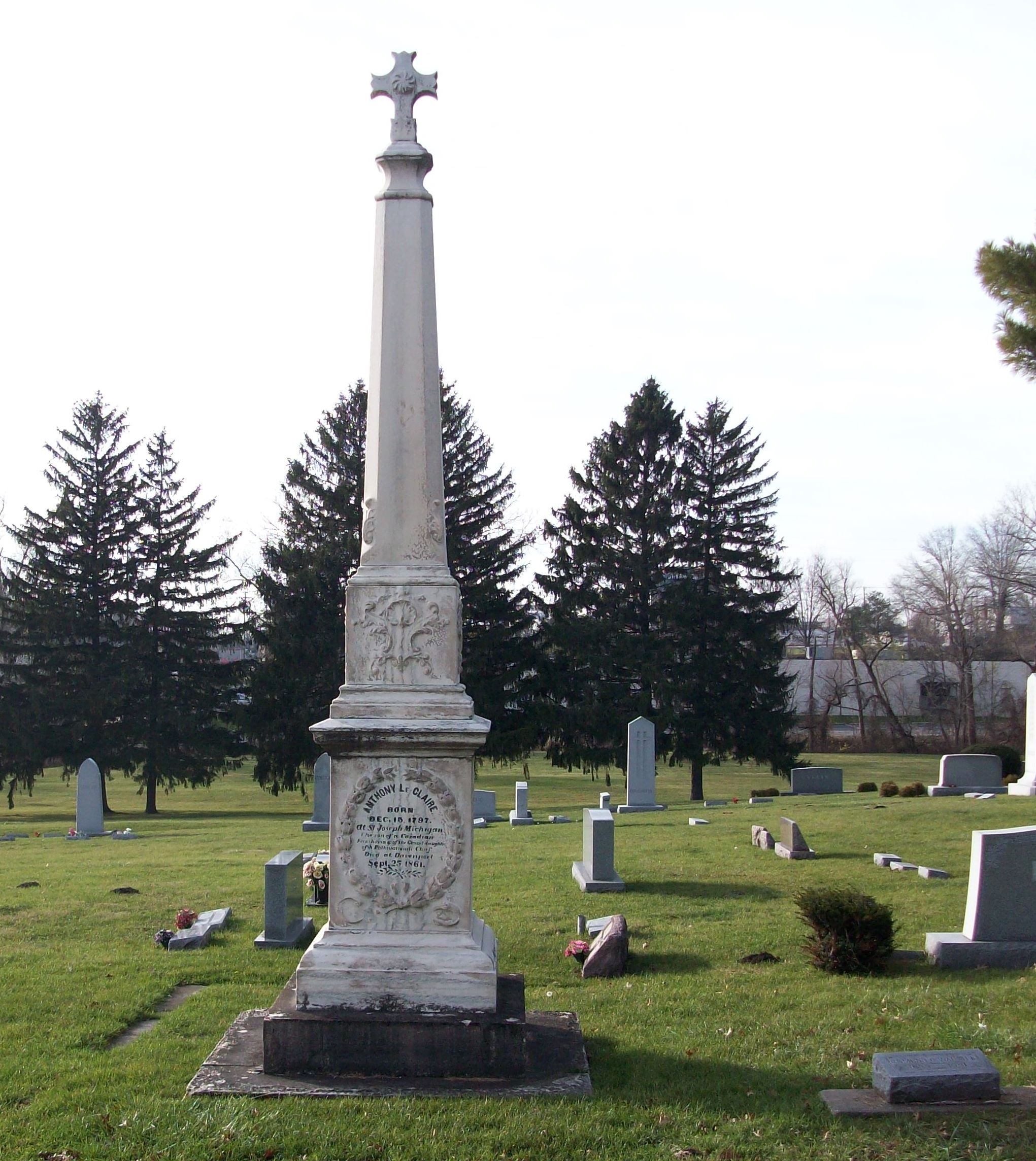
Antoine LeClaire Monument, Mount Calvary Cemetery, Davenport, Iowa.
By the time the City of Davenport was laid out, the Black Hawk War had ended. American men involved with the war, including some who would later become famous — Zachary Taylor, Abraham Lincoln, Winfield Scott, and Jefferson Davis — had departed. There was this land on the Iowa side of the Mississippi River.
With the Indian tribes removed, something needed doing with it, or so they believed. By any measure, the enterprise was a commercial venture in an arbitrary location. Its lackluster beginnings would haunt the city, certainly until I was born more than a century later.
(Spelling and punctuation preserved from the original text).
In the fall of 1835 a group of men met to form a company for the purpose of purchasing land and laying out a town site on the Iowa side of the river across from the fort. These men met at the home of Colonel George Davenport to discuss the issues concerning the town. Other than George Davenport the following men attended the meeting and became part of the company: Major William Gordon, Antoine LeClaire, Major Thomas Smith, Alexander McGregor, Levi S. Colton, and Philip Hambaugh. Another member of the company was Captain James May, in Pittsburg, Pennsylvania at the time.
The spring of 1836, Major Gordon surveyed the land that was to become the City of Davenport. The spot selected was west of the LeClaire Reserve and bounded by what is now Harrison Street on the east, on the north by Seventh, west by Warren, and south by the river. It included 36 square blocks and six half blocks. The cost of the entire platt was $2000.00.
In May, the area had been divided into lots, streets, and a proposed business section. Then the enterprising company offered an auction. People were brought from St. Louis by a steamboat and docked on the river front. The sale continued for two days. During the day the area was shown and in the afternoon an auction was conducted. In the evening the ballroom of their steamboat hotel was turned into a place for a lavish party in hopes that the second day of the auction would be as big a success as the company had hoped for. Unfortunately the sales were far from what was expected. Only fifty or sixty lots were sold at $300.00 to $600.00 apiece.
The promotional adventure to sell the city of Davenport was not a success in the number of sales made or amount of money collected. Most of the lots went for low prices to St. Louis speculators who hoped to make a profit on a resale.
I am an early riser, usually beginning my day by 2 a.m. My spouse is often still up from the previous day.
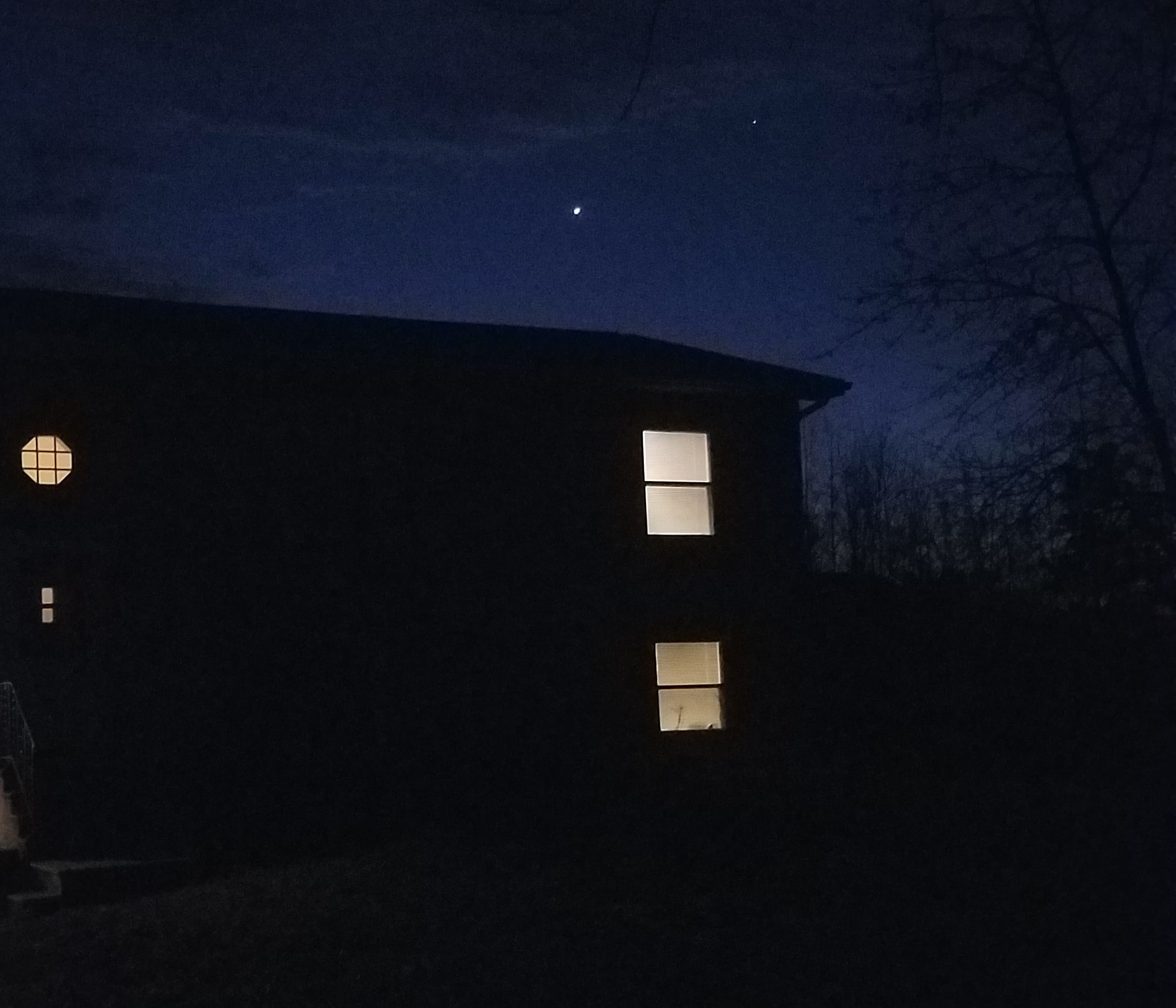
Two windows on the southwest side of the house are illuminated once I reach my writing desk, hers above mine. The planet Jupiter is not always hanging above us as in the photo. We are night owls.
Early rising provides a six-hour shift at my desk before the world wakes up. It is the quiet writers need.
Saturday I culled books. I purged duplicates from the stacks to be donated or given to friends, and put some in a reading pile. I spent the most time reading and considering books that were off grid. That is, they didn’t appear on Goodreads or Amazon, and they had no IBSN, a numbering convention that began in 1967. Many books I will consult for my autobiography predate IBSN. Others were printed privately. It’s a different world when we get off the grid.
I put Who Will Do Our Fighting for Us? by George E. Reedy, with an introduction by Senator Edward M. Kennedy, on my desk. The U.S. military, when I enlisted in 1975, was a backdrop for understanding the role of citizen participation in society. The dialectic Reedy explores is between a conscription and a volunteer army. Reedy favored conscription because such soldiers don’t like what they were doing. “That is precisely the reason why they should be preferred,” he wrote.
I participated in the draft lottery and had the number 128 when I was eligible to be called up. That year they called only through 125 so I could finish my undergraduate degree at the university and fulfill my selective service requirement without a student deferment. It turned out I enlisted after the end of the war in Vietnam.
The other off grid book was A Clearing in the Forest by Gayle A. McCoy. It’s a biography of Colonel George Davenport, one of the founders of his namesake city where I was born. I’m more familiar with his business partner Antoine LeClaire. The plan is to write 500-750 word historical/autobiographical sketches of important places in my life and use them to set the scene for autobiography sections. Both founders require further study before getting to the Davenport segment. I put the biography on my bedside table.
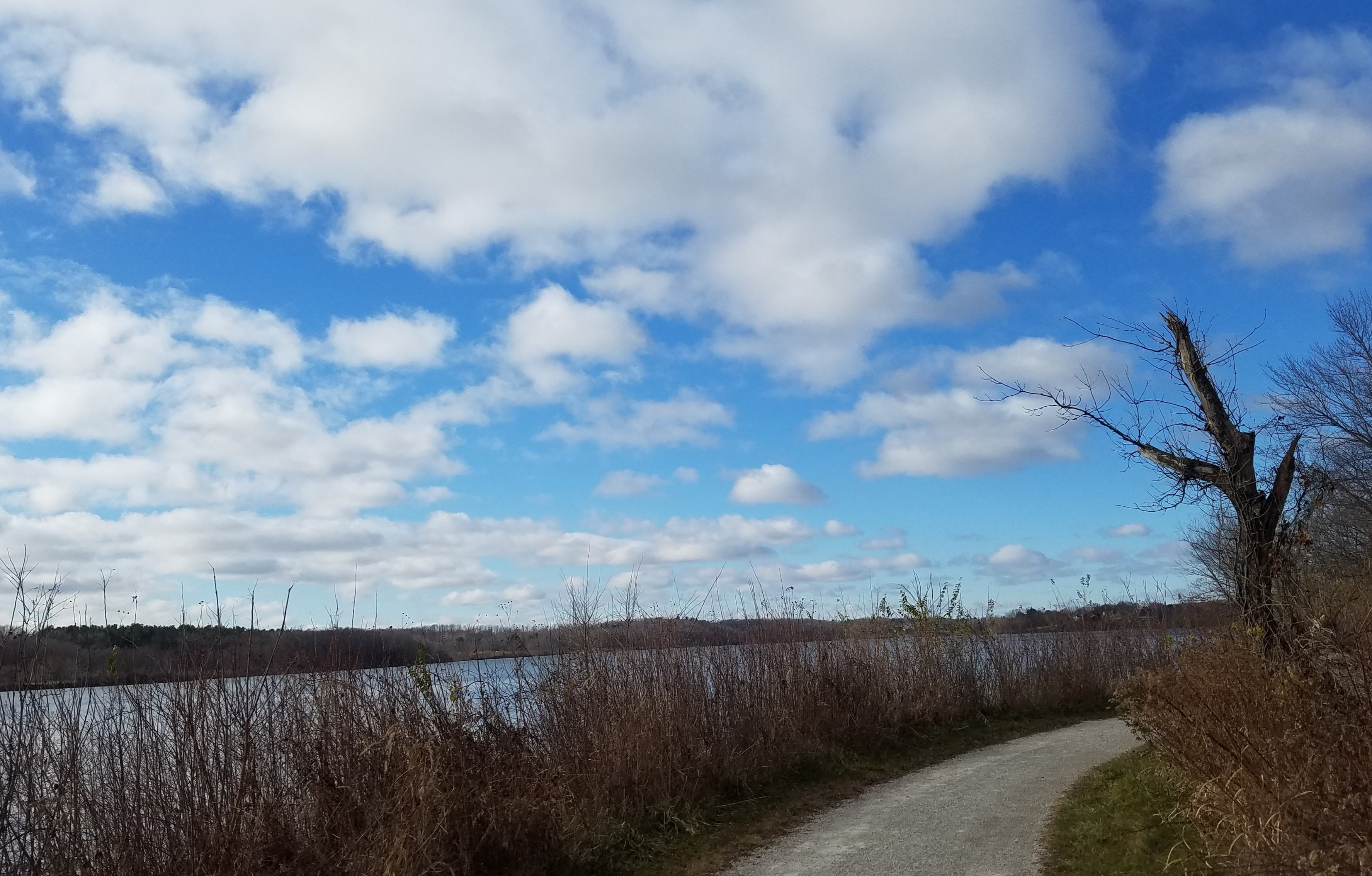
It was a decent fall day yet too cold for bicycle riding. I followed my usual walking route to the public boat docks and back, about 2.5 miles. I was the only trail user wearing a face mask. News media reported a run on grocery stores as there was at the beginning of the pandemic. It is getting dire with reports of high levels of infection in nursing homes, care centers, and at the state prisons. In normal times all of this would be scandalous.
On Friday the Carroll Times Herald published a story about family and friends who contracted the coronavirus. It is anchored around friends playing Euchre and how the virus spread among them. “A spreading sickness” is poignant and timely just before Thanksgiving. Link here to read the first of three parts.
I like the photo in this post. Under a clear sky, light shines from rooms where we live quiet lives. We turn inward for a few hours before dawn, focused on our work. We can be ready when the rest of the world wakes up. What we increasingly find is we are not the only night owls during the disruption caused by the coronavirus pandemic.


 Journey Home
You must be logged in to post a comment.