Categories
Writing

Time Alone

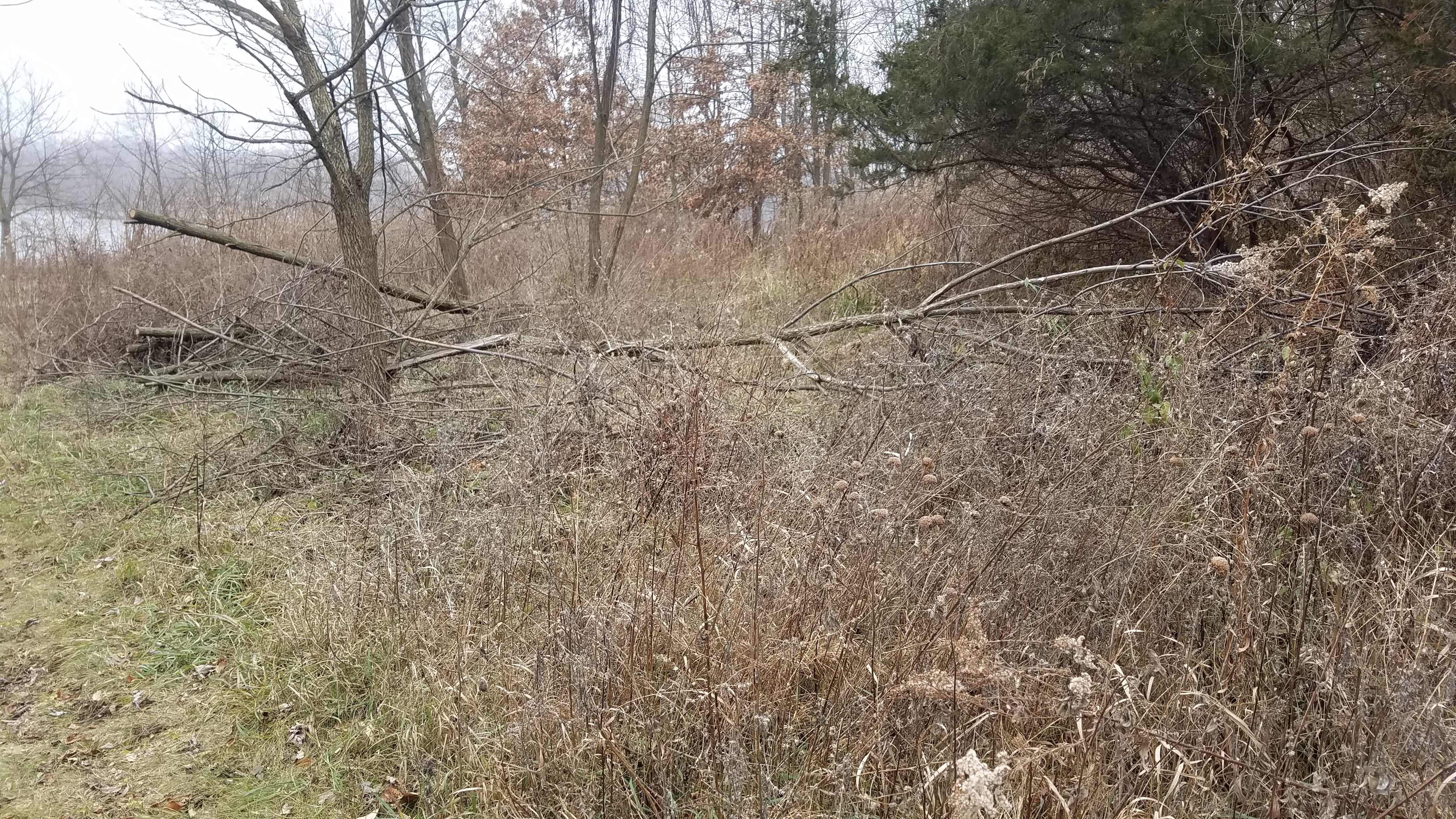
Derecho damaged woods.

I spend plenty of time alone in nature. Mostly it is during walks, or jogs, or bicycle rides. There is no desire to spend an extended time there. “Nature” borders on the sad these days because of its degradation by humans.

When on my grand tour in 1974, I spent time alone. Unless I clicked with someone, it made little difference if I ever saw them a second time. Landing at Heathrow, taking buses, trains, private cars, and in one case, a hovercraft across the English Channel, most of my travels were with someone I met at a youth hostel or hotel, and then for only the time until our next destination. I enjoyed spending the end of each day with others at a hostel. By morning I was ready to venture on my own to interact with the places I’d come so far to see.

Things clicked when I met Gerhard on the green at the Royal Shakespeare Theatre in Stratford-upon-Avon. We met before a performance of Twelfth Night and hung out together afterward. He invited me to visit in Vienna when I made it there in six to eight weeks, and I did. I even tried to get a job in Vienna to extend my stay with him and his room mate from a small village in the Carinthia Alps. When I returned to Europe for military service, while living in Mainz, I took a train to Vienna to visit them again. We corresponded for a long time afterward.

Sometimes I met people I wanted to shake. I met Jorge from Argentina at a hostel in Munich. He was a decade or more older than me and literally falling apart as his partial plate broke twice while I was with him. He brought too much gear, as if he planned to live in some European city permanently, lingering for hours at a local cafe. “He carries with him such a large portion of Argentina that it will break his back someday,” I wrote.

My traveling companion is quite a mess. He smokes very much and eats chocolate and drinks coffee and doesn’t exercise much, all of which combined lead to his poor physical health. Today too, he broke his partial and as a result is walking with his front tooth missing. Also, his temperament makes him very slow and lethargic in moving, and more important, in his thinking. He cannot perceive the world as I do, but acts like a selfish mouse searching only within the egocentric world of self. I often wish to abandon him, but just as many times I see him as needing help. At any rate, I’ll travel with him for as far as Amsterdam.

Personal Journal, Oct. 22, 1974

While I was with Jorge I was encouraged to write more, take photos, travel, and etc. All things seemed better at first. We made it together as far as Heidelberg. He was missing his native Buenos Aires, and my patience with his encumbered companionship was wearing thin. I left him to travel to Cologne alone.

I’m reading a book called Notes from an Apocalypse by Irish author Mark O’Connell. In it he describes going off by himself to the remote Scottish Highlands in a form of pseudo right of passage or retreat. What he found was he couldn’t really get away from other people. A Royal Air Force airplane flew over his campsite, close enough to see and be seen by the pilot, who was on a training mission, or perhaps making a bombing run to Syria, he wasn’t sure which. So it is anywhere on the globe. The mark of we humans is everywhere. In Iowa that is particularly so.

When Big Grove Township was first settled, it was known for the saw mill on Mill Creek. The native oak, walnut, hickory, ash, elm and cottonwood that once thrived among numerous pure springs were long gone by the time we got here. Soon after the big grove was removed, so was the sawmill. Such is living in Iowa, a place with very few natural areas. Even the farmland across the state relies on artificial inputs to produce crops. Every place is subdivided and deeded to someone.

In modern life we can get time alone yet there is always something pulling us back into the maw of humanity. Lately, during the coronavirus pandemic, time alone means a flight into the imagination, into memory. I’m okay with that. If I yearn to do things in person with people, I also accept the restrictions designed to prevent spread of COVID-19. In a time of contagion we get plenty of time alone.

Categories
Writing

Editor’s Desk #3

Work station in Colorado in 2008.

The wind was fierce Tuesday afternoon, blowing down branches in the neighborhood. After the Aug. 10 derecho one would have thought all the weak ones had fallen. Our property survived yesterday’s minor wind storm without damage.

I spend time on process. In reading my journals, I was reminded I always have. Early on it was a response to the quality movement as Iowan W. Edwards Deming practiced it. He was all the rage among manufacturers who spent untold millions of dollars developing ways to “improve quality.” Properly done, quality improvement programs reduced costs and improved gross margins. While on an extended business trip to West Texas, I found an autographed copy of Deming’s main work, Out of the Crisis at a thrift store for a dollar. Deming’s ideas were well disseminated, even reaching the city with the annual rattlesnake roundup. Deming’s quality process applies to writing.

My writing process evolved to the next iteration this week. I liken it to a funnel. The store of memories, artifacts and previous writing go in and slowly drain out in the form of daily thousand words rushes. Rushes are created however they occur. When I’m ready to edit, I print them out triple spaced and edit on the pages.

This week’s development was to use edited rushes to create a draft of the book in a single document n the cloud. I typed the headers of the working outline on the document, and as I write, lay parts of the rushes on the framework, re-write, and edit them again. Experienced writers may find this obvious, but y’all didn’t tell me so I had to figure it out myself. I’m satisfied the process was improved. I back up the book document after each writing session on my desktop and a flash drive.

The main benefit of studying the physical record, writing it into rushes, first edits, then incorporating the writing into the draft book makes me read what has been written multiple times. It becomes a better product. I drop segments, ones I thought were good when writing rushes, in favor of a tighter narrative. I elaborate as needed or make a note to do more research and follow the narrative down the rabbit hole of existence to make it better.

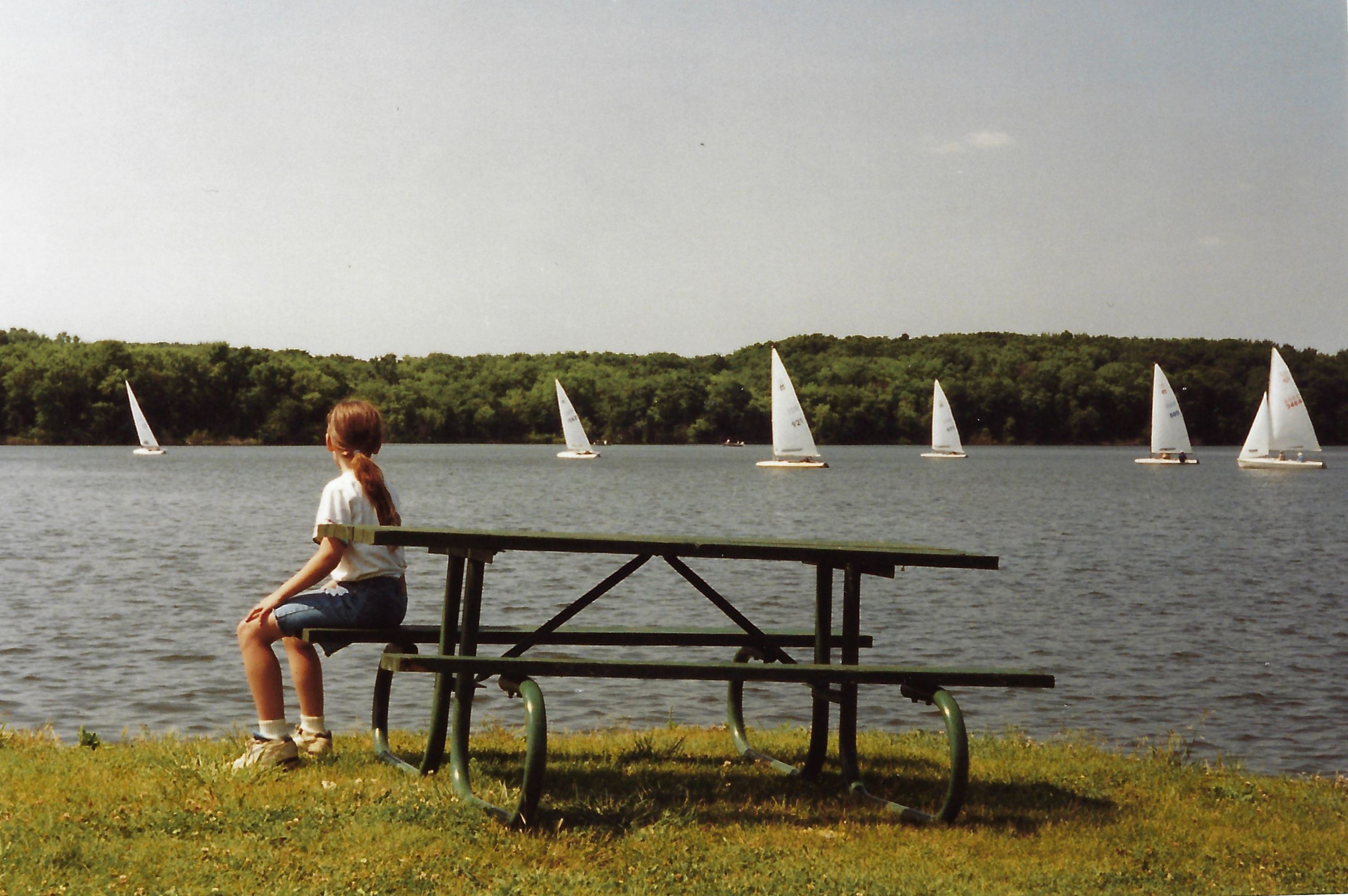
I read a journal from 1996 this week. While I don’t much think about them, the experiences remain in living memory. I tasted wild blackberries we found along the state park trail again. We swam in the lake under a blue moon again. We sat on a picnic bench watching a sailboat regatta breeze by again. The memories are visceral and real. With all the sensory stimulus, the capacity of humans to remember is remarkable.

For the first time this winter, ambient temperature dropped below freezing on Wednesday morning. It’s been a warm winter thus far. As it plays out, I’ll be watching for an opportunity to prune fruit trees. In the meanwhile I’ll be at my writing table coronavirus writing.

Categories
Writing

Colorado Peach Crisp

Kitchen Radio, Colorado Springs, Colorado.

Oct. 4, 2008 – COLORADO SPRINGS, Colo. — After hiking among red rock formations, our daughter and I went to a grocery store and bought vegetables for stir fry dinner — firm tofu, celery, carrots, red bell pepper, snow peas, broccoli florets, yellow onion, and garlic. Upon return to her shared apartment we prepared it the way our household has been doing since before she was born.

At 6 p.m. we tuned the kitchen radio to Garrison Keillor’s A Prairie Home Companion and made dessert. Listening to the program on Saturday afternoon, while working in the kitchen, had been a thing since the early 1980s. It was comforting regardless of what happened each week.

On June 13, 1987 I turned on a tape recorder to capture the final episode of A Prairie Home Companion — supposedly. Our daughter was two years old and wanted to spend time with me. Once the recorder was set, she and I went walking around our neighborhood in Cedar Rapids. When we returned the program had run over its allotted time and the tape ran out. I caught a re-broadcast on Sunday and re-recorded it. As we now know, Keillor didn’t retire. He came back and lasted the second time until 2016. He gave our Saturdays a predictable, calming feeling.

We took ten Colorado peaches from the ice box, peeled and sliced them in the only large bowl available. There was no granulated sugar in the pantry so we macerated them in brown sugar, cinnamon, clove and nutmeg. We arranged them in a glass pie dish and dotted them with butter. Next we cleaned out the bowl and mixed dry ingredients: flour, more brown sugar, salt, butter, rolled oats and a dash of water. I built the top high, knowing it would cook down.

During a yearlong internship in Florida, I bought her toaster oven which I now set to convection at 350 degrees. It doesn’t take long for a toaster oven to preheat. I put the shelf on the bottom rack, set the timer for 25 minutes, and monitored the peach crisp through the glass as it cooked.

She was sewing at the kitchen table, the radio was playing, and I was cleaning up while the crisp baked. We hoped dessert would satisfy, yet whatever its sweetness, it was unmatched by the scene: a father and daughter re-enacting the lives of our grandmothers on a fall Colorado night.

~ Adopted from a post on Big Grove News, Oct. 4, 2008

Categories
Writing

Living on the Kasparek Farm

Last night we looked at an old picture of the building that is now Smitty’s Bar and Grill in Solon. In sepia tones, seven teams of horses and wagon are lined up in front of the building on the dirt street.

We can make out the lettering on the windows of the shop: Cerny Bros Grocery, Cerny Bros Hardware and Cerny Bros Feed. While the roads have been paved for many years, much of downtown and the surrounding area resonates of the area’s origins in history before automobiles.

Big Grove Township was established before Iowa Statehood, and the first sawmill was built here in 1839 by Anthony Sells on Mill Creek. There is a subdivision named Mill Creek today and throughout the area, people refer to early settlers or builders of the homes instead of the people who now live in and own them. The names Cerny, Beuter, Andrews and Brown persist, as does the more recent name of Don Kasparek upon whose former farm our home is situated.

It is important to know the history of the area where we settle and I try to spend some time each year understanding Big Grove history. There is a lot there, and there is much to learn. What dominates is the culture we bring with us to this area where all trees indigenous to the Northwest once existed in abundance.

The oak, walnut, hickory, ash, elm and cottonwood that once thrived among numerous pure springs were gone when we bought our lot here. There were grasses and a lone mulberry tree that appeared to have been started from a bird dropping on the re-bar marker placed by Kasparek’s surveyor. The ground had a high clay content which suggested that Don had removed the topsoil before subdividing the plats. When he died a few years ago, I recognized him in our association newsletter and we speak of him from time to time in the neighborhood.

Yet, like Popeye the sailor, “I am what I am and that’s all that I am,” and can’t help but believe who I am is little of the history of this area, and more of the culture I brought with me. That culture is rooted in coal mining, factory workers, farming, home making and the rural culture of Virginia, Minnesota and north central Illinois. Our history as a family goes back on both sides to the Revolutionary War and my line to Virginia goes a hundred years prior to the revolution. That my ancestor Thomas Jefferson Addington is a common ancestor to the Salyer girls of the Salyer-Lee Chapter 1417 of the United Daughters of the Confederacy stands in contrast to the story of Maciej Nadolski working in coal mines in Allegheny, Pennsylvania after the Civil War and then buying land from the railroad in Minnesota.

What of my father’s birth in Glamorgan, Virginia, named after Glamorgan, Wales? And what of the suppression of Polish Culture by the Russians after 1865 that led to a massive migration of Poles to North America? And what of the failure of farming culture that led the Nadolski family to move from Ivanhoe, Minnesota to Argyle near the Canadian border, and then to the Cherry, Illinois mining community? Safe to say, we don’t often speak of these things here in Big Grove.

Perhaps, with time, we will.

~ First posted on Big Grove News, Nov. 23, 2008.

Categories
Writing

Editor’s Desk #2

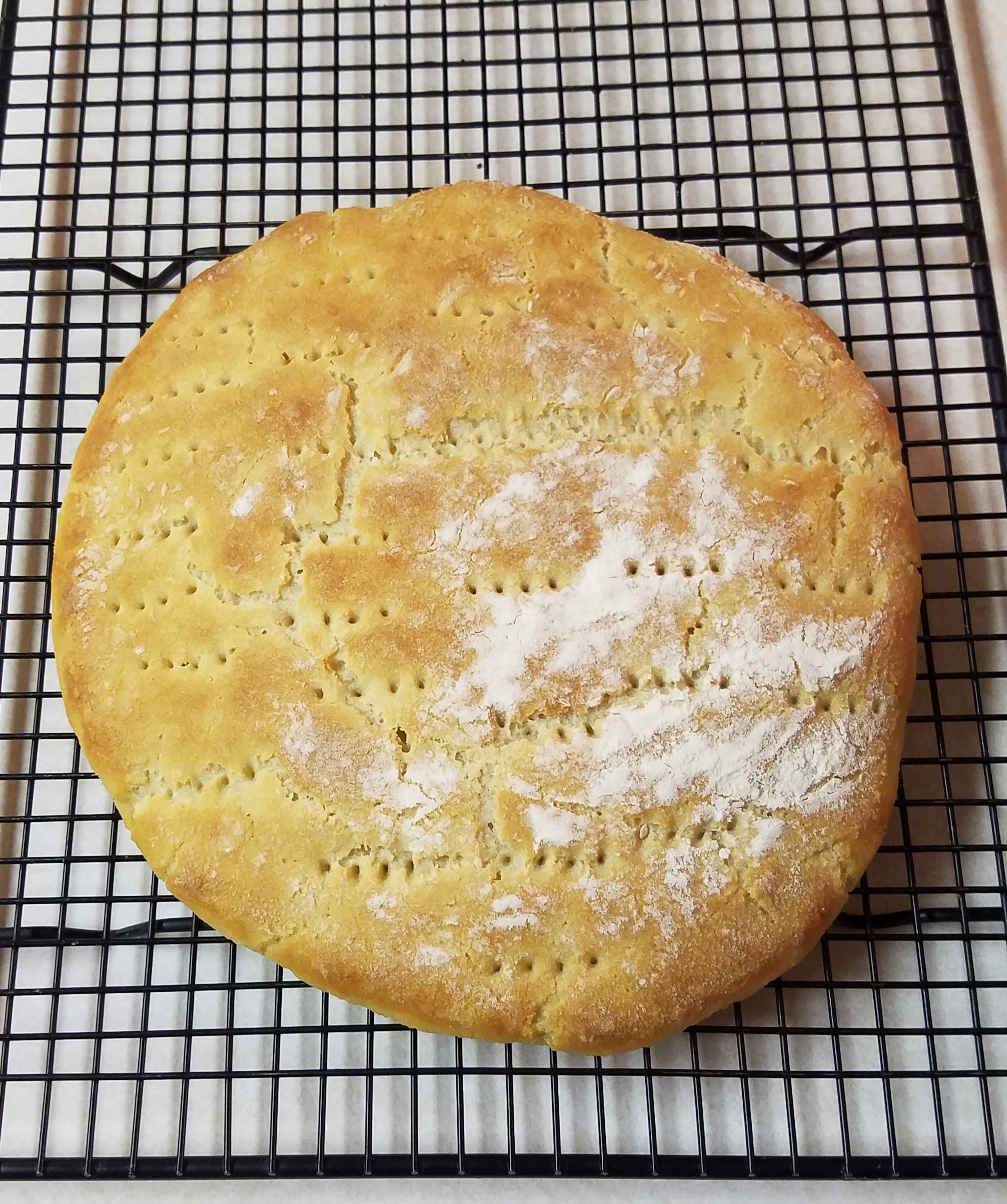
Flatbread to accompany home made soup.

The weekend is a time for exploring the ice box, freezer and pantry for ingredients to make soup. It’s almost always a hearty, satisfying meal. Last night I made flatbread using a blend of half wheat flour and half rice flour. It was a nice and easy accompaniment that made the meal. I don’t use a recipe because yeast bread making is about the feel of the dough once warm water, yeast, and a pinch of salt and sugar are mixed. The rice flour gave the crumb a different and toothsome texture. During the pandemic we’re cooking at home and trying new things.

My Saturday editing session was mostly about the book’s outline. I decided I needed one. After 12 writing shifts this month, I found the automatic writing method of getting memories down on paper will neither be sustainable nor as productive as needed. My commitment to the project is stronger than ever. What else am I going to do in a pandemic with snow covering the ground? An evolving approach to writing is a positive development.

Much of my writer’s life has been writing an autobiography. It is how I processed the vast input into our lives. Crafting a narrative, by its nature, involves a refraction of life experiences yet I don’t envision myself as a fiction writer. Developing characters and dialogue is not in my wheelhouse. I’d rather select what I observe from memory and intuit from life. My writing is a construct, although closely based in actual experiences.

There are five main tools for writing this book. It goes without saying a desktop computer with word processing software is the primary medium. I’ve been using a computer since the 1980s. The hard drive is backed up continuously to an external drive. I also use a written journal as a way to write about process. The nature of handwriting requires more thought before getting an idea down on paper. When considering process, thinking before writing is a must. The outline resides on the cloud with a downloaded copy of each revision filed on my desktop. I have a stack of three by five index cards with topics or events written on them. They are arranged in chronological order and rubber-banded together by decade. Finally there are the numerous books along with boxes and binders of artifacts. This physical record is more organized than it was a couple of weeks ago yet there is a long way to go toward making it usable.

I feel better about the new outline. The main story is a single narrative beginning with my birthday and continuing to the beginning of the coronavirus pandemic. It will be a small fraction of the book.

I begin by setting context with three historical pieces about Lincoln County, Minnesota, LaSalle County, Illinois, and Wise County, Virginia, from where my grandparents and parents came. Sections about our family life begin with historical narratives about our residences in Iowa City, Linn County, Iowa, Lake County, Indiana and Big Grove Township in Iowa. Following the narrative of my life, thematic sections about broader experiences in work, sustainable living, politics, writing and education are planned.

This will be my only autobiography so there will be appendices to publish a small selection of photographs and writing that includes poetry, blog posts, opinion pieces, my resumes, newspaper writing, journals and other published writing. Because there are literally thousands of such documents, understanding the scope will be a key research challenge. The benefit of the outline is it provides a structure upon which to hang artifacts as I discover them.

I ordered more apples from the orchard yesterday. In a concession to the pandemic I paid a fee to have them delivered to a cooler set outside the garage door. We had only two left in the ice box. Now that the orchard decided to remain open year-round, I could go on line, pick from a limited selection of remaining fresh fruit, and have them delivered within an hour. The frugal part of me resisted doing this, but it’s great to have a full apple drawer in the ice box again.

Categories
Writing

Photographs for Writing

Summer sailboats on Lake Macbride

Thursday was a day to organize photographs.

I copied the remaining digital photographs from a storage drive to my desktop and began reviewing and labeling dozens of envelopes of printed photographs. It was all in a day’s work on my autobiography.

The rise of popular photography in the 20th Century is endlessly fascinating, partly because my family participated in it. Changing technology and how it influenced our picture taking informs its increasing democratization. In a time of ubiquitous mobile cameras and the internet it is difficult to determine a consistent meaning of a single image. Changing technology and our adoption of it enables a narrative about our lives that is the focus of writers like me.

A large majority of printed images I handled survived without damage. So far there was only one photo album where prints on opposing pages stuck to each other and ruined them. There were a lot of photographs of other prints made to get them into my collection. That process had mixed results. When I was working on a big project, with hundreds of prints, I scanned multiple prints on one image with the idea of editing them down to individual images later. It sped up the intake process, but I’m not sure of its efficacy as I haven’t gotten to editing most of them.

Whatever I have on hand I will use. Photo sessions over the years, regardless of subject, tell a story of their own. Some of those sessions are compelling, begging further explanation. Some are not. Until I know what’s available it’s impossible to settle on which ones to use.

Photographic prints don’t always have a timestamp on them. Writing is partly about determining when things happened and how they fit a broader narrative. For example, our first family vacation was to Orlando, Florida where we stayed in a motel and visited Walt Disney World and Universal Studios. We took photographs with cameras and developed the film. It was the 25th anniversary of the Walt Disney World opening as the prints reminded me. While there was no timestamp on the prints, I could easily determine they were taken the summer of 1997 during Disney’s 15-month celebration of the occasion. The most difficult prints to date were taken after we moved back to Iowa in 1993 before we adopted digital cameras. There is an evolving discipline to dating prints and I’m getting better at it.

I’ve been successful at meeting my daily writing plan yet there will soon be a bottleneck caused by too many artifacts, previous writing, photographs, and stories to review. I get daily rushes done yet editing lags behind. On the plus side, I’m figuring out a new way to write and that’s part of the project. Consistent, daily work on varied aspects of the project is making a difference. The coronavirus pandemic created an environment for this.

Categories
Writing

Writing Space

Writing space in 2000.

Writing 20 years ago meant something different than it does today.

I worked a full-time, demanding job in Eldridge, Iowa which meant a 67-mile, one-way commute on days I worked in the office. I managed dedicated fleet operations in Chicago, Philadelphia, Pittsburgh, Cleveland, Buffalo, New York, Chattanooga and Knoxville, Tennessee, and consulted on other projects in Georgia, Texas and Iowa. I traveled a lot.

Our daughter was in high school along with everything that meant. I participated in her activities as best I could and felt successful to a degree. I missed a lot of her events because of my travel.

The writing I did was mostly related to work, journaling at home, email, and a few separate pieces. I’m re-discovering my writing from that period because of the current project. While I wrote an increasing number of emails, kept a journal, and wrote a lot of business correspondence, it was not the kind of writing I wanted to do.

We bought our first home computer in April 1996 and four years later each of the three of us had a personal computer. The one in this photograph (behind the Oxford English Dictionary) was from a company called Computer Renaissance in Iowa City, where they built the CPU. We used Compuserve as our internet service provider and I had an email address through them.

By 1999 I ran a telephone line with a dual jack to our daughter’s bedroom so she could have access to the internet for her used computer and an extension phone. I sent her this email.

I figured out that you would probably check your e-mail when you got home from school. I hope you are enjoying having the computer located in your room. Once the monitor gets fixed (it is in Minnesota) then you will really be set up. Remember that for now, we do not plan to get a printer, so copy to disk and we will print on one of the other printers.

Please use the computer wisely. So often, people get bored with life and become cyber worms. It is ok to use the computer for learning and fun, but remember that you have a life outside the computer. When I first got involved with a home computer, I found myself very busy with looking at stuff and installing hardware and software. I did not do as much as I would have liked with the actual software. Don’ let this happen to you.

Anyway, have a great evening, and hopefully if you are looking at this, you have your homework done.

Love, Dad

Personal email, Feb. 2, 1999

When we moved to Big Grove Township we did not have enough money to finish the lower level of the split foyer house. I set up my desk in the unfinished space on moving-in day and moved it around a couple of times through the years. We still haven’t finished the lower level. My writing space has been more like a campsite than an actual room. Even today, when I have walls around me, it retains a temporary quality.

In 2000, everything was connected by wire. I ran a new phone line downstairs and the printer and scanner were connected directly to the CPU. It was on this device I printed countless briefs filed in the Bush v. Gore U.S. Supreme Court case after the 2000 election. When this photograph was taken I had not re-activated in politics. That would happen after Sept. 11, 2001. After that I would use this space for political work as well.

Compared to today, the CPU I used was primitive. Ten years after Microsoft introduced Windows 3.0 I was still using MS-DOS for certain functions on this machine. It was what I learned while working at Amoco Oil Company. I remember the conversion to 3.0 during the period 1989 to 1991 as Amoco was an early adopter. If I was a computer geek, it was only because I wanted to understand how software worked, and how I could use it in my life. In retrospect, the computer work took time away from writing. It wasn’t until I started a blog in 2007 that I would figure how to best write using a computer.

As the breeze blew through the open windows I felt at home in this writing space. An unfinished house, a busy career, and a teenage daughter left little time to use it. Our daughter took the photograph, catching me surprised while I focused on some now unknown computer project. That space served for a while.

Categories
Writing

Editor’s Desk #1

Workbench cleared for seeding onions.

The value of having a good editor is something every writer knows. When one is self-published, isolated due to the coronavirus pandemic, and a novice at book-length writing, a meet up with an editor is inevitable.

When?

My process this year began simply: produce 1,000 words daily, five days per calendar week, and edit on Saturday. It sounded simple and doable when I began. I hadn’t expected the writing process would be a flight into imagination with no net and a flimsy tether. Maybe the editor’s job is to rein that in, put a fence around it, and get it to grow the way sheep do. There is a case to be made to turn edited rushes (results of a daily writing session after my first edit) immediately over to an editor. What decent editor would take such work without compensation?

Just because I work without income doesn’t mean an editor should. I would argue that free editors must be viewed with skepticism. Why are they doing the work, and for free? By the nature of quarantine writing, meet up with a professional editor will be delayed.

Writing the daily 1,000 is like mining coal: the writer follows the seam where it goes. As a result, common themes are found in different daily rushes. There is bad writing that must be improved. Part of the editing process is to hang thematic segments together on a time line and create a consistent, readable narrative. It takes more time than I allowed as I spent parts of last Saturday and Sunday working on rushes. I’m far from done editing and feel an urge to write more rushes.

The autobiography writer’s imagination isn’t linear or sequential. One session leads to new things, not all of them related to each other. In some cases I spent the rest of the day considering events and people once forgotten. In others I discovered new information after writing the initial rushes. The first challenge is to remember what happened and get those things written down regardless of order.

Looking at photographs and reading historical accounts informs a steady yet irregular emergence of what happened. For example, I’m working on a section called Piety Hill, which is the last place Mother said she was born at home. I remember her different accounts over the years and am not sure whether Piety Hill was her final answer, or the original and only one. I settled when writing her obituary, “Born at home on July 28, 1929, near LaSalle, Ill.” An editor might accept that as my siblings did before publication. This evaluation of stories of a single event told by different people is something Clifford Geertz wrote about. While there are multiple stories about a single event, the writer has to decide whether to present them all or to keep them simple and singular as I did with Mother’s obituary.

While thematic issues like education, work, family and travel may hang well on a timeline, the timeline is not the narrative. Too, I can’t imaging writing a sequential work with each paragraph’s content isolated from others. That’s not how we live and to construct such a thing would be a monstrosity and eminently unreadable.

For example, one of the stories I tell repeatedly is about a gathering at Mother’s sister’s home on Gooding Street in LaSalle the night Marilyn Monroe committed suicide. We children were sleeping in the living room when Father came in the room and announced the news. It seemed unusual for him to do that at the time, giving the event increased importance to our family.

The date is fixed, Aug. 4, 1962, and that anchors my narrative in popular culture. Maybe the reason I retell the story is its relationship to popular culture as something more important than what we kids were doing. The role of the autobiography writer is to de-emphasize broader cultural images and focus on the single life. My habit, and it’s a bad one, is to get out the same well worn narrative sawhorses and retell them. An editor could point out those segments and ask, “Do you really want to say that?” I need to recognize it on my own.

Because this is pandemic writing I don’t see getting an editor until I get enough written to call it a first draft, hopefully a year from now. For the time being I need a better rush editing process because even two days a week will not be enough time. That may change as I evolve into the work and gain experience with long-form writing. This week I also must return to last week’s themes and fill out detail. As I continue to unbox the archives this process will be constantly present.

One positive note is the rush editing process has helped me consider the broader themes and narrative. The end result is likely to benefit. For now, suffice it that I recognize the need for an editor. Until I get more of the first draft written, that editor will be me.

Categories
Writing

Second Saturday

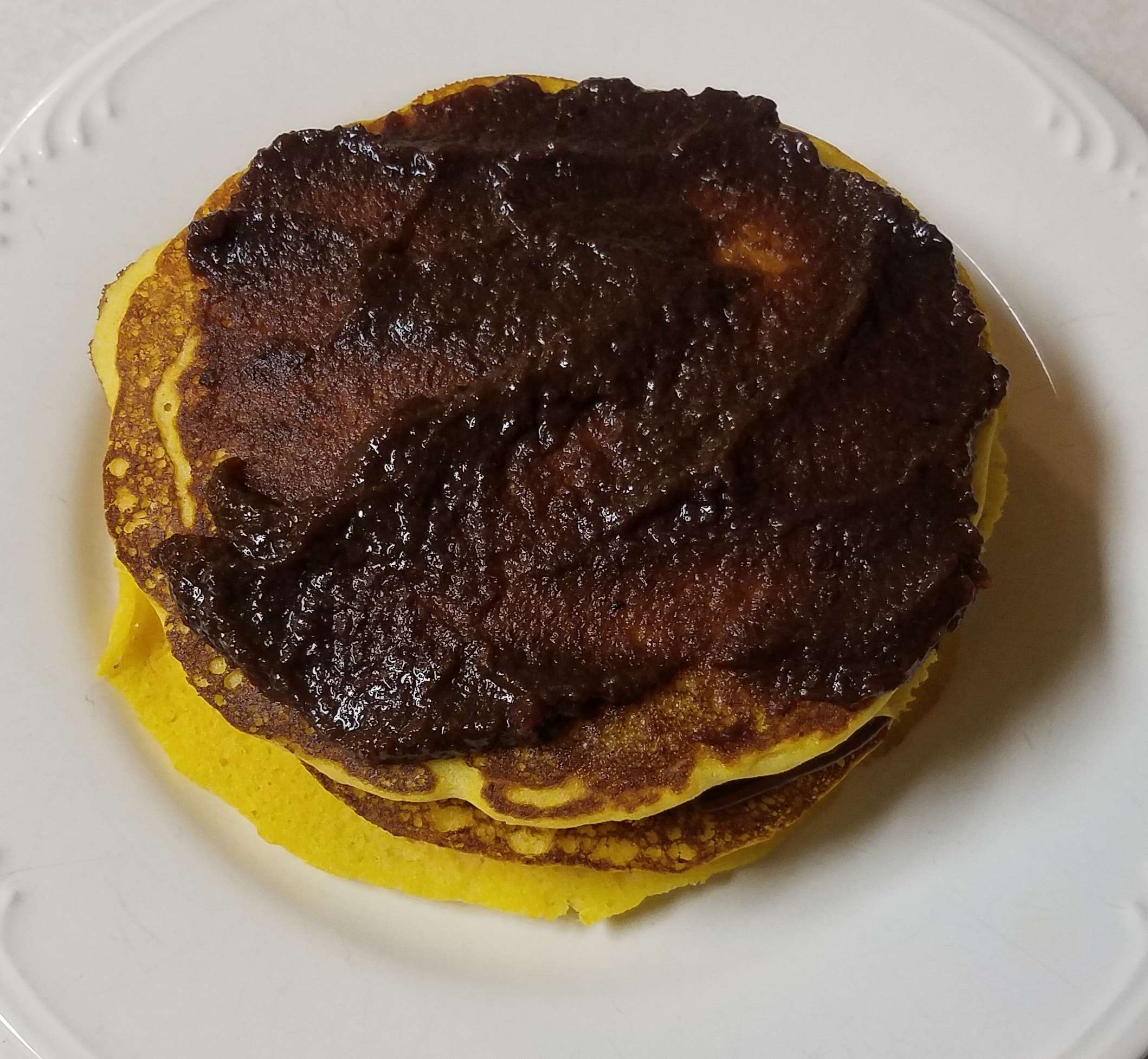
Experimenting with traditional pancakes using rice flour and butternut squash.

2021 has been rough out of the gates. The coronavirus pandemic is raging, armed insurrectionists occupied the U.S. Capitol for a few hours on Jan. 6, and as a society we are as divided as ever. Happy flippin’ New Year!

The combination of cold weather, snow cover, and the virus have kept me mostly indoors. No more trips to town unless it is for provisioning or medical appointments. In the last three weeks I made one trip to the wholesale club, and that’s it for leaving the house.

I go to the driveway and breathe fresh air a few times a day. I don’t want to risk turning an ankle walking on the trail or in the yard.

It’s just as well because I’m using the time before gardening season to get a solid start on my book. 8,882 words this week with a stack of edits waiting for later today. The process is a bit sketchy as it’s the first time I began the project with a long-term writing schedule. Some days writing is based on artifact(s) or previous text, some days mining memory. The main roadblock is so much of my archival material is unorganized and stored throughout the house.

Yesterday I used a photo album from the early 1960s. Taking time to observe each photo, letting memory work, one thing led to another and my daily word goal was met easily. We’ll see how the edits go yet I believe idea production was good. It’s pretty easy pickings because I’m at the beginning of the project.

Another thing is there is so much material. I’ve been a pack rat about keeping artifacts, and there will be inadequate interest to make this book as comprehensive as it could be. I’m undecided about photographs. Picking a dozen or so would take a lot of distillation and they would represent more than their content. A benefit of going through the writing process is the archives will get organized. Presumably the quantity will be reduced.

On the second Saturday of 2021 the local environment seems quiet. It is a good day to stay indoors and work on projects. With the coronavirus everywhere, it’s a safe thing to do.

Categories
Living in Society

First Library Card

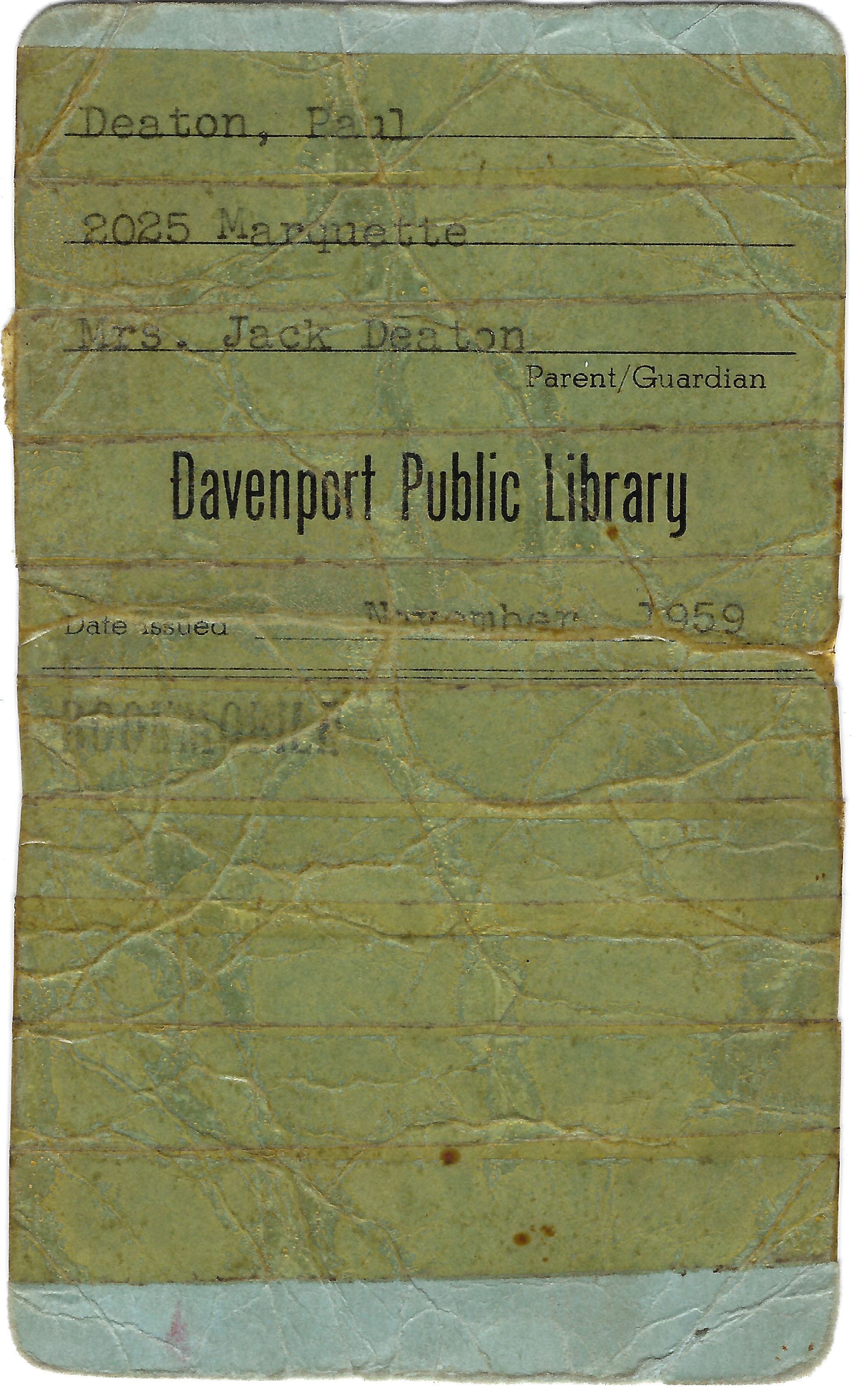
First Library Card, November 1959.

The public library has been important in my life. It began in 1959 at the American Foursquare the first year we moved there. I was in the second grade. The bookmobile made weekly rounds near us, at first to the church parking lot, later to the drug store parking lot at Five Points. I became a regular customer.

Entering from the back, we browsed the stacks, usually Mother and me joined by my sister when she got older. Before there was the Bookmobile I relied on books and magazines Mother gave me for reading.

There were biographies of the Ringling Brothers, Thomas Edison, George Washington Carver, the Wright Brothers and others which expanded my world. The first thing I checked upon arrival was whether there were any new ones in the series. We enjoyed Dr. Seuss books when they were available, which wasn’t always. All the kids who frequented the Bookmobile liked Dr. Seuss so when they were returned they immediately went back out.

When ready to check out, we made our way to the front, where the driver sat in the same seat he used to drive the Bookmobile. He voice-recorded the check outs into a microphone then we left. It wasn’t my last library experience.

The idea the city had a library, and the economics of one organization buying books that could be shared, was part of understanding cooperation and fair play. It was a lesson learned early in my life, part of getting along in the city.

Today our community of about 6,000 has a great public library. We gave money, built it, and then donated the finished building to the city. The irony is I rarely check out a book there. My main use of the library is to socialize. I check the new book shelves from time to time, use the meeting rooms, donate books, and attend the Friends of the Library used book sale. During the coronavirus pandemic I donated some new puzzles for kids to check out. With the pandemic most library activity ceased. Maybe the library will open again this year or next. I hope so.

I still have memories of the Bookmobile and my blue, hand-typed library card. That sustains me for now.