Categories
Writing

Traders and Early Settlers

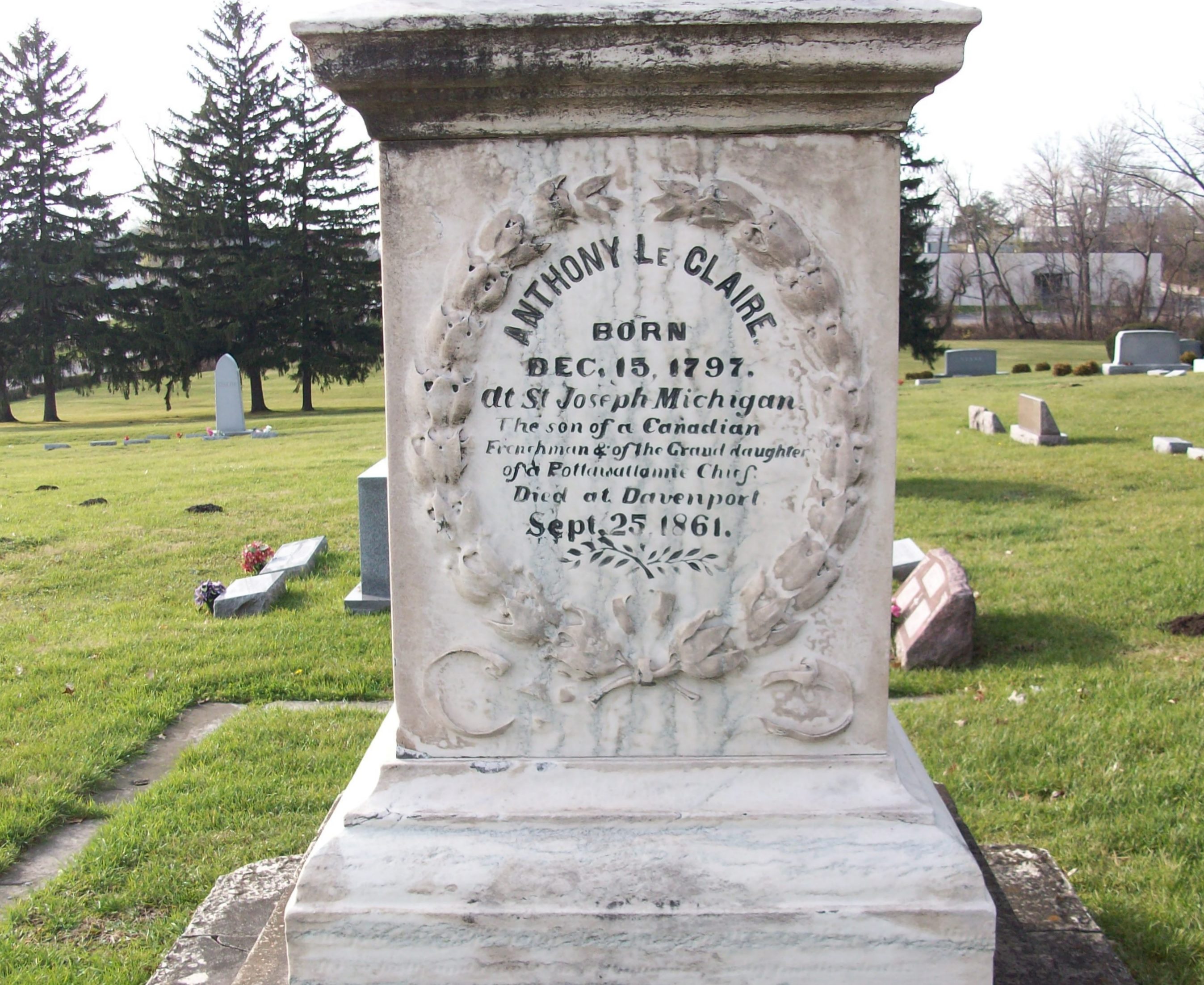
Detail of the Antoine LeClaire grave marker at Mount Calvary Cemetery, Davenport, Iowa. Photo by the author.

The history of Davenport, Iowa was largely absent from my upbringing. I was born there, yet nothing. There was no Iowa history curriculum in K-12 schools, nor at university. The first biography of George Davenport, one of the city’s founders and its namesake, was not published until May 21, 2020.

I left Davenport for university in 1970 and haven’t missed learning the history. I am revisiting it now that I’m writing my autobiography.

The Trader at Rock Island: George Davenport and the Founding of the Quad Cities by Regena Trant Schantz is a serviceable biography which reflects detailed research into the history of the region. Schantz obviously reviewed documentary records, physical artifacts, and sites. It adequately tells the story of early traders, mineral extraction, land speculation, river culture, and the relations with Black Hawk and other indigenous tribal leaders from the perspective on one of history’s most prominent participants. Because of my education, this history matters little in my outlook toward my home town.

By the time my awareness came of age, the city was in a post-World War II economic boom. Depending upon how one reckons economic history, this was preceded by the trader days, land speculation, the surge in lumber milling after 1850 (as Wisconsin and Minnesota forests were clear cut and rafted down river without replanting), and the rise in farming after the Black Hawk War finished in 1832. Some of my spouse’s family were among the early Iowa settlers after the war. A tide of immigration to Iowa started by the 1840s. With the removal of indigenous tribes and native forests, along with ripping up and plowing the prairie, the landscape in which I found myself was already in existence. There was little reason to think about the early days of settlement.

By the time Mother graduated high school in 1947, the city was ready for the post-World War II boom. Settlement had grown far beyond the initial lots surveyed in the 1830s. The house in which we lived while I was in high school was built in 1910, well above the antediluvian banks of the river. There was infrastructure, a bus route, medical facilities, a wide range of churches, and corner grocery stores waiting to get displaced by supermarkets. Many large manufacturing and food processing companies existed. A person could go their whole life without knowing about the exploits of George Davenport, Antoine LeClaire and other traders turned land speculators during the time before the initial plat was laid out.

What does my writing owe to the history of the city of my birth? Not much, I reckon. It served as a landing place for ancestors displaced from other states. Grandmother arrived with children in tow during World War II. My paternal grandfather arrived after the war and didn’t live much longer.

I plan to tell the story of the initial lot sales, the lumber boom, and development of industry. I suppose that’s needed to set context. Besides the meat packing plant where my father, grandmother and I worked, I don’t have many connections to the old days. Most of our early family stories are derived from immigrant experience in Minnesota and Illinois on Mother’s side, along with Father’s ancestry in Southwestern Virginia and nearby Kentucky.

The biography of George Davenport is engaging, and of interest as an alternative to many stories of settlement in the Tidewater and New England. The Louisiana Purchase is often discussed, yet what happened locally is not. I tip my hat to the work of traders, land speculators and developers yet realize that is not my history.

I am from there, yet not of there.
Categories
Writing

Into a Mine Shaft

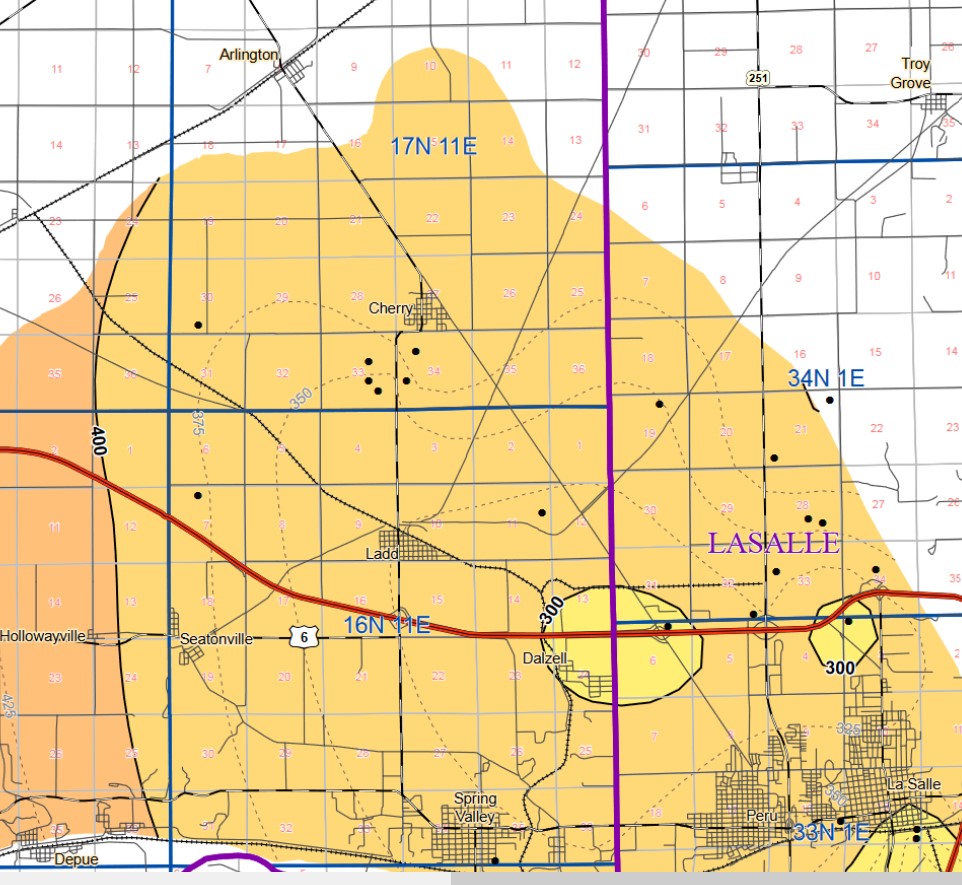
Detail of the USGS quadrant map for coal mining in Bureau/LaSalle County, Illinois. There were three coal seams in the Cherry mine, the deepest at 485 feet.

A Twitch-TV streamer played Minecraft in the background as I worked on daily rushes about… coal mining. From there I descended into the mines, at least figuratively, for several hours.

My maternal grandfather mined coal in Bureau and LaSalle Counties in Illinois for at least 30 years that we know. Besides family lore and my interactions with him while young, I knew little about this aspect of his life. He was the guy from Illinois, no longer married to Grandmother, who gave me a handful of pennies each time he visited. Coal mining was a much bigger deal than I thought in the basin of the Illinois River in Central Illinois.

The Saint Paul Coal Company operated the Cherry mine in Bureau County, one of the places Grandfather worked. The company was established in Illinois in 1902 and owned two mine properties in 1909, the year of the Cherry Mine disaster in which 259 men and boys died. The mine operated on 7,217 acres of land, producing about 300,000 tons of coal annually with a daily capacity of 1,500 tons.

Because of the mining disaster, a significant amount of documentation exists, including the 96-page report on the disaster from the Bureau of Labor Statistics. At this writing, the Cherry Mine disaster remains the third most deadly in American coal mining history. Grandfather first showed up as a miner on the 1910 U.S. Census in LaSalle County, old enough to have worked at the Cherry Mine during that period.

Rushes are the first draft of a section of my book. My process is to take a topic, typically a couple of paragraphs, and write rushes which will be heavily edited before being added to the draft of my autobiography. It gives me a chance to refine what I want to say without mucking up the main draft of my work. So far the process has served.

I decided the chapter about my maternal grandparents’ early days needed historical background. In a couple of ways, the mining history of LaSalle and Bureau Counties depicts a similar lure of wage work that attracted many European immigrants to the United States in the late 19th and early 20th centuries. This includes my maternal great, great grandfather, who mined coal in Allegheny, Pennsylvania after arriving from partitioned Poland in the 1880s. My paternal grandfather mined coal in the early 20th Century in Southwestern Virginia, although his ancestors were well established in the United States by then.

I found a history of Saint Hyacinth’s Church in LaSalle, written on the occasion of their diamond jubilee in 1950. Established in 1875 by a community of mostly Polish and German immigrants, it is named for the saint, a Polish Dominican priest and missionary who worked to reform women’s monasteries in his native Poland in the 13th Century. The Polish exclamation ĹšwiÄ™ty Jacku z pierogami! (“St. Hyacinth and his pierogi!”) is an old-time saying, a call for help in some hopeless circumstance. Pierogi was a constant topic of discussion during family visits to our relatives in LaSalle. It likely remains available there. According to family lore recorded on Ancestry.com, My great grandparents contributed to establishment of the Saint Hyacinth cemetery where they and Grandfather are buried.

I started the day’s research late morning and the next thing I knew, it was time to start dinner. It wanted pierogi, yet we had to settle for enchiladas. I’m not finished with this topic yet.

Categories
Writing

Writer’s Week #1

I discarded worn hats and pulled these out. Spring styling has begun.

It was a good week for my autobiography.

I made steady progress on re-writing the first four chapters. The time was about ten to one editing over writing. The most difficult challenge is getting the narrative right so it is honest and understandable. I located key documents I’d forgotten. I also created one empty banker’s box. That last part is particularly rewarding for a retiree with too much stuff.

There was a file with old resumes in it, including a Statement of Personal History (DD Form 398) I completed in 1982 or 1983. It includes every job I held and every address I had from birth. That will be useful in creating a time line. A quick glance revealed a number of inaccuracies. I know more now about my life than I did when I was living it, which seems normal.

Importantly, I located the family history documents Mother provided about my paternal line. It is a set of genealogy forms with a lot of information completed. This makes the process easier. Like with every documentation, there are some mistakes and omissions. I can fill in the blanks if I choose. I debate whether to tamper with the originals and have thus far mostly left them as is.

In 1983, we made a long automobile trip from Iowa City to Saint Louis; Evansville, Indiana; Wise County, Virginia; and then to Philadelphia to visit friends and relatives. It was a sort of second wedding trip after our first one to Chicago in December 1982. I located my journal entries from the trip, in which I recorded the interaction with my Uncle Gene when he traveled from Florida to Wise County to be with us. He explained his family life in and around Glamorgan, Virginia where he and Father were born. The journal will help. I may quote most of it directly as it tells the story as well as anything I could write now.

Uncle Gene also took us to some of the home places, including a parcel of land described as “lying and being in Wise County, Virginia on the waters of Guests River in the Rocky Fork section of the Gladewell Magisterial District.” This property, called Rocky Fork by family, goes way back. We explored it during the visit.

I spent considerable time thinking about the 1920s and 1930s this week. I’m reading a book called Radium Girls: The Dark Story of America’s Shining Women by Kate Moore. It recounts the history of use of the element radium in manufacturing consumer goods, and the impact of radioactivity on workers. The radium girls literally glowed from toxic radium contamination.

Part of the Radium Girls narrative presents the history of The Radium Dial Company, founded in 1917 in Ottawa, LaSalle County, Illinois. It supported what became the Western Clock Company in 1919, featuring the Westclox brand. Radium Dial Company made watch dials painted by hand with radium so they would glow in the dark. The Westclox manufacturing plant was in Peru, LaSalle County, Illinois.

In the book there are two references to Starved Rock, which is where my maternal grandmother worked when she arrived in LaSalle County from Minnesota about 1925. It was a place for group outings for the radium girls and others. I hadn’t considered the broader context of LaSalle County in my autobiography, but now I am. Reading this book was a breakthrough.

As Moore points out, not everyone had automobiles at that time. Likewise, there was radio but no television. People mainly got news from each other, and from newspapers. For a historian, newspapers make it relatively easy to follow coverage of major stories like the one of the court cases of the radium girls.

This led me to think about how I gather news.

We need news, especially during the coronavirus pandemic, yet always. First priority is news about key family members, which is mostly sourced from networks of family and friends. After that, we seek news about what could impact our daily lives. How we gather news changed since the 1920s and during my lifetime. It will likely continue to change.

Our family tuned the television to watch the Huntley-Brinkley Report for news during my formative years. With theme music from the second movement of Beethoven’s 9th Symphony, it had a weighty feel. News stories were told in direct, clear language. It catered to what passed for adults back then. It went off the air the summer after I graduated high school.

We subscribed to local Davenport newspapers, the Times-Democrat and the Catholic Messenger. In eighth grade we had a project to read and clip newspaper articles into a scrapbook. I got an A on the project. I was a paperboy who delivered the Times-Democrat in our neighborhood yet hardly read it except for a school project.

In graduate school we watched KWWL-TV news when we had a chance. They had opened a news bureau in Cedar Rapids which featured a recent college graduate, Liz Mathis. Mathis is currently running for Congress. I can’t recall when I stopped watching television news. It was long ago.

Today the day begins reading newspapers. I subscribe to online editions of the Washington Post, Cedar Rapids Gazette, Iowa City Press Citizen, and Solon Economist. Each of them informs me from a different part of the community. I’m a member of Practical Farmers of Iowa, the Arms Control Association, and the Climate Reality Project. Each of these sources provides specialized news. I subscribe to the governor’s press releases, to the county supervisors and public health news releases, and to a number of political office holder newsletters, including people who represent me in the Iowa legislature and the Congress. Lastly, I follow news reporters on Twitter. One exercises caution in picking them. I read their biographies and some of their work before following. There are a lot of great people writing relevant news stories about contemporary society if one is lucky enough to find them.

I had a good writing week and felt like sharing. Thanks for reading.

Categories
Writing

Writing Autobiography

Working copy of my autobiography.

Starting an autobiography is easy. Finishing it… is something else.

I began my autobiography a dozen times over a period of decades, and each time it found no conclusion. Last year, while making substantial progress, I had an epiphany. I had no idea what the process should be. I start 2022 with a work plan to remedy that.

Process became a collection of things.

At first I sat and wrote about whatever came to mind, about 150,000 words in 2021. I merged this writing into a single document (with multiple backups). After all that writing, I determined another, better method was needed to write. Too much of the blogger in me was coming out in my daily writing.

I had to get a better plan written down. I began with 3 x 5 inch index cards in a rough outline of topics, one per card. I made a Word document with a more detailed outline. It included most of what was on the cards and more. Finally, after a year of writing, I wrote a Word document called “big sections” which is a list of the chapter headings. I printed it out and placed it on my white board. The big sections will change going forward, yet I developed a way to add topics as the meaning of them was discovered or developed. It took last year’s writing experience to sort out what I would include in the finished product in the form of chapter headings.

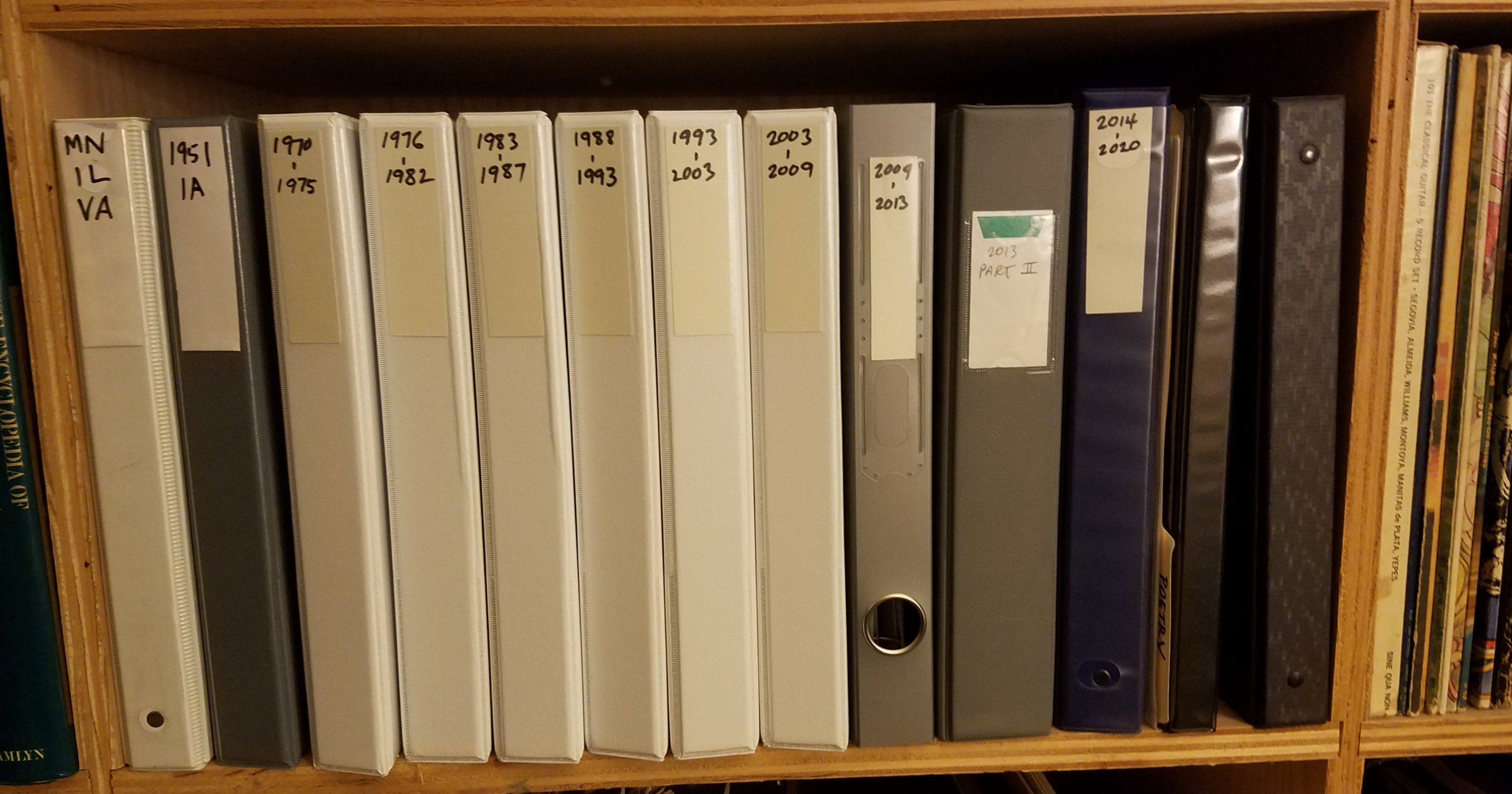
As written on Dec. 16, 2021, I made a shelf of three-ring binders to contain my rough draft. I set aside my 2021 draft document and began a new rough draft which I expect to print and place in the binders. The binders have become a storage place for documents and writing I find along the way. As I write the 2022 draft, documents in the binders will be used as reference. I expect the number of binders to increase as writing proceeds, with the printed draft in front of each chapter heading and source documents behind it.

A main challenge is to follow Robert Caro’s advice to turn every page. At present I don’t know where all those pages reside. I organized my collection of personal journals beginning with school work in 1966. I have a shelf of books which contains my blog writing since 2007. I also placed the letters written to Mother from her estate in three-ring binders. There is a significant trove of emails in electronic form dating to 1999. In a pile on a table are stacks of clippings of opinion pieces, letters written to the editor, and articles I wrote as a freelance journalist. These documents alone are a lot.

What is more challenging is the many boxes of documents and artifacts stored throughout the house. I haven’t counted, yet there are scores of them. They settled in beginning when we moved here in 1993, and I can’t say what is in them with specificity. The way they exist is not in usable form, so I’ll have to open and go through them.

I developed a discovery process to interface with source material. The idea is to methodically go through everything to decide whether it goes in the autobiography, will be stored elsewhere, or discarded. If a particular container is useful to the autobiography, I’ll write about what is in it.

The format will be what I call “rushes,” a name taken from daily rushes in the film days of motion picture making. I’ll encounter an artifact and if applicable, will write a rush, and then edit and place the rushes into the main autobiographical document. I’ve been writing rushes since the beginning of last year. This formalizes what I’ve already been doing.

Along the way, I will edit the main draft of the autobiography for continuity, grammar, spelling, and better word choices. Once the whole document is done, and I’ve examined all the artifacts, true editing will begin. This will lead to eventual publication of the work in an undetermined format, although it likely will be both on paper and in electronic format.

The first year of writing my autobiography felt productive. What I learned makes me optimistic about progress this year. I don’t know if I’ll finish the first draft this year. I know it will be better than the draft I produced in 2021. There is clarity about process, better than there was. Like any process, it will be subject to improvement as I write and learn.

Categories
Reviews

Book Review: My Own Words

Ruth Bader Ginsburg Official Portrait. Photo Credit: Wikimedia Commons

The final book I read in 2021 was My Own Words by Ruth Bader Ginsburg with Mary Hartnett and Wendy W. Williams. It is a compilation of writing by Ginsburg framed by the co-authors as autobiography.

In 1993, when Ginsburg was sworn in to the Supreme Court, I was busy living: moving from Indiana to Iowa to take on new work at the corporate headquarters of the company with which I would finish my transportation career. I wasn’t paying much attention to this supreme court appointment. Maybe I should have been.

Reading My Own Words was part of expanding my range of what types of memoirs have been written. It became more than a writer’s exercise. I realized on how many important decisions Ginsburg opined, and the prominent impact her work for the court had on my liberal sensibilities. Her writing on gender equity, presented in this book, is particularly noteworthy.

My Own Words was for me an infrequent foray into the judicial branch of government. A justice’s official writing, mainly in the form of court documents and opinions, is a matter of public record. To a large extent their work eclipses the personal story of a justice’s life. I am more interested in Ginsburg’s remarks on Brown v. Board of Education, Loving v. Virginia, and Burwell v. Hobby Lobby Stores, Inc. than I am in her opera-going habits with Justice Antonin Scalia or her twice-weekly workouts in the Supreme Court gymnasium. I do not own a Notorious RBG t-shirt and am unlikely to get one, even after reading this engaging book.

The writer’s question was how did she handle her prolific writing as it relates to autobiography. I read reviews that expressed disappointment this wasn’t an “actual memoir.” I don’t understand that criticism. As a public figure, one of the most prominent in the United States, we come to the book knowing more about Ginsburg’s personal life than normal. News media of the time tended to focus on the fact her spouse was an excellent cook rather than her intellectual capacities as a jurist. The latter is clearly more engaging.

If you are a liberal, read this book. If you are a conservative, read this book. If you are engaged in society with its cultures around abortion, gender equity, corporate influence, equal protection under the law, or how the supreme court works, I recommend it as a primer. While Ginsburg was a liberal jurist, the lessons she presents in these writings apply to us all. Highly recommended.

Categories
Milestones

Looking Forward

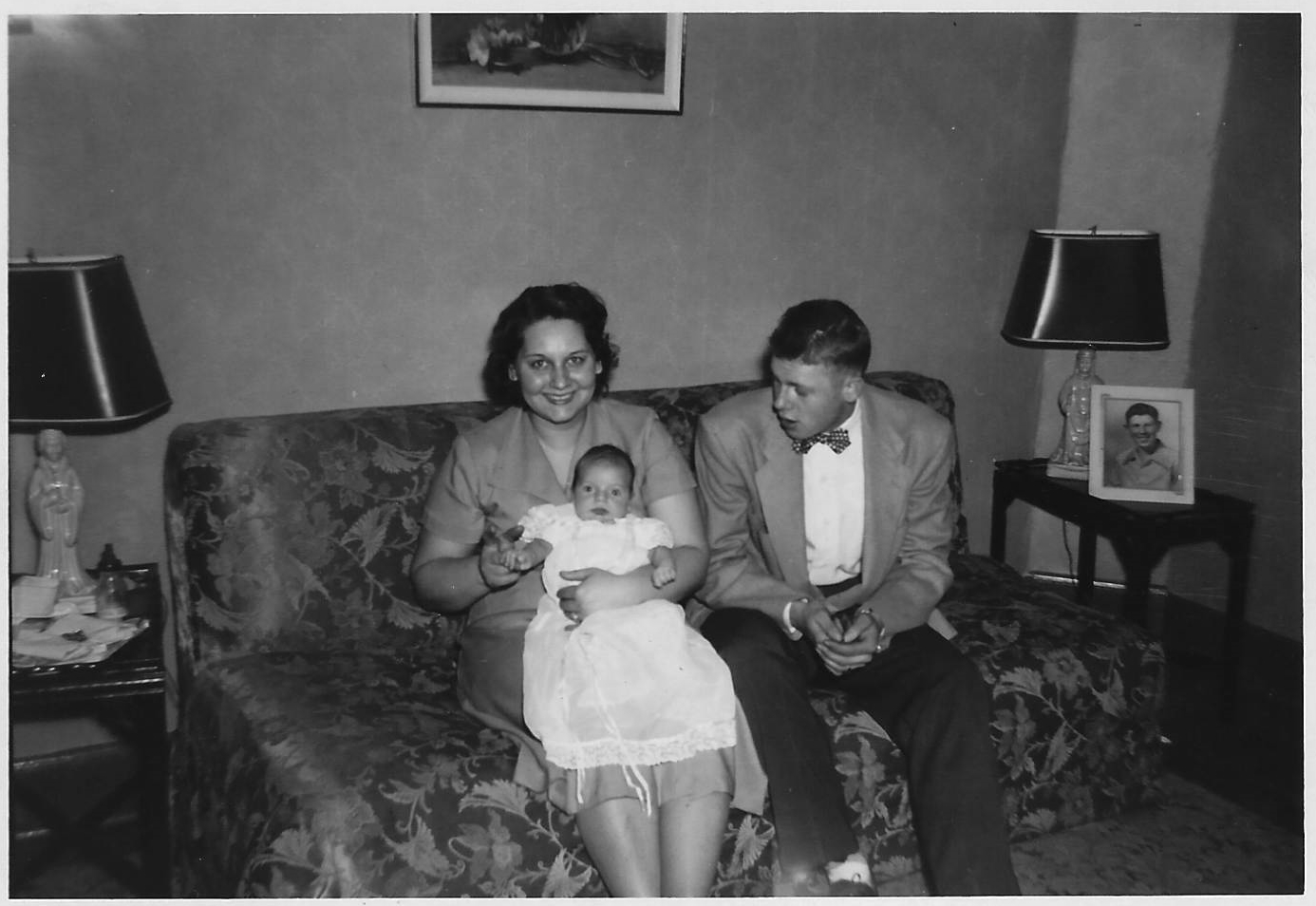
The author at age five weeks with my baptismal sponsors, Aunt Winnie and Uncle Bill.

Today I am officially a septuagenarian. Deep in memories of the previous 70 years, on this day, my birthday, I’m looking forward.

Blessed with good health, I can see 80 from here. 90 is too far ahead for clarity. The goal is to make the best use of my time before shuffling off this mortal coil.

I have no profound thoughts or statements upon turning 70. It is another day to accomplish things. I may accomplish taking a nap after lunch. Priorities change with age.

Yesterday, for the third year in a row, this blog passed 12,000 views. While I’m not running a major outlet here, I am grateful to everyone who finds me and spends time reading what I wrote.

My best wishes for the next ten years. There is so much to do before the final curtain call.

Categories
Writing

Writing Forecast for 2022

State of my autobiography, Dec. 15, 2021.

There is no getting around it: writers write about writing from time to time. Because of the coronavirus pandemic, writing and related tasks like reading, exercise, gardening and cooking have become my sole occupation. As I consider what is possible in 2022, writing and all that surrounds it will be a main part of my daily routine.

Work continues on the multi-year project that is my autobiography. The 13 three-ring binders in the photo are the containers for the first rough draft. The main 2022 project is filling them with a narrative. A key challenge is reviewing the source material in the form of files, journals, public writing, and internet searches. There is a lot of source material and a lot of reading ahead. Last year I wrote at least 1,000 words per day until April, then slowed down. Next year I hope to continue my progress almost every day until the first draft is completed. That may be in 2023 depending upon how 2022 goes.

For now I continue to write blog posts which are published here, on Blog for Iowa, and on a couple of other sites. The subjects have been varied yet they are comprised of two main topics: stories dovetailed into my autobiographical work and current affairs with an Iowa focus. I will have written about 350 posts in 2021, although I expect to slow down next year to focus on autobiographical writing.

At least once a month I plan to write a letter to the editor of the local newspapers. I may branch out with submissions to other papers in Iowa’s new First Congressional District, yet the best impact is closer to home. My primary topics are nuclear disarmament, the climate crisis, and current affairs. When I write to our local newspaper, the Solon Economist, the topics expand to more local issues like the fire station or recognizing local activities. All of my letters are cross-posted on this blog.

I am an email writer and occasional letter writer. I adopted email when I worked for the oil company beginning in 1989. From the beginning I saw it as a valuable medium. It really took off when we bought our first home computer in 1996. While I don’t have copies of most of my work emails, there is a trove of emails relevant to my autobiography dating to 1999. I will continue to write emails as a creative outlet, in addition to taking care of quotidian affairs.

I continue to maintain the journal started after college graduation. With the exception of the bound journal stolen from me in Calais, France, I have them all. I use it to record personal things that aren’t suitable for public consumption. Increasingly I monitor my health there.

Lastly, social media is a form of writing although we tend to view it as throw-away texts of little significance after posting. I expect to continue to post on Instagram, Facebook and Twitter. According to Twitch TV, in 2021 I posted 8,075 chat messages on the platform. My main goals for social media posting are to be kind, honest and thoughtful. I will also endeavor to re-read every post before hitting send.

I am lucky to have stable, adequate pension income after more than 50 years in the workforce. When the pandemic slowed everything down and raised a real risk of contracting COVID-19, stepping back from paid work was possible. For the coming year, I don’t foresee an initiative to take paid work as the coronavirus is still with us. That will enable me to focus on writing.

The forecast is fair writing weather ahead, depending upon what weather in real life does.

Categories
Writing

Writing About Politics

Iowa City political event during the 2010 campaign. Note U.S. flag incorrectly displayed. We fixed it before the event began.

Voting and politics have been part of my life since the earliest days. I remember discussing Dwight Eisenhower with my parents. He was a Republican and we didn’t like him for that. When he started building the Interstate Highway System, it had a direct impact on our lives. We revised our position to say he wasn’t so bad and looked forward to cutting down the time it took to drive to my aunt and uncle’s home in Nashville, Tennessee.

Harry Truman was president when I was born. I have no memory of him in that role. I recall seeing news footage of Truman taking a walk from his retirement home in Independence, Missouri. Mostly, I reference his memoirs to see what he had to say about decisions he made as president. I’ve read the passage about his decision to drop the atomic bomb several times.

Father campaigned for John F. Kennedy in 1960. He had mimeographed canvass sheets he got at the union hall and diligently filled in the names of everyone on our block and how they would vote. When he finished our block, he worked on nearby ones. Kennedy lost Iowa to Richard Nixon and, as we know, won the general election.

The 1964 election of Lyndon B. Johnson framed the way I thought Democrats should govern. LBJ had a big majority in the legislature and was able to pass legislation. In his book The Vantage Point: Perspectives of the Presidency 1963-1969 he listed them inside the front cover. It’s a long list. If his political legacy is tainted by the war in Vietnam, it is dominated by many policies and legislation that changed the United States for the better. I was shocked when Hubert Humphrey failed to win the 1968 election as I felt he was cut in the LBJ mold and would be a great successor. Nixon beat Humphrey 301-191 in the Electoral College. It wasn’t even close.

I have nothing good to say about the Nixon years. 1972 was the first year I was eligible to vote and I don’t recall if I did vote for George McGovern. I remember some confusion about whether I could vote in Iowa City, where I attended university, or whether I had to vote at home. I recently wrote about the 1972 election and McGovern here. Nixon was a liar and it was with a sigh of relief I welcomed his resignation in 1974. I didn’t care who was president. Gerald Ford? Fine.

I didn’t vote in the 1976 election as I was engaged in military training. We were rid of Nixon, so I didn’t much care who was elected. My thinking was “America, figure it out.” From my perch in Mainz, West Germany I thought Carter was doing an okay job. I felt he was unjustly criticized for lack of support for the military when I saw the results of his policy and spending not far from my caserne. During a major field exercise in which I participated, our commanding officer would travel back to the states each week to provide an update to the White House. I saw some of the ideas we discussed in a tent in Germany turned into policy in Washington. It was a heady feeling.

Reagan was the beginning of the decline of America’s greatness with its focus on reducing the power of the central government, favoring the rich. Maybe we were just receiving a comeuppance after the LBJ years. The Reagan administration began overturning reforms of the New Deal, something that would persist with every subsequent Republican president. Each played a role in dismantling the social fabric we had come to depend upon. The years since then left us with with hyper-partisanship and a flow of wealth to a small percentage of people.

My early years, through exiting the military in 1979, were formative. It would be difficult to write about the politics as a separate topic in an autobiography. The challenge is to incorporate these stories in the flow of the book without having them dominate. Figuring this out is where I am this Monday morning.

Categories
Writing

Postcards from Iowa #13

Copyright: Joan Liffring Zug, photographer.

Reverse side: Made by Dexter Press, West Hyack, New York. Published by Mennonite Historical Society of Iowa, Kalona, Ia. 52247. Old Order Amish and conservative Mennonite daughters wear traditional plain homemade dresses familiar throughout 450 years of Anabaptist history. These are the children of a buggy maker living and working near the Kalona Cheese plant of Twin County Dairy, Inc., Highway 1, Kalona, Ia.

Two girls posing for a photographer who had permission to take their picture. There has been more than a little controversy about photographing Mennonites and Old Order Amish. It is permissible with the former, and against views about graven images with the latter. The images are well-circulated.

I used to visit the Twin County Dairy when bicycling from Iowa City. Cycling alone for the exercise, I would stop and buy cheese curds at the dairy. That is, if it were open. Often my trips were predawn when the glow and flicker of kerosene lamps came from house windows and the doors of barns. I no longer travel to Kalona as I learned how to produce almost everything I formerly bought at Stringtown Grocery and other shops scattered in the rural area.

Twin County Dairy, established by a group of Amish and Mennonite farmers as a cooperative in 1946, was shuttered in 2014. Kalona Creamery, a part of Open Gates Business Development Corporation bought it the following year. Their businesses included Kalona Organics®, Kalona Farms, Farmers Creamery, Awesome Refrigerated Transit of Iowa, and Provision Ingredients. I don’t know if they have a retail store that sells cheese curds. Since there is a creamery a few miles from home, I have no need to go and find out.

Author David Rhodes wrote about the area in his novel Rock Island Line. I have a library copy of the first edition, published in 1975. No doubt I bought it at a thrift shop. There is a rubber stamp inside the front cover that reads, “Outdated Removed from Circulation.” Young girls in the Mennonite community and their photographs won’t become outdated any time soon.

Categories
Writing

Postcards from Iowa #11

Photo Credit: The American Scene Collection, American Oil Company 1969.

Reverse side: Washington Skyline, Washington, D.C. Located on the axis of the Lincoln Memorial and the Washington Monument, the Capitol Building is shown in the foreground with the Washington Monument illuminated in the background. See the U.S.A. in a Chevrolet. As you travel ask us.

Life would have been simpler if I had stuck to the same path as friends in high school. Maybe follow a narrative such as after school and military service find a job, raise a family, work it until retirement, then settle back and relax in the golden years. Simple.

Actual living was not simple. While many in my cohort married and started a family immediately after high school, I did not and that made a difference.

The trauma of being injured while young, and the subsequent hospital stay, removed me from conventional pathways. I wrote about it in 2009:

My earliest defining moment was the day, at age 3-1/2, when a swing-set set up in the basement of our Madison Street home collapsed and injured my head. My parents were horrified. I remember the pool of blood on the basement floor, holding the thumb of the ambulance driver, taking ether dripped into a funnel to anesthetize me for the stitches to mend my gashed head. I am lucky to be alive. What I learned through the injury and recovery in the hospital was that there is an infrastructure of knowledge and caring to support us when things happen. I watched the routines of the hospital staff, the doctor checking up on me, changing room mates and bed linen, daily visits from my parents and the handling of my propensity to get out of bed and walk around. This experience assured me that although we are vulnerable, we are not alone.

Over the years, Doctor Kuhl would examine the scar on my forehead and talk about my recovery when I visited him in his office. Today, I don’t think of the scar, and suspect most people do not even notice it. What I do think about is that while we are not alone, we must be part of a society that helps protect those who are most vulnerable, including the injured and infirm. When I was very young, I made a withdrawal from this bank and now the debt needs repaying.

Big Grove News, Jan. 18, 2009.

Little has changed since I wrote this. While I relied on the infrastructure of society, at high school graduation I had neither the interest nor skills to get married and start a family. I went to college instead.

In late 1968 or 1969, I sought Father’s approval while figuring out what to do after high school. Maybe I would study engineering, I told him. The practical, rational approach of an engineer to problem-solving was appealing. He neither approved nor disapproved. He looked surprised it was on my mind. He was completing his own education and perhaps was preoccupied. He would be gone soon afterward.

During senior year in high school we made a class trip to Washington, D.C. and New York City. It was my first trip on a commercial aircraft. We saw the U.S. Capitol and Washington monument depicted in this postcard at about the time it was printed. We played cards for nickels and dimes in our room each night. My winnings paid for incidental expenses through New York. In some ways the class trip was the beginning of living on my own and experiencing the world outside my home town. It seems appropriate it would start with the nation’s capitol.

My life divides into segments: preschool, education, work and family, moving to Indiana, and moving back to Iowa. Each was important for different reasons. As I went through time I didn’t know how each step would unfold.

My education, including military service and graduate school, had the momentum of youth. When I finished school at age 29, I was ready to do great things. Available opportunities were a disappointment. The trajectory of youth found me alone and unsettled, without a career or path forward. I would have to make my own way and that complicated things. In retrospect it was a good complication. If I hadn’t left my home town permanently for university, life may have been simpler.

I’m glad my circumstances gave me the chance to leave home and be different.