Categories
Living in Society

We’re Going Home – Larry Pippins

Larry Pippins died Dec. 2, 2017. Photo Credit – E.J. Fielding Funeral Home and Cremation Services website.

We were at home talking about some of my Army buddies and turned to my friend Larry Pippins. I Googled him and found he died on Dec. 2, 2017, after an 18-month battle with ALS. I hadn’t known. May he rest in peace.

Larry was born three days before me in 1951. I picked this photo from the funeral home site because the way he is standing and the shape of his hands remind me of how I knew him in Germany where we met. I could imagine standing next to him and taking a burger from the tray.

Larry was born in Pensacola, Florida, one of the few native Floridians I have known. He was a male of the South and enjoyed fishing, hunting, kayaking, drinking whisky and vodka, as well as many other activities.

He and his first wife split soon after they left Germany. I stayed in touch with them both until the 1980s. Together they lived in a German castle near Heidesheim that had been subdivided into apartments. I remember more than one overnighter sleeping on the flokati rug they had in the living room. One time, after too much drinking, they had to have it laundered. Those were the days.

We were in the infantry, although he changed his MOS (military occupational specialty) to military police soon after leaving Germany. When we were together, I said the changes we experienced were to transition the military from being prepared for jungle warfare in Vietnam to fighting a war over oil in the Middle East. As so, there we were. He was deployed to the Middle East to support Operations Desert Shield and Desert Storm. I kept a photograph of Larry with a postcard he sent from Desert Shield framed and with a yellow ribbon on it in our Indiana living room until the war was over.

When Larry was accepted to Ranger School I shipped all the fatigues I had left from my service to him to use while in training. Finishing Ranger School was a high point for him at the time. After graduation, he didn’t think Ranger School was all it was cracked up to being. Not a complete waste of time, but close.

When I was living as a writer in Iowa City in 1981, he sent me an audio cassette in which he admonished me to re-join the military. I did not. We fell out of touch after he invited me to attend a change of command ceremony down South and I couldn’t. We hadn’t had a good conversation since we last met in Chicago in the early 1980s.

We spent so much time together in the military and then after leaving our first assignments we corresponded in the days before the internet and email. Tonight I’ll say a prayer for my Army buddy. He lived a decent life full of friends and family. He made something of himself. He was something.

Categories
Living in Society

May Day in Solon

The advertisement read, “On May 1, 2025, we will come together to raise our voices in support of our quality public schools.” The event was volunteer-organized for the National Education Association.

Some students and adults showed up outside the high school in Solon, Iowa on a rainy Thursday morning.

May Day 2025 demonstration outside the Solon High School in Solon, Iowa.

Meanwhile, from Washington, D.C. U.S. Senator Chris Murphy posted the following:

Everything helps.

Categories
Living in Society

Taking Treatment

Photo by cottonbro studio on Pexels.com

Like many people, I am self-sufficient, reasonably healthy, and don’t like going to the doctor or clinic. I go often enough to catch things before they get bad and mostly take their preventive medical advice. On Tuesday I had the third colon screening of my life and the results were favorable. The practitioners were helpful and congenial. I knew one of them from in real life, although surgical spaces with structured hierarchies and apparel are real life too.

My previous colonoscopy was on Feb. 20, 2015. The visit became a horror show when the physician asked me whether I wanted to add an extra procedure just as I took sedation. This seemed a bit of hucksterism. The treatment plan had been laid out for weeks. While I still had consciousness, I told them no thank you, I came for a colonoscopy, so let’s stick with that.

When I presented for the procedure on Tuesday, there was a protocol whereby I stated my name, date of birth, and why I was there. Then the practitioners repeated “colonoscopy” then they each said “I agree.” Things went much better because of this protocol. In both cases, no polyps or biopsies. On Tuesday, doctor said I was good for ten more years. I thought of the Social Security life expectancy table and said to myself, may I live so long.

Neighbors were involved in both procedures. In the earlier case, the neighbor hooked me up to the saline drip which had the apparatus for administering sedation. The night before, we had a discussion on the telephone about another matter. They had the professionalism to not bring that up while I was getting my IV. The procedure was well done. Tuesday, a different neighbor was called in because there was a shortage of nurses to do all the work. This nurse had been a member of the board of directors of a group I was in. In those days, I did not know they were a nurse. We used the time between tasks to catch up.

The community of practitioners is not very big in Iowa. It seems inevitable there is a relationship between the patient and one or more of the folks in blue scrubs and hair netting. One should be on best behavior… always.

The other thing I would mention about my 2015 procedure is getting a colonoscopy was a communal event. After check in, the morning’s patients were assigned space in a large room with flimsy curtains partitioning off one patient from another. We could hear each other talk and we knew what was going on right next to us. That curtain made for little privacy. In 2025, I had a room of my own as a base where the person accompanying me could wait and I could leave my clothing until needed. I felt the care was more personal in the new setting.

Other than the procedure, Tuesday was a lost day. I used the afternoon to sleep off the sedative. One day in the life in Big Grove. Let’s hope there will be others.

Categories
Writing

About Newsletters

Solon Economist – 2016

There is an obvious, intentional flight among journalists and others from working at a news organization to producing a newsletter. Many use the platform Substack, yet there are others. They all can attract viewers, and importantly, have a subscription component that can generate revenue. What they do not do is replace the collaboration of working for a newspaper. Substackers are on their own.

On the road to perdition, this seems the next evolution of journalism. It is littered with potholes and pavement cracks. It has all the aspects of a do-it-yourself, one-person start up. There usually is no editor except the author, unless one is lucky enough to join with others to build some basic, on-the-cheap infrastructure. Call it a newspaper, only without union employees or a big fancy building like the Des Moines Register used to occupy. If a writer misses an issue, they may not get paid, yet there is no blank front page to be concerned about. Newsletters are not redemption for the failings of news organizations. They fracture and fragment news gathering and reduce it down to one-person experiences broadcast on a semi-regular basis. There is value in that, yet it’s not the same by a distance.

Ana Marie Cox wrote on Monday, “Some of the best writing out there is from writers striking out on their own.” That may be so, yet what the proliferation of newsletters has done is enable focus on writers readers like to learn from and leave the rest behind. It is easy to build a silo out of newsletters we like, further breaking down the view that a diversity of writers and opinions is of value. The pressures of today’s society and the changing role of media makes us hunker down into our silos and that is not a positive thing.

“(The exodus from legacy journalism) has created something that it is so personality- and brand-driven, so geared to the success of one person at a time, it scares me,” Cox wrote. “Newsletters are atomizing. They incentivize speed and volume. The newsletter ecosystem isn’t built to support doing big things, or doing things slowly, or doing things collectively. Or doing big things collectively, slowly.”

I get most of my news from one of four sources: newspapers, newsletters, emails, and the social media platform BlueSky. Importantly, I seek news sources that are grounded in the human experiences of the author. Such experience comes at a cost, and newspapers seek to drive out costs by using content from sources like The Associated Press, or in some cases by using artificial intelligence to fill a page. When cost concerns trump personal experience, what is called news becomes less engaging, less worth following.

Newsletter writers try to make it on subscriptions, yet it can be a tough row to hoe. Writers know they need more than a newsletter on their financial platform to live a life. Part of the risk of writing an article is it can be a dud. Without the infrastructure of a news organization, that means less pay for the time spent on the article. As a long-time blogger, I realize the benefit of producing posts with 400 to 1,000 words. They can be produced in an hour or two with less investment of time gathering new experience or information. A seasoned news professional knows the ropes and can survive a dud on a newsletter platform. However, there is a need to produce content on a recognizable, regular basis. To be successful (i.e. generate enough income) a writer must produce engaging volume for their followers. That’s tough to do when an article is based on one person’s experience.

I made a few posts in my Substack account and they get a lot more views than my posts on WordPress. Part of that is how they count a “view.” They explain the same reader may count for multiple views while reading an article. I will continue to post unique content there to see what it does. I doubt I would move this blog to a newsletter format because that is already available to subscribers via email. Too, if there was potential to earn a decent income, I would consider more newsletter content. I don’t see that path as viable at present.

Freelancing has been part of the gig economy since long before we called holding portfolios of income producing jobs as such. Freelancing benefits the news organization because there is a fixed price for each piece of work, and because the number of freelancers can surge or be cut back depending on needs. I produced 100 newspaper articles as a freelancer and I neither felt part of an organization nor like I was paid enough for the investment in time. The idea of a gig economy sounds positive until one has to live in it.

I haven’t talked about “content creators” yet. Maybe that is a topic for a different post.

Categories
Writing

Spanish Moss

The Big Oak in Thomasville, Georgia. Photo Credit – Wikimedia Commons by Carla Finley

A foundational childhood memory is driving with my family through South Georgia and seeing Spanish Moss hanging over U.S. Highway 319 between Thomasville, Georgia and Tallahassee, Florida. Here is an excerpt from my upcoming autobiography where I wrote about this.

Our family drove from Iowa to visit Tallahassee, Florida, the place Father lived after re-uniting with Grandfather after his release from prison. Family lore is Grandfather’s conviction for draft evasion was a misunderstanding. He hadn’t meant to be a draft dodger during World War II, according to his late son Eugene. Apparently, there was a problem with the U.S. Mail service, he said. Father spent time as a teenager in the area and graduated from Leon High School. He then enlisted in the U.S. Army with his brother Don.

That trip was to visit relatives in Wise County, Virginia, according to a conversation with Mother. The Tallahassee stop was a side trip, although look at a map and see it was not on the way. I don’t recall whether the memory occurred southbound or northbound, maybe both.

I sat in the back seat of the family automobile as Father drove on two-lane Highway 319 where Spanish Moss hung from oak trees with branches extending over the road. I suspect it was live oak trees, yet I don’t know. Mother was in the passenger seat, I was in back with my brother and sister. Except for Dad, we had never seen Spanish moss before. We did not have that in Iowa. We visited the plantation where Father stayed, the high school, and maybe stayed over with a relative, I can’t remember. These events and the long trip at slow speed along U.S. Highway 319 rolled into one with my trips commuting back and forth between Tallahassee and Thomasville for work.

For three months in 1997 and 1998, I was assigned to a logistics project in Ochlocknee, Georgia. I flew home from Tallahassee every other week, driving the same road I had as a child, U.S. Route 319. Oak trees lined the highway, their branches leaning over the highway were hung with Spanish moss. I lived there long enough to recognize other flora and fauna, in particular, pine forests and pecan plantations. I made this regular trip between Ochlocknee and Tallahassee for most of my stay.

The main memory, of this drive is essential. It is an unchanging remembrance of something seen as a child in a way that shaped me. It has no time or place. Some days I don’t know if it’s real. It is the human condition to believe it is real, and eternal. So, I do.

Categories
Living in Society

Week Fourteen

Trail walking April 23, 2025

The U.S. president looked like an old man struggling to descend the steps outside Saint Peter’s Basilica in Rome Saturday morning. He leaned his head over and looked down, watching each footstep like a person who needed assistance on the stairs leading to Saint Peter’s Square where the requiem Mass for Pope Francis would be celebrated.

It seems clear at the end of week fourteen Trump is not in charge of the government. If there is a power player in the administration, it is Russell Vought, the director of the Office of Budget and Management. Vought also played a primary role in creating Mandate for Leadership: The Conservative Promise, also known as Project 2025. It is as if they are implementing Project 2025 policies page by page.

It is also clear the administration is in a hurry to gather all power it can in the executive branch of government, under the president specifically. Some describe this as conformance with the unitary executive theory, according to which the president has sole authority over the executive branch of government. In our government today, the legislative and judicial branches continue to have a role to play, including funding the administration and its agencies, and adjudicating what is out of bounds. The president signs executive order after executive order pushing our form of democracy toward the guardrails designed by the founders. No one knows if the guardrails will hold. Some of us have faith.

The Congress returns from Easter recess today. If their work seems superficial in the coming days, the more consequential work of shaping the administration will continue behind the scenes in the lead up to the budget reconciliation vote expected in late May. With the closely divided House, there will be tremendous pressure for Republicans to hold to a conservative budget, one that formalizes some of the president’s executive orders. Everyone knows all it will take is a few Republican House members to vote no to scuttle the conservative dreamscape of government. Democrats cannot afford to let the reconciliation bill pass without a fight.

The playing field is prepared, the players are known. While Democrats are playing defense, they must stick together and find a few Republicans to join them. This alone makes it worth contacting our members of Congress to let them know that the power and money grab by the well to do will not stand.

Categories
Sustainability

Apples in Full Bloom

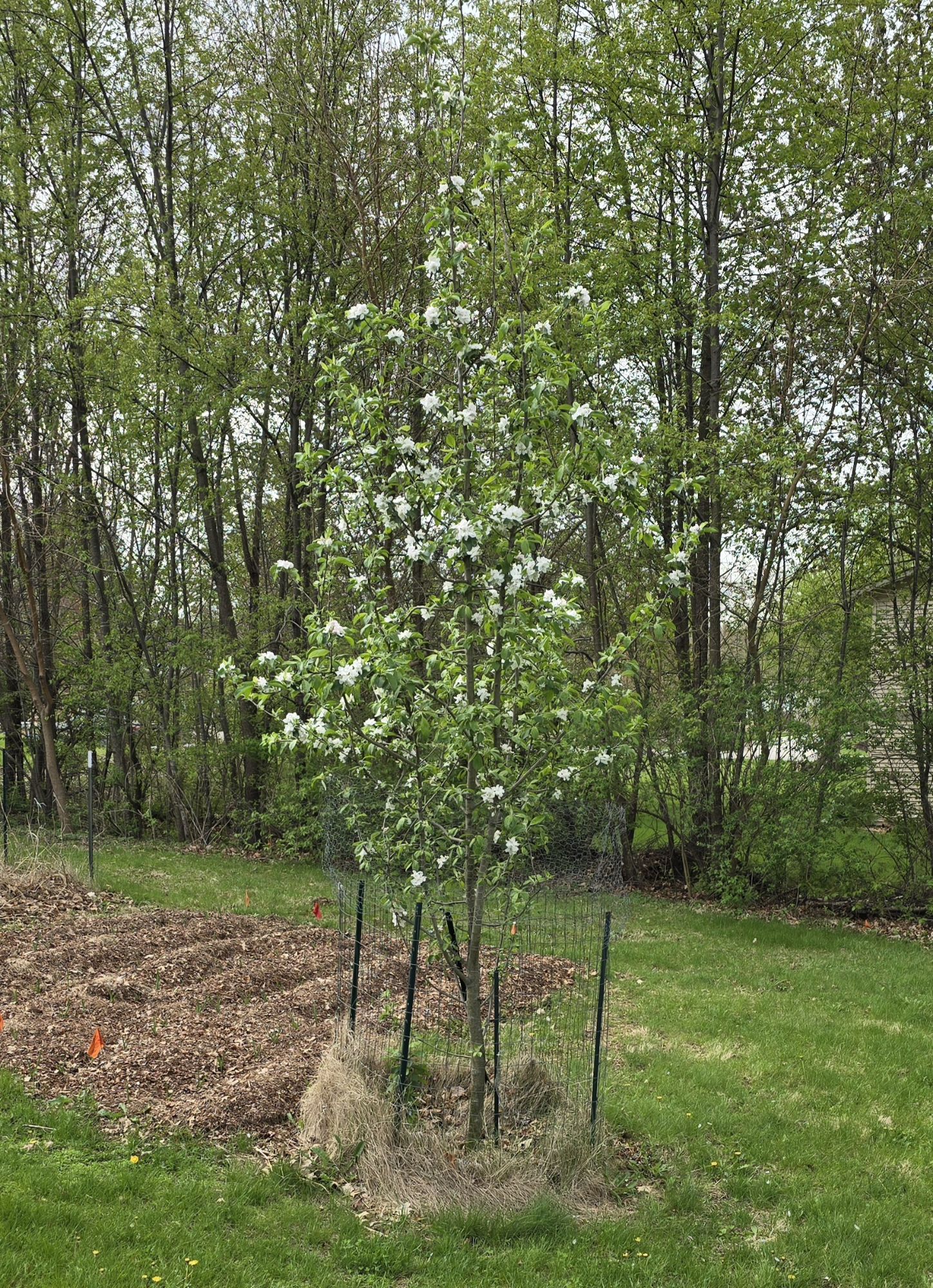
Crimson Crisp apple tree, April 25, 2025.

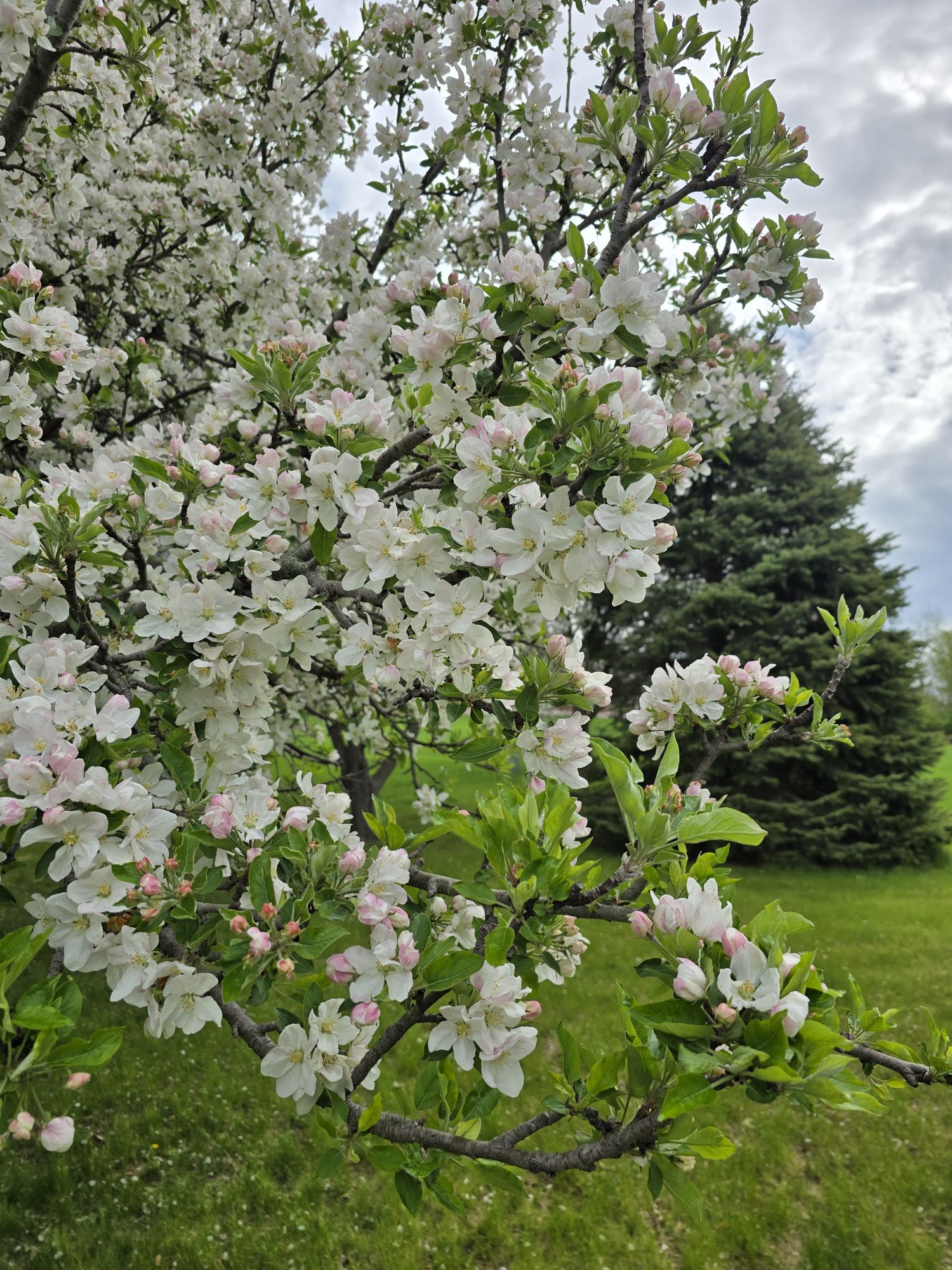
This year should be a good year for apples and pears. Every tree has a lot of blooms, including the two newly planted “replacement” trees. Some days it’s good to just view this fleeting event during which we pray for frost to hold off, pollination to occur, and a bountiful crop.

Categories
Writing

Cranes

We mapped our house
   in a township
      with a lake
         and a preserve
            for native species...

Then structures came on wheels
   manufactured halves
      parked in a cul-de-sac
         while the foundation cured
            waiting the arrival
               of the cranes...

When the schedules converge
   on that day... in this plat:
      the dwelling,
         planned by convention and
            executed in compliance,
               is lifted in place...

May the process of completion
   the prospect of residence...
      engage and enrapture us...

Until when,
   if ever,
      in early light
         we are startled by waders
            lifting from among the water lilies.

~ Circa 1993
Categories
Living in Society

Reading the Shifting Sands of a Life

Flowers in the driveway.

Afternoon plans changed after the optometrist dilated my pupils. It was part of my annual eye exam, in which I seek to monitor whether or not diabetes is showing in my retina. I got an all clear diagnosis but the dilation persisted well into the afternoon. I could not bear working outdoors on a sunny day. That evening it rained for several hours.

Thursday morning I wheeled the recycling bin to the curb for pickup. It has been warm enough I dispensed with wearing a sweatshirt. A light breeze felt good on my skin as I contemplated the dark sky while walking back to the house. Simple things in a simple life.

Also on Thursday I began a five-day prep for a colonoscopy. The hospital would have me reduce the amount of fibrous food eaten, which is a chore since almost everything I eat by design has plenty of fiber. I asked them about it, yet they had no guidance about what I should eat, saying, “Do the best you can.” It will be a change during which I expect to drop a couple of pounds of weight. After the procedure I expect to gain it back.

Four paragraphs in and I’m not sure where this post is going. I don’t want to write about the political-media-government generated chaos available in my email and social media news feeds. I rely on email, newspapers, substack and BlueSky for most of my information in this category. Thing is, everyone has the capacity to access the same kind of information, so repeating it wouldn’t be adding much new to the fray. I guess I’ll write about my changing relationship with the public library.

My writing space has thousands of shelved books. Organizing them is a work in progress. There are thousands more stored in boxes. I don’t need to add many more to my collection, so this year I started using the public library more. It started with a simple request.

I asked the library to order Chris Hayes’ new book The Siren’s Call and they did. Part of this process is the person who suggests a new book gets the ability to read it first. I read it and reviewed it. I am glad others in the community will be able to check it out and read it too. Then I asked the librarian to order Bill Gates new book, Source Code: My Beginnings. They have a process to make book suggestions online, which I love. They did order it, I read it, and wrote a brief review on Goodreads. After reading it, I have no interest in finding a spot on my shelves for it. Better the library keep the copy, as this book should be popular. By this time I was enjoying the public library again.

I began exploring the website, the hosting of which is currently paid by a grant from the federal government. They have a feature called “What’s New” which is a query form that calls up the titles added to the library shelves in the last week. I’m checking it out daily. Already I found several new books to read, books I might have missed in other places. In addition, my home page has this banner at the top: “In 2025, you have saved $434.00 by borrowing from the library rather than buying!” Now I was really hooked.

My philosophy of reading is pretty simple. Read some pages in a book every day. This habit is part of developing a way to live a good life. Some books demand more daily pages than my typical 25 per day. Once I get going on a good book, it is hard to stop reading.

If you haven’t been to the public library in a while, I recommend you check them out. Maybe you will find a way, like I did, to reinvigorate your reading. Plus, there is usually no cost to check out a book! Other advice: figure out your topic before writing an essay. It may keep your readers more engaged.

Categories
Living in Society

Senator Duckworth on Loyalty vs. Performance

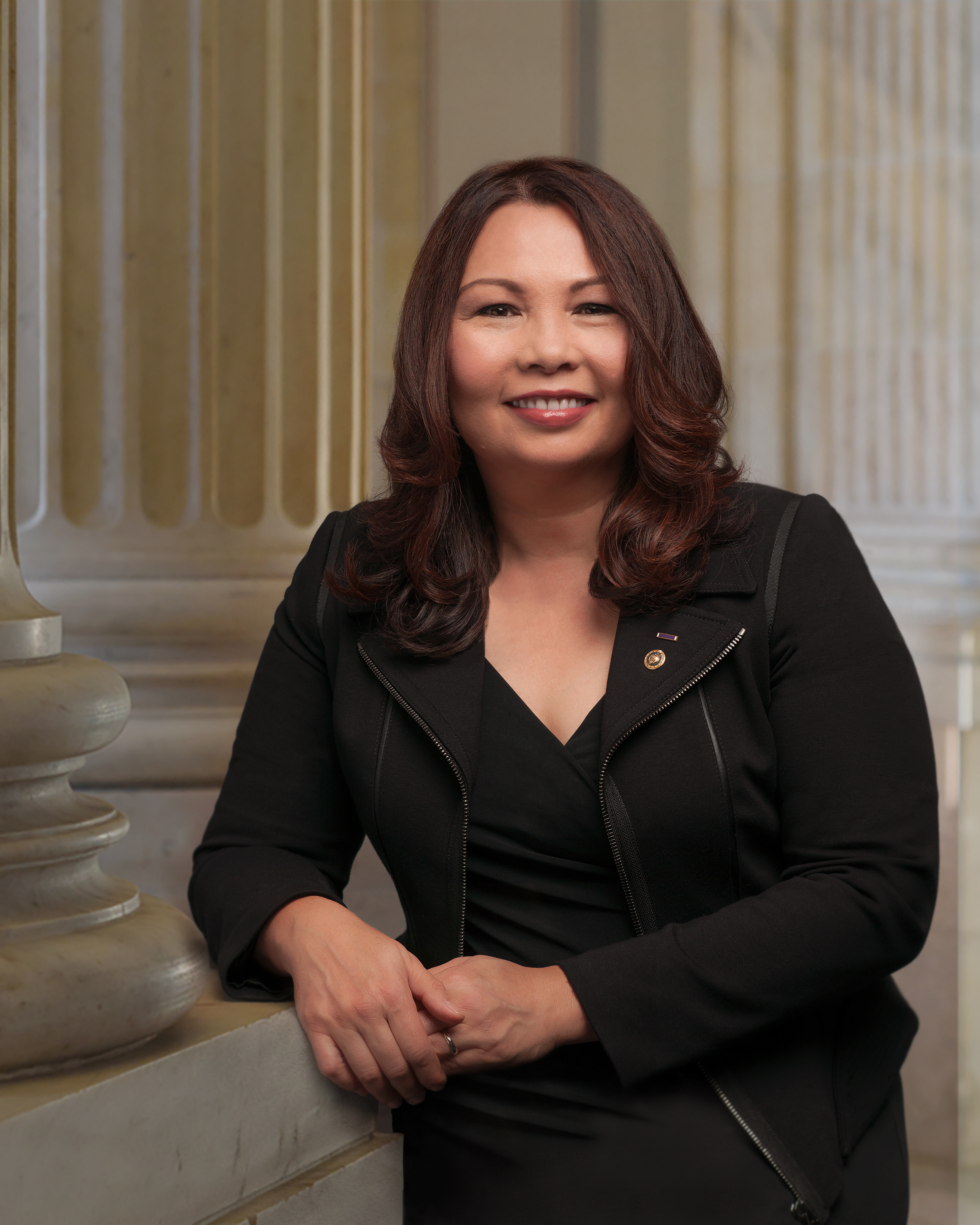
Senator Tammy Duckworth official portrait.

Why Trump’s pattern of purging our highest-performing military officers is dangerous by Sen. Tammy Duckworth.

“Our standards will be high, uncompromising and clear.” – Secretary of Defense Pete Hegseth’s Message to the Force, January 25, 2025

President Donald Trump’s pick for the chairman of the Joint Chiefs of Staff, retired Lt. Gen. Dan Caine (retired), possesses an extraordinary record of service—in Iraq, in special access programs and in the National Guard. There is no question of his capacity to lead, devotion to our country, character, courage or competence.

But those aren’t the qualifications required by law to be the senior-most military officer in our Armed Forces. Federal law requires the chairman to be active duty and have served in any of three senior roles: vice chairman, service chief (except the Coast Guard) or commander of a combatant command. Caine fails to meet one of these.

The president can waive most of the qualifications if he determines it is in our “national interest.” But the only justification that President Trump has stated for waiving these legal standards in this instance is that he remembers Caine stating he “loved” Trump, would “kill” for Trump and that Caine proudly donned a MAGA hat which—as Trump gushed—would be a violation of federal law.

Strangely, Caine has categorically denied that he ever did any of those things, which means either Caine lied—under oath—or that he told the truth and Trump has no justification.

To President Trump, the “national interest” appears to mean personal loyalty.

The nomination of Caine is just the latest example in a dangerous pattern of President Trump purging—in multiple reckless and sudden bursts—the military of its highest-performing general officers from mission-critical roles. Why? Because they promised loyalty to the Constitution instead of to him? These firings have nothing to do with upholding high standards at all they are about prioritizing fealty over qualifications and putting our national security at risk in the process.

Please click here to read the rest of this important opinion piece.