LAKE MACBRIDE— According to the National Oceanic and Atmospheric Administration (NOAA), January 2014 was the fourth hottest January on record. It was also the 347th consecutive month of global temperatures above the 20th century average. February is expected to be the 348th. From NOAA:
The combined average temperature over global land and ocean surfaces for January was the warmest since 2007 and the fourth warmest on record at 12.7°C (54.8°F), or 0.65°C (1.17°F) above the 20th century average of 12.0°C (53.6°F). The margin of error associated with this temperature is ± 0.08°C (± 0.14°F).
The global land temperature was the highest since 2007 and the fourth highest on record for January, at 1.17°C (2.11°F) above the 20th century average of 2.8°C (37.0°F). The margin of error is ± 0.18°C (± 0.32°F).
For the ocean, the January global sea surface temperature was 0.46°C (0.83°F) above the 20th century average of 15.8°C (60.5°F), the highest since 2010 and seventh highest on record for January. The margin of error is ± 0.04°C (± 0.07°F).
It is too damn hot, said as a resident of earth, located in an extremely cold Iowa winter.
LAKE MACBRIDE— Nothing has changed in the form of our state government. People get confused about this, due to an enthusiasm for the House of Representatives. There are three branches, the executive, legislative and judicial, although house enthusiasts say there are a different three, the house, senate and governor. They have it wrong.
I can understand why some get enthusiastic about the house. After all, it is our most representative chamber in a bicameral legislature. People get so enthusiastic, they sometimes forget about the bicameral part— that for a house bill to get to the governor’s desk for signature, the consent of the senate is required. Ditto in the reverse for senate bills. Behind the scenes, leadership is working on a budget, something they know has to get passed. Unlike the school aid formula, there would be consequences if the legislature ignored the statutory requirement to pass a budget before adjournment sine die. Bills without bicameral support are like so many necklaces and doubloons at Mardi Gras.
If people don’t have a relationship with state legislators, they could. The listening posts and forums are sparely attended, so anyone who shows up more than once is likely to get noticed. A visit to the Capitol? Even fewer constituents do that, garnering special treatment.
Guaranteed about any legislator is that a person will not always agree with their votes. In many cases, voting is predictable, but so much depends upon the specifics of the bill and and what leadership brings to the floor for debate. In more than twenty years, I have disagreed with every representative and senator I have had in Big Grove, although mostly I agreed with their votes. It hasn’t made much difference to which party they belonged, the nature of politics is no one gets what they want all of the time.
Iowa is currently in the filing period for state candidates, and a lot of people kick the tires on a run. Some have no idea what a campaign for the legislature involves. Others know well. I look forward to the March 14 deadline to see how our local races will shape up. With my newspaper work, I will be writing fewer letters to the editor than in previous years in an effort to avoid favoring elected officials and candidates to make an attempt at balanced news writing. I have an opinion, but will be expressing it infrequently in public. That is the price of working as a correspondent for a weekly newspaper.
What I do know and will say is that my public silence should not be mistaken for lack of engagement. Elections matter, and people should strive to be informed. I’ll be following the action in my community, and doing what I can to advance common interests. We all should be doing that… and that is an opinion I’m not concerned about expressing in public.
SOLON— When one is connected to the community, it is hard not to like Big Grove Brewery. The city council invested a forgivable loan to get them to build at the corner of Main Street and Iowa Avenue, and unlike the last microbrewery in town, this one scaled to a size to brew lots of beer, accommodate large gatherings and employ a lot of people. They opened Aug. 29, 2013. On a Thursday night, the place was packed with a five minute wait for a table.
My connections to the restaurant are many. Last night, a neighbor greeted me upon entry, handing me a glass of house beer. The subject of one of my newspaper articles was having dinner with his wife and provided positive feedback on my story. I’ve been in the kitchen delivering herbs from the farm, and three of the farms where I worked last year are suppliers. Chef Ben Smart and I share an acquaintance who gave up a job in a Washington, D.C. public relations firm to become a chef. They met at the Herbfarm near Seattle, Wash., where Smart was executive sous chef.
I’m not sure how many jobs were created by this business, but more than 40 people were in their initial staff photograph. The managing partner of the business was busing tables last night and seems to have his fingers on the pulse of the community. It’s all good, but what else would I say?
The kitchen has a high temperature pizza oven, and we each had a 12 inch pizza and took some home. She had Pizza Margherita, topped with San Marzano tomato, fresh mozzarella, basil, olive oil and sea salt. I had the Ham and Egg with La Quercia prosciutto, arugula, pesto, soft cooked local eggs, confit potato and Parmigiano Reggiano. We had a side order of caramelized carrots made with red onion, Parmigiano Reggiano, pine nut, arugula pesto, endive and preserved lemon. For beverages camomile tea and the aforementioned beer. Check out their seasonal menu at www.biggrovebrewery.com.
The vegetarian dishes that were on the menu last year are no longer there. Some friends came from Stone City for the roasted Brussels sprouts, which are now out of season. The dynamic of this restaurant will be whether or not they follow commercial interests, or can develop enough of a market for local, seasonal dishes to continue to be offered, including ample offering of vegetarian fare. In Iowa we like to repeat our favorite meals and dishes and the seasonal menu could get sanded off in the workshop of what sells. I hope not because a vegetarian can live on salad, pizza, side dishes and beer only for so long.
Two pizzas, a side and one paid beverage cost $45.63 with gratuity. It’s a little high for frequent dining, but a competitive price for the quality.
Try Big Grove Brewery in Solon. It’s a great place to get together with friends and celebrate from time to time. The initial energy from the opening has not worn off. Hopefully it never will as the establishment becomes part of the community.
Joint Statement by Senator Rob Hogg and Representative Bobby Kaufmann on Keystone XL Pipeline:
BIPARTISAN OPPOSITION TO KEYSTONE PIPELINE IN IOWA BECAUSE OF EXPECTED USE OF EMINENT DOMAIN
DES MOINES– Two Iowa state legislators– Senator Rob Hogg (D-Cedar Rapids) and Representative Bobby Kaufmann (R-Wilton)– joined today to call on Congress to oppose the proposed Keystone XL pipeline because of the expected use of eminent domain in the development of the project.
“I urge you to stand with those land-owners who do not want this pipeline running through their property,” wrote Rep. Kaufmann in a letter to Congressman Dave Loebsack of Iowa’s Second Congressional District. “The interests in oil profits should not supersede the rights of property owners.”
“It is not in America’s national interests to allow a foreign oil company to condemn American farms and ranches to take foreign oil to the Gulf Coast for sale on the global market,” wrote Sen. Hogg in a letter to Congressman Bruce Braley of Iowa’s First Congressional District. “The Keystone pipeline threatens America’s land, water, and wildlife – Congress should say no, the State Department should say no, and President Obama should say no.”
Senator Hogg and Representative Kaufmann’s letters were also submitted to the U.S. State Department in advance of the March 7 deadline for public comments on the Environmental Impact Statement on the proposal. The public can submit comments at the following web address: http://www.keystonepipeline-xl.state.gov/
Download PDF of Senator Hogg’s letter to Rep. Bruce Braley here.
Download PDF of Rep. Kaufmann’s letter to Rep. Dave Loebsack here.
LAKE MACBRIDE— An article about James Lovelock was recently updated and is in the news again. “Enjoy life while you can,” said Lovelock in 2008. “Because if you’re lucky, it’s going to be 20 years before it hits the fan.” Whether enough people are listening to his admonition about the inevitability of catastrophic climate change is doubtful. Whether we should is another question.
While the U.S. has its share of doomsday preppers, by and large the potential for social unrest, like in Ukraine, Egypt, Syria and Venezuela, is discounted by most people I meet. If some are stocking up at COSTCO, it is the result of a mathematical calculation of price per serving, and how long that over-sized box of crackers will last. Preparing for Armageddon is the last thing on shopper minds. As Americans, we have a high level of tolerance for injustice… as long as we perceive that as individuals, we are being treated fairly.
Our public awareness is influenced by a media bought and sold by a few wealthy people. Corporations influence our lawmakers, agriculture, retail stores, our utilities, and anything we do that requires our participation. Seldom has there been a large scale outbreak of social unrest, nor is one likely without a wholesale breakdown of consumer society. The wealthy are smart enough to prevent that from happening unless it serves their purposes.
Perhaps the most recent American social movement was the political tide that swept Republicans out of power and inaugurated President Barack Obama. Discontent with our government increased once the abuses of presidential power became more widely known after Sept. 11, 2001. It was a peaceful movement, even if we had yet to end two wars, and continued our questionable use of drones to target people in countries with which we are not at war.
It would take a lot for wide-spread, violent protest to topple the U.S. government. For that matter, protests against drones, economic issues, taxation, the Keystone XL pipeline, nuclear weapons installations, mountaintop removal coal mining and other issues pass largely unnoticed by society. In the middle east, it took a widespread drought, a shortage of export crops from Russia and Ukraine and high food prices to activate citizens for social change. Of course now we are getting back to climate disruption caused by global warming.
Helping mitigate the causes of global warming is at the top of my to-do list. I wrote about it at this link, “climate change is real, it is happening now, it’s caused by humans, and is cause for immediate action before it is too late.” Of course, according to Lovelock, it is already too late. Climate change is not the only worry we have about survival of life on the planet.
The other threat is the lingering possibility of a nuclear weapons exchange. In our post-Cold War era, this borders on the absurd. The two countries with the largest number of nuclear weapons are the United States and Russia. The war is over, so disarm. We can’t afford the hundreds of billions of dollar we spend on the nuclear complex, so disarm.
The humanitarian consequences of a small-scale, regional nuclear war, like between nuclear states India and Pakistan, are unthinkable. Conservative organizations like the Red Cross/Red Crescent Society and Rotary International are signing on to abolish nuclear weapons for that reason. They are most active outside U.S. borders.
Americans are already looking to enjoy life more, oblivious to the tangible threats we face. It is possible to mitigate the causes of climate change, work toward nuclear abolition, and enjoy life more. Once one has read Sartre not much seems futile, and engaging in life becomes its own reason to live. Whether we can make a difference is a question the naysayers would answer for us, something we can’t let them do.
SOLON— The restaurant crawl has been intentionally avoiding a trip to the Subway restaurant located in a strip mall at the edge of town. That there would be one is not surprising, although the only thing local about it is the employees and its iteration of industrial food architecture.
According to the chain’s website, Subway has 41,348 restaurants in 104 countries. It’s as popular as any, with about ten patrons when I stopped by at lunch time. Another chain restaurant had opened in a strip mall across the highway, but closed soon after the grand opening— Subway seems to have better staying power.
More than any other local eatery, Subway sits at the retail end of a processed food manufacturing supply chain. I picked a foot long sandwich for $5, and Subway is all about picking from their large stable of proprietary sandwich options. The fare is well advertised, with an ever changing menu. The current promotion is for Flatizzas, a piece of flat bread topped with tomato sauce, cheese and toppings from the sandwich bar, served like a pizza. It all looks the same to me.
Gone are the nostalgic images of the New York subway system that decorated the early stores. The dominant features were the sandwich bar, clean rest rooms and adequate table seating for guests. I noticed one of the sandwich artists changed plastic gloves twice while I was going through the line. Once after a trip to the store room to get something, and once to take money at the cash register. Like most big companies, Subway can’t afford to get on the wrong side of the public health department.
That’s really the saving grace about Subway. Because their processes are designed in a central location and trained locally, the products we buy in Solon are little different from what might be found anywhere else in the United States. Travelers want something familiar and consistent, and Subway meets that need.
I submit that the Solon Subway is no better or worse than any of its outlets worldwide. If that’s what trips your trigger, then there it is on Highway One south of town.
LAKE MACBRIDE— Between now and Tuesday, the Iowa Utilities Board (IUB) is accepting comments on distributed generation, or generating electricity closer to the point of use. This request for comments kicks off their first policy-making. It is common sense that if I can produce some of my own electricity at home, as a citizen, I should have the freedom to do so in compliance with regulations that may be promulgated by the IUB and our government. I made this comment:
NOI-2014-0001: Enable Distributed Generation to Advantage Citizens
Any rules regarding distributed electricity generation should enable individuals, property owners, and businesses to generate some or all of their own electricity and sell excess into the grid. Regulated utilities have made a substantial investment in infrastructure and contracts, and should receive reasonable consideration for them.
Why bother with taking action? Because it matters that we develop ways to reduce the amount of carbon dioxide being dumped into the atmosphere. Distributed generation is a way to take personal control of the decision of how we will generate electricity, and open possibilities to use solar collectors to take advantage of our most abundant energy resource. It’s time to put a price on carbon, and part of the price is taking personal action to mitigate the causes of global warming. Distributed generation is part of an approach to doing so.
Here is the full text of the IUB press release on distributed generation:
Iowa Utilities Board opens inquiry, seeks public comment on distributed generation in Iowa
DES MOINES– The Iowa Utilities Board has opened a notice of inquiry (NOI) proceeding to gather information related to policy and technical issues associated with distributed generation, which is an approach that employs various technologies for power generation closer to the point of consumption.
Information gathered by the inquiry will assist the Board in addressing the potential widespread use of distributed generation, related consumer protections, and interconnection and safety considerations. In its December 2, 2013, and December 16, 2013, Energy Efficiency Plan orders, the Board informed rate-regulated utilities and other relevant parties of its intent to conduct this NOI proceeding.
The Board is asking for comments or information relevant to this inquiry, is accepting responses to its questions related to distributed generation, and could seek additional responses to more specific questions and/or schedule a workshop(s) after all initial comments have been received. For more information, please see the Board’s Order Initiating Docket No. NOI-2014-0001.
The inquiry responses will provide information to the Board and other groups involved in energy, environmental, and economic policy for a more thorough understanding of the technical, financial, regulatory, safety, and policy aspects of distributed generation. In addition to Iowa utilities, the Board invites broad participation from other state agencies, local government and non-governmental organizations, environmental groups, renewable energy trade associations, industrials, and any others with an interest in these issues to contribute in this process.
Anyone may participate, and also respond to the questions posed in the Board’s written order, by submitting comments via its electronic filing system, https://efs.iowa.gov. Questions regarding this inquiry docket may be addressed to Brenda Biddle, Brenda.Biddle@iub.iowa.gov.
The Board is interested in hearing an extensive range of comments. Initial comments are sought by February 25, 2014. The Board has not previously conducted an inquiry related to distributed generation and has not taken any particular positions as it begins to gather information.
LAKE MACBRIDE— Tomorrow I’m doing something for me. I’m taking a three hour course in pruning apple trees at the orchard where I worked last fall. The cost is $10, but what is best is the opportunity to learn from people who prune apple trees for a living. There is a lot else that needs doing tomorrow, but the pruning class takes precedence.
There is also more to tell, but that will be later.
LAKE MACBRIDE— The storm let up, the driveway was dug out, and the second session of the 85th Iowa General Assembly began to shape up during its annual funnel week. The funnel means most non-spending bills must be passed out of committee or they are dead for the year. It’s not a firm rule, but it has implications.
The session starts to take shape the way a funnel cake does at the Iowa State Fair. Political funnel cake is nowhere near as tasty, and be ready to apply lots of powdered sugar to sweeten the underlying bitterness of this airy confection.
Some impossible bills have come forward, like the ban on telemedicine abortions, and a bill introduced by a gunsmith allowing silencers. Such extreme measures are unlikely to make it through the bicameral legislature. Senator Joe Bolkcom of Iowa City withdrew his medical marijuana bill the same day he filed it when no bipartisan support could be found. He seems smarter than others.
Legislators are busy with committee work, attempting to advance their priorities. Any analysis of this session seems premature until we at least get past the funnel.
There is an election this year, and political fundraising has been a recent topic at the coffee shop. We receive countless requests for donations in the mail and via the Internet. Funds are limited this year, and people who ask personally or by telephone are more likely to receive financial help.
Thus far, the following five people have asked me personally for a campaign contribution: State Senator Bob Dvorsky, who has represented me for almost 20 years; county supervisor candidates Janelle Rettig and Mike Carberry; Congressman Dave Loebsack; and candidate for the first congressional district seat, Anesa Kajtazovic. These are all busy people, so if they can call, any candidate not in a state-wide race should be dialing for dollars.
Political coverage takes a lot of work if it’s done right, and my coverage is more on the spotty side. Writing about politics forces me to think about it, something any normal human avoids like the plague. Honestly, I’d rather be at the fair.
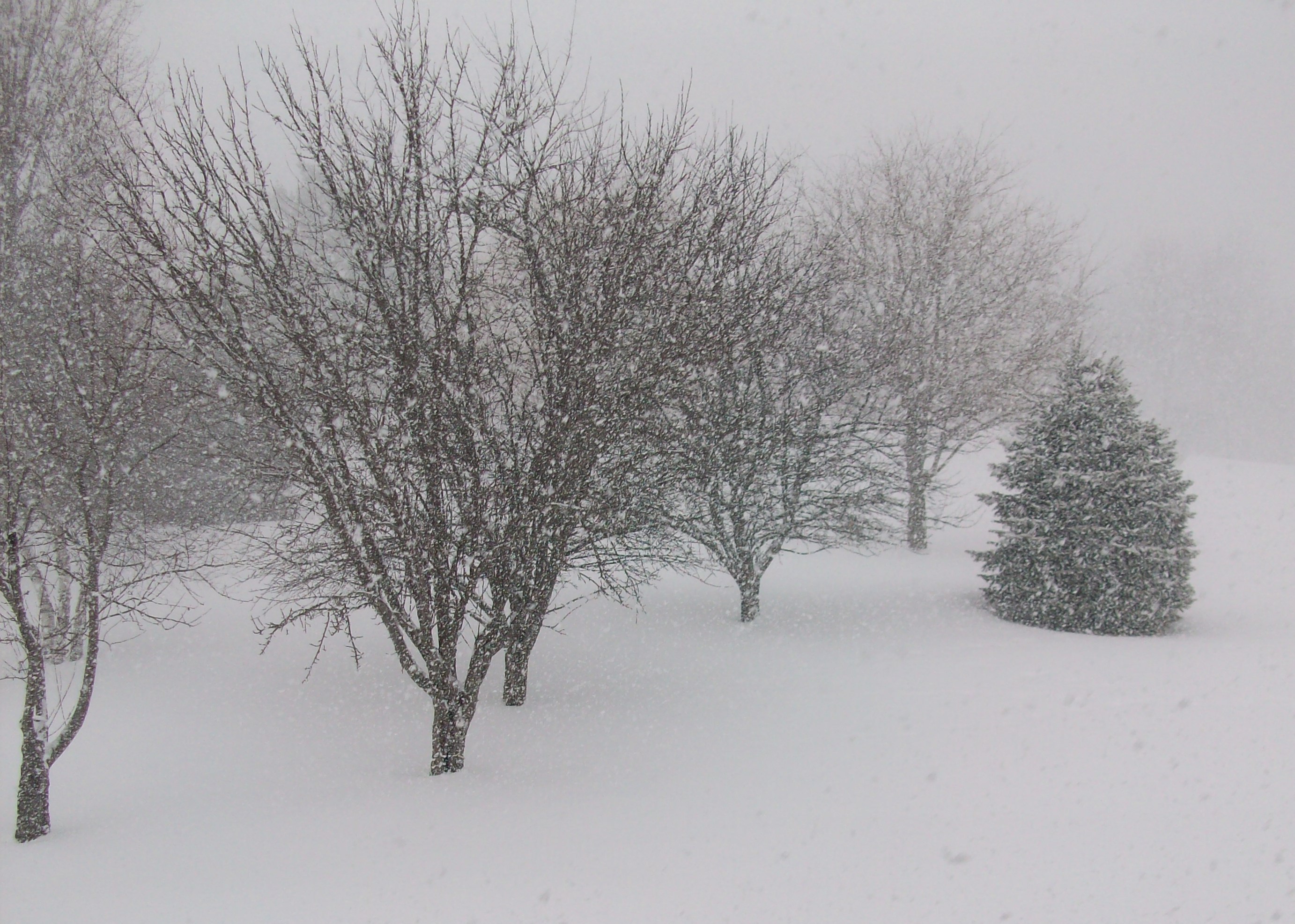
LAKE MACBRIDE— Falling snow whited out the world beyond our driveway. Isolated, it was hard to avoid wondering what was happening out there. The pipeline of data packets delivered to a screen beckoned us to leave our wonder, and engage with society beyond the driveway. At some point, I turned the computer off and set the mobile phone in another room.
Should a writer write what one knows, or what one wonders or imagines? And who is this writing to be about? If it is narcissistic preening, then why not take the whole endeavor off-line, get a paper journal, and write there— because who cares but the individual? Unless we write what we imagine society could be, and how we fit into the greater aspects of it, there is little reason to post on the Internet.
Apple Trees in a Winter Storm
I believe food is a connection to the rest of society and that’s why I write about it. At once it encompasses personal experience, labor, production, the environment, soil quality, botany, chemistry, biology, consumerism, preservation and packaging, distribution, cooking and eating— the whole enchilada of sustaining a life. Since everyone has to eat, food culture has been and remains a fertile field for the imagination, and a practical way to connect with people. That said, why care about what I cooked in the kitchen last night? One needn’t.
If we develop a sustainable culture where we live, we will be better able to survive in a turbulent world. We would be less distracted by media and outside factors, and empowered to act with authority on what we know. One needs a cultural platform to serve as a fulcrum for change. If we don’t make one, social progress becomes difficult.
As the snowfall slowed and stopped, the sun came out. The new fallen snow resembled a blanket over life’s previous markings— a chance to start again. Soon, I’ll grab a shovel and dig a path out to the street and a society with which I was always connected, but from which I took a retreat to work toward sustaining a life on the Iowa prairie.









 Journey Home
You must be logged in to post a comment.