We called the day between Good Friday and Easter Holy Saturday when I was a grader. It was not as important as Easter’s main event in the liturgical year.
On Easter Sunday we dressed in our best clothes to attend Mass with Grandmother. We’d return home for Easter dinner and talk around the table. I remember Grandmother helping wash dishes in the kitchen. It was the most significant holiday of the year, for her, and in our insular Catholic community.
No longer.
It was a punk Saturday because of the stitches in my right hand. Restricted from activity, I stayed indoors, managing to cook dinner, water seedlings, do laundry, make the bed, and read. I would have preferred to get my hands dirty in the soil but it wasn’t meant to be. It was a day of healing if not repentance. Of contemplation, not work.
I rose Easter morning for the first time in a long time without the pain of plantar fasciitis in my feet. Hopefully this condition persists.
Matthew 16:24-25 says, “If any man will come after me, let him deny himself, and take up his cross, and follow me. For whoever wishes to save his life will lose it; but whoever loses his life for My sake will find it.“
If I’m not ready to walk those footsteps, today’s healing is a signpost. Healing is possible. Healing can come. Healing can set us free.
The large bandage on my thumb is a reminder healing is not done.
As darkness yields to dawn and sunlight, one can’t help but be comforted by the possibilities each day brings. Days of work lie ahead until that final night and its return to Earth which engendered us.
People who harp about hourly wages are tedious and mostly fooling themselves. The economic instinct in society should be and is making a decent life from what we have and are given. Wages are a part of that, but there is a lot more.
A person can’t make a decent life based solely on wages.
I’ve read my friends at the Iowa Policy Project on Iowa’s cost of living, wage theft, and minimum wage. I don’t disagree with their analysis of the data sets they chose. My issue is work like theirs serves the political class more than it does regular workers. Useful for policy makers, but not for those working poor.
The Johnson County Board of Supervisors recently implemented a policy to raise minimum wage in the county — with caveats — to $10.10 per hour by Jan. 1, 2017 and then index it to the Consumer Price Index for the Midwest Region. I attended a public hearing on the ordinance in Solon, read online comments and news articles on the ordinance and its impact, and importantly, talked with scores of people impacted by the law. The ordinance is a lifeline to some, but has little impact on most working poor because it does not adequately address their central concern — finding a job that pays a living wage.
As a low wage worker, I tell a small part of my story in the following paragraphs. It includes a brief history lesson, corporate interests in consumer pricing of gasoline, work injuries, and the role of total compensation packages.
History Lesson
In 1975, minimum wage was $2.10 per hour. With the proceeds of a full-time, no benefits job at a convenience store, I rented an apartment, bought food, had a telephone, owned a car and lived a reasonable life in my home town. A person could get along on $2.10 per hour, barring personal cataclysm, if just barely.
According to the CPI inflation calculator, the $2.10 I earned in 1975 equates $9.26 in today’s dollars. The exact same job I held in 1975 — convenience store cashier — now pays a going rate of $10 per hour. Minimum wage hasn’t kept up but the market has.
How can a person can build a decent life on low wages? It’s not easy. However, addressing minimum wage is a form of tinkering around the edges. So many analyses of minimum wage fail to consider the corporate system we have in every aspect of our lives. Yes, people have to contend with complex issues involving corporate life. They include health care, insurance, banking, debt, fuel, communications, food security and electricity. People complain about these aspects of life rather than leverage them to their advantage. The one I know most about is fuel pricing.
Gasoline Pricing
Gasoline prices were $2.099 per gallon at local outlets this week. Gasoline is the dominant passenger vehicle fuel and buying it has become an accepted part of life that includes transportation as a basic expense.
One of my roles during a transportation and logistics career was to purchase about 25 million gallons of diesel fuel per year for a large trucking firm. I visited refineries, pipeline companies and retailers and came to know how every penny of the price we paid came about. While I bought diesel, the same lessons apply to gasoline — something almost everyone who lives outside public transportation routes has to buy.
When I drove my first car, a Volkswagen Beetle in high school, a couple of bucks would fill it up. During gas wars, the price went as low at $0.27 per gallon. Today, state and federal tax alone is $0.579 per gallon in Iowa. An escalating tax became part of the expense background.
Perhaps the biggest change in gasoline pricing over time has been the move from vertical integration of energy companies to the culture of outsourcing and partnering among varied aspects of the fuel supply chain. This is sometimes called horizontal integration.
When I worked for Amoco Oil Company in Chicago in 1990, the corporation was paid $600 million for its oil fields in Iran. Partly because of political instability — their oil fields were seized during the 1979 Islamic Revolution — partly to divest assets and buy crude oil on the open market. Little did we know at the time, Amoco, a company viewed as a stalwart of great places to work and the ninth largest global corporation, was in the process of disappearing. At one point they did everything from exploration, production, refining, research and retailing. They merged into a foreign corporation.
When we pull up to a gasoline pump at a convenience store, the details of the hydrocarbon supply chain seem very remote. Oil and other hydrocarbons have become fungible commodities, and as such, we tend to deal with the price at the pump. Crude oil and crude oil futures trade on financial markets which provides some price visibility. Invisible are the many people from exploration and drilling, to production and refining, to transportation and delivery, to sales and marketing who get some part of the transaction of filling a passenger car gasoline tank.
Working for low wages reinforces the focus on per gallon price. When gasoline prices go up it’s bad. When they go down, we like it. Set aside the government subsidies, the unrecognized cost of using the atmosphere as an open sewer for emissions and everyone taking a fraction of our $2.099 per gallon. Energy company executives and politicians alike realize price is king and expend resources to keep it so. All a minimum wage earner knows is when price at the pump goes down, there are a few more dollars to spend this month. What people in the oil and gas business know is each entity along the supply chain is taking a margin above their costs out of the pockets of gasoline buyers. The impact on working poor is disproportionate. Raising the minimum wage won’t fix corporate extraction of money from gasoline consumers or almost anything else.
Work Injuries
I cut my right hand at work this week and had to get stitches — six of them at the base of my thumb.
It doesn’t hurt much, and my motor skills haven’t been impaired, however, the doctor said I’m supposed to minimize use of my hand until a worker’s comp doctor reviews my healing progress on Monday. There’s plenty of work that can be accommodated at the home, farm and auto store where I work so lost wages there shouldn’t be a problem. I went back to work after returning from the clinic — there was no lost time.
What matters more is the loss of productivity in everything else I do during spring to get by.
I contacted the farm and asked for relief from soil blocking for a week. I’ll lose that wage earning opportunity. The work restriction will also be a setback for weekend work in the garden. I had hoped to plant radishes, peas and turnips in newly turned ground, some of which I will sell at the farmers market. Income is delayed. There’s no short term disability insurance, so If I don’t work, productivity and income will be lost.
People who craft models about minimum wage often include the idea of short term disability as a footnote. Focused on hourly wage, they say if everything goes according to plan a person can make it on $15 per hour or whatever. Everything doesn’t always go according to plan, especially if one is working poor. Consequences of the minor lacerations on my right hand serve as testament.
That’s where economic models created to advocate for raising the minimum wage are inadequate. Life is much more complex. There are unwelcome limits an injury imposes on life at the economic edge. Accommodating and adjusting in response is a more resilient skill that matters more than raising the wage.
I’ll adjust because I have to to preserve the tenuous thread from which our economic life hangs.
Total Compensation Package
Anyone who has studied employee turnover knows the key reason people leave jobs is not wages. It’s how they were treated by their manager. None of the analyses about minimum wage I’ve read included this key aspect of work life. It makes a difference how well trained a manager is in a lowly paid job. The tendency is to rigidly design a work process and try to get workers to fit in like they were a precision machined part of the operation. Low tolerances for performance are often baked into the job, but regardless of performance if one’s supervisor is a prick, that employment will end eventually, usually by choice of the employee.
Under the Patient Protection and Affordable Care Act, companies that employ workers 30 or more hours per week must provide health insurance. To the employer this is one of many costs that yield a total cost of the employee. There is a tendency to push as much of the cost for health insurance on the employee in the form of premium co-pays, deductibles and co-pays. In my current job employees get health insurance benefits with reasonable premium co-pays and a high deductible/co-pay structure. Family coverage is more expensive, and the cost of covering a spouse is roughly equal to the cost of the least expensive policy on the government health insurance marketplace for a single individual.
Since the insurance is offered by the employer, there is no government premium subsidy, which with premium co-pays creates a disincentive for working poor to seek full time work with benefits. It is easier, and better economically, to work multiple part time jobs without benefits and sign up for health insurance through the marketplace to get the subsidy.
Wages in larger businesses are a function of total pay package. Smart companies look at the competitive marketplace for employees and determine the range of how much a position should be paid. Often a human resources consulting firm is engaged to benchmark compensation per position. Once the range is determined, the company decides what part of pay is through benefits and what part through wages. Wages, paid time off, workers compensation, disability, health and dental insurance, employee discounts, clothing allowances and the like are all part of the cost of an employee and their total compensation package. Companies will always strive to keep the overall cost of employees low.
If government raises the minimum wage, a company will seek to keep employee compensation costs the same or lower. That means some aspect of pay and benefits will take a hit, shifting the same dollars to wages from benefits. Another alternative is to turn employee hiring and management over to a temp agency which bills employee costs at a fixed rate. In some cases, like that of the Whirlpool Corporation’s recent operation in North Liberty, there are multiple layers of this type of outsourcing. The employee may earn slightly above minimum wage, but the rest of the benefits package is taken by the temp agency or subcontractor. Raising minimum wage may only shift where the money is coming from. It all comes from the total compensation package.
Conclusion
The starting point for a new conversation about wages is to consider our history, the impact of corporations on almost every aspect of our lives, the risks of injury in low wage jobs and how the total compensation package and erosion of benefits in favor of wages makes a difference when one is working poor. Hopefully this post will serve to begin some new, more meaningful discussions.
I cut my right hand at work yesterday and had to get stitches — six of them at the base of my thumb.
It doesn’t hurt much, and my motor skills haven’t been impaired, however, the doctor said I’m supposed to minimize the use of my hand until a worker’s comp doctor reviews my healing progress on Friday. There’s plenty of work that can be accommodated at the home, farm and auto store so lost wages there shouldn’t be a problem. I went back to work after returning from the clinic — there was no lost time, an important metric for people like our store manager.
What matters more is the loss of productivity in everything else I do during spring to get by.
I contacted the farm and asked for relief from soil blocking for a week. The work restriction will also be a setback for weekend work in the garden. I had hoped to plant radishes, peas and turnips in newly turned ground. I’ll experiment with turning the soil without my right hand, but the prospects seem dim for getting much done.
There’s no short term disability insurance, so If I don’t work, productivity and income will be lost.
People who craft models about minimum wage often include the idea of short term disability as a footnote. Focused on hourly wage, they say if everything goes according to plan a person can make it on $15 per hour or whatever. Everything doesn’t always go according to plan, especially if one is working poor. Consequences of the minor lacerations on my right hand serve as testament.
That’s where economic models created to advocate for raising the minimum wage are inadequate. Life is much more complex. There are unwelcome limits an injury imposes on life at the economic edge. Accommodating and adjusting in response is a more resilient skill that matters more than raising the wage.
It has been so long since I was injured at work — more than 40 years ago at the meat packing plant — I can’t remember what to do.
I’ll adjust because I have to to preserve the tenuous thread from which our economic life hangs. It’s all part of sustaining a life in a turbulent world.
Chives, lettuce and garlic are up in the garden, beckoning my presence.
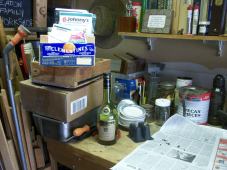
On yesterday’s last day of winter I spent a couple of hours burying four large plastic tubs for an experiment in carrot growing. 18-inches deep, I filled them with compost. After settling overnight, they will be re-filled and planted with four varieties of carrot seeds from Johnny’s Selected Seeds: Yaya F1 OG (hybrid early carrots) Bolero F1 (hybrid storage carrots); Purple 68 F1 (hybrid specialty carrots); and Laguna F1 OG (hybrid main crop carrots).
I have enough seeds to plant a spring and fall crop.
Carrot Container
Anyone who has planted carrots is familiar with the main challenge: providing deep, loose soil for the roots to grow. Last year’s crop was a moderate success in the ground, but I didn’t dig the bed deep and it showed. Over the winter I read about growing carrots in containers. Since I had the tubs, there wasn’t much additional work to cut drainage holes and place them in line 10-12 inches deep.
With rainfall, the new soil may settle. Judging from the locust tree roots I cut to make the holes, there is plenty of soil moisture, although a higher percentage of clay a foot deep. It’s an experiment. We’ll see how it goes.
Raised Beds Next to Compost Bins
Today’s garden task is to consolidate and blend the remaining compost. There are two bins and a pile of decomposed apple pomace and horse manure. There is plenty to build soil in most of the garden plots.
The first two lambs were born at the farm last Sunday, evidence of spring. I’m ready to work in the garden as soon as time off work aligns with precipitation-free days — maybe Saturday morning.
Despite heavy winter precipitation it looks like the upper Mississippi River basin will be spared severe flooding this spring.
The Corps of Engineers has been lowering the water level at the Coralville Lake in preparation, and society is getting used to the threat of perennial flooding. A season without it would be welcome reprieve.
I have been getting ready for spring. Before I leave for work today and the garden tomorrow a few thoughts about political life.
We elected delegates to the district and state convention last Saturday. I stayed until all committee seats were filled and delegate and alternate names were recorded. That was my role in this quadrennial presidential campaign.
On Wednesday a group of political friends from the caucus gathered. While we are engaged, there will be a lull in political action until after Labor Day and the fall campaign in the general election begins.
As the presidential primary season finishes out, it is hard to see a path for Bernie Sanders to overcome Hillary Clinton’s lead in delegates. The fact he didn’t win a single state in the March 15 elections is the sound of the death knell tolling for his campaign.
People want this to be settled, yet the 2008 election of Barack Obama is evidence these things are never really settled. In fact, Clinton’s long history of being assailed by conservatives and liberals alike, predating Obama by decades, suggests there is no such thing as “settled” in national politics any more.
In the Democratic primary for U.S. Senate, four people have announced. I have had multiple conversations with each of them and even have a photograph of Chet Culver, Patty Judge and me at Old Capitol the night before Culver’s inauguration as governor. If you have been reading this blog at all, it’s clear why I would align with State Senator Rob Hogg, who like me is a graduate of Al Gore’s Climate Reality Project.
Congressman Dave Loebsack may or may not have an opponent in the second congressional district. A physician from Iowa City has expressed interest, and they could nominate someone at their district convention. If one considers who ran against Loebsack since he beat Jim Leach, Republicans really have no one.
In the state legislature races, our State Senator Bob Dvorsky isn’t up this cycle, and Republican Bobby Kaufmann doesn’t have a challenger for his seat in the House of Representatives. There is unlikely to be a Kaufmann challenger until 2022 after decennial redistricting.
Five Democrats have announced for three county supervisor seats up this cycle. Rod Sullivan and I have a relatively long relationship, including his two votes to appoint me to the county board of health. Lisa Green-Douglass demonstrated she has political legs and is just getting started as a supervisor. I plan to vote for both incumbents in the primary.
The third choice is more difficult. Three people with careers have announced. Jason T. Lewis is a University of Iowa employee; Kurt Michael Friese is a successful restaurateur and author; and Patricia Heiden is executive director of Oaknoll Retirement Community. All live in the large urban area that includes the county seat.
When one considers the community impact of these three candidates, Pat Heiden stands out. A political newcomer, Heiden seeks elective office after 36 years at Oaknoll, 21 of those as its executive director. I’ve given three talks at Oaknoll and have known a number of its residents. It is a culturally significant social group which makes positive contributions to the growing population of 60 plus citizens of the county. Heiden shares some responsibility for this.
I met Kurt Friese at the county convention, but only briefly. Even though he purchases a significant amount of locally grown food for his restaurant, virtually no one I know in the local food movement mentions his name. I need to understand him and his candidacy better. I also plan to read his book about hot peppers.
Jason T. Lewis announced at the convention and I know a little about him. He has been following the Iowa City Community School District and ran for school board twice unsuccessfully. I need to know him better.
My initial assessment of the race is we have too much board of supervisor influence from people who live in the county seat. I plan to vote for three candidates and favor people who have worked in business over government employees. That means after casting my vote for incumbents, selecting one of the two business people, Friese or Heiden.
We’ll see how it goes as winter ends, spring arrives. I plan to set politics aside as the work to sustain our lives in a turbulent world continues.
Hillary Clinton Delegates and Alternates at the Johnson County Democratic Convention, Tiffin, Iowa, March 12, 2016
JOHNSON COUNTY, Iowa — Democratic delegates met in all 99 Iowa counties on Saturday, March 12. The day was overcast, but hopeful.
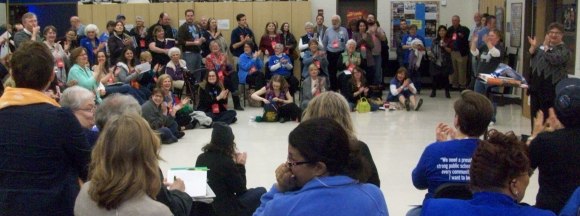
A bellwether was the fact I didn’t recognize many of the hundreds of people at the Tiffin High School auditorium where our county convention was held. Old timers are giving way to a new generation of Democrats brought in this election cycle by the contested presidential primary and Iowa’s first in the nation caucuses.
The results of the presidential horse race were similar to caucus night — Hillary Clinton had four more state delegates after the conventions than Bernie Sanders, ratifying her historic Iowa win 704-700.
The convention was about more than the presidential nomination.
With delegates intoxicated by the allure of the presidential race, Congressman Dave Loebsack and State Senator Bob Dvorsky attempted to sober them up with focus on the importance of the 2016 Iowa legislative races. For six years, Democrats have held the Senate Chamber by the slimmest of margins 26-24, Dvorsky said. If Democrats lose the Senate, Iowa could go the way Wisconsin and Kansas have.
“There are 12 Democratic Senate races this year, and we have to run the table,” Dvorsky said.
First term State Senator Chris Brase has a competitive race in nearby Senate District 46 which includes Muscatine County and parts of Scott. Since none of the Johnson County Senate delegation will be on the ballot in 2016, Dvorsky encouraged delegates and alternates to help with Brase’s campaign.
“Embrace Brase,” he said.
Loebsack was in sync with Dvorsky, affirming his support for Hillary Clinton, saying he would support Sanders if he were the nominee. He then explained that the presidential race, even his race and the challenge to six-term U.S. Senator Chuck Grassley, were less important to Iowa than the state house races.
During the caucus of Clinton delegates and alternates to elect district/state delegates, former Iowa Democratic Party chair Sue Dvorsky affirmed the strategy of the presidential campaign returning to Iowa after the Democratic National Convention. The presidential campaign will bring much needed financial and organizational resources to prop up the Iowa Democratic Party.
There was other news at the convention.
Abbie Weipert of Tiffin announced she will join North Liberty Mayor Amy Nielsen in the June 7 Democratic primary to nominate a candidate in House District 77. Nielsen was first to enter the race after two-term Representative Sally Stutsman announced her retirement last month. I met Weipert during the 2012 campaign when her now husband Travis was elected Johnson County Auditor.
There was no announcement of a challenger to two-term Republican Bobby Kaufmann who represents House District 73 with six precincts in Johnson County along its border with Cedar County. During a previous discussion with Cedar County Democrats chair Laura Twing, no challenger is forthcoming. At this writing, Democrats appear ready to cede this seat.
Jason T. Lewis announced a bid for county supervisor in the June 7 Democratic primary. Lewis joins four other candidates, including incumbents Rod Sullivan and Lisa Green-Douglass, and newcomers Kurt Michael Friese and Patricia Heiden. Heiden, until recently a registered Republican, was the only one of the five who didn’t address the convention Saturday morning. Three seats are up this cycle.
Sullivan and Green-Douglass have the upper hand going into the primary. Sullivan is arguably the most liberal of the current supervisors and has strong rural connections that are important in a county dominated by the City of Iowa City and the University of Iowa.
Green-Douglass was elected in a special election Jan. 19, however, her strong showing during the 2014 primary contest gives her better name recognition than Friese, Heiden or Lewis. Mike Carberry beat Green-Douglass 3,459 to 3,333 on June 3, 2014, which was a respectable showing for both candidates.
What likely tipped the win to Carberry was better county-wide name recognition combined with support of the Newport Road gang. Before the January election, I heard a gang member refer to Green-Douglass as “no good,” so their support may be an issue for her again this cycle. During his speech at the convention, Friese, a friend of Carberry, aligned himself with interests of the Newport Road gang with his campaign tagline, “Stop pouring concrete on good farm land!” He also parroted the Newport Road position of developing the county by filling in existing lots rather than through additional rezoning. It will take more than alignment with any one group to win the Democratic primary. According to the cowboy card Friese distributed at the convention he has a broader palette from which to paint his campaign.
Johnson County’s leaders asserted a focus more on down-ticket races than the presidential or U.S. Senate ones. It’s hard to argue with that.
Best political speech of the day, maybe of all time? Two letters, “Hi,” from County Attorney Janet Lyness who had laryngitis.
The family-owned home, farm and auto supply store put me on a Monday through Friday schedule this year. It created something rare — a regular weekend off.
As winter ends, work at home and at the farm returns to center stage. It was possible to feel I got something done this weekend.
I did — indoors and out.
Le weekend began Friday with a time clock punch. After work, I bought provisions at the warehouse club on the way home. After putting food and sundries away, I repaired one of our two cars in the garage. I drove the repaired vehicle to pick up Jacque after work, reading a book checked out from the library on my phone’s Kindle app while waiting in the parking lot.
That evening at home I made a to-do list on the white board and continued reading. I hope to finish Slavery in the Upper Mississippi Valley 1787 – 1865: A History of Human Bondage in Illinois, Iowa, Minnesota and Wisconsin by Christopher P. Lehman before returning to work on Monday. It’s due back to the digital library in seven days.
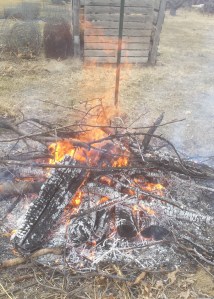
At home I watered the trays in the south-facing window. The basil, lettuce and celery seedlings are coming along. I burned the brush pile and prepared containers for raised beds of root vegetables planned for early planting. Making sure I had five buckets of sand for next winter, I swept the remainder into the ditch from the road in front of our house. Each task accomplished added to a positive, hopeful attitude.
Embers of the Burn Pile
Sunday I’ll soil block at the farm. We’ve been having a problem with invasive species in the seedling trays. That needs discussion and resolution before we get too far along. The schedule is 28 trays of 120 blocks, or 3,360 seedlings, so addressing the problem quickly matters.
Set this aside. Saturday made the weekend.
Saturday cooking included a bowl of steel cut oats for breakfast, chick pea curry to use up the last of the big batch of them, and chili with cornbread for dinner. Since Jacque works on Saturday afternoon, and seldom knows how long the work will take, I always prepare something that can be re-heated easily while listening to A Prairie Home Companion on the radio.
Earlier Saturday I made a trip to the grocery store to buy some organic celery, raisins and onions, then returned to the kitchen and made three jars of lemon flavored iced tea for the week. The food was all good although I forgot the garlic in the curry.
These things seem simple, but framed by a regularly scheduled weekend off, they have the potential to become a way of life. What ever happened to that in our 24-hour, non-stop social media, highly complex, yet unfulfilled lives?
While we won’t get rich living like this, it is rewarding in so many other ways. It’s past time to re-invent Le Weekend.
BIG GROVE TOWNSHIP, Iowa — This headline in this morning’s Boston Globe says it well, “Clinton and Trump are now the presumptive nominees. Get used to it.”
Author James Pindell attributes the appellation to math.
“They have accumulated more delegates than any other candidates in their parties for the national conventions,” he wrote. “Both won three of four early contests in Iowa, New Hampshire, Nevada, and South Carolina. Not a single candidate with those win records has ever lost his or her party’s nomination in modern presidential political history.”
Presumptive. Get used to it. Got it.
While few saw Trump coming a year ago, people have been saying Hillary Clinton was the likely Democratic nominee for president since before she announced on April 12, 2015. They were right then and now.
The nominating process set up by Democrats after the debacle of 1968 is working. It fielded a group of candidates, winnowed the field, and is moving rapidly toward nominating Clinton. Clinton needs 2,383 delegates to the July 25 national convention to win. After last night she has 1,001 to Bernie Sanders’ 371. With the remaining delegates, Sanders needs to do much better than Clinton. But for the details of how the race plays out, as Pindell indicated, it is over.
In Iowa the Super Tuesday result means as soon as Sanders bows out, needed revenue from the Clinton campaign can begin to flow to the Iowa Democratic Party. My quote of Iowa politico Jerry Crawford from last year bears repeating.
“In all the races I’ve been involved with of various kinds it’s not how you start, it’s how you finish,” Crawford said on Iowa Press. “Iowa, the Iowa Democratic Party, our ticket in this state desperately needs the general election assets that Hillary Clinton will bring as our party’s standard bearer. That’s the way we recover from what was a very, very tough 2014 election.”
As I wrote at the time, the coordinated campaign should be blown up and re-invented. It’s money that holds us back. Democrats are damned if we raise it and damned if we don’t.
One of the successes of the Iowa Republican Party since Jeff Kaufmann took the reins has been generating cash for operations. Democrats in a donor poor state still rely on the presidential candidate, and partly because of it, the race has focused disproportionately on electing the president. As my own data crunching during the 2012 race affirms, a winning president doesn’t have enough coat tails to carry all of the down ticket races in Iowa. If he did, my state house candidate would have won his race. This is a basic problem with Iowa Democratic politics: not enough money and too much focus on the presidential horse race. A corollary is not bringing enough new people into the party.
People suggest retaining the new people Bernie Sanders recruited to his campaign is important, and it is.
Rod Sullivan Feb. 22, 2016
At the same time, each electorate is different and there is no expectation everyone who voted or caucused for Sanders in the primary will continue to be involved in a general election campaign for Hillary. The idea we should “do things” to retain them is ridiculous and counter productive. The narrative of momentum and a linear procession from announcement to primary to election is a bankrupt one. People will make their general election decision based on information available to them as election day approaches.
The power of politics has more to do with what people we know are doing. To the extent the power and influence of national media can be mitigated, voters will make a sound decision. However, media continues to shape opinions to the extent Republicans I know are trying to accommodate a Trump vote despite his demagoguery. It’s the media that puts them in this situation.
As the case of Trump indicates, elections no longer are about logic and reasonableness. To elect a candidate we each must work to influence people in our circles. As we march to the finish of another presidential election it is important to remember we have a sphere of influence… and to pay no attention to that man behind the curtain pulling the levers.
The first spadeful of earth was waterlogged. There was no frost more than a foot deep, so I’ll be ready to plant lettuce March 2.
My maternal grandmother called this planting “Belgian lettuce.” I follow the tradition whenever conditions permit. Reserving some lettuce seeds to plant in trays, the rest will be broadcast in a small plot. I will also plant some turnips — mostly for the greens.
The calendar shows it is winter, but spring is everywhere.
This week, former Iowa Secretary of Agriculture and former Lieutenant Governor Patty Judge said she is considering a run in the June 7 primary to be the Democratic candidate to challenge incumbent U.S. Senator Chuck Grassley. The filing period begins Monday and ends March 18.
If Judge enters the race, that would make four contenders, each of whom I know better than most politicians. Based on many conversations with all four, I plan to vote for Rob Hogg, a current state senator, author and climate advocate.
Tom Fiegen, a bankruptcy attorney, is running in the primary. Like fellow candidate Bob Krause, a former military officer and defense contractor, Fiegen challenged Roxanne Conlin in the 2010 Democratic primary for U.S. Senate, placing third of three candidates with 6,357 votes. Krause was ahead of Fiegen with 8,728 votes. Both lost to Conlin, the clear leader who garnered 52,715 votes that election.
Six years later Fiegen and Krause are running again. Fiegen has become a Sanders Democrat, hitching his wagon to the revolution Bernie Sanders asserts is needed. Bob Krause is, well, Bob Krause, a man with an irresistible urge to run for office, not unlike Saul Bellow’s character Henderson the Rain King, with a personal quality “that manifests itself as an inner voice crying out I want, I want, I want.” I like them both, but as I said, will be voting for Hogg. Judge should stay out of the race unless she has something new to offer.
The discussion about a replacement for the late Antonin Scalia on the Supreme Court of the United States has generated anti-Grassley sentiment. The general election campaign should be heated. It will be almost impossible for Grassley to avoid addressing his obstruction in this because Republicans have put the Senate Judiciary Committee he chairs front and center, saying they won’t even consider an Obama nominee.
It will take more than moral outrage to defeat Chuck Grassley in the general election. Grassley has a token primary opponent who will likely be vanquished. I don’t see much outrage directed toward Grassley in society beyond social media. Without that the race is an open question. Whether Democrats can get beyond commenting on blogs and in social media to organize is unknown at this time. I am hopeful — some, tempered with realism.
Filing closes at 5 p.m. on March 18 when the primary races will be defined. Until then, there will not be a lot of action, just work — sustaining a life in a turbulent world.










 Journey Home
You must be logged in to post a comment.