Categories
Environment

Grassley on Climate Change

This response to my message to U.S. Senator Chuck Grassley has been sitting in a file folder waiting for me to write a response. Upon review, I don’t really have a response as the letter speaks for itself. Shorter Grassley: wind, ethanol and biodiesel are what I have been and am willing to work on going forward.

Dear Mr. Deaton:

Thank you for taking the time to contact me. As your senator, it is important for me to hear from you. 

I appreciate you sharing your concerns regarding climate change with me. I have long said that I acknowledge that a changing climate is a historical and scientific fact. I also recognize that most scientists say manmade emissions contribute to climate change. In addition, it is just common sense to promote the development of clean forms of energy. In fact, throughout my tenure in the Senate, I have been a leader in promoting alternative energy sources as a way of protecting our environment and increasing our energy independence. I’ve been an outspoken advocate of various forms of renewable and alternative energy, including wind, biomass, agriculture wastes, ethanol and biodiesel. As the former Chairman and Ranking member of the Finance Committee, I’ve worked for years to enact tax policies that support the growth of these alternative resources and reduce our dependence on foreign oil. We need to develop a comprehensive energy policy and review the tax incentives for all energy sources. Our goal should be that clean energy alternatives become cost-effective, viable parts of our energy mix to power our homes and businesses for the long term.

To the extent that clean, alternative forms of energy can be made more cost effective than fossil fuels, it will be a win-win situation. In the meantime, any measure that forces a shift from low-cost energy sources to higher cost alternatives will impose hardships on hard working Americans, especially those least able to afford higher prices for home heating, food, and transportation. Higher energy costs also affect jobs, particularly in the manufacturing sector.

I believe we have an obligation to future generations that our environment is both clean and safe. Additionally, I believe it makes economic sense to have a healthy environment. Throughout my tenure in the Senate, I have authored and supported legislation that promotes  renewable   energy  sources to protect the environment, support our economy, and increase our  energy  independence. I’ve been an advocate of various forms, including wind, ethanol, and biodiesel.  

As you may know, Iowa has had much success in the production of these  renewable   energy  sources. As the number one producer of corn, ethanol, and biodiesel, our state leads the nation’s  renewable  fuels industry. This cleaner-burning, homegrown  energy  supports the economy by generating 37,000 jobs and nearly $4 billion of Iowa’s GDP. In 2020, Iowa produced 3.7 billion gallons of ethanol. In regards to environmental benefits, ethanol reduces greenhouse gas emissions by 43 percent compared to conventional gasoline.

As the “father” of the Wind  Energy  Incentives Act of 1993, I sought to give this  renewable   energy  source the ability to compete with traditional, finite sources. Today, wind  energy  supports over 9,000 Iowa jobs and provides 40 percent of our state’s electricity. Like ethanol and other advanced biofuels, wind  energy  is  renewable  and does not obligate the United States to rely on unstable foreign states. Further, the U.S. Department of Energy recently released its annual wind Markets Reports. Within this report are several notable updates about Iowa. Iowa currently leads the U.S. in wind-generated electricity. At 57 percent, Iowa has become the only state where over half of our in-state generated energy comes from wind. Lastly, the wind industry supports over 116,000 U.S. jobs.  

Going forward, I believe the most effective action Congress can take to address this issue is to advance policies that increase the availability and affordability of  renewable   energy  sources. If these  energy  sources can become more competitive, market forces will drive a natural, low-cost transition in our  energy  mix that will be a win-win for American families.  

Again, thank you for taking the time to contact me. Please keep in touch. 

   Sincerely,

  Chuck Grassley
  United States Senator
Email from U.S. Senator Chuck Grassley dated Nov. 10, 2021.
Categories
Environment

Waiting for Scions

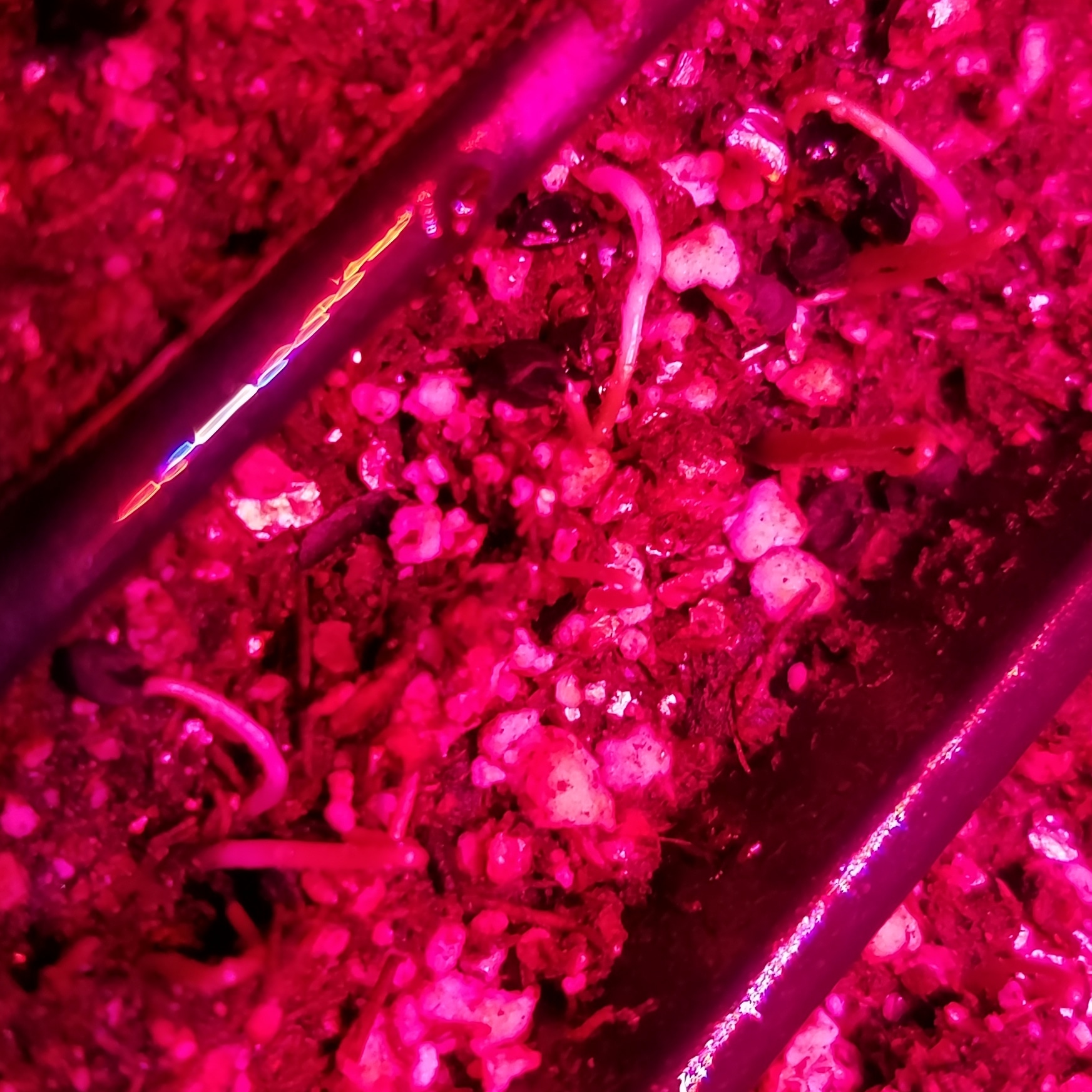
Shallot seeds germinated first this year.

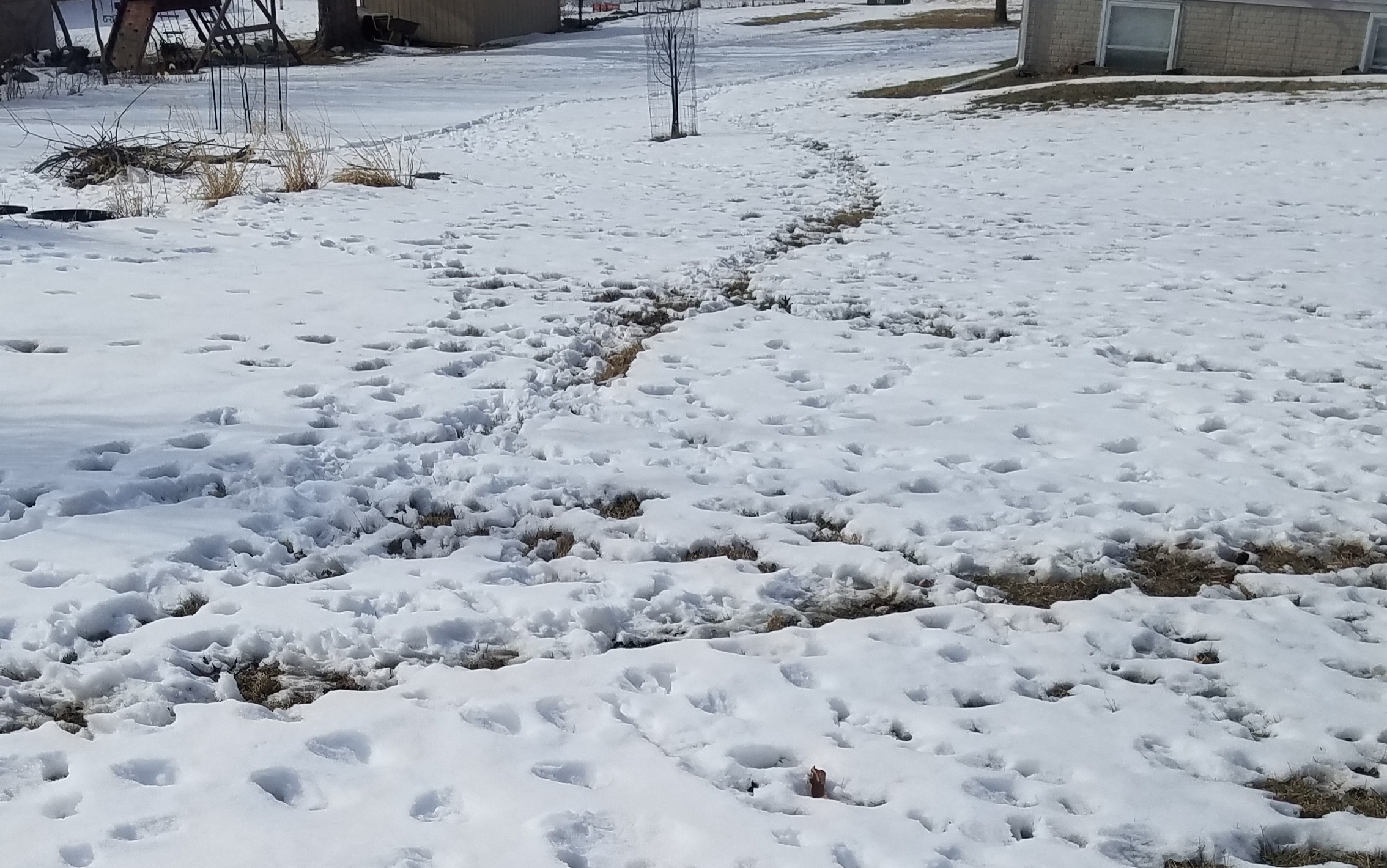
Inconsistent winter weather disrupted fruit tree plans. On Wednesday snow melt began flowing in the gutters and downspout. It felt safe enough to make a trip through melting snow pack to the composter near the garden. A slushy mix returned to the end of the driveway. Weather has been weird.

It takes several days of subzero temperatures in a row to prune fruit trees. I prefer a week of ten or twenty below zero yet we haven’t had that. I also seek to harvest scions, (pencil shaped fruit tree cuttings) to graft on root stock. I would save the Red Delicious apple tree which was damaged in the Aug. 10, 2020 derecho. It served us well while it was whole. Trees need dormancy for scions to work and we haven’t had that either.

This week has been a fake spring. It’s still winter, for Pete’s sake! Yet the buds on trees look healthy, like they are ready to sprout. The lilac bushes were leafing just last month. I wouldn’t mind spring’s arrival yet I want a winter too.

At least the onions and shallots planted Jan. 6 are germinating.

We bunker in to avoid the coronavirus and wait for a deep freeze and dormancy it would bring. These days have been good for writing.

It is difficult waiting for winter and fruit tree work when what we really want is a normal spring. Today, I’d settle for a normal winter so I can harvest scions.

Categories
Environment

Conservatives Have a Climate Caucus

On walkabout, Dec. 18, 2021.

When I wrote my Federal Elected Officials about climate change on Oct. 18, Congresswoman Mariannette Miller-Meeks was first to respond a few days later (see below). I did not know there was a Conservative Climate Caucus. She is a member and lifted the third paragraph of her response to me from the caucus website.

As long as she supports the beliefs of the caucus, there will be trouble reconciling my views with hers. In the long run, that’s okay. It is a starting point and we need to get going. We needed to get going 50 years ago.

The Conservative Climate Caucus was founded by Republican Congressman John R. Curtis (UT-03) in June this year with the following statement of beliefs:

What We Believe

The climate is changing, and decades of a global industrial era that has brought prosperity to the world has also contributed to that change.

Private sector innovation, American resources, and R&D investment have resulted in lower emissions and affordable energy, placing the United States as the global leader in reducing emissions

Climate change is a global issue and China is the greatest immediate obstacle to reducing world emissions. Solutions should reduce global emissions and not just be “feel good” policies

Practical and exportable answers can be found in innovation embraced by the free market. Americans and the rest of the world want access to cheaper, reliable, and cleaner energy

With innovative technologies, fossil fuels can and should be a major part of the global solution

Reducing emissions is the goal, not reducing energy choices

What We Do

Educate House Republicans on climate policies and legislation consistent with conservative values

Organize co-dels and staff-dels to better understand technologies and issues related to climate

Organize Member and staff briefings on conservative climate proposals

Bring Republicans to the table to fight against radical progressive climate proposals that would hurt our economy, American workers, and national security

Introduce Republican members and staff to leaders in industry, think tanks, and more

Conservative Climate Caucus website.

When it comes to hurting our economy, American workers, and national security, engagement of the federal government to address the climate crisis is essential. As long as Iowa focuses on ethanol, industrial agriculture using manufactured fertilizers, and monoculture row crops and livestock, the environment will get worse. It is pretty bad already if one looks at water and air quality. There is not much hope for the Conservative Climate Caucus as it was introduced, yet it’s what we have. It is an open question whether Democrats are up to the challenge of retiring Miller-Meeks after her first term. She is a strong campaigner and well known in the district. We have to begin somewhere, and soon. This may be it.

Email from Mariannette Miller-Meeks, Oct. 22, 2021.
Categories
Environment

Shine More Light on CCS

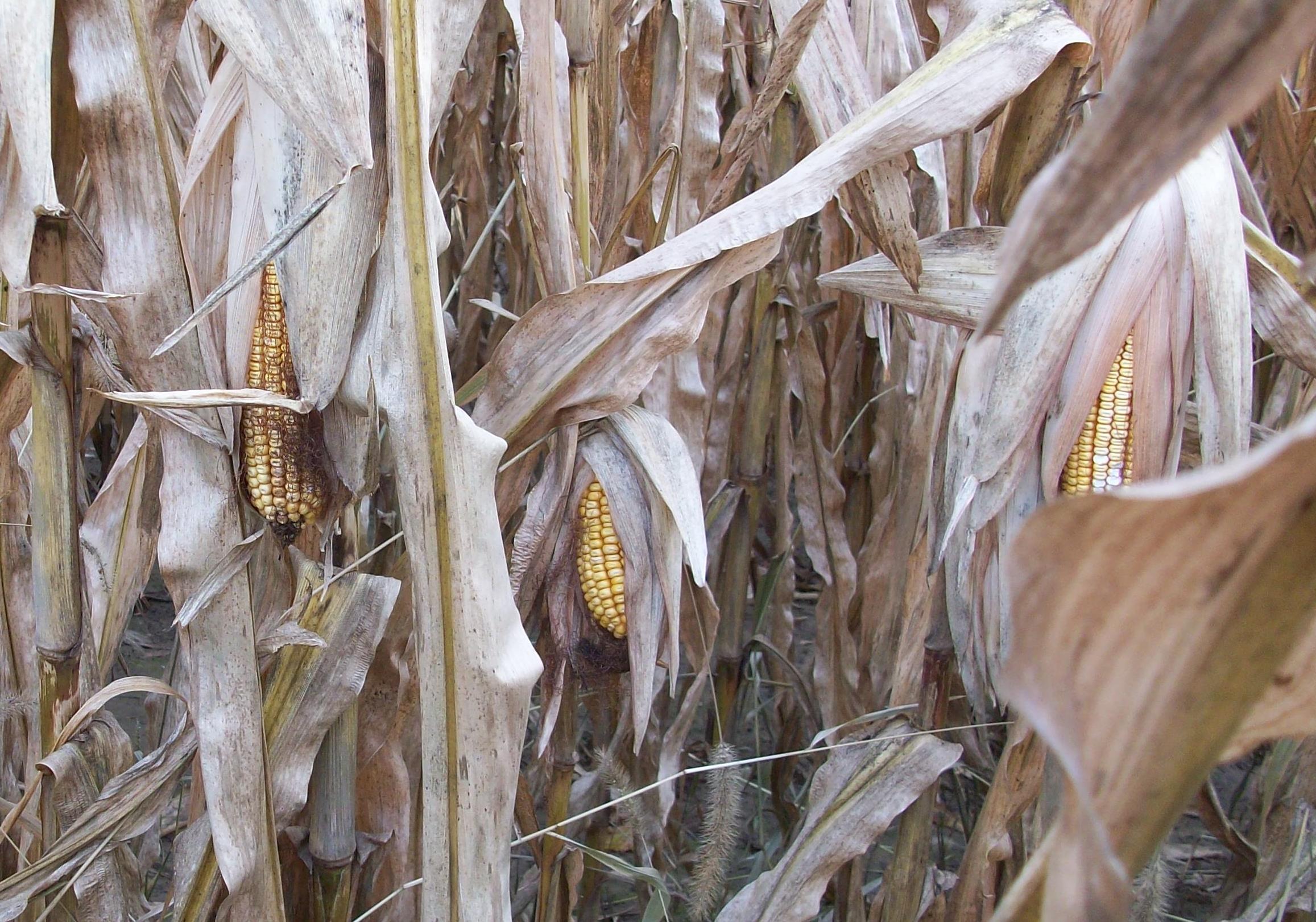
Field Corn

The more sunshine that falls on Carbon Capture and Sequestration plans of Summit Carbon Solutions and Navigator CO2 Ventures the better.

On Sunday, Erin Jordan of the Cedar Rapids Gazette reported something surprising: “Scientists with the Iowa Geological Survey say the state has the underground infrastructure for sequestration here, which would allow Iowa companies to keep more of the federal tax credits for CO2 storage and build fewer miles of new pipelines.”

If CO2 can be stored in Iowa, why build the contentious pipelines from Iowa to North Dakota and Illinois?

“Elizabeth Burns-Thompson, Navigator vice president of government and public affairs, said at a meeting last week Iowa isn’t suited for carbon sequestration,” Jordan wrote. Not so fast say Iowa scientists who produced a study of the matter.

My point in publicizing this article is 1). to thank Jordan for covering an important issue, and 2). what is the rush in building the Summit and Navigator CCS operations?

The climate crisis is an urgent matter now and will escalate in importance during coming years. Before we invest dollars in an unproven, complicated scheme to protect ethanol and fertilizer production in a decarbonized economy, perhaps government should take the lead in determining whether CCS will actually work. In other locations around the world it hasn’t, for example, in Chevron’s operation in Western Australia. Asking the current Iowa government to get involved in examining project viability is contrary to the direction legislators and the governor would take us.

While the federal government budgeted a significant amount of money for CCS, how exactly it will be used is a moving target. Reuters reported “California lawmaker Ro Khanna introduced a bill into the U.S. House of Representatives on Monday that would prevent investors from securing carbon capture and sequestration tax credits if the carbon is used to boost oil production.” Given the propensity of the Congress to support CCS, it seems unlikely Khanna’s bill will see passage. As Reuters reported, “The bill… reflects deep political divisions in Congress over whether and how carbon capture can be used as a tool in the fight against climate change.” Until the Build Back Better Act is passed CCS funding won’t be final. Even then it is subject to modification by the Congress.

As the public and members of news media engage in the Summit and Navigator proposals it should be positive for Iowans. To learn more, check out our updated resource page here. And let the sunshine fall.

~ Written for Blog for Iowa

Categories
Environment

Climate Change Is Missing In CCS Debate

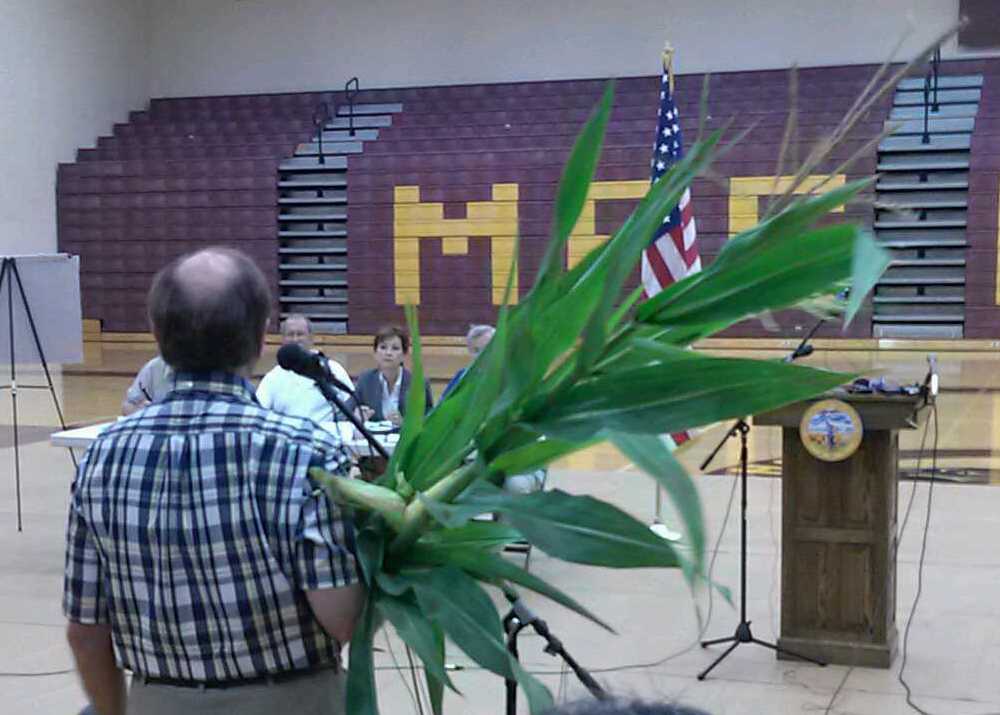
2012 Drought Conference in Mount Pleasant, Iowa

The language used by supporters of carbon capture and sequestration in Iowa is very specific. Not only doesn’t it include the words “climate change,” it specifically avoids mentioning it. This is a long-standing practice among major agricultural groups.

As mentioned last week, Iowa is primarily a production landscape for hogs, cattle, corn and beans where our water, air and land have been and continue to be used like an open sewer. The major agricultural groups are the Iowa Pork Producers Association, the Cattlemen’s Association, the Iowa Corn Growers Association, and the Iowa Soybean Association. Agricultural Iowa is about business at a distance from the meme farmers are the original environmentalists. To them, carbon capture is about business, not reducing greenhouse gas emissions or stewardship of the environment.

Representatives of these agricultural associations showed up in Mount Pleasant, Iowa during the 2012 drought. Governor Terry Branstad and Lieutenant Governor Kim Reynolds heard their report. The words “climate change” were absent from public discussion of the drought.

The eight hundred pound gorilla in the Mount Pleasant High School Gymnasium today was the subject of climate change. Governor Terry Branstad called for a public discussion on drought conditions in Iowa and all of the governmental players were there: USDA, Iowa Department of Natural Resources, Iowa Department of Agriculture and Land Stewardship, Iowa Department of Homeland Security and Emergency Management and the Farm Services Administration. The phrase “climate change,” or any analysis of causation for the current drought was absent from the public discussion. This was a meeting about row crop agriculture and related agricultural producers and it was intended to deal with the as-is situation. The obvious problem, as Mark Schouten of Homeland Security and Emergency Response put it, “you can’t snap your fingers and make it rain.”

Paul Deaton, Blog for Iowa July 17, 2012.

The eight hundred pound gorilla has returned to Iowa as the Iowa Utilities Board hears the case for Summit and Navigator to implement carbon capture and sequestration systems which include hundreds of miles of buried pipeline. The language is familiar in its avoidance of discussion of climate change.

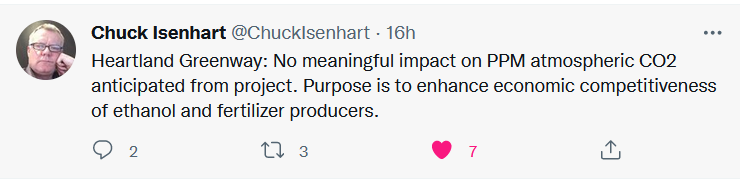
On Monday, Rep. Chuck Isenhart attended a public information meeting held by the Iowa Utilities Board for the Navigator project in Manchester. He used Twitter to relay news from the meeting. If landowners were most concerned with restoration of land productivity in the event the CO2 pipeline crossed their property, following is a main point about the absence of climate change from the discussion:

While the project as proposed would offset the CO2 equivalent of 34.7 million barrels of oil annually, according to Isenhart, “No meaningful impact on PPM atmospheric CO2 anticipated from project.” What is the project about if not reducing greenhouse gases like CO2? “Economic competitiveness of ethanol and fertilizer producers.”

States like California and Oregon have already begun to move toward a low carbon economy, including debate on whether ethanol is a “low carbon fuel.” Let me settle it this way. Summit and Navigator are spending more than a billion dollars to ship condensed CO2 from ethanol and fertilizer plants and bury it deep geological formations. Seems like a lot of carbon dioxide production to me. Why are they doing that?

In a July 2021 letter to President Joe Biden, a group of 70 ethanol producers pledged to reach net-zero carbon emissions by 2050. The main method is carbon capture and sequestration. Why send it?

  • The delay by the Biden administration in release of volume requirements in the Renewable Fuel Standard for 2021 and 2022.
  • The ethanol industry suffered major setbacks in court with the loss of year-round E15 and at the Supreme Court on a small-refinery exemptions case.
  • In response to policies like the Renewable Fuel Standard, California Low Carbon Fuel Standard, and Oregon Clean Fuels Program.
  • President Biden rejoined the 2015 Paris Agreement.

The debate among environmentalists is whether a decarbonized economy reaches net zero emissions or zero emissions. In either case, pairing ethanol and fertilizer production with CCS doesn’t meet the requirements.

The more study of the matter, the clearer it becomes that the Summit and Navigator projects are about making ethanol “competitive” should the economy decarbonize. It is a big hedge against a government directive to eliminate the financial and policy incentives to produce corn for ethanol.

Opposing production of corn ethanol is not a popular position in Iowa because more than half of corn raised is feed stock for ethanol. However, it is the right position.

~ Written for Blog for Iowa

Categories
Environment

Miller-Meeks, COP26, and the Climate Crisis

Woman Writing Letter

Miller-Meeks attended COP26, but her record on climate isn’t promising

To address global carbon pollution everyone must get involved. Even Republicans understand this. In response to the climate crisis, and to political pressure, Republican Congressman John R. Curtis (UT-03) launched a “Conservative Climate Caucus” last June. My member of Congress, Rep. Mariannette Miller-Meeks joined.

Solutions to the climate crisis will take government at all levels. In the United States, only the federal government has the reach to take effective national action which could impact the globe.

To my surprise, Miller-Meeks showed up at the 26th Conference of the Parties in Glasgow, Scotland, where she participated in a podcast with other caucus members extolling the positions of conservatives on climate.

“As a member of the Conservative Climate Caucus this issue is important to my colleagues and myself,” she wrote me in an email.

Well okay. Welcome aboard, I think.

Miller-Meeks’ votes against the Infrastructure and Investment Jobs Act and the Build Back Better Act, both of which address the climate crisis, indicate she is not really on board with federal climate action.

For a Republican to admit they have a problem is the first step toward recovery. Let’s hope Miller-Meeks can resist her addiction to D.C. talking points and do something positive to address carbon pollution.

~ Published in Little Village Magazine Dec. 6, 2021, Iowa City Press Citizen on Dec. 8, 2021, Cedar Rapids Gazette on Dec. 11, 2021.

Categories
Environment

Don’t Pass the Climate Buck to the Next Generation

Finn Harries and All Gore at the Climate Reality Project leadership training in Cedar Rapids, Iowa on May 7, 2015. Photo Credit: Finn Harries Twitter account.

In 2015, Finn Harries sat at our table during former vice president Al Gore’s Inconvenient Truth presentation in Cedar Rapids. I didn’t know his history as a YouTuber with his identical twin brother Jack. I was assigned as his mentor during the training yet Finn didn’t need a mentor to work on the climate crisis.

Friday, Nov. 26, Finn Harries made this statement on Instagram after attending COP26 in Glasgow, Scotland:

One of the responses I often hear from older people when I talk about the work I do is “your generation gives me hope”… but this is the wrong way to think about how we go about tackling the climate crisis. In effect, this is the same strategy that has got us so deep into this mess… just passing the problem down to the next generation. What’s different this time is that we don’t have enough time to wait for our generation to be in institutional seats of power… we don’t have any time at all. So we’re flipping it around. We’re passing the problem back, up to those who can actually instigate change. Our role as young activists is to hold people in positions of power to account. To make sure they do what they’ve said they will do. In this way, we all have a critical role to play.

Finn Harries Instagram Account Nov. 26, 2021.

Harries is right. It will take all of us to make a difference during the climate crisis. In the U.S. we are not doing enough to hold people in positions of power to account.

According to a recent Washington Post – ABC News poll, “A clear majority of adults say that warming is a serious problem, but the share — 67 percent — is about the same as it was seven years ago, when alarms raised by climate scientists were less pronounced than they are now.” What will move the public opinion needle and lead to effective climate action?

In Iowa, the effects of climate change are clear. I outlined some of them in a letter to my federal elected officials. What are the two Carbon Capture and Sequestration pipelines to transport liquefied CO2 from Iowa to North Dakota and Illinois but a response to the need to reduce CO2 emissions into the atmosphere? Our political leaders don’t even acknowledge the climate crisis while supporting CO2 removal from the atmosphere.

We do have a critical role to play to prevent the worst effects of global warming. Implementing a solution will require us all.

Here is the YouTube video Finn’s brother Jack Harries made for the Conference of the Parties 26 in Glasgow, Scotland. It features an interview with former president Barack Obama. Young people like the Harries twins are not buying much malarkey. We, as a society, need to act.

Categories
Environment

Here Comes Carbon Capture Technology

Contains 10 Percent Ethanol

Let’s be clear about Carbon Capture and Sequestration: it is an unproven technology to enable fossil fuel use when society should be turning away and leaving fossil fuels in the ground. Among the problems with the technology is our government supports it to the tune of $8.5 billion in the Infrastructure Investment and Jobs Act recently signed into law by President Joe Biden. There is more money for CCS in the Build Back Better Act as currently written. Why would our government do that?

The answer is a familiar one. Oil, gas and coal interests have too much invested to let go of their extraction and distribution operations. During negotiations between the White House and U.S. Senator Joe Manchin, support for CCS was included in both bills. Manchin’s vote was needed to pass the legislation.

In addition to funding CCS technology, the Biden administration appointed a prominent supporter of it, Brad Crabtree, a coal ally and longtime carbon capture advocate, to serve as the Department of Energy’s Assistant Secretary for Fossil Energy and Carbon Management. While negotiations over the infrastructure bills were private, Manchin is said to have had a hand in Crabtree’s nomination. Oil, gas and coal advocates let loose a loud cheer of approval upon the announcement.

The question is whether substantial government investment in CCS via the infrastructure bills was a poison pill for environmentalists. Only a few people are asking that question here in Iowa, and fewer still knew what was in the bills. Inclusion of CCS was apparently not too toxic for environmental hawks in the U.S. Congress as it was accepted as part of the sausage-making process of creating legislation.

The partisan lines are clearly drawn. The Republican view of climate action is “with innovative technologies, fossil fuels can and should be a major part of the global solution.” Most Democrats “support increased domestic renewable energy development, including wind and solar power farms, in an effort to reduce carbon pollution. The party’s platform calls for an ‘all of the above’ energy policy including clean energy, natural gas, and domestic oil, while wanting to become energy independent.” It’s no wonder CCS made it into the first infrastructure law, and will into the second if it is passed by the Congress.

The Iowa governor’s task force on carbon sequestration quickly led to Iowa going all-in on the technology, with two proposed Iowa projects. The Iowa Sierra Club opposes them.

We want real climate solutions – not greenwashing schemes!

Iowa has two new pipeline proposals. Both are centered around Carbon Capture and Storage (CCS). The lines would carry captured carbon from ethanol plants. CCS is very complicated but when you boil it down, the basic premise is that it captures the carbon and stores it underground (CCS) or it captures the carbon and uses it for industrial purposes. Both Summit and Navigator pipelines claim that they are going to permanently store the CO2 underground, but we have strong evidence that Summit will use the CO2 for Enhanced Oil Recovery (EOR). EOR is the process of pumping CO2 into dwindling oil fields to get the last bit of oil out of the ground. The two pipelines in Iowa are being offered as false climate solutions, especially if they will be utilized for enhanced oil recovery and extending the life of coal-fired power plants and the ethanol industry.

We already know the solutions to our climate crisis – we must end our dependence on fossil fuels and invest in solar, wind, battery storage, conservation and efficiency!

Sierra Club website.

Click on this link to learn more about actions you can take to oppose the Iowa CCS projects. Click here to sign the Sierra Club petition on CCS.

Categories
Environment

Time for Republicans to Act on Climate

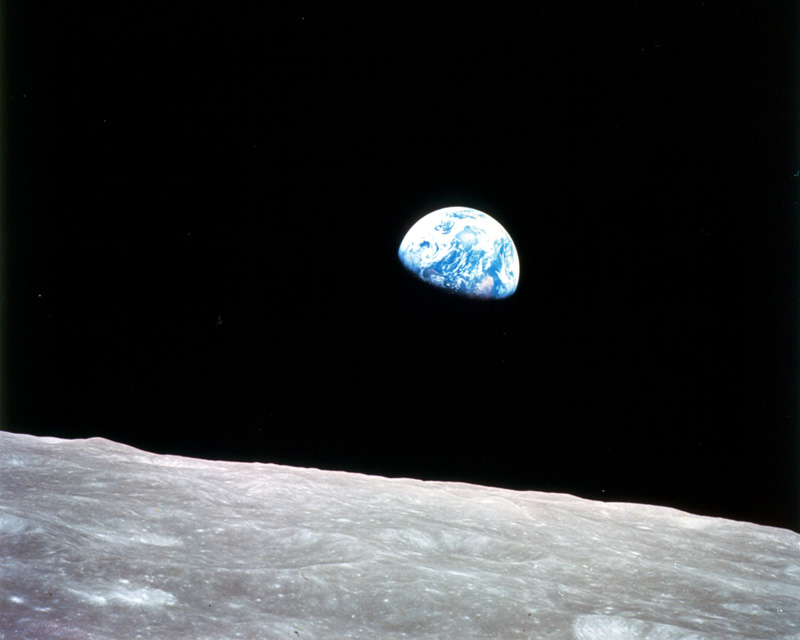
Image of Earth 7-6-15 from DSCOVR (Deep Space Climate Observatory)

We witnessed climate change in Eastern Iowa. For me, it’s personal.

• The 1993 flood delayed progress building our home as we moved from Indiana.

• We experienced multiple straight line wind events that damaged the house, uprooted trees, blew down large branches, and tore through our neighborhood.

• Record flooding in 2008 filled much of the Iowa and Cedar River basins, backing up water into the Lake Macbride watershed to within 100 yards of our home. It made roads around us impassible and devastated many nearby places.

• Record drought in 2012 made life outdoors miserable. It negatively impacted crops. Corn yield in Johnson County decreased from 171.9 bushels per acre in 2011 to 132.4 in 2012, a 23 percent drop.

• There was a derecho on Aug. 10, 2020. In our yard it took down one tree and damaged several others. My greenhouse lifted into the air like Dorothy’s farmhouse in the Wizard of Oz. Winds up to 140 miles per hour destroyed 70 percent of the tree canopy in Cedar Rapids.

I know about climate change from living it, as do most Iowans. It’s time for our Republican members of Congress to work with Democrats and take action to mitigate it.

~ Published in the Iowa City Press Citizen on Oct. 30, 2021.

Categories
Environment

Retro Post: Climate Change is Real

Photo taken by the author.

First published on Iowa City Patch on July 13, 2013.

Climate Change is Real

Last week was arguably the best summer weather we have had in many years. Temperatures were moderate and humidity low; some rain, but not too much; and glorious partly cloudy skies coupled with a light breeze. A bit of imitation vanilla extract on the nose, and even swarms of gnats couldn’t spoil the enjoyment.

Everyone I know who has a garden is having an abundant year of produce. Foragers can find plenty of black raspberries, and while the Iowa DNR sprayed the lily pads on Lake Macbride near Solon, one more toxic substance in the water won’t kill us — we hope.

Climate change is real. Any question that greenhouse gases are warming the planet, and are caused by human activity has fallen away to leave the more appropriate one, “what will we do about climate change?” The crazy weather we have been experiencing recedes from view on days like last week, while coal and natural gas power plants continue to dump CO2 pollution into the atmosphere like it was an open sewer to air-condition our homes. There are two issues: protecting what we hold dear from the effects of climate change, and doing something to address the causes of greenhouse gas emissions.

While addressing climate change is complicated, things we can do to help are not. Reduce energy use at home by turning off lights after leaving a room and unplug your computer and mobile phone chargers when they are not in use. Change how we think about transportation by consolidating errands. We should be doing these things anyway.

The point is not to radically change how we live, but to join the vast majority of Americans in acknowledging that climate change is real, and poses a tangible threat to how we live. Then take steps to personally do something about it. You will be glad you did.