Categories
Environment Reviews

Reading Naomi Klein

This Changes EverythingUnlike the climate crisis story spoon fed to us in decreasing numbers of corporate media stories, in social media memes, and in fleeting conversations at community gatherings, in This Changes Everything: Capitalism vs The Climate, author Naomi Klein said there is a nascent, global movement preparing to take climate action.

“The climate movement has yet to find its full moral voice on the world stage,” Klein wrote. “But it is most certainly clearing its throat—beginning to put the very real thefts and torments that ineluctably flow from the decision to mock international climate commitments alongside history’s most damned crimes.”

If you haven’t read Klein’s 2014 book, you should. Not because of a desire to take sides in the public discussion of global warming and the need to keep global temperature increase to two degrees or less. But because a). reading a paper book can be good for us, and b). with Klein you can hear her broader story and learn new things. Here’s more on why you should pick up a copy at your library or bookstore if you haven’t already.

In Iowa, as home to the first in the nation caucuses, we are inundated with stories about politics. Elections matter, and we have seen how in the Republican awakening after Barack Obama’s 2008 election. Progressives hardly understood that Republicans, though in the minority in the Congress, would exercise such power that much of Obama’s agenda was sidelined from the beginning. Republican comebacks in 2010 and 2014 have turned the congress from Democratic to Republican, and right-wing hardliners have more input to the legislative process than their numbers warrant. Taking climate action in Congress has, for the most part, been a non-starter.

“It’s not just the people we vote into office and then complain about—it’s us,” Klein wrote. “For most of us living in post-industrial societies, when we see the crackling black-and-white footage of general strikes in the 1930s, victory gardens in the 1940s, and Freedom Rides in the 1960s, we simply cannot imagine being part of any mobilization of that depth and scale.”

“Where would we organize?” Klein asked. “Who would we trust enough to lead us? Who, moreover, is ‘we?'”

Klein’s book frames answers to those questions: People are organizing everywhere, resisting unbridled extraction of natural resources by corporations. “We” includes almost everyone.

This Changes Everything reviews the recent history of the climate movement. It covers extreme extraction of natural resources that leave behind waste heaps, fouled water and polluted air, then are burned and produce atmospheric gases that warm the planet. Everyone from fossil fuel companies to environmental groups have been involved in what Klein calls “extractivism.” There is a growing resistance, including environmental groups divesting from investments in the fossil fuel industry, indigenous people mounting court battles, and community groups violating international trade agreements to move to renewable energy sources. The book is a snapshot of where the climate movement currently stands.

While Klein has her point of view, she depicts the complexity of a global network of fossil fuel companies seeking to extract hydrocarbons scientists tells us must be left in the ground. While the resistance may not have found its full moral voice, Klein’s book makes the case it won’t be long and recounts the significant inroads indigenous people and communities near extraction sites are making.

When we talk about taking climate action, Naomi Klein’s work should be part of our conversation.

~ Written for Blog for Iowa

Categories
Environment

The Senator and the Sierra Club

The exchange between U.S. Senator Ted Cruz and Sierra Club president Aaron Mair during an Oct. 6 Senate judiciary subcommittee hearing was a brief flash in the news cycle. Was it also a debate about climate change?

The subject was to have been the impact of federal regulations on minority communities. The junior senator from Texas turned it into something else — a desultory grilling of Mair in which he brought out some old sawhorses from the climate denial tool shed. Here is the exchange:

Sierra Club board member Donna Buell posted this on Facebook after the hearing:

Donna Buell FB Snippet 10-09-15

Mair was quick to reply on behalf of the Sierra Club:

View the entire two-hour hearing if you have the stomach for it here.

Cruz asserted in an Oct. 7 press release he “proved, contrary to liberal assertions that man-caused climate change is ‘settled science,’ that there is still a healthy and vigorous debate about the causes and nature of climate change based on the data and scientific evidence.”

So does Cruz picking a fight indicate debate? Decidedly not. In fact, as Mair pointed out in his video response, Cruz’s claims during the hearing have been debunked by the National Oceanic and Atmospheric Administration, an agency over which Cruz has oversight in his role as chair of the Senate Committee on Commerce, Science, and Transportation.

What’s this about?

It is about the attempt of right wing politicians like Cruz to hijack reasonable discussion among people with differing opinions in favor of a personal agenda.

On Oct. 12, I was part of a Sierra Club panel of presenters in which I suggested attendees could continue the discussion Cruz and Mair started by bird dogging Cruz in Washington, Iowa Wednesday morning.

Miriam Kashia, a veteran of the Great March for Climate Action, raised her hand and said, “I’ve done that.”

She reported the incident in an Oct. 13 guest opinion in the Iowa City Press Citizen,

Then, during a media interview with Sen. Ted Cruz speaking about the terrorist threat, I jumped in and asked him, “What is your response to the fact that the Pentagon tells us that climate change is the biggest threat to America’s security?” His response, “You don’t have the right to ask any questions, because you’re not a member of the media.” The media, meanwhile, was not doing its job.

Statements by Cruz and his ilk so often go unchallenged. People agree with him, and in Texas helped elevate him to power in 2012. His supporters are vocal and much of what is said serves the conservative agenda or it doesn’t get heard. I don’t doubt there is a Cruz community that buys into his world view, even though it appears to be based in something other than reality.

What becomes clearer each time people like Cruz are examined is nothing is behind the verbiage but vapidness. Sarah Beckman pointed this out about Cruz in an Oct. 13 post on Iowa Starting Line.

If you spend enough time with Republican presidential candidate Ted Cruz, you start to get the feeling that there is something “off” about him. His long pauses, his forlorn looks out into the audience, his deep crescendos and trailing whispers, his odd pop culture references. They all paint the picture that Cruz is maybe not as honest and authentic as he lets on while campaigning.

Never is Cruz talking about what we have in common, about how we can live better with each other, or how we solve the greatest problems of our time, like mitigating the causes of global warming.

Elections matter, and when the electorate elevates people like Cruz to positions of power over NASA, NOAA and the government’s scientific bodies, we are doing ourselves no favors.

If readers plan to move to Texas to sort out this mess, and elect someone who will enter the arena to fight for all of us, then God bless. I don’t see that happening.

Cruz gives us reason enough to engage in politics. Leaving important political work to others helped produce Senators Cruz, Ernst and Grassley, and the troubled time in which we live.

There is a better way, and it’s up to us to find and follow it.

~ Written for Blog for Iowa

Categories
Environment

Electricity and Our Future

Annual MeetingIt would be great to just plug into a socket, use electricity and be done with it. There’s more to it than that.

We take lighting after sundown for granted, as we do preserving food in the ice box and proper functioning of the myriad of appliances in a modern home.

Since before the Christian Era, humans have attempted to understand how our universe works. I was reminded of this while doing research on tonight’s supermoon lunar eclipse, the mechanics of which were worked out by the ancients around 200 B.C.E., according to Robert Mutel at the University of Iowa.

Since the industrial revolution began, humans have increased development of community solutions to improve lives. The expansion of electrical usage is one of the great things to emerge, transforming lives where whale oil, then kerosene were the primary fuels used to illuminate darkness.

People continue to pay limited attention to electricity. Friday the Linn County Rural Electric Cooperative annual meeting was held at the Teamsters hall in Cedar Rapids.

The report from staff was that while the number of new connections was down in 2014, crews found plenty of maintenance work to do. The organization is financially sound.

The event turns out a lot of elderly couples who use the occasion to get out of the house, socialize with friends and neighbors, and take advantage of the free lunch, door prize drawing and gifts. Among this year’s gifts was a portable mobile phone charger, something even octogenarians might use.

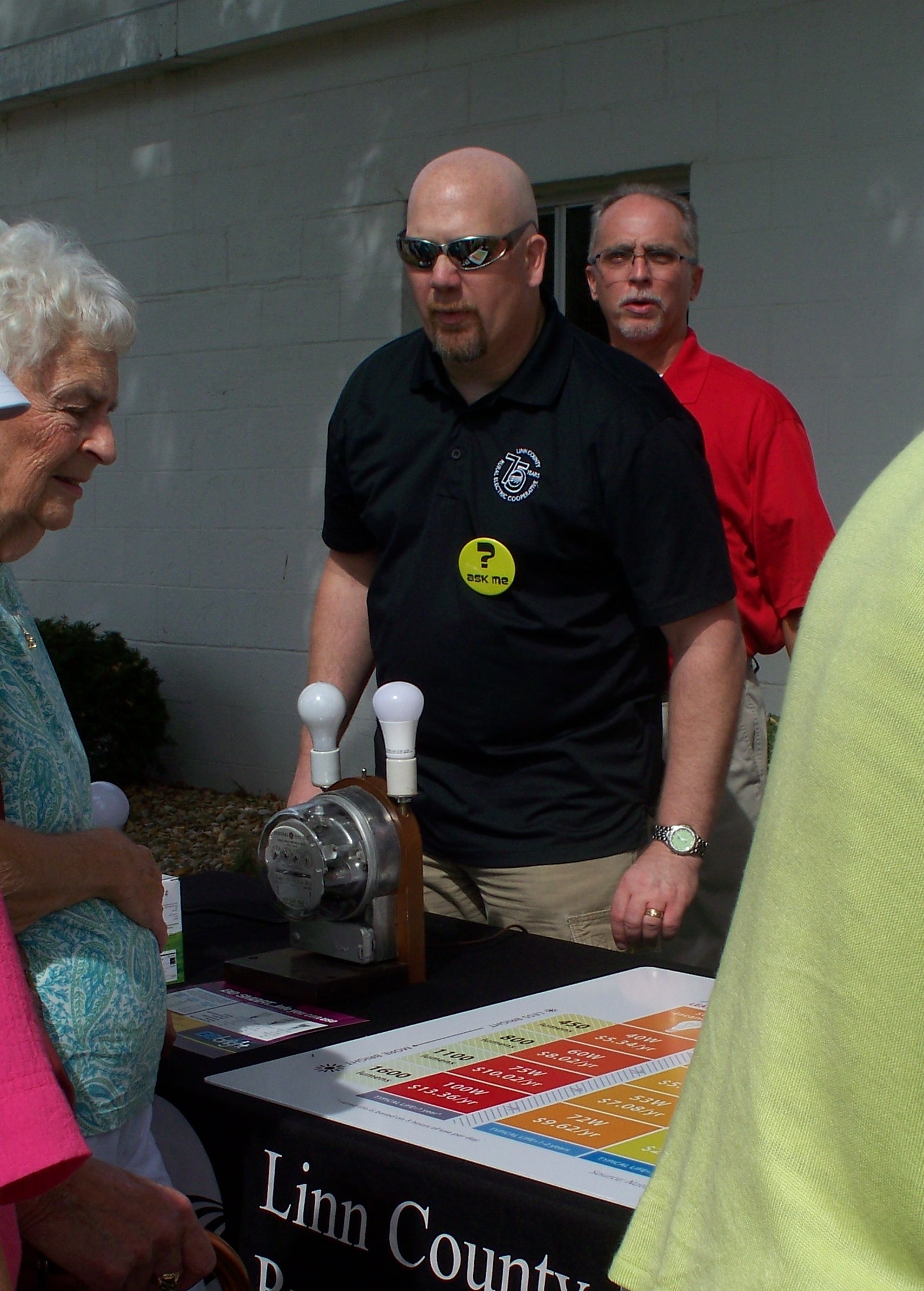
LED - Incandescent Light Bulb Demonstration
LED – Incandescent Light Bulb Demonstration

A demonstration comparing electricity usage of incandescent and LED light bulbs was set up outside. When the demonstrator threw a switch, changing which bulb was turned on, the change in speed of the rotating gear on the electrical meter indicating usage was obvious. The message was buy energy efficient light bulbs and when you do, look at the number of lumens rather than wattage when picking one.

While attendees ate lunch from their laps on folding chairs — choice of cheeseburger or chicken sandwich with sides of baked beans and potato salad — a slide show enumerated financial incentives for home owners and businesses to take advantage of to reduce electricity usage when installing new appliances or constructing a new home or business.

Would that life were so simple when it comes to electricity.

The REC has this statement about how their electricity is generated on its current website.

Linn County Rural Electric Cooperative is committed to providing electricity that is reliable, cost effective and sustainable. One hundred percent of our electric power needs are provided by Central Iowa Power Cooperative (CIPCO), a generation and transmission cooperative.

CIPCO meets our energy needs with a diverse fuel mix of coal, nuclear, hydro, landfill gas, wind, natural gas and oil energy resources. In 2013, approximately 95 percent of the power CIPCO provided to its members was generated right here in Iowa; and over 60 percent of its electricity is generated from carbon free resources that minimize the impact to our natural environment.

Specific generating capacity is listed on the CIPCO website.

CIPCO Map of Generating Sources 9-27-15

There is some political posturing here, in that CIPCO draws electricity from the NextEra Duane Arnold Energy Center, Iowa’s lone nuclear reactor. One assumes that is part of the “carbon free resources” mentioned, even though tremendous carbon-based resources are used in preparation for the moment heat is produced by nuclear chain reaction to boil water.

There’s probably more obfuscation here if one took the time for analysis. It’s not worth the time. Scientific evidence is clear that the ceaseless emission of CO2 pollution by electricity generation stations using fossil fuels is a primary cause of global warming. If people are distracted and assuaged by door prizes and flowery language, they won’t be for long. Global warming is impacting our climate in a pronounced, negative (to humans) way.

The Environmental Protection Agency recognized CO2 as a pollutant and this summer rolled out new regulations in the Clean Power Plan. As with all things governmental, there is a political aspect to the plan. Some states are resisting implementation.

Each state is required to locally implement the Clean Power Plan. In many ways the Clean Power Plan is an opportunity for democratization of how energy is produced and used, and we should take advantage of it, said historian and political economist Gar Alperovitz. He called for “an all-out mobilization with potentially far-reaching consequences,” as states adopt a plan.

In Iowa, Governor Branstad has been resistant to the Clean Power Plan, saying only that he would wait and see the final regulations before commenting. The future is well known as Iowa has consistently said the state will adopt no stricter regulations than those required by the federal government. One expects the state to take minimal steps in compliance, and only after hearing from the American Legislative Exchange Council, and waiting out initial litigation regarding the new rules.

The trouble is transition to renewable, carbon-free sources of electricity can’t occur fast enough to undo the CO2 pollution already emitted into the atmosphere. Urgency at our annual REC meeting only took the form of opening water bottles and cutlery packs with reduced physical capacity.

A lot of good work is going on regarding development of new electricity sources that directly harness the wind and sun. Our future is to accelerate development and implementation of carbon-free, nuclear free electricity. That means a lot more than using the phrase on the REC’s website or in a blog post.

People don’t react well to non-imminent threats. Our future is raising awareness of the climate crisis without causing people to withdraw from society.

While looking up a link for this post, I saw a Bobby Jindal web ad on my article. Jindal referred to the negativity in our world and said, “It’s time to turn to God.” Maybe. For those of us already oriented that direction, there is plenty of work to be done on earth to improve the human condition. Mitigating the causes of global warming is an important part of it.

Categories
Environment

Denial and Denali

Denali Photo Credit - Wikimedia Commons
Denali Photo Credit – Wikimedia Commons

Environmentalists are having trouble wrapping their head around a president who visited Alaska above the Arctic Circle on Wednesday to speak on the need to mitigate the causes of climate change, while at the same time on Aug. 17 approved Royal Dutch Shell’s exploration and development of oil there.

It’s not that hard because the challenge of our time is the lack of political will to take action to reduce CO2 emissions in a culture dependent upon fossil fuels. The problem is politics, not physics.

Bill McKibben expressed the sentiment concisely:

It’s no use crying Bill McKibben’s tears.

In 2014, the U.S. used 6.95 billion barrels of crude oil with 27 percent being imported, according to the U.S. Energy Information Agency. That’s 19.05 million barrels per day, including biofuels. Most of it is for gasoline, diesel, jet fuel, heating oil and liquefied petroleum gas. (The EIA explains how the oil was used here).

During President Obama’s administration the U.S. took substantial action to reduce dependence on imported oil. During the eight years of President George W. Bush, the country imported 28.6 billion barrels of oil or 3.574 billion barrels per year on average. In 2014, the U.S. imported 2.68 billion barrels or 25 percent less than the Bush average.

The rub is that in order to reduce imports, the Obama administration encouraged domestic production through an all of the above strategy that included hydraulic fracturing and increased exploration and discovery like Royal Dutch Shell had been doing in the Arctic in 2012. The strategy worked, and has been revitalized, but at what cost?

Doing nothing about global warming is not an option. The Obama administration has been and is doing something significant. As much as some would like to shut down the coal trains, end hydraulic fracturing and stop drilling for oil – leaving fossil fuels in the ground – it is only beginning to happen under Obama. Whoever is president in 2017, an “all of the above” strategy would mean quite different things with a Democrat or Republican in office.

Scientists understand the basic physics of global warming, and mostly have since the mid-1800s. As long as there is demand for fossil fuels, there is no reason to think exploration and discovery by oil companies will end any time soon. The problem with denial is not so much with political climate deniers. The physics will out, hopefully not too late.

A bigger problem is denial of our addiction to fossil fuels. Most continue to use them like there is no tomorrow. A reckoning is coming and it will take more than renaming that mountain to climb it.

~ Written for Blog for Iowa

Categories
Environment

Oak Leaf Tatters and Herbicides

White Oak Leaf Tatters
White Oak Leaf Tatters Photo Credit Plant Management Network

What to make of a study of the impact of herbicide drift from farming operations on oak trees?

In a peer reviewed 2004 study at the University of Illinois, Department of Natural Resources and Environmental Sciences in Urbana, Ill., scientists found drift of chloroacetamide herbicides is a possible cause of the leaf tatters syndrome in White Oak trees.

During the last few decades, white oak (Quercus alba L.) in the north central region have developed malformed spring leaves often called “leaf tatters.” The symptoms begin with the death of some interveinal leaf tissues, eventually leaving only the main leaf veins with little interveinal tissues present (See Illustration Above). Leaf tatters reduces the overall canopy of trees, making them more susceptible to other stresses. Leaf tatters has been reported in Illinois, Indiana, Iowa, Michigan, Minnesota, Missouri, Ohio and Wisconsin.

It’s a single study, probably not enough data to fully ratify the relationship, even if there is concern among foresters about how herbicide drift may be affecting stands of trees in both urban and rural areas.

The topic is worth more study than it is getting, as chloroacetamide is the active ingredient in a number of herbicides used with row crop corn and soybeans.

Preserving our woodland heritage is more complicated than letting a stand of trees go on as it has. Existing oak-hickory forests are being subjected to a wide range of stress including growth of invasive species below the canopy, and a lack of significant events, like forest fires, to remove mature trees, permitting new growth. After being in place for thousands of years, the oak-hickory forest will become a thing of the past without modern forestry management.

If there are other studies of the impact of herbicide drift on forests, I couldn’t easily find them. In fact, I had to contact an acquaintance to locate the study referenced in this post. Besides a small group of scientists and foresters, I don’t know who else is even looking at this.

What this study suggests to me, and to others whose opinion I value, is chemical drift from large scale farming operations can impact life in urban areas where most of the population lives.

As we escape rural areas in favor of cities we remain connected to what goes on in the country. Part of that, perhaps, includes maladies caused by chemical drift from large farms.

It is time we, as a society, spent time and resources determining what the relationship between chemical drift and our lives in the city is.

Categories
Environment

EPA Clean Power Plan Adopted

WHY-WHY-NOT-MELBOURNE2-4_0Monday the Obama administration formally adopted the Clean Power Plan with targeted reductions of greenhouse gas emissions from coal-fired power plants of 32 percent by 2030 compared to 2005 levels.

If readers care about mitigating the causes of global warming and ceasing the practice of dumping more than 110 million tons of CO2 into the atmosphere each day as if it were an open sewer, this is it.

This is the majority of the United States plan to reduce emissions at the 21st United Nations Conference of the Parties in Paris (COP21) this December. It’s what we plan, as a nation, to do about climate change.

Adoption of the Clean Power Plan is expected to be greeted with derision, litigation, delay, obfuscation, contempt, denial and politically correct, but meaningless statements.

The Environmental Defense Fund, The Nature Conservancy and the World Wildlife Fund US queried 50 companies for their position on EPA’s Clean Power Plan. Their carefully worded responses are here.

They range from this:

Starbucks signed the Ceres letter supporting the EPA Clean Power Plan.”

to this:

“We don’t have a position on the EPA’s proposed Clean Power Plan, and Target does not support the US Chamber’s position.”

to this:

Cargill is part of Risky Business to lead a dialogue across the philosophical spectrum about the long-term impact that climate change could have on the ability to produce food and the ways that agriculture can adapt to ensure global food security. We believe progress can best be made by engaging with groups and discussing our point of view. In fact, Greg Page, former CEO of Cargill, briefed Tom Donahue, president and CEO of the US Chamber of Commerce, this summer about the Risky Business project and its findings. We also spoke with the Farm Bureau about the Risky Business report and asked their advice about how to effectively engage farmers on the climate change issue.”

to this:

Caterpillar filed comments with EPA opposing the coal-plant rules. The company said: ‘Caterpillar strongly urges EPA to withdraw the Proposed Rule in order to (1) reevaluate the agency’s legal authority to establish requirements on both the entire electric sector and end-users of electricity; (2) conduct a more full and realistic estimate of the economic impacts of its proposed rule; (3) consider changes that avoid the adverse impacts outlined in these comments; and (4) provide guidance to states so that they have the tools necessary to minimize adverse impacts as they construct compliance plans.’ In its sustainability report, Caterpillar says: ‘We support intelligent, responsible public policies addressing climate and energy issues.’”

Gov. Terry Branstad has been critical of the proposed clean power rule, saying it will push energy costs higher and “hurt Iowa consumers and cost Iowans jobs,” according to the Des Moines Register.

If everyday Iowans don’t support the Clean Power Plan, then what? Doing nothing is not an option when it comes to mitigating the causes of climate change, and the Clean Power Plan is something.

There are few better options to take climate action than supporting the Clean Power Plan. Letting government officials know of your support is part of the picture, but what matters more is making the discussion part of everyday life. We may be accused of being “political” in our social circles, and that may be better than suffering the consequences of inaction, now and going forward. The Clean Power Plan is a solution worthy of our support. As the administration adopts it, so should we.

~ Written for Blog for Iowa

Categories
Environment

DSCOVR Our Blue Marble

Image of Earth 7-6-15 from DSCOVR (Deep Space Climate Observatory)

This week NASA released new photographs from the DSCOVR satellite launched Feb.11 from Cape Canaveral. DSCOVR, or Deep Space Climate Observatory, is a NOAA Earth observation and space weather satellite. DSCOVR arrived at the L1 Lagrangian point, roughly 1 million miles from Earth, on June 5 and part of its mission is to photograph Earth and transmit images every two hours.

DSCOVR is the result of work initiated in 1998 by then vice president Al Gore. We take for granted the images of the fully illuminated Earth, but for most of the last 35 years, it has been the same set of images taken Dec. 7, 1972 by the crew of the Apollo 17 spacecraft.

Senator Ted Cruz, chair of the U.S. Senate subcommittee on space, science and competitiveness which funds NASA, has said NASA should spend less time studying the planet and more time finding ways to go out into space. Cruz views much of Earth study as “political distractions that are extraneous to NASA’s mandate.”

NASA Administrator Charles Bolden begs to differ.

“Our core mission from the very beginning has been to investigate, explore space and the Earth environment, and to help us make this place a better place,” Bolden said. “It is absolutely critical that we understand Earth’s environment because this is the only place that we have to live. Science helps exploration; exploration helps science.”

Whatever one thinks about the politics of NASA, the new images coming from DSCOVR remind us Earth is our only home, and there is no Planet B.

~ Written for Blog for Iowa

Categories
Environment

Iowa’s Algae Blooms

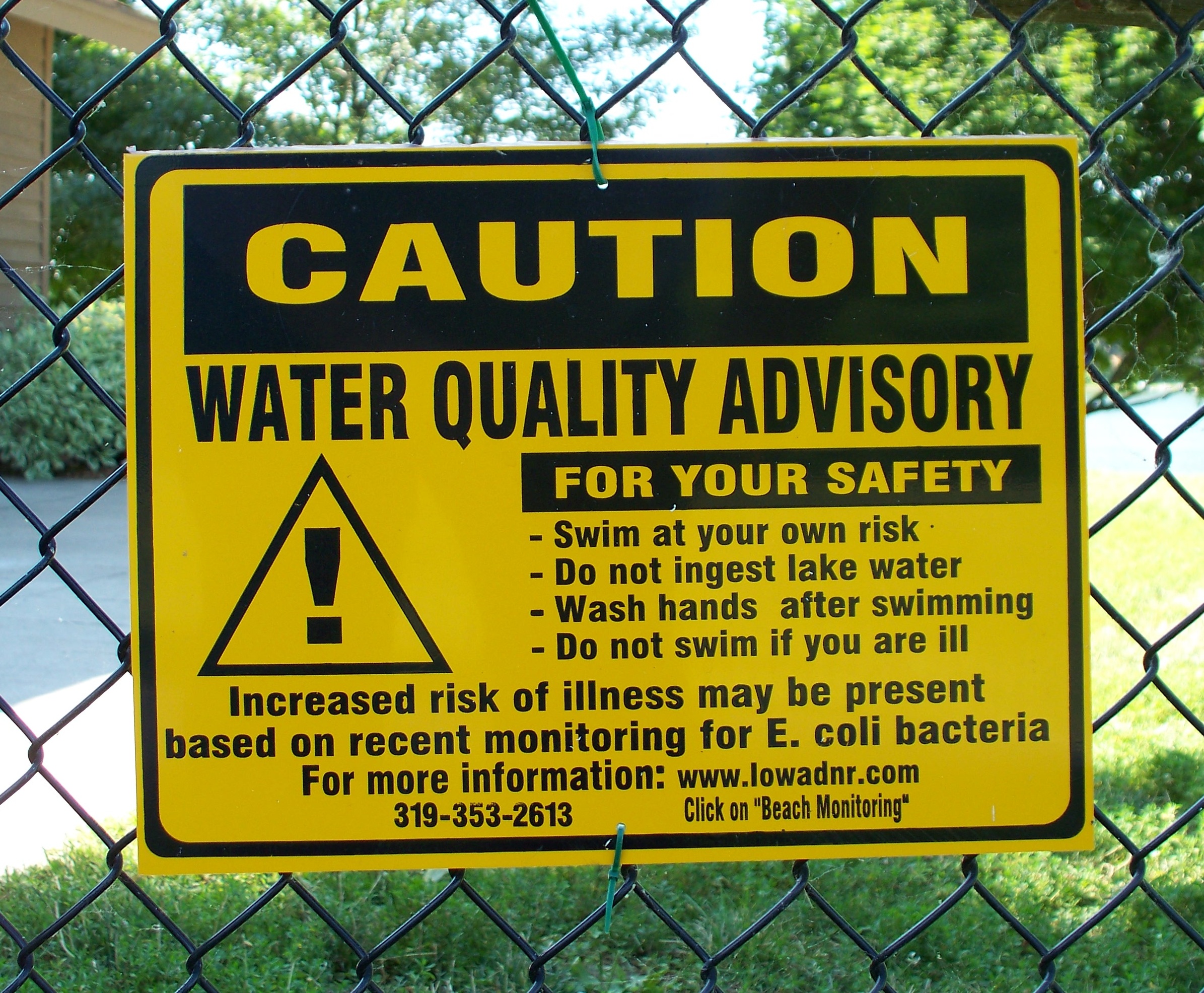
Bacteria Notice on Lake Macbride

Iowa recreational lakes have become a nutrient-rich soup in which blue-green algae thrives. The Iowa Environmental Council won’t say what I will: nutrient runoff from agriculture, and to a much lesser extent from home lawn applications, is a key ingredient in this toxic soup.

Algae can produce microcystin bacteria, which is toxic to humans and animals, and is only intermittently monitored outside Iowa DNR beaches. That means people who participate in low-impact water sports, like canoeing and kayaking may not get sufficient warning of the presence of microcystin bacteria.

While adventurers develop protective safety protocols for dealing with the unknown, the end result of recent warnings of elevated levels of bacteria was a scene where the homes of affluent locals looked on an abandoned beach on a brilliant summer day.

Cottage Reserve from Lake Macbride Beach July 14

 The Iowa Environmental Council made this press release on Friday:

Toxic algae blooms pose threat to human, animal health

DES MOINES– Summer is in full swing, and many Iowans are heading to the state’s lakes to swim, paddle, relax and cool off with family and friends. However, many Iowans are being greeted by an unwelcome sight at their favorite swimming spots: toxic blue-green algae blooms.

This type of algae, caused by a combination of high levels of phosphorus pollution and increased temperatures can produce harmful microcystin toxins that can make people sick and be deadly for dogs, livestock and other animals.

The Iowa Department of Natural Resources (DNR) has posted 14 swimming advisories cautioning Iowans to stay out of the water at 11 different State Park beaches so far this summer due to high microcystin levels. Independence Day weekend, one of the busiest outdoor recreation weekends of the year, the DNR posted microcystin warnings at five Iowa beaches – the worst week yet. Included on this summer’s list are Lake Darling, Pine Lake, Red Haw Lake and Twin Lake West beaches – all first-time toxic blue-green algae offenders.

“The threats posed by toxic blue-green algae blooms are serious,” said Water Program Director Susan Heathcote. “Iowans need to be aware of this problem, the health risks, and know how to recognize and respond to toxic blue-green algae blooms.”

Toxic blue-green algae blooms create green, murky water, visible surface scum and a foul odor. The blooms can spread across the water but tend to accumulate in shoreline areas. Beach warnings are posted by the DNR when microcystin levels exceed 20 ug/liter, a guideline established by the World Health Organization. Contact with water at or above this level can result in breathing problems, upset stomach, skin reactions, and even liver damage. Inhaling water droplets containing toxic blue-green algae can cause runny eyes and nose, cough, sore throat, chest pain, asthma-like symptoms, or allergic reactions.

After tracking microcystin poisoning cases in Iowa as part of a national pilot project, Iowa’s public health leaders recently announced plans to add “microcystin-toxin poisoning” to the list of conditions doctors must report to the Iowa Department of Public Health.

“To rid Iowa of toxic blue-green algae blooms and ensure our lakes are safe and healthy for our families and pets, we must improve our water quality and reduce phosphorus pollution caused by agricultural and urban runoff and wastewater treatment systems,” Heathcote said. “This pollution not only puts our health at risk, but also has negative economic impacts on communities that depend on lake tourism, as well as our environment.”

The DNR monitors 39 State Park beaches for microcystin on a weekly basis between Memorial Day and Labor Day, issues advisories and posts warning signs when conditions are unsafe for swimming. The weekly beach advisories can be found on their website. Last summer, the DNR posted 22 beach warnings for high levels of microcystin during the recreational season.

At this time, DNR only monitors State Park Beaches, so if you swim at other public or private beaches you need to be aware of the potential for toxic blue-green algae this time of year. Not all blue-green algae is toxic, but when in doubt, stay out of the water and call the DNR Beach Monitoring Hotline at 515-725-3434. If you think you or your pets may have been exposed to toxic blue-green algae, thoroughly wash it off with fresh water. If you or your pet are experiencing symptoms associated with high microcystin levels after suspected exposure, seek medical or veterinary care immediately.

Records showing State Park beaches with documented Microcystin levels exceeding 20 ug/L dating back to 2006 are available on the Iowa Environmental Council’s website.

~ The Iowa Environmental Council actively works in public policy to provide a safe, healthy environment for all Iowans. The Council focuses on public education and coalition building to give Iowans a voice on issues that affect their quality of life and to protect Iowa’s natural resources for current and future generations. For more information, visit iaenvironment.org.

~ Written for Blog for Iowa

Categories
Environment

Road to Paris – What is COP21?

Paris COP 21In 2015, France will be hosting and presiding over the 21st Session of the Conference of the Parties to the United Nations Framework Convention on Climate Change (COP21/CMP11), otherwise known as “Paris 2015.”

COP21 will be held from Nov. 30 to Dec. 11 on the Paris-Le Bourget site, bringing together around 40,000 participants in total – delegates representing each country, observers, and civil society members. It is the largest diplomatic event ever hosted by France and one of the largest climate conferences ever organized.

COP21 will be a crucial conference, as it needs to achieve a new international agreement on the climate, applicable to all countries, with the aim of keeping global warming below 2°C.

The stakes are high: the aim is to reach, for the first time, a universal, legally binding agreement that will enable us to combat climate change effectively and boost the transition towards resilient, low-carbon societies and economies.

To achieve this, the future agreement must focus equally on mitigation – that is, efforts to reduce greenhouse gas emissions in order to limit global warming to below 2°C – and societies’ adaptation to existing climate changes. These efforts must take into account the needs and capacities of each country. The agreement will enter into force in 2020 and will need to be sustainable to enable long-term change.

France will therefore be playing a leading international role to ensure points of view converge and to facilitate the search for consensus by the United Nations, as well as within the European Union, which has a major role in climate negotiations.

To learn more about COP21, go to http://www.cop21.gouv.fr/en

~ Written for Blog for Iowa

Categories
Environment

Going Solar in Iowa

WHY-WHY-NOT-MELBOURNE2-4_0(Editor’s Note: This is a revised and updated post about solar power).

Climate Reality Leadership Corps founder and former vice president Al Gore gave his slide show, an updated version of the one used in the film An Inconvenient Truth, in Cedar Rapids on May 5.

It’s the third time I’ve seen him do so in person. There were differences in emphasis, but the big message of day one came from the panel on renewables and policy.

“Go solar,” said Warren McKenna, president of Farmers Electric Cooperative, Kalona.

In significant ways, these two words sum up what’s needed to meet world energy needs, replace fossil fuels, and move civilization toward sustainability.

In an hour, sunlight shining on Earth provides enough energy to meet our collective needs for a year. Whether we realize it or not, fossil fuels represent ancient sunlight stored for millennia in the ground. Which is more accessible?

According to multiple speakers at the conference, most of proven reserves of fossil fuels cannot be burned if we seek to retain Earth’s livability.

What makes solar an attractive solution to the climate crisis is the cost of installation is plummeting. At the point solar electricity generation reaches grid parity it will be an easy financial argument to make that fossil fuels should stay in the ground in favor of the less expensive alternative.

It’s not just me saying this.

The Way Humans Get Electricity is About To Change Forever is an article that appeared on Bloomberg Business last week. Author Tom Randall outlines shifts in electricity generation that will transform markets in the next 25 years. Randall predicts investments in solar will surge into the trillions of dollars, including distributed generation in the form of rooftop solar panels.

Companies such as Berkshire Hathaway Energy (BHE) already like solar, wind and other renewable energy generating capacity.

BHE accounts for six percent of U.S. wind electricity generating capacity and seven percent of solar according to Warren Buffet’s 2014 letter to shareholders.

“When BHE completes certain renewables projects that are underway, the company’s renewables portfolio will have cost $15 billion,” Buffet wrote. “In addition, we have conventional projects in the works that will also cost many billions. We relish making such commitments as long as they promise reasonable returns–and, on that front, we put a large amount of trust in future regulation.”

Solar is not without it’s problems. Natural resources must be exploited to make photo-voltaic panels, and the issue of conflict minerals continuously gets pushed aside. There are manufacturing, labor and transportation issues with solar. Problems notwithstanding, the argument for solar boils down to do we want a future, or not?

What we know is dumping 110 million tons of CO2 pollution into the atmosphere every day is not sustainable, and already we are seeing the impact of global warming and related climate change damage the lives of tens of millions of people.

There are no simple answers to solving the climate crisis. As industry demonstrates the viability of renewable energy, the only thing holding us back is a lack of political will to take unavoidable steps to mitigate the causes of global warming.

The economic argument provided by declining solar electricity generating costs will be a potent weapon in the political fight.

~ Written for Blog for Iowa