Categories
Living in Society

Ask Better Questions

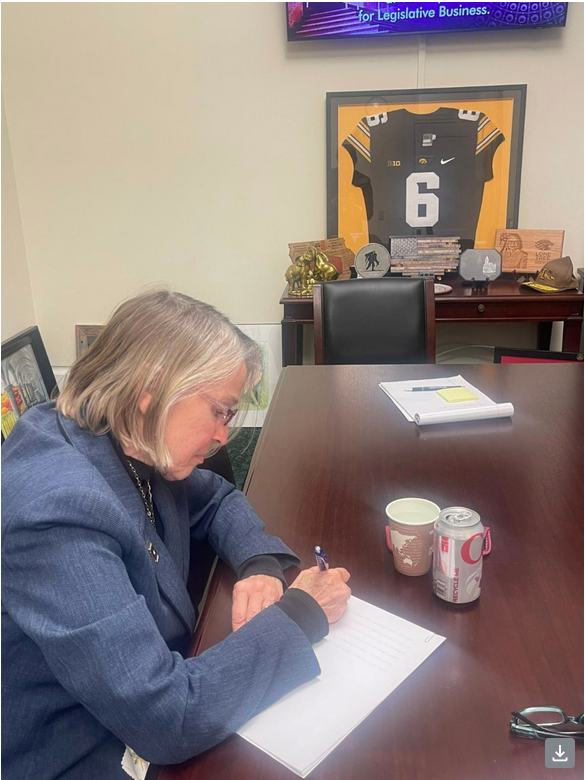
Mariannette Miller-Meeks hosting a telephone Town Hall on Tuesday, Feb. 4, 2025. Photo Credit – Miller-Meeks weekly congressional newsletter.

On Tuesday, Feb. 4, Congresswoman Mariannette Miller-Meeks hosted a Telephone Town Hall with an estimated 15,000 participants. I listened to the whole thing. If one can filter out all the MAGA assertions, such as “As we know, January 20, 2025 was the beginning of a new golden age in American history,” there were things to learn about the job she is doing on our behalf. I wrote about this previously. The MAGA talking points were wearying yet we must persist.

Whoa buddy! Improvement is needed in the questions asked during the event. Let’s start with a good question to set an example:

Hi. Good evening. Thanks for taking my call. I had a question about H.R. 809, which basically prohibits Chinese ownership of agricultural land here in Iowa and the rest of the country. My main concern about this is this was introduced back in 2023, I believe, and it still hasn’t been passed. Where are we at as far as that goes? And what are you looking at as far as, you know, furthering this cause?

This is the kind of question we all should be asking. It references a specific bill and a specific issue: Chinese ownership of agricultural land. The caller explained their concern and asked the congresswoman for an update. Well done!

Now here’s a problematic question:

Thank you. I’ve been very concerned five years. I’ve been very concerned. Five years ago, the government budget was 4.5 trillion. Now it’s $7 trillion or over that. And I’ve noticed what the government’s using that extra money for is shamefully discriminating against Americans based on race. I’m concerned that they’re using USAID money to fund coronavirus research in China and give our adversaries weapons of mass destruction and fund it. I want to know over the next four years, if we think we can rightsize the federal government, if we can fire the people that have been, you know, hired and just wasting taxpayer dollars on things like work from home and how you think the best path to achieve that is?

This caller appears to live in a media bubble that consists of FOX News, News Max, The Blaze, and One America News Network. It’s a free country and people can spend their time and attention how they will. It would be a good thing to ask about increases in the federal budget and how that money is used. The statement, “I’ve noticed what the government’s using that extra money for is shamefully discriminating against Americans based on race” comes directly out of left field racist talking points and detracts from the effectiveness of the question. This is a case where if the caller sat down at the kitchen table and wrote out what they wanted to ask, they would seem less like they were in a media-induced trance.

Not only conservatives have been marinating in media bubbles.

Hi. I had a question. I was concerned about, you talked about, you know, putting America first. You talked about this is going to be an age of national security, but I’m very concerned about our national security. There is an undocumented immigrant that was just granted clearance to a lot of really confidential data. Um, Elon Musk has overstayed a student visa, and he’s not here legally. And so I’m very concerned about that. You you spoke earlier about caring a lot about illegal immigration. So, um, you know, I’d like you to elaborate more on your previous answer, um, because that seems like a contradictory statement. 

This discussion appears to have come from the timeline of someone’s social media. The caller does not identify the undocumented immigrant who was just “granted clearance.” Likewise, hate him as we do, Elon Musk is a U.S. citizen. If one is to call into a public town hall meeting, set the socials aside, and like I recommended for the conservative caller, sit down and write out what you want to ask. Get the facts straight. Be brief, be brilliant, and be done. I believe it would be more effective and might help get actual answers.

It is unfortunate participants in the call had to wade through the poorly worded questions and the congresswoman’s ideological answers to access useful information. In some cases, callers just wanted to make a statement. All I’m asking is please do your homework and think before opening your mouth to speak in public. I know I’m better off when I do.

Categories
Living in Society

Making a Stand

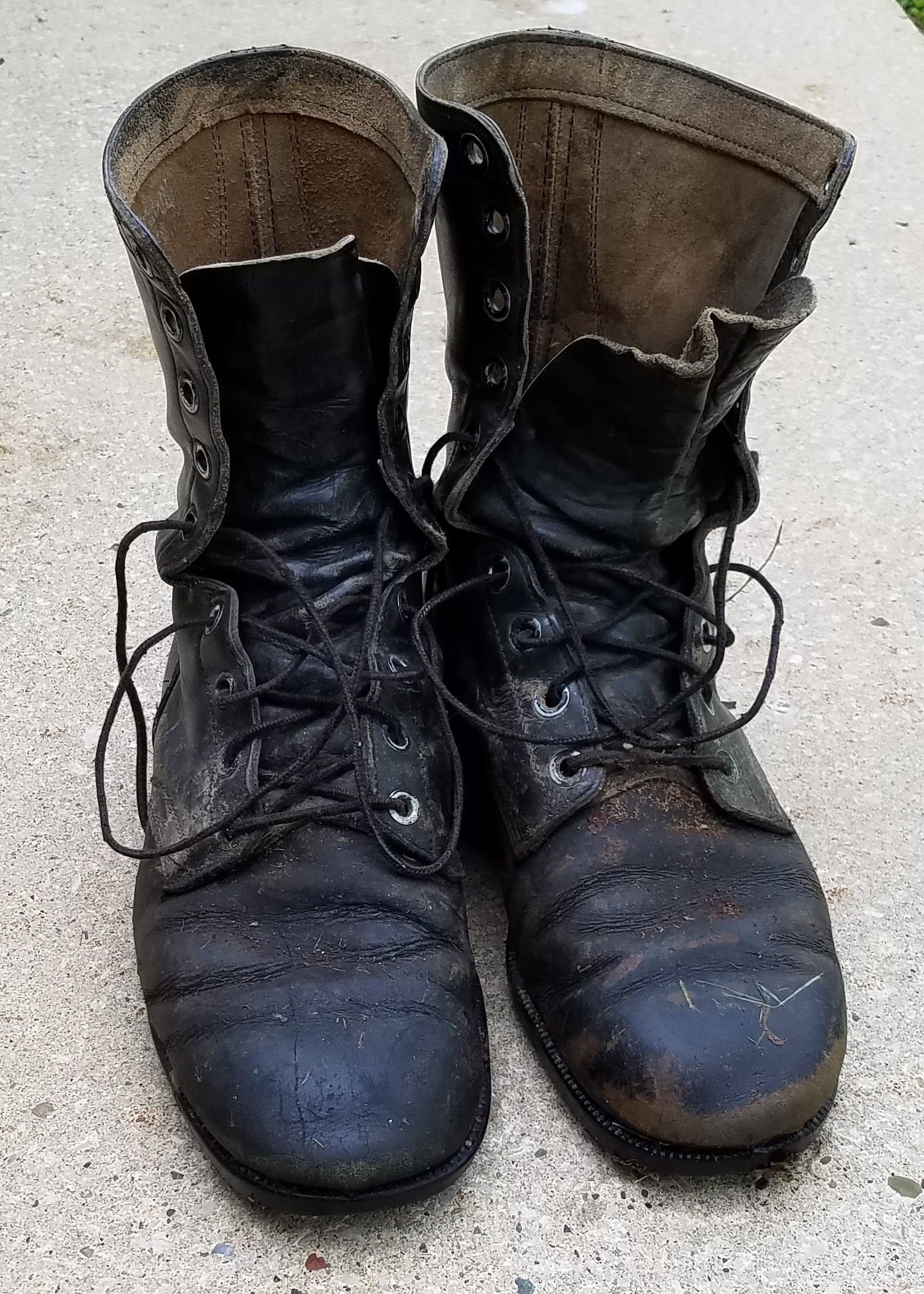
Government issued boots.

A recurring theme in my personal journals is the following:

We must all recognize our two feet standing squarely on the ground. (Personal Journal, Iowa City, Iowa, June 29, 1983).

What does that mean? Since I left home to attend university, my life has been one of self reliance. I intend to stand on my own for as long as I can.

Today, I’m thinking of friends whose life is impacted by the new administration and its unlawful cutting of government programs. I’ve been spared much of the current pain because I rely on government programs as little as possible. This round of cuts, the two main ones that support me, Social Security and Medicare, have been spared the knife. During a Feb. 4 telephone town hall, my Congresswoman Mariannette Miller-Meeks said, “(President Trump’s) instruction to us as well is that there are no cuts to Medicare or Social Security.” Check with me next year to see if that continues to be the case.

I received a government paycheck twice. When I served in the U.S. military and when I worked at the University of Iowa College of Dentistry.

My 1975 enlistment in the U.S. Army had everything to do with how screwed up the military was coming out of Vietnam. I asked myself, if regular people didn’t step up and fix the mess, who will? I stepped up and did what I could to make the military better. While my colleagues tried to convince me to stay in, I finished my enlistment, got out, and finished my graduate degree with money from the G.I. Bill.

When I took a job at the Dental School, I was seeking employment to support myself as a writer. The University of Iowa is by far the largest employer in Johnson County and my prior military service put me a step up in the point system they used to select candidates for jobs. I met my future spouse there and once we married, it was time for employment outside government work.

Among my friends and their families, many work for the government and are caught in the current, illegal federal funding slowdown and cuts. Some have invested heavily in the jobs they hold, with degrees, with tenure, and with a commitment to place. I empathize with them.

I’m glad I left my government jobs, and to be honest none that paid well enough to support a family was ever offered to me. It’s not like I was looking.

I’ll admit we need the government for things like utilities regulation, road and bridge building and maintenance, financial regulation, public water standards, research and development of new treatments for disease prevention and cures, and more. Self reliance goes only so far. I could get along without all these things, yet it would be a poorer world. We join together for enterprises bigger than ourselves. Abraham Lincoln once said, “The legitimate object of government is ‘to do for the people what needs to be done, but which they can not, by individual effort, do at all, or do so well, for themselves.'”

I paid taxes since 1968 and have been happy to do so. I served four years as an elected official to help provide emergency services for the community and maintain local cemeteries. I volunteered in our neighborhood to help provide a public water system and wastewater treatment. Now our government needs to make wealthy people pay their fair share of taxes. I don’t see many rich folks out here doing volunteer work. What’s fair for one is fair for all.

Although I have two feet standing squarely on the ground, I know it is good for society when we bend down and lend a helping hand to those who need it. Together we can find resilience. I hope we will.

Categories
Reviews

Book Review: The Sirens’ Call

In The Sirens’ Call: How Attention Became the World’s Most Endangered Resource, author Chris Hayes addresses things people in my network are experiencing and to some extent freaking out about: Why can’t I stop doom scrolling TikTok and Instagram Reels? Why can’t I read a long book any more? Or more than one book in a year? How could we have elected the attention hound who is the 47th president? Hayes says attention has become a fungible commodity in our society and people and corporations are intentionally stealing it from us, in part to monetize what we pay attention to. If readers are interested in challenges in modern society, I recommend this book.

“Attention is the substance of life,” Hayes wrote. “Every moment we are awake we are paying attention to something, whether through our affirmative choice or because something or someone has compelled it. Ultimately these instants of attention accrue into a life.” Hayes asserts things have changed, “Our dominion over our own minds has been punctured.”

Back in the day I held an overnight work meeting in Fairless Hills, Pennsylvania. For entertainment, the group voted to go to nearby Atlantic City for dinner and sightseeing. We ended up walking through the Trump Casinos before they went bankrupt. I recall signs saying something to the effect, “Don’t Disturb the Players,” referring to scattered people in a sea of slot machines dropping coin after coin into the slots. Hayes discusses this phenomenon in The Sirens’ Call.

Slot machines hold our attention by grabbing it for just a little bit while we wait for the spinning to stop, and then repeating that same brief but intense process over and over. The model is simple: Each play lasts only a few seconds. Bright lights and novel stimuli compel our attention. A moment of suspense is followed by resolution. A mystery in miniature is revealed, perhaps satisfyingly, perhaps unsatifyingly, but right there to be repeated. (The Sirens’ Call by Chris Hayes).

Hayes points out it is not the gambling that keeps players at the slots. “It is the unique attentional trance the machine’s gameplay induces,” he wrote. The casino uses players’ attention to monetize their time in the trance. That most gamblers have the same motivation is an example of making attention a fungible commodity. In this scenario, the house always wins, even if Trump himself couldn’t make a go of it.

The connection Hayes makes between slot machines and mobile devices, upon which to scroll various platforms, now seems obvious. Mobile devices garner and commoditize our attention to show us advertising, thereby monetizing our time and attention the way slot machines do. We often can feel like we are not in control of our minds.

The range of the book is broad. Hayes uses the narrative of Odysseus and the Sirens from the Odyssey throughout to tell his story. Among the topics covered are Early 19th Century newspapers, The Lincoln Douglas Debates, P.T. Barnum, alienation related to attention harvesting, and the evolution of what he calls the Attention Age. He closes the book with a chapter titled, “Reclaiming Our Minds,” asserting, “The internet is getting worse and worse.” He also offers things we can do to offset this.

Chris Hayes is not your typical writer. Because he spent ten years on cable television he has been in the thick of gaining attention in the form of ratings for his show on MSNBC. In cable T.V. gaining attention is everything. As a young father, his stories resemble ours in important ways. He has an interesting story to tell. I found the book to be a page turner. I recommend picking up a copy at a local library and reading it. Here’s a link.

Categories
Living in Society

Cutting the Cord

Photo by Photo By: Kaboompics.com on Pexels.com

On Saturday I cut the cord.

Not literally, as cable television no longer comes into the house via coaxial cable. It arrives from an internet modem. Nonetheless, we canceled our service and they took it away within five minutes of me hanging up the phone. The bill is to be pro-rated.

I stood by the cable guy when they laid the coax in a ditch from the curb box to the house in 1993. We had the same service provider all these years and don’t regret it. Now the missing television service will likely not be noticed.

My viewing was sporadic. I turned on CSPAN a couple of times a year and viewed maybe two or three shows on the Public Broadcasting System. We used to watch the weather during severe events, yet the local broadcast channel migrated to the internet. For that reliable service it was costing $70 per month (too much). Budgets are tight and something had to go. It’s the end of an era.

We changed our internet package as well. We had way over the amount of capacity needed for our usage. Shouldn’t the service provider be monitoring our usage to determine we have the correct offering? Maybe they should, yet that is not what they are about.

What was the downfall of cable television programming? I submit that in part it was the proliferation of specialty channels. Take T.V. shopping, for example. When it was new, I tuned into QVC Network to see what was on offer. I don’t recall ever buying anything, yet many viewers did. When we arrived at QVC’s West Chester, Pennsylvania headquarters for a sales call, we saw the quality of merchandise in the show room was questionable. With so many cable channels hawking wares, combined with my experience in Pennsylvania, the shopping channels all got lost in the noise.

When we were first married, we viewed television programs at home. In 1983 we consumed what was probably typical T.V. fare: forgettable programs like Dallas, Dynasty, Kate and Allie, The Scarecrow and Mrs. King, and The Love Boat.  The last episode of M*A*S*H aired on Feb. 28 that year. A program by Iowa City filmmaker Nicholas Meyer called The Day After aired on Nov. 20. I don’t know if this was cable, yet it doesn’t really matter. We don’t watch any television now.

Saying I left cable T.V. is a form of conspicuous non-consumption. The personal and political decision to announce this can be interpreted as a decision to abandon conversation topics with friends, or some kind of “holier than thou” internet asceticism. It can be that. All I’m trying to do is reduce our expenditures so we can survive into retirement.

While it is the end of an era, I won’t be missing cable television very much. I’m not sure what that means to the broader society. Bean counters of the internet suggest cable television subscribers are declining by about 5 percent per year over the last eight years. A lot of viewers remain. There is so much to do, so little time, and people are choosing cable television less.

Perhaps we should have cut the cord earlier. That we didn’t is evidence long-held habits are hard to break. At least, for now, there’s the internet.

Categories
Living in Society

Week Three

Ice covering most of the lake. Photo taken while trail walking.

Week Three of the new administration was one of stupid stuff. I don’t know how much time to allow this to play out, yet I’ve been busy with my three federal representatives: Mariannette Miller-Meeks, Chuck Grassley and Joni Ernst.

All three favor the scrutiny USAID is receiving. Ernst gets to the heart of the Republican matter in her recent newsletter where she links to this five-page letter to Secretary of State Marco Rubio regarding the agency. Short version:

The United States Agency for International Development (USAID) repeatedly stonewalled my investigations that aimed to uncover how tax dollars were being spent at the agency.

As the Senate DOGE Caucus founder and chair, I blasted the rogue agency’s history of obstruction and waste, including millions for Sesame Street in Iraq, sending Ukrainians to Paris Fashion Week, and risky research in Wuhan. I demanded a full and independent analysis of the recipients of USAID assistance.

Americans deserve answers about how their tax dollars are being spent abroad, and I will not be deterred in fighting for and uncovering the truth. (Senator Joni K. Ernst Constituent Newsletter, Feb. 7, 2025).

While I’m willing to bet some bad decisions were made about USAID expenditures, the way the government is attacking the congressionally mandated agency is rookie politics at its worst. Ernst should know better than to support firing most of the 10,000 workforce without notice. If USAID was stonewalling Ernst’ investigation as she said, there is plenty of reason to call key leaders to Washington for hearings. The fact the courts stopped indiscriminate firings without the Congress being involved, plus paid for supplies to fight disease sit idly in warehouses, just makes Team Doge look stupid. In addition, damage has already been done to good work USAID has been doing.

What was up with the big guy and Mexico and Canada? We’re gonna slap tariffs on you, he said, then as just as quickly, he lifted them for a 30-day period. The whole thing supports his campaign rhetoric about the borders and has little to do with reality. The fentanyl talking points seem like especially weak tea since very little of the drug arrives through the U.S.-Canadian border.

Number of overdose deaths from fentanyl in the U.S. from 1999 to 2022

According to the U.S. Drug Enforcement Administration, Fentanyl is a “synthetic opioid drug approved by the Food and Drug Administration for use as an analgesic (pain relief) and anesthetic.” The number of deaths from fentanyl use began to skyrocket after Trump came down his escalator in Trump Tower to run for president (See chart above). It begs the question of why he didn’t do something about it when he had the chance? To slap a tariff on Mexico and Canada to address a non-issue, resulting in higher costs for consumers, just makes him look stupid.

The Heritage Foundation observed, “The Senate has been keeping their foot on the gas this week by confirming five more Cabinet nominees. That brings the total of Cabinet positions filled to thirteen.” They are also pleased RFK Jr. and Tulsi Gabbard were voted out of committee to be scheduled for a vote by the full Senate. Senator Grassley has been doing his part of the Republican loser-nominee train as chair of the Judiciary Committee.

Senate Democrats called for an additional hearing on Kash Patel, the nominee for Director of the F.B.I., because of his shady background. Grassley would have none of it.

Kash Patel testified before the Committee for more than five hours, disclosed thousands of pages of records and media appearances, and provided 147 pages of responses to written questions. Further hearings on his nomination are unnecessary. 

No one was convinced by the Minority’s baseless efforts to mischaracterize and malign Kash Patel. It’s additionally outrageous to assert that a nominee should come before the Senate to answer for government actions that occurred prior to their time at an agency.

The Senate Judiciary Committee will not fall for Democrats’ delay tactics. I intend to hold a final committee vote on Patel’s nomination as soon as next week. (Press Release by Chuck Grassley, Feb. 4, 2025).

The idea we would avoid adequately vetting someone for the top law enforcement agency, a person with close ties to Russia, is just ridiculous. In a way, Grassley is right. Patel’s hearings are not about vetting. They are about politics and that makes our senators look stupid.

I could go on yet I won’t… Except to say the proposed firing of the board at the Kennedy Center, and making the president chair of that board is really stupid. If there is or was a golden age of American arts, it began when the Kennedy Center was built and opened to the public. It is hard to say what the president has in mind going forward, yet how could his leadership do anything but put gilt on it. The fake brilliance would dim the hearts and minds of anyone who cares about the arts. With him, that is probably the point. Also, a person can listen to only so many Lee Greenwood concerts.

I don’t know how many more of these weekly updates I will do. At the same time, there is plenty of stupid to go around.

Categories
Living in Society

Gamble On, Iowa

Photo by Darya Sannikova on Pexels.com

On Tuesday, Feb. 4, Republican State Senator Ken Rozenboom, who chairs the Senate State Government Committee which was considering a bill to declare a five-year moratorium on new Iowa gambling casinos, decided the fate of a new gaming license for Iowa’s second largest city.

“According to my conversations, this bill did not have enough support from Senate Republicans to advance all the way through the Senate process,” Rozenboom said. “In the interest of moving this session forward to other issues of critical importance to Iowans, I have no plans to reconsider the legislation for the remainder of this session.”

That was that. On Thursday, the Iowa Racing and Gaming Commission voted 4-1 to grant a gaming license to the City of Cedar Rapids, and the ground breaking ceremony was scheduled for Friday. Cedar Rapids Mayor Tiffany O’Donnell was exuberant, saying it was a “(transformative) day for Cedar Rapids and Linn County.” Lawsuits are expected, yet unless established gaming interests have bribed the judiciary, it seems there will be a Cedar Rapids casino.

I occasionally visited a casino during my lifetime. It takes less than both hands to count the number of times. When my parents took our family to the west coast by automobile, we stopped near Las Vegas at a restaurant that had a slot machine in the lobby. When my home town of Davenport got its first casino, I boarded the riverboat to see what it was about. I visited the land-based casino in Bettendorf for a wedding reception. When I worked at the oil company, the department head hosted a trip to Dubuque where we spent part of our time on a riverboat casino cruise. I once held a meeting near Philadelphia and the group decided to visit Atlantic City for dinner and sightseeing. We walked through the Trump casinos then in operation with row upon row of slot machines. During all those visits, I gambled away roughly $50. It seems unlikely I’ll visit the new Cedar Rapids casino to gamble.

Cedar Rapids is in close proximity to three casinos: Riverside, Tama, and Waterloo. If a person wanted a change of scenery, Dubuque is not that far away. My point in favor of the new casino is why should people have to drive so far to gamble? They shouldn’t. It burns unnecessary fuel, and the risk of a highway accident is increased. Why not let Cedar Rapids build a casino?

In his new book, The Sirens’ Call, released last week, author Chris Hayes discusses the deleterious effect of slot machines on our mind. He explains “the unique attentional trance the machine’s gameplay induces.” In a libertarian society, such simple pleasures, addictions and exploitation should be allowed. Society at large should not function the way someone’s nanny might.

If you like gambling, Cedar Rapids says Gamble On.

Categories
Living in Society

Insider View of D.C.

Editor’s Note: Our main news sources do us a disfavor in the way they reported the first three weeks of the new administration. I’ve been following Laura Rozen for many years and found her to be a reliable source of information. Not as famous as other pundits are, but much better, especially in reporting what’s going on in U.S. diplomacy. Here is the first part of her Feb. 7 substack. Read the whole thing here.

Split Screen by Laura Rozen

From close up, here in Washington, D.C., as someone who regularly covers the U.S. federal government, the sweeping assault that unelected billionaire Elon Musk and his unvetted DOGE team are committing on U.S. government agencies and personnel is alarming.

Alarming, not because there should not be reforms or cuts to federal agencies’ budgets, programming or staffing; but because their anti-government jihad is being conducted without any oversight, legal mandate, organizational plan, knowledge of the workings of the government, or security vetting of the Musk/DOGE staff barging into federal agencies and demanding access to sensitive government payment and IT systems and personnel databases. In short, without any respect or accountability for the damage they could wreck on systems that American citizens and federal workers rely on to protect their security, privacy, and functional governance.

And there is growing evidence today that the DOGE team infiltrating these systems was not properly vetted. Click here to continue reading.

Recommend you subscribe to Diplomatic by Laura Rozen on substack as part of your news about foreign affairs.

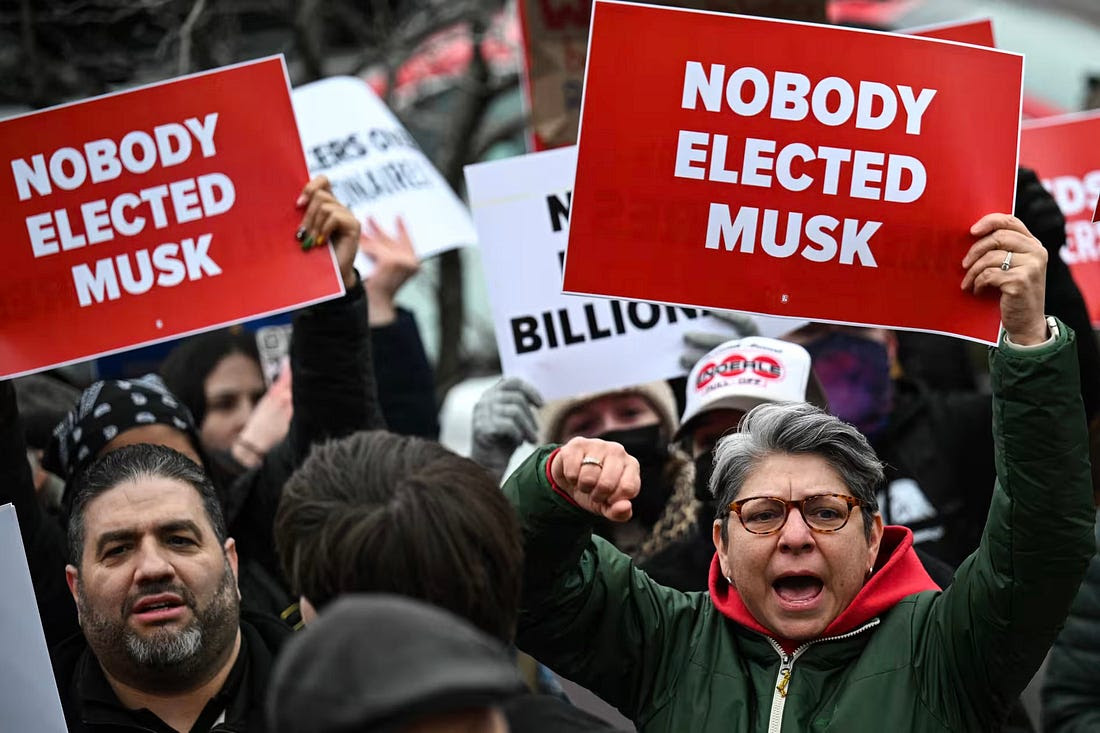
Photo: People protested Wednesday against the so-called Department of Government Efficiency outside of the Department of Labor in Washington, D.C., as concerns grow about the unprecedented power that President Donald Trump has handed over to Elon Musk, the world’s richest man.DREW ANGERER/AFP VIA GETTY IMAGES
Categories
Living in Society

Winter Layering

Trail walking.

The number one tip for helping seniors stay warm indoors during winter is wearing layers of clothing. Begin with a tank top, a t-shirt next, a woolen shirt, then a light jacket. As we age, we tend to be chilly in winter. Cocooning with layers can help.

We also have a tendency to get stir crazy, as evidenced in the questions callers asked during Rep. Mariannette Miller-Meeks’ telephone town hall on Tuesday. One woman was in a hospital room for the previous two days and was concerned about Medicare not paying for treatment of a family member’s Alzheimer’s Disease. She could not be consoled, and seemed distraught, even after Rep. Miller-Meeks said a relative of hers had Alzheimer’s and Medicare paid for treatment.

The questions were mostly good, although people need to do a better job asking them. Focus people! You are not in your media bubble at home! Try out your questions before joining the call. Practice! I know, it is a lot to ask.

I made it through to the end. The parts Miller-Meeks read, about the new golden age, energy dominance, and the like, were hardened talking points she used previously in her newsletters. Her way of saying these things drives me crazy. It’s like she’s paying tribute to the MAGA gods before getting started with her shtick, the way a priest says a prayer and does the sign of the cross before approaching the altar.

I took away a couple of things:

  • They are working on passing the budget through reconciliation, not regular order.
  • She is all in on DOGE.
  • Current Social Security, Medicare, and Medicaid will not be cut now, but any enhancements from the Affordable Care Act are on the table.
  • No answers on what to do to bring more manufacturing to Iowa.
  • USAID is not supported by her and others and will likely be cut dramatically or eliminated.
  • She waffled on the question about privatizing the VA.

I spent worse hours, like the time my boss made me listen to Rush Limbaugh while we were driving around Pennsylvania back in the day. At least I know how to stay warm in winter.

Categories
Living in Society

Vote No on Tulsi Gabbard

Tulsi Gabbard in the author’s neighborhood. Photo by the author.

Dear Senators Grassley and Ernst,

Associated Press reported Tuesday Tulsi Gabbard, President Trump’s nominee for director of national intelligence, advanced from the Senate Intelligence Committee in an 8-9 vote. Next steps are for the Senate to schedule a vote. I urge you to vote no on Gabbard.

When Gabbard was running for the Democratic nomination for president in 2019, I met her at a neighbor’s home. I am a U.S. Army veteran, and from this and one previous encounter in 2016, I can say I was not impressed with her depth of thought or with her qualifications to head a government agency. It is personal experiences like this that drive my opposition to her confirmation as director of DNI.

Thank you for your consideration.
Regards, Paul Deaton

Categories
Living in Society

Giving Attention to Stuff

Photo by Ola Dapo on Pexels.com

Our home is a relatively quiet sanctuary for creative work and networking with family and friends. It is easy to enter a room and “do something,” whether it be cooking, cleaning, writing, reading, or working in the garage, garden or yard. We made it this way when we designed the house and its setting. We are constantly using computers.

I recently discovered a new widget on my mobile device called Digital Wellbeing and parental controls. It tracks screen time. The results were shocking: more than six hours per day. Since then, I’ve been using the tool to reduce screen time. Last week I averaged 4 hours 24 minutes per day, which is a still a lot. I am endeavoring to do better.

What did I do about it? First I sorted my social media accounts. During the last year I reduced my social media presence, deactivating Twitter, Facebook, Instagram, and LinkedIn. I left Threads on my desktop and had BlueSky on my mobile device. This morning I removed all social media from mobile. In doing so, I removed them from my bed room and living room.

Second, I turned my mobile device into the tool it was intended to be. Instead of garnering my attention on social media feeds the way a slot machine empties one’s pockets, I time my morning exercise, read ebooks, keep up with news and email, and monitor traffic on my blog. I don’t mind the screen time if I’m getting something other than distraction in return.

Since paring back social media my human interaction increased with more telephone time and emails. As the weather warms, I expect to have more interaction with neighbors outdoors. These are positive developments.

The main thing I learned through the widget is to think about how I spend my time and focus more of it on stuff that adds value. That doesn’t just happen by itself.