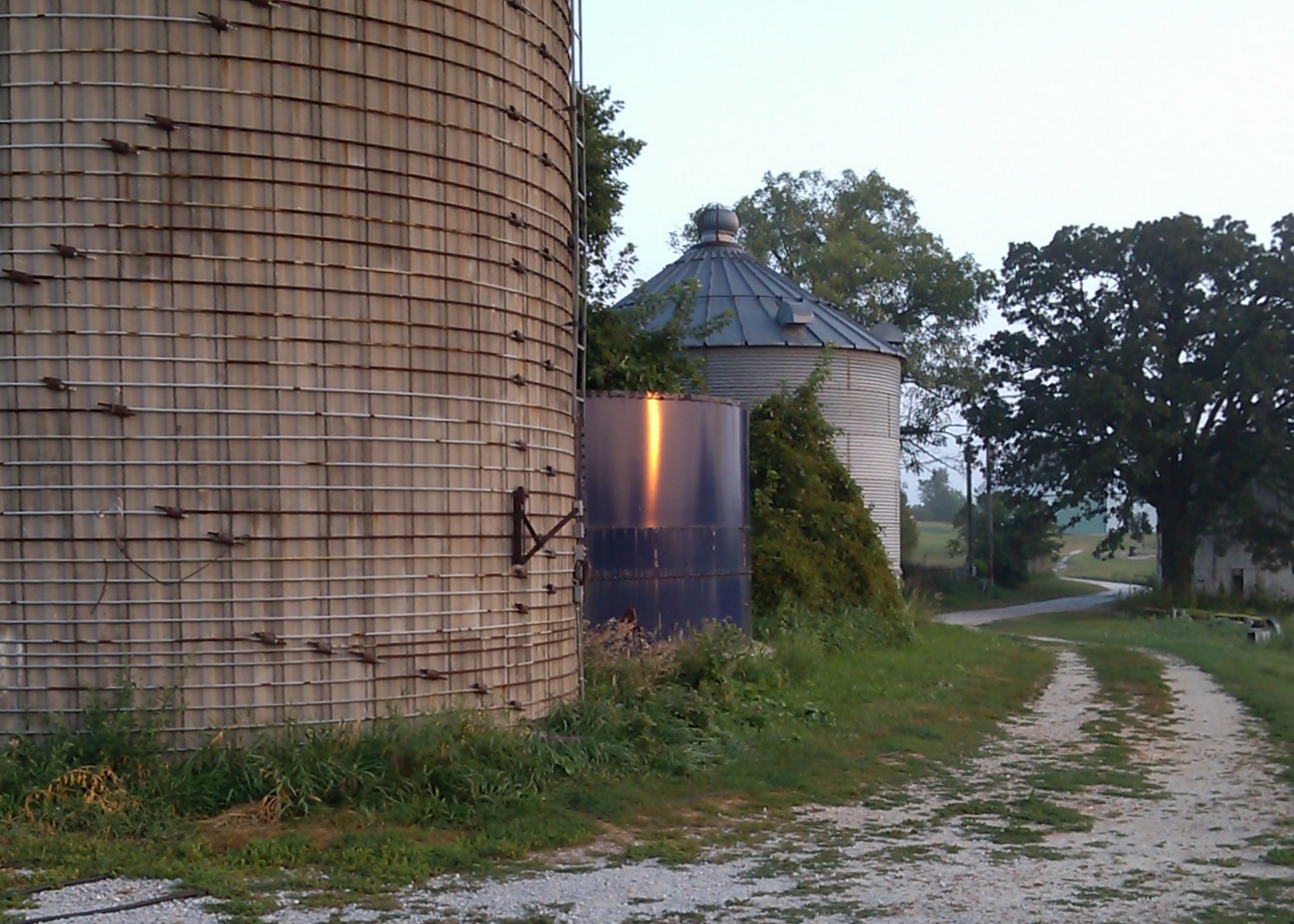
RURAL CEDAR TOWNSHIP— The onion harvest is in at the CSA, and more than two tons of white, red and yellow onions have been arranged in the germination house and barn to dry. Today begins the third day of trimming the excess leaves and arrange them for further drying. A few more four hour shifts and the project will be complete. Onions are one of the most popular vegetables, so the shareholders at the CSA will enjoy continuing to receive this bounty in their shares.
Trimming Onions
I filled the blank spaces in my garden’s cucumber row yesterday afternoon and gave the new patch a good watering. The zucchini are about done, the vines withering and yellowed. Same with yellow squash. There are butternut squash seedlings to plant, although I’m not certain they will make the 90-100 day window needed to mature— another experiment. Next weekend I begin paying work at a local orchard, helping with the weekend surge of city dwellers who come out for family entertainment and apples. That means this weekend will become a working time in the yard and garden, getting caught up on weeding, grass mowing, tree trimming, and preparing garden plots for the next iteration of planting.
White Onions
Fall crops will include turnips for the greens, radishes, lettuce and spinach for sure, adding to the most prolific of gardening years here in Big Grove. (Note to self: prepare more trays for germinating seeds).
My first crop of apples is getting close to ripe (there will be two harvests this year, plus pears), which means the CSA operator and I have to stay in touch with the work for tomatoes project so everything can get processed as it comes in at the same time. In my garden, the large tomatoes are beginning to ripen. We’ve been eating fresh tomatoes for about three weeks.
In the kitchen the storage space is filling up with onions, potatoes and apples, and the soup stock is getting used, making room for the approaching tomato harvest in a week or so. There is a lot to do before Labor Day.
It must get a Republican’s hackles up when a Democrat talks about the founding fathers. After all, it was Republican Warren G. Harding who coined the term, first using it in his keynote address at the 1916 Republican National Convention. The term is less than one hundred years old, much younger that our family roots in Virginia where ancestors named their male children after well known revolutionaries from the state. Leave it to a Republican to omit women as founders, but women’s suffrage and the 19th amendment to the U.S. Constitution wouldn’t come until four years later. Harding, while elected as president in a landslide in 1920, was never a visionary, unable to see the scandals in his own administration.
What we know about the founders was they were part of a natural aristocracy, or gentry, as Stow Persons described it in his book “The Decline of American Gentility,” based more on talent and taste than birth or financial status. 13 were merchants, seven were major land speculators, 11 were large scale securities speculators, 14 owned or managed plantations or large farms operated by slaves, eight received a substantial percentage of their income from holding public office and the rest were occupied as small farmers, scientists, physicians, retirees and other occupations. There is no evidence my forbears were included in this group, although they were in Virginia by 1680.
I never thought much about the founders while growing up, focusing on those revolutionary figures who were from Virginia, where my father’s family settled: George Washington, Thomas Jefferson, Patrick Henry and James Madison. I also liked Thomas Paine, who while not a Virginian, wrote the practical sounding and popular pamphlet “Common Sense.” He also wrote “The Age of Reason,” his book that advocates deism, promotes reason and freethinking, and argues against institutionalized religion in general and Christian doctrine in particular. We’re getting to the point of this post.
Thomas Jefferson, James Madison, Thomas Paine, Benjamin Franklin, Ethan Allen and George Washington were deists, or influenced by them. Deists insisted that religious truth should be subject to the authority of human reason rather than divine revelation. Consequently, they denied that the Bible was the revealed word of God and rejected scripture as a source of religious doctrine.
They were also products of the Age or Enlightenment which was a cultural movement intending “to reform society using reason, challenge ideas grounded in tradition and faith, and advance knowledge through the scientific method.” These views proved to be unpopular, and emblematic of this was the fact that only six people attended Thomas Paine’s funeral as he had been ostracized for his ridicule of Christianity.
Anyone who knows this history must see the irony of modern day citizens who constantly refer to the founders, yet eschew the scientific method, especially as it pertains to climate change. We know why that is.
In mass society, media plays an important role in educating the public, just as Paine’s “Common Sense” informed the American Revolution. The public’s attention has been bought and sold by the hydrocarbon industry through prolific and continuous advertising. The executives of the oil, coal and gas industry must know the science of climate change, and that they are mortgaging their children’s future to make a buck near term. Yet they continue their work as slaves in the fields of corporatism.
There was an age of enlightenment, but its promotion of scientific inquiry has today been replaced by something else. A combination of misinformation, partisan politics and fundamentalist faith. Arguments about the science of climate change fall on many deaf ears, and opposing voices create a voluminous din that echoes in valleys carved over millennia that predate Europeans on this soil.
As I write this post, I am reminded of William Faulkner’s Nobel Prize acceptance speech.
I decline to accept the end of man. It is easy enough to say that man is immortal simply because he will endure: that when the last dingdong of doom has clanged and faded from the last worthless rock hanging tideless in the last red and dying evening, that even then there will still be one more sound: that of his puny inexhaustible voice, still talking.
My response is simple, climate change is real, it’s caused by us, the effects on humans are getting worse, and we can do something about it without changing our way of life or hurting our economy. We should do something about it before it’s too late. The founders resolved the issue of their time, now is the time for us to return the favor by solving the climate crisis.
LAKE MACBRIDE— It is with a bit of trepidation that I venture into another expository piece about urban chickens. As people continue to move from rural areas to cities, attracted by jobs, apartments, and a type of society reliant upon the aggregation of diverse human interests, to raise chickens at home seems anachronistic.
By definition, city life eschews barnyard animals. Getting rid of urban chickens, pigs and cows was part of the rise of the public health movement. Whether intentional or not, urban society, by definition, replaced the need to produce one’s own food. Why else would so many people have left the farm but to take advantage of society’s mass production capacity? To seek a return of urban livestock is a throwback to an era that was not necessarily better.
Nearby North Liberty is considering an ordinance to allow city folk to raise chickens in their yards. As I mentioned in my March post, this type of pursuit seems to be a material interest in pursuit of respectability among peers, rather than about nutrition. What makes the North Liberty proposal different is the requirement for neighborhood consent, rather than providing a courtesy notification of a chicken coop under construction. If passed, the ordinance would build community feelings, predictably on both ends of the love-hate continuum. Already there’s squawking.
At first reading, it is unclear to whom the ordinance would apply: whether or not the city would preempt home owners associations with a local address from making their own rules. The way the current ordinance is written, home owners associations could be more restrictive and disallow home chickens even if the city does permit them. Preemption has a long and controversial history in Iowa, notably as it applies to concentrated animal feeding operations where lobbying groups want control centralized in Des Moines in the self-interest of focusing their lobbying efforts with less resources. I’m confident the city council will work through this issue.
Some cried foul over the 25 foot rule (the coop, fowl house, or fenced pen area shall be a minimum of 25 feet from any property line), saying it was too restrictive, or the chicken coop location would be aesthetically challenged. This aspect of the draft ordinance serves my point that urban chickens are more like pets than food sources. More like a landscaping ornament or a window treatment for a view of lives where there is not enough constructive work to do.
The limit is four chickens, kept in a confinement facility— hens only. There were no instructions on how to determine if a chick was a rooster or a hen, but a Facebook friend resolved the issue by saying, “once a cockerel is old enough to crow, it’s big enough for the dinner plate.” This raises the issue of chicken slaughter. My grandmother lived on a farm, and knew the process well. During my time in French Army Commando School, we learned how to turn the gift of local partisan support into food for survival. Slaughtering animals for meat just doesn’t go with contemporary notions of city life. Maybe it should.
What I am saying is the idea of urban chickens is adjunct to local food systems. It is more an expression of bourgeois libertarianism in a consumer culture, than a revolution in local food production. Gil Scott-Heron famously wrote “the revolution will not be televised,” and we are hearing too much about regulation of urban chickens on the T.V., so a reverse logic applies: the local news is covering the story, so therefore it can’t be a revolution.
In the end, a community should have self-determination on how people live. I’m not against urban chickens, but don’t see the point. It seems like a lot of work and expense for a small number of boutique pet chickens. Why not buy the best eggs from the grocery store, or farmers market, or barter for eggs and save the money? And maybe get a dog or cat at the animal shelter, as they make better pets.
LAKE MACBRIDE— Some days it’s hard to know the path. On Friday, still tired from long days in Chicago and facing a full slate of regular work combined with the search for paying work, it was a bust. Saturday was better, engaging in society— a slow walk with neighbors and friends.
Part of living in Iowa is an endless stream of birthdays, graduations, anniversaries and other celebrations. On Saturday there were two, the one year wedding anniversary reception for a friend in the peace and justice movement, and a 50th wedding anniversary reception for a neighbor I got to know shortly after we moved to Big Grove. Both events served great food and drink, and enabled me to get caught up with friends.
Conversations included a discussion of dating in the 1960s, the recent Green Party national convention in Iowa City, next week’s Veterans for Peace national convention, what to do with zucchini, demonstrations for nuclear abolition, nuclear power, Blackhawk and Poweshiek, pioneer cemeteries, gardening, a YouTube video shot in high summer and more.
I don’t often visit Central City, where one of the events was held, and stopped for directions. Off Highway 13, a local was selling produce. He had a grain wagon decorated with advertising for his farm stand on the highway. When I asked if he was from the area, he said, “of course.”
He sold seasonal produce, the usual fare, including melons, zucchini and tomatoes. He had a flat of Missouri peaches, fresh and made into jam, and when asked about them, showed one he had begun to slice, offering a taste. Sweet and juicy. I bought a pound and a half for two dollars and he gave me directions to the park where the event was being held. Of course, he knew where it was.
Two decades after the rise of the Internet, being with people in social settings remains compelling. We are drawn to events with a craving for company. Bearing cards with handwritten notes, hoping to give greetings and hear stories, little has changed over centuries. It is an important part of sustaining a life on the Iowa prairie, and help in finding our way in a turbulent world.
CHICAGO, Ill.— My third day in Chicago and most noticeable is how isolate and deserted everything seems. Metra riders move deliberately through the motions of public transit, saying little. Well groomed, they move diligently toward their destinations, one wearing plastic bags on her feet to keep the rain from the dressy work shoes. The 59th Street station has been empty each time I rode the train.
On the way to my bed from the station, I passed countless police telephones and friendly security people in drizzling rain, as if to say there may be danger on this quiet street, but people are watching in the dim blue light of the call boxes. Sleep came quickly after a long day.
This morning, I drove along Lake Shore Drive and through the truck marshaling area for McCormick Place to parking Lot B. It’s cheap there, $14 the day, and an easier getaway after today’s work. The meeting room was accessed through a labyrinthine path of underground, past truck docks and security, with the din of fans and clatter of forklift trucks. Almost alone, I found the path, avoiding doors locked against early morning intruders and riding escalators up and down the levels of the building. I solemnly made may way to the concourse in search of coffee.
I’m no longer new to Chicago, and have driven and walked her streets— no longer do I get lost. It is a city that minds its own business, with nose to the grindstone of industry. A place where external signs hide everything that matters. Chicago has settled in to lives more diverse than Sandburg envisioned. The city of big shoulders is hunched over into individual lives within the enclaves of a consumer society.
On Saturday, July 27, Rep. Dave Loebsack (IA-02) and Rep. Collin Peterson (MN-07), ranking member of the house agriculture committee, held a farm bill forum at the Johnson County Extension Office. Over 40 people attended, and a lot of ground was covered related to the farm bill, how the U.S. Congress works (or doesn’t), and during an open question and answer period with discussion of the Supplemental Nutrition Assistance Program (SNAP), change in the agriculture committee makeup after the 2010 election, crop insurance, conservation, rural development, LIHEAP (Low Income Home Energy Assistance Program), the renewable fuel standard and target prices for direct payments for wheat, corn, soybeans, cotton and rice. The forum was a primer for anyone who wanted to learn the recent history of the farm bill.
Rep. Loebsack said, “last year was the time to pass the farm bill.” Congress extended the 2007 farm bill for a year, and that extension expires on Sept. 30. Representatives of the Iowa Farm Bureau and the Iowa Corn Growers Association present at the forum indicated they did not want another extension. One audience member pointed to a $50,000 direct payment he would receive this year he didn’t need and didn’t want. Loebsack attributed the situation to the failure of congress to pass a new farm bill last year.
Rep. Peterson said the agriculture committee members had reached a bipartisan agreement last year, but the problem was (and remains) the Republican leadership. He was more specific, saying “it wasn’t Speaker Boehner… he never got in the way.” He added, Eric Cantor is the problem, “he’s the guy who screwed this thing up in the house.”
Mike Owen, executive director of the Iowa Policy Project, entreated the congressmen to take the political spin out of SNAP because it was destructive to families who depend upon the $1.30 per person per meal the program provides. A food pantry volunteer added, “it’s not just SNAP.” The farm bill impacts food pantries, meals on wheels and other nutrition programs people rely upon. Rep. Peterson was direct, “there will be more SNAP cuts (in order to pass a farm bill).”
The clock is ticking on getting a farm bill passed by Oct. 1. After this week, congress begins the August recess, reconvening on Sept. 8 or 9. The U.S. Senate has formally requested a conference committee, but house members have not been appointed. According to Peterson, they may not be until after the recess. There is time, but not any extra.
The framework for the farm bill has been set by the U.S. Senate version, for which the entire Iowa delegation voted. Passing the farm bill comes down to the U.S. Congress doing their work, something at which they have been less than effective. Also something could go wrong between now and Oct. 1 to stop the farm bill from moving, according to Peterson.
After the farm bill failed last year, Peterson said, speaking of the Republican house majority, “you guys have finally made me a partisan.” If SNAP is cut completely by the conference committee and replaced with block grants, as some conservatives want, the Democratic house delegation is expected to walk away, and the farm bill would expire. Well funded groups like the Heritage Foundation, Club for Growth, the Wall Street Journal and others have lobbied hard to cut SNAP, get rid of conservation and rural development programs, and crop insurance.
If readers are interested in more information about any of these topics, please post a comment below, and I’ll reply with any relevant information from the forum.
LAKE MACBRIDE— Hundreds of us are converging upon Chicago for the Climate Reality Leadership Corps training. To avoid the expense of the conference hotel, I will be staying with friends of a friend for the duration. I’m making up a gift basket of produce for them. It’s a showcase of the local, organic produce that is passing through our house this summer.
Included will be a pointed cabbage, green and yellow zucchini, blue lake green beans, market more cucumber, yellow squash, a box of cherry tomatoes, kohlrabi, daikon radish, broccoli and a jar of home made apple butter. If there’s sunlight in the morning, I’ll add herbs: rosemary, basil, flat leaf parsley, sage and thyme.
To keep the veggies, I’m dumping the freezer’s ice in a cooler, topping it with a water barrier and the veggies. Hopefully it will survive the trip.
It is somewhat ironic that while I am with Al Gore, one of the leaders in the use of technology, and a board member of Apple, I’ll be leaving my laptop at home. I’ll be off the Internet, except to communicate through my mobile device. Regular posting will resume over the weekend, so stay tuned.
LAKE MACBRIDE— UPDATE Aug. 2, 2013. Organizers have delayed this event due to scheduling conflicts. Email me if you want a notification of the new date/time.
Lifting the ban on boat motors larger than ten horsepower on Lake Macbride has been a perennial issue in the Iowa legislature. The issue for opponents, including former Iowa state senator Swati Dandekar, has been Iowans can’t afford to own a second motor for their boats to use the lake. It seems a lame reason when there are so many other boating opportunities in the state, and nearby.
The Lake Macbride Conservancy is a group of area property owners that works to conserve Lake Macbride and environs. They have posted about the horsepower restriction on their web site. A neighbor sent this note from them yesterday.
Dear Lake Macbride Friends and Neighbors,
Our local legislators (Senator Dvorsky and Representative Kaufmann), along with members of the Senate Natural Resources and Environment Committee (Senators Dearden, Zumbach and Seng) will be joining us on Sunday, Aug. 4, for a tour of Lake Macbride.
Our plan is to tour the lake on a single pontoon (boat), starting on the North arm and ending on the South at the U of I Sailing Club dock. We hope to start the lake tour at about 1:15 p.m. and end at about 3:30 p.m. This tour will be a great opportunity to explain the history of Lake Macbride and describe environmental and safety concerns around the park and lake. We think it will strengthen our message to these legislators when they see, first hand, the number of individuals who use the lake and the number of different types of crafts employed.
Organizers indicated, “it’d be great to have a good showing of association watercraft use during the tour.”
Our family does not include regular boaters, but supports the efforts of the group.
LAKE MACBRIDE— The summer weather has been as good as it gets, a reminder of what it was like as a child, with endless days to play in the sunlight, safe and without worry. This summer has been unforgettable. Besides the weather, it has been a different and somewhat tribal life after turning to those with whom we live out our lives in the neighborhood.
A quick garden update. Removing the green caterpillars with a medical grade forceps did the trick of removing the pest, and the new leaves are growing bug free. The white butterflies are around, so there may be more, and I lost one plant, but the new growth looks great.
Cucumber Seedlings
Today, I harvested the rest of the green beans, composted the plants, and planted a row of cucumbers from seedlings. I planted the seed in pots on July 13, so they are two weeks from seed to seedling. The benefit of growing them this way is with the wet root ball, they can tolerate diverse conditions better to get off to a good start in the ground. They bring their own moisture with them to the initial planting. I watered them well and mulched. With my newly developed pickle addiction, I may plant more before summer is gone. There were some seedlings leftover from planting a row, so maybe next weekend.
Three Rows of Lettuce
The current crop of lettuce is suffering. Not from the heat, or lack of water, but from disappearing. There used to be three full rows here, and some plants are missing. Not sure what is the pest, but it seems doubtful deer are jumping the fence as there are no deer footprints inside. Perhaps a rabbit, or something else. Whatever is left, will be enjoyed by the humans. The leaves are big enough to pick, so when I return from my trip, we’ll bring some in for a tasting.
Green Tomatoes
Finally, the tomatoes are maturing and three varieties have begun to ripen: two cherry tomatoes and Roma. Tomatoes have been the continuous crop in our garden, since the first duplex where we lived after our wedding ceremony. Perhaps there was a gap in Cedar Rapids, but not much of one. This year’s crop was the first I planted as seeds, and based on the results, I’ll do that next year as well.
Roma Tomatoes
The primary concern this year is to finish processing tomatoes before the apples come in. There are a lot of apples. I know what I want from the tomatoes: 12 quarts and 12 pints of tomato sauce, the leftover juice, 24 pints of diced tomatoes, and maybe a dozen pints of hot sauce using the cayenne and jalapeno peppers. Knowing how to approach it is half the battle.
Tonight for dinner, I made a pizza. Thin, wheat crust with tomato sauce I canned in 2011 mixed with fresh basil and salt. Toppings were half an onion from the CSA, thinly sliced zucchini, diced green peppers, sliced green olives with pimiento, halved cherry tomatoes and 6 ounces of mozzarella cheese. It is out of the oven, so I had better go sample.
LAKE MACBRIDE— There’s a lot to get ready before departing Big Grove on Tuesday to attend the Climate Reality Leadership Corps training in Chicago. The week’s posts on Blog for Iowa need to be wrapped up, financial matters put in order, a major work session in the garden completed, and logistical things like reading the course materials and packing are prerequisites. This in addition to my usual responsibilities at the newspaper and CSA. The next eight days will be busy.
My friend Dick Schwab decided to run for another term on the community school board. Being on the board is a thankless, unpaid job made more contentious by the negative community reaction to standards based grading. I have been reading about the new program in our local newspaper for about two years, so I don’t get why there is a reaction when the long planned program is being implemented. That is, only to say that while there has been complete transparency, like in most locations in the U.S., the public tuned out until it dawned on them the discussion actually affected their lives. I’m also helping Dick get petition signatures for the Sept. 10 school board election before leaving for Chicago.
During a phone call with my mother we talked about the food storage cabinet in her basement. It looks home made, and was built to store a year’s worth of canned goods in Mason jars. On grocery day, one of the tasks I shared was hauling bags of canned goods to the basement and arranging them on its shelves. The cabinet was in the house when we moved there the summer before I entered second grade. For a while, I wanted it in Big Grove to store my own canned goods, but changed my mind. I favor a better arranged pantry close to the kitchen over an artifact designed for another era.
Dawn has broken on another glorious summer day in Iowa, and soon I’ll be off to the newspaper for a long morning’s work. This summer has been what we expect of summer days, full of life and belle weather on the Iowa prairie.
You must be logged in to post a comment.