Categories
Juke Box

Juke Box — Forever Young

Time to slow down and consider what’s next for a while.
Enjoy one of my current faves, followed by Bob Dylan’s Nobel Prize acceptance speech:

Bob Dylan’s Nobel Prize Acceptance Speech
Dec. 10, 2016

Good evening, everyone. I extend my warmest greetings to the members of the Swedish Academy and to all of the other distinguished guests in attendance tonight.

I’m sorry I can’t be with you in person, but please know that I am most definitely with you in spirit and honored to be receiving such a prestigious prize. Being awarded the Nobel Prize for Literature is something I never could have imagined or seen coming. From an early age, I’ve been familiar with and reading and absorbing the works of those who were deemed worthy of such a distinction: Kipling, Shaw, Thomas Mann, Pearl Buck, Albert Camus, Hemingway. These giants of literature whose works are taught in the schoolroom, housed in libraries around the world and spoken of in reverent tones have always made a deep impression. That I now join the names on such a list is truly beyond words.

I don’t know if these men and women ever thought of the Nobel honor for themselves, but I suppose that anyone writing a book, or a poem, or a play anywhere in the world might harbor that secret dream deep down inside. It’s probably buried so deep that they don’t even know it’s there.

If someone had ever told me that I had the slightest chance of winning the Nobel Prize, I would have to think that I’d have about the same odds as standing on the moon. In fact, during the year I was born and for a few years after, there wasn’t anyone in the world who was considered good enough to win this Nobel Prize. So, I recognize that I am in very rare company, to say the least.

I was out on the road when I received this surprising news, and it took me more than a few minutes to properly process it. I began to think about William Shakespeare, the great literary figure. I would reckon he thought of himself as a dramatist. The thought that he was writing literature couldn’t have entered his head. His words were written for the stage. Meant to be spoken, not read. When he was writing Hamlet, I’m sure he was thinking about a lot of different things: “Who’re the right actors for these roles?” “How should this be staged?” “Do I really want to set this in Denmark?” His creative vision and ambitions were no doubt at the forefront of his mind, but there were also more mundane matters to consider and deal with. “Is the financing in place?” “Are there enough good seats for my patrons?” “Where am I going to get a human skull?” I would bet that the farthest thing from Shakespeare’s mind was the question “Is this literature?”

When I started writing songs as a teenager, and even as I started to achieve some renown for my abilities, my aspirations for these songs only went so far. I thought they could be heard in coffeehouses or bars, maybe later in places like Carnegie Hall, the London Palladium. If I was really dreaming big, maybe I could imagine getting to make a record and then hearing my songs on the radio. That was really the big prize in my mind. Making records and hearing your songs on the radio meant that you were reaching a big audience and that you might get to keep doing what you had set out to do.

Well, I’ve been doing what I set out to do for a long time now. I’ve made dozens of records and played thousands of concerts all around the world. But it’s my songs that are at the vital center of almost everything I do. They seem to have found a place in the lives of many people throughout many different cultures, and I’m grateful for that.

But there’s one thing I must say. As a performer I’ve played for 50,000 people and I’ve played for 50 people and I can tell you that it is harder to play for 50 people. 50,000 people have a singular persona, not so with 50. Each person has an individual, separate identity, a world unto themselves. They can perceive things more clearly. Your honesty and how it relates to the depth of your talent is tried. The fact that the Nobel committee is so small is not lost on me.

But, like Shakespeare, I too am often occupied with the pursuit of my creative endeavors and dealing with all aspects of life’s mundane matters. “Who are the best musicians for these songs?” “Am I recording in the right studio?” “Is this song in the right key?” Some things never change, even in 400 years.

Not once have I ever had the time to ask myself, “Are my songs literature?” So, I do thank the Swedish Academy, both for taking the time to consider that very question, and, ultimately, for providing such a wonderful answer.

My best wishes to you all, Bob Dylan.

Categories
Living in Society

Better With Cats

Shadow Waiting for the President's Speech
Shadow Waiting for President Obama’s Speech

President-elect Donald Trump made a victory lap in Iowa last night, speaking to a crowd in Des Moines estimated at 5,000.

The word “great” was used frequently, at least once in quick succession, referring to the “great, great people of Iowa.”

At least one of my neighbors attended. I did not.

The internet was filled with chatter about Trump, and to a lesser extent, Hillary Clinton. Much of it seemed outrageous and ridiculous as anonymous people asserted false and true notions with opinions thereof in a melee heard throughout the wires of social media. The world wide web enabled Iowans to hear the remote cackling of presentism from as far away as China.

I wish we had a cat.

If people spent more time posting photos of cats on the internet, life would be better. Better cats than politicians, their entreaties and supporters.

I don’t really want a cat.

Supporters are finding Trump can’t or won’t fulfill some of his campaign promises. For example, he said in Iowa during the primary he would change his hairstyle if elected president.

“I would probably comb my hair back. Why? Because this thing is too hard to comb,” Trump said, according to The Des Moines Register. “I wouldn’t have time, because if I were in the White House, I’d be working my ass off.”

No hair-styling appointment has been announced.

There were other pie crust promises:

Drain the swamp: You’re kidding, right? Millionaires, billionaires and retired general officers have been his picks for key positions. The District of Columbia swamp was drained long ago and the better question is what types of creatures will populate it during Trump’s first term? The mix will change, but every one of his picks has lobbied on Capitol Hill, some more prominently than others. They all seem to be swamp rats.

Lock her up: He won’t appoint a special prosecutor for Hillary Clinton. That’s the role of the Justice Department, and anyway, he doesn’t have the will to go through with it.

“I don’t want to hurt the Clintons, I really don’t,” Trump said during a New York Times interview. “She went through a lot and suffered greatly in many different ways, and I am not looking to hurt them at all. The campaign was vicious.”

Build the Wall: Whether the Congress will approve funds to build a wall on the United States southern border is an open question. In any case, Trump acknowledged part of the “wall” will be a fence.

The idea a “wall” would keep out undesirables has always been fallacious. Have we forgotten the open border with Canada? “Wall” was always a metaphor for putting the United States first, protecting U.S. jobs, and revitalizing an odd anthropological domain of American culture. That it advanced to a major campaign theme is emblematic of a bogus need for “security” in a country where any criminal can get a gun and wreak havoc in our schools, churches and other public places.

I predict Trump will follow Reagan’s lead on immigration reform as business interests persuade him to back off the deportation plans so the benefit of low wage workers can enhance their bottom lines. He already reduced the number of undocumented residents he seeks to deport.

As we consider the 2016 election aftermath, recall how long it took for corruption during the Warren G. Harding administration to come to light under Calvin Coolidge. Harding led to Coolidge, then to the richest president at that point, Herbert Hoover. Hoover led us through the consequences of business excess when regular people seemed all to be living in Hooverville.

I hope that part of history doesn’t repeat itself under Trump. If it does, life will likely be better with cats. It took 12 long years for the worm to turn after World War I, bringing Roosevelt and the New Deal. We have to pace ourselves.

Let’s all take a deep breath and post a few pictures of cats. It’s not a real solution, but fit diversion to get us through to inauguration day and the repudiation of everything we hold dear. That’s when the true challenge will begin.

Categories
Living in Society

Waking the Beast

First Snowfall
First Snowfall

Snow fell over swords of grass

making a mottled, pre-dawn blanket of white and dark.

It won’t last long.

Stored heat in the driveway already melted some of it.

Snowfall portends winter and the end of autumn work.

We turn indoors to the somnolent beast within.

The 2016 general election was a pisser.

Almost no one outside my immediate family and friends talked in public about politics before the election. Now… colleagues and denizens of the county are unpleasant, gossipy and intolerant. Where did that turn in attitude originate?

It’s easy to blame presidential candidates, politicians and corporate media, and many do. It’s not that simple. Our discontent comes from the unsettling nature of life in the post Reagan era. The reality of it hits hard as social fabric, woven with progressive ideas, unravels.

Now is the winter of our discontent
Made glorious summer by this son of York;
And all the clouds that low’r’d upon our house
In the deep bosom of the ocean buried.
Now are our brows bound with victorious wreaths;
Our bruised arms hung up for monuments;
Our stern alarums chang’d to merry meetings,
Our dreadful marches to delightful measures.
Grim-visag’d war hath smooth’d his wrinkled front;
And now, — instead of mounting barbed steeds
To fright the souls of fearful adversaries, —
He capers nimbly in a lady’s chamber
To the lascivious pleasing of a lute.

~ Richard III, Act I, Scene I, A street in London

Right now the country could use a good Plantagenet-era revolt — like the one in 1381 — to check the excesses of the coming shit storm of governance. By all accounts, there is a growing will to resist and take action. We wait and watch as skies darken despite approaching dawn.

Inside a beast is awakened. Once groggy and listless, now restless and wondering whether Robartes’ vortex has begun to narrow.

Given time and vigilance, it will.

Categories
Living in Society

Funding the IDP — Unpacking the Idea

Here’s what I wrote in my last post:

“Iowa Democrats have a paucity of large donors. There just aren’t that many in the state. The chair plays a role in party fundraising, but the effort would be better served by delegating it to prominent Democrats on a volunteer basis. The idea some have proposed of requiring the chair to spend a percent of time fund raising belies the chair’s more important role in party building.”

The response was quick

The editor of Bleeding Heartland weighed in:

Here’s what’s inside this paragraph:

What the heck is he talking about? The state party chair is traditionally responsible for fundraising.

It is time to break with tradition. The chair will always be responsible for the major activities of the state party headquarters, including fundraising. The question is how should his or her responsibilities be prioritized? In my view the chair will continue to have a daily call list for those donors where the chair’s involvement makes a difference. Most of the fundraising work would and should be done by others.

The main purpose is not to create a fundraising shortfall, but to get firm commitments from prominent Democrats who are also experienced fundraisers to help manage the financial need for income. That should enable the chair to work more on party building.

Who the heck is Paul Deaton and what does he know about fundraising?

My main experience in political fundraising was working with Dick Schwab in his campaign for state representative. Schwab had raised hundreds of thousands of dollars for numerous enterprises including non-profits and businesses. When it came to raising over $100,000 for his political campaign he already had the network in place to tap people for donations. He lost the election but it wasn’t for lack of money.

In the years after the election I was approached three times about raising money for other candidates in the district based on my experience with Schwab. What I told them is relevant to this post. “The donor list is a matter of public record, but Schwab had a relationship with most of the people who contributed to his campaign. Neither I nor likely you can replicate that.”

Would Schwab be one of those “prominent Democratic volunteers” I mentioned? I don’t know but he serves as an example.

The Iowa Democratic Party needs dozens of this kind of volunteer — that have a Rolodex and relationships — who are willing to commit to fundraising. Maybe they do one event per cycle. Maybe they work longer to hunt the elephant that will feed the whole village. Maybe they work in a decentralized group. Based on my experience, it is unreasonable to rely on the single Rolodex and relationships of a party chair for fundraising. Cold calling lists provided by others is no substitute for existing relationships. There is a need to broaden the fundraising base by recruiting the prominent Democrats who are willing to play.

What the heck is all this money for?

The main point of my original post was “our quadrennial coalition building relies less on political parties and more on the places we go every day: church, schools, work, daycare, the grocery store and in our neighboring yards, gardens and apartments.” The commitment needed to run this kind of campaign is much broader into the electorate and boils down to what kind of people will we be as Democrats and can we get to know and recruit people in our circle of influence to join us? How much money is needed for that? Not much.

An eye opener for me came during the 2008 general election. One of my neighbors had a list of everyone in the neighborhood. It was her job to canvass them all, along with others persuade those she could, and get all of the Democratic supporters to vote early or on election day. Toward election day, we discussed every name on the list and made sure they either had voted or were still with us. It is election work as it should be, as I am proposing be supported by the Iowa Democratic Party.

The main needs from the party headquarters to support such an operation are a strong communications team and a stronger information technologies team. If done right, this decentralized approach can come at a very reasonable price.

Hillary Clinton outspent Donald Trump in campaign expenditures $450 million to $239 million. This broke the unwritten rule that the campaign with the most money wins the election — the origin of which is often attributed to Bill Clinton. Clinton was outspending Trump on TV ads 7-1 and 5-1 some weeks. After 2016 one should question the efficacy of political TV advertising, and every expense incurred during the course of the campaign. That is, if we want to elect Democrats to public office.

I hope this explains the idea.

Categories
Living in Society

Next for Iowa Democrats

Rural Polling Place
Rural Polling Place

The Iowa Democratic Party should be blown up and its structure re-engineered — from scratch.

There has been a lot of internet discussion about what’s next for the Iowa Democratic Party after three terrible election cycles. That is, terrible in terms of winning elections.

Here are my thoughts, most of which have been expressed previously.

Part of me says the Iowa Democrat Party has become irrelevant to most Iowans of voting age. According to the Iowa Secretary of State, 1,367,072 active voters (68 percent) were not registered as Democrats on Nov. 1.

Part of me says the Iowa Democratic Party is needed as a voice to counter Republican dominance in the legislature and governor’s office.

Part of me says the current Iowa Democratic Party should be completely blown up — new people, new office, new strategy, new tactics, new everything.

Part of me says I am getting too old to be investing much time in Democratic politics. I should let go and let the next generation take charge. I’m working on that.

The current generation doesn’t get to pick the next party leaders, nor do men and women in their twenties and thirties need a lecture from bloggers about what should or shouldn’t be next. They, and in turn we, will be fine.

I believe the strength of the Democratic party is it remains a big tent with people of all ages participating to some degree, if only by voting. We need to be less like a caravansary wandering in the desert and more like occupiers of the society Republicans have made on our historic turf. In that regard, age and experience in Democratic politics matters very little. What matters more is forgetting the anthropomorphism of “Democratic Party” and understanding our quadrennial coalition building relies less on political parties and more on the places we go every day: church, schools, work, daycare, the grocery store and in our neighboring yards, gardens and apartments.

What does that mean to the Iowa Democratic Party?

  1. The time has come to compensate the party chair. Not a stipend. Not expense reimbursement. A salary with benefits.
  2. Communications is the most important thing the party does and we need improvement. I subscribe to the news summary, read the press releases and listen to statements by the chair. While they have their high and low points, we are chasing the news rather than leading it. We need news people can use in places we go every day to talk about why we identify with the party. Party communications staff must spend some time figuring out what that means and making information easily available to party members.
  3. Iowa Democrats have a paucity of large donors. There just aren’t that many in the state. The chair plays a role in party fundraising, but the effort would be better served by delegating it to prominent Democrats on a volunteer basis. The idea some have proposed of requiring the chair to spend a percent of time fund raising belies the chair’s more important role in party building.
  4. The world won’t end if we ditch the caucuses. I see no reason to continue to collaborate with the Republicans in their party building. They are much better at using the caucuses toward this end, so why cede an advantage? I’d move the presidential preference vote to the June primary election and walk away from the notion that Iowa Democrats have any true influence. David Redlawsk disagrees with me, but I don’t spend any time in academia and almost all of my time in public with Trump voters drawn in as a result of Republican organizing during the caucus cycle. The Iowa caucus disadvantaged Democrats in 2016 and if it continues, it will get worse.
  5. Data analysis is important to modern elections and some permanent staff is required to maintain it. Probably two or three people to make sure there is cross training if one gets recruited outside the party.  What matters less is using voter history as the primary driver in targeted canvassing. In fact there is a case to be made targeted canvassing should be relegated to the dustbin of history. It is neighbors and friends who voted Republican this cycle. We need to get to know them better throughout the state and recruit them to vote for our candidates. The party can assist in this effort, but the importance of decentralizing the canvass and get out the vote effort cannot be overstated.
  6. The party needs a bookkeeper and my preference would be to find a talented, bonded firm to perform that work on a contract basis.

So that’s it — four or five permanent staff, and the rest contracted out or drawn from volunteers willing to work on Democratic politics year-around.

While I appreciate the internet discussion hosted by bloggers in the state, most voters I know don’t read many blogs. To be successful in 2018 and beyond, our focus as Democrats must be on making sure we know what we stand for and then working within our community to create a climate of listening to divergent views, followed by accommodation where it is possible and persuasion that Democrats have something to offer.

Additional Comment Dec. 6, 2016:

I sincerely appreciate the platform (Bleeding Heartland, where I cross posted) to present my ideas about restructuring the Iowa Democratic Party. I have no hope or illusions that anyone outside the blogosphere will pay much attention to what I say here but there has been some internet chatter about my post.

This statement was curious:

“This post does not say how to ‘blow up the party and start over.'”

Let me make it clear.

Withdraw from participation in the first in the nation caucuses and move presidential preference to the June primary.

Reduce IDP staffing to 4-5 paid employees focusing on leadership, communications and information technology.

Get rid of the targeted canvass and GOTV process.

Decentralize control of the party to counties, hopefully reducing the Polk County influence.

Empower local Democrats with information that can be used in our daily lives.

Renew focus on party recruitment by local Democrats.

Sixty-somethings like me should find another way to contribute and step back so young leaders can build the party they want to see.

If that’s not blowing up the current structure, I don’t know what is.

Thanks again to DesMoinesDem for providing this platform.

Categories
Home Life

Retirement Milestone

Embers
Embers

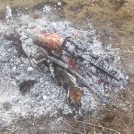
Today is my first day on Medicare. It’s no time for rejoicing.

This category of mandatory spending by the federal government garners renewed attention with each new congress. With Republicans having majorities in the House of Representative and Senate, it will continue to be under attack from conservatives and wing nuts. There is little comfort having made it to the next milestone on the road to full retirement.

As with any health insurance, one hopes never to have to use it.

Categories
Living in Society

Coolidge Revisited

Trumpworld
Trumpworld

It saddens me to return to the Coolidge administration for guidance about the role of the press in contemporary times.

“The chief business of the American people is business,” President Calvin Coolidge said during a speech to the American Society of Newspaper Editors on Jan. 17, 1925.

“There does not seem to be cause for alarm in the dual relationship of the press to the public,” he said, speaking of the relationship between newspapers and their business interests. “Whereby it is on one side a purveyor of information and opinion and on the other side a purely business enterprise.”

Everyone who believes there is no cause for alarm about the role of the corporate media during the recent election stand on your head.

“I could not truly criticize the vast importance of the counting room,” Coolidge said. “But my ultimate faith I would place in the high idealism of the editorial room of the American newspaper.”

How many editorial rooms are there today? What the heck is an editorial room? Anyone?

Coolidge’s lack of criticism of the counting room, in this speech and throughout his administration, contributed to the stock market crash and the Great Depression.

“According to a Brookings Institution report in 1928, more than half of American families remained near or below the poverty level from 1923 to 1929,” Steven Oftinoski wrote in his biography of Calvin Coolidge. “Coolidge’s failure to put restraints on business and industry or to regulate the stock market certainly contributed to the 1929 market crash.”

“The administration took the narrow interest of business groups to be the national interests, and the result was catastrophe,” historian William Leuchtenberg wrote.

To say newspapers, and by extension the corporate media, are corrupt is to misunderstand the basic relationship between the press and business. They were just doing their job during the 2016 election, which in the post-Reagan society is to make money.

Ronald Reagan thought well of Coolidge.

“One of the rooms in the White House that benefited from Nancy’s good taste was the Oval Office, which got some new paint, a new floor, and new carpeting,” Ronald Reagan wrote in his autobiography An American Life. “I did my part by hanging up a picture of Calvin Coolidge in the Cabinet Room. I’d always thought of Coolidge as one of our most underrated presidents.”

What will President Donald Trump think?

Considering the birtherism he engendered and other criticisms laid on President Obama he seems likely re-decorate the Oval Office to purge evidence of his predecessor.

More important, he has pledged to lower tax rates and listen to business interests. Will trickle down tax policy work again as some claim it did during the Coolidge administration when he lowered taxes and paid down the country’s debt from World War I? I doubt it.

As my colleagues at the home, farm and auto supply store say, Trump hasn’t been president for one day yet. Nonetheless, the scent of Coolidge permeates his transition.

Will Trump be the next Coolidge with a little Reagan added?

I’m not holding my breath for the corporate media to report it, so I’d better just write it myself.

Categories
Living in Society

Comment about Cedar County Politics

Woman Writing Letter

EDITOR NOTE: Last week I made the following comment on Bleeding Heartland’s web site on a post titled Iowa’s No Bellwether Anymore — And Neither Is Cedar County.

I’ve heard the framing “bellwether Iowa” before and believe it is buncombe (H.L. Mencken spelling). To me the discussion should be about swing voters.

Here are my initial reactions:

The size of Trump’s win in Cedar County doesn’t matter to the operative condition of swing voting which is the culture of the electorate. The mathematical framework here seems arbitrary. As I’ve argued with prominent Democrats in Cedar County, mathematical analysis isn’t how one understands the electorate at the county level.

History matters less than the candidate or slate of candidates up for election. It is predictable that based on population, ethnicity and factors you mentioned, with the high number of no preference voters (4,586) compared to Democrats (3,173) and Republicans (3,902) Trump would do well. Many in the Clinton bubble, including me, underestimated how much people dislike Hillary and Bill Clinton. The Republican party strategy was hammer Clinton repeatedly then do it again and it worked to persuade swing voters to vote Trump in big numbers.

Cedar County voters were willing to split the ticket in 2012. To answer the bellwether question one has to understand whether they will swing back given a different set of candidates. I believe they will.

The elephant in the room is the Kaufmann family. Since Jeff ran successfully for Cedar County supervisor, and Bobby ran for state house, and their family has deep, multi-generational roots in the county, their influence is everywhere. The fact that Jeff Kaufmann was Republican Party chair this cycle mattered a lot to Trump’s high margin. Beginning with the caucuses he was able to activate voters for events in a way I believe gave Republicans a clear advantage in preparing for the general.

I don’t claim to be an expert on Cedar County, although I virtually lived there most of July – October of 2012. As long as the Kaufmanns sustain their hegemony it won’t be anything like a bellwether.

~ Written for Bleeding Heartland

Categories
Home Life

Budget Time in Big Grove

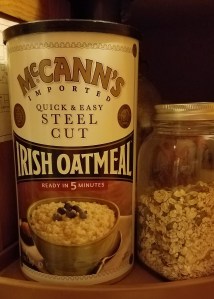
McCann;s Steel Cut Irish Oatmeal
McCann’s Steel Cut Irish Oatmeal

BIG GROVE TOWNSHIP — The ambient temperature outside was 20 degrees this morning. It was time to break out oatmeal for breakfast and dig into the numbers behind our dreams.

At Thanksgiving we turn inward toward family and friends to work on a plan for next year.

That means being with each other and discussing our potential. Life is on auto-pilot as next year’s activities and budget are considered, determined and planned.

I enjoy budgeting as it relates to planning how our lives will change.

2017 will be the last year before I am eligible for “full retirement” with the Social Security Administration. Mainly, this means an influx of monthly cash beginning in 2018. We need to make it to that mile marker without incurring too much debt. I plan to keep my job at the home, farm and auto supply store at least until then.

Like many baby boomers, I plan to work for income long past retirement. The time since leaving my transportation career well prepared us for cutting expenses and making do with less — the new American condition.

Dreams persist in the real world. Writing a budget is tangible evidence of such reality.

It is easier to write an expense budget than a revenue budget. There is a baseline of fixed and variable expenses that doesn’t change much. Basic costs of living change without doing anything differently. The hard part is figuring out how to pay basic expenses to support our dreams and ambitions, hopefully in sufficient quantity to enable dreams made real.

There is a lot to consider and nothing but time during the extended holiday season.

Categories
Living in Society

Letter to the Solon Economist

Newspaper Office
Solon Economist

Open Letter to State Representative Bobby Kaufmann

Congratulations on your mentions on FOX News and in the Washington Post last week.

Your proposed legislation to claw back money from state funded schools that supported students after the general election got their attention and raised your personal national profile. Well done on self-promotion!

Your political supporters may be cheering you on, but constituents are not.

Perhaps you should have considered the November protests in Iowa City and elsewhere more thoroughly before clutching the limelight of media attention.

Your statement on FOX News that “in life there are winners and losers” may apply to elections and sporting games but our God-given lives are about much more than winning and losing. You denigrated the lives of hard-working parents by this statement.

To CBC Radio you said, “I believe the national conversation needs to take place with both sides coming to the table.”

Let me refresh your memory.

Republicans attempted to de-legitimize President Obama from his inauguration and obstructed everything they could during his administration. They pledged to do the same should the Democrat have won Nov. 8.

In 1971, I joined with others to stop traffic on Interstate 80 near Iowa City, not unlike the recent protests you found annoying. Those of us who had been tear-gassed in our dormitory rooms without provocation had a bone to pick as we intentionally tried to stop business as usual and pay attention to ending the Vietnam War. Our bonfire on I-80 didn’t last long before the Iowa Highway Patrol broke it up, pursued and arrested many among us.

When people take to the streets in protest there is little concern about one’s arrest record regardless of the penalties.

“Eternal vigilance is the price of liberty,” Thomas Jefferson said. We’ll be vigilant during the 87th Iowa General Assembly.