LAKE MACBRIDE— Today I planted seeds outside. Rover F1 Hybrid Round Radishes; French Breakfast Radishes; Purple Top White Globe Turnips; White Globe Radishes; Nelson F1 Hybrid Early Carrots; Bloomsdale Long-Standing Spinach; Razzle Dazzle Hybrid Spinach; and Dwarf Blue Scotch Curled Kale.
LAKE MACBRIDE— During the late 1990s I worked on a logistics project in Ochlocknee, Ga. for four months. I don’t remember much about the town, except it was a poor place, with a per capita income of $10,112. When I encountered locals outside the job site, the conversation was a mix of complaining, gossiping and harshness. The place and its people defined hard-scrabble.
The project was located at the largest employer in the area, which was and is involved in mining and processing minerals for a variety of consumer applications. No local ever complained to me about the mines. The rest of the economy was agricultural: peanuts, cotton and pecans. It was a common practice to let cattle roam without fences, and we frequently had to stop the car on Main Street to let them cross. I decided to stay in the nearby county seat at a motel with cable television— a needed escape after working 14 hour days.
TV Food Network, as it was known, occupied my non-working time, and I developed an insatiable curiosity about food and its preparation. Emeril Lagasse, Mario Batali, Susan Feniger, Mary Sue Milliken, Julia Child and others prepared food on screen, and I was captivated, watching episode after episode on Georgia weekends. Food is a common denominator for humanity, and I couldn’t get enough. My involvement in the local food movement today has its origins in the contrast between that uninviting place in South Georgia and my food escape.
There is a broader point to be made than one person’s transient addiction to a television network while away from home. It is that American food pursuits, and the economy around them, continue to be based partly upon curiosity.
I discovered a confection made of dark chocolate, quinoa, blueberries and agave syrup. Why would any informed person want that, given the problems?
Maybe blueberries could be cut some slack, but cocoa production is a fragile and labor intensive operation. The growing demand for cocoa products is leading to deforestation and its negative impact on the environment. Consumer demand for quinoa has elevated prices so that indigenous people in Peru, who used it as a staple food, now can’t afford it. Agave syrup has 50 percent more calories per tablespoon than refined sugar, and like sugar and corn syrup, is a highly processed food. According to WebMD, “the American Diabetes Association lists agave along with other sweeteners (table sugar, honey, brown sugar, molasses, fructose, maple sugar, and confectioner’s sugar) that should be limited in diabetic diets.”
The answer to the question is people like chocolate and are curious about food.
It seems clear that American curiosity about food and food preparation drives what we find in stores. It is a commonplace that corn syrup can be found in every aisle of a traditional mega mart, but it is the endless combinations of diverse ingredients that attract our attention then get us to buy.
By developing and marketing new things— quinoa mixed with chocolate or chicken, troll or pole and line caught tuna, gluten and GMO free products, and a host of others— purveyors of the consumer economy seek to engage us through the current sales cycle. I suspect we will stop buying at some point, returning to staple foods, or moving on to what the food marketers deem next.
In a free society, people should be able to do what they want with only minimal restrictions to protect the commons. In our consumer society, that is a joke. For a local food system to be sustainable beyond the initial curiosity of trying it out, something fundamental must change. It is a need— perceived or real— to change from the act of consuming to the act of production. That involves a lot of hard work, and I’m not sure it could be done in the current society.
If we are serious about sustainability and local food systems, we must get beyond curiosity, and distraction from the challenges of a turbulent world. We must get to the production of things that matter in our lives on the prairie.
LAKE MACBRIDE— Following a truck pulling a double bottom of anhydrous ammonia tanks, I snapped a couple of photos at a traffic signal. On my way to a shift at the warehouse, thoughts were turning to all the garden work needing done at home, and the closed environment at the warehouse seemed a distraction from more important things in the outside world.
This type of rig is out everywhere, although it is more common to see them being pulled by tractors in a field during spring than on the streets. It’s time to fertilize the fields for the row croppers.
We accept this type of wobbly evidence of conventional farming, rolling off on the shoulders of roads on busy traffic days, because of the importance of the farm economy to our community. As readers know, I work in the local food system, which in some ways is different, and in some ways, similar. In fact, the question, what is farming, comes up with regard to many diversified farms.
A rebellion is brewing among local food producers. Rep. Art Staed of Cedar Rapids posted this on his Facebook page yesterday:
I attended a meeting today organized by John Whitaker, State Executive Director of the IA Farm Service Agency. The meeting’s focus was on addressing and removing barriers to the production of local foods. We heard producer goals and concerns, and county concerns from a zoning and building perspective. We also studied legislative, financial, regulatory and other issues and perspectives. The goal is to encourage and support small farmers in their efforts to provide more fresh, local fruits and vegetables. This was an informative discussion, and I’m really excited to assist with this endeavor at the state level. More local meetings will be scheduled…
Staed put the best face on the issue, which is farmers are not always treated as farmers in this state. The biggest barrier to local food producers is that they are often treated as commercial operations by local governing bodies, rather than farming operations. They are deprived— wrongly, they believe— of the Iowa agricultural exemption from regulations. The meeting organized by John Whitaker is one of a number of them, and I’m carrying one of his business cards in my wallet, if you want a sign of where I’m at on the issue.
Staed is the ranking member of the local government committee in the Iowa legislature, which will play a key role in enabling all farmers to take advantage of the agricultural exemption, should the legislature act. Already, there is bipartisan support for doing something to relieve local food producers of unnecessary regulatory burdens that add a financial hardship that inhibits entry of new family members into diversified farm operations. More diversified farm operations would be better for our economy, and better for the environment.
We’ll see how this plays out, and there is a lot going on that hasn’t made it into the public eye. Right now, folks focus on those prominent anhydrous tanks, distracted from the movement toward parity that is stirring among farmers involved with local food production.
LAKE MACBRIDE— The soil is ready. If there was ice in it a few days ago, it is now mellow from recently departed frost and dry weather. Rich and soft and easy to work. I’ll turn over a plot after work at the warehouse. What to plant next?
I have become a buyer of beets, cabbage, potatoes, kohlrabi, and other common vegetables. Eschewing those, the first plot will add carrots, spinach, turnips and radishes to the lettuce broadcast there this week. I’ll time the radish planting to provide a continuous harvest through the end of spring. Too, I’ll leave space to transplant lettuce started indoors when the weather warms. Once the spring vegetables finish, the space will be used for something else.
April has been a very busy month. The late spring, coupled with four public speaking events in the next two weeks, many jobs, and yard and garden work, filled my calendar to overflowing. I’m not complaining. Just sayin’.
The whirlwind between now and Memorial Day weekend has begun.
LAKE MACBRIDE— The ground turned over, just moist enough and no ice below the surface. I planted the leftover lettuce seeds from last year and it started sprinkling rain.
Despite the branch busting apple crop last year, there are a lot of flower buds forming. Garlic is up and the spring bulbs outside my library window are pushing through the mulch piled on them last fall.
The last seed tray has been planted with hot peppers, and just in time, as not only lettuce, but spinach, arugula, turnips and radishes all need planting.
One never knows, but there is a good feeling about this spring, even with the late arrival. Here’s hoping all the work gets done.
LAKE MACBRIDE— Dressing pasta is a culinary practice with so many variations, it is difficult to justify a single recipe over others. It is a matter of taste, available ingredients and tradition, so far be it from me to set anything in stone.
Prepared pasta sauce— the industrial food kind— is available at warehouse clubs and grocery stores, but it is hard to imagine ever bringing a jar home when it is so easy to make it in the kitchen. Here’s how.
Drain a quart of canned whole tomatoes in a colander, reserving the liquid.
Heat a skillet on medium high heat and coat the bottom with extra virgin olive oil. Use the best oil you have.
Dice a medium onion according to preference and sautée in the heated oil.
Season with salt and pepper.
Mince five cloves of garlic and add to the pan. Cook until the onions are translucent. Don’t let the garlic burn.
Season with dried oregano and basil, fresh if you have it.
Add six ounces of tomato paste. Stir and heat until you can smell the tomato.
Add the drained whole tomatoes, chopping them with the edge of a spoon while stirring the mixture.
It is optional to add protein at this point. We use Morningstar Farms® Recipe Crumbles, although browned ground beef, pork, chicken, tofu, seitan or others could be substituted.
Once the ingredients are thoroughly incorporated, add the reserved tomato juice until the sauce has the desired fluid characteristics. Store any leftover juice in a jar in the ice box, or drink it.
Adjust seasoning.
Turn the heat to low and and simmer until the pasta is cooked.
LAKE MACBRIDE— The trouble began with the bountiful harvest of local produce last year. The larder was filled to the brim, and we had fresh vegetables until this month. In the end, I made a gigantic pot of soup, filled with root vegetables, onions, and a host of other ingredients. It is delicious, and I’m tired of it at the same time. There is another gallon left in the fridge and freezer.
I want to be working and dining from outdoors, and until this past weekend, that proved to be impossible. Indoor pantry cooking has becomes too quotidian. If we were living on a subsistence basis, we would be okay. There’s more to life than that.
So to get out of the early spring doldrums caused by the delay of warmer temperatures, here comes a series of posts to alleviate the sad state of cookery that has befallen this kitchen.
CEDAR RAPIDS– A light snow is falling and Iowa DOT trucks are spraying a saline solution to make the Lincoln Highway passable. Not that it is really needed. Spring is here, and the snow will provide needed moisture as it melts soon. Any sensible driver will reduce speed and avoid a collision in this hiccup of precipitation– not that there are a lot of those out there.
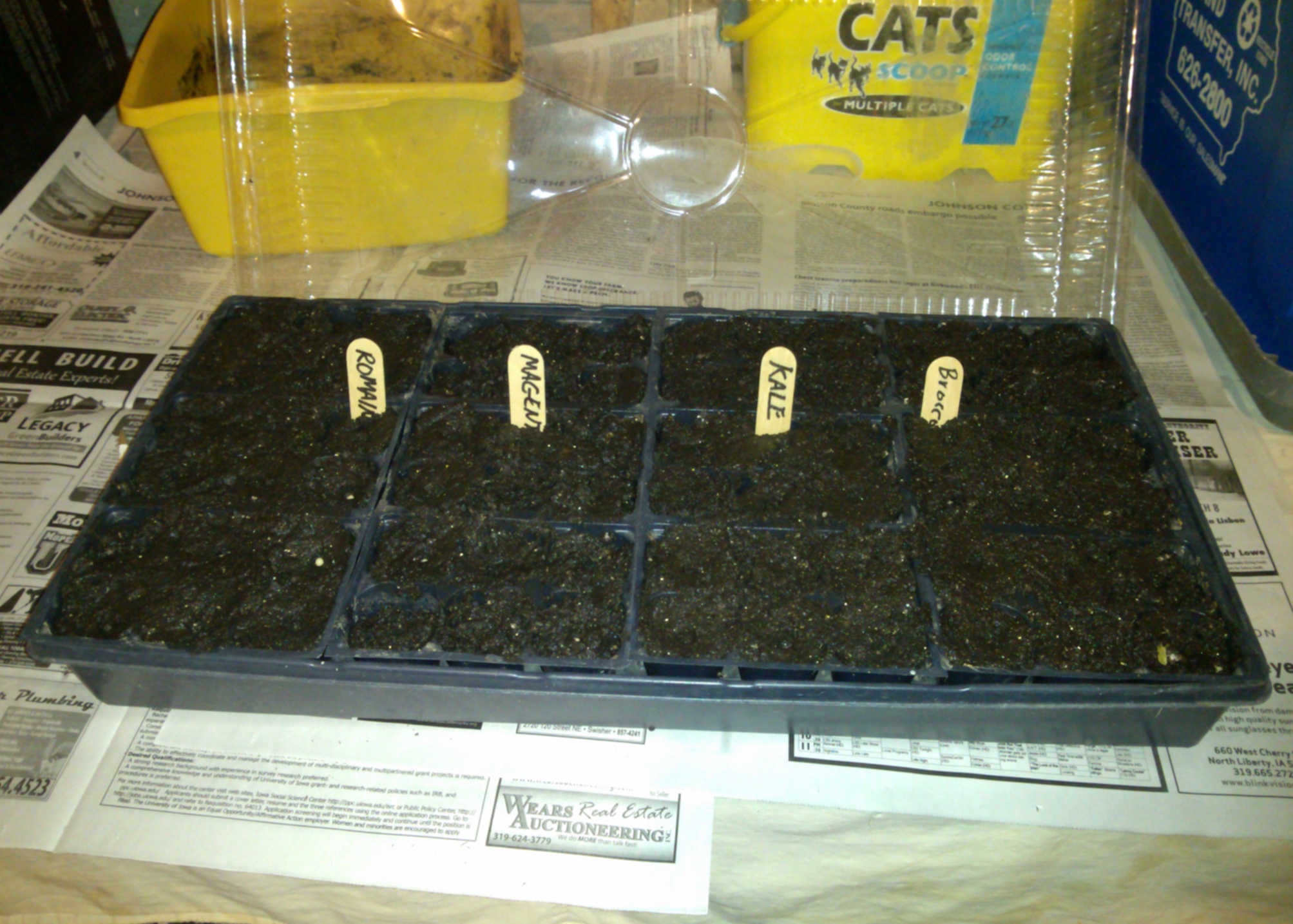
I’ve been challenged to get seedlings to start. The germination rate has been good, averaging 90 percent with all but one batch of seeds. The problem was getting good light on the trays before I set up the table near the south facing window. Plenty of time to re-plant this season, and if even light is the problem, that can be worked through.
Another difference was the first batch of soil mix was too dense. With batch two I added some vermiculite from a bag I found in the garage. These trays seem to be doing better and the tomato seedlings look pretty good. Time is on my side, for now.
As I write, I’m waiting for the dealership to replace the driver-side seat belt under the Subaru lifetime seat belt warranty. A couple of guys are talking about deer meat, canned salsa, tequila, home bars, sports, California, Hawaii, the ocean, seafood, fresh produce and other idle topics. It’s a “waiting room,” where I’m thankful for the fresh coffee, if not for the loud voices.
A neighbor burned his brush pile last night, reminding me how ready I am to be working outside. I keep telling myself, “it won’t be long.”
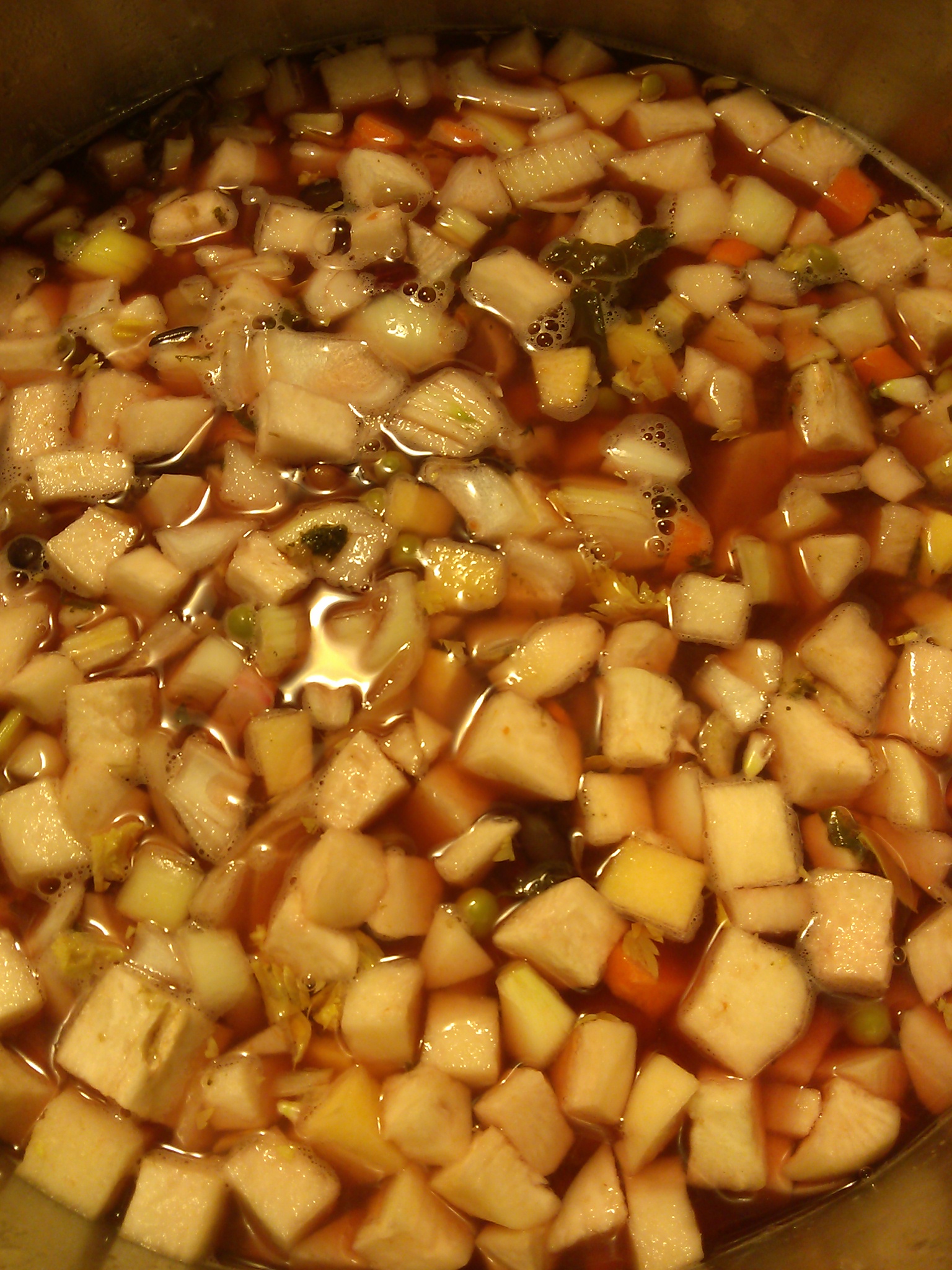
LAKE MACBRIDE— Taking the last of the root vegetables– four kinds of potatoes, three kinds of turnips, and beets– and six jars of canned goods, two kinds of beans, barley, peas, onion, celery and carrot, I made the last batch of winter soup last night. It cooked until bed time, when we turned the heat off to sleep. In the morning, I brought the mixture to a boil, then turned the heat down to simmer until it becomes soup.
All that’s left in the fridge from last year’s local harvest is a couple of daikon radishes and some cabbage. There is plenty of garlic in the pantry, and a single spaghetti squash, but that’s it for fresh. It will be a few weeks until spring produce begins to come in at the markets. The soup and remaining canned goods will have to last.
Yesterday, I finalized plans for a presentation titled, “Living Non-traditional Lives: Focus on Finances.” It is part of the American Library Association “Money Smart Week,” which is a national initiative in its fourth year between the ALA and the Federal Reserve Bank (Chicago) to provide financial literacy programming to help members of our community better manage their personal finances.
Here’s the blurb I posted on Facebook: “Will be speaking at the Solon Public Library on April 12 about living without working a conventional 5 x 8 job as part of Money Smart Week. I plan to focus on: my personal work history, including what it means to be a writer in a time of social media; the role of jobs, the role of households and family, and personal finance in alternative lifestyles (banking, debt, income, taxes, bartering, health care, transportation, communications), deciding what’s important (community engagement, family, stress management, health, time management).”
My Climate Reality colleagues are meeting in Johannesburg, South Africa today where Al Gore is making his slide show presentation. The organizers didn’t know the exact number of attendees, as visa and finance problems deterred some who had registered. However, it looks like about 700 new members of the Climate Reality Leadership Corps, from many nations, will join us at the conclusion of the 24th training session.





 Journey Home
You must be logged in to post a comment.