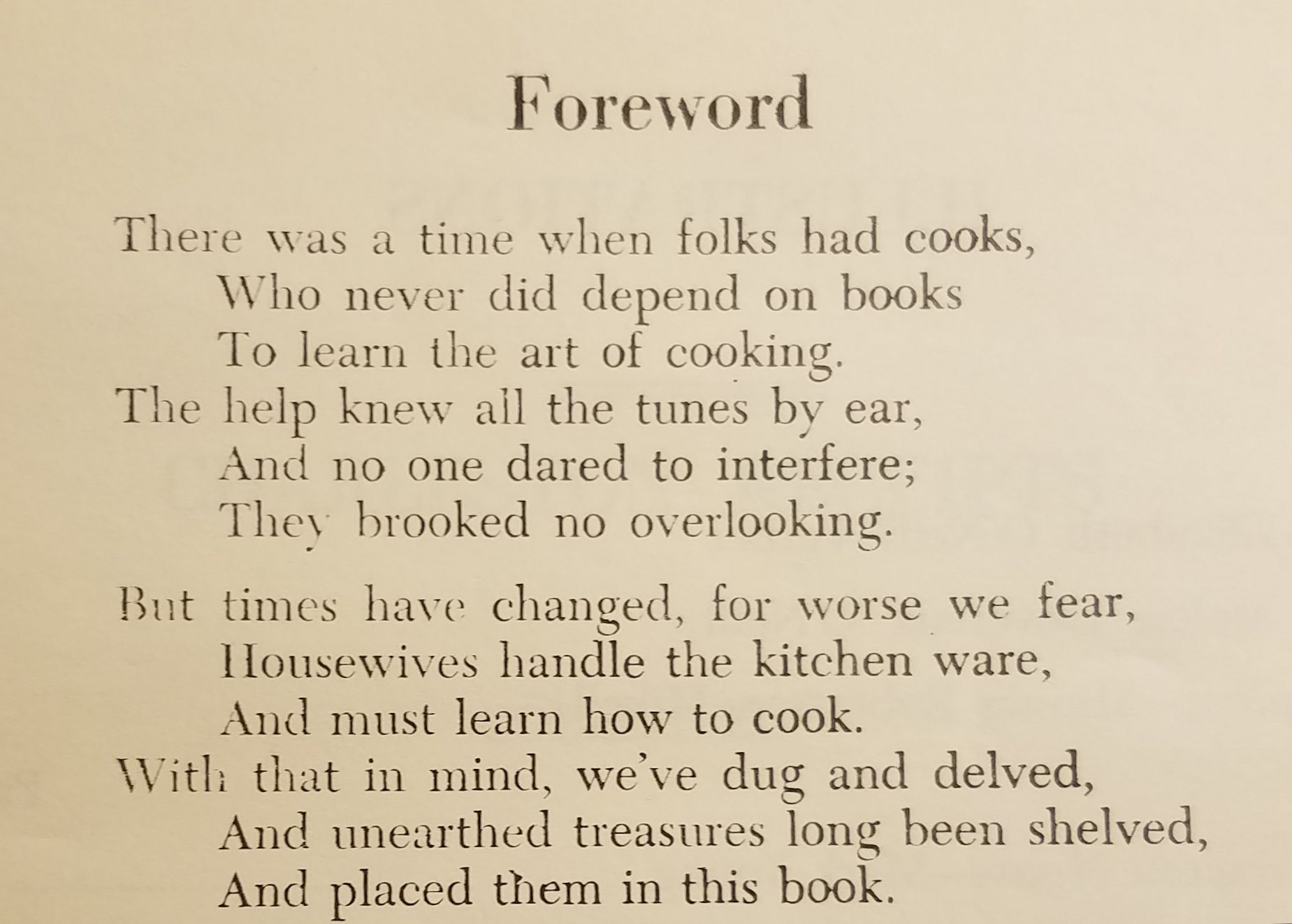
I don’t know about this forward to a 1950s cookbook, Charleston Receipts. The unspoken part is cooks in the first verse were mostly black women, and housewives in the second were white. It is not overtly stated, but I’m certain it was implied. This book trades on fond remembrance of antebellum food culture. The word plantation is used in the names of some of the receipts (not recipes, per the author).
A large number of white women and girls worked as servants in the United States. It is possible the reference is not racist. Home cooking and cleaning were common employment for female Irish immigrants and those of other nationalities. When Grandmother left the Minnesota farm in the 1910s, she was employed as a servant in a home in Minneapolis. She worked as a cook well into her sixties. In the 1970s, people I knew in southern Indiana continued to employee a black woman as a home cook. It bothered me then, and it bothers me now. A person has to live, but not like this.
I have two copies of the book and one was missing its binder. Copies were readily available in thrift stores and used book stores. I read all the pages and saved a few from the volume without a binder to refresh my memory. There was a multi-page section about hominy, “long a favorite in the Carolina Low Country.” The section begins, “Man, w’en’e hongry, ‘e teck sum egg or cheese an’ ting an ‘eat till e’ full. But ‘ooman boun’ fuh meck wuck an’ trouble. ‘E duh cook!” I don’t recall the name of this type of language but it is stereotyped and hearkens to minstrel shows of the 1830s, which characterized blacks as lazy, ignorant, superstitious, hypersexual, and prone to thievery and cowardice. Charleston Receipts is racist, although I am confident the Junior League of Charleston, which published the book, would deny it.
When I stopped in Charleston enroute to military service in Germany, I had a couple days before dropping off my pick up truck at the port. Charleston traded in slave culture then, and they do now. I saw for the first time up close, slave auction blocks, shackles, and whips used on enslaved humans. I searched the internet and found today there is the Old Slave Mart Museum that tells Charleston’s role in slave trade from 1856 to 1863. They were domestic slave traders then, one of the biggest in the country for collecting and selling human chattel.
In writing my autobiography I find the racist side of my personal history was in plain sight. I didn’t understand that then, mostly because my parents taught me a person is a person and that was that. It helped this outlook to have made a family trip to the plantation where Grandfather was on work release from prison and see my father sharing memories with a group of black men we encountered there. They seemed like old friends. It was a formative experience.
Racism never died out, although I forgot about it for a while… until I began writing my story. In that context, it is hard to miss, even in old cookbooks.
 Journey Home
One reply on “Receipts of Racism”
I need say nothing more than, “Yup.”
LikeLiked by 1 person