The following email was sent to my federal elected officials, Senators Joni Ernst and Chuck Grassley, and Representative Mariannette Miller-Meeks, on Wednesday, Jan. 7, 2026.
I must be blunt. If you don’t know that what the administration did in Venezuela over last weekend is wrong, there is little hope for you.
I have taken time to understand administration arguments supporting what they called Operation Absolute Resolve. In particular, U.S. Attorney General Pam Bondi said, “It was a law enforcement function to arrest indicted individuals in Venezuela.” Everyone who believes law enforcement was the sole purpose of the operation should stand on their head.
President Trump’s actions in Venezuela and the Caribbean Sea are an extension of a long U.S. tradition of interference in the region. While in 1934, U.S. President Franklin D. Roosevelt introduced the “Good Neighbor Policy,” pledging not to invade or occupy Latin American countries or interfere in their internal affairs, the region has been rife with covert U.S. operations to overthrow left-wing elected officials. Trump is not unique in this regard.
The public, announced plans from President Trump have been about much more than arresting Nicolás Maduro.
I urge you to use your position in The Congress to de-escalate what is wrong about our incursions into sovereign nations. News reports indicate about 75 people died in the action to capture Maduro. Our nation should think twice before repeating this mistake at the cost of dozens of human lives.
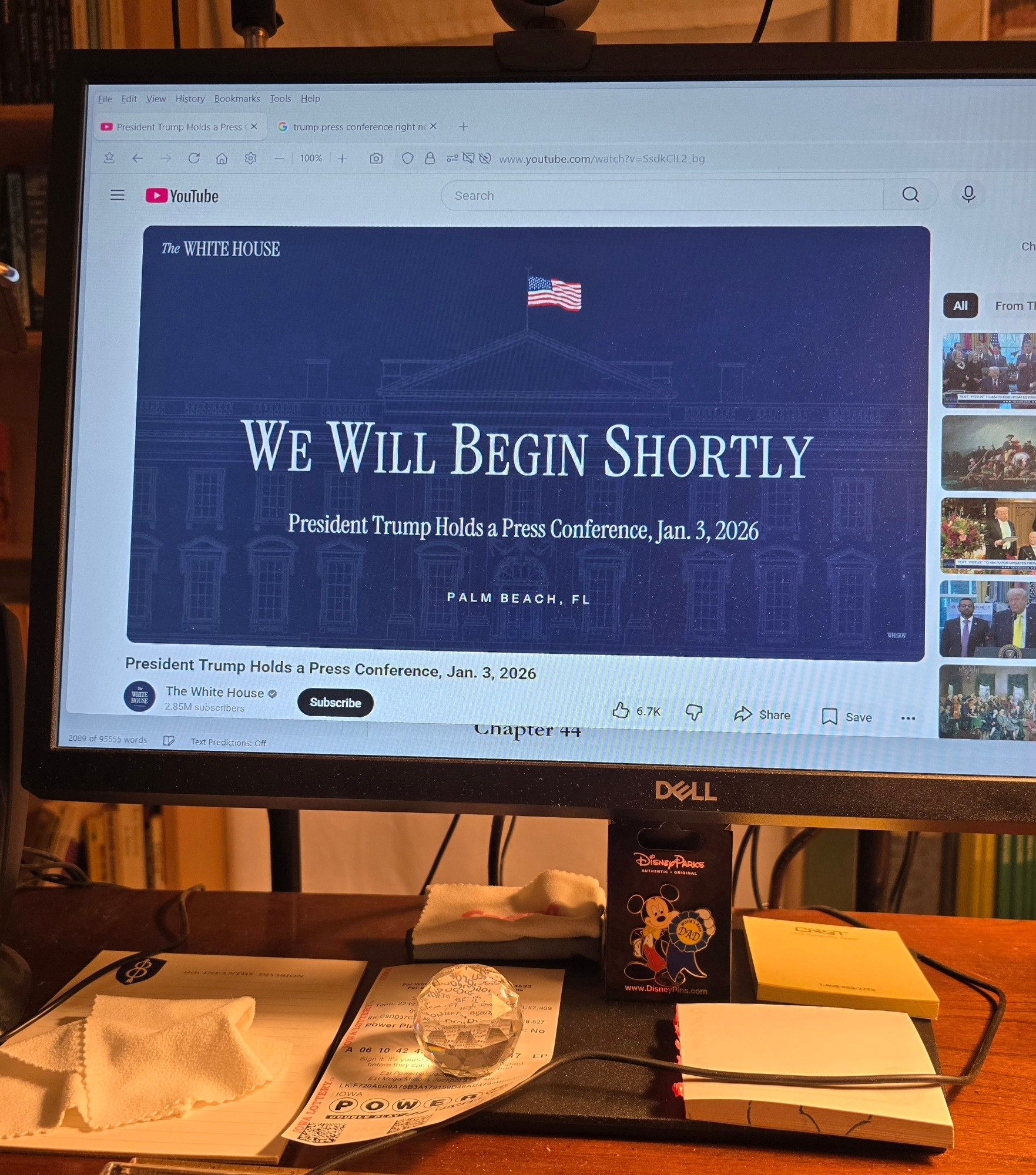
The president is not good at starting on time. One might say he is undisciplined.
At his inaugural ball, President Donald J. Trump said that his “proudest legacy will be that of a peacemaker and unifier.” What planet is he living on? I understand his rationale of peace through strength. In the case of Venezuela it is as bogus as a three dollar bill. The weekend operations escalated war-like behavior, not peace-making. If peace is what he wants, Trump is going in the opposite direction.
According to the Military Times, U.S. military operations are surging under Trump. He has overseen at least 626 air strikes, compared with 555 for President Joe Biden during all four years of his term. Military operations occurred in eight countries listed in the article. Donald Trump is not a peacemaker.
I viewed the entire press conference about weekend operations in Venezuela. It was hard to stomach all the misrepresentations and lies — the self-aggrandizement — yet it yielded a couple of things.
As many of us believed, the invasion and kidnapping of the Venezuelan president was about taking the country’s oil. Some in the United States have been lusting after it for decades. Trump confirmed this during the presser. How U.S. oil companies would proceed is sketchy at best.
The Cedar Rapids Gazette reported on Sunday:
“We’re going to run the country until such time as we can do a safe, proper and judicious transition,” Trump said at a Mar-a-Lago news conference where he boasted that this “extremely successful operation should serve as warning to anyone who would threaten American sovereignty or endanger American lives.” (Cedar Rapids Gazette front page, Jan. 4, 2026).
Not so fast! Shortly after Delcy Rodríguez was sworn in as Venezuela’s new president she pushed back on Trump. “We are determined to be free,” she said, according to the New York Times. “What is being done to Venezuela is a barbarity.”
“We had already warned that an aggression was underway under false excuses and false pretenses, and that the masks had fallen off, revealing only one objective: regime change in Venezuela,” she said. “This regime change would also allow for the seizure of our energy, mineral and natural resources. This is the true objective, and the world and the international community must know it.” (New York Times, Jan. 3, 2026).
What should happen next is Donald Trump, Pete Hegseth, Marco Rubio and General Dan Caine — and probably others — are removed from office. The only remaining question is how that gets done.
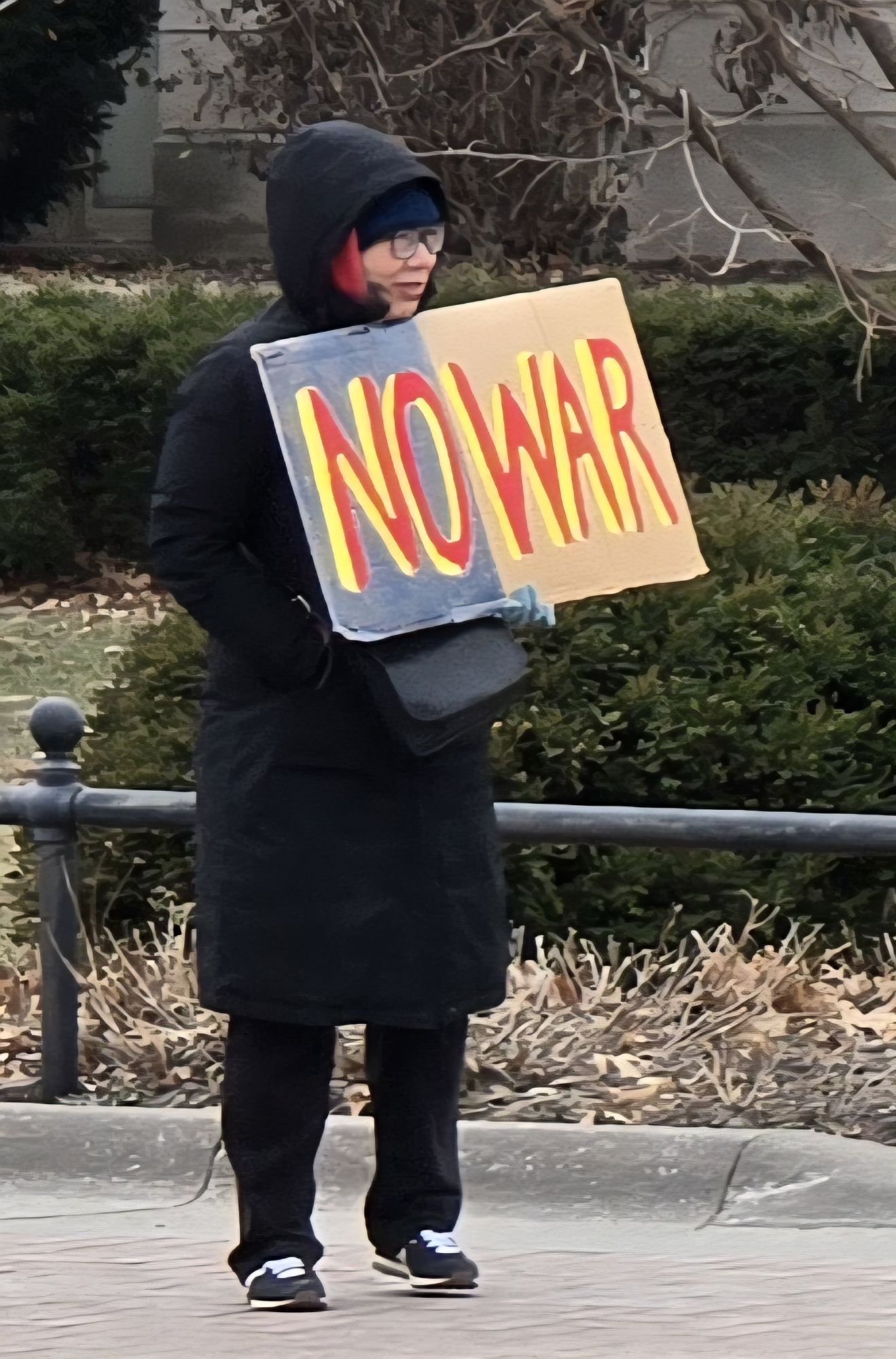
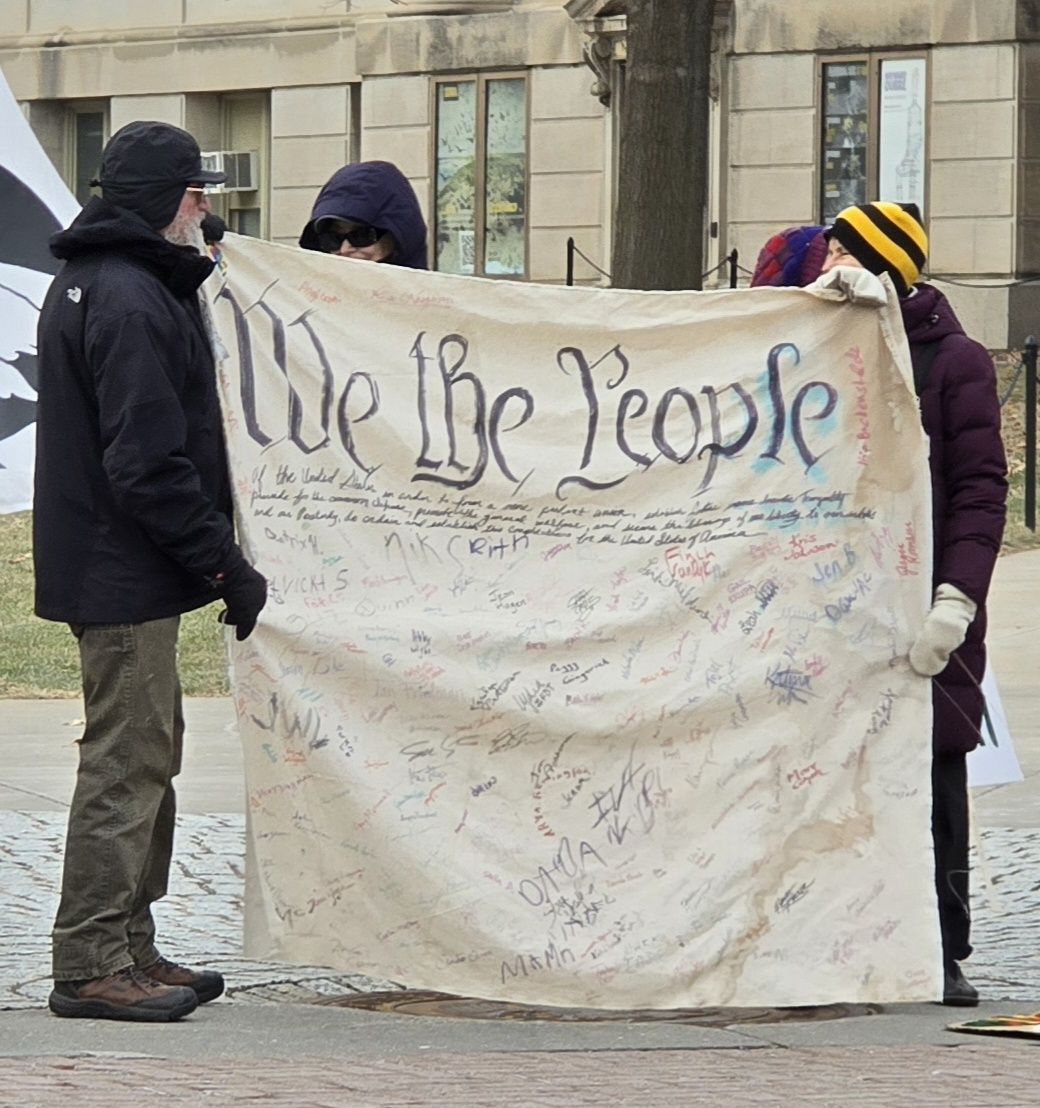
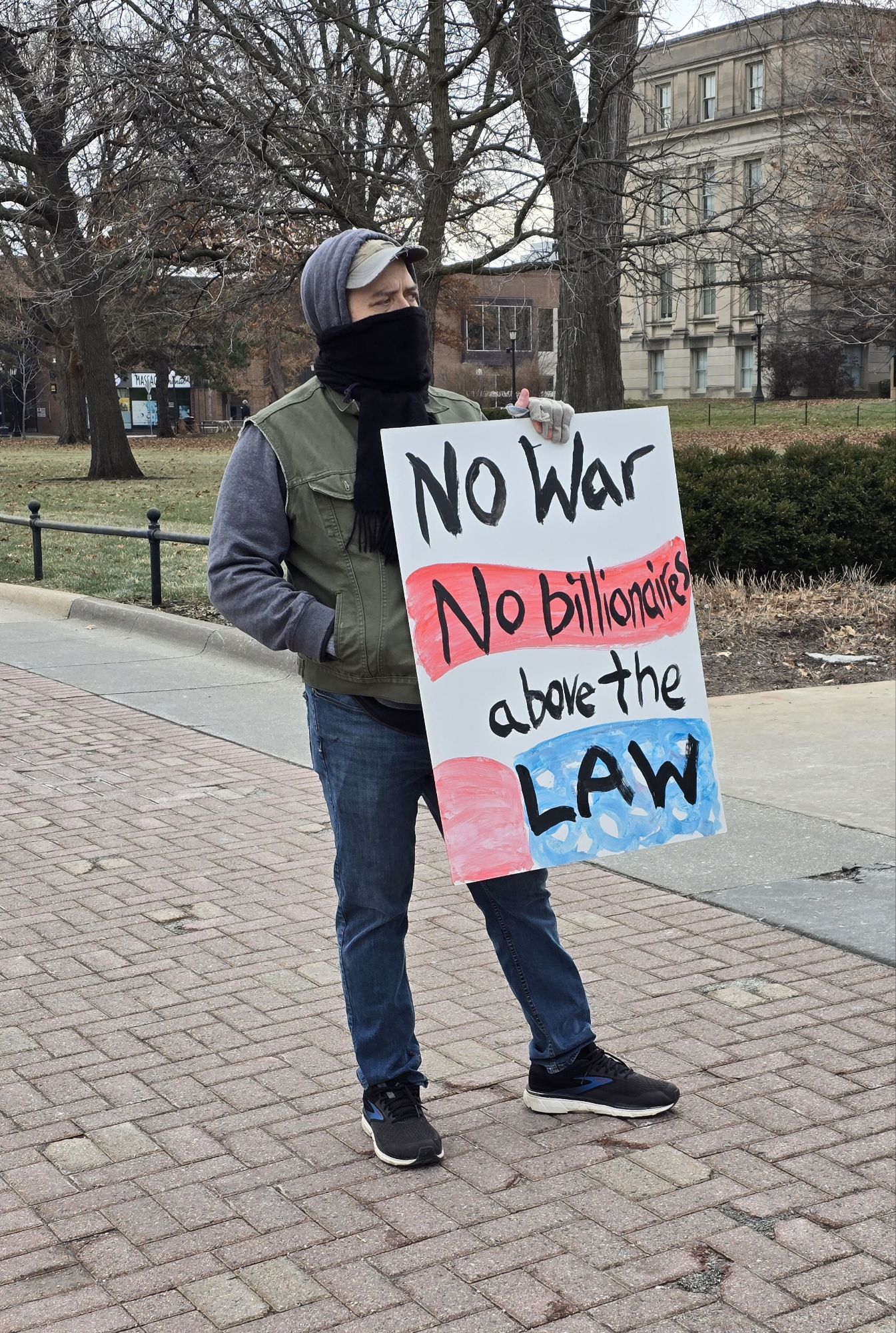
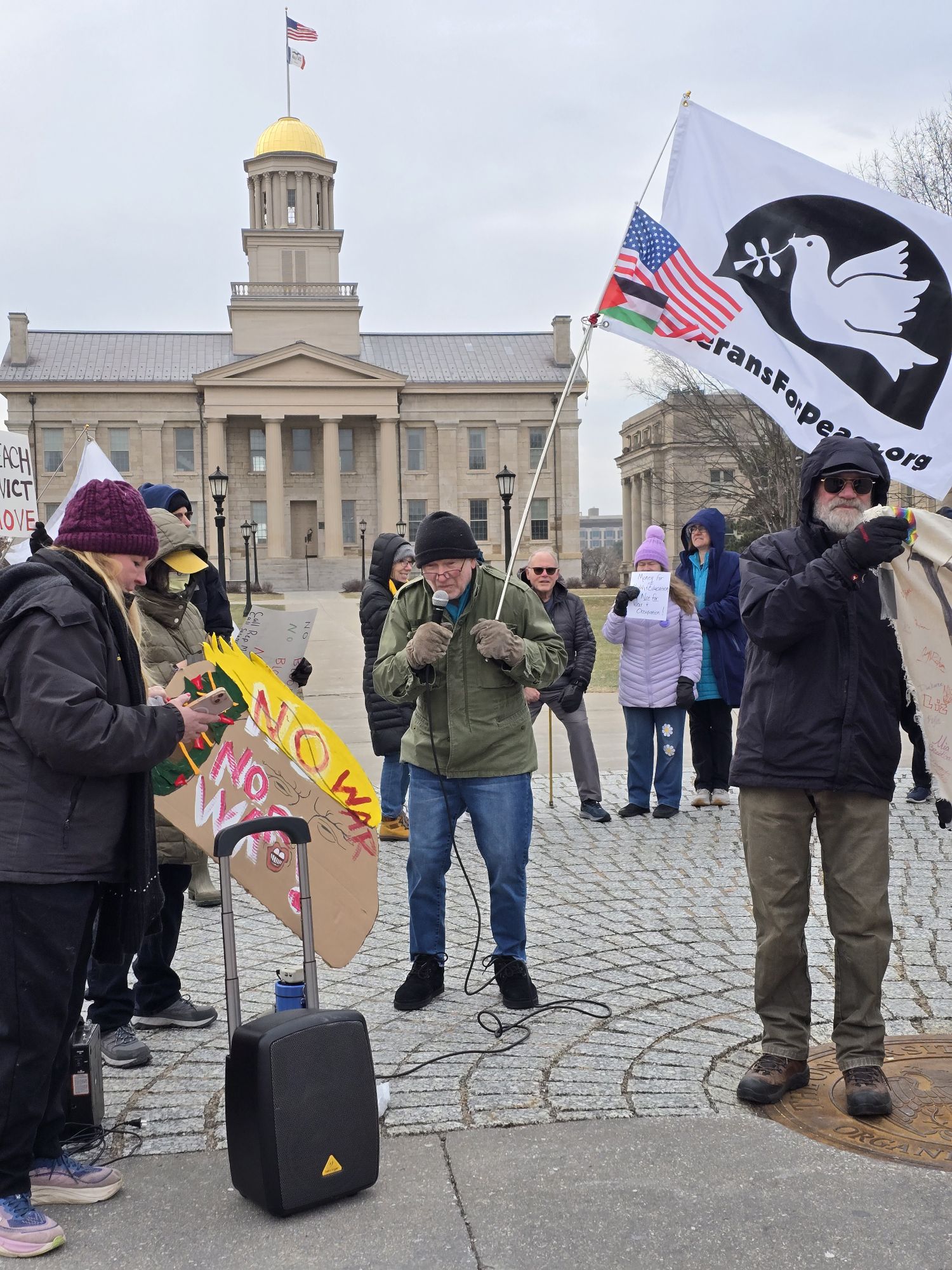
On Sunday, Jan. 4, Veterans For Peace was part of an anti-war demonstration in Iowa City. Here are some photographs I took.
No War.We The People.No War. No billionaires above the law.Ed Flaherty of Veterans For Peace speaking at the anti-war demonstration on Jan. 4, 2026.
My veterans group asked about having a social hour at the Hilltop Tavern in Iowa City last Friday. I don’t visit many taverns yet I like folks in our group and it was located across the street from the grocer from which I needed provisions. I drove the 14 miles to the county seat, parked in the grocery store parking lot, and walked across the street to get there.
The hill in “hilltop” refers to what was known as Rees’ Hill. This is from the Our Iowa Heritage website:
The area was generally known as Rees’ Hill – reflecting the winery and wine garden owned by Jacob and Agatha Rees across from the Hilltop Tavern location. The wine garden was well known and popular with Goosetown residents during the 1880s (and likely earlier). Jacob’s death in 1889, and Agatha’s (and son Frank’s) deaths in 1893 likely resulted in the closure of the winery. For many years, the property was either unused or planted for strawberries or general nursery. This property is where the Hy-Vee grocery store and gas station exist now at the corner of North Dodge and Prairie du Chien and occupied two acres. (The Origins of Iowa City’s Hilltop Tavern by Derek (D.K.) Engelen, Our Iowa Heritage).
The tavern opened after prohibition ended and has been in operation ever since. When I entered through the door in the photo, the bar was right there on the right, maybe 20 feet from me. People behind the bar immediately recognized that I entered and inquired what I wanted. I found my friends in a large, adjacent room with three pool tables and ordered a draft beer.
My friend, a banker before retirement, brought a roll of quarters so we could play eight ball. I hadn’t played since grade school but we formed teams and racked the balls twice. None of us were talented at the game, yet it helped pass the time by encouraging conversation.
What do aging septuagenarian veterans talk about on a Friday afternoon?
One of us recently had hip replacement surgery, and that took a bit of time. I obviously know hip surgery exists, but haven’t discussed it with someone who had it. I had questions. It turned out someone else had knee replacement surgery, so that led to a discussion of the differences between the two procedures.
About that time, someone walked up to ask if we minded if he played music on what in earlier years would be called a jukebox. We didn’t mind, and one of our party asked him to play some Kenny Rogers, which he did.
Being veterans, we discussed the extrajudicial executions of people suspected of being drug runners in the Caribbean Sea, and whether Admiral Mitch Bradley, the commander of U.S. Special Operations Command, would be the scapegoat for the president and secretary of defense to avoid responsibility for two specific killings that were clearly illegal. We drew no conclusions.
The prior day, the Iowa Legislative Services Agency released the first county supervisor redistricting plan. The Iowa Legislature earlier voted to require certain counties that elected supervisors at-large to divide into districts. Their idea is that creates an opportunity to elect some Republicans, although the logic is based on deceptive arguments. A lawsuit was filed to stop this process. Our group agreed the court system had little time to make a decision because of the long lead time to plan an election. We were in a wait and see mode until the lawsuit is resolved.
We talked some organizational business, finished our beverages and game, and headed out. It was a pleasant way for aging peace warriors to spend an afternoon in these trying times.
IOWA CITY — On Tuesday, Nov. 11, 2025, beginning at 11 a.m. CST, the local chapter of Veterans For Peace will hold three public events in Iowa City to re-dedicate ourselves to the work of peace. Members of the public are invited.
Beginning at 10:45 a.m., we will assemble at the Iowa City Ped Mall. Bells will ring at the 11th hour, 11th day, 11th month, as is tradition. Dr. James Zogby will present brief remarks.
In 1985, Zogby co-founded the Arab American Institute, a Washington, D.C.-based organization which serves as the political and policy research arm of the Arab American community. He continues to serve as its president. Zogby is also Director of Zogby Research Services, a firm that has conducted groundbreaking surveys across the Middle East.
Immediately following the outdoor observance, Veterans For Peace will host a free luncheon at the Iowa City Public Library. Dr. Zogby will address the group in a longer format. His topic is “The war that didn’t end all wars and instead launched a century of conflict.”
At 6:30 p.m., Veterans For Peace will sponsor a screening of the new film Earth’s Greatest Enemy at Iowa City FilmScene, 404 East College Street, Iowa City. This is a documentary exposé of the world’s biggest—and most unaccountable—polluter: the US military. Learn the environmental cost of having a military empire. The film was written and directed by Abby Martin and Mike Prysner. Prysner will attend and introduce the film. Afterward he will host a question-and-answer period. Tickets are pay-what-you-can.
This is the sole Armistice Day observance in the State of Iowa.
More about Dr. James Zogby from the Arab American Institute website:
James Zogby co-founded the Arab American Institute, a Washington, D.C.-based organization which serves as the political and policy research arm of the Arab American community, in 1985 and continues to serve as its president. He is Director of Zogby Research Services, a firm that has conducted groundbreaking surveys across the Middle East.
In September 2013, President Obama appointed Dr. Zogby to the United States Commission on International Religious Freedom. He was reappointed to a second term in 2015 and concluded his service in May 2017. He was twice elected Vice Chair.
Zogby is featured frequently on national and international media as an expert on Middle East affairs. Since 1992, he has written a weekly column that is published in 12 countries. In 2010, Zogby published the highly-acclaimed book, Arab Voices. His 2013 e-books, “Looking at Iran: The Rise and Fall of Iran in Arab Public Opinion” and “20 Years After Oslo,” are drawn from his extensive polling across the Middle East with Zogby Research Services. His most recent book is, “The Tumultuous Decade: Arab, Turkish, and Iranian Public Opinion – 2019-2019” analyzes the fascinating transformations taking place across the Middle East region following the US withdrawal from Iraq and the Arab Spring.
Dr. Zogby has also been personally active in U.S. politics for many years; in 1984 and 1988 he served as Deputy Campaign manager and Senior Advisor to the Jesse Jackson Presidential campaign. In 1988, he led the first ever debate on Palestinian statehood at that year’s Democratic convention in Atlanta, GA. In 2000, 2008, and 2016 he served as an advisor to the Gore, Obama, and Sanders presidential campaigns.
For the past 3 decades, he has served in leadership roles in the Democratic National Committee. He currently serves as Chair of the DNC Ethnic Council, an umbrella organization of Democratic Party leaders of European and Mediterranean descent. He served on the DNC’s Executive Committee from 2000 to 2017 and for more than a decade served as Co-Chair of the party’s Resolutions Committee.
In 1975, Dr. Zogby received his doctorate from Temple University’s Department of Religion, where he studied under the Islamic scholar, Dr. Ismail al-Faruqi. He was a National Endowment for the Humanities Post-Doctoral Fellow at Princeton University in 1976 and is the recipient of a number of honorary doctorate degrees.
The Situation Room during the death of Osama Bin Laden, May 1, 2011. Photo credit – Official White House photo by Pete Souza
While stationed in Europe, I drew an assignment to serve as a visiting officer to a French battalion of Infantry Marines in the coastal city of Vannes in Brittany. Not many American officers knew the French language, and even though my French was marginal, the command felt it would improve and be needed in case the balloon went up. That is, there was war on the central plains of Europe. After returning to garrison, I was asked to write a classified account of my observations while assigned to a French platoon. Our battalion S-2 officer knew what the word classified meant and complied with Army procedure in handling my report. Today, I don’t recall what I wrote, except to say the French were liberal in the use of corporal punishment by officers on enlisted personnel. I filed the report and hadn’t thought about it much since then.
The news this week is of the operational security breach when National Security Advisor Michael Waltz added national security reporter and editor in chief of The Atlantic Jeffrey Goldberg to a chat about an ongoing attack in Yemen on the messaging application Signal. I had not heard of this app, which is an American open-source, encrypted messaging service for instant messaging, voice calls, and video calls. Signal has known vulnerabilities to infiltration by Russian and Chinese intelligence. Worse case scenario, bad actors were listening in on the chat in real time, in addition to an experienced national reporter present by apparent mistake. There are issues.
First, the president was not part of the chat and likely should have been. When people on the chat asked whether the attack should commence, whether the president authorized it, no one knew. The decision to make the strikes then appears to have been made by deputy chief of staff Stephen Miller, according to Heather Cox Richardson. What was the president doing then, instead of being in this meeting? Watching television or doom scrolling his phone? The president said he didn’t know anything about it.
Content of the chat aside, why weren’t the participants using secure channels for this discussion? Even if the Situation Room at the White House is not a viable option, the government has secure channels for use in its place. Either the administration hopes to avoid scrutiny by using a commercial messaging app, or they are incompetent… maybe both.
I would much rather write about other things on this blog. The truth is I need to process what I’m hearing and writing about it helps. What we heard this week is important and we can’t look away. Plenty of other sources have better detail and analysis about the security breach. I’ll let the story run its course, which is expected to be a long one.
Remarks as prepared for the Armistice Day observance in Iowa City on Nov. 11, 2024.
Thank you for joining us during this observance of Armistice Day. My name is Paul Deaton. I was a founding member of the Iowa Chapters of Veterans for Peace. When we organized the chapter, we had veterans from every armed conflict going back to World War II. Some of our members have died, and I ask for a moment of silence in their honor.
I intend to keep my remarks brief. Some of you who know me may realize how difficult that will be for me. Nonetheless, let’s get started.
In World War I we find the beginnings of the misinformation and disinformation that became so prevalent in our society. There are 5 things I would like to say about that.
Point 1: There were conspiracy theories about the war.
Was World War I a hoax? No, yet conspiracy theories were prevalent. During the War, the American home front was awash with them alleging internal German enemies were intentionally spreading disease among both human and animal populations, most egregiously during the 1918 influenza pandemic. While false, these stories nevertheless revealed Americas’ shifting relationships to the environment, warfare, and the federal state. They channeled immediate fears over what type of war, and what type of enemy, the nation faced, as well as deeper, Progressive-era anxieties related to the dramatic expansions of government and scientific expertise in American life. It underlines how the war permitted individuals to discuss, denounce, and contest state and scientific authority at this moment in the early twentieth century. In my view many of the conspiracy theories we hear today have their roots in this.
Point 2: Allied Propaganda
Propaganda was used by both the allies and the Germans during the World War.
Allied governments launched propaganda efforts in the days after the invasion, pushing out terrifying, often untrue tales, published in newspapers, fliers, and pamphlets. There were stories of bayoneted babies, mass rape of girls, and old men who obediently turned over useless rifles, and were shot on the spot by heartless “barbarians.” No doubt the intent was to stoke the fire of support for the war.
Point 3: German propaganda.
For the Germans, the goal of propaganda was to make the war seem less devastating than it was. More soldiers were needed at the front, so government officials downplayed the number of casualties to recruit them. The truth about the scale of casualties – an estimated 40 million civilian and military personnel dead and wounded – could only be kept secret using propaganda. The total number of deaths includes more than 9 million military personnel. The civilian death toll was between 6 and 13 million. Disease, including the influenza pandemic, took about a third of these lives. World War I ranks among the deadliest conflicts in human history. Suppression of this fact was a goal of German propaganda.
Point 4: The Armistice.
I visited the Glade of the Armistice while I lived in Europe. It’s in the French Forest of Compiegne where the Germans and Allied Supreme Commander signed the Armistice we commemorate today. They used a rail car for the ceremony. Years later, in 1940, Hitler used the same rail car to accept the French surrender. Hitler had obvious propaganda reasons for doing so. I saw a similar rail car in France while I was there, although not the same one used in 1918. The original disappeared after the Nazis took possession of it. I remember how quiet it was in the forest that day. It was a day filled with meaning.
Point 5: Living History
Veterans of World War One are deceased. The veteran I knew was my Grandfather who never spoke to me of the war. We were more concerned with his black lung disease contracted during decades of coal mining in Illinois. Family lore is Grandfather arrived in France shortly before the Armistice and did not see conflict. He was there six months waiting to return to Illinois. If you have a memory of the war and its veterans like mine, today is a day to remember.
As living memory fades let us hope and pray that the World War I dead shall not have died in vain.
In conclusion, I’d like to read a poem used by the allies to recruit soldiers. The idea was for new people to take up arms to replace the fallen. You may know this one. In Flanders Fields is by Canadian physician John McCrae, published December 8, 1915.
In Flanders fields the poppies blow
Between the crosses, row on row,
    That mark our place; and in the sky
    The larks, still bravely singing, fly
Scarce heard amid the guns below.

We are the Dead. Short days ago
We lived, felt dawn, saw sunset glow,
    Loved and were loved, and now we lie,
        In Flanders fields.

Take up our quarrel with the foe:
To you from failing hands we throw
    The torch; be yours to hold it high.
    If ye break faith with us who die
We shall not sleep, though poppies grow
        In Flanders fields.
Kathy Kelly speaking to Veterans for Peace Midwest Conference in Cedar Rapids, Iowa Sept. 21, 2024.
On Sept. 21, 2024, the Veterans for Peace Midwest Conference was held at the Kiteville Hotel in Cedar Rapids, Iowa. One of the featured speakers was Kathy Kelly, who is a familiar face to peace activists in Iowa. She gave a talk titled “Who Are The Terrorists?”
Kelly’s work took her to Bosnia, Haiti, Afghanistan, Iraq, Yemen, Gaza, and other countries where she worked for peace. Her story is worth reading on Wikipedia.
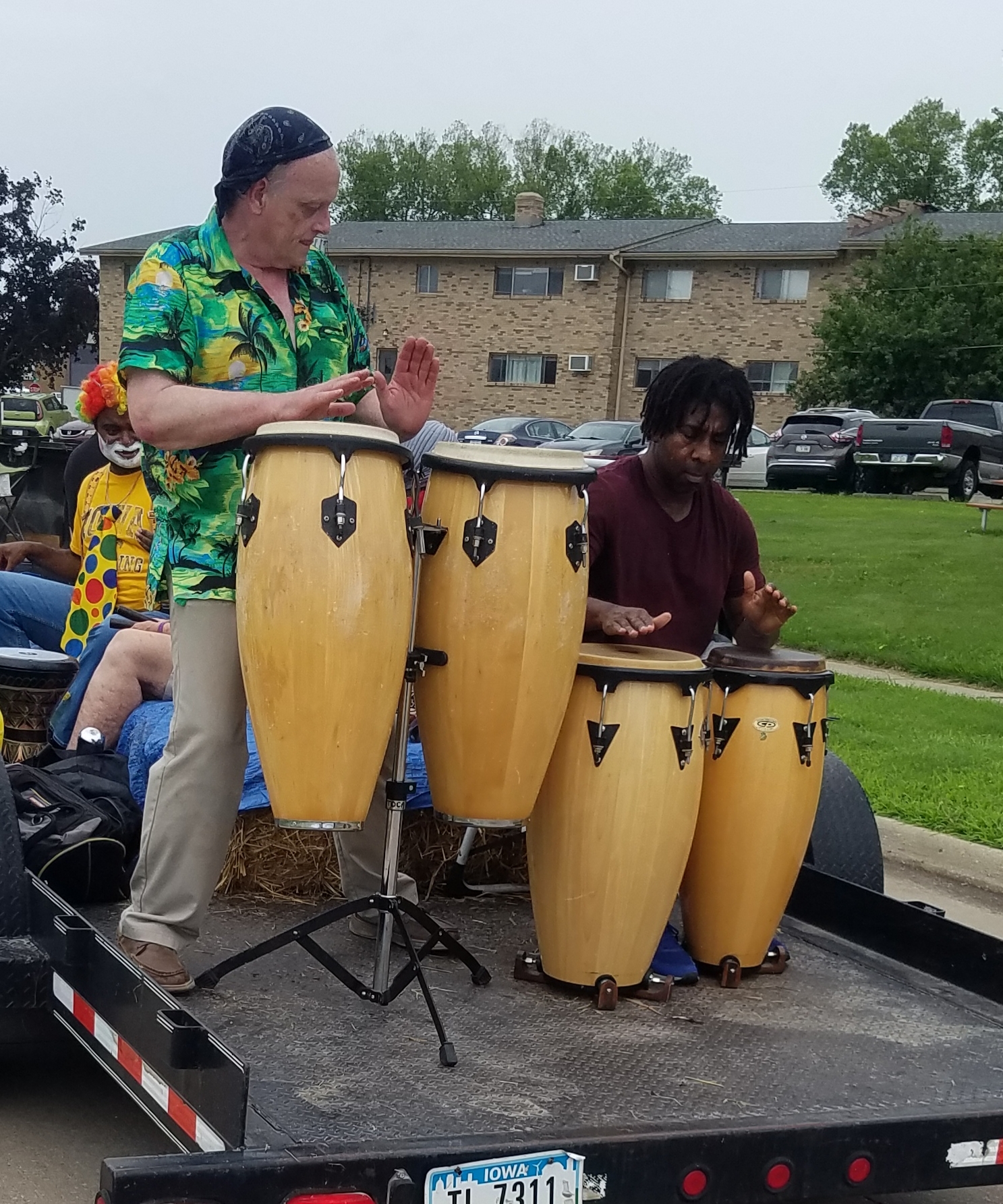
Yahoo Drummers at the end of our Independence Day parade entry in Coralville, July 4, 2024.
The Independence Day parade in Coralville is likely the last hurrah for many of us in the People’s Coalition for Social, Environmental and Political Responsibility. Our members are aging. Some of the 100 Grannies for a Livable Future died. The World War II members of our chapter of Veterans for Peace also passed. The number of Yahoo Drummers is diminished with two playing the rear guard of this year’s parade entry. This event is a big deal in the life of the county. I hope others replace us going forward.
My right hip began to bother me at some point in the parade. When I got home, I found my feet sore. I walked in two parades and drove a vehicle in a third, yet my parade walking days are over. I hope to recover from the aches and pains, yet I don’t want to exacerbate them either.
Riders in the People’s Coalition for Social, Environmental and Political Responsibility Independence Day parade entry in Coralville, July 4, 2024.
Beginning at the turn around from walking east to west, I got a bug in my brain that concerned me about shooters. For the rest of the parade I scanned the crowd with that in mind. There were none, and that was good. I couldn’t shake the irrational fear.
What impressed me most about the parade was the youth of those gathered. Children and parents alike seemed very young. It is time for some of us oldsters to step aside to make room for the young.
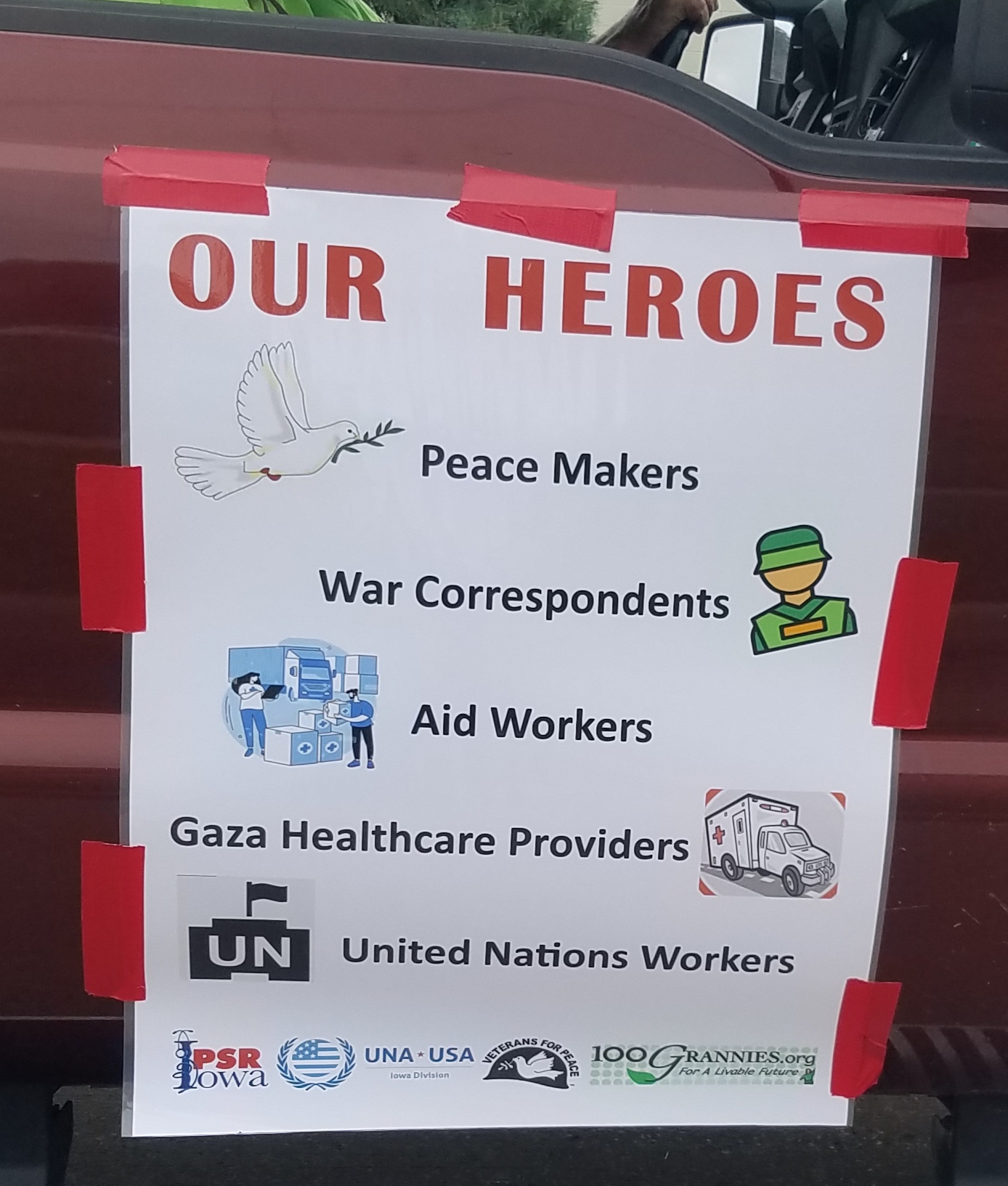
Placard made for the Independence Day parade in Coralville, July 4, 2024.
War has always been devastating yet the devastation of the Israel-Hamas war is unprecedented. What makes this war different is it is occurring in the ever-present media-influenced eyes of a populace unfamiliar with the long relationship between Israel and Palestine. People young and old are being activated by this public war: donating money to relief funds, protesting, and more. There are a lot of moving parts.
That said, I don’t know what else to say, other than there should be an immediate, permanent ceasefire; humanitarian aid should have unfettered access to the Palestinians; and both sides should release any hostages or unlawful detainees. At yesterday’s Democratic district convention, we passed a resolution saying those things.
Some friends with family ties in Palestine were present at the convention. One spoke during debate over the resolution. He pointed out the plight of children in the war zone. What heartless fool could not be affected by this?
I read about the use of artificial intelligence in generating military targets. Computers find targets, which may or may not be reviewed by a human before striking. What algorithms often find is the best place to target someone is in the evening when they are at home. Often the whole family is present when the bombs hit.
On-campus protests have drawn an undue amount of attention. The varying responses by school administrations and law enforcement has been both appalling and comforting. The temptation is to compare it with my own campus protests over the Vietnam War in 1970-1973. That is the wrong impulse. Things have changed on campus in more than 50 years.
Another temptation is to blame the U.S. administration for the war. President Joe Biden is an easy scapegoat. While exerting public pressure for him to change tactics is acceptable in a democracy, it is of itself, no solution. When it comes to the Mideast, there will unlikely be consensus in an approach to peace-making.
It feels hopeless some days. I contribute to relief funds as I can, write my congressional representatives, and pray for resolution. There is no assurance there will be a resolution in the Mideast, and that’s part of the problem.
Newman Abuissa, chair of the Iowa Democratic Party Arab American Caucus, speaking at a peace vigil in Iowa City on Dec. 29, 2023.
I studied the Israeli Six-Day War (June 1967) and the Yom Kippur War (October 1973) while I was in the military. We figured with the Vietnam War over, the next major conflict would be over oil in the Middle East. We lifted Israeli tactics and put them into practice in our Mechanized Infantry Division in preparation for the inevitable conflict. General Norman Schwartzkopf, who led U.S. forces during the First Gulf War, served as Assistant Division Commander in the same unit I was in, although after I left Germany.
Besides that, I haven’t studied the Middle East to any extent. It has been a blind spot in my knowledge of history. A friend from high school was serving in the Peace Corps in Israel during 1973. By chance, I ran into him while leaving a youth hostel in Florence, Italy. We walked to Piazza San Marco and chatted about life since I had last seen him stateside. I don’t recall what he said about the war, but it was one contributing factor to his return to the states. When I boarded a bus to Fiesole was the last time I saw him.
A group of local peace activists held their regular Friday afternoon vigil at the University of Iowa Pentacrest on Dec. 29. KCRG-TV was there and wrote this story.
Iowa City, Iowa (KCRG) – The Iowa City chapter of Veterans For Peace held a peace vigil in front of the Pentacrest in downtown Iowa City on December 29th.
They were joined by people from the following groups: Iowa City Action for Palestine, Iowans for Palestine, Jewish Voice for Peace, Iowa Physicians for Social Responsibility, Mennonite Peace Group, Johnson County United Nations Association, and the Johnson County Interfaith Coalition who all spoke at the event.
The chapter’s co-founder Paul Deaton called for a ceasefire as well as allowing unrestricted humanitarian aid into the Gaza Strip.
“There is a need for peace in this world and if we don’t work for peace we won’t have peace,” said Deaton.
‘Veterans For Peace’ handed out leaflets outlining their positions, saying being critical of Israel’s actions is not the same as being anti-Semitic.
The leaflets also stated “Support for Palestinian justice and a cease-fire does NOT equate to endorsement of Hamas.”
The group holds peace vigils every Friday.
Groups come together in Iowa City at vigil for peace in Israel-Hamas War KCRG-TV, Dec. 29, 2023.
I don’t understand the Middle East any better than I did in 1974 when I ran into my friend in Florence. What I do understand is what I told KCRG-TV, “There is a need for peace in the world and if we don’t work for peace we won’t have peace.” Working for peace are words to live by.





 Journey Home
You must be logged in to post a comment.