Categories
Kitchen Garden

Making Soup

Root Vegetable Soup
Root Vegetable Soup

LAKE MACBRIDE— It’s hard to go wrong making soup. The dish is tolerant of variation, and is as diverse as can be. Soup is a pantry-based dish, good to use vegetables up, and has been the basis for meals since forever. It’s a never ending experiment in living. Here is how I made it today.

There were five components to this batch of soup: roots, soup base, canned soup, barley and frozen corn and peas.

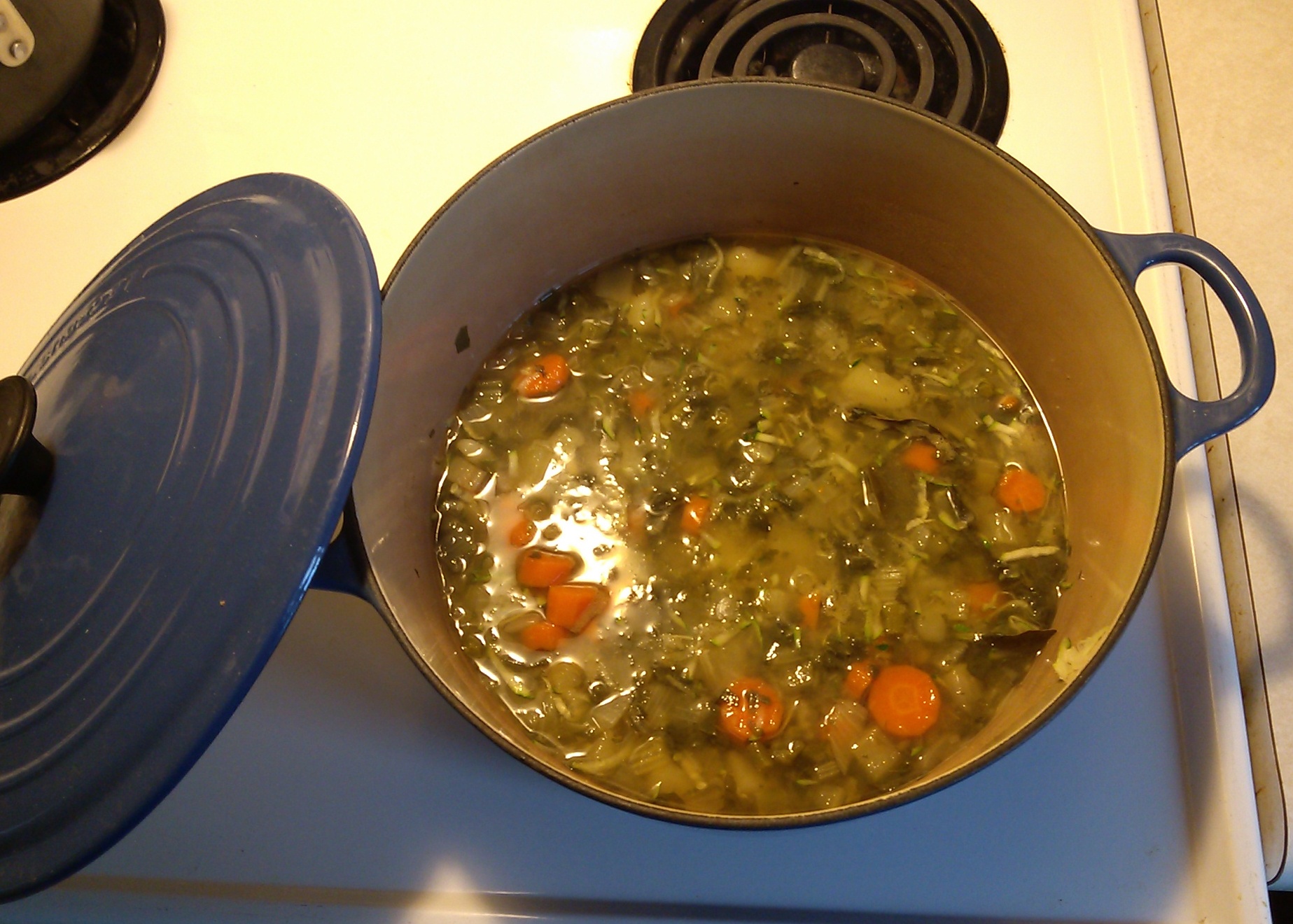
I picked five different types of root vegetables from the refrigerator drawer and counter: hakurei and purple top turnips, rutabaga, kohlrabi and potato. The point was to use what was on hand. These roots were grown in my garden, and on three different farms, so I know them well. I peeled and diced them into small, uniformly sized pieces, then covered them with cold water in a Dutch oven, and cooked until tender. I poured the whole lot into a strainer placed inside a stainless steel bowl to separate the roots and save the cooking water. The roots went back into the Dutch oven, reserving the liquid.

Soup base is a form of local frugality. In our kitchen, I make and use a lot of vegetable stock. What I call soup base is the remains of vegetables after straining away the cooked stock. I process the cooked vegetables through a food mill and can the result in a water bath. Soup base adds both flavor and texture to soups, and helps thicken them. At this point, I added a quart to the roots.

A farmer friend had a lot of kale at the end of the 2012 season. She typically mows everything down and plants a cover crop, but called me the day before to ask if I wanted any kale. I took a bushel and made soup from the pantry and canned it. The quart jars can be eaten as-is, but lately I prefer to use them as an ingredient. I added a quart of vegetable soup to the pot.

After stirring the mixture, I added enough of the root cooking liquid to cover, along with a quarter cup of pearled barley.

The mixture simmered the better part of four hours— until it was soup. At the end, I added a cup each of frozen peas and cut corn.

The next step to making a meal is flexible. The old way was to lay a plank of thick, coarse bread in the bottom of a bowl and ladle soup on it. It could be topped with bits of browned meat for omnivores, or seitan or fried or baked tofu for vegetarians. Salt and pepper and you’re ready for a hearty winter meal made from local ingredients, one that stands up to the test of time.

Categories
Kitchen Garden

Tart Cherry Coffee Cake

Tart Cherry Coffee Cake

LAKE MACBRIDE— Six pounds of tart cherries from Michigan were buried below frozen corn, eggplant and broccoli in the freezer drawer. The cherries were frozen in one bag, so I thawed them and separated and strained the liquid to use in a separate dish, and make coffee cake with part of them.

The recipe calls for one can of cherry pie filling, but substituting fresh frozen cherries takes only a bit of  preparation. In a large pan, measure three cups of pitted cherries and place on medium heat. Add one half cup of honey, a tablespoon each of white flour and corn starch, and a scant teaspoon of cinnamon. I’m from Iowa, so I use corn starch, but other thickeners will work, including potato starch, arrowroot, or flour only. Stir gently until the mixture thickens completely and set aside to cool.

The batter is in two parts, the cake and topping.

Cake dough: Cream one stick of softened, unsalted butter with one cup of granulated sugar in a mixer. On low speed, add two cups of white flour and one teaspoon baking powder. Mix thoroughly and add 3/4 cup of milk. When the ingredients are thoroughly mixed, press the dough into a greased, spring form pan. I line my pan with parchment paper, but that is optional.

Topping: Cream one stick of softened, unsalted butter with one cup of granulated sugar in a mixer. On low speed, gradually add one cup of flour and mix until the dough turns into crumbs.

Pour the cooled cherry mixture on the dough in the pan and sprinkle on the topping.

Bake for 45 minutes in a 325 to 350 degree oven. Allow coffee cake to cool before serving, although it will be hard to wait. I reserve superlative descriptions for dishes like this when I say, “it is insanely good.”

Categories
Writing

Biscuits and Gravy

Photo Credit Salt Fork Kitchen

LAKE MACBRIDE— Biscuits and gravy is not a balanced meal, but it is very popular around the lake, and at the restaurants in town. Recently, a restaurant developed the dish to stave off its ultimate demise. Biscuits and gravy are popular, but not miraculous. The restaurant closed. Most local restaurants that serve breakfast offer the item on the menu, and people buy it.

While growing up, our mother prepared a variation on biscuits and gravy we called creamed hamburger on toast. Slices of toasted white bread were cut into small squares and placed on a plate. Ground beef was browned in a cast iron skillet, then removed, leaving the drippings. Using flour and milk, she made gravy with the fat in the pan, seasoned with salt and pepper. When the gravy thickened, she added back the meat, stirred and served the mixture on the toast. We didn’t have it often, but enjoyed it when we did. It was a tribute to my father’s southern heritage, and a somewhat exotic, inexpensive meal made with ingredients usually on hand.

Photo Credit Big Grove Brewery, Solon

In a vegetarian kitchen, there is no meat fat, so our gravies, if made at all, are done so with butter, using the familiar process. It serves. Biscuits are a quick bread, and easy to make, but at home the similar use has been to place a halved biscuit in the bottom of a large bowl and spoon a hearty vegetable soup or stew over it. This is a traditional serving method, one that stretches back in time for multiple millennia. It is much more common in our household than preparing gravy.

Our neighboring town is in a position to develop a vibrant Main Street with the recent interest in local food combined with a proliferation of eateries. While biscuits and gravy is far from haute cuisine, competitive offerings of the dish make a case that a local food scene is alive and growing. That can only be good for those of us who live nearby.

While locals enjoy biscuits and gravy, will outsiders, whose business is needed to supplement local purchases, make the trip for such items? It’s an open question. An answer lies in restaurants serving good food, something which the competition for business will hopefully provide for those who dine out on a Sunday drive, or during a motorcycle or bicycle rally.

One would like to support local businesses, but can only eat so much biscuits and gravy. Here’s hoping the word gets out about our growing food scene in town. In the meanwhile, for those who do most of their cooking at home, here’s a simple biscuit recipe that is easy and quite tasty.

Whole Wheat Biscuits

Ingredients:

2 cups whole wheat flour
4 teaspoons baking powder
1/2 teaspoon salt
4 tablespoons cold unsalted butter
1 cup milk

Preparation:

Preheat the oven to 450 degrees.
In a medium sized bowl, combine the flour, baking powder and salt, mixing thoroughly. Cut the butter into tiny bits and mix into the flour mixture until the texture is coarse. Pour in the milk and mix the dough until it comes together. Knead it 8 to 10 times and turn it out on a floured surface. Flatten the dough to 3/4 inch thickness and cut biscuits into single serving sizes. Bake at 450 degrees for 10 to 12 minutes or until lightly browned. Makes about eight servings.

Categories
Writing

Scalloped Potatoes

Scalloped Potatoes
Scalloped Potatoes

LAKE MACBRIDE— As Thanksgiving leftovers linger in the refrigerator, diminishing bit by bit each day, we need to make something different, a new dish. With the abundance of potatoes at the end of the growing season, making a scalloped potato dish fits the bill instead of the usual mashed, boiled or fried. Serve it with a green vegetable and a protein, and it would make a comforting meal on a day that didn’t get above 15 degrees.

My first thought was to find a home neighborhood recipe in one of the cookbooks I collected from the church and hospital near where I grew up. No luck there. Apparently the church ladies didn’t cook gratin much. (There were no credits to men in the book). So off to the Internet and a review of the standard fare of websites returned after a search for “scalloped potatoes.” While there are many variations of potato dishes, I sought the simplest, with the fewest ingredients, and least prep time. Modified from the recipe to use items on hand, here is the dish.

Scalloped Potatoes

Ingredients: 1-1/2 cups milk (or heavy cream), 3 bay leaves, half teaspoon dried thyme, 2 garlic cloves run through a garlic press, half teaspoon freshly grated nutmeg, salt to taste, 2 pounds of potatoes peeled and cut into eighth inch slices, half cup Parmesan cheese, salt and pepper to taste.

Preheat the oven to 400 degrees.

In a saucepan, heat the milk or cream with the bay leaves, garlic, thyme, nutmeg and salt and pepper. Butter a casserole that will hold the potatoes. Pour the heated milk through a strainer into a large bowl with the slices potatoes. Sprinkle half the Parmesan cheese on top and mix gently to coat the sliced potatoes with milk and cheese.

Spoon part of the milk mixture into the bottom of the casserole and layer the potatoes so they are evenly positioned. Pour the rest of the liquid over the potatoes and sprinkle the remaining Parmesan cheese on top as a crust.

Cover the dish with aluminum foil and bake for 40 minutes. Remove from the oven and let cool for five to ten minutes and serve.

Note: If chives were in season, I’d finely slice them and sprinkle them between layers of potato.

Categories
Home Life Kitchen Garden

Making Pesto and Other Things

Fresh Kale
Fresh Kale

LAKE MACBRIDE— Summer’s harvest has been bountiful and we are less than two weeks in. Keeping up with the vegetables we grow and get from the CSA, has been a challenge of cooking, preserving, refrigerator and freezer space, and rotation. Thus far, little that was brought into the house spoiled. We are thankful to have enough food to eat in a society where so many people go hungry. Even our small town of 2,037 souls requires a food bank, making adequate food for everyone a tangible, local issue.

Yesterday was the first pick of green beans and we steamed them for dinner. Over the years Asian aphids have been a pest for this annual favorite— to the extent I quit planting them for a while. This year they were pristine in the basket. Not sure what happened, but I suspect row-crop farmers didn’t care for the damage to soybeans, and “did something” during the past few years.

I picked broccoli for dinner, and some Swiss chard. Spinach is ready to harvest, the last before the fall planting. There is also lettuce ready to go and plenty of herbs. The apple trees are still looking good: no sign of dreaded Popillia japonica, or Japanese beetle, which during previous years had made its debut by the first of July. Last year was a horrible year with them, and they are sure to arrive soon.

A summer indulgence is to make pesto. The process is simple. Into blender put a cup of first cold pressed extra virgin olive oil, with equal amounts of chopped garlic scapes, basil leaves and kale leaves with the stems removed. Blend the mixture, adding enough olive oil to make it a liquid, or additional garlic and basil to thicken it. Then add a handful of pine nuts, half a cup of Parmesan cheese and salt to taste. Blend until the mixture is a thick puree. The recipe produced enough to fill Mason jars with pesto for the freezer. I reserved some for immediate use, of course.

The thing about pesto, is it can be made with a number of summer greens and herbs. It’s a way to preserve the summer harvest. The other thing is a person can consume only so much of the delicious spread/sauce at a time. For now, we’re living the high life and contemplating dishes, other than just spreading it on bread, in which to use it. Pesto pasta will definitely be one dish on the menu.

Once one is plugged into the local food system, there is little cost to make pesto, except for the olive oil, which is always a luxury. During the summer harvest, a gardener and cook can live in the lap of luxury, even on a limited budget.

Categories
Home Life Kitchen Garden

Summer is Coming

Radishes
Radishes

LAKE MACBRIDE— The weather was perfect today: temperatures in the high sixties and low seventies; sunny, then partly cloudy; and not a trace of humidity. Days like these are the harbinger of summer.

The lawn looks like a lawn, neatly trimmed and the grass clippings collected for mulch. A good part of today was spent weeding and mulching the garden. Everything is beginning to look good.

Because of the abundance, we’ve eaten fresh salads almost every night for dinner the last two weeks— spring fare that never gets old.

A simple and tasty salad dressing is to put equal amounts of balsamic vinegar and first cold pressed extra virgin olive oil, and a teaspoon of Dijon mustard in a small Mason jar. Add a pinch of Kosher salt and pepper to taste and shake until emulsified. Adjust to taste by varying the amounts of the ingredients. If available, add finely chopped herbs like oregano, thyme or basil before mixing. Serve immediately and make only enough for the meal. A millennial might write “yummy,” and so do I.

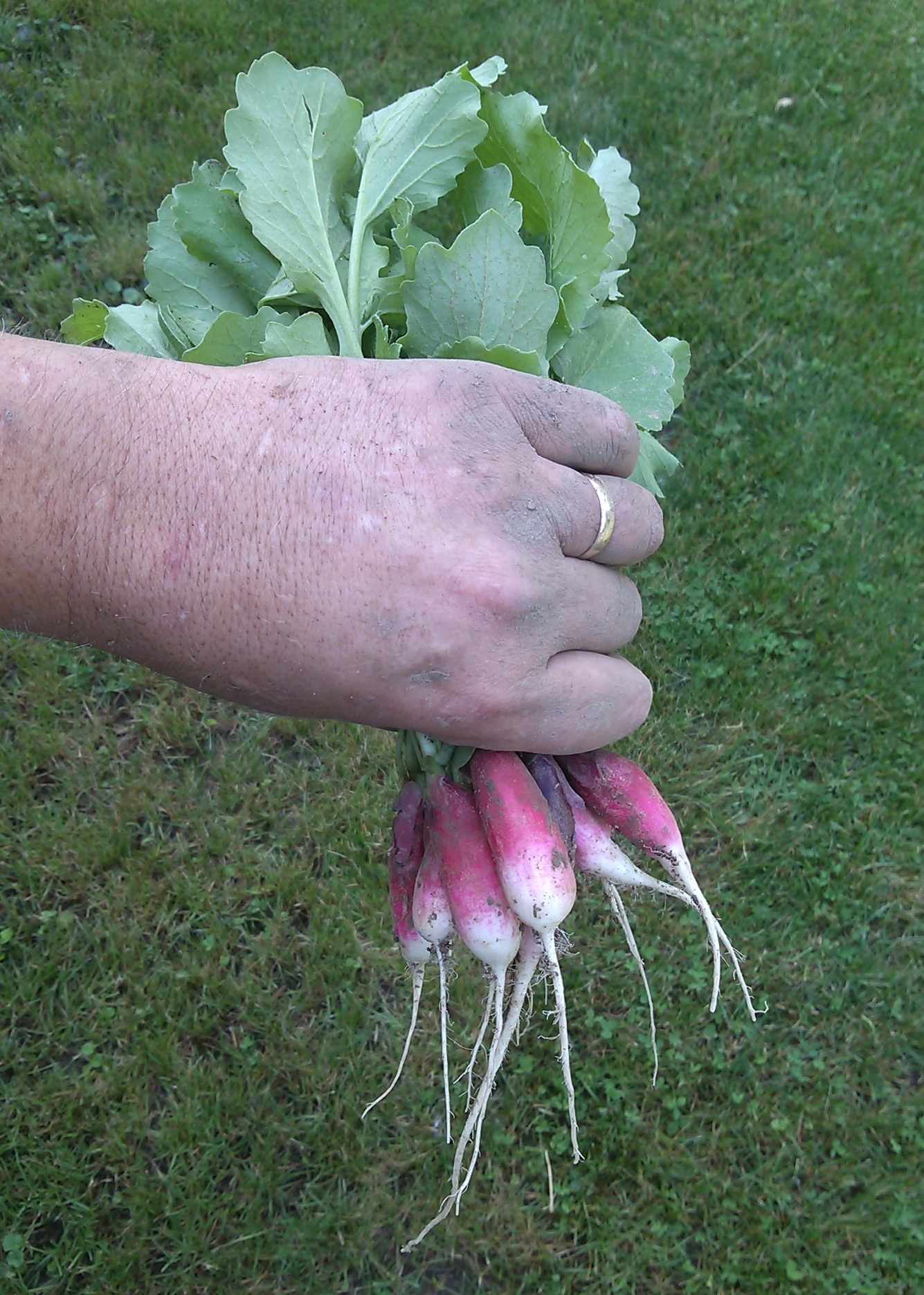
Today was the day to start reading “The Great Gatsby.” After the garden and yard work I set up a folding chair in the garage and upended a five gallon bucket to use as a table. From the refrigerator came a dozen spring onions and a handful of radishes. I poured a small dish of Kosher salt in which to dip them. From the cooler in the garage came a locally brewed beer. To the sound of birds in the lilac bushes and the engines of four wheelers in the neighborhood, I dove into the story of Nick, Daisy, Myrtle, Tom, Jordan and the rest of them. The dinner party at the Tom Buchanans took place two weeks before the longest day of the year, which is coincidentally what today is. It is a summer ritual in Big Grove to read Fitzgerald’s novel, almost since we lived here. At some point, I recognized it as an almost perfect novel of summer— an escape from the worries we found when propelled here so many years ago.

I’ll finish the book before the weekend is over, and get ready for summer.

Categories
Home Life Kitchen Garden

Starting Over with Soup

Spring Soup
Spring Soup

LAKE MACBRIDE— One is ready to take on the world after a bowl of home made soup. In between projects, several things at home are de derigueur. Going through the refrigerator and pantry finding ingredients to make soup is one of them. A fresh start to new beginnings using preserved and aging vegetables.

A job, project or activity can distract us from our home life. Home becomes a camp— a place to return from doing other things. Making soup can be a way to clean up loose ends and refocus our energies for what is next. It is a re-centering on home life.

Making soup is also being frugal— picking from items reaching the end of their shelf life and using them for a warm meal. It is a reversal of consumerism and can be celebratory and reassuring. Most often, the results are delicious, especially when served with a slice of home baked bread.

Still tired from my last day of warehouse work, I made vegetable soup today. There was no recipe, but learned behaviors came into play. This post is intended to share some of the learning.

Put a half cup of water in the bottom of a Dutch oven and bring to a boil on high heat. Medium dice or slice a large onion, three or four small carrots and a couple of stalks of celery and add to the pot. Season with salt and pepper and a couple of bay leaves. This provides the basic flavor profile. (In our house, we add pepper when the meal is served so each person can get as much as they want).

Next, add fresh ingredients on hand. Today, it was potatoes starting to develop eyes, part of a zucchini, and baby Bok Choy leaves beginning to yellow. Peel and dice three or four potatoes, fine dice the stems of Bok Choy and add them to the pot. Grate the zucchini with a box grater and reserve along with 20 or so Bok Choy leaves. If there were other fresh vegetables on hand, I would use them. Note that soup is about using things up, not buying specific items especially for the dish.

In the freezer is my soup project. Throughout the year I collect the cut bottoms of asparagus stalks, broccoli stems, beet greens, spinach and a host of other odds and ends of garden vegetables to use in soup. It is how gardeners deal with their irregular and surplus produce. From the freezer I added bits of broccoli stalk, some finely sliced asparagus, and chopped greens of an undetermined nature (beet greens I think) to the pot.

Add a quart of home made stock if you have it and cover the vegetables with water. Bring to a boil on high heat and reduce to a steady simmer. Simmer until the vegetables are cooked through, add the zucchini and Bok Choy leaves and stir until the Bok Choy is wilted. Re-season and it is ready to serve, a fit luncheon for contemplating the future on a rainy afternoon.

Categories
Writing

Working People Dream of Local Food

Tulips on the Fenceline
Tulips on the Fence Line

LAKE MACBRIDE— Preoccupation with mixed greens can be a good thing when working in a warehouse. The repetitive tasks, and long periods without human engagement create an open mind that will fill with worry if one lets it. Yesterday I got two bags of mixed greens from the CSA, and spent the second shift thinking about making a frittata made from local ingredients.

A couple of notes:

There is an abundance of Iowa artisan cheese. The trouble is the expense is more than a working person can afford on a daily basis. After trying many kinds of cheese, we settled on Cabot Extra Sharp Cheddar (yellow and white) which retails at less than $4.50 per pound. Not really local, but affordable, made with vegetable rennet and what one expects a sharp cheddar cheese to taste like.

Vidalia onions are in season, and were addressed here.

Mixed Greens Frittata

Frittata Ingredients

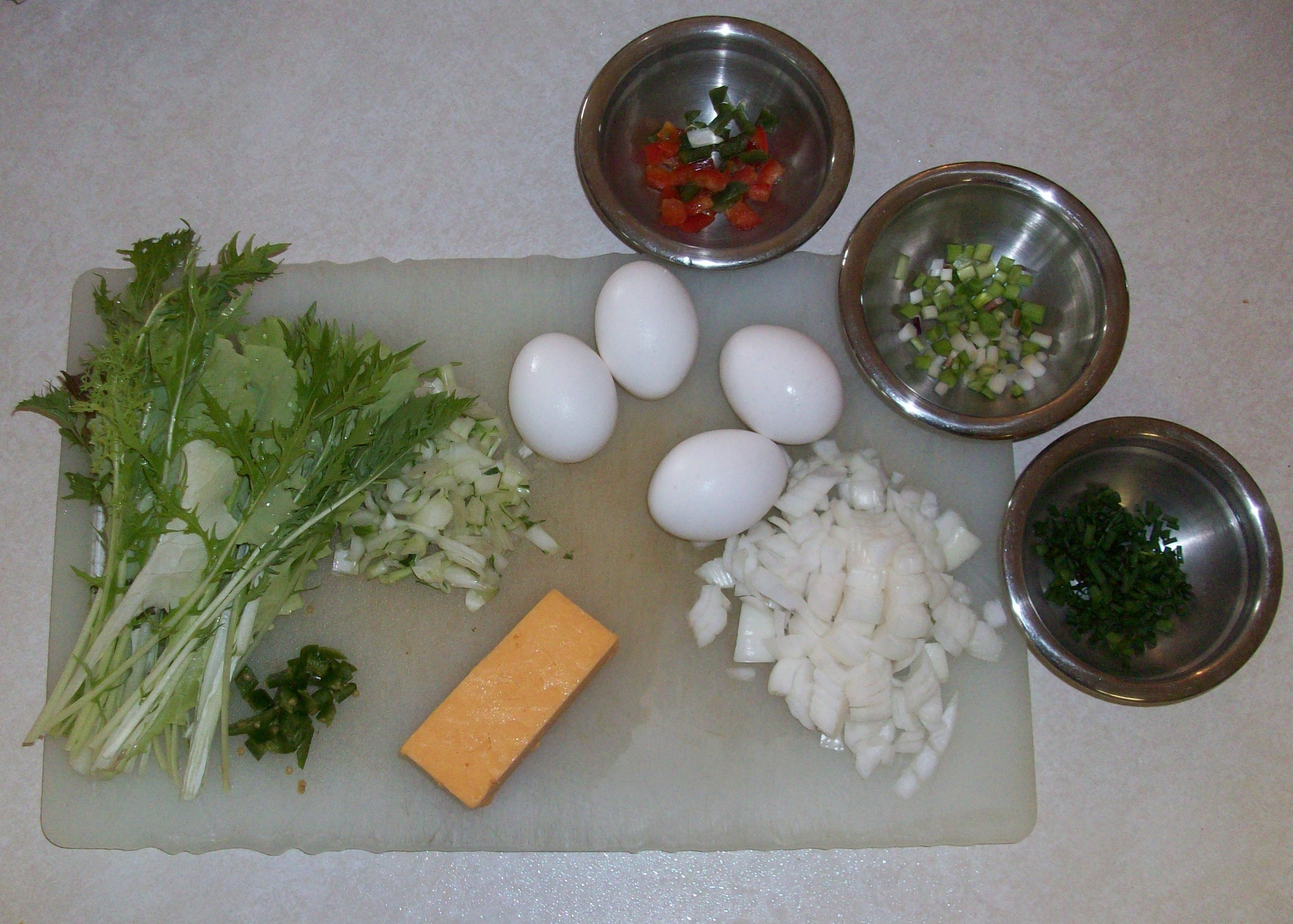
Making frittata is somewhat flexible. Part of my workingman’s dream of local food included the ingredients in our pantry: the mixed greens mentioned, half a Vidalia onion, sharp cheddar cheese, a Jalapeno pepper from last year’s garden and Farmer Kate’s bell pepper – both from the freezer, chopped stems of local Bok Choy, spring garlic and chives picked this morning in my garden, and four eggs – locally, but mass produced. Enough extra virgin olive oil to coat the frying pan.

One can see from the photo how the vegetables were prepared. The stems of the greens were cut into small bits and reserved. The remaining mixed greens were roughly chopped. Here is how:

Heat a non-stick frying pan on high heat. Coat the bottom with extra virgin olive oil and when the oil heats, add diced onions. Season with salt and pepper to taste. Cook the onions for a couple of minutes and add in the following order: bell and Jalapeno peppers, Bok Choy stems, chopped mixed greens stems, and spring garlic. Cook until the onions are translucent. Add the chopped greens and stir constantly until the leaves wilt. Don’t overly cook the greens.

Finished Frittata
Finished Frittata

Whisk four whole eggs in a bowl, and pour over the cooked vegetables to cover. Turn the heat to medium low and cover the frying pan with a lid. Cook about six minutes, or until the eggs are cooked through. Sprinkle a half cup of grated cheddar cheese on top, turn off the heat and cover with the lid. When the cheese is melted, transfer to a serving plate and garnish with fresh chives.

Serve with a slice of your favorite bread, a piece of fruit, and a cup of coffee for a working person’s breakfast.

Categories
Writing

Preparing Bok Choy in a Home Kitchen

LAKE MACBRIDE— Yesterday, I brought home a bag of Bok Choy from the farm. It is fresh, in season, grown locally, and the makings of a dish to be served as part of a meal.

I asked a long time chef and caterer how he would prepare Bok Choy. He said he would steam it, and serve with seafood or pork. Seafood and pork don’t work well in the Midwestern semi-vegetarian kitchen, so I pursued another option, which was to use it in a stir fried vegetable dish. The meal idea was to use the stir fry mixture as the serving base for a home made veggie burger. A quick lunch for a working man.

A couple of notes.

If there is hope for a local food movement, it lies inside thousands of home kitchens, where cooks prepare meals for themselves and their families. A home cook’s kitchen has ingredients from all over, providing an individual and local context for ingredients. For example, there are Vidalia onions in my kitchen today. They were grown in Georgia, so not local, but in season.

In the freezer is a large zip top bag of sliced bell peppers. I bought a large quantity of seconds from a local grower last year, cut away the bad parts, and sliced them into long thin pieces. I froze them on a cookie sheet and bagged them to use later for stir fry.

Preparing Bok Choy Stir Fry

Depending upon how the Bok Choy comes (mine were still attached to the stalk of a plant), separate and pick through the leaves and wash them in a bowl of ice cold water. Drain, and if you have one, dry in a salad spinner. Otherwise, towel dry. Cut the thick part of the stem below the leaf and reserve. The stems are good to eat, and take a little longer to cook than the leaves.

Dice one half a large Vidalia onion, medium dice. Prepare the equivalent of one half of a bell pepper in long strips (or use bagged, frozen ones prepared as above).  Here we go:

Heat a wok or large skillet over high heat. When the pan is hot, coat the bottom with extra virgin olive oil. Add the diced onion, stirring constantly. Season with salt and black pepper to taste. Add the bell pepper and Bok Choy stems and stir constantly. When the vegetables are tender, add the leaves and stir constantly until they are wilted. Serve on a plate or bowl, with your favorite veggie burger and condiment on top.

Categories
Kitchen Garden

Red Beans and Rice

Red Beans and Rice
Red Beans and Rice

LAKE MACBRIDE— Welcome new readers of On Our Own: Sustainability in a Turbulent World. Since I opened the site up to search engines, people from all around the U.S. have been taking a look and liking and following my posts. I sincerely appreciate the interest, as it inspires me to do a better job when I post here. Believe it or not, I spend time crafting the prose to develop my own voice from a perspective grounded in rural Iowa. One would think there would be fewer typos with all of that so-called writing.

By far, the most immediately positive post was my recipe for Buttermilk Biscuits. Recipes are a solution to problems in life, in this case, how to make a buttermilk biscuit that was light, crunchy and split into layers, and didn’t require the purchase of a quart of buttermilk at a time. If I knew recipes would be so popular, I would have posted more of them. Knowing how to do something, cooking included, is a step along a path of sustainability, so going forward, I’ll post recipes that solve problems in the kitchen from time to time.

Sometimes recipes are a conundrum. Red beans and rice is one of those. The dish is different things to different people, and mine is partly a remembrance of many Saturdays in a motel in Thomasville, Georgia, where I discovered the food network, and Emeril Lagasse’s version of Louisiana cooking. He taught me about the trinity— onion, bell pepper and celery— and my version showcases this basic ingredient. My red beans and rice is also about Midwest semi-vegetarian cooking, and it has become a way of weekend cooking to make extra portions for weekday luncheons. It goes like this:

Heat a dutch oven over medium high heat for a couple of minutes.
Add two to three tablespoons extra virgin olive oil, enough to generously coat the bottom of the pan.
Add crushed red pepper flakes to taste, about a teaspoon for starters, and cook them a minute or so.
Add one yellow onion, one bell pepper and two stalks of celery, medium dice, and sauté for a minute or so.
Season with salt, garlic powder, a prepared dry seasoning with hot peppers in it, and add three bay leaves. Add a few splashes of Louisiana-style hot sauce if available.
Continue cooking until the vegetables are soft.
Squeeze in the juice of a lime and stir.
Add one pint canned, diced tomatoes (fresh if you have them), one cup brown rice, one 15 ounce can prepared red beans (drained and washed), and a pint of home made soup stock. Add several sprigs of fresh thyme.
Stir, bring to a boil, and turn the heat down to just above a simmer. Cook until the moisture is absorbed and the rice is done.
In a separate frying pan, brown eight ounces of seitan in a couple of teaspoons of extra virgin olive oil and cook with thinly sliced spring onions. Set aside.
When the Dutch oven mixture is finished, and all the moisture is gone, re-season as appropriate. Add the seitan mixture and stir gently.
Serves five or six as a main course, more as a side dish.

Thanks again for reading my posts. I hope you will check back often.