Categories
Living in Society

Caucus Politics in Perspective

Caucus-goer
Caucus-goer

Conventional wisdom is there are two tickets out of Iowa after the Democratic caucuses scheduled Feb. 1, 2016—the front-runner and one other.

2008 caucus results might be used to argue there could be three, but 2016 is no 2008: two tickets is the number.

If New Hampshire ratifies the Iowa results, we will have our nominee. If the Granite State doesn’t ratify, the nominee will be decided by South Carolina. Given the current political climate, I feel very confident about this.

Democrats have five candidates who expressed interest in running for the nomination as president. Of these only three are viable—Hillary Clinton, Martin O’Malley and Bernie Sanders.

Lincoln Chafee of Rhode Island announced for president, and Jim Webb of Virginia established an exploratory committee, but they fall victims to the honored tradition, “snooze, you lose.” Neither of them capitalized on the pent up demand for Democratic political action to fill the void created by the vast and well publicized Republican field in early 2015.

Hillary leads in the early polling. While she is neither inevitable, nor seeking a crown, she has been a part of the public discussion for so long—arguably since her 1996 book, It Takes a Village—she has name recognition and a presence in American society that creates a substantial obstacle for Democratic presidential challengers to overcome. O’Malley and Sanders are doing “the Iowa work,” garnering substantial attendance at their events. Nonetheless, it seems clear they are vying for the second ticket out of Iowa.

The question is not as much whether Clinton will win the Iowa caucuses. It is whether having three contenders will generate enough interest in partisan politics to build a coalition that can win Iowa—perhaps a swing state in the general election—and win the 2016 general election. That is the uncertainty going into caucus season. I, for one, am trying to be part how that plays out.

Both the administration of elections and the electorate have changed since Bill Clinton’s first election as president in 1992. What matters more than the outcome of the caucuses (Tom Harkin and Uncommitted got the two tickets out of Iowa that year) is the redistricting processes of 2000 and 2010 that created electoral maps which relegated decisions on national elections to a comparatively small number of swing states. There is also a flight from partisan politics, as reflected in the Iowa voter registration numbers, where no preference is a larger group than either political party.

We can support or detract from the Iowa caucuses as much as we want, but campaigns have to be more about the general election than collecting caucus cards from Democratic activists. This is an advantage to Hillary Clinton’s campaign.

The Iowa Democratic Party has become reliant on national interest in the Iowa Caucuses to generate financial resources which pay for campaign offices and staff to do the party work. Prominent figures in the party have publicly said so. That’s the reason we have an interest in remaining first in the nation, and having a “competitive” caucus.

To put this into perspective, it is important to engage in politics. The most productive work we can do is talk to people we know about issues that matter. We could also debunk the myth that we are polarized, except in the non-functional congress which we have the power to change.

My take away is worry less about the outcome of the Iowa caucuses and turn our attention to winning the general election. They are related, but not the same, and that is an important distinction.

Categories
Living in Society

O’Malley in Mount Vernon in Caucus Season

Listening to Martin O'Malley in Mount Vernon
Listening to Martin O’Malley in Mount Vernon Photo Credit O’Malley Campaign

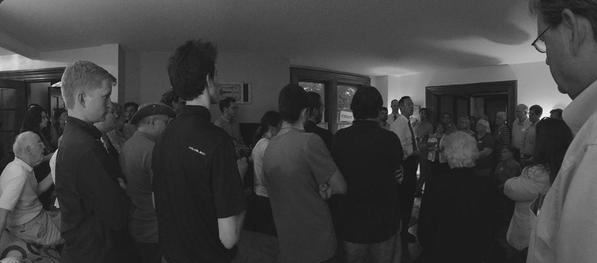
MOUNT VERNON—In his family’s modest living room, Nate Willems introduced former governor Martin O’Malley to about 75 guests on Thursday.

O’Malley announced for president May 30 and was a regular presence in Iowa during the run up to the 2014 midterm elections. Because of that, Democratic activists are sympathetic to his message and polite. Not a lot signed support cards at the end of last night’s speech. It may be too early for that.

The message was about O’Malley’s 15 years of executive public service as mayor of Baltimore, Maryland from 1999 until 2007, then as governor until January 2015. Among his twitter hashtags is #newleadership, presumably differentiating himself from the Clinton/Bush dynasties. He was concise and repeated those points during the house party.

In my April 11 post I asserted, “O’Malley is a story teller. Will we like the narrative?” That observation was borne out last night.

O’Malley stumped on core Democratic issues, similar to the April speech. It’s hard to find fault with his broad positions. On climate change, I don’t like the narrative.

An audience member asked O’Malley what he would do as president about CO2 and methane emissions. The answer to this is easy. President Obama presented the U.S. plan for reduction of greenhouse gas emissions to the United Nations Climate Change Conference, or 21st Conference of the Parties in Paris this December. The U.S. plan relies upon the Clean Power Plan advanced by the Environmental Protection Agency for most of the proposed reductions. All O’Malley had to say was, “I support the Clean Power Plan” to satisfy climate voters. He didn’t.

Instead of a simple answer, he changed the question to one about “climate change.” He enumerated 15 things he did as governor to address climate change. It was an admirable punch list, but reducing CO2 and methane emissions is not the same thing. He missed the point of the question.

His brief statement on the campaign website did not provide much depth either:

Launch a Jobs Agenda for the Climate Challenge

Clean, renewable sources of energy represent one of the biggest economic opportunities in a century. And the threat of climate change is real and immediate. We must make better choices for a more secure and independent energy future—by limiting carbon emissions, setting renewable energy targets, driving innovation, seeding new industries, and creating good local jobs.

My take away from the event is that before I sign an O’Malley card for the February caucus, I need to get beyond the superficial narrative created for the campaign. Not just about climate change, but about each of his positions. This is Iowa, so that’s possible.

Some of my regular political companions were dismissive of O’Malley last night. I’m not ready to cast aside any of the five in the game at this point.

Political Miscellany

For the first time I interacted with a candidate’s D.C. staff via twitter. I posted this message:

A DC campaign staffer sent me this email after that post:

“You should go see O’Malley! Saw your tweet. You might like him.”

I gave the staffer a shout out on twitter:

Haley Morris, O’Malley’s national press secretary, liked my tweet.

While I was at the house party, first congressional district Democratic candidate Monica Vernon called. It was very noisy, so I explained I didn’t have money to donate, and when she was still interested in talking to me, asked her to call back in an hour after the O’Malley event.

I called her and we talked about ways I could help her campaign, even though I live in the second district. Of the three Democrats in that primary, she seems to be the only one really working.

I track how many views each post gets when I am live tweeting an event. It tells me whether or not there is an audience. Curiously, the following tweet had not been viewed by anyone. Could that mean someone is moderating the twitter without us knowing and behind the scenes?

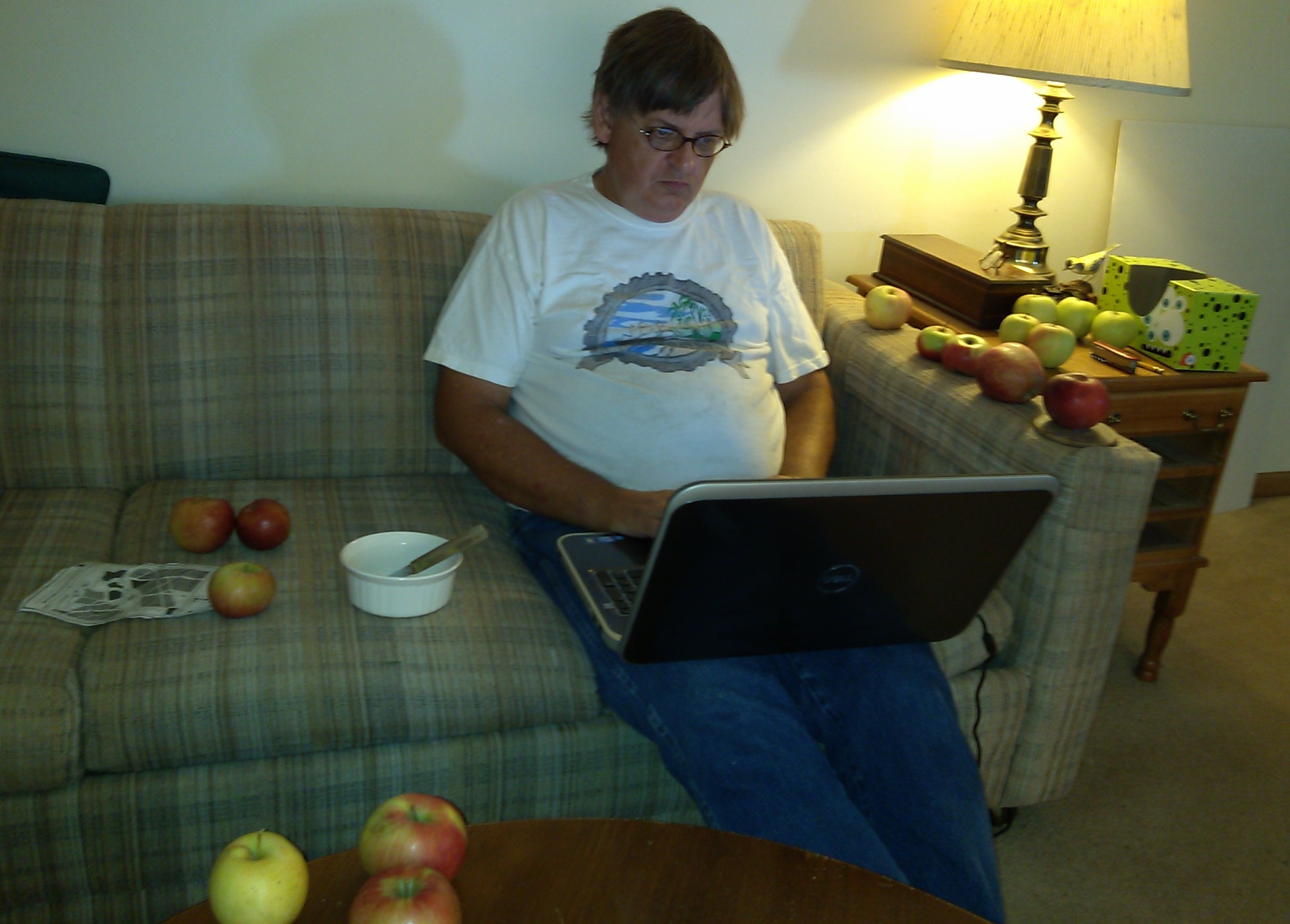
Finally, I appear in the right side of the frame of the photo above. The women who took it almost knocked a lamp over getting into position with me behind the Willems’ couch. Note my ear seems very large compared to the image of the candidate. At least with that big ear I was listening.

Categories
Living in Society Social Commentary

Letter to the Solon Economist

Writing About Apples

A Bloomberg/Des Moines Register poll published last week contrasted how Democrats and Republicans weigh subjects in their approach to selecting a candidate running for the 2016 nomination for president in their respective parties.

Republican likely caucus goers surveyed were most interested in the budget deficit, national defense and taxes; Democratic likely caucus goers surveyed were most interested in energy, income inequality and the nation’s infrastructure.

One of the few places the two results were close was on job creation, favored by both Republicans and Democrats 86-14. The partisans have different approaches on how best to create jobs.

This framing of Republican versus Democratic by news organizations does us a disservice. It perpetuates the lie that people are divided.

For those of us who talk a lot to people from diverse backgrounds, we can see it is simply not the case. More people want to join together and work toward a common goal than get involved with political discussions.

That is especially true in our small community where we can join a non-profit, serve on committees, volunteer at the fire department, at church, or at the library, or if we are simply celebrating a special event like our sesquicentennial, or hanging out Wednesday night for music in the bandstand. Political party preference just doesn’t matter that much.

There is data to back this up.

According to the May report of the Iowa Secretary of State, the number of no party preference active voters in Iowa House District 73 exceeds either of the main parties by a distance (with 1,492 more no party registrants than Democrats and 1,817 more no party registrants than Republicans).

My point is this: we have more in common with each other than we disagree. What matters more than partisan debate is working toward common goals.

Large news organizations may not get this, but if we look around at the familiar faces near us, we should.

Categories
Living in Society

Enraptured in Fandom

Iowa Caucus
Iowa Caucus

We’ve seen it so many times before progressives should be used to it.

The folks at Run Warren Run, financed partly by MoveOn.org, threw in the towel and are “suspending operations,” according to the MoveOn.org website. Hard to run a campaign when Senator Elizabeth Warren said repeatedly she’s not running for president in 2016. Fanboys and fangirls are nonplussed and will literally move on.

Non-Democrat Bernie Sanders announced his Democratic presidential ambition April 30, and pent up demand for a left-leaning presidential candidate burst the scene the way @POTUS and @Caitlyn_Jenner set records for ramping up Twitter followers.

Politicos are enraptured in fandom.

The allure of candidates who fit an intellectual ideal drew me in too. In 1980 it was Ted Kennedy; in 1984, George McGovern. After that, I was busy with a career and life, and moved to Indiana where the presidential elections seemed less important than they do in Iowa. No one else generated this type of excitement, especially when we’re in it for the long term.

Make no mistake, Sanders drew reasonable crowds at his Iowa and Minnesota events. They haven’t reached the bin-buster level yet, even if the room was too small at the Robert A. Lee Recreation Center in Iowa City last Saturday, and he drew several thousand people in Minnesota on Sunday. He’s had a good campaign launch, but as Slate points out, the front runner has little reason to worry.

While Sanders confidently told Katie Kouric, “My goal is to win this election,” his election is as likely as those of Presidents Ted Kennedy and George McGovern unless he begins to ramp it up among caucus-goers who are swing voters.

There’s no talking to most fan boys and girls about this. I’ll note one of the very few political questions I’ve heard on the street and at the convenience store has been “Did you see Bernie Sanders?” There is something there.

The art of politics is partly about excitement in a campaign. The problem is people don’t seem to be able to distinguish between events in the corporate news cycle and excitement, let alone momentum (whatever that is).

Note that no 2016 Democratic candidates for president are in Iowa this week.

Yesterday’s article by Paul Waldman of The American Prospect asks the right question, “Does the Iowa Caucus Still Matter?” He correctly points out that our star was diminished by the Republicans in recent cycles. While Jimmy Carter made the most of the caucuses, his style of personal campaigning will be, if it already hasn’t been, relegated to the dustbins of history.

Fandom is not for me, any more than cosplay or being a Trekkie has been. It is a form of enthusiasm, as described by the little known theologian Monsignor Ronald Knox. Not good for the long haul, even if Bernie Sanders has devilish eyes.

Categories
Environment Living in Society

Al Gore Comes to Iowa

Earthrise 1968
Earthrise 1968

CEDAR RAPIDS, Iowa– Al Gore held up a T-shirt presented by a youth group from Indiana that said, “Ask me about my future.” The context can be political, even if the presenters intended the question be about the environment.

Gore joked about wearing the T-shirt in Iowa and what it might mean during the run up to the 2016 Iowa Caucuses. During the 28th training of climate activists for The Climate Reality Project, he made clear he was a “recovering politician” and had no plans to run for president again.

Why did Gore pick Cedar Rapids for his first North American training since 2013? Five reasons.

It is partly about influencing the presidential selection process related to Iowa’s first in the nation political caucuses. By training Iowa activists, he hopes to make the voice for climate action heard by candidates for president.

It’s about extreme weather events including the 2008 Iowa flooding and recovery. The conference used space that was under water during the flood and heard from Mayor Ron Corbett about what the city did to repair the damage of the flood.

It’s about bringing a focus on the impact of climate change on agricultural issues in the breadbasket of the world.

It’s about Iowa’s success in development of renewable sources of electricity, wind energy in particular, but solar as well.

It’s about advocating for world governments, including the U.S. government, to make meaningful commitments to climate action at the United Nations 21st conference of the parties in Paris, France this December.

There was a lot to discuss and Gore was generous with his time, speaking multiple times each day of the conference. The significance of its 350 attendees from around the world, 75 of whom were from Iowa, is hard to miss. The movement for meaningful governmental action to mitigate the causes of global warming and related climate change is gaining momentum worldwide.

Here are some takeaways from the conference:

The people at my table, and attendees generally, are already doing a lot to raise awareness of the need for climate action. They are possessed of a high level of energy and are really smart people devoted to taking climate action.

The price of solar electricity is plummeting and installation of photovoltaic arrays is growing exponentially. In some parts of the world solar reached grid parity, and this, coupled with other sources of renewable energy, will drive the end of the era of fossil fuels.

The Iowa Soybean Association had a seat at the table, which a few years ago would not have happened. Christopher Jones, an environmental specialist for the group, said they had begun to change their thinking about global warming during the last year. If this is borne out by their actions, it would be a tidal shift for the big agricultural organizations.

Gore added information about Iowa to his already encyclopedic knowledge of global warming and related climate change. He spoke about everything from extreme floods and droughts that have hit Iowa, solutions implemented here—particularly wind and solar electricity generation, and current political issues, including the eminent domain legislation working its way through the last days of this Iowa legislative session.

A member of Citizen’s Climate Lobby asked Gore why he hasn’t endorsed the fee and dividend scheme they propose. Gore responded he favors putting a price on carbon, there are multiple mechanisms to do so, and he hasn’t finished research to determine which one(s) to endorse.

The political will to take climate action is building worldwide. The election this week of Rachel Notley as provincial premier in Alberta, Canada, where the long ruling Progressive Conservative party was oustered by her New Democratic Party is a prime example. “During the campaign, Notley promised to withdraw provincial support for the (Keystone XL pipeline) project, raise corporate taxes and also potentially to raise royalties on a regional oil industry already reeling from the collapse in world prices,” according to the Guardian.

Finally, there is hope. The solutions to the climate crisis are working. Renewable energy is beginning to take off, gain broader acceptance, and reach toward grid parity. Almost no new coal-fired electricity generating stations are planned for North America and old ones are being shuttered. We are not there yet, but Gore’s training and inspiration made the journey easier for us, and encouraged us to tell our own story about why it is important to take climate action before it is too late.

There is no planet B.

“We couldn’t even evacuate New Orleans as hurricane Katrina approached,” Gore said.

Earth is our only home, and is hanging in the balance. It’s up to us to protect it.

Categories
Living in Society

Political Sidetrack

Hillary at Benghazi Hearings

Suddenly sucked into the vortex of writing about politics, my reaction is to back down. It was hard not to pay some attention to Hillary Clinton’s campaign launch in Iowa last week. After all, people have been talking about it for years and there was pent up Hillary demand.

She’s on to New Hampshire now, so brief respite and on to other things.

Not quite. It is noteworthy that the D.C. paid punditry and lobby industry was out attacking and criticizing Clinton almost immediately. Heritage Action for America sent a fundraising request on announcement day last Sunday.

“If her campaign gains momentum, political consultants may encourage conservatives to compromise their principles to sound more like Hillary,” according to the email. That’s dog whistle for something I don’t understand, except they seek to raise money to support their work.

Without doing much besides launching, Hillary for America already has momentum, so Heritage may be too late.

That said, it’s time to return to more engaging topics like gardening, cooking, worklife and advocacy.

Categories
Living in Society

A Farmer and a Politician Greet George McGovern

Farm to Market
Farm to Market

Out in the country good stories get circulated. I don’t mean Liz Mair’s self-described “incendiary” piece on Hillary Clinton, or other tales of paid punditry emanating from inside the D.C. beltway and nearby Maryland and Virginia suburbs.

Here’s one that circulated earlier this week as an example:

FARMER: I’d like to see Hillary Clinton again.

ME: I thought you caucused for Obama.

FARMER: I did, but I met her. Did you hear my story about that?

ME: No, I didn’t.

FARMER: Well a friend invited me to the Democrats annual barbecue and I was in the rope line. I can’t recall whether I had just shaken Hillary’s hand or was waiting my turn. Up came George McGovern and I said, “I don’t suppose you remember me, but I ran your campaign in San Francisco.”

MCGOVERN: Of course I remember you.

HILLARY: Well I ran your campaign in Texas.

FARMER: Yeah, but we won.

I don’t tell the story as well as the farmer, but a couple of things are important.

First, who thought Hillary would be so competitive on a personal level after being a first lady and U.S. Senator? Contrary to what some people say, Hillary made a strong effort in Iowa during the run up to the 2008 caucuses. Even I got an invitation to meet her personally in a small group setting. Some of my best friends and neighbors supported her and got involved in politics—some for the first time—because of her campaign. While there is the famous memo, what gets forgotten is she disregarded the advice.

Second, it was the reforms of the Democratic party after the debacle of the 1968 Chicago Democratic National Convention that brought us the Iowa caucuses in their present form. McGovern had a hand in those reforms, and Jimmy Carter was arguably the first presidential candidate to leverage them in 1976, beginning with his appearance at the Iowa State Fair. There are still some Harold Hughes for President backers in our county who can tell the tale of what went on to bring about the changes in the Democratic party.

And finally, Hillary is a fighter. This link to an excerpt from the Benghazi hearings shows what kind of fighter Hillary Clinton is. Most readers have seen it before. Of the national Democrats traveling Iowa presently, Jim Webb, was Born Fighting and established an exploratory committee. Elizabeth Warren is a fighter, but is likely not running for president. Not to be dismissive of other hopefuls, but that’s it.

There are other great stories circulating in rural Iowa. I hope to have an opportunity to tell a few more.

Categories
Living in Society

Following My Tracks – Hillary’s First Campaign Visit

Iowa Row Crops
Settled Iowa

Hillary Clinton spent Monday night at the Blackhawk Hotel in Davenport.  It felt very close.

When I was 17 my father had me put on a tie and took me to dinner there with his boss at the Amalgamated Meat Cutters and Butcher Workmen of North America Local 431. I recall the room was dimly lit. I had steak which was something we rarely had at home.

Dad was a union steward deciding whether or not to make his living from union work. When he died soon thereafter, he planned to get out of the meat packing plant as soon as he was licensed to become a chiropractor.

My wife and I spent our wedding night at the Blackhawk Hotel. We couldn’t afford the presidential suite, but it was a nice hotel—a way station on our wedding trip to Chicago. It served free champagne to newlyweds.

When I saw photographs of Clinton departing the Blackhawk in social media they possessed a peculiar reality that harkened back to those seminal events.

From there, Clinton went to LeClaire, another town imbued with my footprints. Once I sought the William F. Cody homestead there, only to find there was a controversy about where it was located. Cody was born and raised near LeClaire and his family subsequently moved near McCausland, with the two sites competing for authenticity and tourism dollars. Never mind that Cody shipped his family home out to Cody, Wyoming on a rail flat car. It was good to see Clinton did not weigh in on the controversy and opted for a local coffee shop. The Cody homestead may not be controversial any longer.

LeClaire’s namesake has been a prominent figure, literally. When visiting family grave plots at Davenport’s Mount Calvary Cemetery, we drive past the tall monument on Antoine LeClaire’s grave. He has been a presence ever since my father died and I visited the cemetery more frequently—as much as his 300-pound frame was when he was living.

Clinton’s last stop of the day was at the Kirkwood campus in Jones County—also near a family site. A family cemetery at Langworthy is two miles from the Kirkwood facility. When our daughter was young we explored it to find her maternal ancestors buried there in the 1840s and 1850s. The page of a nineteenth century plat book with our ancestor’s Wayne Township farm noted on it hangs in our living room.

In addition to launching her Iowa presidential campaign, Hillary Clinton is walking where the founders and early settlers established Iowa. I don’t know if her handlers were cognizant of this when the trip was planned, but it seems different and perhaps significant.

One more thing to consider as the run up to the 2016 Iowa caucuses continues.

Categories
Living in Society

Eminent Domain Bill Emerging in Iowa Legislature

Iowa Capitol
Iowa Capitol

An eminent domain bill is emerging in the Iowa legislature. If it becomes law, it would impact both the Dakota Access Pipeline and the Rock Island Clean Line which share the issue of being merchant distribution lines for oil and gas, and electricity respectively.

Whether an eminent domain bill would be sent to the governor is an open question. The Iowa legislature is stymied over K-12 school funding, and the overall budget. Last weekend’s discussion was whether or not to send legislators home while a committee ironed out details.

“I think that’s unwise,” said Senate Majority Leader Mike Gronstal in an Associated Press interview. “I think everybody’s voice needs to be heard. I think everybody should stay and work. I think it’s time to knuckle down and get to work.”

The legislature is required by statute to finish the budget before adjournment, so April and likely part of May will be a slow grind toward compliance. At this point, the parties can’t agree on a revenue number or on how to spend it. There appears to be time to work on an eminent domain bill while the budget is finalized.

Last Thursday, Ed Fallon completed his walk across Iowa along the route of the Dakota Access Oil Pipeline. In his daily report from the project, Fallon wrote, “eminent domain legislation is coming this week! I was in touch this weekend with two key lawmakers who assured me that, before week’s end, we’ll have companion bills with bipartisan support in both House and Senate. This is very encouraging. Stay tuned.”

The two lawmakers are State Senator Rob Hogg and Representative Bobby Kaufmann, who chair the government oversight committee in their respective chambers. I confirmed the bills were sent to drafters with Kaufmann in a telephone conversation last night. Government oversight is exempt from the funnels that limit introduction of new legislation during session.

On April 10, the Iowa Supreme Court issued a 23-page ruling on Clarke County Reservoir Commission v. Edwin D. and Deloris A. Robins Revokable Trust, in which Justice Thomas Waterman wrote for the majority, “we strictly construe statutes delegating the power of eminent domain and note the absence of a clear legislative authorization for a joint public-private entity to condemn private property.”

Both the Dakota Access Pipeline and the Rock Island Clean Line are such public-private partnerships, so this court decision has ramifications for the projects. Notably, as Fallon described during his pipeline walk, many land owners along the route oppose the pipeline and eminent domain would have to be used to gain an easement. The legislation proposed by Hogg and Kaufmann includes definition of “merchant projects” and “public use,” which if enacted into law could effectively end both projects in their present form.

In Kelo v. City of New London, the U.S. Supreme Court found that projects initiated by private developers could use eminent domain as a tool, finding that “economic development did not violate the public use clauses of the state and federal constitutions.” However, as Kaufmann noted last night, if states have a stricter interpretation of eminent domain and the takings clause of the U.S. Constitution, such state laws would take precedence under Kelo. An intent of the proposed legislation is to create stricter interpretations of public use when used in the context of eminent domain, and to separate eminent domain uses for merchant projects from those of regulated utilities.

An eminent domain bill is emerging. With legislators divided over the Rock Island Clean Line and the Dakota Access Pipeline, and over eminent domain abuses in the state, there appears to be enough support to advance the bill.

For parties interested in eminent domain and in both projects, this will be one to watch.

Categories
Living in Society

Hillary Clinton Announces for President

I spent most of Sunday working with people without Hillary Clinton on their mind. People going about their lives without a care for politics, or any perceptible interest in it. That is the new normal, and it has been the norm for a while.

Later in the day, I had a conversation about Hillary’s announcement to run for president and the other person said, “I’m not sure it’s a good idea because she is such a lightning rod.”

She is, I said. But look what has happened with Obama. There is an active movement to de-legitimize his presidency by impeding anything he has done or tried to do. Any Democrat who runs for president will experience the same thing. “What else is Hillary going to do?” I naively said.

“She could practice law, she could work at the Clinton Foundation, she could write another book, there’s lots she could do.”

“Well she’s decided to run,” I said. “and there’s no stopping her now.”

If you don’t think Clinton can hold her own, think again and watch this segment of the Benghazi hearings posted on YouTube by ABC News.

In a little noticed Sunday afternoon tweet, John Podesta, chairman of the 2016 Hillary Clinton presidential campaign posted this:

That he mentioned climate change as a priority in a 140 character micro blog  indicates the importance of addressing the climate crisis. Both politically, and in the real world where the economic effects of climate change are being felt by almost everyone I know whether they recognize it or not. How this plays out over the campaign remains to be seen, but it’s early, and Democrats are expected to own the issue. The Mad Hatter’s tea party of the Republicans is expected to continue denial to their detriment.

Because Clinton is a prominent public figure we know a lot about her and there is much to like and dislike. That seems okay because a perfect candidate—one who matches our shopping list of desired qualities—does not exist. What matters more politically is she is a woman.

During a recent conversation about the 2008 Iowa caucus someone recounted a story about a group of local Democrats who caucused for Obama. The upshot was “rather the black guy than a woman.”

Since the 2008 election, some of them bought into the bullshit about Obama, according to the story, and changed their voter registration to no preference. They aren’t coming back to the Democratic party any time soon.

Within the microcosm of a precinct the departures may be good for Hillary during the caucuses, but the attitude is not good for our lives in society. In the whisper campaigns that go on in Iowa, being a woman will make a difference, and not always in a good way.

I’ve made my preference for Jim Webb known publicly, and there are not a lot of others in that or any camp at the beginning of the run up to the Iowa caucuses. If Webb decides not to run, or if Hillary wins the Democratic nomination for president, I will support her more than I did Obama after the 2008 Democratic National Convention.

The simple truth is a lot is at stake and Hillary’s combative strength will be needed if progressive ideas are to gain prominence in our country.

As I wrote on Saturday, caucus season in Iowa has begun.