Categories
Living in Society

Concentrated Press Feeding Operation

Iowa Democratic Party Hall of Fame Celebration Press Pass

The corporate media deserves criticism.

Occasionally they redeem themselves, as in Margie Mason’s coverage of slavery on Indonesian fishing boats for Associated Press, but mostly its people produce hack work and appear to do what they must to get through the day and draw a paycheck. Political writers can be the worst of the lot.

I secured a press pass for the Iowa Democratic Party Hall of Fame celebration July 17 and sat among them for a few hours.

It is important to exclude some Iowa reporters from a blanket condemnation. At the event I saw Dean Borg of Iowa Public Television, James Q. Lynch of Source Media, and O. Kay Henderson of Radio Iowa, all of whom had had long days, and whose work is important and anything but journalistic sausage. I also think highly of Ed Tibbetts of the Quad City Times, Kathie O’Bradovich of Gannett, Art Cullen of the Storm Lake Times and Bret Hayworth of the Sioux City Journal. There are other good journalists missing from this inoculation, and I have no criticism of bloggers like me who work for beer money or no compensation at all. What went on behind the press pen in Cedar Rapids confirmed my worst fears.
Behind the Confinement Fence

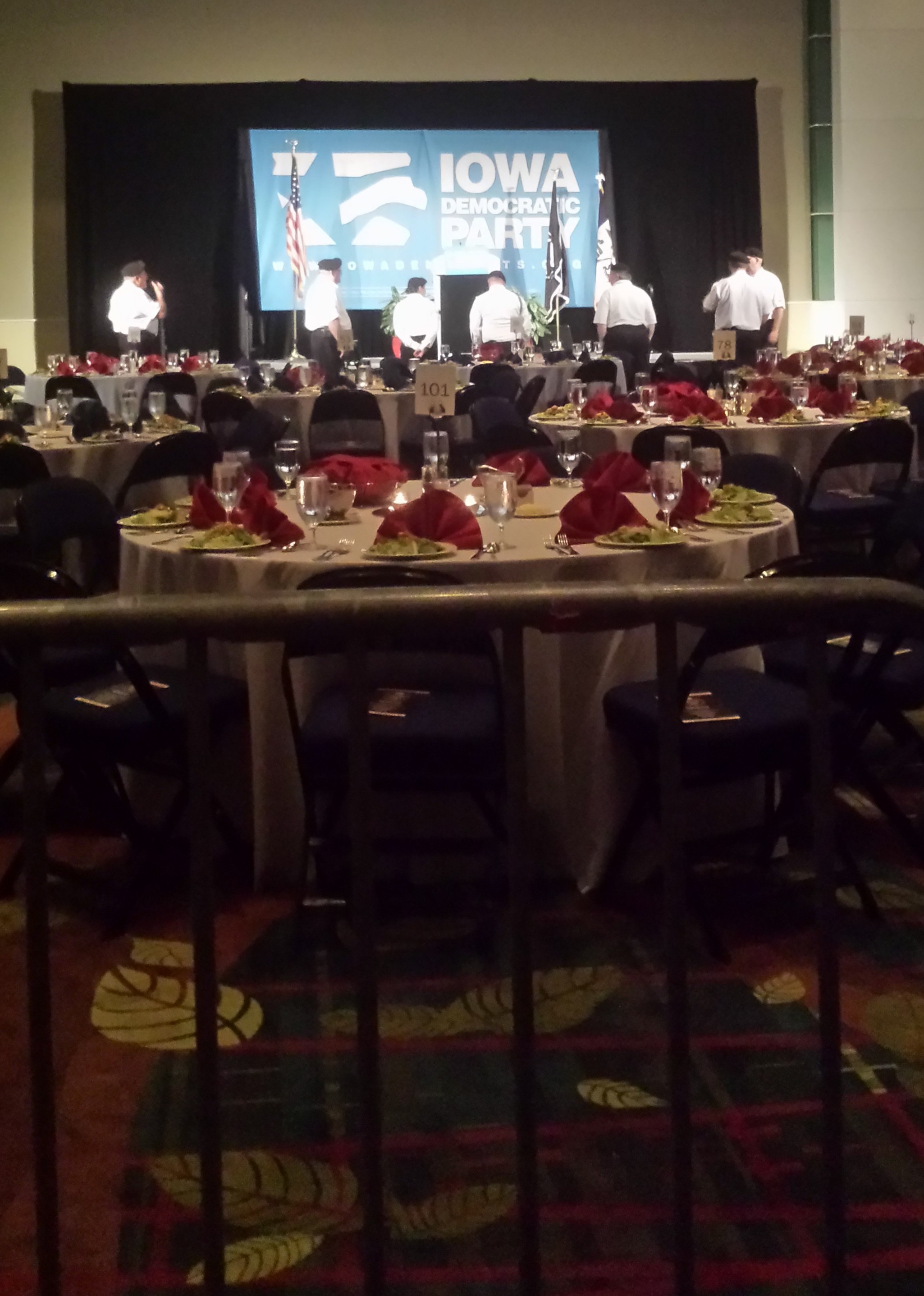
The press area at the Cedar Rapids Convention Complex was very much part of Iowa, including the fencing which surrounded the confinement. It was the kind one buys at the farm and fleet store or Theisen’s to fence in livestock. One entered through a private door to the platform where more than a dozen video cameras were configured on tripods. In front was a long table with chairs placed as closely as possible together. My movements were restricted the way pigs and chickens are in concentrated animal feeding operations. By arriving early, I got a center seat and an electrical outlet to recharge my mobile phone. I was happy just to be there.

The first faux drama had to do with Hillary Clinton. A reporter from a large news organization asked in a tone of moral outrage if I’d heard the Clinton campaign wouldn’t allow the participants in the pre-event rally on First Avenue talk to the press. My moral outrage having been burned up during the early George W. Bush years, I have been paying attention to the media’s favorite story, how “Hillary hates the press.” I simply said, “no I hadn’t,” not about to encourage her.

The person next to me was having trouble connecting to the Internet. I looked at her laptop screen and she appeared to be connected. Unsatisfied, she ended up calling her IT department and taking her computer outside the confinement. I hope she’s alright. Another journalist quickly filled her slot.

Before the event, in a bit of local color I glanced two seats over and noticed John Deeth was using a Windows machine. The author of Linux Monday responded:

I don’t think he had any choice, as he previously explained how Microsoft killed Linux on netbooks.

“I didn’t expect to see you in the press section,” said a prominent Hillary Clinton supporter involved with a local quilting project.

Throughout the build up to the main program people stopped by and chatted, having noticed me in the cage. A woman took a long video while walking the length of the press confinement, the way one photographs a group of zoo monkeys.

A state legislator offered to pass us food through the bars as press was excluded from the dinner. Now one knows that press descriptions of the “rubber chicken dinner” have more to do with their feeling of sour grapes about being excluded. From the look of things, these folks with their fancy bottled water and expensive clothing could afford their own dinner. Of course, I ate before arriving so as not to be distracted while observing the event. That is too practical for this crowd.

What was worse, other than the articles written during and after the event, was the constant chatter about set shots and internal company politics. Some were focused on anything but the proceedings on stage, to the point where I was surprised the press corps stood up for the pledge of allegiance. Some were paying attention, but I came away believing many stories had been set long before party chair Dr. Andy McGuire opened the proceedings.

I’d do it again given the opportunity. The best preparation is to go in having a plan and then work the plan despite the distractions. Importantly, pay attention to the actual event, something apparently not possible for many in the national press corps.

 ~Written for Blog for Iowa

Categories
Living in Society

IDP Hall of Fame Celebration – Overnight Reactions

Pre-Hall of Fame Rally

CEDAR RAPIDS–It was a great night for Iowa Democrats as the state party hosted five announced presidential candidates during its annual Hall of Fame celebration at the Cedar Rapids Convention Complex yesterday.

Former Cedar Rapids mayor Kay Halloran, one of seven inductees, received the outstanding supporter award. Congressman Dave Loebsack reminded the audience of her work dealing with the record 2008 flood that had much of downtown Cedar Rapids under water, including significant damage to the venue where first in the nation Iowa held the event.

Lincoln Chafee, Hillary Clinton, Martin O’Malley, Bernie Sanders and Jim Webb spoke in alphabetical order by last name.

This post captures fleeting reactions before they disappear into the ether of a busy life. No analysis of policy here. C-SPAN live streamed the event and has the video up here.

Because this is Iowa, I have heard all of the candidates, except Chafee, in person before. This was Chafee’s first trip to Iowa since announcing.

Both the audience and candidates were reasonably “Iowa Nice.” The candidates gave speeches reflecting Democratic values, serving them up like a rarified buffet in the desert of corn and soybeans that is Iowa. The majority of the audience stayed until party chair Dr. Andy McGuire wrapped things up. While Hillary Clinton left immediately after her speech according to reports from the national media, the four other candidates stayed to hear the last words, and some mingled with the audience afterward.

The playing field is not level, despite the use of the alphabet to set the speaker order. It is reflected in how candidates approached their speeches.

Lincoln Chafee and Hillary Clinton were the only two to acknowledge the inductees to the Hall of Fame–the nominal reason we gathered.

Bernie Sanders briefly acknowledged he was in Iowa, and could have given the same speech anywhere and probably has. The audience did not mind, supporters responding as if in church to his every jeremiad. Chafee had a wrestling connection, he was a wrestler and knew of Iowa’s program, Clinton talked about current Iowa issues, particularly the recent closure of two state-run mental health facilities, O’Malley talked about the Newton Maytag closure in the context of NAFTA and his opposition to the TPP, and Webb also briefly acknowledged he was in Iowa. Points to Clinton for weaving important current Iowa issues into her speech.

Clinton and Sanders said very little about their resume to be president. Chafee, O’Malley and Webb spoke about their credentials as if they were applying for a job. Name recognition is always an issue in campaigns, and at this event, Clinton and Sanders had it and could focus their speech in other areas. The others did not and made their case via qualifications.

Chafee, Clinton and O’Malley gave props to President Obama. Sanders and Webb did not. Webb has concerns about the recently negotiated agreement between the P5 + 1 nations and Iran to shut down Iran’s growing nuclear program. He carefully articulated his position without criticizing the president.

The surprise was none of the five mentioned two important words: Tom Harkin. The group of moneyed Democrats who could afford the minimum donation is well familiar with Harkin and how he speaks. Clinton, Sanders and Webb served in the U.S. Senate with him. It was brilliant that Clinton wove some classic Tom Harkin into her speech, talking about how the Republicans want to take the country backwards, and Democrats want to move forward. Clinton didn’t mention Harkin, but her speech reflected Harkin-like phrasing with which audience members are very familiar. From an oratory perspective, Clinton gave the best speech.

There were no “yikes moments” for the five, and only a naysayer couldn’t find something positive in each of the candidates. Next comes the organizing where Clinton, O’Malley and Sanders are ahead of Chafee and Webb. As Loebsack said during his remarks, the caucus season has officially begun.

~ Written for Blog for Iowa

Categories
Living in Society

Austerity Comes To Iowa

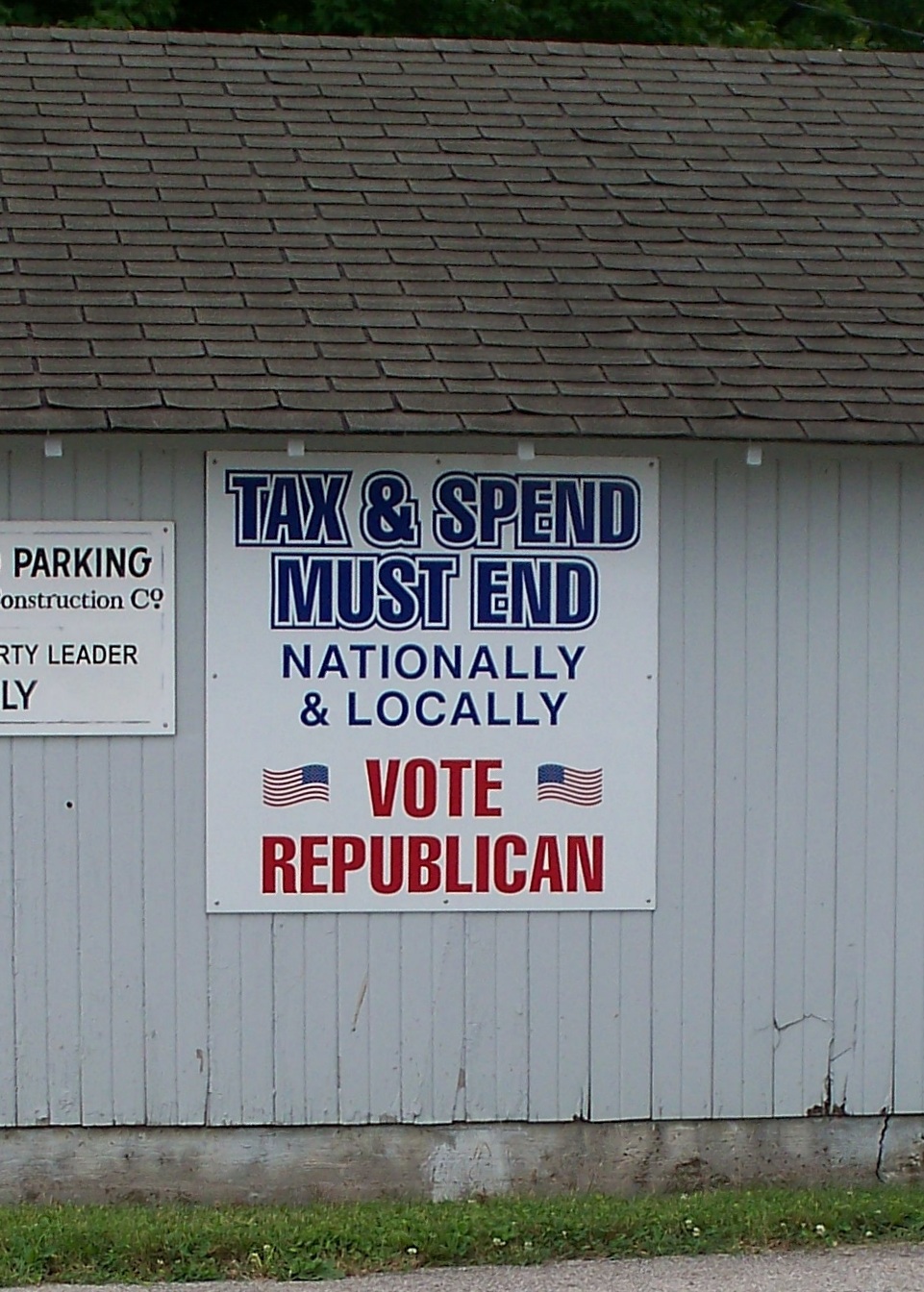
Signage Near Front and Cherry Streets, North Liberty

Elections matter. They have mattered for a long time. A more pertinent maxim for political life in 2015 Iowa, however, is:

“Those who cannot remember the past are condemned to repeat it.” ~ George Santayana.

If elections matter, understanding the intellectual context for them, from a conservative perspective is equally important.

In the 20th Century we rose from the Great War and the agricultural experiment that led to the Dust Bowl and the Great Depression. We created the military industrial complex and its prosperity for many. We bought into an illusion of unending opportunity.

This has always been more story than truth. Because so many like the story, it persists. Senator Bernie Sanders (I-Vermont) taps into it.

“At a time when millions of American workers have seen declines in their incomes and are working longer hours for lower wages, the wealth of the billionaire class is soaring in a way that few can imagine,” Sanders said on his website. “If you can believe it, between 2013 and 2015, the 14 wealthiest individuals in the country saw their net worth increase by over $157 billion dollars. We live in one of the wealthiest countries on earth, yet children go hungry, veterans sleep out on the streets and senior citizens cannot afford their prescription drugs. This is what a rigged economic system looks like.”

Our lives have been coarsened by the unending work of the wealthy and their politicians. It has been no accident.

“36 men created the economic mental model that has delivered the mess we’re in,” wrote L. Hunter Lovins, president, Natural Capitalism Solutions. “Meeting in 1947 at the Mont Pelerin hotel outside Montreux, Switzerland they built the intellectual architecture of an economy of small government and individual decision-making in an unfettered free market.”

If austerity, and that’s what we’ve come to call it, began after World War II, it found its home in the Reagan administration.

“Let us remember that the basic purpose of any tax cut program in today’s environment is to reduce the momentum of expenditure growth by restraining the amount of revenue available and trust that there is a political limit to deficit spending,” said economist Alan Greenspan, Federal Reserve chair from 1987 to 2006, in testimony to the U.S. Finance Committee July 14, 1978.

“Starving the beast” is a political strategy employed by American conservatives in order to limit government spending by cutting taxes in order to deprive the government of revenue in a deliberate effort to force the federal government to reduce spending.” (Source: Wikipedia)

“My goal is to cut government in half in twenty-five years,” Republican Grover Norquist said. “To get it down to the size where we can drown it in the bathtub.”

These statements are not abstractions. They find their way to Iowa, where Governor Branstad and the Republicans take an approach of cut the budget, cut taxes, then repeat the cycle. The segregation of funding for K-12, community college and higher education this legislative session, and Branstad’s subsequent veto, are out of a playbook with roots in 20th Century conservative thought.

Government is often inefficient and programs outlive their usefulness. An example is the recent closure of two of Iowa’s four mental health facilities. The idea that those who need in-patient mental health treatment should not be warehoused in a few central locations has merit. What better than to re-integrate people into local communities and settings? The fact that this devolved into a dispute between the governor, certain legislators and an Iowa union does a disservice to people who need the treatment. It’s no way to make sensible or reasonable changes in our governance.

Each of the five Democratic candidates for president said unlimited money in politics is a problem for our Democracy. This is a core problem with elections post-Citizens United. The unstoppable advancement of the ideas of shrinking government, looting the commons and war profiteering are the context in which Citizens United is possible. The culture is so pervasive that even small business owners have bought in, displaying signs like the one in the picture all around Iowa.

Elections matter and the moneyed interests know it. Their ability to indoctrinate an electorate that often votes against its own interests has been stunning. Using mass media they own, literally, or with unlimited monetary resources to buy programming, the depth of their penetration into an American psyche has given us Ronald Reagan, and a legion of Reagan wannabes.

Our hope is more of us recognize elections matter. One has to have faith the American electorate will wake up, the scales will fall from their eyes, and people will focus on what’s right, and not what the wealthy tell us must be.

If we care about our country and the people in it, we can’t afford to sit on the sidelines. I’m grateful most people I know agree and are willing to work for the change we need. What about you?

~ Written for Blog for Iowa

Categories
Living in Society

First Press Pass

HOF DinnerThe Iowa Democratic Party approved my press credentials to attend the Hall of Fame Celebration Friday night for Blog for Iowa.

This is the first time the five declared candidates for president will speak from the same stage. It is a key milestone on the road to the Feb. 2 Iowa Democratic caucuses. Going forward, if candidates don’t get organized, they won’t win delegates—it’s as simple as that.

Hillary Clinton and Martin O’Malley are working the caucus process diligently. Bernie Sanders is attracting interest—good sized crowds—but I haven’t been to one of his events since 2014, before he announced for president. I’m less certain of what organizing Sanders is doing, but the staff he hired knows the Iowa caucus process.

Lincoln Chafee and Jim Webb appear to be decent people, but have furnished no evidence they are signing people up for anything except donations and email contact lists. Chafee made his first trip to Iowa this week and Webb held about 25 events in Iowa according to the Des Moines Register. Clinton, O’Malley and Sanders are far ahead of them in terms of traditional organizing. Catching up in Iowa will be hard for the other two to do.

I plan to provide a unique perspective on the events tonight. My first post on Blog for Iowa was about the 2009 Hall of Fame Celebration and I’ve learned a lot about Democratic politics since then. Here’s what to look for in my coverage:

The candidate speeches will be streamed on C-SPAN and posted on their website for later viewing. I won’t be covering what is said, or trying to assert points about this or that, creating spin. If people want to know what candidates said, they can invest the time and hear for themselves.

If I can keep my phone charged, I will send a few tweets about the event. Since hoards of news media will be there, I’ll let others generate the Twitter traffic. I want to spend my time observing, not tweeting.

I’m most interested in the framing of this event. There is an inherent deception of a level playing field in the graphic above and the event. Both Clinton and Sanders have solid name recognition because of their prominence in public life. Hillary Clinton is so well known, her most significant problem may be we know her too well. Enough so she is taken for granted as people look at other options. Martin O’Malley has been doing a lot of work in Iowa, going all in here in an effort to get a ticket out. By its framing, the event takes Clinton and Sanders down a peg, allowing the other three to to see some sunlight. Will the five candidates share the stage or sit in the crowd? What will be the order of speakers? How will the IDP frame the night’s events? If there’s a story in answering these questions, I’ll write it.

By having a press pass I hope to understand how other journalists frame the events. I don’t know which national political correspondents will be present, but they bring with them an external style that seems self-perpetuating regardless of what may actually happen. By hanging with them to some extent I hope to learn and report about it.

It would be more convenient to view the speeches from the comfort of home wearing casual clothing and drinking fizzy lemon water. In 2009 my photo on the Hall of Fame event post shows me wearing a suit. I plan to be more casual tonight with my trademark blue jeans, blue twill shirt and comfortable shoes. Getting out among the moneyed Democrats of Iowa once in a while is important, and on this one pivotal night, I can invest the time.

I hope readers will stay tuned.

Categories
Living in Society

Rob Hogg Forms Exploratory Committee For US Senate

Rob Hogg
Rob Hogg

When I spoke to Rob Hogg about his July 8 announcement, he emphasized it was an exploratory committee to consider a run for U.S. Senate against incumbent Chuck Grassley. If Hogg was precise about framing the discussion, it matches his personality, and represents a desire to be clear when it comes to elections and the laws surrounding them.

Hogg has little to lose and everything to gain by running for U.S. Senate. He was re-elected to a four year term to the state senate in 2014, so his seat is secure. Already well known in Iowa as chairman of the senate judiciary committee, Hogg has a track record that goes beyond his signature issue of acting on climate change. Even if Hogg loses to Grassley, a challenge has the potential to burnish his credentials as a state-wide politician, and puts Grassley in a position where he has to organize and spend some of his campaign war chest locally. Hogg may win if he runs.

Before the 2015 legislative session, Hogg traveled around the country to promote his book America’s Climate Century: What Climate Change Means for America in the 21st Century and What Americans Can Do About It. Connections made on the book tour may translate into financial contributions to his exploratory campaign. He also toured much of Iowa speaking on climate change.

Mitigating the causes of climate change and dealing with its real world effects is Hogg’s signature issue. In a letter to colleagues in the environmental movement he wrote, “I am considering this candidacy, in part, because I believe it is long past time for Congress to act on climate change. By running, I would give voters a chance to vote for climate action. As I said in my release announcing the formation of the exploratory committee, ‘If we had a Congress that worked better, we could confront the challenge of our century–climate change–through solutions that work for our economy, our health, and our environment.’”

There is expected to be a Democratic primary for U.S. Senate next year. Hogg hasn’t formally announced, and plans to use the time raising money and discussing issues with party activists, two necessary prerequisites to making a decision to run.

Here is the text of Hogg’s announcement:

Hogg forms Exploratory Committee for possible U.S. Senate run

CEDAR RAPIDS–Today, I am announcing that I have formed an exploratory committee to consider becoming a candidate for the United States Senate in 2016. Like many Iowans, I believe we need Congress to work better for all of our citizens and our country’s future. If we had a Congress that worked better, we could:

> Build a vibrant, full-employment economy that works for all Americans.
> Improve public health and public safety through prevention, prevention, and more prevention.
> Strengthen Social Security and Medicare and fulfill our commitments to seniors, veterans, and people living with disabilities.
> Confront the challenge of our century – climate change – through solutions that work for our economy, our health, and our environment.

In order to get Congress to work better, Iowans know it will require new leadership. Iowans also know it will require significant reform in the way we conduct our political campaigns.

Over the coming weeks, I look forward to visiting with Iowans across our state, to have a conversation about our Congress, our country, and our future, as I make a decision about running for the United States Senate.

For more information, please visit http://www.robhogg.org, email Senator Hogg at rob@mail.robhogg.org, write the Rob Hogg Exploratory Committee at P.O. Box 1361, Cedar Rapids, IA 52406-1361, or call the exploratory committee at 319-360-3401.

~ Written for Blog for Iowa

Categories
Living in Society

Governing The Undocumented

Community IDIOWA CITY–Johnson County announced acceptance of applications for a new Community ID program on Wednesday. The county seeks to become more welcoming, and to resolve a practical public safety issue problem—undocumented residents prefer to stay in the shadows.

“Johnson County will be the first community in the Midwest, and the first outside a major metropolitan area, to offer community-issued identification,” according to a press release. “The Community ID program is designed to help people who may have difficulty getting a state-issued ID, such as seniors who no longer drive, the homeless, people in poverty or transition, and new immigrants. A Community ID can help these people interact with law enforcement, local government, pharmacies and banks.”

Rod Sullivan, Johnson County supervisor, explained the public safety aspect of the program in an April 9 email.

Why do we need a Community ID? I have a very personal story. After years of doing nothing, a few years ago, the board of supervisors finally began taking action against the criminals that own Regency Mobile Home Park. State law severely limits the ability of the board to intervene, but there were dozens of credible reports of fraud coming from Regency.

Johnson County detectives swooped in, gathered all the info they could, and began following up on leads. Then they ran into a stone wall. Most of the people they needed to speak with refused to talk to them. These folks saw law enforcement coming, and they went the other way–even when they were innocent victims!

I spoke at length with the lead detective on the case, and he said that this avoidance of law enforcement was common. When I asked why, he said it all came back to a lack of ID.

This illustrates the number one reason for instituting a Community ID – public safety. We need victims and witnesses to come forward in order to solve crimes and see to it that justice is served. The Community ID will help with this.

There have already been hundreds of applications for Community IDs. The program requires both documentary proof of identity and proof of residency. It is an open question whether the victims and witnesses Sullivan referred to will actually come forward to secure a Community ID, or change their behavior.

In an unrelated incident undocumented immigrants made news Wednesday when Rep. Steve King (R-Kiron) condemned the concept of “Sanctuary City” for the umpteenth time in the wake of the murder of Kate Steinle in San Francisco. The accused is a seven-time felon who has been deported to Mexico five times, according to the story.

“Sanctuary cities exist because of the left, because of the open border policy,” King told Newsmax. “Yes, there is blood on their hands and San Francisco is at fault. All of California is a sanctuary state today, and many states have these jurisdictions like this.”

Having a Community ID is not the same as being a Sanctuary City, but it may represent what is possible in governing the undocumented.

Categories
Living in Society

Lincoln Chafee In A Small Field

That Lincoln Chafee’s presidential campaign gets noticed is largely attributable to the small field of five announced Democratic contenders. Just by the fact of inclusive blogger to-do lists, Chafee gets an article mention here and there… not unlike this one.

Maybe it would be best if Chafee became president and imposed his will on a disgruntled nation. “Dammit,” he might say, “we’re switching to the metric system, and that’s that.”

Not really. As Arlo Guthrie said, “we have to solve our problems the way we made them, inch by inch, and mile by mile.”

If Chafee has been to Iowa this year, it was a forgettable moment. When he speaks at the Iowa Democratic Party Hall of Fame Dinner in Cedar Rapids on July 17, Democratic eyes will be watching just by the fact of his being there. For my part, I hope the event is broadcast on YouTube or CSPAN, as I am already scheduled to volunteer at my local community town festival that night. Politics takes a holiday for that.

Chafee’s views are Democratic ones, according to his website. He hammers Hillary Clinton for her vote for the Iraq War, and as the only Republican senator to vote against authorization, Chafee has standing to do so. But what else Lincoln Chafee? What differentiates your campaign?

Maybe the metric system is it.

~ Written for Blog for Iowa

Categories
Living in Society

On Jim Webb for President

Marine Corps SealJim Webb announced his campaign for president via email to supporters July 2, cross posted it on his web site and social media, then spent the Independence Day holiday weekend with family in his home state of Virginia.

When the Des Moines Register posted an article titled, “Presidential hopefuls discuss patriotism on July 4th,” the Webb campaign submitted the Marine Corps seal as his response. There was a caption referring to Webb’s combat service in Vietnam, but the seal was the submission according to the Register.

If Webb has a natural constituency, I am part of it. We share common roots in western Virginia, we both felt a duty to serve our country in the military, we both had ancestors who served on both sides of the Civil War, and we both believe the Scots-Irish heritage is an important American legacy that continues to be influential. Because his campaign is so different, I’m not sure what to make of it.

I expect to find out.

What we know is the East Coast liberal establishment has not taken to Webb as a Democratic candidate for president.

Barbara Morrill of Daily Kos had eight words for Webb, “Good luck Jim, You’re going to need it,” and posted a link to polling that showed Webb at the back of the heap at 1.2 percent, ahead of only Lincoln Chafee who was at zero.

David Corn of Mother Jones took umbrage with Webb from the git go.

Perhaps the most favorable East Coast establishment liberal article came from Alex Seitz-Wald of MSNBC, who wrote,

The former senator, author, decorated Marine combat veteran and Navy secretary is a true maverick. He’s a rebel who refuses to play by Washington’s rules, and he has excited some liberals with his anti-conformist ethos.

Webb’s refusal to play by the rules, and his willingness to break with convention, is considered refreshing in an age of deep dissatisfaction with politics. But it also means he often ends up alone, as when he defended the Confederate flag after the shooting massacre last month at a historically black church in Charleston, South Carolina.

By throwing out the political playbook and letting seven months pass by without building a real campaign infrastructure, Webb went from being the first potential candidate to declare an exploratory committee to being the 15th candidate to officially enter the race.

And his ideological heterodoxy and refusal to comport to anybody’s doctrine makes it unclear where he stands in a Democratic field that has so far broken down cleanly along ideological lines.

In a canvass of likely caucus-goers in the Peoples Republic of Johnson County over the last few days, I found a lot of people have established camp with a candidate. By that reckoning, Webb’s delay, from last November when he formed his exploratory committee to his announcement, cost him support in this and probably other liberal centers of the state.

Webb 2016 has a steep climb to get a share of Johnson County delegates, but it may not matter much. Johnson County is an island in a sea of disgruntled Iowa voters and that’s where Webb’s opportunity to pick up delegates may be.

Among Iowa Democrats, delegates matter most in the caucuses, and the smart money is on activating people so as to maximize delegate count. Webb could target historically neglected and disaffected Democrats, including those in conservative areas, as a tactic to garner delegates. There may be a winning path, but at this point, who knows what Webb has in mind for strategy and tactics given his close to the breast style?

I spoke to both Joe Stanley, Webb’s Iowa campaign coordinator, and Craig Crawford, his communications director in Clinton June 26. Both Stanley and Crawford are long-time friends of Webb. Crawford summed up the situation, “We will need people, lots of people.”

Webb surrounded himself with people he can trust for the campaign, but in Clinton, the focus was on whether, when and where to announce. In the audience were cousins from Cedar Rapids, and three former Marines, including at least one who was in his Vietnam combat unit.

Fox news is the only media outlet quoting an unnamed source saying Webb planned to announce his bid for the presidency at the Clinton County Democrats Hall of Fame Dinner. For those who understand Iowa Democratic politics, that makes no sense. Even if it were true, county party chair Jean Pardee’s reading a letter from Bernie Sanders to those gathered, and Senator Amy Klobuchar devoting half her 23 minute speech to advocating for Hillary Clinton were both very predictable at a high visibility county party event.

Where does that leave Webb 2016? His campaign tag line is “Leadership You Can Trust.” One has to believe he’s serious about running, given his personal character. From here the path leads to gaining enough trust among Democratic caucus-goers and primary voters to win some early states. If the liberal establishment has been dismissive of Webb’s campaign, he may be relying on family, friends, veterans and an extensive personal network to secure the nomination. It should be engaging to see how he expands his network and gains trust, and if that’s possible.

Webb’s campaign strikes me as pure Appalachia. To understand him we may need to get back to his roots, and keep on the sunny side.

~ Written for Blog for Iowa

Categories
Living in Society

Hillary and the Golden Road

Hillary PrideThe energy and excitement of Hillary Clinton’s Iowa organizers is very high. On a scale of 1-10, it’s a 16.

In May I met with Clinton campaign organizer Janice Rottenberg at the North Dodge Hy-Vee in Iowa City. She was busy on a conference call when I arrived ten minutes early.

Her handshake was firm, her voice confident, her manner enthusiastic. Rottenberg is an experienced political activist who demonstrated ownership in the Clinton campaign. From past campaigns I recognize one or two others like her in Clinton 2016. Between those I know personally and those I know through social media, they are sunlight diamonds who put on their wings to engage in politics. They seem to like the work very much.

If people like Rottenberg are the face of the Clinton campaign, Hillary will be hard to beat in the Iowa caucuses. They represent the polar opposite of what Iowa Democrats had become, bringing a positive, youthful energy to what otherwise have been desultory meetings among aging party operatives. They bring the party with them, and in doing so have the potential to elevate the Iowa Democratic Party.

If one doesn’t know where Hillary Clinton stands on an issue, the problem is likely with that person. For goodness sake, she has been around so long, and everywhere in the media. She has been part of the public conversation on a wide range of issues since the 1996 publication of her book, It Takes a Village.

That may be the flaw in the Clinton campaign: people feel they know her too well. In Iowa we like to survey the whole field before caucusing for someone, and while we know Hillary, we are also curious about the others.

It was with some regret I told Janice that Hillary was my second choice. I’m confident she entered that in a database soon afterward, probably before she left Hy-Vee.

As I returned to my car to drive the nine miles home, I thought about how my views on political campaigns had changed, and about the Golden Road (To Unlimited Devotion).

Hey hey, hey, come right away,
Come and join the party every day;
Hey hey, hey, come right away,
Come and join the party every day.

~ Written for Blog for Iowa

Categories
Living in Society

O’Malley Re-enters The Battle

OMalleyOne has to credit former governor Martin O’Malley—he listened.

After a lackluster and downright dull answer to a question about reducing greenhouse gas emissions at a house party in Mount Vernon last month, he now has a clearly defined plan to act on climate.

An audience member in Mount Vernon asked O’Malley what he would do as president about CO2 and methane emissions. The answer should have been easy.

President Obama presented the U.S. plan for reduction of greenhouse gas emissions to the United Nations Climate Change Conference, or 21st Conference of the Parties in Paris this December. The plan relies on the Clean Power Plan advanced by the Environmental Protection Agency for most of the proposed reductions. All O’Malley had to say was, “I support the Clean Power Plan” to satisfy climate voters. He didn’t.

Instead of a simple answer, he changed the question to one about “climate change.” He enumerated 15 things he did as governor to address climate change. It was an admirable punch list, but reducing CO2 and methane emissions is not the same thing.

He missed the point of the question and gave an answer that muddied the water on his climate change position.

Since then, he went into his fortress of solitude equivalent and came up with a plan to combat climate change focused on transitioning the U.S. electricity generating capacity to renewable sources by 2050. He is visiting Iowa this weekend to roll out his plan.

If you don’t think bird dogging candidates in the early caucus and primary states makes a difference, O’Malley’s adjustment reminds us of why being first in the nation matters.

Or does it?

O’Malley polled at three percent among likely Iowa Democratic caucus goers in today’s Quinnipiac University poll—less than the margin of error. While he may be doing the right things in Iowa—securing commitment cards, listening and adjusting positions, shaking hands, and answering questions—it doesn’t matter unless he can generate more buzz around his campaign.

He’s fighting a battle to gain recognition and create excitement that may not be winnable given his personality. He’s an excellent story teller, and I heard he sings and plays the guitar. It seems clear people don’t like the O’Malley narrative enough to commit to his campaign, even if they have heard it.

It’s still early, and people could line up behind his policy positions, which are mainstream Democratic. But a big shell from the Clinton-Sanders artillery could easily take him out, leaving him behind to lament:

~ Written for Blog for Iowa