Categories
Sustainability

Helsinki and New START

B-61 Nuclear Bombs

I don’t know one person, acquaintance or public figure who thought the July 16 meeting between Donald Trump and Vladimir Putin in Helsinki went well.

The only people who found a ray of hope in the awkward encounter are those in the arms control community who pointed out some positives, not the least of which is an easing of tensions between the two nuclear powers evidenced in the meeting.

“It looks like Trump and Putin may have agreed in Helsinki to resume strategic stability talks.” Daryl Kimball, director of the Arms Control Association, posted on twitter. “One key issue: New START, which can be extended without complex negotiation, without further approval by Senate or Duma, and without Trump making unwise concessions.”

Such a move makes sense and would be an easy win for Trump. It may not be well received among Trump’s base supporters because, after all, the Obama administration negotiated New START. The 44th president called in his markers to get the U.S. Senate to ratify the treaty. Some of us felt he gave away too much with a complex offering of perquisites to Republican hawks led by Jon Kyl. Not the least of these was an expensive, unneeded modernization of the U.S. nuclear complex. The Trump crowd won’t like it, regardless of the efficacy of an extension, because of the association with President Barack Obama.

Republicans have expressed disappointment with Trump’s foreign policy, such as it exists. They may (publicly or privately) attempt to reign in the president. At some point the U.S. wants to address perceived Russian violations of the INF treaty negotiated between Presidents Ronald Reagan and Mikhail Gorbachev, signed in 1987. Russia has threatened to withdraw from the INF treaty for many years, according to the Bulletin of the Atomic Scientists.

As we look forward with trepidation to the next meeting between the two heads of state, the arms control community will be working to advance the causes of nuclear disarmament and abolition. It is something they do regardless which party has majorities in the Congress or who is president.

~ First posted on Blog for Iowa

Categories
Environment Living in Society Sustainability

Stronger Together

Stronger TogetherIf we accept the premise articulated by Hillary Clinton’s presidential campaign, that we are stronger together, there is a lot in society requiring our collective attention.

What did we work on? What are we working on? What should we be working on? What did we get done?

If we are separated from the pack, answers to these questions don’t much matter. We might think of ourselves as lone wolves, fending for ourselves in a hostile world, but we aren’t by nature. Being stronger together is a fundamental characteristic of homo sapiens. It’s what we do as a species.

I see three critical issues requiring us to be stronger together to save ourselves from near-term extinction.

The first is applying the golden rule, or the law of reciprocity. When we view the troubles of society through our flawed lenses, there is no other, only the One, of which we are all a part. We should treat others as one seeks to be treated oneself. We should be applying the golden rule to everything we do already. This is basic.

Second is the threat of nuclear weapons. Today, on very short notice, nuclear powers could unleash a holocaust that could end life as we know it. Nuclear war is not talked about much in the 21st Century, however the threat is as real today as it was in the wake of the Hiroshima and Nagasaki nuclear bombings. The United States should begin taking steps to eliminate nuclear weapons. As my friend Ira Helfand said, “We need a transformational change in our nuclear policy that recognizes that these weapons are the gravest threat to our security and must be banned and abolished.”

Finally, we are wrecking our environment and need to stop. Just 90 companies are to blame for most climate change, taking carbon out of the ground and putting it in the atmosphere, geographer Richard Heede said. If that’s the case, and he has evidence to suggest it is, the move to eliminate fossil fuel extraction and use can’t come quick enough. Our governments must intervene, and targeting the 90 most responsible businesses should make it easier. The businesses say they are not to blame for demand from billions of consumers driving fossil fuel use. The technology exists to eliminate fossil fuels and we should work toward its adoption with haste.

The measure of August’s passing was in milliseconds, and September will be the same. The election will be here before we know it, as will the next one. What should be our focus? The three issues outlined above represent a viable starting point, and I plan to get to work. Will you join me?

~ Written for Blog for Iowa

Categories
Sustainability

No Nukes? Not Now

Nuclear Spring in Sioux City

It is no surprise the 2015 Nuclear Non-proliferation Treaty (NPT) review conference failed to reach consensus about next steps.

On Nov. 7, 2014 the U.S. State Department made a statement about the role of the NPT in a press release, “The United States is committed to seeking the peace and security of a world without nuclear weapons. As we have said previously, the Nuclear Non-Proliferation Treaty (NPT) is the focus of our efforts on disarmament, as well as on nonproliferation and the peaceful uses of nuclear energy.”

The Arms Control Association highlighted the fact that the parties “could not overcome deep differences over the slow pace of action on nuclear disarmament.”

The U.S. and Russia have each embarked on a nuclear complex modernization process—the opposite direction from disarmament. Disarmament was talked about and around, but was never really on the table at the conference.

“The 2015 NPT Review Conference does not signal the end of the NPT, which remains vital to international security, but it reveals a lack of political will and creativity that undermines the treaty’s effectiveness. Without fresh thinking and renewed action on the 70-year old problem of nuclear weapons, the future of the NPT will be at risk and the possibility of nuclear weapons use will grow,” Daryl Kimball, executive director, Arms Control Association warned.

Some found hope in the humanitarian campaign for abolition of nuclear weapons.

“Regardless of what has happened here today, the humanitarian pledge must be the basis for the negotiations of a new treaty to prohibit nuclear weapons”, said Beatrice Fihn, executive director, International Campaign to Abolish Nuclear Weapons in an email. “It has been made clear that the nuclear weapon states are not interested in making any new commitments to disarmament, so now it is up to the rest of the world to start a process to prohibit nuclear weapons by the 70th anniversary of the atomic bombings of Hiroshima and Nagasaki.”

Fihn released a statement titled, “The Real Outcome,” that includes the following.

As the 2015 NPT Review Conference ended, over 100 states had endorsed the humanitarian pledge, committing to work for a new legally binding instrument for the prohibition and elimination of nuclear weapons.

The pledge reflects a fundamental shift in the international discourse on nuclear disarmament over the past five years. It is the latest indication that a majority of governments are preparing for diplomatic action after the Review Conference.

The wide and growing international support for this historic pledge sends a signal that governments are ready to move forward on the prohibition of nuclear weapons, even if the nuclear weapon states are not ready to join.

But for the nuclear-armed states, none of this seemed to matter.

The idea that world opinion could force nuclear states to abolish nuclear weapons is hopeful, but unlikely.

The U.S. made it clear in words and deeds it has no interest in moving forward under a new treaty. Unless the U.S. accelerates its progress toward compliance with Article VI of the NPT, progress in all of the nuclear states is stymied. At present the majority of countries has not been able to press their case for abolition in the U.S., where it is most needed.

While the NPT is legally binding, the lack of political will makes enforcement of its terms unlikely. That may be the most significant outcome of the conference.

Categories
Sustainability

It is 5 Minutes to Midnight

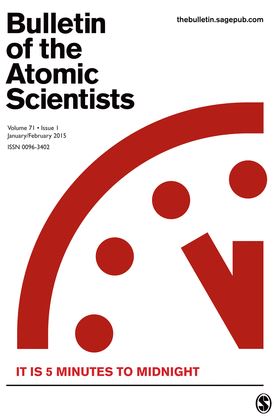
BAS CoverThe world has not tamed the nuclear beast and we should be concerned.

Later this month, the Bulletin of the Atomic Scientists (BAS), a group formed 70 years ago by some of the physicists who worked on the Manhattan Project, will decide whether to update their Doomsday Clock which says, “It is 5 minutes to midnight.®”

The clock has become a universally recognized indicator of the world’s vulnerability to catastrophe from nuclear weapons, climate change, and emerging technologies in the life sciences.

This may seem alarmist. So why should Iowans worry when most don’t think about nuclear weapons at all, yielding to the cacophony of radio, television and Internet noise?

Iowans don’t need to freak out, but they do need to be aware and concerned.

In 2009, President Obama announced pursuit of a world free of nuclear weapons in Prague. Things have gone another direction under his leadership.

“I note the United States does not support efforts to move to a nuclear weapons convention, a ban, or a fixed timetable for elimination of all nuclear weapons,” said Adam Scheinman, U.S. delegate to a Dec. 8, 2014 international conference on the humanitarian consequences of nuclear weapons in Vienna, Austria.

Jaws dropped in the room where people from around the world had gathered to hear the witness of Hibakusha, people who had survived the nuclear explosions in Hiroshima and Nagasaki. It was a tone-deaf statement.

According to the Congressional Budget Office, the administration plans to spend $355 billion over the next 10 years to modernize our nuclear arsenal, and a trillion dollars over the next 30 years. This is an absurd waste of taxpayer dollars on weapons that should never be used.

The Doomsday Clock is a reminder that we can’t afford the luxury of an incremental approach to nuclear disarmament.