Categories
Sustainability

Nuclear Risks in Russian Invasion of Ukraine

The crisis in Eastern Europe could become a regional and global humanitarian catastrophe if war involving nuclear-armed nations erupts in Ukraine. IPPNW hosted an emergency briefing on 19 February with a distinguished panel of experts to examine the terrible human cost if diplomacy fails. The experts’ remarks are outlined below, topics include:

  • Conventional war – Possible direct and indirect impacts of a conventional war in Ukraine on health, human rights, and the environment. Presented by Barry Levy, M.D., M.P.H.
  • Damage to nuclear power reactors – The risk of large radioactive releases from one or more of the 15 nuclear power stations in Ukraine that are vulnerable to deliberate or accidental destruction or meltdowns due to loss of power through cyber attacks. Presented by Linda Pentz Gunter
  • Escalation to nuclear weapons – The catastrophic regional and global consequences if nuclear weapons are launched intentionally or by accident or miscalculation. Presented by Ira Helfand, M.D.

Watch the event recording and learn more about the panelists at www.ippnw.org/no-war.

Conventional War – Barry Levy, M.D., M.P.H.

During war, civilians are often injured or killed directly — sometimes accidentally — by the indiscriminate use of weapons. They were in the wrong place at the wrong time. But increasingly, civilians are targeted — attacked on purpose, as part of a strategy of war. Men are taken from their homes in the middle of the night, never to return. Women are raped and often killed. Even children are sometimes targeted and killed as a strategy of war.

However, most deaths during war are not caused by direct attacks, but indirectly. Many of these indirect deaths result from damage to infrastructure. After farms and the food supply system are damaged, people become malnourished and more susceptible to respiratory infections, like COVID-19. Water treatment plants are bombed, and people develop cholera, dysentery, or other diarrheal diseases. Hospitals and healthcare workers are attacked, public health agencies are not able to function, and people are unable to receive clinical care or public health services. And  power plants, communication networks, and transportation systems are damaged, leading to disease and death.

Population displacement is another major cause of indirect deaths during war. People can be displaced within their own country or as refugees to other countries. Internally displaced persons are generally worse off because they have inadequate food, water, health care, and security — and therefore are at increased risk of disease and death. And if war continues, people may be displaced for long periods of time.

Indirect deaths far outnumber direct deaths during war. Since 1990, the Uppsala Conflict Data Program in Sweden has recorded an average of about 50,000 direct deaths per year in state-based armed conflicts. In a separate analysis for the same period of time, Mohammad Jawad and colleagues estimated about one million indirect deaths occurred per year, on average – 20 times more indirect deaths than direct deaths. Even if the estimate of indirect deaths is too high or the number of direct deaths recorded too low, indirect deaths far outnumber direct deaths during war.

Noncombatant civilians most frequently suffer from the following diseases during war:

  • Malnutrition — with young children and pregnant women at greatest risk
  • Communicable diseases, including diarrheal diseases such as cholera, acute respiratory infections such as COVID-19, and other diseases such as measles and tuberculosis
  • Mental disorders, such as posttraumatic stress disorder, depression, and suicide
  • Adverse effects on reproductive health, including higher rates of maternal mortality, infants born with low birthweight, and infant mortality.
  • Noncommunicable diseases, with greater occurrence and exacerbations of heart disease and stroke, chronic lung disease, and cancer — and less available treatment for these diseases.

While everyone is at risk, some populations are especially vulnerable: women, children, displaced people, older people, people with chronic diseases and disabilities, and ethnic and religious minorities.

How many people will suffer from the health impacts of a war in Ukraine?  No one knows.

But there could be large numbers of civilian deaths, widespread damage to health-supporting infrastructure, millions of people displaced, many people with post traumatic stress disorder and depression, widespread violations of human rights, and substantial damage to the environment — all of which occurred after the U.S. invasion of Iraq 20 years ago.

Ukraine today is similar in some ways to Iraq in 2003 and different in others. Ukraine has 42 million people, Iraq then had 26 million, but was more densely populated. Life expectancy in Ukraine today (72 years) is about the same as it was in Iraq in 2003 (69 years). But the population of Ukraine today is much older than the population of Iraq in 2003; 17% of Ukrainians are 65 years of age or older, compared to about 3% in Iraq — the percentage of older people is five times higher in Ukraine than in Iraq. Therefore, they have higher rates of chronic disease and disability, more dependency on ongoing medical care, less mobility, and increased vulnerability to COVID-19. Therefore, the death rate in a protracted war in Ukraine could be even higher than in the Iraq War.

War and its health impacts can be prevented. There are four levels of prevention that can be applied:

  • Primordial prevention addresses the root causes of war.
  • Primary prevention addresses the precipitating causes of war and aims to resolve disputes nonviolently.
  • Secondary prevention attempts to end war and reduce its impacts
  • Tertiary prevention rehabilitates and restores the health of individuals and communities after war has ended.

But soon, it was be too late for primordial or primary prevention, and efforts may need to focus on protecting civilians and civilian infrastructure, providing humanitarian assistance, and working to end the violence as soon as possible.

Damage to Nuclear Power Reactors – Linda Pentz Gunter

The 15 nuclear power reactors at four sites in Ukraine both face and create a series of risks should a war or escalated conflict break out there. Even if the reactors sites —which deliver 50% of Ukraine’s electricity needs — are not embroiled in the conflict zone, they are still vulnerable to catastrophic outcomes.

The Chernobyl nuclear site and the Exclusion Zone are also potentially at risk.

The presence of 15 reactors in Ukraine, or any nuclear reactors anywhere, automatically adds to the medical risks for the surrounding populations should something else major happen.  And that something else need not be a war.

We are already seeing the ravages of the climate crisis and how this can knock out

essential power supplies. Nuclear power plants are already vulnerable. They are more so if caught up in a war that could cause the grid to go down.

There are 15 reactors in Ukraine grouped at 4 sites and providing 50% of the country’s electricity needs. They are Russian VVER reactors of 1,000 megawatts each, similar in design to our traditional light water reactors.

And there is the closed Chernobyl nuclear plant in the north, which were RMBK graphite moderated reactors.

If a war takes out the electric grid, whether by accident or deliberate sabotage—including even through a cyber attack, the nuclear plant operators will try to shut the reactors down. But if they lose onsite power as well, should that backup power fail, as it did at Fukushima, things can get  far more dire with similar outcomes to an actual attack.

Are any of Ukraine’s reactors likely to be within the battle zone? Rivne and Khmelnitsky in the far west, are probably out of harm’s way. South Ukraine is also less likely to come under direct attack. Of most concern, given its size and location is Zaporizhzhia. It’s the largest nuclear power station in Europe, with a net capacity of 5700 MW. The Zaporizhzhia reactors were already vulnerable during the Crimea invasion in 2014 when a far-right Ukrainian group tried to gain entry. They are about 200 kilometers from the Donbas conflict zone.

If any of these reactors are embroiled in the war zone but not attacked or hit, the nuclear plant workers, may fear for their lives and the lives of their families. They would want to — and should — evacuate with their loved ones.

But what happens if they do? The answer is they can’t. Or not all of them. Nuclear power plants, even under normal circumstances are never walkaway safe. Some workers would have to stay behind.  If the nuclear workforce evacuates, you set in motion a cascade of meltdowns at that site, whether or not it is directly attacked.

If one or more of these reactors takes an accidental hit from a bomb or missile or even just artillery fire, we could be talking about another Chernobyl or, actually, multiple Chernobyls.

The worst of all possible outcomes is that a direct hit destroys the reactor immediately. But even if the reactor is severely damaged or disabled, then you start to lose coolant and the reactor heats up, the fuel rods are exposed, and explosive gases are created. One spark and you could see an explosion as we did at three of the Fukushima reactors.

Some of the workforce may be injured or killed, or struggling to shut down the remaining reactors. Added to that, if the spent fuel pools boil and evaporate, exposing the rods, these could catch fire. A fuel pool fire is even worse than the reactor exploding because spent fuel pools contain a far hotter radioactive inventory than the reactor itself.

Those radioactive releases would be dispersed across thousands of miles. We have already had a glimpse of what that would look like for human health after Chernobyl. The plume pathway for just radioactive cesium-137 resulting from the 1986 Chernobyl explosion hit Belarus, Russia and Ukraine the worst. But it went all across Europe. Not all the hot spots were concentrated closest to Chernobyl.

If any of Ukraine’s 15 reactors were hit, it would be much worse than Chernobyl. All of them are older than Chernobyl Unit 4 was in 1986. They have bigger radioactive inventories. And they are all multiple reactor sites. People all across Europe would be affected.

But what if there was a deliberate attack on the reactors, an act of sabotage to disable them, or even a cyber attack? We know nuclear sites are vulnerable to cyber attack. We’ve seen it before with the 2010 Stuxnet cyber attack on 15 of Iran’s nuclear facilities including the Natanz uranium enrichment plant.

Would Russia — or any country or even rogue group —really use reactors as weapons of war, allowing them to deliberately melt down and potentially contaminate wide portions of Europe?

This would seem like a scaled down exercise in mutually assured destruction, given prevailing winds would likely blow much of the radiation across Russia and Belarus. A deliberate attack  on a nuclear plant would have much the same outcome as an accidental one. It would release a massive plume of radioactivity and would be a medical and humanitarian disaster of monumental and likely completely unmanageable proportions.

What would that mean for human health?

We should have a guide from the example of Chernobyl. But there was a scandalous and even heartless international effort, by agencies like the IAEA, with vested interests in minimizing the disaster, to do just that. We must look to independent sources to get a truer sense of the numbers. And here we must remind ourselves that, with Chernobyl, we are talking about just one, relatively new reactor not the multiple ones now in Ukraine containing far more radioactivity.

Three of the best sources on the real health impacts are IPPNW Germany’s 20-years after Chernobyl report;  Ian Fairlie’s TORCH Report; and Kate Brown’s book — Manual for Survival: A Chernobyl Guide to the Future. And then you just take their numbers and imagine an orders of magnitude worse situation  if, let’s say, one or more of the Zaporizhzhia reactors are hit, whether accidentally or deliberately, and melt down. 

And that’s not where it ends.

Looking at a specific sample of Chernobyl victims, Dr. Wladimir Wertelecki, a physician and geneticist, who conducted post-Chernobyl research in Polissia, Ukraine, found birth defects and other health disturbances among not only those who were adults at the time of the Chernobyl disaster, but their children who were in utero at the time and, most disturbingly, their later offspring.

So if reactors are breached during a war in Ukraine, that war, in a medical sense, will never be over.

But what about the Chernobyl Exclusion Zone? Could it, and the nuclear site itself, get caught up in a war?


Russian troops could choose to cross into Ukraine from Belarus, the shortest route to Kyiv, taking them through the Chernobyl Zone. But it is marshy and difficult terrain, in addition to being radioactive, so certainly not the ideal entry point.

The destroyed Chernobyl Unit 4, along with 200 metric tonnes of uranium, plutonium, liquid fuel and irradiated dust, are encased in a sarcophagus completed in 2019. But that sarcophagus, which is only supposed to last 100 years, could collapse under the vibrations of explosions in a war zone. That would loft radioactive dust into the atmosphere causing yet another major health crisis.

And there is one more huge threat to this area, as well as to any war zone involving nuclear plants, and that is fire. We’ve already seen literally hundreds of fires in the Chernobyl Zone, sadly many started deliberately. Under ever more extreme climate conditions, wildfires will get larger and more frequent. In 2020, a forest fire that broke out within the Chernobyl Zone threatened to reach the plant site.

Forest fires reloft and redistribute radiation trapped in the soil. The 2020 fire increased radiation levels to 16 times higher than they had been previously. War clearly raises the risk of fires. And the Chernobyl Zone is a tinder box.

Dr. Tim Mousseau and his team discovered that dead wood and leaf litter on the forest floors is not decaying properly, likely because the microbes and other organisms that drive the process

of decay are reduced or gone due to their own prolonged exposure to radiation.

Equally, wildfires triggered by war close to any of Ukraine’s operating reactors could have dire consequences. Even under just normal reactor operating circumstances, fire is considered the bulk of the risk for a core melt.

Wars in regions where there are nuclear reactors raise the dangers to almost unimaginable heights.  All of this, in my view, strengthens the argument to permanently close and dismantle the world’s nuclear power plants as soon as possible.

Escalation to Nuclear Weapons – Ira Helfand, M.D.

A large scale conventional conflict in Ukraine will create a catastrophic humanitarian crisis.  But the parties to this dispute, NATO and Russia, are armed with enormous nuclear arsenals, and so it is important to consider also the consequences if the conflict escalates to the use of nuclear weapons since both NATO and Russian military doctrines allow for the use of tactical nuclear weapons to fend off defeat in a major conventional war.

Despite reductions in nuclear forces over the last several decades, Russia still has 1900 tactical nuclear weapons and 1600 deployed strategic nuclear weapons.  On the NATO side, France has 280 deployed nuclear weapons and the UK, 120.  In addition the United States has 100 B 61 tactical bombs deployed at NATO bases in Belgium, Germany, Italy, the Netherlands and Turkey and an additional 1650 deployed strategic warheads. (Ref)

If even a single 100 Kt (kiloton) nuclear weapon exploded over the Kremlin, it could kill a quarter of a million people and injure a million more, completely overwhelming the disaster response capability of the Russian capital. A single 100 kiloton bomb detonated over the US Capital would kill over 170.000 people and injure nearly 400,000. (Ref)

But it is unlikely that an escalating nuclear conflict between the US and Russia would involve single warheads over their respective capitals.  Rather it is more likely that there would be many weapons directed against many cities and many of these weapons would be substantially larger than 100 Kt.  For example, Russia’s 460 SS-18 M6 Satan warheads have a yield of 500 to 800 Kt.  The W88 warhead deployed on US Trident submarines has a yield of 455 Kt. 

Major cities like New York or Moscow are probably targeted with at least 10 to 20 nuclear weapons each 30 to 50 times more powerful than the Hiroshima bomb. To describe the destruction they would cause we can use the model of a single 20 MT (megaton) bomb. The total megatonage in an actual attack would be less, but, because the explosive force would be spread out more efficiently across the metropolitan area, the actual destruction would be even greater.

Within 1/1000th of a second, a fireball would form reaching out for two miles in every direction, four miles across.  Temperatures would rise to 20 million degrees Fahrenheit, and everything–buildings, trees, cars, and people–would be vaporized.

To a distance of 4 miles in every direction, the blast would produce pressures of 25 pounds per square inch and winds in excess of 650 miles per hour. Forces of this magnitude can destroy essentially anything that we build including reinforced concrete and steel structures. Even deep underground bomb shelters would be crushed.

To a distance of six miles in every direction, the heat would still be intense enough to melt sheet metal.  And to a distance of 10 miles in every direction,  the blast wave would create pressures of 7 to 10 pounds per square inch and winds of 200 miles per hour.

To a distance of at least 16 miles in every direction, the heat would ignite all easily flammable materials–paper, cloth, wood, leaves, gasoline, heating oil–starting hundreds of thousands of fires. Fanned by blast winds still in excess of 100 miles per hour, these fires would merge into a giant firestorm 32 miles across and covering 800 square miles. Everything within this entire area would be consumed by flames. Temperatures would rise to 1400 degrees Fahrenheit. And everyone would die.

If just 300 warheads in the Russian arsenal got through to urban targets in the US, 75 to 100 million  people would die in the first half hour and tens of millions would be fatally injured.  Huge swaths of the country would be blanketed by radioactive fallout and the industrial, transportation and communication infrastructure which we all depend on would be destroyed.  The internet, the electric grid, the food distribution system, the public health and banking systems would all be gone.  In the following months the vast majority of those who survived the initial attack would also die, from radiation sickness, epidemic disease, exposure and starvation. A US attack on Russia would cause similar devastation.

But these are just the direct effects.  In addition, the large scale use of nuclear weapons would also cause catastrophic climate disruption.  When a nuclear attack causes a city to burn, enormous amounts of soot are lofted into the upper atmosphere.  If all of the deployed weapons in the US and Russian arsenals were used against urban targets some 150 Tg (terragrams or million tons) of soot would be generated, blocking out the sun and dropping temperatures across the planet an average of 100 C.  In the interior regions of North America and Eurasia temperatures would drop 25 to 300 C.  The Earth has not seen temperatures this cold since the last Ice Age.  In the temperate zones of the Northern Hemisphere there would be 3 years without a day free of frost—the temperature would drop below freezing every single day.  Under those conditions the ecosystems which have evolved since the last Ice Age would collapse, food production would plummet and the vast majority of the human race would starve.  (Ref)

Even a much more limited nuclear war would cause catastrophic global climate disruption.  As few as 250 100 kiloton bombs could generate 37 Tg. of soot dropping temperatures 5.5 0 C and triggering massive crop failures and catastrophic worldwide famine that would put hundreds of millions, possibly billions of people at risk.  This would not mean the extinction of our species; if would mean the end of modern civilization.  No civilization in history has survived a shock of this magnitude and there is no reason to assume that the delicate, complex economic system on which we all depend would do any better.

Categories
Sustainability

Cranes for Our Future

Paper Cranes

Friday is the 76th anniversary of the atomic bombing of Hiroshima, Japan. Monday is the anniversary of Nagasaki. The world little realized the devastation caused by President Harry Truman’s decision to detonate those bombs.

In response to the anniversary, the Nuclear Threat Initiative organized a global project to make paper cranes and post them on social media with the hashtag #CranesForOurFuture. The idea is an affirmation of hope and a unified statement that a world without nuclear weapons is possible on what should be this weekend of peace.

I hope you will join us in this project.

For more information about how to participate, paper crane folding and social sharing instructions, including a video and printable template prepared by Hiroshima Prefecture, click on the link: https://www.CranesForOurFuture.org/Fold

Categories
Sustainability

76th Anniversary of the Atomic Bombings

B-61 Nuclear Bombs

World War II veterans were still living when our family moved back to Iowa in 1993. In each conversation with one of them, I asked about the Aug. 6, 1945 atomic bombing of Hiroshima, Japan and the Nagasaki bombing three days later. To a person, they felt the bombings were warranted, agreeing with President Harry Truman’s decision to drop them. As they aged and died a couple changed their minds.

We have come to accept what President Ronald Reagan and Secretary General Mikhail Gorbachev said in Geneva, Switzerland 36 years ago, “A nuclear war cannot be won and must never be fought.”

Since then, the U.S. rushed to undo arms control measures. Under President George W. Bush we withdrew from the Anti-Ballistic Missile Treaty. Under President Trump, we withdrew from the Intermediate-Range Nuclear Forces Treaty, the Joint Comprehensive Plan of Action (Iran Deal), the New START Treaty, and the Open Skies Treaty. Hard work of arms control, and compliance with Article VI of the Nuclear Non-proliferation Treaty, seemed to have been abandoned.

On the 76th anniversary of the atomic bombings we are heartened by the June 16 meeting between U.S. President Joe Biden and Russian President Vladimir Putin. The leaders released a joint statement, “Today, we reaffirm the principle that a nuclear war cannot be won and must never be fought.” They pledged to launch a bilateral Strategic Stability Dialogue to lay the groundwork for future arms control. We can only work toward the idea that this time it sticks.

~ First published in the Solon Economist on July 29, 2021.

Categories
Living in Society Sustainability

A World Without Nuclear Weapons

B-61 Nuclear Bombs

While it got scant notice in the U.S. press, the joint statement after the Geneva, Switzerland meeting between President Joe Biden and Russian President Vladimir Putin was significant:

We, President of the United States of America Joseph R. Biden and President of the Russian Federation Vladimir Putin, note the United States and Russia have demonstrated that, even in periods of tension, they are able to make progress on our shared goals of ensuring predictability in the strategic sphere, reducing the risk of armed conflicts and the threat of nuclear war.

The recent extension of the New START Treaty exemplifies our commitment to nuclear arms control. Today, we reaffirm the principle that a nuclear war cannot be won and must never be fought.

Consistent with these goals, the United States and Russia will embark together on an integrated bilateral Strategic Stability Dialogue in the near future that will be deliberate and robust. Through this Dialogue, we seek to lay the groundwork for future arms control and risk reduction measures.

The White House, June 16, 2021.

The joint statement echoed what President Ronald Reagan and Secretary General of the Communist Party of the Soviet Union Mikhail Gorbachev said 36 years earlier in Geneva, “A nuclear war cannot be won and must never be fought.”

“The complete abolition of nuclear weapons is the only way to be safe from their threat,” president of Physicians for Social Responsibility of Los Angeles Robert Dodge, M.D. wrote in Common Dreams.

The United States and Russia possess far more nuclear weapons than the rest of the nuclear states combined, enough to destroy life as we know it on Earth many times over. The two states working toward strategic stability is essential to compliance with Article VI of the nuclear nonproliferation treaty. During the previous U.S. administration, future compliance with the NPT came into doubt. President Biden is getting the U.S. back on the right track.

That’s not to say it will be easy. As Dodge points out, the Treaty on the Prohibition of Nuclear Weapons went into force January 22 this year. Currently it has been signed by 86 nations and been ratified by 54. Neither Russia nor the U.S. have joined the treaty and the prospects of them doing so near term are dim.

All nine nuclear states must take a step back from the brink of nuclear annihilation. The Geneva statement on strategic stability suggests it is possible to do so.

To learn more about the U.S. grassroots organizing effort to produce the safer, healthier and more just world that is possible without nuclear weapons, visit the Back from the Brink website.

~ First Published on Blog for Iowa

Categories
Sustainability

New START Treaty Extended

B-61 Nuclear Bombs

We received news on Tuesday afternoon the New START Treaty was extended.

“A week ago, the United States and Russia ‘exchanged diplomatic papers’ in order to extend the New START treaty for 5 years,” wrote Physicians for Social Responsibility in a Feb. 2 email.  “Biden and Putin got this done in time — before New START was set to expire this Friday, Feb 5.”

Recent Republican administrations have not favored arms control treaties. In fact, the George W. Bush and Donald Trump administrations exited existing agreements. U.S. Admiral Charles Richard recently wrote in the U.S. Naval Institute journal Proceedings, the potential for nuclear war remains present.

“There is a real possibility that a regional crisis with Russia or China could escalate quickly to a conflict involving nuclear weapons, if they perceived a conventional loss would threaten the regime or state,” the four-star admiral wrote.

There’s nothing new in the Richard’s statement. While our relations with Russia and China require scrutiny, not only with regard to nuclear weapons, but with every facet of their complexity, a few things remain clear about the course the United States should be taking to prevent the detonation of nuclear weapons which may escalate into a full on war. In their new book, The Button: The New Nuclear Arms Race and Presidential Power From Truman to Trump, William J. Parry and Tom Z. Collina outline a framework that includes these items:

The president should not have sole authority to launch a nuclear weapons attack. The U.S. Constitution gives Congress sole authority to declare war. They should be engaged with any decision to launch nuclear weapons against another state or non-state actor. There is no need for the “nuclear football” that has been shadowing the president since the Kennedy administration.

We should never rush into nuclear war. Experience has shown us time is required to gather all the information needed to verify an attack is in progress. There is simply no need for the president to decide to retaliate based on sketchy or incomplete information in a matter of a few minutes. Launch on warning should be prohibited.

First use of nuclear weapons should be prohibited. Given U.S. conventional force superiority, there is little reason to use nuclear weapons.

Intercontinental Ballistic Missiles with nuclear warheads, positioned in silos to launch on warning are obsolete. If the U.S. were attacked with a large-scale nuclear missile launch, ICBMs in silos would be the among the first targets. They are part of the so-called nuclear triad which includes submarines and bombers ready to launch a nuclear attack or counter attack. If there were a nuclear attack on the U.S., submarines and bombers would comprise our primary retaliatory response. ICBMs are obsolete sitting ducks.

Strategic missile defense systems don’t work, despite billions of dollars spent developing them. Russia sees U.S. missile defense systems as a threat to their ability to retaliate in the event of a U.S. nuclear attack. U.S. missile defense systems, by their existence, block advancement of arms control negotiations between the world’s two owners of 90 percent of nuclear armaments.

The bigger picture is nuclear states should take seriously Article VI of the Non-Proliferation Treaty and work toward elimination of nuclear weapons. For those nuclear states which haven’t joined the treaty, they should. Countries should reduce and eliminate spending on weapons of mass destruction.

While I don’t agree with the Biden administration’s military spending priorities, I’m glad to receive the news they extended New START for five more years. Now build upon it.

Categories
Living in Society

Fall Cleanup 2020

Big Grove Township, Nov. 8, 2020

While returning from a walk in the state park I picked up four yard signs a neighbor placed in their yard. Two of the candidates are poised to win and two are not.

While crossing the street, another neighbor called out but I couldn’t hear them. They walked over to discuss Saturday’s events in the general election. They had considered leaving the country if the president were reelected. Like many in our neighborhood, they keep their politics private. Sigh of relief the president was defeated. They are good neighbors.

After my walk I drove over to a damaged street sign and removed the signs from the pole. It is hard to get the screws loosened so I brought it home to repair in the garage if I can. Leaves are mulched with the mower so the minerals can return to the soil. The smell of neighbors burning leaves permeated the neighborhood. What fall work remains in the yard is optional. Today looks to be in the 70s so it is a chance to work outdoors.

Emails began arriving from groups with which I associate after the election. This one from the Climate Reality Project is typical.

We will mobilize support like never before for federal-level climate policy, and will bolster this with continued state and local-level work, which has been so instrumental in building this movement since 2016. We will persist in fighting for climate justice, by forging partnerships and adding capacity to campaigns that address systemic ways the climate crisis hurts historically marginalized communities. And we will continue to the grow the Climate Reality Leadership Corps, ensuring we have even more voices conveying our clear message. We have the solutions at-hand, and there is no more time to waste.

Ken Berlin, President and CEO, The Climate reality Project

To work on any of the received requests, I had to get organized. Here is what I came up for post-election priorities from an email to friends:

My first Iowa work will be determining a leverage point to advocate for mitigation of the coronavirus pandemic. The virus prevents us from organizing as we are accustomed. I plan to follow State Senator Rob Hogg’s lead on this. As you likely know, experts are saying we will be challenged by the virus into 2022. This is a high priority.

I’m working on nuclear arms control issues with the Arms Control Association, and on the climate crisis with the Climate Reality Project. I’m also working with the Sierra Club on the Pattison Sand proposal to pump water from the Jordan Aquifer and ship it to arid western states. However those things dovetail with your organization will be our points of opportunity to work together.

The Biden administration will quickly become besieged with its efforts to undo the four years of the current administration, therefore I view moving the ball forward on our issues as something our folks in DC should lead. My expected local contributions include writing an op-ed for the Cedar Rapids Gazette every 4-6 weeks (arms control and social topics), organizing a group in Solon to help me work on issues including politics and political advocacy, and set the stage for a Democratic comeback in the 2022 election. Tall orders all.

I don’t see Iowans devoting much bandwidth to the TPNW (Treaty on the Prohibition of Nuclear Weapons) until there is an opportunity for the administration to listen and take action on the treaty. I forget who’s having the Zoom meeting that includes Rose Gottemoeller but I plan to listen in. For the time being, the U.S. government and those of the other nuclear states are ignoring the treaty. If that changes in the next couple of years I’ll get more involved.

If we don’t get organized ourselves, we will be hindered in working with others. Onward we go!

Categories
Sustainability

UN Treaty on the Prohibition of Nuclear Weapons Ratified

The weekend has been a stream of emails from friends leading to ratification of the United Nations Treaty on the Prohibition of Nuclear Weapons (TPNW).

On Oct. 24, Beatrice Fihn, executive director of the International Campaign to Abolish Nuclear Weapons (ICAN), reported Honduras became the 50th state to ratify the treaty. This started a 90-day clock for the treaty to enter into force and become international law on Jan. 22, 2021.

Congratulations to everyone who worked to achieve this significant milestone.

What we have known all along is the nine nuclear states have scant interest in eliminating nuclear weapons, even if most of them give lip service to Article VI of the Non-proliferation Treaty which calls for it.

During the Obama administration activists fully understood the United States would not lead on abolition of nuclear weapons. ICAN, International Physicians for the Prevention of Nuclear War (IPPNW), The Bulletin of the Atomic Scientists, and others took the cause to the international stage and yesterday set the world on a more definitive path by making nuclear weapons illegal. The hard work now begins.

There remains a growing danger of nuclear weapons proliferation. In an Oct. 24 statement, reacting to the 50th state ratification of the TPNW, IPPNW laid out the risks:

The treaty is especially needed in the face of the real and present danger of nuclear war climbing higher than ever. The hands of the Doomsday Clock stand further forward than they have ever been: 100 seconds to midnight. All nine nuclear-armed states are modernizing their arsenals with new, more accurate and “useable” weapons; their leaders making irresponsible explicit nuclear threats. The cold war is resurgent—hard won treaties reducing nuclear weapons numbers and types are being trashed, while nothing is being negotiated to replace them, let alone build on them. If the Trump administration allows the New START Treaty to expire, then from 5 February 2021, for the first time since 1972, there will be no treaty constraints on Russian and US nuclear weapons. Armed conflicts which could trigger nuclear escalation are increasing in a climate-stressed world. The rapidly evolving threat of cyberwarfare puts nuclear command and control in jeopardy from both nations and terrorist groups. Close to two thousand nuclear weapons remain on hair-trigger alert, ready to be launched within minutes of a leader’s fateful decision.

~ Tilman Ruff, Ira Helfand, Arun Mitra, and Daniel Bassey—Co-presidents of IPPNW

This milestone is a moment for celebration as the plan to eliminate nuclear weapons comes together as well as it has since the United Nations was established 75 years ago. Whatever uncertainties there are in our global civilization — the coronavirus pandemic, economic injustice, and armed conflict — today there is hope for a better world. That’s worth noting.

Categories
Sustainability

75 Years After Hiroshima

Chia Fen Preserve, Aug. 3, 2020

President Harry Truman did not need to drop the atomic bomb to end World War II.

The first test explosion of an atomic bomb, called Trinity, was conducted by the U.S. Army July 16, 1945, as part of the Manhattan Project on what is now part of White Sands Missile Range.

The day after Trinity, U.S. Secretary of War Henry Stimson flew to Potsdam, Germany where President Harry Truman was meeting with Winston Churchill, Clement Attlee and Joseph Stalin to determine the fate of Germany which had surrendered unconditionally on May 8.

Truman wrote about this meeting with Stimson in his memoir:

“We were not ready to make use of this weapon against the Japanese, although we did not know as yet what effect the new weapon might have, physically or psychologically, when used against the enemy. For that reason the military advised that we go ahead with the existing military plans for the invasion of the Japanese home islands.”

A committee had been established to evaluate use of the atomic bomb once testing was successful. On June 1, 1945 the committee of government officials and scientists made their recommendation, which Truman recounts:

“It was their recommendation that the bomb be used against the enemy as soon as it could be done. They recommended further that it should be used without specific warning and against a target that would clearly show its devastating strength.”

Ultimately Truman made the decision to drop the atomic bomb on Hiroshima and on Aug. 6 the U.S. Air Force delivered it. On Aug. 9 the Air Force bombed Nagasaki. The Japanese surrendered Aug. 10.

Historian Gar Alperovitz, in his book The Decision to Use the Atomic Bomb, asked two well-known questions about Truman’s decision.

“To what degree did (the president) understand that a clarification of the officially stated demand for ‘unconditional surrender’ specifying that Japan could keep its Emperor would be likely to end the war?”

“To what degree did (the president) understand that the force of a Russian declaration of war might itself bring about an early end to the fighting?”

The book based on his research is 847 pages.

The idea that dropping atomic bombs on Hiroshima and Nagasaki saved tens of thousands of allied forces lives by ending the war early is a myth perpetuated by those who would absolve our country from a decision to kill tens of thousands of Japanese children and as many or more other non-combatants. Historian Howard Zinn asked, “Would we have sacrificed as many U.S. children to end the war early?” Obviously we wouldn’t.

A friend, the late Samuel Becker, was in Guam in August 1945 preparing for the invasion of Japan. I recently asked him about the atomic bombings of Hiroshima and Nagasaki. The reaction in Guam was positive he said. U.S. military personnel were in favor of it because they felt it would bring a quick end to what could have been a prolonged, bloody conclusion to World War II. Before he died, Becker changed his mind. With time and reflection he found the notion that the atomic bombings saved many lives was a myth. The Japanese were already in a position to surrender.

Alperovitz said in a recent webinar that, to a person, contemporary military leaders went on the record to say there was no need to use the atomic bombs to end the war early. The war had already been won.

Truth matters and one truth is the atomic bombings of Hiroshima and Nagasaki were unnecessary. Their effects would fuel the Cold War and the idea of mutually assured destruction should they be used. This is crazy talk. Nuclear weapons must be eliminated and the only way to do that, to pierce the wall of our federal government, is citizen action demanding it.

On the 75th anniversary of Hiroshima it’s past time we took action.

~ Written for the Cedar Rapids Gazette and published Aug. 9, 2020. Used with permission of the author.

Categories
Living in Society Sustainability

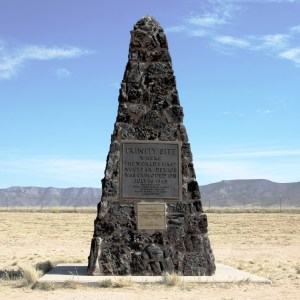
Trinity 75 Years Later

Trinity Marker near Bingham, N.M.

Trinity was the code name for the first nuclear bomb detonation 75 years ago today.

The test explosion was conducted by the U.S. Army at 5:29 a.m. on July 16, 1945, as part of the Manhattan Project. It took place in the Jornada del Muerto desert about 35 miles southeast of Socorro, New Mexico, on what is now part of White Sands Missile Range.

The day after Trinity, U.S. Secretary of War Henry Stimson flew to Potsdam, Germany where President Harry Truman was meeting with Winston Churchill, Clement Attlee and Joseph Stalin to determine the fate of Germany which had surrendered unconditionally on May 8.

Truman wrote about this meeting with Stimson in his memoir:

We were not ready to make use of this weapon against the Japanese, although we did not know as yet what effect the new weapon might have, physically or psychologically, when used against the enemy. For that reason the military advised that we go ahead with the existing military plans for the invasion of the Japanese home islands.

A committee had been established to evaluate use of the atomic bomb once testing was successful. Before Trinity, on June 1, the committee of government officials and scientists made their recommendation, which Truman recounts in his memoir:

It was their recommendation that the bomb be used against the enemy as soon as it could be done. They recommended further that it should be used without specific warning and against a target that would clearly show its devastating strength.

Ultimately Truman made the decision to drop the atomic bomb on Hiroshima and on Aug. 6 the U.S. Air Force delivered it. Truman threatened to drop a second atomic bomb. On Aug. 9 the Air Force bombed Nagasaki. The Japanese surrendered Aug. 10.

A friend and fellow Veteran for Peace, the late Samuel Becker, was in Guam in August 1945 preparing for the invasion of Japan. I recently asked him about the atomic bombing of Hiroshima and Nagasaki. He said the reaction in Guam was positive, they were in favor of it because it brought a quick end to what could have been a prolonged, bloody conclusion to World War II. In the years before he died, Sam didn’t believe it was a good idea. With time and reflection, the notion that the atomic bombings saved many lives turned out to be a myth. The Japanese were already in a position to surrender. At a Zoom call on Monday, author of the book The Decision to Use the Atomic Bomb Gar Alperovitz said that to a person contemporary military leaders went on the record to say there was no need to use the atomic bombs on Japan. The war had already been won.

On July 1, 1968, states began to sign the Treaty on the Non-proliferation of Nuclear Weapons (NPT) which entered into force on March 5, 1970. Every state on the planet has joined the treaty with the exception of India, Israel, Pakistan, and South Sudan. India, Israel and Pakistan have nuclear weapons. The treaty has three interrelated parts: non-proliferation, disarmament, and peaceful use of nuclear energy. Article VI states, “Each of the Parties to the Treaty undertakes to pursue negotiations in good faith on effective measures relating to cessation of the nuclear arms race at an early date and to nuclear disarmament, and on a treaty on general and complete disarmament under strict and effective international control.” 75 years after Trinity we missed the “early date” by a country mile.

Progress is measured in a meeting of the parties every five years. This year’s scheduled NPT review conference was postponed until next year because of the coronavirus pandemic. In the Trump administration nuclear arms control is not even up for discussion, except to eliminate constraints on “American freedom.” The U.S. plans to spend $1 trillion on the nuclear complex in the coming years. That will drive Russia to do likewise. FOX News personality Chris Wallace recently wrote a popular book regurgitating false myths about the history of the atomic bomb. Alperovitz debunked some of Wallace’s claims on Monday.

Also on Monday Sueichi Kido spoke about his experience as a five-year-old during the bombing of Nagasaki. People like him are called hibakusha or survivors of the atomic explosions at Hiroshima or Nagasaki in 1945. Over the years he and other hibakusha told their story many times. The hibakusha are aging and will soon all be gone. Along with them will go living memory of the effects of a nuclear weapon.

Truth matters and one truth is the atomic bombings of Hiroshima and Nagasaki were unnecessary. Atomic bombs were never needed for defense. Their existence, as demonstrated at Trinity, would fuel the Cold War and the idea of mutually assured destruction should they be used. This is crazy talk. Nuclear weapons must be eliminated and the only way to do that, to pierce the wall of our federal government, is citizen action demanding it. On the 75th anniversary of Trinity it’s past time we took action.

Categories
Sustainability

No First Use

B-61 Nuclear Bombs

On Jan. 30, U.S. Senator Elizabeth Warren (D-MA) and U.S. House Armed Services Committee Chairman Adam Smith (D-WA) introduced companion bills in the 116th Congress to establish the policy of the United States to not use nuclear weapons first.

That’s the bill, 14 words, “It is the policy of the United States to not use nuclear weapons first.”

Sounds like a no-brainer for rational people. Nuclear weapons should never be used. Under what circumstances would our country ever consider using them first? No rational person could come up with a scenario to do so that would stand the light of public scrutiny.

Russian President Vladimir Putin said Russia would only use its nuclear weapons in response to an incoming missile attack. He acknowledged the global catastrophe that would result from a nuclear war. “We can’t be those who initiated it,” Putin said.

H.R. 921 has 25 house co-sponsors, all Democrats. S-272 has six co-sponsors including five Democrats and one Independent. None of the six members of the Iowa delegation to the 116th Congress has signed on as a co-sponsor. That is unfortunate.

The reason Iowa’s lack of co-sponsors on this no first use policy is unfortunate includes:

Iowa’s agricultural industry would be particularly hard hit in the aftermath of a limited nuclear war elsewhere in the world. Smoke and debris thrown into the upper atmosphere would disrupt the growing season. Crop yields in Iowa and other Midwestern states, as well as in other parts of the world, would plummet according to a 2012 study, due to declines in precipitation, solar radiation, growing season length, and average monthly temperature. As many as two billion people would be at risk of food insecurity.

There is no adequate medical response to a limited nuclear war. “We know from the International Committee of the Red Cross’s first-hand experience in Hiroshima in 1945 that the use of even a relatively small number of nuclear weapons would cause death, injury and destruction on a massive scale, that there would be no effective means of providing aid to the dying and wounded, and that those exposed to radiation would suffer life-long and fatal consequences to their health,” Kathleen Lawand, head of ICRC arms unit said.

Preparing for a limited nuclear war, one which should never be fought, is costly. The Trump administration is planning to spend more than a trillion dollars to upgrade the U.S. nuclear weapons complex, including improved weapons, delivery systems and labs. They are even considering development of so-called “low-yield” nuclear weapons which were phased out at the end of the Cold War. Those funds could be better used elsewhere or could even pay for tax cuts.

My ask is modest. The Iowa delegation to the 116th Congress should sign on as co-sponsors to the no first use bills. It is a rational first step in reducing global tensions surrounding the use of nuclear weapons. Those of us in the nuclear abolition community would ask for a lot more, but a no first use policy is something upon which people could agree without even considering more controversial aspects of a ban on nuclear weapons.

There is no cure for a nuclear war. We must prevent what we cannot cure.