
An eminent domain bill is emerging in the Iowa legislature. If it becomes law, it would impact both the Dakota Access Pipeline and the Rock Island Clean Line which share the issue of being merchant distribution lines for oil and gas, and electricity respectively.
Whether an eminent domain bill would be sent to the governor is an open question. The Iowa legislature is stymied over K-12 school funding, and the overall budget. Last weekend’s discussion was whether or not to send legislators home while a committee ironed out details.
“I think that’s unwise,” said Senate Majority Leader Mike Gronstal in an Associated Press interview. “I think everybody’s voice needs to be heard. I think everybody should stay and work. I think it’s time to knuckle down and get to work.”
The legislature is required by statute to finish the budget before adjournment, so April and likely part of May will be a slow grind toward compliance. At this point, the parties can’t agree on a revenue number or on how to spend it. There appears to be time to work on an eminent domain bill while the budget is finalized.
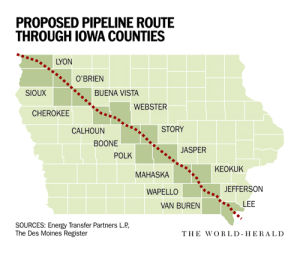
Last Thursday, Ed Fallon completed his walk across Iowa along the route of the Dakota Access Oil Pipeline. In his daily report from the project, Fallon wrote, “eminent domain legislation is coming this week! I was in touch this weekend with two key lawmakers who assured me that, before week’s end, we’ll have companion bills with bipartisan support in both House and Senate. This is very encouraging. Stay tuned.”
The two lawmakers are State Senator Rob Hogg and Representative Bobby Kaufmann, who chair the government oversight committee in their respective chambers. I confirmed the bills were sent to drafters with Kaufmann in a telephone conversation last night. Government oversight is exempt from the funnels that limit introduction of new legislation during session.
On April 10, the Iowa Supreme Court issued a 23-page ruling on Clarke County Reservoir Commission v. Edwin D. and Deloris A. Robins Revokable Trust, in which Justice Thomas Waterman wrote for the majority, “we strictly construe statutes delegating the power of eminent domain and note the absence of a clear legislative authorization for a joint public-private entity to condemn private property.”
Both the Dakota Access Pipeline and the Rock Island Clean Line are such public-private partnerships, so this court decision has ramifications for the projects. Notably, as Fallon described during his pipeline walk, many land owners along the route oppose the pipeline and eminent domain would have to be used to gain an easement. The legislation proposed by Hogg and Kaufmann includes definition of “merchant projects” and “public use,” which if enacted into law could effectively end both projects in their present form.
In Kelo v. City of New London, the U.S. Supreme Court found that projects initiated by private developers could use eminent domain as a tool, finding that “economic development did not violate the public use clauses of the state and federal constitutions.” However, as Kaufmann noted last night, if states have a stricter interpretation of eminent domain and the takings clause of the U.S. Constitution, such state laws would take precedence under Kelo. An intent of the proposed legislation is to create stricter interpretations of public use when used in the context of eminent domain, and to separate eminent domain uses for merchant projects from those of regulated utilities.
An eminent domain bill is emerging. With legislators divided over the Rock Island Clean Line and the Dakota Access Pipeline, and over eminent domain abuses in the state, there appears to be enough support to advance the bill.
For parties interested in eminent domain and in both projects, this will be one to watch.
 Journey Home
You must be logged in to post a comment.