Governor Kim Reynolds mentioned carbon-capture in her condition of the state address during a segment on renewable energy.
I am introducing new legislation that will improve access to E15 and B20 and upgrade Iowa’s fuel infrastructure to offer higher blends. And I’m proposing that we invest in carbon-capture solutions to sustain and build on our leadership position in renewable energy.
Governor Kim Reynolds Condition of the State Address, Jan. 11, 2022.
To be clear, the governor supports carbon-capture to protect Iowa’s investments in ethanol and bio-fuels. It has nothing to do with addressing the climate crisis, and everything to do with continuing to grow corn for ethanol. We are not sure if carbon-capture even works.
“The U.S. Department of Energy invested $684 million in unsuccessful carbon capture and storage demonstration projects at coal plants under the 2009 stimulus package, a U.S. Government Accountability Office audit found,” according to Karin Rives at S&P Global. “This time, the DOE has close to $1 billion from the 2021 infrastructure law earmarked for large-scale carbon capture pilot projects, as well as $2.5 billion for carbon capture demonstrations.”
If DOE spent $684 million on carbon capture and it failed to capture carbon, why would our government increase the amount to be spent? To address the climate crisis, ethanol and bio-fuels need to go out of business. Society should develop true alternative fuels that free farmer fields to grow food crops and don’t rely on release of carbon dioxide to produce ethanol.
Fool me once on carbon capture, shame on you. Fool me a second time, shame on me.
Read all of my posts on carbon-capture at this link.
Inconsistent winter weather disrupted fruit tree plans. On Wednesday snow melt began flowing in the gutters and downspout. It felt safe enough to make a trip through melting snow pack to the composter near the garden. A slushy mix returned to the end of the driveway. Weather has been weird.
It takes several days of subzero temperatures in a row to prune fruit trees. I prefer a week of ten or twenty below zero yet we haven’t had that. I also seek to harvest scions, (pencil shaped fruit tree cuttings) to graft on root stock. I would save the Red Delicious apple tree which was damaged in the Aug. 10, 2020 derecho. It served us well while it was whole. Trees need dormancy for scions to work and we haven’t had that either.
This week has been a fake spring. It’s still winter, for Pete’s sake! Yet the buds on trees look healthy, like they are ready to sprout. The lilac bushes were leafing just last month. I wouldn’t mind spring’s arrival yet I want a winter too.
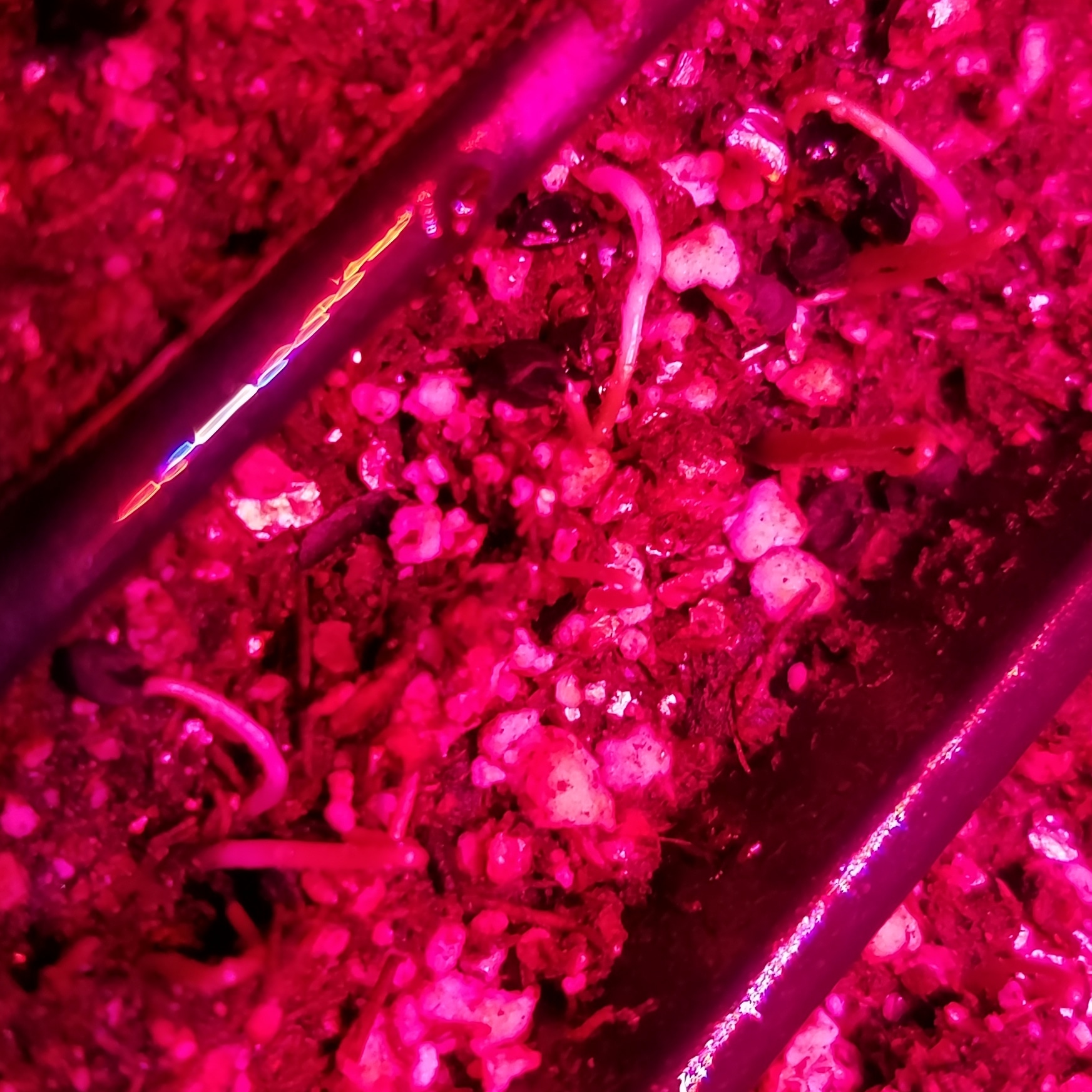
At least the onions and shallots planted Jan. 6 are germinating.
We bunker in to avoid the coronavirus and wait for a deep freeze and dormancy it would bring. These days have been good for writing.
It is difficult waiting for winter and fruit tree work when what we really want is a normal spring. Today, I’d settle for a normal winter so I can harvest scions.
Two corporations plan to install Carbon Capture and Sequestration technology to collect CO2 emissions at about 40 ethanol and fertilizer plants spread across Iowa. Next, they plan to permanently bury the resulting liquefied CO2 in deep rock formations in North Dakota and Illinois. I don’t know who is swallowing this malarkey. Almost no one is.
The CO2 pipeline is planned to cross Karmen McShane’s family land in Linn County.
“It’s heartbreaking,” McShane told Gannett’s Donnelle Eller for a story. “My dad is 77. My mom needs care. And he feels powerless (to fight the pipeline).”
There is a lot of that going around.
The pace of news articles on CCS is increasing. Eller wrote about it in Monday’s Iowa City Press Citizen and followed it with another article in Tuesday’s newspaper. Erin Jordan of the Cedar Rapids Gazette has been covering CCS as well. When the regular news coverage is frequent, we should read what paid media writers have to say. That’s what I’ll be doing to see how the process unfolds over the end of year holidays. This is my seventh post on CCS.
The Iowa oligarchy of agriculture decided to do this thing, so resistance may be futile unless more people than have become engaged. If McShane is typical, the train left the station and once ground is broken for the pipeline, there will be no stopping it.
As long as Iowa focuses on ethanol, industrial agriculture using manufactured fertilizers, and monoculture row crops and livestock, the environment will get worse. It is pretty bad already if one looks at water and air quality. Implementing CCS does not address any of this and is a distraction from needed action to address Iowa’s water and air quality.
CCS is premised on a vague statement that we must decarbonize the economy. People have written books on this, and just because two companies are spending big bucks on the project, the one-off process in Iowa does not address broader concerns about reducing the amount of greenhouse gases being released into the atmosphere as if it were an open sewer. As far as I can tell, the sole reason for the project is to protect agricultural oligarchs’ two children: corn ethanol production and fertilizer manufacturing.
To read the rest of my coverage of carbon capture and sequestration in Iowa, click here.
When I wrote my Federal Elected Officials about climate change on Oct. 18, Congresswoman Mariannette Miller-Meeks was first to respond a few days later (see below). I did not know there was a Conservative Climate Caucus. She is a member and lifted the third paragraph of her response to me from the caucus website.
As long as she supports the beliefs of the caucus, there will be trouble reconciling my views with hers. In the long run, that’s okay. It is a starting point and we need to get going. We needed to get going 50 years ago.
The Conservative Climate Caucus was founded by Republican Congressman John R. Curtis (UT-03) in June this year with the following statement of beliefs:
What We Believe
The climate is changing, and decades of a global industrial era that has brought prosperity to the world has also contributed to that change.
Private sector innovation, American resources, and R&D investment have resulted in lower emissions and affordable energy, placing the United States as the global leader in reducing emissions
Climate change is a global issue and China is the greatest immediate obstacle to reducing world emissions. Solutions should reduce global emissions and not just be “feel good” policies
Practical and exportable answers can be found in innovation embraced by the free market. Americans and the rest of the world want access to cheaper, reliable, and cleaner energy
With innovative technologies, fossil fuels can and should be a major part of the global solution
Reducing emissions is the goal, not reducing energy choices
What We Do
Educate House Republicans on climate policies and legislation consistent with conservative values
Organize co-dels and staff-dels to better understand technologies and issues related to climate
Organize Member and staff briefings on conservative climate proposals
Bring Republicans to the table to fight against radical progressive climate proposals that would hurt our economy, American workers, and national security
Introduce Republican members and staff to leaders in industry, think tanks, and more
When it comes to hurting our economy, American workers, and national security, engagement of the federal government to address the climate crisis is essential. As long as Iowa focuses on ethanol, industrial agriculture using manufactured fertilizers, and monoculture row crops and livestock, the environment will get worse. It is pretty bad already if one looks at water and air quality. There is not much hope for the Conservative Climate Caucus as it was introduced, yet it’s what we have. It is an open question whether Democrats are up to the challenge of retiring Miller-Meeks after her first term. She is a strong campaigner and well known in the district. We have to begin somewhere, and soon. This may be it.
Email from Mariannette Miller-Meeks, Oct. 22, 2021.
Sun shining through clouds the afternoon of the Dec. 15, 2021 derecho.
While Wednesday’s extreme weather manifested as a blustery thunderstorm in Big Grove, meteorologists have since categorized the multi-state storm as a derecho. It was nowhere as severe as the Aug. 10, 2020 derecho. (Update: The National Weather Service said it confirmed 43 tornadoes on Dec. 15, 2021. On Jan. 7, 2022 the number was revised to 61).
The good news is with generator and fuel standing by, and gallon jugs of bottled drinking water stored downstairs, we are ready. Practice makes perfect, as they say.
I spent 30 minutes chatting with a registered Republican, small business owner, and FOX News watcher this week. Things went well. We had plenty in common. The challenge is turning points of commonality into votes for progressive ideas. When push comes to shove, abortion is the dominant wolf in the pack. It is a firewall against political persuasion because if raised, the chat stops right there. People who oppose a woman’s right to choose raise the issue early in political conversations.
I have no choice but to interact with Republicans. They are and have been a part of our community since we lived here. During election cycles when I’ve had access to the voter rolls, I looked for the Democrats and increasingly they are in a minority where I live. I’m not complaining, just saying.
On a Zoom meeting with Iowa gubernatorial candidate Deidre DeJear last night, I asked what we should be doing to organize between now and the June primary. The response, somewhat predictably, was we should sign up to work on her campaign. It was her event, so I’m okay with that. A challenge remains unaddressed, though.
Democrats have three U.S. Senate candidates, two for governor, an unknown Democrat for the First Congressional District, and no declared candidate for either my state senator or state representative. There is a lot of work ahead if we want to elect more Democrats.
There is a case to be made the party primary election should be eliminated in favor of selecting candidates at a convention. It sounds undemocratic yet we could pick our people soon after the February precinct caucus rather than wait until June. That would give us four additional organizing months. We need every one of those in the current environment.
Back in the ancient days when megafauna roamed Earth, during the run up to the 2020 Democratic precinct caucuses, Iowa’s system failed to produce a clear winner in the presidential race. Instead results were delayed, the winner barely won the delegate count, and a loser asked for a recanvass of selected precincts. It wasn’t much better in 2016 when Hillary Clinton bested Bernie Sanders by a few delegates. There is no perfect system yet we can do better than the Iowa caucuses.
What I do, talking to Republican neighbors, is part of the political process yet I don’t see how it dovetails into the broader, state-wide politics. Politicians should concentrate on counting votes, yet there are endless conversations in all settings going on every day. These local conversations matter more than the vote-counting of politicians. They are valid and useful if sometimes frustrating. Often people who are different in political views put their best foot forward to get along in society. That may be all we have together. Democrats have yet to define our values in a way that resonates outside our clan.
I’m glad to have survived my second derecho. Now if I can survive our politics. That would be the rainbow at the end of a storm.
The language used by supporters of carbon capture and sequestration in Iowa is very specific. Not only doesn’t it include the words “climate change,” it specifically avoids mentioning it. This is a long-standing practice among major agricultural groups.
As mentioned last week, Iowa is primarily a production landscape for hogs, cattle, corn and beans where our water, air and land have been and continue to be used like an open sewer. The major agricultural groups are the Iowa Pork Producers Association, the Cattlemen’s Association, the Iowa Corn Growers Association, and the Iowa Soybean Association. Agricultural Iowa is about business at a distance from the meme farmers are the original environmentalists. To them, carbon capture is about business, not reducing greenhouse gas emissions or stewardship of the environment.
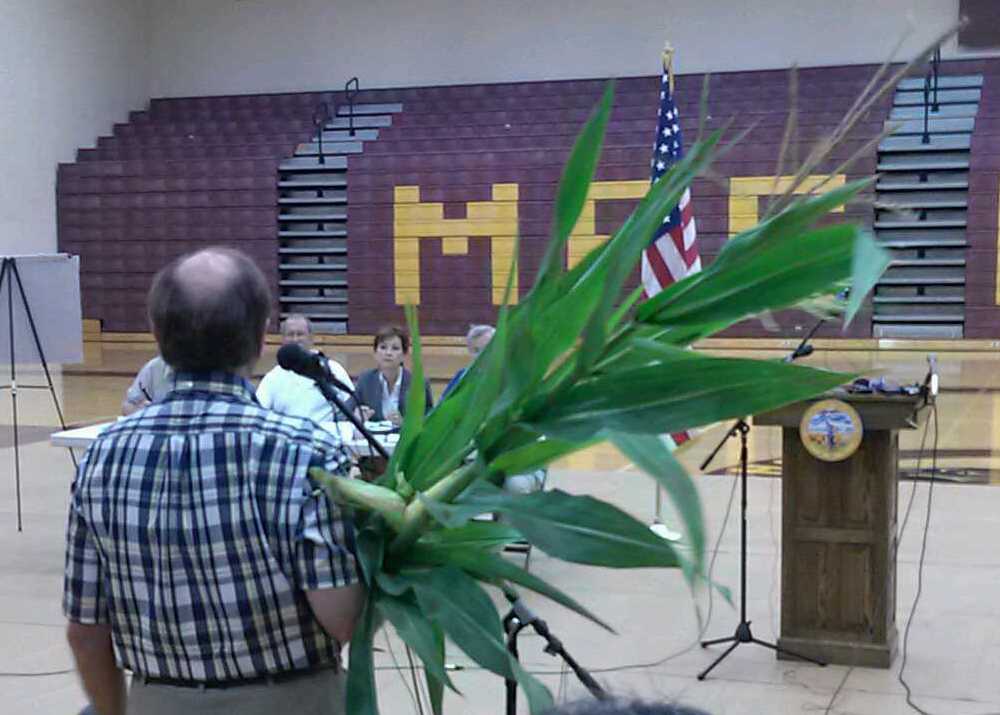
Representatives of these agricultural associations showed up in Mount Pleasant, Iowa during the 2012 drought. Governor Terry Branstad and Lieutenant Governor Kim Reynolds heard their report. The words “climate change” were absent from public discussion of the drought.
The eight hundred pound gorilla in the Mount Pleasant High School Gymnasium today was the subject of climate change. Governor Terry Branstad called for a public discussion on drought conditions in Iowa and all of the governmental players were there: USDA, Iowa Department of Natural Resources, Iowa Department of Agriculture and Land Stewardship, Iowa Department of Homeland Security and Emergency Management and the Farm Services Administration. The phrase “climate change,” or any analysis of causation for the current drought was absent from the public discussion. This was a meeting about row crop agriculture and related agricultural producers and it was intended to deal with the as-is situation. The obvious problem, as Mark Schouten of Homeland Security and Emergency Response put it, “you can’t snap your fingers and make it rain.”
The eight hundred pound gorilla has returned to Iowa as the Iowa Utilities Board hears the case for Summit and Navigator to implement carbon capture and sequestration systems which include hundreds of miles of buried pipeline. The language is familiar in its avoidance of discussion of climate change.
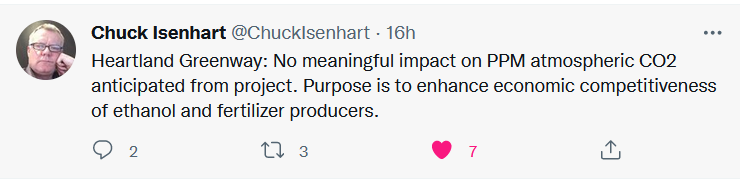
On Monday, Rep. Chuck Isenhart attended a public information meeting held by the Iowa Utilities Board for the Navigator project in Manchester. He used Twitter to relay news from the meeting. If landowners were most concerned with restoration of land productivity in the event the CO2 pipeline crossed their property, following is a main point about the absence of climate change from the discussion:
While the project as proposed would offset the CO2 equivalent of 34.7 million barrels of oil annually, according to Isenhart, “No meaningful impact on PPM atmospheric CO2 anticipated from project.” What is the project about if not reducing greenhouse gases like CO2? “Economic competitiveness of ethanol and fertilizer producers.”
States like California and Oregon have already begun to move toward a low carbon economy, including debate on whether ethanol is a “low carbon fuel.” Let me settle it this way. Summit and Navigator are spending more than a billion dollars to ship condensed CO2 from ethanol and fertilizer plants and bury it deep geological formations. Seems like a lot of carbon dioxide production to me. Why are they doing that?
The delay by the Biden administration in release of volume requirements in the Renewable Fuel Standard for 2021 and 2022.
The ethanol industry suffered major setbacks in court with the loss of year-round E15 and at the Supreme Court on a small-refinery exemptions case.
In response to policies like the Renewable Fuel Standard, California Low Carbon Fuel Standard, and Oregon Clean Fuels Program.
President Biden rejoined the 2015 Paris Agreement.
The debate among environmentalists is whether a decarbonized economy reaches net zero emissions or zero emissions. In either case, pairing ethanol and fertilizer production with CCS doesn’t meet the requirements.
The more study of the matter, the clearer it becomes that the Summit and Navigator projects are about making ethanol “competitive” should the economy decarbonize. It is a big hedge against a government directive to eliminate the financial and policy incentives to produce corn for ethanol.
Opposing production of corn ethanol is not a popular position in Iowa because more than half of corn raised is feed stock for ethanol. However, it is the right position.
Miller-Meeks attended COP26, but her record on climate isn’t promising
To address global carbon pollution everyone must get involved. Even Republicans understand this. In response to the climate crisis, and to political pressure, Republican Congressman John R. Curtis (UT-03) launched a “Conservative Climate Caucus” last June. My member of Congress, Rep. Mariannette Miller-Meeks joined.
Solutions to the climate crisis will take government at all levels. In the United States, only the federal government has the reach to take effective national action which could impact the globe.
To my surprise, Miller-Meeks showed up at the 26th Conference of the Parties in Glasgow, Scotland, where she participated in a podcast with other caucus members extolling the positions of conservatives on climate.
“As a member of the Conservative Climate Caucus this issue is important to my colleagues and myself,” she wrote me in an email.
Well okay. Welcome aboard, I think.
Miller-Meeks’ votes against the Infrastructure and Investment Jobs Act and the Build Back Better Act, both of which address the climate crisis, indicate she is not really on board with federal climate action.
For a Republican to admit they have a problem is the first step toward recovery. Let’s hope Miller-Meeks can resist her addiction to D.C. talking points and do something positive to address carbon pollution.
~ Published in Little Village Magazine Dec. 6, 2021, Iowa City Press Citizen on Dec. 8, 2021, Cedar Rapids Gazette on Dec. 11, 2021.
When we took the land after the 1832 Black Hawk Purchase, it was decimated to make neatly cut rectangles of farmland. People are used to that now. Today Iowa farmland is used mostly as a production landscape for hogs, cattle, corn and beans. For too long, Iowa’s air, water and land have been used like an open sewer to support these operations. Farmers are used to what they know and don’t want to change. That’s true for people besides farmers.
Iowa is not an empty place where someone can do what they want with the land. A utility should not be able to build pipelines and transmission lines, or construct large-scale wind farms and solar arrays with impunity. The current crop of Iowa farmers is possessive of the right to their land and to use it as they see fit. They believe they know better than government what works here and what doesn’t. They don’t want infringement on their rights. The myth of farmers as the original environmentalists persists despite evidence to the contrary.
When solutions to the climate crisis require cooperation between large corporations and Iowa farmers there is resistance.
The new carbon capture and sequestration proposals of Summit Carbon Solutions and Navigator CO2 Ventures will confront these well-established beliefs. Even though a prominent farmer, Bruce Rastetter, is behind Summit, the rollout will follow a path familiar to anyone who knows the history of electricity transmission lines and oil pipelines here. Farmers will push back.
Donnelle Eller of Gannett stated the obvious about Summit in Monday’s Iowa City Press Citizen, “The company, a spinoff of Bruce Rastetter’s Alden-based Summit Agricultural Group, says the project would help ethanol and other energy-intensive ag industries remain viable as the nation seeks to cut greenhouse gas emissions in half by 2030 to address climate change.” The Iowa governor spoke about a low carbon economy, but failed to mention climate change or how CCS fits in such a framework. This underscores a key problem with CCS. They are just out there and bottom line, it’s backers don’t give a hoot about climate change. It’s another opportunity for capital investment which could yield big profits.
The sides are already lining up for this fight.
Opponents of CO2 pipelines have also been opponents of the Rock Island Clean Line and the Dakota Access Pipeline. Rural Iowans do not speak of one mind on this yet a common theme is big money, not farmers, are behind these transmission schemes. They claim the voices of farmers are not being heard. They also claim climate change is a lie.
What is the purpose of CCS if not to address climate change? That’s the wrong question. These projects are about investing capital to get a return on investment. If the government is a source of start-up capital, more’s the better for investors. The words “climate change” aren’t needed in this transaction.
“The world must reach net-zero CO2 emissions by 2050 in order to achieve the 1.5 degree Celsius global average temperature increase limit,” according to Summit’s website. “A dramatic increase in carbon capture and storage (CCS) is crucial to achieving net-zero CO2 emissions.”
The second sentence is unlikely to be accurate. The problem is Summit and Navigator seek to change nothing about industrial use of fossil fuels. They seek a profit from ethanol plants and other CO2 emitters who keep on doing what they are doing now. CCS has become a gigantic boondoggle instead of a solution to climate change.
“Climate and other environmental and public safety concerns about CO2 pipelines are important,” Ed Fallon wrote in a Nov. 11 email. “But as with Dakota Access Pipeline, in terms of mobilizing the broadest possible coalition of opponents, the strongest argument is the abuse of eminent domain.”
In a filing with the Iowa Utilities Board, Janna Swanson, whose land the Summit pipeline would cross, had this to say about the project and climate change:
There are a whole bunch of plans to mine our tax money for revenue and the excuse is Climate Change. When using that as an excuse then any action against humans is justified.
Summit Carbon Solutions will want the right of eminent domain. They will say that because of Climate Change that their business model is for public use.
When one paints with that wide of a brush then no one’s property is off limits for anything. No one has rights.
Let’s be clear. Summit and Navigator are in the CCS business to make money, as much of it as they can. Comments like Swanson’s are setting up climate change as a talking point instead of the reality of extreme weather it is and that must be dealt with.
It is early in the process yet already many comments have been made to the Iowa Utilities Board regarding the potential CCS proposals of Summit and Navigator. If you’d like to make a comment, here’s the information.
Written comments or objections to the proposed pipeline can be filed electronically using the IUB’s Open Docket Comment Form, by email to customer@iub.iowa.gov, or by postal mail to the Iowa Utilities Board, Attn: Docket No. HLP-2021-0003 (Navigator) and/or Docket No. HLP-2021-0001 (Summit) , 1375 E. Court Ave., Des Moines, IA 50319.
The downside of the CCS approval process is it turns rural Iowans against a second science-based phenomenon. Only 56.5 percent of Iowans are fully vaccinated against the coronavirus. There is no inoculation against extreme weather made worse by climate change that Iowans already experience.
Finn Harries and All Gore at the Climate Reality Project leadership training in Cedar Rapids, Iowa on May 7, 2015. Photo Credit: Finn Harries Twitter account.
In 2015, Finn Harries sat at our table during former vice president Al Gore’s Inconvenient Truth presentation in Cedar Rapids. I didn’t know his history as a YouTuber with his identical twin brother Jack. I was assigned as his mentor during the training yet Finn didn’t need a mentor to work on the climate crisis.
Friday, Nov. 26, Finn Harries made this statement on Instagram after attending COP26 in Glasgow, Scotland:
One of the responses I often hear from older people when I talk about the work I do is “your generation gives me hope”… but this is the wrong way to think about how we go about tackling the climate crisis. In effect, this is the same strategy that has got us so deep into this mess… just passing the problem down to the next generation. What’s different this time is that we don’t have enough time to wait for our generation to be in institutional seats of power… we don’t have any time at all. So we’re flipping it around. We’re passing the problem back, up to those who can actually instigate change. Our role as young activists is to hold people in positions of power to account. To make sure they do what they’ve said they will do. In this way, we all have a critical role to play.
Harries is right. It will take all of us to make a difference during the climate crisis. In the U.S. we are not doing enough to hold people in positions of power to account.
According to a recent Washington Post – ABC News poll, “A clear majority of adults say that warming is a serious problem, but the share — 67 percent — is about the same as it was seven years ago, when alarms raised by climate scientists were less pronounced than they are now.” What will move the public opinion needle and lead to effective climate action?
In Iowa, the effects of climate change are clear. I outlined some of them in a letter to my federal elected officials. What are the two Carbon Capture and Sequestration pipelines to transport liquefied CO2 from Iowa to North Dakota and Illinois but a response to the need to reduce CO2 emissions into the atmosphere? Our political leaders don’t even acknowledge the climate crisis while supporting CO2 removal from the atmosphere.
We do have a critical role to play to prevent the worst effects of global warming. Implementing a solution will require us all.
Here is the YouTube video Finn’s brother Jack Harries made for the Conference of the Parties 26 in Glasgow, Scotland. It features an interview with former president Barack Obama. Young people like the Harries twins are not buying much malarkey. We, as a society, need to act.
Let’s be clear about Carbon Capture and Sequestration: it is an unproven technology to enable fossil fuel use when society should be turning away and leaving fossil fuels in the ground. Among the problems with the technology is our government supports it to the tune of $8.5 billion in the Infrastructure Investment and Jobs Act recently signed into law by President Joe Biden. There is more money for CCS in the Build Back Better Act as currently written. Why would our government do that?
The answer is a familiar one. Oil, gas and coal interests have too much invested to let go of their extraction and distribution operations. During negotiations between the White House and U.S. Senator Joe Manchin, support for CCS was included in both bills. Manchin’s vote was needed to pass the legislation.
In addition to funding CCS technology, the Biden administration appointed a prominent supporter of it, Brad Crabtree, a coal ally and longtime carbon capture advocate, to serve as the Department of Energy’s Assistant Secretary for Fossil Energy and Carbon Management. While negotiations over the infrastructure bills were private, Manchin is said to have had a hand in Crabtree’s nomination. Oil, gas and coal advocates let loose a loud cheer of approval upon the announcement.
The question is whether substantial government investment in CCS via the infrastructure bills was a poison pill for environmentalists. Only a few people are asking that question here in Iowa, and fewer still knew what was in the bills. Inclusion of CCS was apparently not too toxic for environmental hawks in the U.S. Congress as it was accepted as part of the sausage-making process of creating legislation.
The partisan lines are clearly drawn. The Republican view of climate action is “with innovative technologies, fossil fuels can and should be a major part of the global solution.” Most Democrats “support increased domestic renewable energy development, including wind and solar power farms, in an effort to reduce carbon pollution. The party’s platform calls for an ‘all of the above’ energy policy including clean energy, natural gas, and domestic oil, while wanting to become energy independent.” It’s no wonder CCS made it into the first infrastructure law, and will into the second if it is passed by the Congress.
The Iowa governor’s task force on carbon sequestration quickly led to Iowa going all-in on the technology, with two proposed Iowa projects. The Iowa Sierra Club opposes them.
We want real climate solutions – not greenwashing schemes!
Iowa has two new pipeline proposals. Both are centered around Carbon Capture and Storage (CCS). The lines would carry captured carbon from ethanol plants. CCS is very complicated but when you boil it down, the basic premise is that it captures the carbon and stores it underground (CCS) or it captures the carbon and uses it for industrial purposes. Both Summit and Navigator pipelines claim that they are going to permanently store the CO2 underground, but we have strong evidence that Summit will use the CO2 for Enhanced Oil Recovery (EOR). EOR is the process of pumping CO2 into dwindling oil fields to get the last bit of oil out of the ground. The two pipelines in Iowa are being offered as false climate solutions, especially if they will be utilized for enhanced oil recovery and extending the life of coal-fired power plants and the ethanol industry.
We already know the solutions to our climate crisis – we must end our dependence on fossil fuels and invest in solar, wind, battery storage, conservation and efficiency!





 Journey Home
You must be logged in to post a comment.