Good people are working to address the climate crisis… just not in the Trump administration. The dominance of the president and his minions runs throughout the federal government to promote energy solutions that make climate change worse. More specifically, discussion about loosening the regulatory environment blocks needed conversations about addressing the climate crisis.
Since January 2025, the Congress held hearings that mention climate change. However, they hear mostly from industry representatives. Which industries? Groups like the American Petroleum Institute and U.S. Chamber of Commerce. Industry is urging Congress to create a more predictable, streamlined regulatory environment, emphasizing faster permitting, lower compliance costs, and clearer rules. They argue current regulations hinder investment, energy development, and competitiveness. They often frame climate policy in economic and security terms rather than scientific urgency. They do not address climate change, nor will they.
Few people I know don’t see the urgency of addressing the climate crisis.
Absent action by our federal government, there are voices we should recognize, beginning with Dr. Katharine Hayhoe, an atmospheric scientist. Global warming exists and Hayhoe doesn’t accept it on faith. According to her website, she crunches data, analyzes models, and helps engineers and city managers and ecologists quantify the impacts. She is everywhere on social media and tells the scientific truth about where our priorities should be.
Another person to follow is Bill McKibben, a prominent American environmentalist, author, and co-founder of the grassroots climate campaign 350.org. He is also founder of Third Act, which organizes people over the age of 60 for action on climate and justice, according to his website.
There are others, yet Hayhoe and McKibben are in the middle of what is currently happening regarding the climate crisis. Follow them.
Blog for Iowa also recommends the handy climate change BS guide I first posted in 2015, “Is That Climate Change Article BS?” It’s a bit dated, yet still has good advice:
Skip climate articles by people who think the problem is hopeless or intractable — because it most certainly is not.
Skip articles written by George Will and his ilk.
Skip articles — especially longer climate essays — by authors who don’t explicitly tell you what temperature target or CO2 concentration target they embrace and how they’d go about attaining it.
Skip articles embracing Orwellian terms like “good Anthropocene.”
“One of the most important things we all need to know when it comes to climate action is this: we are not alone.,” Katharine Hayhoe recently said. I invite readers to follow Hayhoe and McKibben on social media if you are not already.
With Al Gore and Company in Chicago 2013. This is about half the attendees. I’m in there somewhere.
The 29th Conference of the Parties was a disappointment. Fossil fuel interests hindered the ability to accomplish constructive things since the beginning of the process. Now, they stopped anything except the most minimal action at COP29. Former Vice President Al Gore summarized the situation in this statement:
November 23, 2024
While the agreement reached at COP29 avoids immediate failure, it is far from a success. On the key issues like climate finance and the transition away from fossil fuels, this is — yet again — the bare minimum.
We cannot continue to rely on last-minute half measures. Leaders today shirk their responsibility by focusing on long-term, aspirational goals that extend far beyond their own terms in office. To meet the challenge of our time, we need real action at the scale of months and years, not decades and quarter-centuries.
This experience in Baku illuminates deeper flaws in the COP process, including the outsized influence of fossil fuel interests that has hobbled this process since its inception. The Kingdom of Saudi Arabia has been particularly obstructive. Putting the future of humanity at severe risk in order to make more money is truly disgraceful behavior. Reforming this process so that the polluters are not in effective control must be a priority.
On climate finance, our primary task in the coming years must be to not only fulfill and build upon the financial commitments agreed to at COP29, but to unleash even larger flows of affordable and fair private capital for developing countries.
Ultimately, coming out of COP29, we must transform disappointment into determination. We can solve the climate crisis. Whether we do so in time to meet the goals of the Paris Agreement will depend on what comes next.
The climate is changing. Do humans have the capacity to protect all we hold dear from the ravages of the climate crisis? Time will tell. The Conference of the Parties is our last, best hope to stave off the worst impacts of human-caused climate change.
Stonehenge with orange powder paint applied by vandals on June 19, 2024. Photo Credit: BBC.
In the first place, it is difficult to recognize this gathering of large rocks in the photo as Stonehenge. Mostly, the significance of an act of vandalism may have been more prominent in the minds of two vandals than in anyone else. I get it. Summer was about to begin. That’s a big day for some. Just Stop Oil, the organization behind the vandalism, said their motivation was to demand the next UK government end extraction and burning of oil, gas and coal by 2030. Whatever. Apparently it took an oversized hair dryer to blow the powder paint from the rock surfaces without harming colonies of lichen that developed there. If people know about the incident, it’s been forgotten by now.
Having done my tour of duty on the Salisbury Plain, my memories are scant. I stayed at a youth hostel, and made visits to Salisbury, Bath and Stonehenge. Another traveler, who spent the previous few weeks wandering about the moorland of southwest England, invited me to accompany him. I declined. It sounded too much like Iowa, and a bit dreary. I bought a post card at the Stonehenge gift shop and worked my way from the chalky plateau to the chalk cliffs of Dover and then to Calais, where my journal of Salisbury and England was pinched with my backpack after crossing the channel in a hovercraft.
I never looked back on England, and don’t understand the fascination with Stonehenge at solstice. It is an old thing, shrouded in lost history. I’m more thankful the days start getting shorter, and planning for autumn can begin in earnest.
One surviving account of my visit to Stonehenge remains.
Very sunny here today near Stonehenge, and other ancient ruins. Stonehenge yesterday brought to attention the very tourist like notions of seeing something only to tell your friends about it when you get back. It may be that these days this is the notion you should have or at least most common, but it is also a notion of which I refuse to partake. It is only a very insensitive person who will go look and come back in one hour as the tour bus takes, but then there’s hours and barb wire fence to keep you from doing it any other way. Yet here too comes the notion that since there are so many books and pictures and articles about Stonehenge why even bother the few minutes to even see the thing.
On the way from the rocks to the return bus, the drivers were talking and one said to another, “It’s too bad it started to rain. It spoiled their trip.”
Here it seems that there is such a “holiday” preconception among these drivers (and all Britons as well) that it prevents them from seeing what is really, actually there: some rocks with barb wire about them with people crowded within these premises. At any rate, I was no different from the others when I paid my 65p and walked, took some photographs, and bought some postcards which I today mailed to the states.
Journals, Winston Churchill Gardens, Salisbury, England, 11:45 a.m. on Aug. 27, 1974
In the 5,000-year history of Stonehenge, Wednesday’s protest is less enduring than the lichen that over millennia colonized the massive stones. I don’t wish ill on the two vandals. I just hope they receive their just desserts. I’m sure the ancient druids could care less about this week’s events.
Snow fell and a day later it began melting. The ground is partly snow-covered in today’s predawn darkness. With a forecast high of 30 degrees, there will be more melting in sunny areas. Eleven days remain in winter.
With President Biden’s March 8 announcement, “We’re banning all imports of Russian oil and gas and energy,” U.S. gasoline prices increased immediately. I’m planning to round up our gas cans, take them to town, and fill them. I expect prices to continue to climb because of Russia’s continuing aggression in Ukraine. The country should get completely off fossil fuels, although there has been a lack of political will to do so.
Lettuce and herbs are beginning to germinate on the heating pad. As soon as the snow melts I can build the burn pile and clear the first planting plot. As the growing season begins, I’m ready.
This response to my message to U.S. Senator Chuck Grassley has been sitting in a file folder waiting for me to write a response. Upon review, I don’t really have a response as the letter speaks for itself. Shorter Grassley: wind, ethanol and biodiesel are what I have been and am willing to work on going forward.
Dear Mr. Deaton:
Thank you for taking the time to contact me. As your senator, it is important for me to hear from you.
I appreciate you sharing your concerns regarding climate change with me. I have long said that I acknowledge that a changing climate is a historical and scientific fact. I also recognize that most scientists say manmade emissions contribute to climate change. In addition, it is just common sense to promote the development of clean forms of energy. In fact, throughout my tenure in the Senate, I have been a leader in promoting alternative energy sources as a way of protecting our environment and increasing our energy independence. I’ve been an outspoken advocate of various forms of renewable and alternative energy, including wind, biomass, agriculture wastes, ethanol and biodiesel. As the former Chairman and Ranking member of the Finance Committee, I’ve worked for years to enact tax policies that support the growth of these alternative resources and reduce our dependence on foreign oil. We need to develop a comprehensive energy policy and review the tax incentives for all energy sources. Our goal should be that clean energy alternatives become cost-effective, viable parts of our energy mix to power our homes and businesses for the long term.
To the extent that clean, alternative forms of energy can be made more cost effective than fossil fuels, it will be a win-win situation. In the meantime, any measure that forces a shift from low-cost energy sources to higher cost alternatives will impose hardships on hard working Americans, especially those least able to afford higher prices for home heating, food, and transportation. Higher energy costs also affect jobs, particularly in the manufacturing sector.
I believe we have an obligation to future generations that our environment is both clean and safe. Additionally, I believe it makes economic sense to have a healthy environment. Throughout my tenure in the Senate, I have authored and supported legislation that promotes renewable energy sources to protect the environment, support our economy, and increase our energy independence. I’ve been an advocate of various forms, including wind, ethanol, and biodiesel.
As you may know, Iowa has had much success in the production of these renewable energy sources. As the number one producer of corn, ethanol, and biodiesel, our state leads the nation’s renewable fuels industry. This cleaner-burning, homegrown energy supports the economy by generating 37,000 jobs and nearly $4 billion of Iowa’s GDP. In 2020, Iowa produced 3.7 billion gallons of ethanol. In regards to environmental benefits, ethanol reduces greenhouse gas emissions by 43 percent compared to conventional gasoline.
As the “father” of the Wind Energy Incentives Act of 1993, I sought to give this renewable energy source the ability to compete with traditional, finite sources. Today, wind energy supports over 9,000 Iowa jobs and provides 40 percent of our state’s electricity. Like ethanol and other advanced biofuels, wind energy is renewable and does not obligate the United States to rely on unstable foreign states. Further, the U.S. Department of Energy recently released its annual wind Markets Reports. Within this report are several notable updates about Iowa. Iowa currently leads the U.S. in wind-generated electricity. At 57 percent, Iowa has become the only state where over half of our in-state generated energy comes from wind. Lastly, the wind industry supports over 116,000 U.S. jobs.
Going forward, I believe the most effective action Congress can take to address this issue is to advance policies that increase the availability and affordability of renewable energy sources. If these energy sources can become more competitive, market forces will drive a natural, low-cost transition in our energy mix that will be a win-win for American families.
Again, thank you for taking the time to contact me. Please keep in touch.
Sincerely, Chuck Grassley United States Senator
Email from U.S. Senator Chuck Grassley dated Nov. 10, 2021.
When I wrote my Federal Elected Officials about climate change on Oct. 18, Congresswoman Mariannette Miller-Meeks was first to respond a few days later (see below). I did not know there was a Conservative Climate Caucus. She is a member and lifted the third paragraph of her response to me from the caucus website.
As long as she supports the beliefs of the caucus, there will be trouble reconciling my views with hers. In the long run, that’s okay. It is a starting point and we need to get going. We needed to get going 50 years ago.
The Conservative Climate Caucus was founded by Republican Congressman John R. Curtis (UT-03) in June this year with the following statement of beliefs:
What We Believe
The climate is changing, and decades of a global industrial era that has brought prosperity to the world has also contributed to that change.
Private sector innovation, American resources, and R&D investment have resulted in lower emissions and affordable energy, placing the United States as the global leader in reducing emissions
Climate change is a global issue and China is the greatest immediate obstacle to reducing world emissions. Solutions should reduce global emissions and not just be “feel good” policies
Practical and exportable answers can be found in innovation embraced by the free market. Americans and the rest of the world want access to cheaper, reliable, and cleaner energy
With innovative technologies, fossil fuels can and should be a major part of the global solution
Reducing emissions is the goal, not reducing energy choices
What We Do
Educate House Republicans on climate policies and legislation consistent with conservative values
Organize co-dels and staff-dels to better understand technologies and issues related to climate
Organize Member and staff briefings on conservative climate proposals
Bring Republicans to the table to fight against radical progressive climate proposals that would hurt our economy, American workers, and national security
Introduce Republican members and staff to leaders in industry, think tanks, and more
When it comes to hurting our economy, American workers, and national security, engagement of the federal government to address the climate crisis is essential. As long as Iowa focuses on ethanol, industrial agriculture using manufactured fertilizers, and monoculture row crops and livestock, the environment will get worse. It is pretty bad already if one looks at water and air quality. There is not much hope for the Conservative Climate Caucus as it was introduced, yet it’s what we have. It is an open question whether Democrats are up to the challenge of retiring Miller-Meeks after her first term. She is a strong campaigner and well known in the district. We have to begin somewhere, and soon. This may be it.
Email from Mariannette Miller-Meeks, Oct. 22, 2021.
Finn Harries and All Gore at the Climate Reality Project leadership training in Cedar Rapids, Iowa on May 7, 2015. Photo Credit: Finn Harries Twitter account.
In 2015, Finn Harries sat at our table during former vice president Al Gore’s Inconvenient Truth presentation in Cedar Rapids. I didn’t know his history as a YouTuber with his identical twin brother Jack. I was assigned as his mentor during the training yet Finn didn’t need a mentor to work on the climate crisis.
Friday, Nov. 26, Finn Harries made this statement on Instagram after attending COP26 in Glasgow, Scotland:
One of the responses I often hear from older people when I talk about the work I do is “your generation gives me hope”… but this is the wrong way to think about how we go about tackling the climate crisis. In effect, this is the same strategy that has got us so deep into this mess… just passing the problem down to the next generation. What’s different this time is that we don’t have enough time to wait for our generation to be in institutional seats of power… we don’t have any time at all. So we’re flipping it around. We’re passing the problem back, up to those who can actually instigate change. Our role as young activists is to hold people in positions of power to account. To make sure they do what they’ve said they will do. In this way, we all have a critical role to play.
Harries is right. It will take all of us to make a difference during the climate crisis. In the U.S. we are not doing enough to hold people in positions of power to account.
According to a recent Washington Post – ABC News poll, “A clear majority of adults say that warming is a serious problem, but the share — 67 percent — is about the same as it was seven years ago, when alarms raised by climate scientists were less pronounced than they are now.” What will move the public opinion needle and lead to effective climate action?
In Iowa, the effects of climate change are clear. I outlined some of them in a letter to my federal elected officials. What are the two Carbon Capture and Sequestration pipelines to transport liquefied CO2 from Iowa to North Dakota and Illinois but a response to the need to reduce CO2 emissions into the atmosphere? Our political leaders don’t even acknowledge the climate crisis while supporting CO2 removal from the atmosphere.
We do have a critical role to play to prevent the worst effects of global warming. Implementing a solution will require us all.
Here is the YouTube video Finn’s brother Jack Harries made for the Conference of the Parties 26 in Glasgow, Scotland. It features an interview with former president Barack Obama. Young people like the Harries twins are not buying much malarkey. We, as a society, need to act.
Let’s be clear about Carbon Capture and Sequestration: it is an unproven technology to enable fossil fuel use when society should be turning away and leaving fossil fuels in the ground. Among the problems with the technology is our government supports it to the tune of $8.5 billion in the Infrastructure Investment and Jobs Act recently signed into law by President Joe Biden. There is more money for CCS in the Build Back Better Act as currently written. Why would our government do that?
The answer is a familiar one. Oil, gas and coal interests have too much invested to let go of their extraction and distribution operations. During negotiations between the White House and U.S. Senator Joe Manchin, support for CCS was included in both bills. Manchin’s vote was needed to pass the legislation.
In addition to funding CCS technology, the Biden administration appointed a prominent supporter of it, Brad Crabtree, a coal ally and longtime carbon capture advocate, to serve as the Department of Energy’s Assistant Secretary for Fossil Energy and Carbon Management. While negotiations over the infrastructure bills were private, Manchin is said to have had a hand in Crabtree’s nomination. Oil, gas and coal advocates let loose a loud cheer of approval upon the announcement.
The question is whether substantial government investment in CCS via the infrastructure bills was a poison pill for environmentalists. Only a few people are asking that question here in Iowa, and fewer still knew what was in the bills. Inclusion of CCS was apparently not too toxic for environmental hawks in the U.S. Congress as it was accepted as part of the sausage-making process of creating legislation.
The partisan lines are clearly drawn. The Republican view of climate action is “with innovative technologies, fossil fuels can and should be a major part of the global solution.” Most Democrats “support increased domestic renewable energy development, including wind and solar power farms, in an effort to reduce carbon pollution. The party’s platform calls for an ‘all of the above’ energy policy including clean energy, natural gas, and domestic oil, while wanting to become energy independent.” It’s no wonder CCS made it into the first infrastructure law, and will into the second if it is passed by the Congress.
The Iowa governor’s task force on carbon sequestration quickly led to Iowa going all-in on the technology, with two proposed Iowa projects. The Iowa Sierra Club opposes them.
We want real climate solutions – not greenwashing schemes!
Iowa has two new pipeline proposals. Both are centered around Carbon Capture and Storage (CCS). The lines would carry captured carbon from ethanol plants. CCS is very complicated but when you boil it down, the basic premise is that it captures the carbon and stores it underground (CCS) or it captures the carbon and uses it for industrial purposes. Both Summit and Navigator pipelines claim that they are going to permanently store the CO2 underground, but we have strong evidence that Summit will use the CO2 for Enhanced Oil Recovery (EOR). EOR is the process of pumping CO2 into dwindling oil fields to get the last bit of oil out of the ground. The two pipelines in Iowa are being offered as false climate solutions, especially if they will be utilized for enhanced oil recovery and extending the life of coal-fired power plants and the ethanol industry.
We already know the solutions to our climate crisis – we must end our dependence on fossil fuels and invest in solar, wind, battery storage, conservation and efficiency!
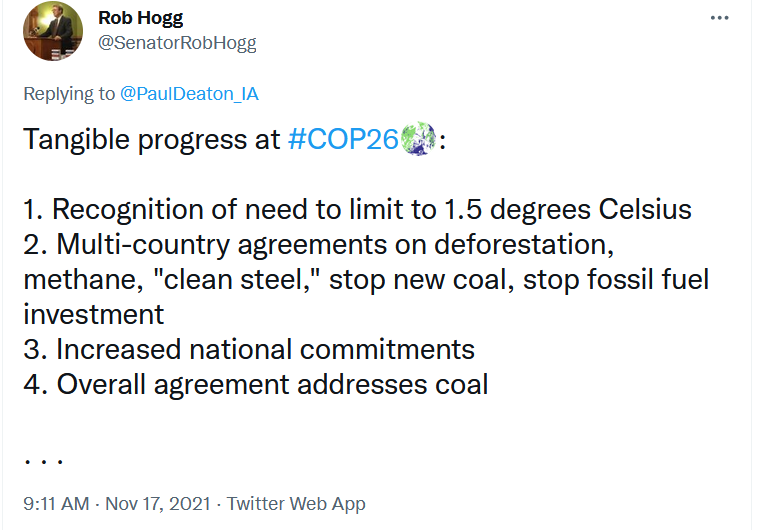
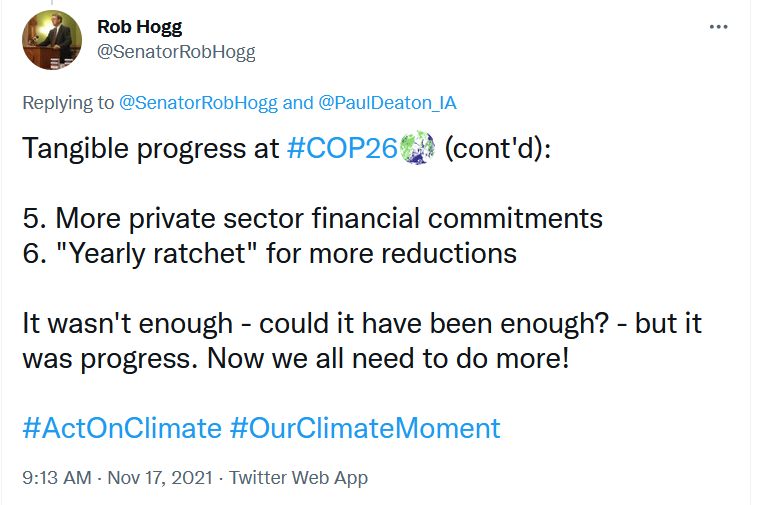
The 26th Conference of the Parties in Glasgow, Scotland seemed like a dud. My friend Rob Hogg corrected me on Twitter, posting:
So there were some positive developments. I’m reminded that zero countries is the number living up to their 2015 commitments to reduce greenhouse gases at COP 21 in Paris, France. It is difficult to let go the negativity when it comes to our collective lack of action on climate change.
On a video call a friend asked if we had installed solar panels to generate electricity for our home. I know our financial condition well enough to say it is unlikely we will because of the up front capital expense. We are doing okay financially yet know our limits.
“When it comes to climate change, we can’t afford to go backward—or even stay where we are,” former president Barack Obama said. “If we are going to act on the scale that’s required to combat this climate crisis, we all need to step up and meet this moment together.”
What does “together” mean? It means governments and a select group of non-governmental organizations and rich people that have the means to address climate change at scale. Behind Obama’s statement is the assumption we live in a democracy. Increasingly, we don’t, as floods of dark money buy our government, including the court system. An individual’s local actions matter, yet they are not enough, especially if one is the only person on the block generating electricity from solar panels.
Former Vice President Al Gore weighed in on COP 26:
Statement from Former US Vice President Al Gore on the Outcome of COP 26
“The Glasgow Climate Pact and the pledges made at COP 26 move the global community forward in our urgent work to address the climate crisis and limit global temperature rise to 1.5°C, but we know this progress, while meaningful, is not enough. We must move faster to deliver a just transition away from fossil fuels and toward a cleaner and more equitable future for our planet.
The progress achieved in the lead-up to and at COP 26 was only possible because of the power of people – young and old – using their voices to demand action.
Thanks to that advocacy, for the first time in 26 negotiations, leaders at COP 26 agreed to language that calls for a phase down of coal power and fossil fuel subsidies – a critically important step forward. Even more important, the deal significantly accelerates the timeline for nations to revisit and strengthen their net zero goals, calling for updates from every nation by the end of next year and a global convening by the UN Secretary General in 2023 to focus on more ambitious goals for cutting emissions dramatically by 2030. But despite that progress, there is much more that must be done – especially to deliver meaningful climate finance for both mitigation and adaptation to developing nations.
Ultimately, the outcome of COP 26 shows us that it has never been more important to hold our leaders accountable to their words and pledges. Advocates for climate action cannot – and must not – let up.
Six years ago, the Paris Agreement set a clear direction of travel that is moving the world away from greenhouse gas pollution and toward a sustainable future. The deal reached at COP 26 reflects the progress we’ve made in the intervening years and shows that the global community of nations is now in agreement that the era of inaction on the climate crisis must come to a swift end.”
Now is the time for government leaders, policymakers, business leaders, consumers, and activists in every nation to redouble their efforts and use the Glasgow Climate Pact as a springboard from which to drive bold action that will keep the goals of the Paris Agreement alive.”
It’s easy to become overwhelmed by the scale of the climate change problem. It is a problem, although against all reasonable efforts to educate, even that is in question for many people.
I wrote to my federal elected officials about how climate change impacted my life. I heard back from Rep. Miller-Meeks and Senator Grassley and am assessing their responses. I’m using my voice to raise the issue with my federal elected officials. Their response falls flat.
We have the tools we need to solve the climate crisis. That seems certain. Yet a society that is interested in supporting the richest among us more than taking care of each other is morally bankrupt.
The latest revelations about the Trump administration’s efforts to manipulate the Centers for Disease Control and Prevention at the beginning of the coronavirus pandemic are evidence that the highest office in government was willing to use mass-death as a political weapon at a cost of hundreds of thousands of lives. What kind of human can support that? Yet Trump flags fly unabated in our neighborhood. It is clear the previous administration was going to do nothing about the climate crisis. If they get back in office after the 2024 elections, they will set about undoing what Biden got started to address climate change and more.
In this context it is important to ask, “What will it take on climate change?” From these quotations and more, we know it will take action on a scale only governments can provide. Yet we can’t be reduced to helping political candidates we favor get elected. There is something more at stake. Regardless who holds political office, governments must act on climate change. There will come a time, and soon, when it will become obvious to even the most prominent naysayers we have to act. So we keep plugging away and hope we are not already too late.
I viewed the S&P Global Market Intelligence discussion between reporter Taylor Kuykendall and Former U.S. Energy Secretary Ernest Moniz on Nov. 8. The thirty minute video is worth viewing to hear Moniz on major technologies and technological developments that will help prevent and mitigate the effects of global warming on humans.
Dr. Moniz answered the question I posted in the YouTube chat: “Regarding CCS (carbon capture and sequestration), how important is it to leave sequestered carbon in the ground? If a market for CO2 were developed, would there be an interest in digging it back up?”
He sort of laughed at the idea of “digging it up” as something that would not be done, yet gave an answer I hadn’t expected. There may be engineering applications to use captured CO2 in order to address our goal of net zero emissions by 2050, rather than burying it in geologically stable underground rock formations. This has been a point of contention with opponents to the Summit project.
Summit Carbon Solutions, an Iowa company, has proposed construction of a pipeline to transport liquefied CO2 captured from ethanol plants and other Iowa industrial producers to North Dakota for sequestration. The Iowa Utilities Board approved public hearings in the 30 counties the proposed pipeline would cross. One of the sticking points between activists who oppose the pipeline and the company was about Summit making a written commitment to leave any sequestered carbon in the ground permanently. CEO Bruce Rastetter indicated they would not make such a commitment because markets may be found for captured CO2. Moniz’ comments yesterday indicated such markets are under study and may be developed in order to address the climate crisis.
Is carbon capture and sequestration technology a hero that will help society reach net zero emissions by 2050, or is it a villain that will violate landowner rights and cause more pollution than it prevents? Fossil fuels should be left in the ground.
The highlight of Moniz’ interview for me was that advocates against the Summit Project (or the similar Navigator CO2 Ventures project) have a lack of big picture information about addressing the climate crisis using carbon capture and sequestration technologies. The information has not been readily available.
Ed Fallon of Bold Iowa isn’t perfect. However, he is a veteran of multiple pipeline fights. In a Sept. 23 blog post he outlined his concerns about the Summit project. He claimed Summit plans to use sequestered CO2 for “fracking” instead of sequestering it in the ground. He also claimed Summit wasn’t being transparent about their intentions. Summit denies these claims. Fallon is the right person to engage in a pipeline fight, yet his blog post lacked a depth of understanding of CCS beyond his immediate concerns. Ed could use more information as could we all.
Over the coming weeks, I intend to remedy the lack of accessible information about carbon capture and sequestration. In a series of articles, I will explain what it is, evaluate whether the Summit and Navigator projects are boondoggles designed to skim taxpayer money for the richest Americans, and what plans exist for implementing CCS as a solution to the climate crisis. Hopefully, with a better understanding of the technology and its proposed applications, advocates for and against it will have a better base of information to address the climate crisis. Stay tuned.









 Journey Home
You must be logged in to post a comment.