Categories
Environment

Interview with Ed Fallon

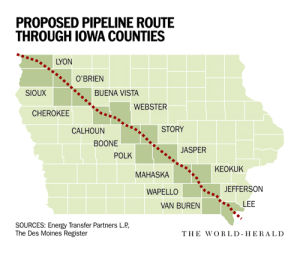
Bakken-Pipeline-Proposed-RouteBlog for Iowa caught up with Ed Fallon in Iowa City at a March 11 fundraiser for his Iowa Pipeline Walk along the proposed route of the Dakota Access oil pipeline from the Bakken shale formation through Iowa to Illinois.

Fallon presented a slide show of his experiences on last year’s Great March for Climate Action across the U.S., and answered questions during an event attended by about 35 supporters.

Discussions ranged over a variety of related topics. Two seemed most important: eminent domain and an environmental study of the Dakota Access pipeline.

Rep. Bobby Kaufmann (R-Wilton) is leading a bipartisan effort to restrict use of eminent domain by private companies like Dakota Access in Iowa.

“I intend to introduce legislation in the Government Oversight Committee,” Kaufmann said in an email to constituents. “My committee is funnel proof and next week I will introduce an Eminent Domain Omnibus bill that will attempt to address the numerous eminent domain abuses going on throughout the state.”

When asked about the legislation, Fallon acknowledged the several bills filed regarding eminent domain had not yet been finalized into one.

“My biggest hope is it defines public use so clearly that you can’t come in and build a pipeline across Iowa and use eminent domain to build that,” Fallon said. “Because it’s not oil that’s being used here, it’s not being produced here, it’s being refined in Texas and shipped for the most part overseas.”

A bipartisan group of legislators sent a letter to the Iowa Utilities Board asking the regulatory body commission an environmental impact study of the proposed Dakota Access oil pipeline.

According to the Cedar Rapids Gazette, the letter raised eight concerns:

1. Safety risks and hazards associated with the product(s) to be transported through the pipeline;

2. Potential damage to water, land, soil, water, air and wildlife/wildlife habitat during construction;

3. Threats to the environment, farmland, wildlife and public health as a result of spills or explosions;

4. Spill prevention and clean up provisions;

5. Liability for damages to both public and private property and sufficiency of resources to cover such liability;

6. Adequacy of inspection/monitoring/enforcement mechanisms and resources;

7. Responsibility for planning, training, and equipping for emergency response;

8. Indirect impacts of the oil extraction process facilitated by the pipeline that may affect public health and safety as well as environmental security.

“If studying the environmental impact is something we do before we decide to move forward on this, then that has value,” Fallon said. “But if it’s something we do after the fact, after the damage is done, after the decision is made, then it’s kind of a moot point.”

During the question and answer session, Jack Knight of the Allamakee County Protectors indicated that delaying the IUB approval process through an environmental study was a valuable tactic in preventing the oil pipeline from being built.

Opponents of the Dakota Access oil pipeline have a bigger issue and Fallon touched upon that during our interview.

“Based on what the entire scientific community is telling us, that oil needs to remain in the ground,” he said. “Really this conversation about the pipeline is a sidebar, but a really important one.”

For more information about Fallon’s work, Blog for Iowa recommends, “Hitting the Pavement,” in the March 16 issue of the Newton Daily News, or follow him on FallonForum.com.

~ Written for Blog for Iowa
Categories
Environment Living in Society

Train Wrecks and an Ag Summit

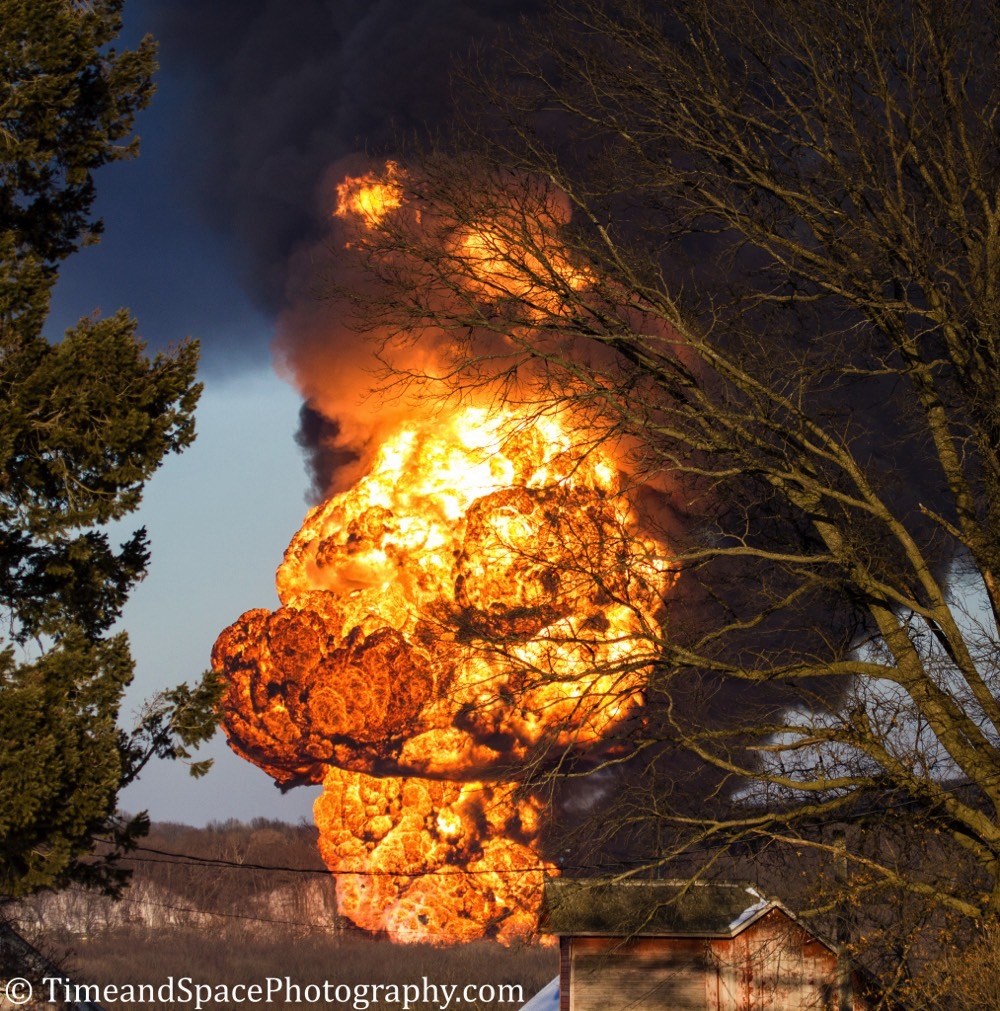
Galena Train Derailment

As punctuation to my article Why Bakken Oil is Dirty, last Thursday’s BNSF oil train derailment in a remote area near Galena, Ill. tells the story better than I could.

It is the third Bakken oil train derailment in the last three weeks according to National Public Radio.

Carrying light sweet crude to market from the Bakken field, the train derailed on tracks inaccessible to first responders, rupturing at least five tank cars of 21 that left the tracks, igniting a pyre that could be seen for miles. No one was injured and officials are investigating the causes. Because of the location, accessible only via a bicycle path, fire fighters decided to let the fire burn itself out. Remediation of the oil spill will be difficult because of the location, but no oil has made its way to the Mississippi River yet. As I write, the fire is still burning.

BNSF was quick to report the rail cars were a newer, safer model voluntarily designed to be less prone to rupture. Critics say it’s not good enough. Being a level headed Iowan, I’m willing to wait until the investigation is complete before condemning anyone but ourselves and our addiction to fossil fuels.

“In the coming days, we need to look at not just the safety of the rail cars, but the safety of what is being put into those cars,” U.S. Senator Dick Durbin told NPR. “There is mounting evidence that stricter standards are needed in the handling of Bakken crude which appears to be particularly volatile. We can’t wait. The safety of our communities depends on it.”

News coverage of the accident revealed that the State of North Dakota will require oil producers to remove excess natural gas from the crude oil before shipping it by rail to help reduce volatility, according to NPR. What exactly that means, and whether it will make a difference is uncertain. It confirms what I said in my last article about the volatile nature of the Bakken crude oil being shipped, and the role the refining process plays in its volatility.

Photo Credit: Quad City Times

While the Galena fire burned, Bruce Rastetter’s Des Moines Ag Summit proceeded on schedule, serving up Republican nostrums the way cattle in a CAFO are fed. All twittering eyes were on the summit, leaving a void among Democrats. Democrats don’t have anything similar to this, so it was a great way for Republicans to build party support. Disagreement and agreement with looney ideas is part of Republican party-building, and they are getting better at it with each election cycle.

Iowa Citizens for Community Improvement, who demonstrated at the Ag Summit and held their own event, are neither Democrats nor lefties, despite repeated corporate media attempts to characterize them that way. In my experience, they are issue-oriented individuals who band together to make points about life in Iowa, using visible, direct action tactics in their advocacy. The reason they receive media characterization at all is Democrats cede the space to Republicans on these presidential candidate cattle calls. There is nothing else for political reporters and bloggers to cover.

Rastetter contributed over $60,000 to the Branstad-Reynolds re-election, and $1.49 million to various candidates over the last 16 years according to FollowtheMoney.org. Who is the Democratic equivalent? Maybe Fred Hubbell, who gave $60,000 to the Hatch-Vernon campaign.

Hubbell may be well known to political insiders but most Democrats only know vaguely that he is an attorney, if they even know that. He would be no useful substitute to the hated, loved, and very public Rastetter.

Democrats had the Harkin Steak Fry as a comparable event, although last year’s was to have been the last. Maybe it will return, but that’s up to Harkin, not us.

For the first time in a long while, I didn’t hear that our county party was having an off-year caucus last week until after it had begun. I arrived home from work just as it was finishing. If a couple of people hadn’t been covering it on twitter, it would have passed unseen. That’s a train wreck of a different kind.

As we hope for spring, society begins to make more sense. For now, winter’s cold remains, and there’s plenty to keep us busy as we sustain our lives on the Iowa prairie.

Categories
Environment

Why Bakken Oil is Dirty

Bakken-Pipeline-Proposed-RoutePeople who care about hydraulic fracturing say the oil coming from the Bakken formation in North Dakota, Montana and Saskatchewan is dirty. It is. All oil is dirty, and my two cents is we should leave what’s there in the ground. That won’t go over well in North Dakota where discovery of the Parshall Oil Field in 2006 created an oil boom.

What makes Bakken crude oil problematic is that it contains more volatile organic compounds (VOCs) than oil shipped from wells in other regions of the country. This makes the oil more flammable, so when there is a train derailment, as there was in Lac-Mégantic, Quebec in 2013, the oil easily ignites and creates hell on Earth. (Read Adam Federman’s article in Earth Island Journal here).

Because so little public study has been conducted on Bakken crude oil and the operations that produce it, scientists don’t fully understand why the oil is so flammable. There are suspected causes.

The Bakken formation shale oil boom developed from almost nothing to more than a million barrels of crude oil daily in a short period of time. According to Federman, the infrastructure doesn’t exist in the Bakken to fraction off the VOCs as is done with other oil production facilities. The oil is shipped with the VOCs in it, making Bakken crude oil more flammable. There’s more Bakken crude oil today, it poses a real threat to public safety, and the transportation modes used are not regulated well enough for the commodity’s characteristics.

One of the frequent concerns in the Bakken is there are not enough suitable rail cars available to meet shipping needs. Lack of transportation capacity to get the oil to market is an issue. This created a business opportunity, and that’s what the Dakota Access pipeline is about.

Debate over trucks vs. rail vs. pipeline to transport Bakken crude oil is wasted time. Each mode of transportation has its own issues, and most transportation experts agree pipeline is the safest of the modes of transportation. Regardless of transportation mode, if there is a spill, first responders will be required to deal with a commodity on which they have in most cases received inadequate training. That problem could conceivably be fixed, but awareness of the issue hasn’t adequately emerged as we wait for the Iowa Utilities Board’s public healing on the Dakota Access oil pipeline.

Combine the increased flammability of Bakken crude oil with lack of proper shipping regulations and capacity, and we know why it is called dirty oil.