Editor’s Note: This is fifth in a series of posts about my creativity while living in Indiana. Check out the first post here.
When we lived on West Post Road in Cedar Rapids, our child was transitioning to talking in human language and walking. Singing and running soon followed. I determined the best time for my creative endeavor was in the early morning hours before the rest of the household woke and I had to leave for work. On good days, I got in two solid hours of reading and writing.
After moving to Indiana before our child started preschool, working in the garage became a main creative activity. The ranch-style home on a crawl space had inadequate room for much of my creative inventory except for some book shelves in the living room and a place to put the word processor. In the garage I had a workshop, a writing desk, and boxes of stuff brought from Iowa. My longer spells of creative activity occurred on weekends and vacations and included all aspects of my life muddled into one process. I continued through winter by acquiring a propane construction heater.
Elizabeth is in the driveway washing the car windows. I am in the garage, writing at my desk, listening to the radio WJOB.
The garage is a place where we can let our imagination go. Much time is spent organizing and moving supplies, but the creative endeavor is what we live for.
What assumptions are behind this garage and the endeavors in which we engage? (Personal Journal, Merrillville, Indiana, Sept. 12, 1992).
Our child was often outside with me playing in and around the garage. It was a main activity we did together. Some days they would ride the Big Wheel tricycle up and down the driveway, sometimes play on the small deck where there was a sandbox shaped like a turtle (called Shelly), sometimes playing in the backyard and garden, and much time hanging out with me inside the garage. All of those memories combine into one of just being together. I felt it was what fathers did.
I built a workbench out of two by fours custom designed to match my 73-inch height. At times I would use it to build or repair something. At times I would spread out papers on a project in progress. It was well built and survived the move to Iowa in 1993 where it occupies a prominent place in the current garage.
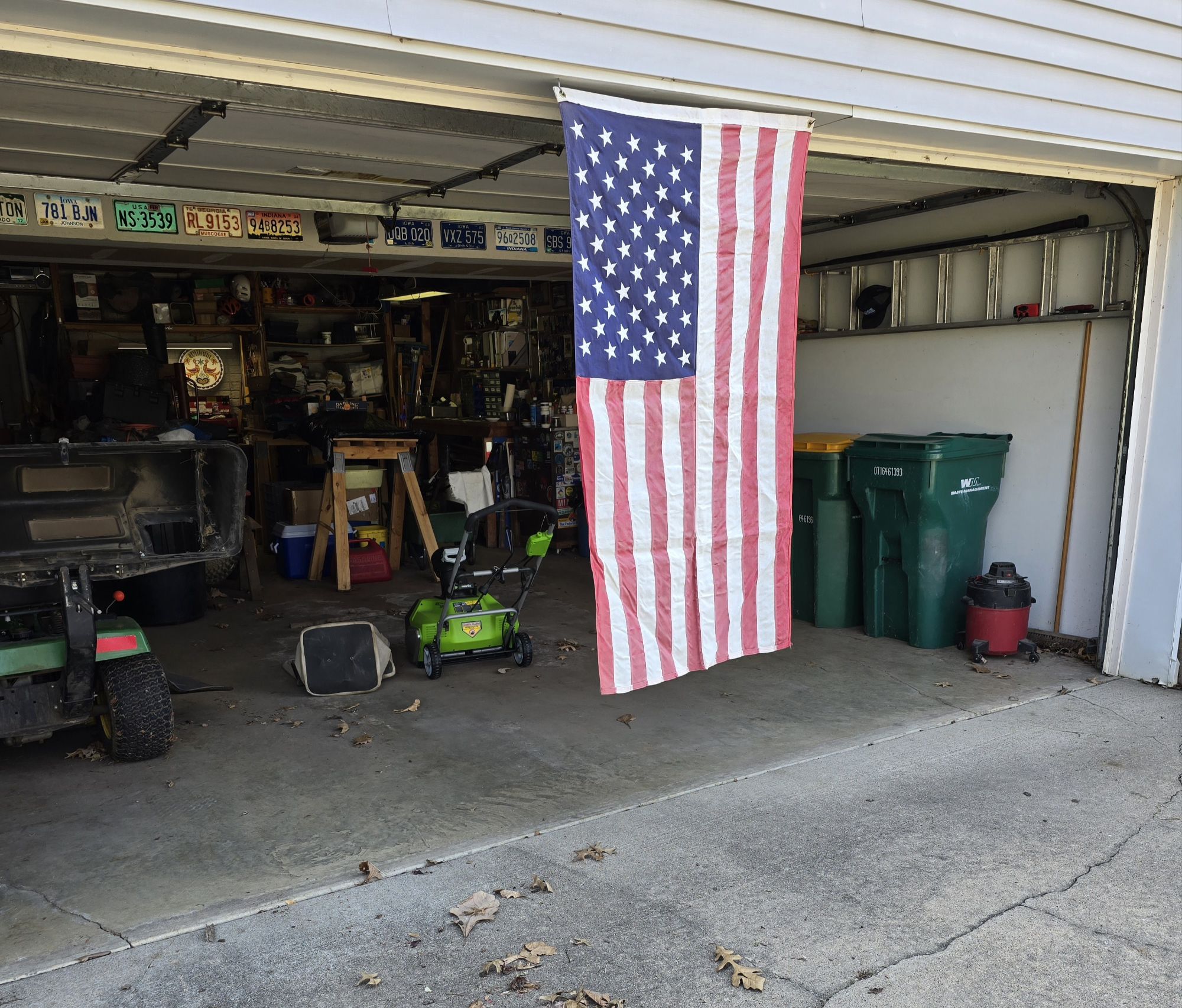
Characteristic of warm days in my creative space was to open the garage door and hang an American flag on the door frame. The flag was one I used in Mainz while on Autobahn road marches with armored vehicles. Garage door up! Flag hung! I was open for business!
In my journal I described some conversations about what we should call this space. We tried out names and settled on The Deaton Family Workshop. I wrote that on a student-sized chalkboard and placed it where all who entered could see. We possessed a secret life with each other in the garage and were co-conspirators regarding our lives in the Calumet.
Today I continue to put the garage door up and hang a flag. It is not the same one. This American flag once flew over the U.S. Capitol and was acquired through my congressman. It is fading from exposure to sunlight and needs to be replaced.
When I’m open for business in the garage today, it is not the same feeling as before our child left home. I do the best I can. I don’t mind remembering what once was when we simply went outside and played together. Days like that are no longer commonplace. Once in a while we get together and simply be with each other. I look forward to those days.
Editor’s Note: This is a draft chapter from my memoir. I was assigned to the Schererville, Indiana trucking terminal of Lincoln Sales and Service for most of the time from 1987 until 1993.
On my first day of work, as I crested the railroad bridge just south of the Schererville terminal, I saw a car had driven under the trailer of one of our tractor-trailer rigs while it was making a left-hand turn onto Indianapolis Boulevard. I didn’t know it then, yet this would become the typical start of a day. During the time I worked there, about four of the six years we lived in the Calumet, there was always something happening. It was nearly impossible for a human to keep up. Thankfully, no one appeared to be hurt in this specific accident.
The Town of Schererville, Indiana is called the “crossroads of the nation.” Situated in Saint John’s Township in Lake County, it has been a crossroads since before becoming a state when Native American trails crisscrossed not far from the current location of the intersection of U.S. Highways 30 and 41. At one time, Standard Oil Company owned all four corners of that intersection. The Standard Oil Trust had lots of money and was buying desirable locations to sell automotive fuel and lubricants across the country. Locations along the Lincoln Highway, which ran coast to coast, were prime. Their corporate descendant, BP, still operates on the northeast corner which currently has a large gas station and convenience store. Our trucking terminal was about two miles north on Highway 41, which is also called Indianapolis Boulevard.
Because the company fuel island was close to the main roads traveled by our truckers, almost all our drivers stopped to get fuel, drop off payroll paperwork, use the restroom, check in with the company trainer, and if needed, get their equipment repaired or serviced. Our fuel island attendant J.J. knew Chicago like the back of his hand and gave directions to help out-of-state drivers find their customers using routes safe for an 18-wheeler in the city and its suburbs.
In 1987, Lincoln Sales and Service in Schererville was a full-service trucking terminal. During my two tours of duty there, we evolved into a driver recruiting station when the shop and fuel island were closed after a union organizing attempt, and training was moved to the corporate office in Cedar Rapids to provide a consistent, documented process when the U.S. Department of Transportation audited us. Driver payroll had already been centralized in nearby Griffith, Indiana. Our terminal staff shrank from more than 25 employees to half a dozen over the years. There was less traffic after the fuel island closed, yet it was busy enough for us to hire an outside security service. I was young and could keep up with the workload which often bled over into family time.
I described terminal operations in Chapter 18, yet I want to bring focus to the story of my work.
The many driver interviews I conducted were a story of dehumanization. Workers were laid off by companies that felt they had to be competitive, whatever that meant. It was a time of ubiquitous management consulting firms who restructured businesses to direct more revenue and earnings to owners, shareholders, and high-level managers. CRST followed this path eventually. It was busy at our terminal because most of the time I worked in uncharted territory in managing a recruiting operation with little guidance unless there was a lawsuit, workers compensation claim, or union activity.
In the crucible of manufacturing in transition, tens of thousands of workers in our area were trying to adjust. I was there listening to them and found one heck of a story. I hired some of them, doing what I could to ease their transition.
I officed in Schererville yet traveled a lot. By the end of my time there I was managing trucking terminals in Schererville and Richmond, Indiana, and starting recruiting operations in West Virginia, Georgia, Pennsylvania and Missouri. I would wake up on airplanes unsure of where I was, or where I was going.
I’m glad for the experience. I hated the experience. My life in the Calumet, and everywhere else I traveled, taught me about unionization and the consequences of change sparked by the Reagan Revolution in a way I believe gave me a unique perspective. They were days of hope for an intangible future that included success. In retrospect, I don’t know what that means. It was a busy time and there was little time and energy left for family.
Drafting Part II of my memoir is proceeding well. During the last ten years I did so much work writing bits and pieces that paragraphs now fall quickly into place. I have a solid draft of chapters 1-17, which is before we moved to Indiana. Because the time is so recent (1988), and because I wrote a lot while living through it, there are ample documents and memories available. Too many, really. I have choices to make. Sadly, the choice is what to leave out.
I wrote this description of where we lived last week:
The dominant geographic feature in the Calumet is Lake Michigan. I remember endless flocks of geese migrating above our house, noise of their honking entering through open windows continuously and for hours at a time. There was “lake effect” snow that piled up quickly during winter. Outside our house, it never really got dark because of the proximity of Chicago and Gary which indirectly illuminated our yard. The hum of traffic from nearby Highway 30 was a constant white noise, muffling the broader world.
I don’t remember much of what we ate in Indiana but my grandmother gave us money to buy a stove and refrigerator for the kitchen. We bought them at Sears, which was a short drive from our house. Grocery stores were not open on Sundays, so we had to plan. We got to know several family-style restaurants, many run by Greek immigrants, where we would get away from home for a dinner out. (Excerpt from a draft memoir, March 16, 2025).
The Calumet Region can be characterized by its proximity to Lake Michigan, and being the home of the largest concentration of steel mills, oil refineries, and chemical plants in the world during the 20th Century. I adapted the name to characterize my life as “living in the Calumet.” The havoc wrought by the Reagan Revolution resulted in many tens of thousands of unemployed industrial workers who were the raison d’être for our company to establish a driver recruiting operation there. During my six years working in the Calumet, I personally interviewed some 10,000 job seekers spread out across the states north of the Ohio River. A person learns a lot about American culture while doing that.
That’s the problem. I’m stuck with getting out a literary funnel to narrow the scope of my narrative. There are simply too many stories to tell.
My time in Indiana has a fixed beginning and end point which can be dealt with. Long time readers of this blog have likely heard some of these stories, like the post Flint and Reagan’s Wake which tells about my experience in Flint, Michigan in 1988. The balance a memoir writer must achieve is in the mixture of hardened memories and rediscovering our past lives through research. Including some of the hardened narratives is a must. They just can’t dominate the overall story.
Achieving this balance is the real work of autobiography. In my early years, the stories remaining are fewer and the inclination is to include them all because it was reasonable to do so. Not so when the main work of a life begins. The issue of my ideology, combined with specific experiences that stand out is not a given. We need to turn more pages to make sure we get the narrative to align with our intentions.
Like many Midwestern homes, ours has become a cornucopia of stuff. I think about downsizing, and had better get on that or face an estate sale at the end of the line. For now, though, the accumulated memorabilia is the equivalent of a limestone quarry: the stuff of which to build my literary edifices.
Instead of disciplining myself to write a book of fiction in 1986, I continued to collect writings, journals, photographs, clippings, books, musical recordings, posters, and such until they would press hegemony into my 2025 writing space. One book into my autobiography, I am now mining this personal memorabilia to tell my story.
Let’s frame this with a passage from a letter I wrote to a friend:
I got a copy of F. Scott Fitzgerald On Writing from the Book of the Month Club. Though I had little good to say about Fitzgerald before now, there is much of what he says here I find pertinent. I recommend this book; much of it makes sense to me. He speaks of an attic of albums, files and clippings being the bank account of a writer, I look around my study and say, ‘Of course.’ This spring I hope to draw on my account and invest in creative endeavor. Appreciation will come close behind. (Personal Letters, Cedar Rapids, Iowa, April 6, 1986).
I’ve been back and forth with Fitzgerald, but he got this right. The part he missed is the role living memory plays in writing. Sometimes memorabilia can trigger living memory, and that is the point of keeping it. The trouble I’ve found is letting go of it, both literally and figuratively. The best use of attic findings is to allow them to be a springboard for new ideas or a germ of creativity. What writers do here isn’t coal mining. It’s more like panning for gold in California. If an artifact doesn’t present value, we should get rid of it.
Organizing personal memorabilia for use is not a straight forward task. Like anyone, my tendency has been to throw things in a box or folder and tuck them away wherever there is space. As a result, memorabilia is scattered all over the house in a semi-organized mess. The wall of boxes outside my writing space is intimidating and inadequately marked. Boxes are seven high and seven wide, or 49 of them. This doesn’t count the other two walls of boxes, or the trunks, desks, and stashes in the living room and bedroom closet. Since I am following a chronological narrative, it would be best to arrange everything by date order. That in itself would be a too-long task.
There is a lot of writing to be found in memorabilia. That raw material is the easiest to convert to new narratives. Sometimes I quote directly from the past with minimal editing. Sometime I take previous pieces and completely rewrite them while preserving the essence. Either way the presence in the original usually shines through its new use. That’s what a writer wants. By the time I finish book two I expect I won’t have touched half of the memorabilia. If the narrative is good, I’m okay with that.
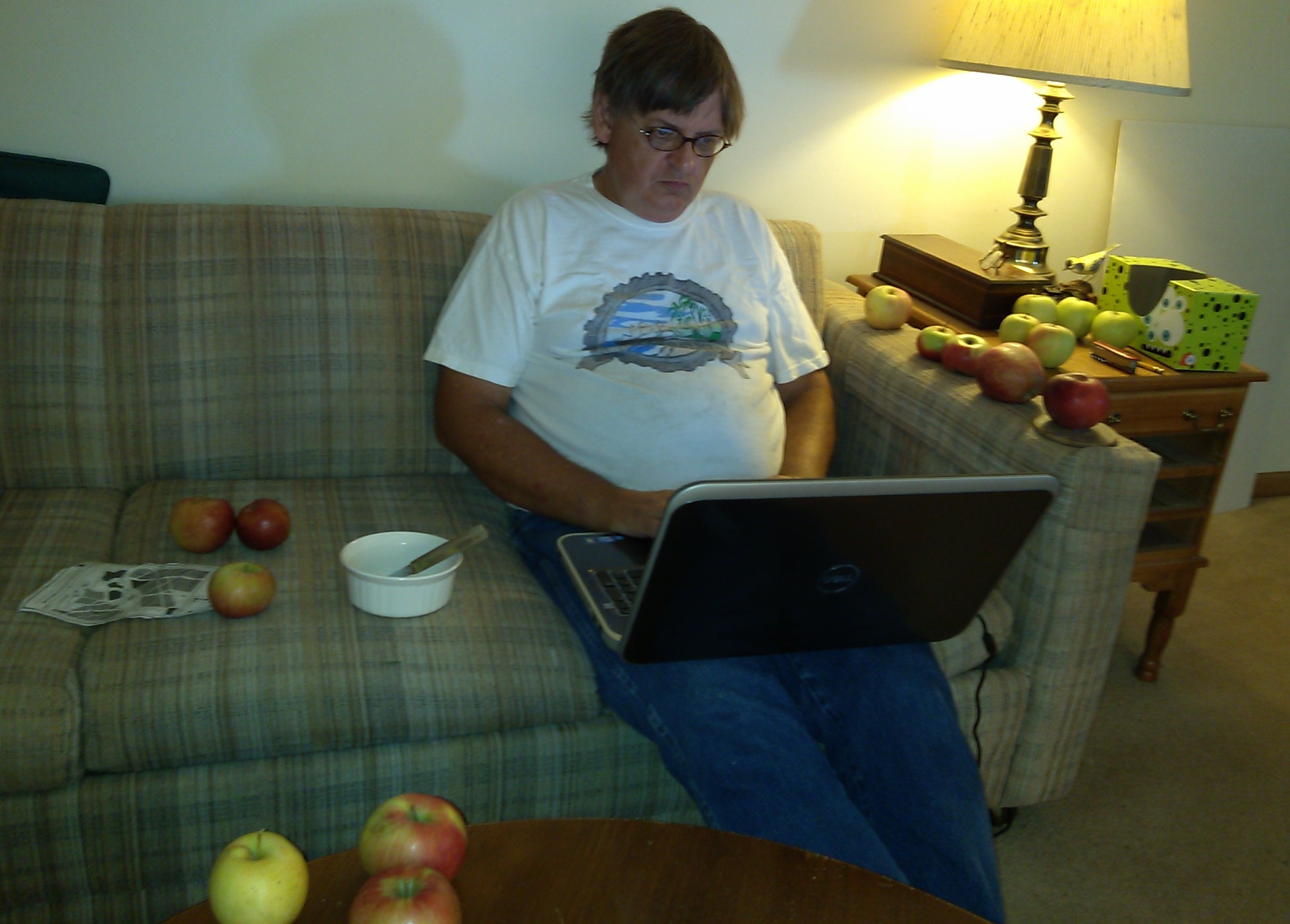
My farmer friends are lining up customers for the 2025 growing season. February is the time folks sign up for a community supported agriculture share and there is a limit to how many shares each farm can produce. I used to belong to a CSA yet no longer need one. My large garden usually produces enough good stuff to serve our family. I wish them a productive and profitable season. This photo is one taken after I harvested bell peppers to take home, process, and freeze.
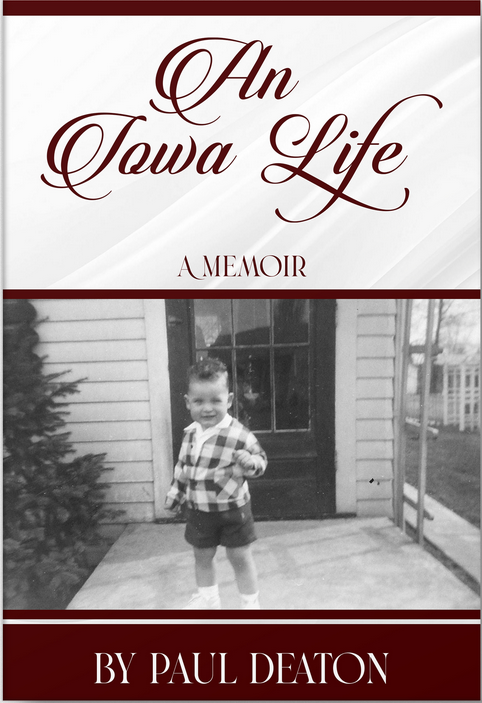
Part of writing an autobiography involves photographs and art work. The visual arts convey something much different from narrative text. In An Iowa Life: A Memoir, the first volume of my autobiography, I included a single photograph of me as a toddler. In volume two, I may include more than one, depending upon the expense. The book is not available to the public at present, but may be once early readers all provide feedback. Here is the cover with the photograph:
The way I used photographs in volume one was to describe something based on them, using my narrative to control the meaning. This is important because we don’t want to distract the reader from the energy of the narrative by introducing a photograph that can be interpreted in multiple ways. By describing photographs, instead of inserting them into the text, we can better guide readers.
Part two begins in 1981, a time when I took many film photographs. I keep the prints in boxes near my writing space, and in a few photo albums we made. I don’t know how to process them, yet at a minimum, I will get them out and look at them. There are a host of projects one could create with old photographs. A couple of days ago, I cleared access to the piles of boxes where the photographs rest.
I had a flip phone with a camera and took this photo of Senator Barack Obama on Sept. 17, 2006. The video of that year’s Harkin Steak Fry is here. It was one of the first digital photographs I took. The quality is not the best, yet it records the moment.
Obama at the Sept. 17, 2006 Harkin Steak Fry
Obama is in the rope line after he gave his keynote address. You can see Chet Culver and Tom Vilsack behind him. I shook his hand and was surprised at how genuine he was in our brief conversation. He had quite a handshake.
On May 3, 2008, I bought my first digital camera and took this photo after opening the box. Once I entered the realm of digital photography, the number of images exploded. Cameras in smart phones changed how I looked at photography. Now I take many exposures of a scene and then pick and edit the best one. There is no additional cost for multiple exposures and device memory seems unlimited.
My first photograph using a digital camera on May 3, 2008.
This has been a roundabout way of getting to the topic. In figuring out how to address photography in part two, I need to:
Find all available photographs in our house.
Look at them and set aside the ones I can use in the narrative.
Pick a small number for inclusion in the book.
While I look at them, I need another photo project in the works in which to use them. Posting on social media is one. Making specific albums, both paper and digital, is another. I might enlarge and frame a few of them. Each requires a significant investment of work.
Reviewing photographs should help make my picture-taking better. I hope to be cognizant and thoughtful in this process. I hope to be a better photographer.
My storage system has been good in that few have been damaged. Determine how to store them going forward.
I need to get rid of some of them. I don’t want to pass along photos that are meaningless to whoever inherits them.
I will read or reread a couple books about photography. In particular, The Photographer’s Eye by John Szarkowski, Photography and the American Scene by Robert Taft, Wisconsin Death Trip by Michael Lesy, On Photography by Susan Sontag, and others. If you know of a current book about photography, please drop a comment with the name and author.
At the beginning, this project is hopeful. It should be a fun year reviewing the images of my past and recalling the living memories behind them.
Editor’s Note: This is a draft of the opening chapter of Part II of my memoir. Its purpose is to introduce some major themes in the narrative and stand alone as a story.It is also a work in progress. I removed the full names of people I know for this post.
After my post-master’s degree tour of racism in America, I stayed in Iowa City. The reasons were not complicated.
I had to decide whether to be in a relationship with someone, and Iowa City was a regional social hub offering a large pool of potential friends and mates. The rest of the state seemed a primitive agricultural landscape, desolate and barren of intellectual engagement. As a young Iowan possessing two degrees, and aspiration to do better than merely survive, of course I chose to live in Iowa City.
Iowa City seemed an excellent place for a writer. It offered a broad intellectual life, not to mention, was the home of multiple writers’ workshops and groups. I expected to find other writers of varied skills, along with what it took to support a writing community. Nowhere else in Iowa could I find that.
In the pre-internet days, relationships were in person or they were difficult. A long-distance relationship involved telephone calls, letters, and the occasional audio cassette. We made our life where we lived and it took a year for me to discover what was in Iowa City and what was possible. The year beginning in summer 1981, became my year of being a writer.
I knew how to live in Iowa City as a writer. Writers came and went at the shared house on Gilbert Court during my undergraduate studies. The pattern was simple. Find a place to live and write, find income and resources to pay bills, and then go on living with a view toward producing poetry or prose. It was no different when I finished graduate school.
When I moved out of JG’s basement, I found a small apartment with a kitchen in a divided single-family dwelling. My apartment search benefited from most students being out of town on summer break.
On a pre-rental tour, a tenant still lived there. I deduced she was a writer of some kind. “A writer’s workshop type,” I noted. She had photographs of writers on the walls, and many books by workshop alumni in a living room pier cabinet. My quick analysis of her book shelves was she displayed the kinds of books I avoided. My future landlady had had a run in with her and described her as “a little backward.” I didn’t care that much about the drama. I was ready to move in and get started with the next iteration of my life.
The second-floor apartment at 721 Market Street had six windows. It helped me feel more in touch with the world after living in a windowless basement. It literally gave me perspective on quotidian affairs on the street. I felt included with events going on around me in the vibrant county seat. I also felt power in the old part of the city. It took me two days to settle in.
If I had an idea about being an Iowa City writer, it was modeled on John Irving’s time there in the 1960s and ‘70s. He began his first book, Setting Free the Bears, as part of his Master of Fine Arts thesis at the University of Iowa Writer’s Workshop. His second book, The Water-Method Man, was set in Iowa City and contained settings one can easily recognize. I carried this model of Irving with me throughout my life. Eventually, John Irving displaced Joan Didion as my favorite writer, although that will be much later in this story. I read The World According to Garp while living on Market Street.
More than anything, I sought to define my writing life as unique in a society of sameness. I had no intention of applying to the Writer’s Workshop, carrying a bit of residual skepticism about it from my days living with Pat Dooley, Darrell Gray, Pat O’Donnell, and other Actualist writers and artists I met in 1973 and ‘74. Gray described his time at the workshop as a “two years of duty on the U.S.S. Prairie Schooner which houses the Famous Poets School, a singularly enigmatic vessel that always seems on the verge of ‘going somewhere.’” I sought to enable my native, if somewhat naive impulses and culture. I hoped to discover what that meant, yet not in the context of the writers’ workshop.
I had three main accomplishments during 1981. By describing myself as a “non-academic Americanist,” I hoped to distance myself from formal structures of creativity. If I didn’t produce much writing beyond my journal, I neither wanted to be pinned down by ideas of fiction, non-fiction, poetry, or other categories of writing. As I read an 1855 facsimile edition of Walt Whitman’s Leaves of Grass, I felt I could embrace Whitman, who wrote, “I too am not a bit tamed, I too am untranslatable, I sound my barbaric yawp over the roofs of the world.” I felt just below the roof line at the Market Street apartment because I was.
In furtherance of putting my recent life in the past, I culled writings from my archives and produced a self-published book Institutional Writings. It was intended to be about the bonds that connect us to our common humanity yet it was more than that. It represented work I had done in institutional settings and was also my departure from institutions to seek a new creative path. I printed and distributed about a dozen copies to friends and family.
Finally, after settling in and suffering what I described in my journal as depression, I pieced together a life and was filled with the desire to do things. Throughout this year, old and new friends were supportive of what I sought to do, even if none of us fully understood it.
From a logistics viewpoint, the pieces were coming together. What I realized now, and didn’t then, was I needed something to write about. That gap made it difficult to get words down on paper in the time with most of my future ahead of me.
I kept a journal that recorded movies I saw, books read, and people I encountered. I described parts of my search for paid work. That journal was the primary work-product of the period from May 1981 until July 1982.
It was my time to be a writer, especially after I moved to my own apartment. The need to pay bills to support my new lifestyle emerged as a dominant force. Work was available. The money I banked in the military would eventually run out, so I needed income to pay monthly bills. I had no idea of supporting myself beyond the next rent payment. I could live paycheck to paycheck indefinitely, working a job that would leave enough energy each day for writing. The chance of long-term employment with decent benefits had already begun to fade from American society as Ronald Reagan was inaugurated president that year.
I looked for work that would pay bills to stay in Johnson County. It was tough to find work after graduate school, mostly because I hadn’t looked for any job since I enlisted in the military in 1975. I made a conscious decision to stop moving from place to place, from activity to activity, and settle down. I began the job search with what I knew. Buying every local newspaper, I marked each job in the help wanted pages with an “X” after contacting the company. The work environment had changed from a decade previously when all a person had to do was make the rounds of major employers to find a good paying, union job. No more.
My application for work got extra points for consideration at the university because of my military service. That led to more job offers. In July 1981 I took a job as a clerk at the College of Dentistry because it was offered. At the University of Iowa there was a small retirement plan, no pension, and no health benefits. The income resolved my immediate needs.
About a month later, on Aug. 3, 1981, the Professional Air Traffic Controllers Organization (PATCO) went on strike. President Ronald Reagan ordered them back to work and on Aug. 5, he fired 11,345 workers who did not cross the picket line, breaking, and ultimately decertifying the union. While on a later business trip to Philadelphia, I met one of Reagan’s attorneys in the PATCO action. We discussed the strike and Reagan’s handling of these government employees. My understanding of the action was confirmed. It was political.
What started in 1981 with the PATCO strike continues, without apology, as part of Reagan’s legacy of breaking unions. The unintended and maybe less considered consequence of Reagan’s union policy was to make life harder for middle class workers like me.
Beginning that July, I had a year to see if I could be a writer.
During my young life, several residences stood out as hubs of personal creativity: my apartment on Mississippi Avenue in Davenport, my bachelor officer quarters in Mainz, Germany, and my apartment at Five Points in Davenport. The apartment on Market Street in Iowa City was my last stand in creative endeavor. The coming year would either make or break my effort to write a book. During that time, I acclimatized to living in Iowa City and did many things. Starting a book was not one of them.
One of JG’s friends was MAM, a nurse who was studying printmaking at the University of Iowa College of Art. She maintained an apartment not far from Market Street. During that year, I felt welcomed to stop by after a run or enroute somewhere else. She and her artist friends provided an ad hoc forum to discuss creative ideas. I got several ideas about how to live and be creative in Iowa City from her. While I wanted more than a creative dialogue with her, I accepted the relationship for what it was and moved forward. I repeated this familiar pattern with other female artists I had known.
MAM encouraged me to purchase a bicycle, which I did. I bought a Puch Cavalier, one of the last of their bicycles made in Austria. She would give me maps of places to ride, including a route south through Sharon Center. I rode a lot, and eventually rode a century organized by the Bicyclists of Iowa City. The two of us met at the finish line and had something to eat at the Sanctuary Pub afterward.
The Century was the first time I experienced glycogen burn-out. My legs were shaking so badly, I didn’t know what to do. I stopped and rested at the side of the road until the shaking abated. I slowly made my way, first walking, and then riding, to the next rest stop where I ate fresh fruit to replenish my glucose supply. I spent a lot of time on my bicycle, mostly riding by myself.
MAM also encouraged me to keep running, which I did… for long distances. I would run out Prairie du Chien Road to the Coralville Reservoir and back. There was only so much to do in my apartment, so exercise helped me be constructive and feel stronger. That summer I ran the Bix 7 in Davenport, a road race that attracted international participants during the Bix Beiderbecke jazz festival weekend. Some of my Iowa City artistic friends, including MAM, came along to make it a fun day.
When I began work at the Dental College, I met a new group of people. Occasionally we got together and did things like seeing the movies Return of the Secaucus 7 and Gallipoli. Because we got to know each other at work, social activities seemed to fit. Mostly, though, we had one-on-one relationships.
MC worked in the records department in the lower level of the Dental Science Building. She followed her husband from Ohio to Iowa where he worked on his graduate degree in art. During my breaks I would often hang out with her. Eventually I helped her make a Super 8 film called “One Hundred Years in Iowa City.” In addition to exposing film for the project, we had many meet ups and conversations about cinema as an art form. We took advantage of Iowa City’s vibrant film scene. Our friendship was valuable to my creative life.
I continued to play music with JP who I met in graduate school. JP and MP were from California. MP worked at the Cancer Registry while he finished his master’s degree. They expressed a self-defined idea of being Californians. He was a fan of Stan Rogers and played many of his songs. From time to time, he would play at the Mill Restaurant Open Mike. We often played together. He was more talented at guitar-playing and singing than I.
My high school friends and former college roommates DB and DC were constantly in each other’s orbits through letters, telephone calls, and in-person visits. Both of them visited me in Iowa City, and DC brought his spouse TC. We continued our practice of talking about creative matters then, and for many additional years. My military friend from Mainz, LP, sent me an audio cassette in which he admonished me to re-join the military. I did not. Apparently, I was complaining about a lack of female companionship to my high school friend GG. During a phone call, he passed along the advice to “just fall in love.” Communication with old friends was constant during my time on Market Street. I didn’t always take their advice.
There were plenty of significant events in Iowa City. I heard Toni Morrison read at Old Brick, Chaim Potok at the Iowa Memorial Union, and James Laughlin, founding publisher of New Directions, at the Lindquist Center. The Morisson event was notable for a bat circling above the author as she read. I noted the Potok lecture was almost identical to the one he gave in 1975 when I lived on Mississippi Avenue in Davenport. I wrote in my journal about a Laughlin event:
On James Laughlin: Tonight in deteriorating body the consciousness that went in and out of the lives of so many of the 20th Century’s “great” writers lectured on William Carlos Williams. Full of memories, reading poems from a text prepared by many, he spoke of his view of Williams. He read poems and almost came to tears. And this is what remains of those like Williams. The stories of a friend who has survived, to tell of poems and flowers and love, engaged in humanity. (Personal Journal, Iowa City, Iowa, April 22, 1982).
I saw one or two films each week that year. I had been deprived of most films while serving in the military. I wasn’t sure what they meant to me, other than another form of intellectual engagement in which to find nourishment. The New German Cinema was in vogue in Iowa City. I saw several films by Rainer Werner Fassbinder who died on June 10, 1982, of a drug overdose/suicide. His work had a lasting impact on me.
A writer must eat. My journal includes an early discussion of gardening and cooking. I lived within walking distance of the HyVee Grocery Store on North Dodge Street and John’s Grocery at Market and Linn Streets. I became more aware of buying ingredients for cooking. Among the dishes I described in my journal were soup, chili, souffle, and Sergeant Juan San Miguel’s hot sauce. I wrote about the importance of growing my own food as soon as I had sufficient resources to buy a house on a plot big enough for a vegetable garden. I enjoyed cooking.
In the kitchen – I’ve got a pot of bean soup cooking, a cultural heritage to be sure, a family tradition, a piece of ethnicity. I’ll enjoy cooking and eating that soup and really, this gives me a lot of satisfaction – cooking. But I have little desire to make a living or an income from my interest in cooking. It is a source of satisfaction, yet I like doing it here in the privacy of my kitchen, where I’m busy writing and thinking. (Personal Journal, Iowa City, Iowa Jan. 10, 1982).
Cooking was part of living a good life. I believed cooking and eating was not for mere nourishment. We created a meal of each repast, seeking to please our palate, and soothe our souls. Contentment with our diet is equated to soothing our souls. “Before we commence anything else, we must first of all get our kitchens in order,” I wrote.
“If I could but learn to cook chicken well, I believe my troubles would be over.” (Personal Journal, Iowa City, Iowa, March 21, 1982).
In May 1982 I went on an extended weekend getaway to Northeast Iowa. I stayed at the Guttenberg Inn and visited Galena, the Vinegar Hill Lead Mine, Harper’s Ferry, Gays Mills, Wisconsin, and other places. I remember a walk I took from the motel to town on May 13:
I walked down the hill to town, along the river and through town – I noticed people in their homes, shades up, in the kitchen, or watching television. How it distresses me to see those televisions going. I admit I like to watch certain T.V. shows, but the engagement of a Thursday night: Television – ugh! Here, as in so many other things, this national, institutionalized force captivates the people. They seem to have no will of their own.
In their tidy houses, with well-trimmed lawns, and groomed gardens, life goes on, but there is something missing here. (Personal Journal, Guttenberg, Iowa, May 13, 1982.)
The time alone in Northwest Iowa served me well. I had to make something better from my life.
On April 16, 1982, President Ronald Reagan issued a proclamation that designated Memorial Day, May 31, 1982, as a day of prayer for permanent peace. Beginning at 11 a.m. local time, Americans were to unite in prayer. I don’t recall participating in this event. That weekend I did write at length about being a writer when I returned to Iowa City.
Shall I go on writing? There are so many things in the world to be done, yet I go on writing.
I think a majority of people in my generation would “like to be a writer.” That is, they would like to deal with images. But a writer cannot deal solely with images. He must address the realities of his and all the people’s situation. The writer must be socialized into the culture of which he writes. As a member of a culture, a writer has a vested interest in his culture. He seeks the continuance and survival of the vital elements of his culture.
Too, he seeks change. Not only change that is the essence of a day’s spontaneity but change in terms of his conception of both the past and the present. Although a person can have misconceptions about the nature of the world, the meaning of the world, he is required to act based on this knowledge.
In every case, this is far less than a science of action. In fact, the notion of science we share is obsolete. There is science only insofar as we can all agree on what that is.
But shall I go on writing? Yes, at least in the pages of this journal. For it is one of the things that has sustained me for so long I cannot give it up yet. Nor shall I. Yes. I will go on writing. I’ll fill the pages of this and many another book like it. For this is the path I’ve chosen. (Personal Journal, Iowa City, Iowa, May 30, 1982.)
Though committed to writing, the journal posts ended abruptly after the July 11, 1982, entry. JC and I began dating and became more than work acquaintances.
January turned into a tough month for writing. The main concern is a lack of productivity in writing my autobiography. I’ve written in it on nine days this month for a gain of 1,814 words. Volume two stands at 64,739 words today and is quite rough. While thinking about memories and documents and how they might fit the narrative is part of my time usage, I need to get more words in the draft. Six days remain in January, so I may be able to do improve the editing and word count.
This makes my 23rd post on Journey Home this year. There is more to write about, and once I sit down and write a first paragraph, the rest flows pretty easily. Because of my long experience writing blog posts, this work comes easily and for now I expect to write regular posts. Viewership is up in January.
I expect to deactivate my Facebook, Instagram, and Threads accounts by the end of the month. I joined FB in 2008 to follow our child. They don’t use it any longer. I am of an age where I experience being alone as many elderly people do. Social media reinforces loneliness for me. I’d rather do things besides social media to address this. We’ll see if I actually pull the plug, yet at the end of the Meta Blackout, I’m not missing those platforms very much.
I continue to spend a lot of time writing carefully worded emails. I am a fan of Gmail because it stores every email written through that platform. For my autobiography, I am reviewing older emails, even before I joined Gmail in 2006, for potential content and history. Email is personal, so I expect there will be more of it when I pull the plug on Meta.
While it is not writing, telephone and video calls have become more important. There are more of them and they have a longer duration. Voice communication is becoming increasingly important.
While the weather continues to be wintry, I spend most time indoors. My reading and writing have increased even if I was discontented about progress on my autobiography. This is a winter of discontent, yet I feel a burning hope for better days… for days when I’m planning my next big writing project.
The trail began to melt on Sunday. Thanks to overnight temperatures in the single digits, the surface was frozen again on Monday: perfect for winter walking. A light breeze chilled my face, yet I persevered and encountered only two regular trail walkers while I was out for my fast-paced, 30-minute walk. It was chilly!
I dreamed last night I had to untangle the shoe laces of a pair of my army boots. I still have two pair (acquired in 1976) I use in the garden. The shoe laces were exceedingly long and well tangled. Unlike most dreams, this one persisted into waking. Its meaning is clear. I need to go through the stacks of notes, mail, and things to do on the dining room table and get organized for a rapidly approaching spring. What seemed different this time is my acceptance of the dream as reality. I got the shoelaces untangled just as I awoke. Indoor planting of garden starts is just a few weeks away.
I’ve been reading my hand-written journals from May 1981 until July 1982. It was a year I worked as a writer in what is now a UNESCO City of Literature. I wasn’t a particularly good fit for Iowa City, yet the rest of the state seemed a primitive agricultural landscape, desolate and barren of intellectual engagement. As a young Iowan with two degrees, and aspiration to do better than merely survive, of course I chose to live in Iowa City. Besides my journal I didn’t do much writing during that time.
I did write a lot in my journal, which fills three volumes. I wrote frequently about how to escape the “institutional” realms of writing that included the University of Iowa Writers Workshop and other formal programs. I wanted to be a writer, yet not like “those writers.” My reading turned to familiar places as I dealt with the urge to write.
I was enamored of Tom Wolfe because his writing came from a place of reality. He and several others were parents of the New Journalism, publicized in his 1973 book. He immersed himself in his subjects, spending months in the field gathering facts through research, interviews, and observation. I didn’t have a lot of role models outside institutions, but Wolfe was one.
Another role model was William Carlos Williams, the pediatrician/poet. Prompted by a talk given by Williams’ publisher James Laughlin, I wrote this in my journal the next day:
William Carlos Williams: I’m not exactly sure where in my world view to put him. I think his position as doctor/poet, his molding of those two professions into one homogeneous lifestyle is admirable. But, to the extent that they remained two separate elements in his life, his life was a failure.
I think his poetry, at least as much as I have read, is poetry for the learned… yet one more attempt to elevate himself from among the people among whom he worked. It served him as a diversion from being a doctor. Well there may be people who would argue that diversion is necessary, the diversionary aspect of any activity adds connotations of the Victorian era for me. While James Laughlin states that the elements of Williams’ life were inseparable, he, too, is immersed in that ideology. He, too, is suspect.
I think I have a lot to learn from Williams, his problems notwithstanding. He is full of energy. He is above all else animated — filled with life. This is an example to be taken to heart. To be weighed and brought into my own life. (Personal Journal, Iowa City, Iowa. April 23, 1982).
I thought I could quickly dispatch the requisite words for my autobiography from this period in a couple thousand words. The more I read the journals, and invoke living memory, it is clear that year was more formative in my life. I wrote about writing, gardening, cooking, exercise, and about the meaning of being alone without feeling lonely. I will read this writing from 44 years ago again before my autobiography is done.
Writing space at Five Points in Davenport Iowa. 1980.
This excerpt from my personal journal was written on May 30, 1982.It reflects what I felt after a three day retreat in Northeast Iowa near Guttenberg, Harper’s Ferry, and Galena, Illinois.Most significant in this piece is the first instance of a decision to follow the path of short, written pieces like daily journal entries, and later, letters to the editor, newspaper articles, and blog posts in my writing. This decision was key to what I became as a writer. I couldn’t get rid of all the male pronouns without changing the meaning, yet I wrote it intending it to be gender neutral. It is lightly edited.
Shall I go on writing? There are so many things in the world to be done, yet I go on writing. I think a majority of people in my generation would “like to be a writer.” That is, they would like to deal with images. But a writer cannot deal solely with images. He must address the realities of his and all the people’s situation.
The writer must be socialized into the culture of which he writes. As a member of a culture, a writer has a vested interest in his culture. He seeks the continuance and survival of the vital elements of his culture.
Too, he seeks change. Not only change that is the essence of a day’s spontaneity but change in terms of his conception of both the past and the present. Although a person can have misconceptions about the nature of the world, the meaning of the world, he is required to act based on this knowledge.
In every case, this is far less than a science of action. In fact, the notion of science we share is obsolete. There is science only insofar as we can all agree on what that is.
But shall I go on writing? Yes, at least in the pages of this journal. For it is one of the things that has sustained me for so long I cannot give it up yet. Nor shall I. Yes. I will go on writing. I’ll fill the pages of this and many another book like it. For this is the path I’ve chosen. (Personal Journal, Iowa City, Iowa, May 30, 1982.)
Canadian Geese swimming in a shrinking pool as the lake freezes.
When I retired in April 2020 I didn’t stop working. No one stops working, ever, unless they are disabled or derelict. The work I do is to make productive use of my remaining time on Earth. During the holidays I slack off and take it easy. That’s finished as the new year has begun.
When I say “the holidays” I mean from Thanksgiving through January 6. I would add the Memorial Day, Independence Day and Labor Day weekends. That is enough holiday celebrating for me. Now that I’m back to work, it’s time to reorganize.
My days begin with what I call wake up chores. Depending on when I wake, I read right away, exercise, dress, take care of personal hygiene, make coffee and catch up on overnight news. I use my mobile device for the news part, although I put limits on how long each day I use certain programs.
Once finished with chores, I head downstairs to my writing table.I finish recurring tasks on my pre-printed list and get down to the first shift of the day. Most days that is writing. If I’m lucky or efficient, that starts by 4 a.m. I break around 5:30 a.m. for breakfast, followed by exercise as soon as the sun begins to rise and I’ve got my new words.
The regular work schedule this year has me writing and editing my memoir as first priority. I’m still getting organized and the goal will be to add 1,000 words per day to the 61,000 I carried over from 2024. These will likely be edited down with new words added. There is research and revision so I don’t yet know how much time it will take. I’m guessing about four hours each day. From my experience, that is a good amount of time wrangling words.
I’m not sure how this writing will impact my bloggery. While my posts don’t count toward my daily goals, they do get me thinking about language and that benefits my memoir.
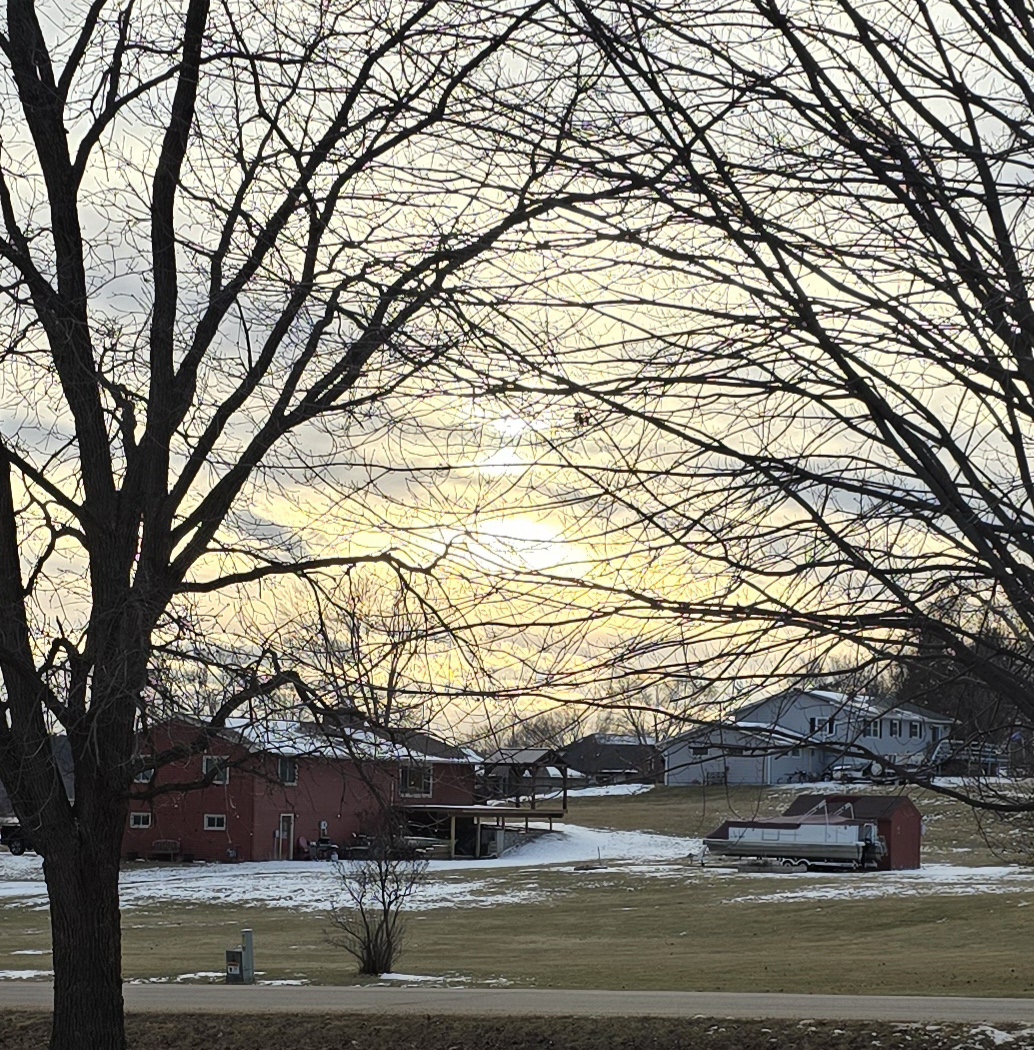
There is open water on the lake with a bright day ahead. Time to get writing!








 Journey Home
You must be logged in to post a comment.