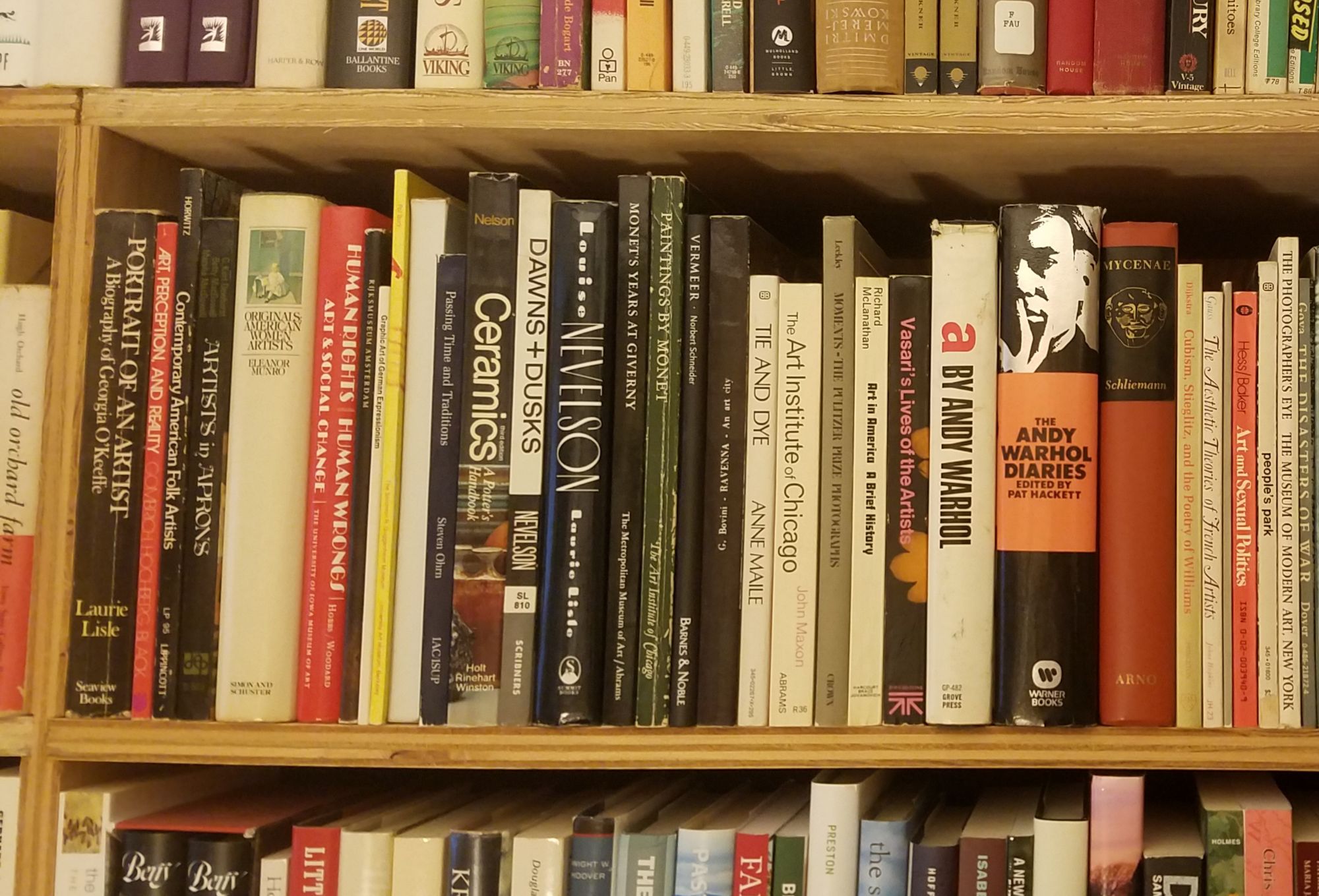
My relationship with the world of art is tenuous at best. A few high school and university friends practiced the visual arts. They were, and in some cases still are, multidisciplinary artists. I viewed myself as a multi-media creator yet throwing a pot, painting a watercolor, or drawing a sketch are activities in my portfolio that have been lost to exigencies of living a modern life. I have a lot of art books and art memories. It’s a big topic, so I’ll limit myself to three things: books in my library, artists I’ve seen or knew in person, and major shows I attended.
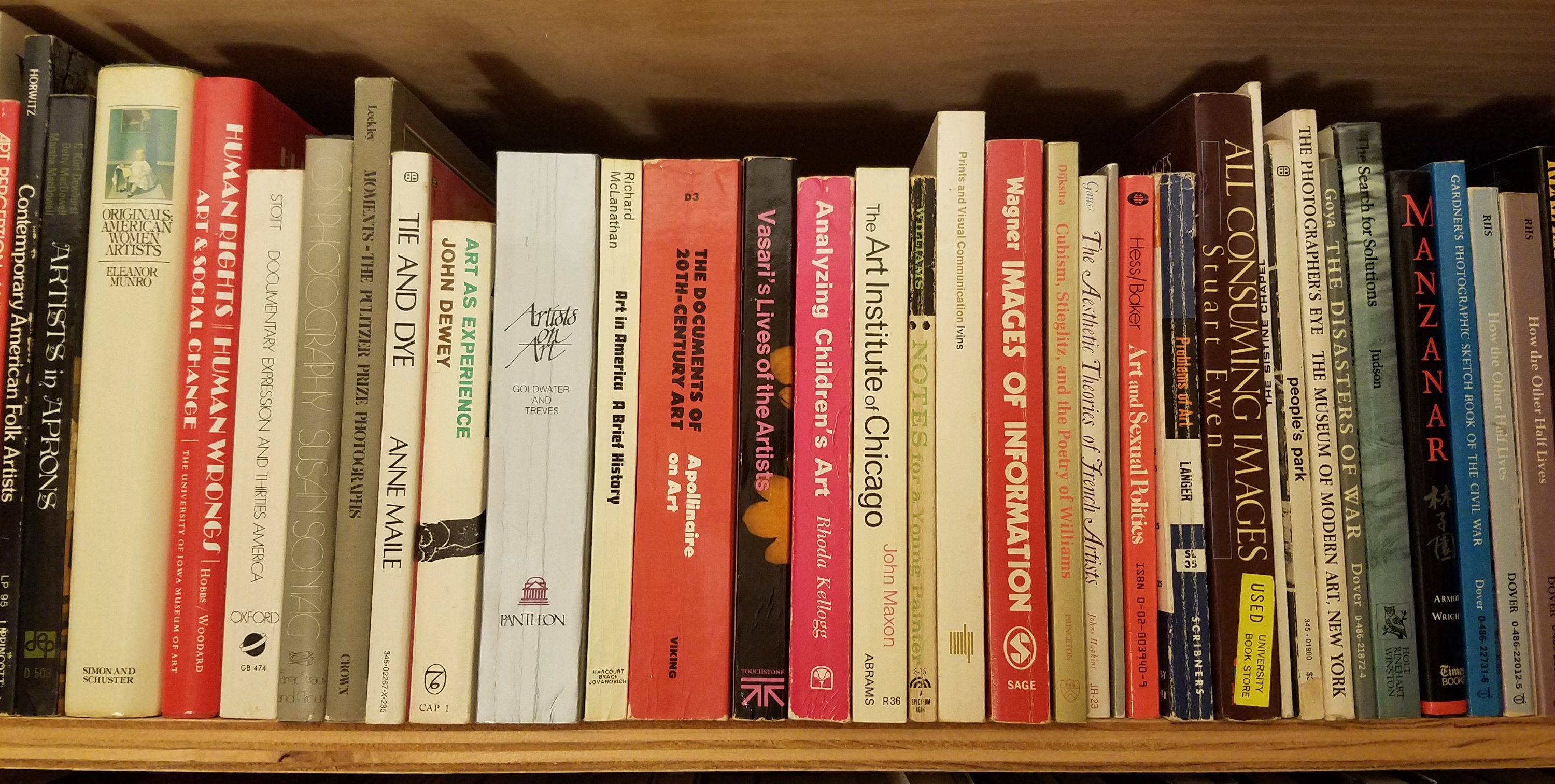
Art books take up too much space. When I built the bookshelves in my library I designed a shelf to accommodate them. Having so many is a function of my interest in certain artists like Picasso, Joan Miró, Georgia O’Keeffe, Andy Warhol, Edward Hopper, and the like. I saw major retrospectives of each of these artists and usually bought a book to remember the work. I picked up many art books at used book sales. Until I get to the point of running out of space, most of them will stay right where they are in the library.
Among the pantheon of artists who lived during my lifetime, three come to mind: Joan Miró, Louise Nevelson, and Leslie Bell.
I saw a major Miró retrospective in Paris in 1974. I wrote in my journal, “The show of Joan Miró was very complete and what impressed most were the ceramics and weaving. The paintings lacked something in such great numbers, better just a few to contemplate rather than such overdose.” Later, on a 1978 trip through Italy with friends, I saw the artist filming a program for French television at Fondation Maeght in Saint Paul de Vence. While Miró is known as a Catalan painter, the unexpected encounter on the French Riviera cemented him as French to me.
Louise Nevelson came to Iowa City for the installation of Voyage at the University Lindquist Center. I happened to be at the installation site when the artist walked up to have a look at the space. She was scheduled to give a lecture at the Museum of Art later that day. The University describes the work in place:
Voyage was the first sculpture purchased with funds provided by the Art in State Buildings Program, initiated in 1978. With public works such as Voyage, Louise Nevelson creates a visual dialogue using existing scenery and groups of vertical elements, evocative of trees or plant like forms. Nevelson preferred to see her large-scale outdoor sculpture, which she undertook in the last fifteen years of her life, as environmental architecture. Voyage fits this description as it commands attention within the closed-off courtyard of the Lindquist Center. Yet, it does not overwhelm the entire space. The work invites dialogue with the viewer, offering a variety of shapes, forming spatial relationships with both the spectator and the architectural environment.
Iowa Facilities Management website.
One local artist I knew well was Leslie Bell, an art professor at Saint Ambrose University. Les was a couple years ahead of me in high school. I came to know him more as a musician than a visual artist. He was good at whatever he did. I recall picking him up while hitch hiking to a friend’s home. I engaged his band to play at our fifth high school class reunion. He was part of a small group of intellectuals in the Quad Cities. He helped create a film festival around the time I returned from military service. We were not close friends. He was an example of someone successful in making art a career. He influenced many students at Saint Ambrose. I thought about him while I tried to figure out how to live in my home town as an adult in the early 1980s.
I visited so many art museums during my life. During trips to Europe I made a point to see the works of Johannes Vermeer, which are not gathered in a single location. I saw a lot of them. I made a point to see Monet’s work in Paris. I bought a book of Byzantine mosaic images when visiting Ravenna, Italy in 1974. I saw the Picasso retrospective at the Museum of Modern Art in New York City, the Andy Warhol retrospective at the Art Institute of Chicago, and the Georgia O’Keeffe retrospective somewhere. The latter was so much about the artist and not about the location of the retrospective. Seeing art in person is essential and I did my share of it.
How shall I use the couple hundred art books in my library? For reference, of course. There has to be something more than that. I’ve been creating so long, I don’t need many references. As long as I have the space, they can sit on shelves waiting for my attention.
 Journey Home
You must be logged in to post a comment.