Categories
Environment

Rain Came and the NOAA Report

Sunrise before the rain.

We had good rain a couple of days this week with predictable results: garden tomatoes are swelling and cracking, the lawn is turning green, and there are more mosquitoes buzzing around the garden.

The county public health department identified a pool of mosquitoes that tested positive for West Nile virus. They issued this press release:

Mosquito Surveillance Program Reveals West Nile Virus Risk

The Johnson County Public Health Mosquito Surveillance Program, in collaboration with testing from Iowa State University and the University of Iowa Hygienic Lab, have identified a pool of mosquitoes testing positive for West Nile virus (WNV). Mosquito samples from a trap located in Hickory Hill Park recently tested positive, suggesting mosquitoes with the potential to carry West Nile virus are likely present in the community.

This is the first pool of mosquitoes to test positive for West Nile virus in Johnson County, since the surveillance program was re-instituted in 2017. No human cases have been reported this season. “Historically, we are near the peak season for mosquito activity and potential WNV transmission, “said James Lacina, Environmental Health Manager at Johnson County Public Health. “Avoiding mosquito bites is the best way to limit the risk of transmission, along with reducing habitat, such as areas of standing water where mosquitoes may breed.”

People can take simple precautions to protect themselves against mosquito bites.
• Use an effective, EPA-registered insect repellent.
• Wear long sleeves, long pants, and socks when outdoors.
• Limit time outside from dusk to dawn, when mosquitoes are most active.
• Mosquito-proof your home by installing or repairing screens on windows and doors to keep mosquitos outside.
• Eliminate mosquito-breeding areas by disposing of standing water from flowerpots, gutters, buckets, pool covers, pet water dishes, discarded tires, and birdbaths.

Email from Johnson County Public Health, Aug. 26, 2021

We don’t live near the park where West Nile virus was found yet I forwarded the notice to some friends who do. It is great to have a functioning public health department.

In other Thursday news, the Washington Post reported on release of the National Oceanic and Atmospheric Administration report “State of the Climate in 2020.” I haven’t read the 481-page document yet the news is not good, it is bad.

Contrary to some news stories about decreased greenhouse gas emissions during the coronavirus pandemic, an associated drop in carbon emissions was all but undetectable to scientists studying our air.

While humanity grappled with the deadliest pandemic in a century many metrics of the planet’s health showed catastrophic decline in 2020. Average global temperatures rivaled the hottest. Mysterious sources of methane sent atmospheric concentrations of the gas spiking to unprecedented highs. Sea levels were the highest on record; fires ravaged the American West; and locusts swarmed across East Africa.

Many measures of Earth’s health are at worst levels on record, NOAA finds by Sarah Kaplan, Washington Post Aug. 26, 2021.

We live in Biblical times with plague, locusts, drought, hurricanes, floods, rising sea levels and wildfires. The planet is literally burning up. While some hope for the rapture to take us from the problems of a deteriorating environment, the rest of us have to cope with the challenges of a planet whose atmosphere traps too much warmth.

Without consistent, concerted efforts to reduce emissions from burning fossil fuels and other human activities, scientists warn, Earth’s condition will continue to deteriorate.

Many measures of Earth’s health are at worst levels on record, NOAA finds by Sarah Kaplan, Washington Post Aug. 26, 2021.

Just read the two-page abstract of the report on page Siii. It is past time to reduce greenhouse gas emissions. No single person can make a difference. It will take all of us working toward the same goal.

It’s no consolation the planet will be fine. The people living on it will not. It’s past time to act on climate.
Categories
Sustainability

Local Food — Summer 2021

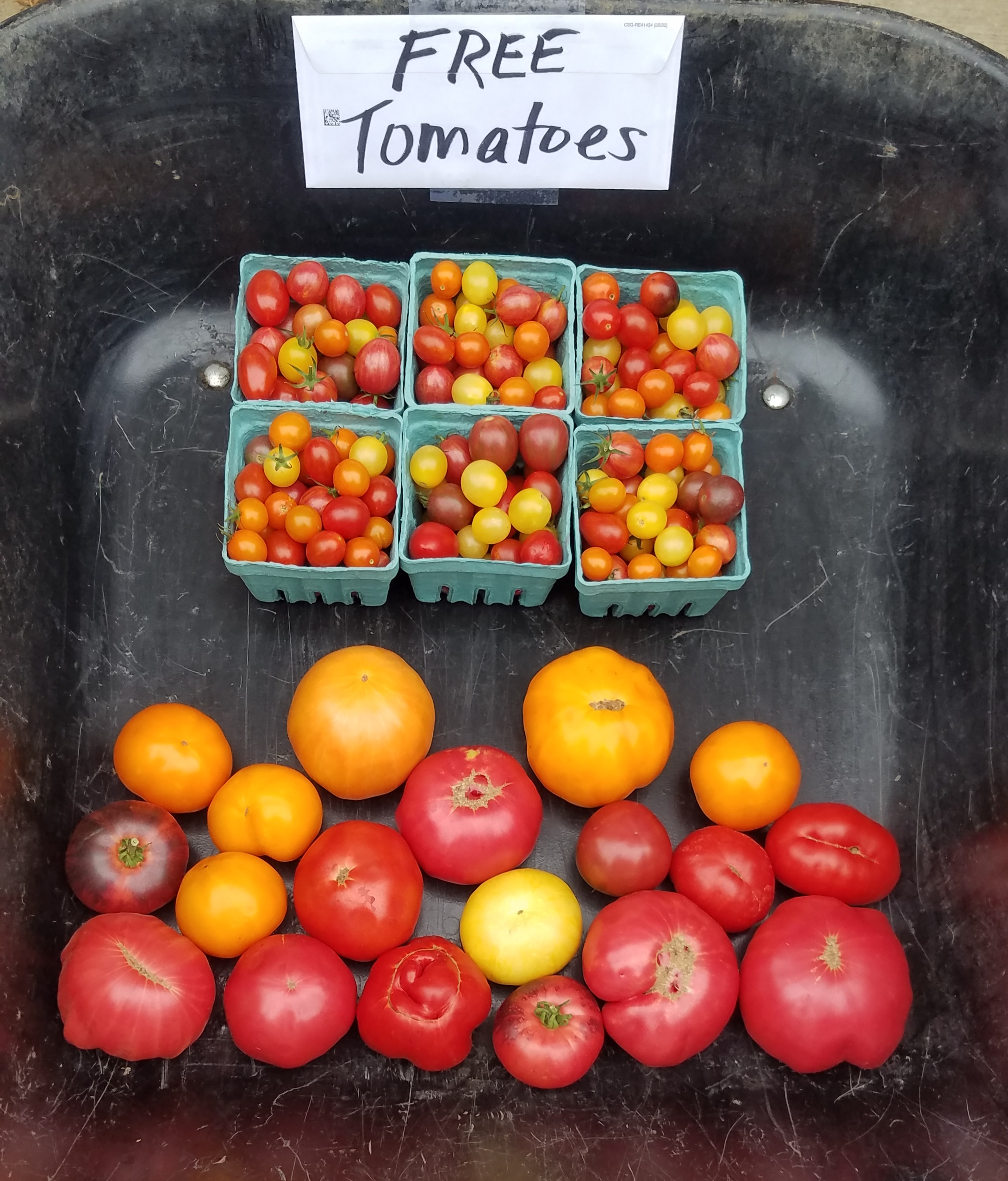
Neighborhood tomato give-away, Aug. 21, 2021.

The food system is in transition and I believe the local food movement will come along with it.

The way Americans produce and consume food, with centralized growing operations at a distance from markets, is being forced to change because of a new and different climate. I believe changes will be positive over time, although they will take adaptation which will not be pleasant. The local food movement will focus on three types of operations: specialty growers, more complex farm operations centered around key individuals or a small group, and more kitchen gardens like mine. To some extent that structure already exists.

The ongoing, long-term drought made worse by climate change is taking a toll. The water shortage is acute in the Western U.S. because there has not been enough snow melt or rain. It should be called aridification rather than drought, because the changes are likely permanent. With the continuing water crisis, reservoirs and lakes across the west are at record low levels. A reckoning is coming and it means, among other things, higher prices and disrupted food supplies.

It’s not much better in Florida, Texas and Mexico. We long recognized growing lettuce and other produce in California and Arizona, and shipping it to the Midwest and East Coast, made little sense and was expensive in multiple ways. Have you ever tasted a Florida tomato? There are better alternatives. Because vegetables are grown with shipping in mind, taste has taken a back seat.

Producing food more locally is a natural reaction to disruption in food supply. In the settler days, before we had all these fancy supply chains, it was called “making do.” More people will grow some of their own food in backyard gardens, on decks and patios, or in community gardens. Not only does the food taste better, we can control the inputs to eliminate worry about pesticides and fertilizers. In the pandemic people lost some control of external events and one way they regained it was to become more self sufficient. So many people are preserving food that it has become difficult to obtain canning jar lids.

Labor is a basic problem the local food movement cannot solve. By growing food ourselves, the labor element is removed as we each invest labor to support our garden. Labor is an assumed investment and we scale personal labor in food production to fit our ambitions and the size of our garden or farm. Produce grown like this will meet some of our nutritional needs.

53 percent of Iowa corn goes to producing ethanol. If the country moves to electric vehicles, ready or not, adaptation is coming. The simple truth is either farmers find new markets for all that corn or adapt to other crops. Expect agricultural interests to oppose elimination of ethanol. Folks have proposed some of those crop acres be devoted to different kinds of produce, the kind people eat at the dinner table. However, it’s now or never to effect mitigation of climate change. There will be no choice but to adapt and land use is only one aspect of adaptation.

Climate change is real, it is having an impact on our lives, and unless we do something to reduce greenhouse gas emissions — on a large scale — it is going to get worse. Local food production can be part of the solution.

Categories
Living in Society

Is Jessica Reznicek a Terrorist?

Jessica Reznicek Photo Credit: Twitter @FreeJessRez

Jessica Reznicek, a 39-year-old environmental activist and Catholic Worker from Des Moines, Iowa, was sentenced in federal court June 30 to eight years in prison for her efforts to sabotage construction of the Dakota Access pipeline.

In November 2016, Reznicek and Ruby Montoya, a former preschool teacher, set fire to heavy construction equipment at a pipeline worksite in Buena Vista County, Iowa.

Over the next several months, the women used oxyacetylene torches, tires and gasoline-soaked rags to burn equipment and damage pipeline valves along the line from Iowa to South Dakota. Their actions reportedly caused several million dollars’ worth of damage and delayed construction for weeks.

Catholic activist sentenced for Dakota Access Pipeline vandalism by Claire Schaeffer-Duffy at NCROnline.com. To read the rest of the article, click here.

Reznicek’s criminal penalties were substantial. In addition to jail time, U.S. District Court Judge Rebecca Goodgame Ebinger included $3,198,512.70 in restitution and three years’ post-prison supervised release after she plead guilty to a single count of damaging an energy facility, according to Common Dreams. It’s hard to argue her protest was intended to be non-violent. She used an oxyacetylene torch to damage the pipeline without knowing if fuel was in transit.

Reznicek is being prosecuted as a terrorist. Is that what she is? It seems unlikely the board of directors or billionaire Kelcey Warren of Energy Transfer Partners felt terrorized. They had reason to know there would be protests during construction, and likely built defense from them into their operating, overhead, and risk management budgets. For ETP, pipeline protests represented business as usual. In 2018 there was a “protect the protests” direct action in Dallas, Texas where demonstrators accused ETP at its corporate headquarters of attempting to silence them with lawsuits.

Like many in the Des Moines Catholic Worker community Reznicek has been willing to break the law in peaceful protest and has been arrested. In 2014, she was detained for nearly 48 hours and then deported after flying into Israel to support Palestinians in the Israeli-occupied West Bank, according to the Des Moines Register. It seems obvious the Iowa Legislature had people like Reznicek in mind when they recently increased penalties for protesters.

I received the first of a series of emails from Reznicek during the Occupy Movement in 2011. She was an organizer for Occupy Iowa, Occupy Des Moines, Occupy the Caucus, Occupy Monsanto, Occupy the World Food Prize, and other direct action protests. She was arrested at some of these protests. It seemed like boilerplate organizing. Whatever cache the Occupy movement may have had, the work she did was straight forward with transparency. It was not a terrorist plot the way in 1995 Timothy McVeigh plotted to bomb the Alfred P. Murrah Federal Building in Oklahoma City. It would be better for the peace and justice movement if Reznicek did not have to spend her time serving time and defending herself in this prominent case. It goes with the territory, though.

The answer is no. Jessica Reznicek is not a terrorist. Society needs more people like her to call attention to injustice. If there is a cost to her protests, she has been willing to accept responsibility. If asked, my neighbors would say justice was served with Reznicek’s prosecution and sentencing. As it plays out in the judicial system, some of us wonder who will step in to fill her shoes in the peace and justice movement. It may be someone, but it won’t be her for a while.

~ Written for Blog for Iowa

Categories
Environment

Iowa Senators and Climate Change

2012 Drought Conference

In March I wrote my U.S. Senators Chuck Grassley and Joni Ernst about the climate crisis as follows:

I hope you will support the efforts of the Biden administration to act to mitigate the effects of our changing climate. Naturally I’m curious about your views on how you might address the effects of climate change while in the U.S. Senate. The approach of the Biden administration regarding mitigation of climate change is such there should be many areas in which to work with them without supporting an overarching environmental bill. I look forward to hearing your policy stances and how you can help address climate change while you are in the Congress. Thank you for your public service.

During a recent conference call with Ernst and a group of environmental activists, she touted her support for the then upcoming vote on the Growing Climate Solutions Act, the first bill to specifically address climate change since Biden was sworn in. Grassley and Ernst joined the 92-8 Senate majority to pass the bill on June 24. (Booker, Hawley, Inhofe, Lee, Markey, Merkley, Sanders and Warren were nays). Storm Lake journalist Art Cullen opined in the Washington Post, “Ignore the chatter. Stuff is getting done. And both parties are helping.

After familiarizing myself with the bill, I can only ask of the legislators, “What else you got?”

Below are the Iowa senators’ unedited responses to my query. Grassley’s is first because he is our senior senator. Ernst replied first. I’m glad to hear from our elected representatives.

April 14, 2021
Dear Mr. Deaton:

Thank you for taking the time to contact me with your concerns about the environment. As your senator, it is important to me that I hear from you.

I appreciate hearing your concerns about climate change. In contacting me, you shared your support for climate-related legislation. While I believe a changing climate is a historical and scientific fact, I also recognize that most scientists say man-made emissions contribute to these changes. With that being said, it is just common sense to promote the development of clean forms of energy. Throughout my tenure in the Senate, I have been a leader in promoting alternative and renewable energy sources as a way of protecting the environment and increasing our energy independence. I’ve been an advocate of various forms, including wind, biomass, agriculture wastes, ethanol and biodiesel.

I’m proud to let you know that Iowa has had much success in renewable fuels and wind energy production. As the number one producer of corn, ethanol, biodiesel and cellulosic ethanol, Iowa has the opportunity to lead our nation’s renewable fuels industry. This cleaner-burning, homegrown energy supports the economy by generating 47,000 jobs and nearly $5 billion of Iowa’s GDP. In 2018, Iowa produced 4.5 billion gallons of ethanol. In regards to environmental benefits, ethanol reduces greenhouse gas emissions by 46 percent compared to conventional gasoline.

Iowa’s wind industry ranks second in the nation behind Texas. Wind energy supports over 9,000 jobs in Iowa alone and provides 40 percent of the state’s electricity. As the “father” of the Wind Energy Incentives Act of 1993, I sought to give this alternative energy source the ability to compete against traditional, finite energy sources. Like ethanol and other advanced biofuels, wind energy is renewable and does not obligate the United States to rely on unstable foreign states.

The most effective action Congress can take to address this issue is to advance policies that increase the availability and affordability of alternative and renewable energy sources. If alternative energy sources can become more competitive, market forces will drive a natural, low-cost transition in our energy mix that will be a win-win for American families. I will keep your thoughts in mind as the Senate considers related legislation in the future.

Again, thank you for taking the time to contact me. I appreciate hearing your concerns and encourage you to keep in touch.
Sincerely,

Chuck Grassley
United States Senate

March 25, 2021
Dear Mr. Deaton,

Thank you for taking the time to contact me about the issue of climate change. It is important for me to hear from folks in Iowa on policy matters such as this.

As you may know, on January 21, 2015, during the Keystone XL Pipeline debate, I voted in support of S.A. 29, an amendment offered by Senator Sheldon Whitehouse (D-RI) that acknowledged the existence of climate change. I do believe that the climate is changing, however, the science surrounding climate change continues to develop, and additional, objective research needs to be done to conclusively identify the root causes. Our climate is experiencing a period of changing temperatures, but it is important to note that not all scientists agree on the cause.

I believe that government can take reasonable and concrete steps to protect and improve the environment. This includes encouraging the utilization of a diverse mix of energy resources and improving energy efficiency. We can also make personal choices that have a positive impact on the environment—I am a committed recycler.

I support an all of the above energy approach that increases America’s energy independence and domestic production. Iowa is a national leader in alternative energy sources. As a result, nearly 40% of electricity generated in our state is by wind. I believe America can responsibly take advantage of our nation’s abundant resources while also emphasizing conservation and efficiency.

We all care about clean water and clean air, but any efforts to reduce pollution must be done in a thoughtful manner that involves the communities, businesses, and families that will be most affected by changes to rules and regulations. Climate change is an international issue, not one limited to the United States. Any policies designed to mitigate the effects of climate change should take into consideration the impact they will have on American consumers and also on our businesses and their ability to compete globally and create jobs.

Please know that I will continue to keep your views in mind as the Senate works on this issue. Feel free to contact my office with any further information, as I always enjoy hearing from Iowans.
Sincerely,

Joni K. Ernst
United States Senator

~ Written for Blog for Iowa.

Categories
Environment

The Climate Crisis is Accelerating – Now What?

Ronne Ice Shelf in Antarctica Nov. 4, 2017. Photo Credit: Wikimedia Commons

What can we do when confronted with the climate crisis? The answer is everything. If climate change is developing faster than human solutions, what then?

During the last few months we have been assaulted with news about the climate crisis getting worse. Lake Mead is at its lowest level since the Hoover Dam was built, threatening downstream communities with loss of needed water. People are dropping dead on the street in the Pacific Northwest which is experiencing record high temperatures. President Biden called a White House meeting with Republican and Democratic Western Governors about the continued heat wave and wild fires it caused. Above the Arctic Circle in Siberia, ground temperatures approach 120 degrees, melting the permafrost. 2020 was the hottest year in recorded history for Antarctica, causing a record 1,600 square mile iceberg to calve off the Ronne ice shelf into the Weddell Sea. Drought continues in Iowa, the worst in 20 years. This is what I mean by being assaulted.

Professor Julia K. Steinberger offers a toolkit for would-be climate activists in info graphic format here. It is pretty cool and accessible. It offers things a person can do to address the climate crisis. It is something, not everything. It is not enough.

The next step in taking effective action to address global climate change is to understand where we are. According to Bill McKibben in the New Yorker, we’re not in a good place.

“The earth won’t simply keel over and die like a human being might, but it is now changing in substantial ways in real time,” McKibben wrote. “If you’re used to thinking that the earth changes in the course of geological epochs, and that fundamental shifts require thousands or millions of years, think again.”

“The speed with which this happens is remarkable,” he said. “And it is dramatically outpacing the speed at which humans—our governments, our economies, our habits, our mind-sets—seem able to adapt.”

In a piece in the New York Times, Farhad Manjoo opined, “Democrats have a year to save the planet.”

We’d better get going.

While we need to do everything possible to avert the worst effects of the climate crisis, the longest, most complicated journey begins with a single step. Click on the links in this post. Read the articles. Discuss them with friends. Figure out how you can contribute to solutions to the climate crisis.

“Become active as a citizen of our democracy, regardless of party,” recommended Al Gore on CNN.

This is about the future of humanity. We all have a stake.

~ First published on Blog for Iowa

Categories
Environment

Dry Spring In Iowa

It is abnormally dry in our part of Iowa. Just as we are needing rain, we are not getting it. A home gardener can irrigate new trees, fruits and vegetables, but the massive scale required to hydrate Iowa’s main commodity crops and livestock is not available. Creating the infrastructure to pump water from ancient aquifers is doable, yet an unsustainable practice. It seems like we are heading into a drought. (The map is from the state climatology website which provides data about precipitation, temperature and other aspects of the climate).

Iowans are familiar with drought. In the 2012 drought corn yield per harvested acre was 123.1 bushels compared to the average of the seven following years at 170.4 bushels. The drought decreased corn production by 27.8 percent according to USDA numbers.

There is a relatively finite amount of water on Earth which cycles through the atmosphere, on land, and in the oceans. Some of it rests in deep underground aquifers where it has been since prehistoric times. An increasingly warm climate impacts how water cycles and it is getting hotter. “Earth’s global average surface temperature in 2020 tied with 2016 as the warmest year on record,” according to an analysis by NASA. The oceans are getting warmer too.

Rising air and water temperatures and changes in precipitation are intensifying droughts, increasing heavy downpours, reducing snowpack, and causing declines in surface water quality, with varying impacts across regions. Future warming will add to the stress on water supplies and adversely impact the availability of water in parts of the United States.

Fourth National Climate Assessment.

The problem goes beyond Iowa. The Hoover Dam, located on the Colorado River near the Nevada-Arizona border, is suffering the consequences of drought. Lake Mead, the artificial lake created by the dam, is at a lower water level than was when it was built. The water shortage will impact 25 million people including in the cities of Los Angeles, San Diego, Phoenix, Tucson and Las Vegas.

Farmers are abandoning crops, Nevada is banning the watering of about one-third of the lawn in the Las Vegas area, and the governor of Utah is literally asking people to pray for rain.

Firefighters are facing worsening conditions this summer — after nearly 10,000 fires in California alone during the last wildfire season burned 4.2 million acres (1.7 million hectares), an area nearly as large as Kuwait.

Reuters, June 10, 2021

Water in California’s Lake Oroville will fall so low this summer that its hydroelectric power plant may be forced to shut down for the first time.

We must do something more than pray for rain. It begins with recognition.

The Lakota phrase “Mní wičhóni” (“Water is life”) was the protest anthem from Standing Rock heard around the world, but it also has a spiritual meaning rooted in Indigenous world views. For Native Americans, water does not only sustain life, it is sacred.

Bioneers.org

Action to prevent drought must include acknowledging that climate change is real, something Senators Chuck Grassley and Joni Ernst have both done. The next step is addressing the climate crisis through policy and legislation and that’s been the rub. The climate crisis is more complicated than any single policy or law.

Peter Rolnick of Citizen’s Climate Lobby wrote a guest opinion in the Cedar Rapids Gazette on June 15, 2021. He commended the Iowa senators and Rep. Cindy Axne for supporting the bipartisan Growing Climate Solutions Act. If passed, the law would engage farmers in storing more carbon in our soil instead of emitting it into the air in the form of carbon dioxide or methane. The relationship to drought is clear. A molecule of CO2 or methane sequestered in the ground is one that does not get into the atmosphere and increase warming. Even the American Farm Bureau is in favor of this bill, which on its own raises red flags. One bill is not enough.

We need much more in the way of policy and legislation. The Biden administration’s approach of embedding work on climate change in each of the executive branch departments is important. It is up to each of us to encourage those in government to work toward viable climate solutions. There are personal actions we can take to reduce our carbon footprint, yet the most effective action is in the government arena. If constituents don’t remind members of our governing bodies to act on the climate crisis, they seem likely to forget.

We’ll know it when we hit the drought this year. News media has been forthright in reporting it because so many Iowa livelihoods depend upon the weather. When will we wake up to take action to address what is causing the drought? Not soon enough.

Categories
Kitchen Garden

Spring Burn Pile

Spring burn pile April 22, 2021.

Thermal energy came from the pile of white ashes on this year’s tomato patch. It warmed my hands. The embers will exhaust their fuel soon and I’ll spread them on the ground after they cool. Tomatoes will be the last to be planted in a few weeks.

The burn pile was mostly branches from the felled oak tree. Yesterday I cleared three garden plots for spading, tilling, and then planting: more steps on the path to a productive garden.

It looks like Tuesday night’s hard frost killed most of the beets and damaged broccoli, kale and collards. I have plenty of seeds and seedlings for replanting. First we’ll see if the bigger plants recover before yanking them out.

The Washington Post published an article about transportation and the shift to electric vehicles. It gave reasonable consideration to the operating costs of such vehicles, and the trade offs between operating a gasoline powered vehicle and going electric. I found if the car gets parked most of the time, very little gasoline is burned.

Thus far in 2021, I spent $36 on gasoline; in all of 2020, $492; and in 2019, $930. The coronavirus pandemic curtailed our driving and reduced how much gasoline we purchased. Unless one of us returns to working a job, the gasoline we burn for transportation should be minimal.

All the same, the news in the Post article about the inefficiency of internal combustion engines was eye-opening.

Most internal combustion engine cars are so inefficient that the vast majority of energy produced by burning gas gets lost as heat or wasted overcoming friction from the air and road. In other words, instead of filling my car’s 16.6-gallon tank, I might as well put 14 gallons of that gas in an oil drum, light it on fire and watch the smoke drift upward.

Washington Post, March 30, 2021.

When you put it that way, of course we’ll look at buying an electric car. We need to stop burning fossil fuels as quickly as we can.

When I burn brush on a garden plot I’m releasing carbon into the atmosphere, along with returning minerals to the soil. However, what I’m doing is already part of the carbon cycle and therefore a renewable process. University of Iowa chemistry professor Betsy Stone explained it to me:

“It’s considered to be a renewable fuel because we have that carbon cycle going on,” Stone said. “With fossil fuels, we’re releasing fossilized carbon. It goes into the atmosphere and takes millions of years to get back to fossilized form again.”

Paul Deaton, Iowa City Press Citizen, Oct. 7, 2015.

I cut the stump of the oak tree tall so I could sit on it while contemplating the garden or needing a rest. Yesterday, while figuring out where to plant things it occurred to me burning brush was a good thing. I also thought we should probably get an electric vehicle.

While the first burn is done, I’ll be sitting on that stump coming up with ideas more often. Some of them will make their way into doing things.

Categories
Environment

Climate Change Response

Bridge over calm, polluted water, April 6, 2021.

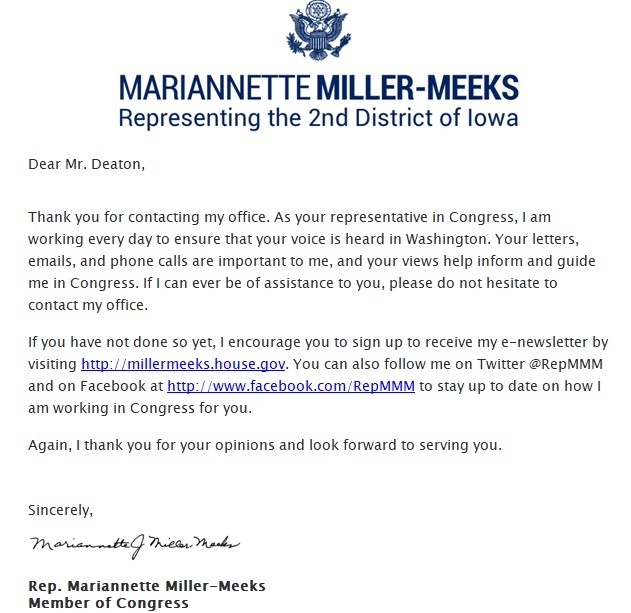
In March I wrote Congresswoman Mariannette Miller-Meeks about the climate crisis as follows:

I hope you will support the efforts of the Biden administration to act to mitigate the effects of our changing climate. Naturally I’m curious about your views on how you might address the effects of climate change while in the U.S. Congress. The approach of the Biden administration regarding mitigation of climate change is such there should be many areas in which to work with them without supporting an overarching environmental bill. I look forward to hearing your policy stances and how you can help address climate change while you are in the Congress. Thank you for your public service.

Here is her unedited response. It is not what I expected.

Received April 19, 2021 via email.
Categories
Environment

Introducing Myself, Again

Leftover seedlings

This is the text of an email sent this morning to the small group of Climate Reality Leadership Corps participants I am mentoring this spring. Every time I introduce myself, it seems like I am re-inventing who I am. Eventually all the stories will add up.

Welcome to the spring 2021 Climate Reality Leadership Corps training. I am Paul Deaton and will be your mentor. We’re looking forward to your participation!

Before I get too far, if you received this email and no longer plan to participate in the training just hit reply and let me know. As of last night’s mentor training, more than 4,700 people had RSVP’d for the training. There are 300 mentors.

I will be your mentor for both the training and as you begin to perform acts of leadership after the training. I use the pronouns he/him. I was born in Iowa and now live in a rural, Eastern part of the state.

I participated in the first Earth Day on April 22, 1970 and have been working on environmental issues, in addition to a career, ever since. I completed a career in transportation and logistics in 2009 and fully retired during the coronavirus pandemic. I attended the 2013 Climate Reality Leadership Corps training in Chicago and was a mentor at the 2015 Cedar Rapids, Iowa training. For me, Climate Reality has been a portal to diverse climate action all over the planet. I learned a lot and am here to help you do the same.

In retirement I spend more time writing. I started a blog in 2007 and am currently working on a book-length project. I am an avid gardener and last night I had to put a space heater in my small, portable greenhouse because of a frost warning. I start most of my own seedlings and spend a lot of time in my kitchen garden.

During my career I spent time in Texas, which is where everyone in our small group lives. One consulting project was near Sweetwater where I stayed on a 5,000 acre cotton farm during the rattlesnake roundup. (All the motel space was booked). I learned Texas is a large, diverse state. I look forward to getting to know you and other group members.

I plan to follow the lead of the Climate Reality staff as a mentor. I’m here to help as much or as little as you want. The Climate Reality staff continues to release information about the training and will up until the first day. As they do, I’m reading it and asking questions to prepare for our experience. One of the main things I will do is host the small group sessions via Zoom after each of four streamed general sessions. I want to assure you everyone’s voice is welcome to be heard during our small group meeting.

If you have questions, email is the best way to reach me. As the training takes shape, I may send an additional group email with any update. Staff will be emailing a lot, so I will keep mine to a minimum.

I hope you are as excited as I am for the training. Let me know how I can help.

Categories
Environment

Solar Arrays and Politicians

Sunset in Colorado Springs on July 11, 2011

Earth Day is coming and politicians have been reviewing Iowa’s solar electricity generation capacity. State Rep. Ras Smith posted about his trip to a solar array in Decorah. Iowa Lieutenant Governor Adam Gregg, Senator Joni Ernst, and Rep. Mariannette Miller-Meeks attended the dedication of a solar array in Wapello last week. The support for solar was bipartisan.

It’s no surprise. Solar arrays require no fuel except free sunlight. It is becoming the lowest cost option to generate electricity. Solar importantly avoids most liabilities of burning fossil fuels like coal and natural gas.

The message I hope these politicians take away from such appearances is government action is required to reduce carbon emissions in Iowa and elsewhere. Replacing coal and natural gas generating capacity with solar arrays is a way to do that.

We can install solar arrays on our homes, contributing to reduction of air pollution. Government regulation of our air and water quality is more important than individual action when it comes to reducing use of fossil fuels.

Focus on individual actions diverts our attention from what’s most important: what only government can address. Let’s remind our politicians we need government action this Earth Day.

~ Published in Little Village on April 13, 2021