Categories
Environment

More Weird Weather

Raindrops on the Driveway

While watering the garden it started to rain. It wasn’t much, a sprinkle really. I turned the sprayer nozzle off, pulled the mobile device out of my pocket, and looked at the weather application. The forecast was rain, maybe three tenths of an inch toward midnight. I decided to wait and went inside to prepare dinner.

We need rain for a lot of reasons, importantly for the farming community. Large farm operations can capitalize the loss of a major drought, spreading the financial loss of a period of years. Small scale farmers, like the vegetable farmers in my community, not so much. Something is afoot in this spring’s weird weather.

Jonas Morgan of Fairfield opined in the Cedar Rapids Gazette that farmers are between a rock and a hard place.

A Des Moines Register poll found that among those who make their living working Iowa’s fertile soil, 81 percent believe our climate is changing but only 18 percent accept the overwhelming scientific evidence that humans are the cause.

Why the disparity? On the one hand, farmers are experiencing firsthand that long-term weather patterns are changing, changes that threaten not only their livelihoods, but the viability of the farms they hope to leave to their children and grandchildren, as well.

On the other hand, like all of us, farmers are under the sway of their political tribe.

Jonas Morgan, Cedar Rapids Gazette, June 21, 2021.

That tells part of the story. The same farmers to which Morgan referred might accuse him of falling under the influence of his own political tribe, noting he lives in Fairfield. I used to pen opinion pieces like this, which while accurate, don’t do much to move the needle toward acceptance of the realities of the climate crisis, much less the potential to do something about it before it’s too late.

A farmer friend wrote about the weird weather in their newsletter to CSA members:

The thing that has stood out to me the most this spring has been the extreme temperature swings, both hot and cold. […]

Extreme temperature swings (either hot or cold) are generally hard on vegetable crops, and the way different crops respond can also be somewhat unpredictable. Since we had two months that included periods of both unseasonable heat and cold, I feel like things were especially unpredictable. Some of the cool season greens have been bolting (sending off shoots to flower) early, which means that we have to harvest them smaller and earlier than we had hoped. The small Napa Cabbage in the share last week is an example of that. On the other hand we have struggled in the past to grow Hakurei turnips in the spring, and they have been mysteriously doing very well with this weather.

Local Harvest CSA Newsletter, June 21, 2021.

There has not been enough rain. Last night’s rainfall is welcome, but not enough to make up for the dry spring. Weird weather is not just in Iowa.

“In Siberia the ground surface temperature is a shocking 118 degrees Fahrenheit (47.8 degrees Celsius),” wrote Eric Mack in Forbes. “That’s bad news for permafrost.”

Laptev Sea ice on the Siberian coast set a new record low this week.

I’ve written about the dry spring in Iowa and in the western United States.

It’s not just farmers between a rock and a hard place. We go on living, aware the climate has changed and is changing. Our political leaders don’t have the will to mitigate the effects of the climate crisis. The good intentions of the Biden administration seem unlikely to become reality given the current political climate in Washington, D.C.

In the meanwhile, we’ll deal with weird weather as best we know how.
Categories
Environment

Trail Walking

Algae on Lake Macbride

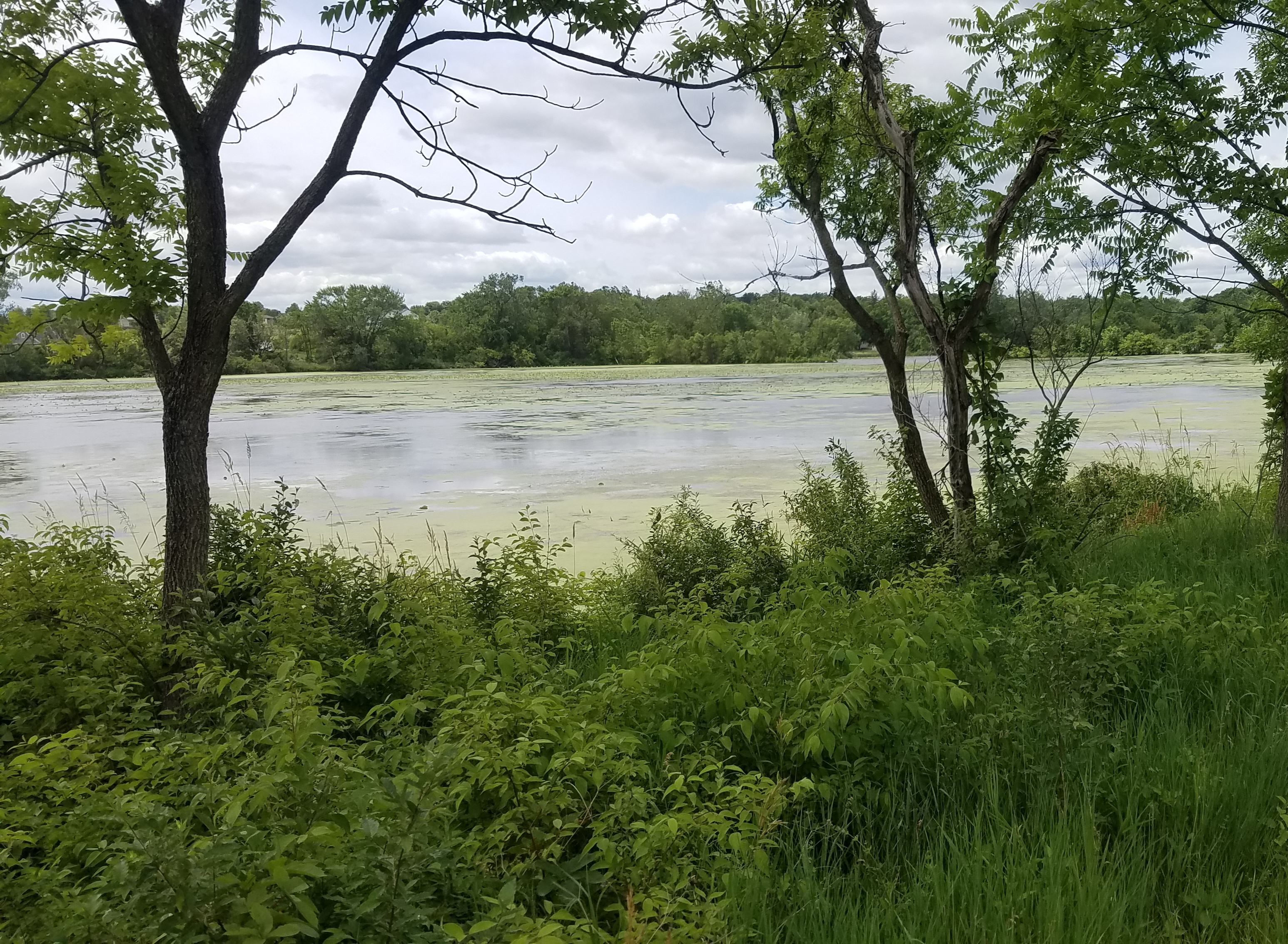
Nutrients in the Lake Macbride watershed created an environment where algae thrive. Blue-green algae covers much of the lake surface in the photo. The public beach a few miles to the west has been closed this season because of the presence of e.coli bacteria. There are likely patches of cyanobacteria where there is so much blue-green algae. During my morning walkabout every pond of water along the trail had algae covering most of the water surface. It didn’t used to be this way.

In Iowa there is discussion about whether the nutrients come from home application of fertilizer or from farm fields where chemical fertilizers are applied along with drainage tile which pushes them toward the Gulf of Mexico. It is a ridiculous discussion. Of course modern farming created this problem. Farmers depend on free contamination of downstream water systems to make margin on their investment in crops.

Despite reminders of civilization, I enjoy trail walking. Foremost, it is needed exercise. Even though one can hear automotive engines in traffic not far away, there is a relative quiet on the trail. On a Monday morning there were not a lot of other people out. Add cooler ambient temperatures and a partly cloudy sky, a trail walk serves as a suitable getaway from what ails a person. It also makes opportunities for photos like this:

Trail walking in Big Grove Township, June 21, 2021.

Categories
Environment

Dry Spring In Iowa

It is abnormally dry in our part of Iowa. Just as we are needing rain, we are not getting it. A home gardener can irrigate new trees, fruits and vegetables, but the massive scale required to hydrate Iowa’s main commodity crops and livestock is not available. Creating the infrastructure to pump water from ancient aquifers is doable, yet an unsustainable practice. It seems like we are heading into a drought. (The map is from the state climatology website which provides data about precipitation, temperature and other aspects of the climate).

Iowans are familiar with drought. In the 2012 drought corn yield per harvested acre was 123.1 bushels compared to the average of the seven following years at 170.4 bushels. The drought decreased corn production by 27.8 percent according to USDA numbers.

There is a relatively finite amount of water on Earth which cycles through the atmosphere, on land, and in the oceans. Some of it rests in deep underground aquifers where it has been since prehistoric times. An increasingly warm climate impacts how water cycles and it is getting hotter. “Earth’s global average surface temperature in 2020 tied with 2016 as the warmest year on record,” according to an analysis by NASA. The oceans are getting warmer too.

Rising air and water temperatures and changes in precipitation are intensifying droughts, increasing heavy downpours, reducing snowpack, and causing declines in surface water quality, with varying impacts across regions. Future warming will add to the stress on water supplies and adversely impact the availability of water in parts of the United States.

Fourth National Climate Assessment.

The problem goes beyond Iowa. The Hoover Dam, located on the Colorado River near the Nevada-Arizona border, is suffering the consequences of drought. Lake Mead, the artificial lake created by the dam, is at a lower water level than was when it was built. The water shortage will impact 25 million people including in the cities of Los Angeles, San Diego, Phoenix, Tucson and Las Vegas.

Farmers are abandoning crops, Nevada is banning the watering of about one-third of the lawn in the Las Vegas area, and the governor of Utah is literally asking people to pray for rain.

Firefighters are facing worsening conditions this summer — after nearly 10,000 fires in California alone during the last wildfire season burned 4.2 million acres (1.7 million hectares), an area nearly as large as Kuwait.

Reuters, June 10, 2021

Water in California’s Lake Oroville will fall so low this summer that its hydroelectric power plant may be forced to shut down for the first time.

We must do something more than pray for rain. It begins with recognition.

The Lakota phrase “Mní wičhóni” (“Water is life”) was the protest anthem from Standing Rock heard around the world, but it also has a spiritual meaning rooted in Indigenous world views. For Native Americans, water does not only sustain life, it is sacred.

Bioneers.org

Action to prevent drought must include acknowledging that climate change is real, something Senators Chuck Grassley and Joni Ernst have both done. The next step is addressing the climate crisis through policy and legislation and that’s been the rub. The climate crisis is more complicated than any single policy or law.

Peter Rolnick of Citizen’s Climate Lobby wrote a guest opinion in the Cedar Rapids Gazette on June 15, 2021. He commended the Iowa senators and Rep. Cindy Axne for supporting the bipartisan Growing Climate Solutions Act. If passed, the law would engage farmers in storing more carbon in our soil instead of emitting it into the air in the form of carbon dioxide or methane. The relationship to drought is clear. A molecule of CO2 or methane sequestered in the ground is one that does not get into the atmosphere and increase warming. Even the American Farm Bureau is in favor of this bill, which on its own raises red flags. One bill is not enough.

We need much more in the way of policy and legislation. The Biden administration’s approach of embedding work on climate change in each of the executive branch departments is important. It is up to each of us to encourage those in government to work toward viable climate solutions. There are personal actions we can take to reduce our carbon footprint, yet the most effective action is in the government arena. If constituents don’t remind members of our governing bodies to act on the climate crisis, they seem likely to forget.

We’ll know it when we hit the drought this year. News media has been forthright in reporting it because so many Iowa livelihoods depend upon the weather. When will we wake up to take action to address what is causing the drought? Not soon enough.

Categories
Sustainability

Safe Food for a Healthy Tomorrow

Belgian Lettuce Harvest

The United Nations General Assembly declared June 7 World Food Safety Day. There is not much recognition of the event in the United States where there are programs to ensure safe food in the national production and distribution system.

Food safety is a shared responsibility between governments, producers and consumers. Everyone has a role to play from farm to table to ensure the food we consume is safe and healthy. Through the World Food Safety Day, WHO works to mainstream food safety in the public agenda and reduce the burden of foodborne diseases globally. Food safety is everyone’s business.

World Health Organization website.

In the United States, food safety is less of a problem until we get to large-scale agricultural operations. Even then, when there is an issue, such as the e.coli outbreak in lettuce from Arizona and California farms in 2018, news media and government are quick to take action to prevent spread of foodborne disease. Potentially bad lettuce was pulled from store shelves within hours of recognition of the outbreak.

I have little worry about the safety of food harvested from our garden or sourced locally. I learned enough about food safety to make sure meals cooked at home are safe. We have control of everything from garden to plate, making the risk of infection exceedingly small.

As vegetarians we have few worries about chicken, turkey, beef and pork. The world would be a better place if consumption of those proteins were reduced. As far as seafood is concerned, with imminent depletion of fisheries I don’t understand why anyone would eat any type of seafood. It would be good to give ocean life a rest so it can restore itself, if that’s still possible. The dairy industry is highly regulated in the United States. I use some dairy in our household and have had no issue with contamination or spoilage. I understand a large percentage of the population relies on fishing for subsistence, livestock as a main protein, and dairy products.

In an affluent country government has standards to ensure a safe food supply chain. Consumers are informed about the risks of foodborne disease. This may be why World Food Safety Day gets little attention here. Food safety should be the background hum in modern society, something we take for granted. For the most part, in the United States it is. That’s part of our American privilege.

Categories
Environment

Climate Change Response

Bridge over calm, polluted water, April 6, 2021.

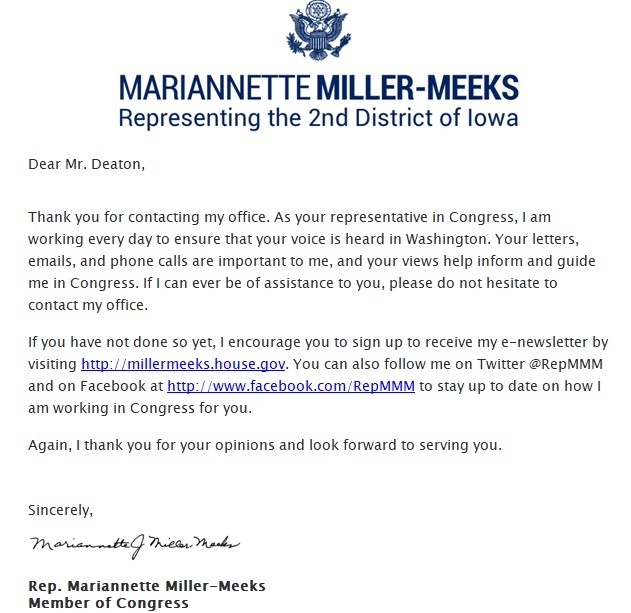
In March I wrote Congresswoman Mariannette Miller-Meeks about the climate crisis as follows:

I hope you will support the efforts of the Biden administration to act to mitigate the effects of our changing climate. Naturally I’m curious about your views on how you might address the effects of climate change while in the U.S. Congress. The approach of the Biden administration regarding mitigation of climate change is such there should be many areas in which to work with them without supporting an overarching environmental bill. I look forward to hearing your policy stances and how you can help address climate change while you are in the Congress. Thank you for your public service.

Here is her unedited response. It is not what I expected.

Received April 19, 2021 via email.
Categories
Sustainability

Grassley, Ernst on Climate Change

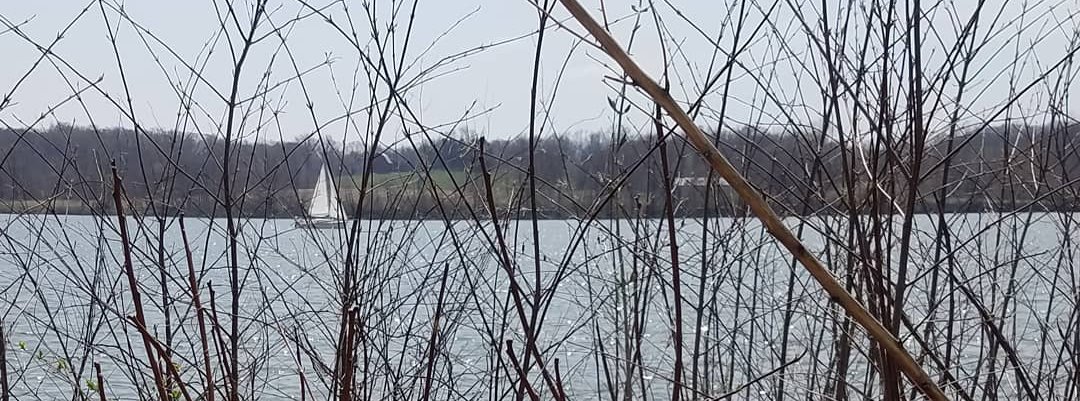
Sailboat on Lake Macbride.

In March I wrote my U.S. Senators Chuck Grassley and Joni Ernst about the climate crisis as follows:

I hope you will support the efforts of the Biden administration to act to mitigate the effects of our changing climate. Naturally I’m curious about your views on how you might address the effects of climate change while in the U.S. Senate. The approach of the Biden administration regarding mitigation of climate change is such there should be many areas in which to work with them without supporting an overarching environmental bill. I look forward to hearing your policy stances and how you can help address climate change while you are in the Congress. Thank you for your public service.

Here are their unedited responses. Grassley’s is first because he is our senior senator. Ernst replied first. I may have more to say about these responses, yet I’m glad to hear from our elected representatives.

April 14, 2021
Dear Mr. Deaton:

Thank you for taking the time to contact me with your concerns about the environment. As your senator, it is important to me that I hear from you.

I appreciate hearing your concerns about climate change. In contacting me, you shared your support for climate-related legislation. While I believe a changing climate is a historical and scientific fact, I also recognize that most scientists say man-made emissions contribute to these changes. With that being said, it is just common sense to promote the development of clean forms of energy. Throughout my tenure in the Senate, I have been a leader in promoting alternative and renewable energy sources as a way of protecting the environment and increasing our energy independence. I’ve been an advocate of various forms, including wind, biomass, agriculture wastes, ethanol and biodiesel.

I’m proud to let you know that Iowa has had much success in renewable fuels and wind energy production. As the number one producer of corn, ethanol, biodiesel and cellulosic ethanol, Iowa has the opportunity to lead our nation’s renewable fuels industry. This cleaner-burning, homegrown energy supports the economy by generating 47,000 jobs and nearly $5 billion of Iowa’s GDP. In 2018, Iowa produced 4.5 billion gallons of ethanol. In regards to environmental benefits, ethanol reduces greenhouse gas emissions by 46 percent compared to conventional gasoline.

Iowa’s wind industry ranks second in the nation behind Texas. Wind energy supports over 9,000 jobs in Iowa alone and provides 40 percent of the state’s electricity. As the “father” of the Wind Energy Incentives Act of 1993, I sought to give this alternative energy source the ability to compete against traditional, finite energy sources. Like ethanol and other advanced biofuels, wind energy is renewable and does not obligate the United States to rely on unstable foreign states.

The most effective action Congress can take to address this issue is to advance policies that increase the availability and affordability of alternative and renewable energy sources. If alternative energy sources can become more competitive, market forces will drive a natural, low-cost transition in our energy mix that will be a win-win for American families. I will keep your thoughts in mind as the Senate considers related legislation in the future.

Again, thank you for taking the time to contact me. I appreciate hearing your concerns and encourage you to keep in touch.
Sincerely,

Chuck Grassley
United States Senate

March 25, 2021
Dear Mr. Deaton,

Thank you for taking the time to contact me about the issue of climate change. It is important for me to hear from folks in Iowa on policy matters such as this.

As you may know, on January 21, 2015, during the Keystone XL Pipeline debate, I voted in support of S.A. 29, an amendment offered by Senator Sheldon Whitehouse (D-RI) that acknowledged the existence of climate change. I do believe that the climate is changing, however, the science surrounding climate change continues to develop, and additional, objective research needs to be done to conclusively identify the root causes. Our climate is experiencing a period of changing temperatures, but it is important to note that not all scientists agree on the cause.

I believe that government can take reasonable and concrete steps to protect and improve the environment. This includes encouraging the utilization of a diverse mix of energy resources and improving energy efficiency. We can also make personal choices that have a positive impact on the environment—I am a committed recycler.

I support an all of the above energy approach that increases America’s energy independence and domestic production. Iowa is a national leader in alternative energy sources. As a result, nearly 40% of electricity generated in our state is by wind. I believe America can responsibly take advantage of our nation’s abundant resources while also emphasizing conservation and efficiency.

We all care about clean water and clean air, but any efforts to reduce pollution must be done in a thoughtful manner that involves the communities, businesses, and families that will be most affected by changes to rules and regulations. Climate change is an international issue, not one limited to the United States. Any policies designed to mitigate the effects of climate change should take into consideration the impact they will have on American consumers and also on our businesses and their ability to compete globally and create jobs.

Please know that I will continue to keep your views in mind as the Senate works on this issue. Feel free to contact my office with any further information, as I always enjoy hearing from Iowans.
Sincerely,

Joni K. Ernst
United States Senator

Categories
Environment

Introducing Myself, Again

Leftover seedlings

This is the text of an email sent this morning to the small group of Climate Reality Leadership Corps participants I am mentoring this spring. Every time I introduce myself, it seems like I am re-inventing who I am. Eventually all the stories will add up.

Welcome to the spring 2021 Climate Reality Leadership Corps training. I am Paul Deaton and will be your mentor. We’re looking forward to your participation!

Before I get too far, if you received this email and no longer plan to participate in the training just hit reply and let me know. As of last night’s mentor training, more than 4,700 people had RSVP’d for the training. There are 300 mentors.

I will be your mentor for both the training and as you begin to perform acts of leadership after the training. I use the pronouns he/him. I was born in Iowa and now live in a rural, Eastern part of the state.

I participated in the first Earth Day on April 22, 1970 and have been working on environmental issues, in addition to a career, ever since. I completed a career in transportation and logistics in 2009 and fully retired during the coronavirus pandemic. I attended the 2013 Climate Reality Leadership Corps training in Chicago and was a mentor at the 2015 Cedar Rapids, Iowa training. For me, Climate Reality has been a portal to diverse climate action all over the planet. I learned a lot and am here to help you do the same.

In retirement I spend more time writing. I started a blog in 2007 and am currently working on a book-length project. I am an avid gardener and last night I had to put a space heater in my small, portable greenhouse because of a frost warning. I start most of my own seedlings and spend a lot of time in my kitchen garden.

During my career I spent time in Texas, which is where everyone in our small group lives. One consulting project was near Sweetwater where I stayed on a 5,000 acre cotton farm during the rattlesnake roundup. (All the motel space was booked). I learned Texas is a large, diverse state. I look forward to getting to know you and other group members.

I plan to follow the lead of the Climate Reality staff as a mentor. I’m here to help as much or as little as you want. The Climate Reality staff continues to release information about the training and will up until the first day. As they do, I’m reading it and asking questions to prepare for our experience. One of the main things I will do is host the small group sessions via Zoom after each of four streamed general sessions. I want to assure you everyone’s voice is welcome to be heard during our small group meeting.

If you have questions, email is the best way to reach me. As the training takes shape, I may send an additional group email with any update. Staff will be emailing a lot, so I will keep mine to a minimum.

I hope you are as excited as I am for the training. Let me know how I can help.

Categories
Environment

Solar Arrays and Politicians

Sunset in Colorado Springs on July 11, 2011

Earth Day is coming and politicians have been reviewing Iowa’s solar electricity generation capacity. State Rep. Ras Smith posted about his trip to a solar array in Decorah. Iowa Lieutenant Governor Adam Gregg, Senator Joni Ernst, and Rep. Mariannette Miller-Meeks attended the dedication of a solar array in Wapello last week. The support for solar was bipartisan.

It’s no surprise. Solar arrays require no fuel except free sunlight. It is becoming the lowest cost option to generate electricity. Solar importantly avoids most liabilities of burning fossil fuels like coal and natural gas.

The message I hope these politicians take away from such appearances is government action is required to reduce carbon emissions in Iowa and elsewhere. Replacing coal and natural gas generating capacity with solar arrays is a way to do that.

We can install solar arrays on our homes, contributing to reduction of air pollution. Government regulation of our air and water quality is more important than individual action when it comes to reducing use of fossil fuels.

Focus on individual actions diverts our attention from what’s most important: what only government can address. Let’s remind our politicians we need government action this Earth Day.

~ Published in Little Village on April 13, 2021

Categories
Environment

Earth Day 2021

Woman Writing Letter

Earth Day is upon us. We should do something to note the occasion. Things like plant a tree or garden, or get together with neighbors to volunteer in our community come immediately to mind. I want to do those and more.

An individual can do a lot to improve the environment. We are past the point of relying solely on individual actions to address environmental problems.

The non-profit Conservation Coalition recently posted video of Congresswoman Mariannette Miller-Meeks. She said, “We don’t talk about very simple things that we can do that will allow us to both clean our environment, have a better environment, let people enjoy nature, but then also will be very productive and low cost going into the future.”

Individuals can do more. However, reducing acid rain, to which she referred in the video, was accomplished neither by an individual, nor was it low cost. Acid rain was addressed by George H.W. Bush signing the 1990 Clean Air Act.

We need more environmental accountability driven by the Congress, specifically by Chuck Grassley, Joni Ernst and Miller-Meeks. Focus on individual actions diverts our attention from what’s most important: the issues only government can address. We need focus on government action this Earth Day.

~ Published by the Cedar Rapids Gazette on April 13, 2021

Categories
Environment

Environment

1970 Earth Day Button

Where does society stand as Earth Day approaches? On shaky ground.

The Iowa legislature was unable to pass a revised bottle bill this year. Grocers and other retailers have wanted out of the responsibility to accept recycled cans and bottles since the beginning in 1978. If the legislature passes anything, it would be to relieve them of this duty once and for all. That’s how we roll in Iowa under Republican rule.

The problem with any of the states that has a bottle bill is not the amount of deposit, recycler handling fees, or the decision which containers are covered. It is that even with the best programs too much plastic, glass and metal finds its way into the waste stream. For Pete’s sake, it’s raining microplastics and the ocean is inundated with the stuff. Bottle bills create a diversion from the problem of regulating manufacturers, they assert that consumers are responsible for this form of pollution. Blaming consumers is an old sawhorse originating in the industry-backed Crying Indian campaign of 1971. If you are of a certain age, you’ll recognize this commercial.

Iowa is a state that does not care about the quality of our water except to comply with public drinking water standards. We have more livestock than people here and between manure runoff, field drainage tile, and surface runoff, our list of impaired waters is very high. Just this month, Iowa Department of Natural Resources approved a cattle feedlot in the watershed of a pristine trout stream.

“IDNR’s refusal to disapprove the plan submitted by Supreme Beef shows the sad state of affairs in Iowa when it comes to animal feeding operations. State laws and the DNR both prioritize new concentrated animal feeding operations (CAFOs) over protecting our streams, rivers, and lakes,” Iowa Environmental Council attorney Michael Schmidt said in a statement.

Perry Beeman, Iowa Capitol Dispatch, April 5, 2021.

There are two main components to environmental protection. Personal actions and government regulation of polluters. The largest corporations would like to see a focus on individual action because they seek to divert our attention from their corporate behaviors and what it would cost for them to improve. Elected officials? They mostly would like to avoid controversy with the electorate that put them in office. I eat a vegetarian diet, so I avoid most hog, cattle and chicken products. It’s not doing the job of environmental protection from livestock pollution.

Earth Day has become a celebration of Spring where individuals do things: clean up litter, plant a garden, or go on a bicycle ride. While personal action to improve the environment remains important, what matters more is corporate accountability, something a small group of industrialists is working hard to get us to avoid. Like the Crying Indian advertisement, they seek to distract us.

On Earth Day 2021, we must focus on holding corporate polluters accountable. That means working with elected officials to get something done to protect the environment. We’ll have to be persistent, though. In Iowa our federal elected officials don’t want to hear about holding their financial backers accountable. Even with our Republican office holders, one hopes repetition can lead to belief. Not contacting them about the environment is exactly what corporate interests want us to do.