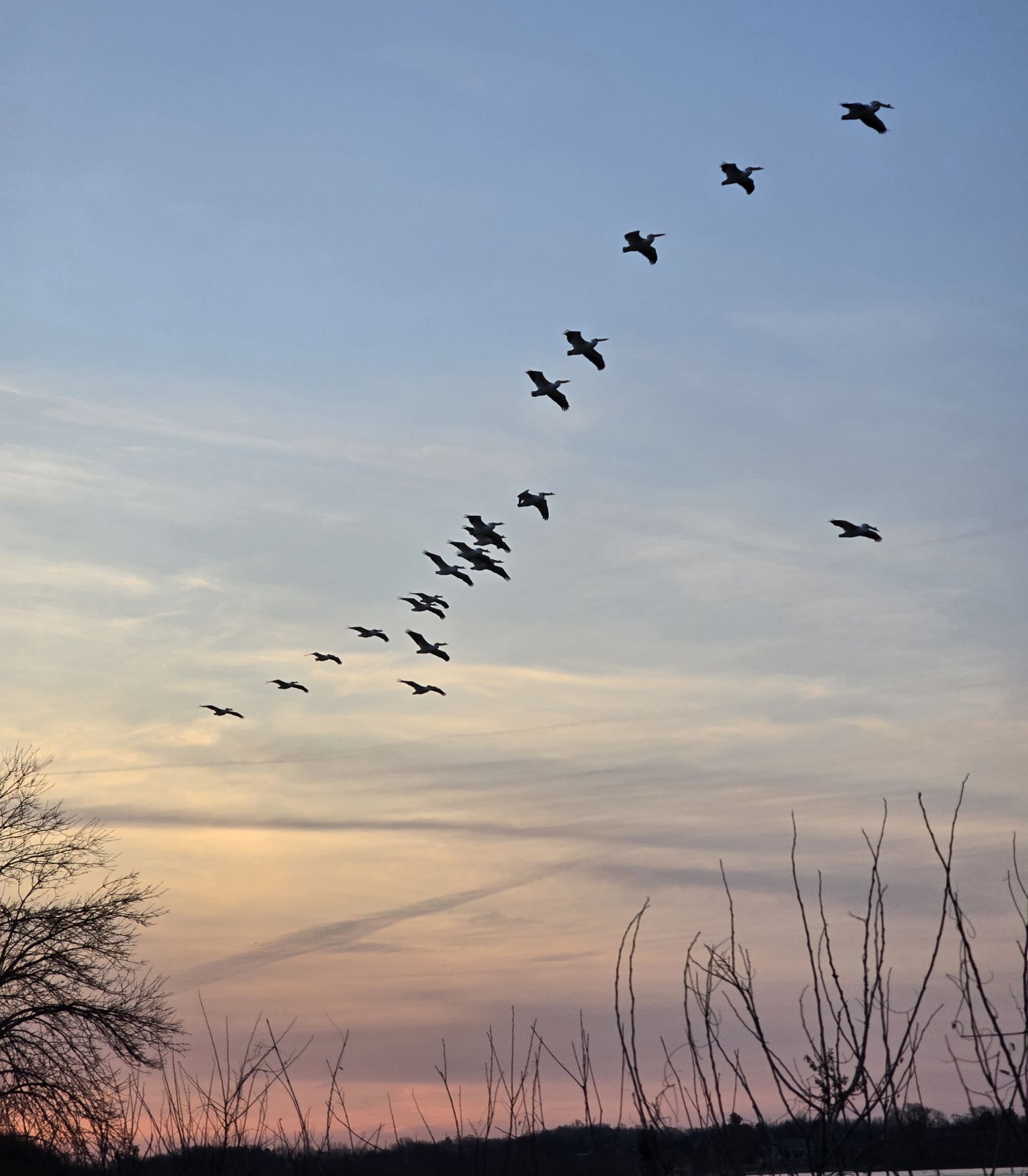
Pelicans lifting from the lake surface before dawn.
Pelicans have been on the lake for a few weeks now. For the moment, they gather overnight on the east end, a loose white raft in the shallows, then lift off just before dawn to find better fishing. In time, they will move on, continuing north. It is another sign that, despite the odd turns in this year’s weird weather, spring has arrived.
These are American White Pelicans, and they are everywhere—far more than one might expect. On clear days, when flying into or out of the Cedar Rapids airport, the landscape below reveals why: it is patterned with reservoirs, river backwaters, sand pits, and lakes, all of them inviting to birds in transit. From the ground, one can see them gather into long, shifting V formations, angled north toward Minnesota and the Dakotas. For now, though, they are here — resting, feeding, and reminding us, in their numbers and movement, that the season is turning.
During the day, the pelicans scatter. Across the open water, individuals and small groups spread out, each bird taking up its own stretch of lake or backwater, like a sentinel. They are not simply feeding at random, but searching — reading the surface, the light, and subtle signs of fish below. Only later, when something is found, do scattered birds begin to draw together. The distances close, the spacing tightens, and the loose geometry of the day gives way to purpose. They gang up on fish for dinner.
It took me years to recognize these patterns. I have a lot more to understand about this seasonal guest. For now, I just see them lifting from the lake in the predawn light. Heading out for better feeding areas: the way I would if one of them.
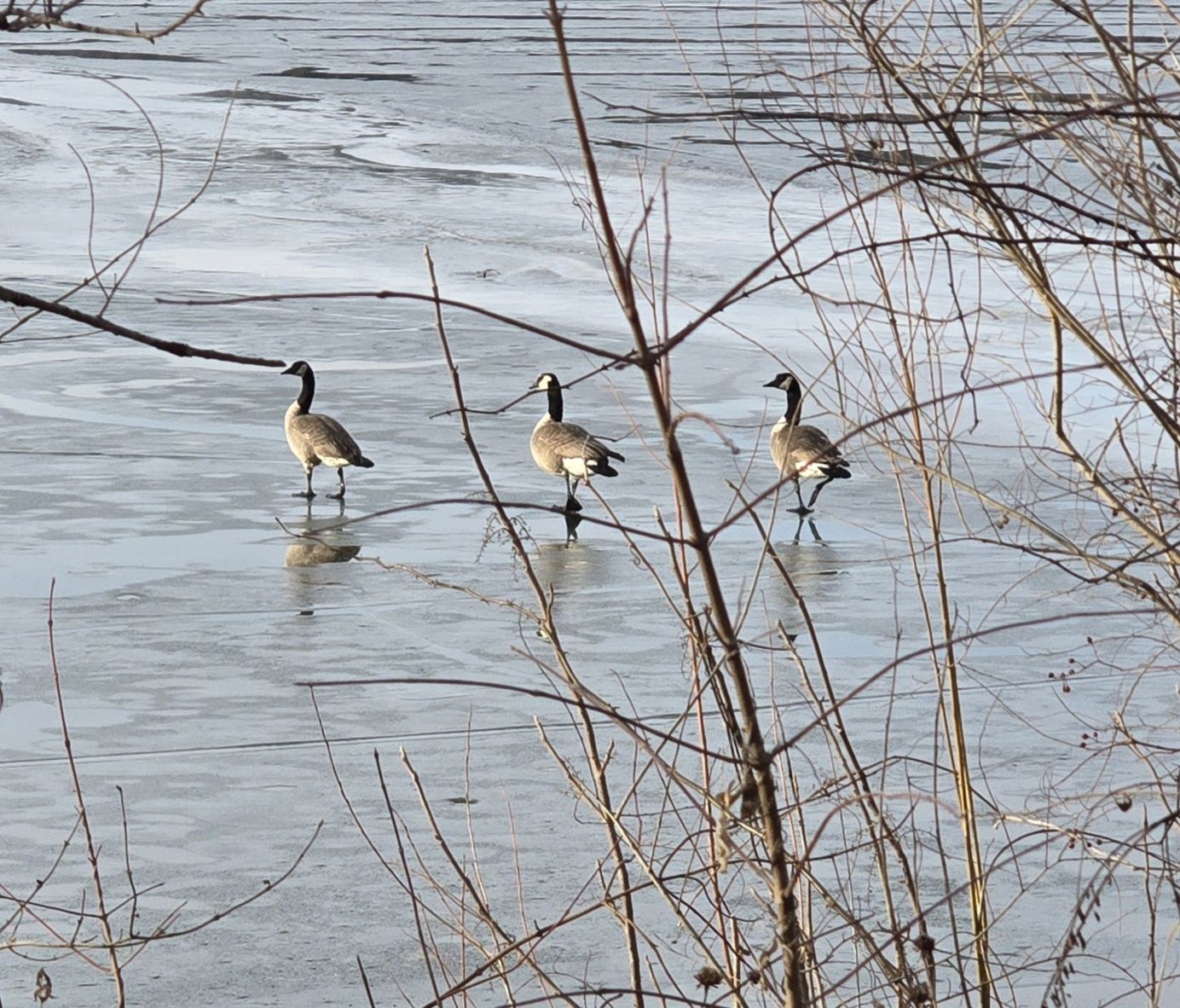
Canada geese on the margin between open water and ice.
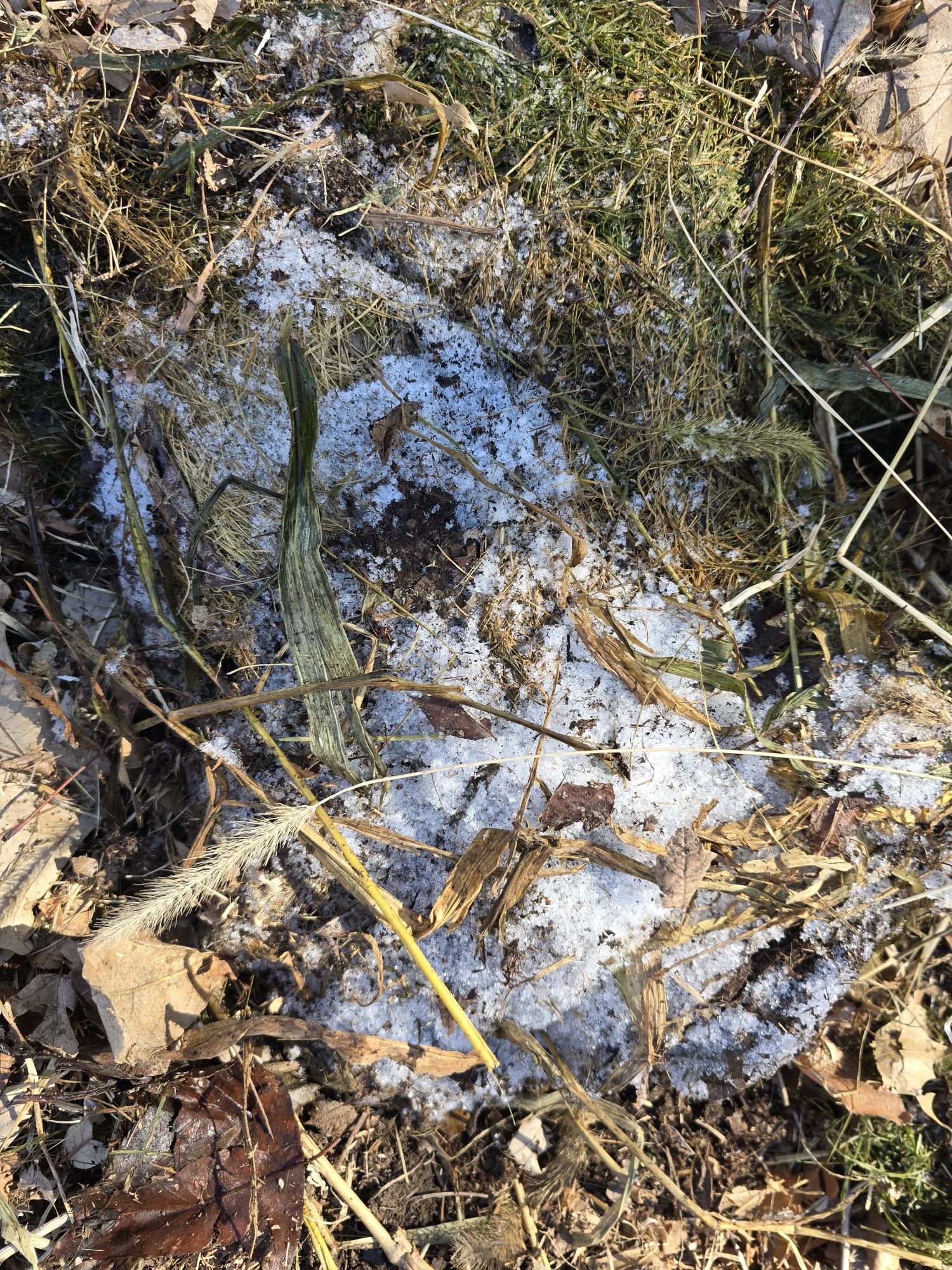
Things are happening in Big Grove Township. Songbirds are migrating, the ice cover on the lake is melting, and parts of the ground are thawing. Ambient temperatures hit 68 degrees Fahrenheit on Monday — it was shirt sleeves weather. Due to high winds and combustible material everywhere, the National Weather Service issued a special weather statement with elevated fire danger in the mix. Welcome to the new winter.
Each day I spend an hour or so outdoors clearing the garden. Once the ground thaws it will be more time than that. There is a lot to do, yet I’ve been to this rodeo. Steady work as the ground is ready gets the garden in.
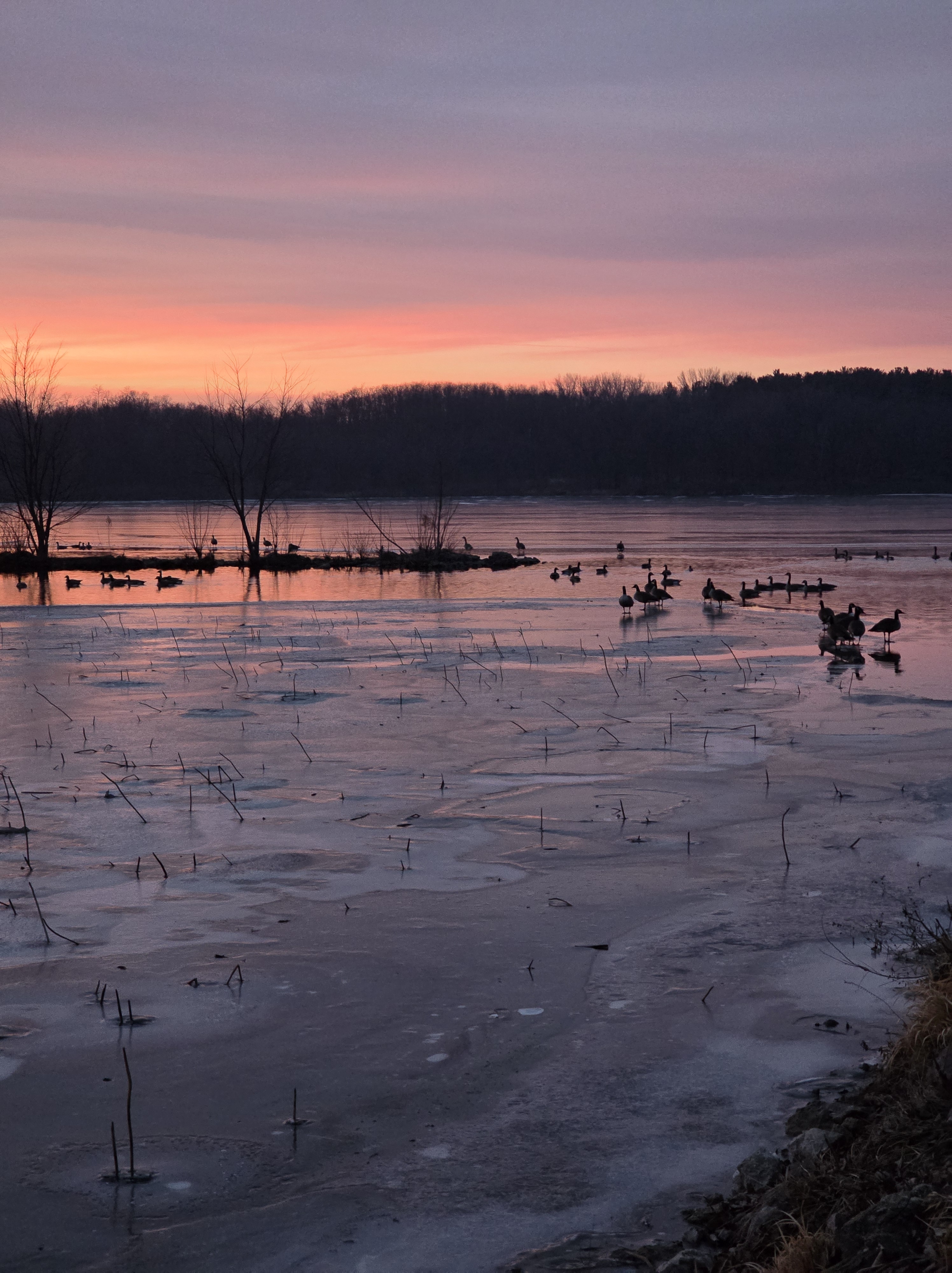
The sound of geese chatting and flapping their wings dominates the pre-dawn hour on the state park trail. Such vocalization and display on Jan. 15, can only mean one thing: the climate crisis has come home to roost.
There is the science of weather. La Niña is present but fading into a neutral state of the El Niño-Southern Oscillation. In other words, the weather is not doing much except what can be seen: ice melting, warmer ambient temperature pushing into the 50s, and lack of precipitation. So what’s up with these birds?
I know geese have strong bonds within mating pairs. They are particularly protective of their goslings. What I’m seeing now is not mating behavior, per se. It is a reaction to climate change in the form of over-wintering, early pairing displays, and vocal/aggressive behaviors. These behaviors are now normal near the lake where I take my daily walk, and in other parts of North America. The environment changed faster than their instincts evolved. What I observed in an earlier post is mostly pair-bond reinforcement and territory signaling, not actual breeding yet. I don’t need to be worrying about freezing little goslings in 3-4 weeks just yet.
Like with anything, my fellow early morning trail walkers noticed the noise and wondered what it was. I opined about it before really understanding the behavior. Geese will eventually adapt to changing climate. One might say they already are.
There is a lot of chatter in the national news media about the price of electricity. We are apparently in a war with China over dominance in artificial intelligence, which requires a lot of electricity. National Public Radio reported, “Electricity prices are climbing more than twice as fast as inflation.” We don’t hear that so much here in Iowa except on national media. Why? According to Bill McKibben, “The average Iowan will spend 39% less on electricity than the average American because it produces 57 percent of its electricity from the wind, the second-biggest wind state in the country.” If you throw solar arrays, and other renewable energy into the mix, Iowa’s total share of renewables is 64 percent.
Spoiled as I am by normally low electricity rates, when last month’s electric bill arrived it was 51 percent higher than the same period last year. What the heck? Although the total amount of the bill was comparatively low — typical for Iowa — I had to look at it.
The price per kWh of electricity from our electric cooperative has been stable and predictable. It wasn’t a rate change that caused our increase. Our monthly usage increased from 429 kWh to 745 kWh. The average American household usage is much higher than that. The reason for higher costs was this increased usage.
What happened? The average temperature increased by four degrees year over year. We likely ran the air conditioner more because of it. It was also oppressively hot this July, which meant spending more time indoors and using more electricity with the washer, dryer, stove and our electronic devices. We also had a millennial house guest for an extended stay. They did online streaming from here with a multitude of electric devices which sucked more juice. In sum, the increase was explainable.
Why are people concerned about increasing electricity costs? Donald J. Trump is president. He does not seem well educated about electricity.
On Trump’s first day in office he declared an “energy emergency” for made up reasons. The unstated reason is he extorted oil, gas and coal companies. “Candidate Trump literally told the fossil fuel industry they could have anything they want if they gave massive contributions to his campaign, and then they did,” according to McKibben. Trump’s payback for the bribe was to hobble the renewable energy industry.
The Trump administration immediately began to do absolutely everything in its power to stop this trend (to develop more sun, wind, and batteries) and replace it with old-fashioned energy—gas, and coal. They have rescinded environmental regulations trying to control fossil fuel pollution, ended sun and wind projects on federal land, cancelled wind projects wherever they could, ended the IRA tax credits for clean energy construction and instead added subsidies for the coal industry. Again—short of tasking Elon Musk to erect a large space-based shield to blot out the sun, they’ve done literally everything possible to derail the transition to cheap clean energy. (Trump is shockingly dumb about (electric) energy, Bill McKibben on Substack).
More than ninety percent of new electric generation around the world last year came from clean energy. This was not because everyone in the energy business had “gone woke,” McKibben wrote. Texas, arguably the most un-woke place in the U.S., installed more renewable capacity than any other state last year. It was because you could do it cheaply and quickly—we live on a planet where the cheapest way to make power is to point a sheet of glass at the sun.
I don’t know what happened to Republicans. Senator Chuck Grassley used to be one of the big supporters of wind energy in Iowa because of the way wind turbine arrays meshed with farm operations, giving a farmer another revenue stream.
Under Trump we have taken a step backward and let China, Europe, and literally everyone else take the lead in developing the electricity of the future which taps power directly from the sun.
We can and must do better than this as we consider our energy future.
When I visited the Iowa legislature, one of the people I sought was Rep. Chuck Isenhart from Dubuque. Almost every bill regarding conservation, climate change, renewable energy, and water quality involved him in some way. We were sad to see him lose his last election. Since then, Isenhart has been staying active including writing about environmental issues on Substack.
Why would our national legislators back away from clean energy? Isenhart has some thoughts.
“Just because our gardens are growing cucumbers doesn’t mean we have to make pickles,” Isenhart wrote. “Backing away from clean energy while continuing to subsidize fossil fuels and mandate biofuels puts us in a pickle, making even the wildest dreams come true for those who advocate for an “all-of-the-above” energy future (meaning ‘don’t leave fossil fuels behind’).”
In an Aug. 18 post, Isenhart outlines the damage done to renewable energy programs by Republicans. He starts with his personal story of installing solar panels on his roof and what a good deal it was for him, the utility company, and the environment. The story arrives here:
So – good for consumers, good for business, good for workers, good for the environment. Win-win-win-win. Thus, good for government to keep promoting, no?
Ahhhhh, no. Iowa’s Congressional delegation voted unanimously to unravel most of the federal government’s support for clean energy. Your chance to use the incentive I did is fast running out.
We may know how bad Republicans are with advances in renewable energy and the environment. Isenhart lays it out with specifics. Read his entire post here.
Here are some of the best shots from the first days of summer 2025:
Young Oak Tree LeavesSummer light.Trail flowers.Exiting the canopy into the light.Cloud formation.Light on cluster of trees.Sidewalk flowers in Skokie, Ill.Dill pickles.
The heat and humidity backed off, making Tuesday a pleasant summer day. Ambient temperature got up to the mid eighties, yet a lack of high humidity made everything outdoors tolerable. I spent a good amount of time there.
Like many, I’m not happy the U.S. Senate passed the budget reconciliation bill. It apparantly came down to Alaska’s Senator Lisa Murkowski who, fearing retribution for a no vote, changed her mind and provided the 50th yes vote. That enabled the vice president to break the tie and deliver a win for Republicans. It is now up to the House to concur… or do what they will.
There is a lot to deal with. Senator Adam Schiff pointed this out in the bill:
If it passes, this will be a setback for environmental quality. Many environmental advocates may feel like the U.S. is back to square one. Me? I can’t give up.
For now, we have perfect summer weather. For how long is hard to say.
I decided to call my morning exercise a hike instead of a walk. That’s mostly because when my sneakers wore out, I replaced them with a pair of hiking shoes. I don’t know if this will persist, but I’m trying it on for size, to wit:
Here are some photos from my morning hike.
Sunrise on the trail.The trail goes on forever.Reflections in the state park lake.A neighbor’s bush.Bur Oak tree leaves.


 Journey Home
You must be logged in to post a comment.