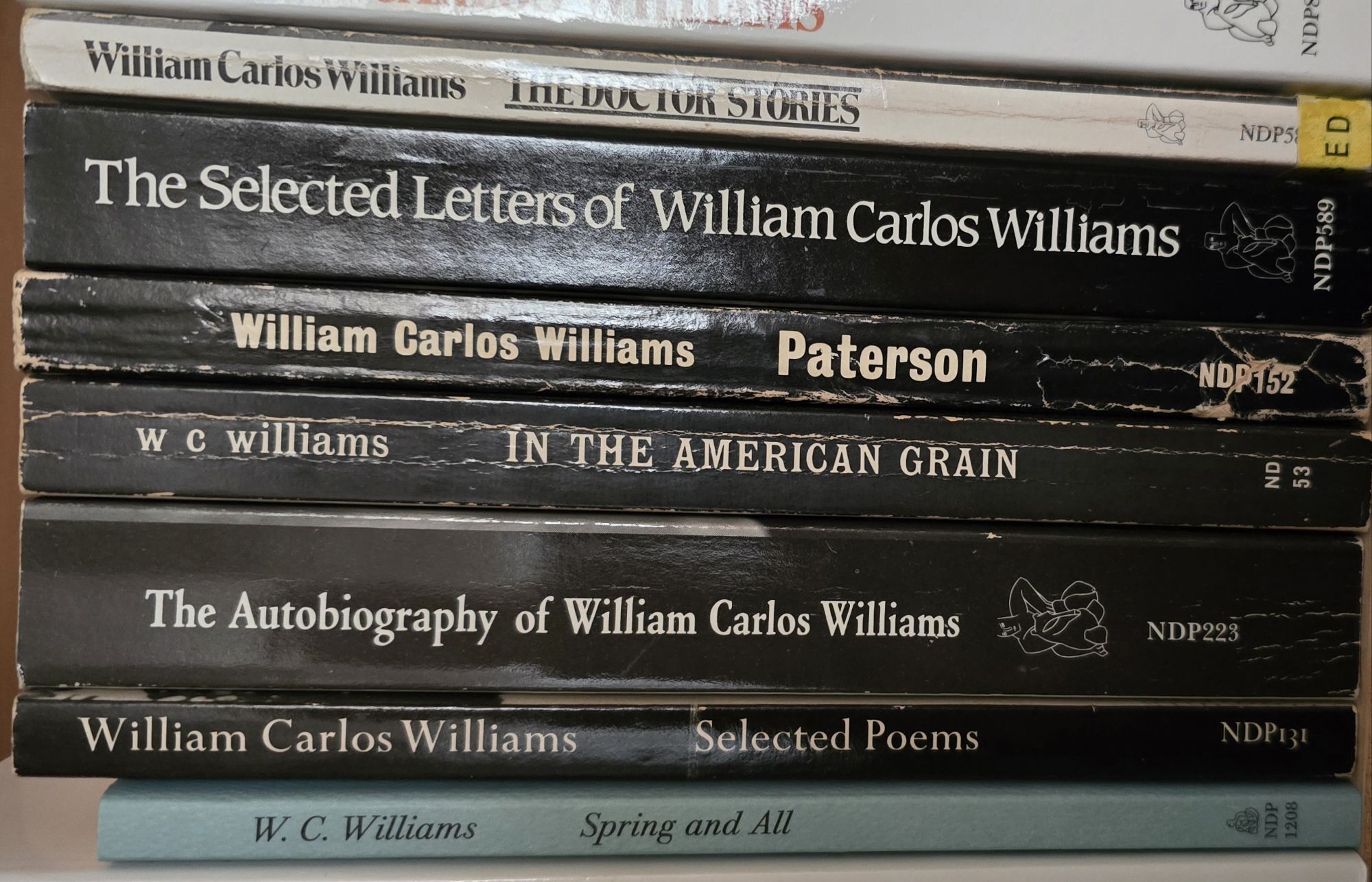
It wasn’t a whim from the great beyond that led me back to William Carlos Williams, but the practical matter of finding shelf space in my writing room. Williams has been important most of my adult life, beginning at university. In the mid-1980s, when I lived in Cedar Rapids, Iowa, a home to Grant Wood, I wrote:
Also on my mind was the idea of the professional who wrote or was creative as a sideline. Grant Wood was one, teaching at the University of Iowa to support his painting. I thought of William Carlos Williams and Wallace Stevens who worked as a physician and insurance executive respectively. I thought about David Morrell, whose class in American fiction I took while he was writing the books First Blood, Last Reveille, and Testament.
At that point in my development as a writer, while working for a large transportation and logistics company, I was determined to be the transportation equivalent of William Carlos Williams. I proposed to find life in what surrounded me and reduce it to words and images. I stole moments away from family and work for creative endeavor that was and remains important to me.
It is time to re-read William Carlos Williams.
The practice of medicine made Williams’s poetry possible—not as patronage, as I once thought, but through its effect on how he saw things and worked. Being a physician enabled a perspective that shaped his native impulses to write about what he saw, and what language he used. It enabled his resistance to the literary professionalism of his time, rendering him outside mainstream literary culture of the 1920s and ’30s.
What I like most about Williams is his attention to a certain kind of reality, the same reality that underlies much of my own writing. Williams clearly influenced me, although I never felt the security of a profession that he manifested in his writing.
Returning to Williams in my eighth decade is partly to better my understanding of him, and partly to revisit some of the decisions I made about the role of reality in my writing. I decided to start with these four works: Spring and All, Selected Poems, The Autobiography of William Carlos Williams, and In the American Grain. I read them all previously and hope for new insight. Let’s see where this goes… does my early read of Williams hold… or does it not?
 Journey Home
You must be logged in to post a comment.