
My farmer friends are lining up customers for the 2025 growing season. February is the time folks sign up for a community supported agriculture share and there is a limit to how many shares each farm can produce. I used to belong to a CSA yet no longer need one. My large garden usually produces enough good stuff to serve our family. I wish them a productive and profitable season. This photo is one taken after I harvested bell peppers to take home, process, and freeze.
Part of writing an autobiography involves photographs and art work. The visual arts convey something much different from narrative text. In An Iowa Life: A Memoir, the first volume of my autobiography, I included a single photograph of me as a toddler. In volume two, I may include more than one, depending upon the expense. The book is not available to the public at present, but may be once early readers all provide feedback. Here is the cover with the photograph:
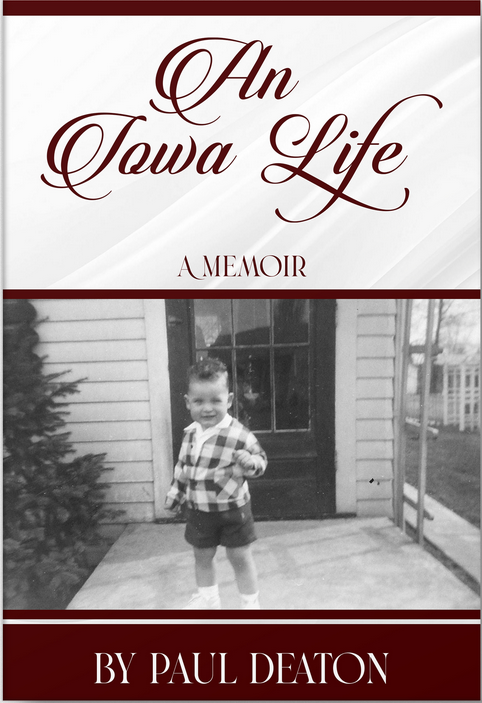
The way I used photographs in volume one was to describe something based on them, using my narrative to control the meaning. This is important because we don’t want to distract the reader from the energy of the narrative by introducing a photograph that can be interpreted in multiple ways. By describing photographs, instead of inserting them into the text, we can better guide readers.
Part two begins in 1981, a time when I took many film photographs. I keep the prints in boxes near my writing space, and in a few photo albums we made. I don’t know how to process them, yet at a minimum, I will get them out and look at them. There are a host of projects one could create with old photographs. A couple of days ago, I cleared access to the piles of boxes where the photographs rest.
I had a flip phone with a camera and took this photo of Senator Barack Obama on Sept. 17, 2006. The video of that year’s Harkin Steak Fry is here. It was one of the first digital photographs I took. The quality is not the best, yet it records the moment.

Obama is in the rope line after he gave his keynote address. You can see Chet Culver and Tom Vilsack behind him. I shook his hand and was surprised at how genuine he was in our brief conversation. He had quite a handshake.
On May 3, 2008, I bought my first digital camera and took this photo after opening the box. Once I entered the realm of digital photography, the number of images exploded. Cameras in smart phones changed how I looked at photography. Now I take many exposures of a scene and then pick and edit the best one. There is no additional cost for multiple exposures and device memory seems unlimited.

This has been a roundabout way of getting to the topic. In figuring out how to address photography in part two, I need to:
- Find all available photographs in our house.
- Look at them and set aside the ones I can use in the narrative.
- Pick a small number for inclusion in the book.
- While I look at them, I need another photo project in the works in which to use them. Posting on social media is one. Making specific albums, both paper and digital, is another. I might enlarge and frame a few of them. Each requires a significant investment of work.
- Reviewing photographs should help make my picture-taking better. I hope to be cognizant and thoughtful in this process. I hope to be a better photographer.
- My storage system has been good in that few have been damaged. Determine how to store them going forward.
- I need to get rid of some of them. I don’t want to pass along photos that are meaningless to whoever inherits them.
- I will read or reread a couple books about photography. In particular, The Photographer’s Eye by John Szarkowski, Photography and the American Scene by Robert Taft, Wisconsin Death Trip by Michael Lesy, On Photography by Susan Sontag, and others. If you know of a current book about photography, please drop a comment with the name and author.
At the beginning, this project is hopeful. It should be a fun year reviewing the images of my past and recalling the living memories behind them.
 Journey Home
One reply on “Harvest of Photos”
Wonderful ♥️
LikeLike