
Municipal Stadium in Davenport, Iowa was an important part of my growing up. As much as anything, it was a central gathering place for big events for the local proletariat in this sleepy city on the Mississippi River. Our family or I attended events there, including musical performances, high school football games, professional wrestling matches, and a revival meeting. I once attended a Minor League Baseball game there.
By the 1950s and ’60s no culture of big community events existed in Davenport. Segments of the population did gather at a stadium for events tailored to their interests. Promoters tried to make something of our sports teams, yet everyone seemed to have their own life with accompanying other things to do. Here are four things in which I participated at Municipal Stadium, as we called it then.
Herman’s Hermits
On Aug. 27, 1966, Herman’s Hermits played in Davenport at the Municipal Stadium. In the wake of Beatlemania, this was the best our Midwestern city could do. My cohort had watched the Beatles on the Ed Sullivan Show and talked about it at school. I had visions of becoming a musician, having gotten a guitar at the King Korn Stamp Store soon after the British Invasion began.
I don’t recall how I got tickets, but I had income from my newspaper route. Mother made the arrangements for bleacher seats. It was a sunny day for the concert.
If I wrote down everything I remember about the concert, the paragraph would not be long. Besides the concert, the Times Democrat story of Peter Noone and other band members shopping in the book section of the M.L. Parker Department Store struck home. It was the same place I had begun buying books with my own money. That made everything pretty real. A few of my classmates also attended the concert. The songs the band performed were not memorable, even the ones played on the radio.
All Star Wrestling
Father and we kids attended a professional wrestling match at Municipal Stadium. The stands were not packed although because of the popular Saturday morning television program, All Star Wrestling, the event drew a good-sized crowd. Patrons were unruly, with arguments breaking out among them. I almost got into a fight after mouthing off to a stranger. That day there was a cage match during which constructing a cage of chain-link fencing was part of the spectacle. Young women would visit the motel across the river where the wrestlers stayed and attempt to accompany them on tour. Such plebeian entertainments were typical in my home town.
The American Wrestling Association (AWA) was an American professional wrestling promotion based in Minneapolis from 1960 until 1991, according to Wikipedia. It was founded by Verne Gagne and Wally Karbo, originating as part of the Minneapolis Boxing & Wrestling Club. Unlike modern professional wrestlers of the WWE, Gagne was an amateur wrestling champion who was an alternate on the U.S. freestyle wrestling team at the 1948 Summer Olympics. He ran the AWA with a conservative sensibility, Wikipedia said, firmly believing that sound technical wrestling should be the basis of a pro-wrestling company. Cage matches reflected no basis in technical wrestling as Gagne had come to know it.
New Flying Buttresses
When Mother settled with the elevator company in 1973, after Father’s death, we kids got a share. Mine amounted to about $4,000, which I hastily spent on a Volkswagen micro bus, a Fender Telecaster Thinline guitar, a public address system and two Peavey guitar amplifiers. Some stage crew buddies and I formed a band. I’d call it a garage band but we mostly played in the basement of the bass player’s family home, or in Mother’s dining room. Because we invested in equipment from a music store on the Illinois side of the Quad Cities, when they staged a concert for bands to whom they sold equipment, we were invited to perform.
Municipal Stadium is the largest venue in which I played. We only performed a song or two, which made the rigamarole of setting up and tearing down, the main part of the time we spent there. We were all stage crew, so we lived in that realm. We played Six Days on the Road by Earl Green and Carl Montgomery. I remember breaking a string during the performance. We didn’t have a name and were introduced as Paul Deaton and his New Flying Buttresses. The name lasted exactly for that single gig.
Johnny Cash
On July 22, 1974, Johnny Cash, Carl Perkins and their band traveled to Davenport to perform at Municipal Stadium at the request of the Rev. Tommy Barnett, then of the Westside Assembly of God. During his tenure as pastor, Barnett grew the congregation from 76 to more than 4,000 members. Westside buses could be seen each Sunday, plying the neighborhoods throughout the lower part of Davenport, picking up its church-goers for service and then delivering them home.
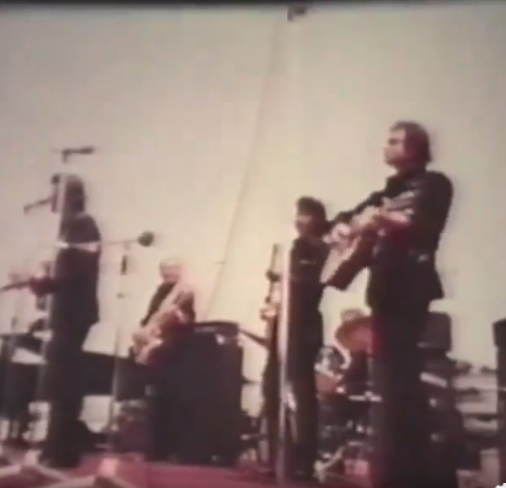
Cash was supportive of Barnett at the time, although he recanted his support in one of his memoirs. In researching this post, I found numerous stories about the concert, and having been there, found almost all of them to be greatly exaggerated. A short video of Barnett and Cash includes a panoramic shot of the crowd at Municipal Stadium (Link is here). The stadium and bleachers show the concert was well attended. I’d come to the concert to hear my shirt-tail relative June Carter Cash, but she stayed behind in Tennessee at the last moment. Since I had already been baptized, I passed on the opportunity to walk to the stage and be saved.
These are the kinds of events that attracted working class families in Davenport during the 1960s and ’70s. We weren’t Marxists, yet the word proletariat fits.
 Journey Home
You must be logged in to post a comment.